



Abstract
Recent scholarship suggests that personal tie instability, that is, the dissolution of old ties and the formation of new ties, may lead to psychological distress. However, this association remains understudied among the immigrant population, for whom acculturation may present unique challenges to both personal tie stability and psychological well-being. Using data from the National Longitudinal Study of Adolescent to Adult Health, we investigate the mental health implications of instability in immigrant adolescents’ same-sex best friends, and how it explains the association between acculturation and depressive symptoms. We find that friendship instability was associated with higher depressive symptoms only among immigrant adolescents with a low level of acculturation. For more acculturated adolescents, replacing their original friendship with an interracial friend predicted lower depressive symptoms. These findings imply that friendship instability constitutes a dimension of acculturative stress, with detrimental effects unique to immigrant adolescents in the early stages of acculturation.
Following the Immigration and Nationality Act of 1965, the United States has witnessed a drastic inflow of new immigrants (Portes and Rumbaut 2014). As of 2019, immigrants account for 15.3 percent of the U.S. population, a substantial increase from 5.4 percent in 1960 (U.S. Census Bureau 2020). In understanding the well-being of the immigrant population, the existing literature has paid extensive attention to the mental health of immigrant adolescents (Takeuchi et al. 2007; Zhou 1997). In particular, scholars have found that immigrant youths’ social relationships play an important role in shaping their psychological well-being (Harker 2001; McMillan 2019).
The process of acculturation may cause substantial challenges to the formation of personal social networks, which typically function as key sources of social support. Indeed, the notion of “acculturative stress,” that is, psychosocial stress directly induced by acculturation, explicitly accounts for network-related stressors (Berry et al. 1987; Vega et al. 1998). Feelings of social isolation and interpersonal conflicts with native-born people are common network-related risk factors that lead to psychological distress (Mora et al. 2014; Xu and Chi 2013). However, most prior studies have relied on cross-sectional data to investigate the role of social relationships in immigrants’ mental health. Examining temporal changes in immigrants’ social ties may shed unique light on their psychological well-being on a dynamic account.
Evidence suggests that personal network instability, that is, the dissolution of old ties and the formation of new ties, is associated with more psychological distress (Chan and Poulin 2009; Schwartz and Litwin 2017). Experiences of friendship instability could be especially relevant to immigrant adolescents, as their social relationships are subject to considerable cultural and educational challenges in host educational institutions (Cherng 2015; Kao 2004; McMillan 2019; Zhou 1997). Scholars have found that immigrant youths face high risks of social isolation in secondary schools, due to cultural differences and discrimination from native-born peers (Cherng 2015). To the extent that these factors may hamper immigrant adolescents’ formation of in-school friendships—in ways that translate into psychosocial stress, it would be also important to examine the mental health implications of their friendship dynamics over time.
Drawing on two waves of data from the National Longitudinal Study of Adolescent to Adult Health, this study investigates how friendship instability predicts depressive symptoms among first- and second-generation immigrant adolescents, and how it explains the association between measures of acculturation (e.g., time in the United States and English use in-home) and depressive symptoms. We focus on instability in adolescents’ same-sex best friends in school, who symbolize their strongest tie in the educational institutions and may have substantial mental health consequences (Chan and Poulin 2009; Rude and Herda 2010).
Background
Acculturation and Mental Health among Immigrant Adolescents
Acculturation refers to the process by which immigrants adapt to the dominant socio-cultural norms in the receiving society, through changes in their language use, values, behaviors, and so on (Zhou 1997). For immigrant children (i.e., first generation) and native-born children with immigrant parents (i.e., second generation), acculturation has important implications for their educational outcomes and mental health. Compared with adult immigrants, first- and second-generation immigrant adolescents are less likely to perceive their ethnic origins as a point of reference; instead, they are more inclined to align their values and behaviors with those held by native-born peers (Gans 1992; Rumbaut 2004). These inclinations expose immigrant adolescents to more substantial contacts with people native to the host society, such that acculturation plays a crucial role in shaping their psychological well-being (Zhou 1997; Zhou and Gonzales 2019).
Prior literature has used numerous measures of acculturation to understand its mental health consequences. Immigrant generation status and, among first-generation immigrants, years in the United States have been commonly used as proxies of acculturation (Greenman and Xie 2008; Harker 2001; Kimbro, Gorman, and Schachter 2014). Empirical evidence suggests that these measures tend to negatively predict mental health: first-generation immigrant adolescents experienced a decline in mental well-being with more years in the host country, and second-generation adolescents report worse mental health than those who are foreign-born (Harker 2001; Tam and Lam 2005). Other studies have focused on behavioral indicators of acculturation. For instance, English language proficiency, capturing the language aspect of acculturation, is associated with better mental health (Harker 2001; Kim et al. 2011).
An important mechanism explaining the linkage between acculturation and mental health is the stress entailed in this process (Kimbro, Gorman, and Schachter 2014; Morey et al. 2021). Acculturation may engender a unique set of stressors, that is, acculturative stress, as individuals undergo dramatic changes in their values, behaviors, and lived experiences (Berry et al. 1987). Immigrant adolescents might experience heightened acculturative stress, as growing up in the host country entails additional challenges in their psychosocial and educational developments (Cherng 2015; Montazer and Wheaton 2011; Zhou 1997). Existing research has examined how the risk of acculturative stress could vary by the degree of acculturation. For instance, adolescents with low English proficiency reported higher rates of encountering discrimination (Berry et al. 1987; Kim et al. 2011). Other studies have investigated how the negative mental health consequences of acculturative stress vary by acculturation (Berry 2006). Alamilla and associates (2010) found that retaining Latino values, suggesting a lack of acculturation, promoted the association between perceived discrimination and anxiety among Latino college students.
To date, what constitutes acculturative stress—as well as how it might explain the mental health consequences of acculturation—remains an important topic in immigration studies. However, less is understood about whether and how personal tie instability over time factors into immigrants’ mental health, largely because longitudinal data on immigrant networks remain scarce (c.f. Lubbers et al. 2010). Existing research on acculturative stress alludes to the potential that immigrants may encounter considerable difficulties in maintaining stable personal ties (Berry 2006). Understanding friendship instability as a risk factor for depression may shed new light on how the acculturation process shapes immigrants’ mental health.
Friendship Instability as a Psychosocial Stressor
A large bulk of the literature has demonstrated the profound influence of friendship on adolescents’ mental health (Bearman and Moody 2004; Falci and McNeely 2009; Ueno 2005). Studies have also investigated how friendships shape the mental well-being of immigrant adolescents, who are at a high risk of experiencing friendship isolation and marginalization in schools (Cherng 2015; Kao 2004; McMillan 2019). In particular, scholars found that having a larger proportion of foreign-born friends was associated with lower rates of depression and less alcohol misuse for first-generation youths, but it failed to predict better mental health in the long run (McMillan 2019; Niño et al. 2017). These patterns have led scholars to speculate on the potential role of friendship instability in immigrant youths’ mental health decline over time.
Recent studies point to the mental health implications of personal network instability. The dissolution of egocentric ties, including those with friends, family members, and neighbors, may lead to social isolation if it is not compensated through the formation of new relationships (Perry and Pescosolido 2012; Schwartz and Litwin 2017). The lack of enduring ties may reflect an individual’s weak connection with the larger social environment (Chan and Poulin 2009). Instability in personal ties may also result in inconsistent access to social support, advice exchange, and coordinated oversight around health behaviors (Bearman and Moody 2004; Chan and Poulin 2009; Flashman 2012), thereby contributing to elevated risks of depressive symptoms (Chan and Poulin 2009; Schwartz and Litwin 2017). An important caveat is that social ties can also be sources of considerable stress, and curtailing these “negative ties” may improve an individual’s mental well-being (Offer 2020).
For adolescents, friendship instability could be particularly detrimental to their mental health. Peer support and influence profoundly shape adolescents’ skill acquisition, values, and sense of belonging (Faris and Felmlee 2018; Kao 2004; Poulin and Chan 2010). A high degree of friendship instability is associated with perceptions of low friendship quality and marginalization from peer groups (Brendgen et al. 2002; Chan and Poulin 2009). Notably, Chan and Poulin (2009) found that changes in adolescents’ self-reported best friends predicted more depressive symptoms, whereas dynamics in secondary friendships were not associated with depression. This is in part because best friends constitute strong ties in youths’ friendship networks, and these bonds are typically characterized by high-quality support (Brendgen et al. 2002; Chan and Poulin 2007; Rude and Herda 2010).
Furthermore, the mental health consequences of friendship instability may depend on the characteristics of any new ties that are added to the network following the loss of old ties (Schwartz and Litwin 2017). The characteristics of youths’ new friends may determine whether their mental health could “recover” from prior friendship loss. For example, switching from in-school peer friendships to out-of-school friends may marginalize youths from the educational environment (Cherng 2015). The resultant loss of peer support in schools could translate into more depressive symptoms (Chan and Poulin 2009; Cherng 2015).
The race/ethnicity of friendship ties may also matter for the mental health implications of friendship instability. Same-race friendships among adolescents are typically characterized by higher levels of quality than interracial friendships (Aboud and Sankar 2007; Rude and Herda 2010). Newly formed interracial friendships may provide inadequate social support, thus harming youths’ mental health. Conversely, scholars argued that friends of different racial/ethnic origins may facilitate integration into the educational environment (Kao 2004; Reynolds and Crea 2017), which could positively contribute to immigrant youths’ well-being.
The Current Study
This study is guided by the overarching research question: How does friendship instability explain the association between acculturation and depressive symptoms? If relationship-related stress may emerge throughout the acculturation process (Berry et al. 1987; Harker 2001; Singh, McBride, and Kak 2015), instability in personal ties could also factor into immigrant youths’ acculturation experiences. We focus on the instability in immigrant adolescents’ same-sex best friendships (Chan and Poulin 2009), considering two potential mechanisms of how it explains the association between acculturation and depressive symptoms.
First, lower levels of acculturation might be associated with a higher risk of friendship instability, which leads to more psychological distress. In this way, friendship instability mediates the association between acculturation and health. Evidence suggests that English proficiency alleviates acculturative stress and facilitates bonding with native-born people (Brown 2006; Kim et al. 2011). Immigrant youths who reported greater language barriers are less likely to develop interethnic ties and more likely to experience social isolation in schools (Cherng 2015). Furthermore, previous studies suggest that immigrants with more years in the host society reported higher levels of social support because longer migration experiences enhance immigrants’ social skills and enable them to develop better-quality social relationships (Harker 2001; Morey et al. 2021).
Second, friendship instability may be more psychologically detrimental to immigrant adolescents with lower levels of acculturation; it therefore moderates the association between acculturation and depressive symptoms. Secondary schools in the host society subject immigrant youths to a variety of challenges, including taking courses in another language, socializing with peers of different ethnic origins, and dealing with discrimination based on national and racial origins (Cherng 2015; Zhou 1997). In-school friendships play a crucial role in buffering those stressors that emerge from youths’ educational experiences (Kao 2004). These challenges may be disproportionately experienced by immigrant students who have yet to acculturate into the host society, and they tend to rely more heavily on peer support (Cherng 2015; Kim et al. 2011). Friendship instability may predict more depression for those with low levels of acculturation.
Among less acculturated immigrant adolescents who experienced friendship instability, higher risks of depressive symptoms might be further concentrated among those who replaced a friendship tie with an out-of-school friendship. As lowly acculturated adolescents tend to have inadequate social capital in schools, the replacement of an in-school best friend with one outside of their school context may pull them away from the in-school peer network, thereby having adverse consequences for integration into educational environments. This could diminish their receipt of social support from schoolmates and heighten their feelings of social exclusion (Chan and Poulin 2009; Cherng 2015).
For more acculturated immigrant adolescents, friendship instability may be less stressful. Friendship networks in secondary schools are highly dynamic (Chan and Poulin 2007; Flashman 2012); immigrant adolescents with higher levels of acculturation may be adjusted to friendship changes and, thus, are less likely to perceive friendship changes in a negative light. Instead, replacing their prior tie with an interracial friendship might improve their mental health. This is because more acculturation enables immigrant youths to form higher-quality friendships with their interracial peers (Rumbaut 2004). Interracial friendships might facilitate their integration into peer social groups in the host educational institutions, which lowers depressive symptoms (Kao 2004).
Data and Methods
Data
This study draws on data from the National Longitudinal Study of Adolescent to Adult Health (Add Health). Add Health is a longitudinal study of a nationally representative sample of 90,118 adolescents, who were in grades 7–12 during the 1994–1995 school year. Descriptions of the study design are documented by Harris et al. (2019).
Add Health’s Wave I study consisted of two rounds of data collection. An in-school questionnaire was administered to all students from the 132 selected secondary schools (hereafter W1). In the same school year, an in-home interview followed a subsample of 20,745 respondents (W2). The mean time lapse between W1 and W2 was 7.64 months. We focus on immigrant adolescents’ instability in their same-sex best friend and depressive symptoms during this period, as opposed to friendship changes in later waves of Add Health, for two reasons. First, friendship instability within a short timeframe is more psychologically detrimental for adolescents than longer-term changes (Chan and Poulin 2009). Second, a substantial proportion of students (29.2 percent) left their original schools in later waves. These students were ineligible for our analyses as their in-school friendships were disrupted by their departure from the initial school context (Meter and Card 2016). As a result, the sample size is substantially reduced and not large enough to produce reliable inferences.
Sample
The W1 and W2 surveys collected data on respondents’ friendship networks. A name generator recorded respondents’ nominations of up to 10 individuals whom they perceived as their closest friends (five males and five females). Nominated friends could be either peers in their school or people outside of school. The first male and female friendship nominations recorded respondents’ best male and female friends, respectively (Rude and Herda 2010). W1 interviewed all students in sampled schools and, thus, made available global network data. W2 interviewed a subsample of students in each school, and many respondents (about 80 percent) were asked to nominate only one male friend and one female friend. This precludes analyses of longitudinal, sociocentric network analyses over the W1–W2 timeframe. 1
Following Rude and Herda (2010), we investigate how adolescents’ depressive symptoms are associated with the instability of their same-sex best friend. Our analysis is not able to account for adolescents’ cross-sex best friendships, because Add Health’s name generators placed respondents’ romantic partner, if any, as their first different-sex friendship nomination, making these two types of relationships indistinguishable from each other (Quillian and Campbell 2003; Rude and Herda 2010). The mental health implications of adolescents’ romantic experiences merit different theoretical discussions (Quillian and Campbell 2003).
Our analytic sample consists of adolescents with an immigrant background, that is, first and second generation (Zhou 1997). 2 Respondents were eligible for analyses if they nominated an in-school same-sex best friend who was identifiable by student rosters in W1. Nominations of a same-sex best friend in W1 who was out of school, or who could not be matched in the school roster, were not traceable in subsequent waves of Add Health, and therefore their dynamics over time could not be captured.
Overall, a total of 1,434 first- and second-generation adolescents met these criteria. Among them, only a small proportion (n = 44) did not nominate a same-sex best friend in W2. As such, we could not produce reliable estimates on how losing a best friend without replacement predicted depressive symptoms. These individuals were therefore not included in the sample. We further excluded 140 respondents who were missing on survey design factors, for example, survey weight, strata, and cluster (Chen and Harris 2020). Missingness within the rest of the sample occurred only among covariates (parental education, two-parent house, GPA, delinquency, depression at W1, and network average depression) and was generally lower than 5 percent. The two exceptions are respondents’ GPA (15.9 percent) and delinquency (9.2 percent). We employed listwise deletion and yielded a sample of n = 952 respondents. 3 Supplemental analyses using multiple imputations by chained equations (with 10 imputed datasets) yielded substantively similar results, as presented in Supplemental Table S1.
Measures
Depressive symptoms
The dependent variable for the present study is the Center for Epidemiologic Studies Depression Scale (CES-D), a well-validated measure of depressive symptoms. Perreira et al. (2005) recommended a five-item version of CES-D for producing valid assessments of mental health disparities across race/ethnicity and immigrant generation. The five CES-D items are depressed, life, sad, happy, and blues. Corresponding survey questions for these items are described in Supplemental Table S1. Each item is measured through a 4-point scale (with values ranging from 0 to 3). We recoded each item such that larger values indicate more depressive symptoms. The CES-D index sums the scores of the five items (Cronbach’s alpha = .77) and has a range of 0–15.
Friendship instability
Friendship Instability consists of our categories, based on respondents’ in-school same-sex best friend nominations in W1 and W2: W1 friendship maintained; W1 friendship replaced by an out-of-school friend; W1 friendship replaced by an in-school, different-race friend; and W1 friendship replaced by an in-school, same-race friend. Following previous studies, we consider Latino as a race and distinguish Latino youths from non-Hispanic White, non-Hispanic Black, and Asian adolescents (Greenman 2011; McMillan 2019).
Acculturation measures
We employ two variables as proxies of acculturation. First, English Use In-Home captures respondents’ language assimilation. The variable is coded as 1 if respondents reported speaking English with close family members at home and as 0 otherwise.
Second, we constructed a three-category variable indicating respondents’ Time in the United States, accounting for their immigrant generation status and, among the first-generation adolescents, their years in the host country (Bersani 2014; Greenman 2011). The variable consists of three categories: first generation with fewer than five years in the United States, first generation with at least five years in the United States, and second generation. Previous research shows that first-generation adolescents with fewer than five years of migration experience reported significantly lower rates of substance (Greenman 2011), which could have major influences on their mental health (Conway et al. 2018). In our sample, time in the United States has a low correlation with English use in-home (r = .322; p < .05). 4
Covariates
All covariates are measured at W1 to account for lagged effects. We adjust for individual sociodemographic characteristics including age (in years), female, and race (Black, Latino, Asian, non-Hispanic White, and other). Parental education measures the highest level of education among respondents’ parents (less than high school, high school graduate, some college, and BA degree). Two-parent household is a binary variable indicating whether respondents shared their residence with both parents. Additionally, the duration between W1 and W2 could affect the persistence of friendship ties (Meter and Card 2016). We account for the time difference between W1 and W2 interviews, measured in months.
Students’ behavioral characteristics are found to be associated with their depressive symptoms (Kao 2004). Respondents’ GPA is calculated by averaging their grades in English, math, science, and social studies courses (McMillan 2019). Number of delinquent events indicates the total number of the following events that respondents had engaged in the past year: lied to their parents, skipped school without an excuse, and got into physical fights (Sweeten 2012). Depression at W1 measures respondents’ depressive symptoms in the baseline wave. Because Add Health employed different survey items to measure depressive symptoms in the first wave, only one item in the questionnaire was pertinent to Perreira et al.’s (2005) recommendations for measuring depressive symptoms across immigrant generations: “In the last month, how often did you feel depressed or blue?” The survey item employed a 5-point scale (values ranging from 0 to 4), with higher values indicating more depression.
We also control for other aspects of respondents’ friendship networks at W1 that could affect their levels of depression. First, respondent’s frequency of social interactions with their baseline best friend could be an important determinant of their friendship loss (Chan and Poulin 2009). Frequency of interactions with best friend at W1 measures how often respondents interacted with their original best friend, which is a 5-point scale summing binary items indicating whether respondents went to the friend’s house, hung out with them, spent time with the friend, talked about a problem together, and talked on the telephone during the past seven days, with higher values indicating more frequent social interactions. Number of in-school friends measures the number of respondent’s total in-school friendship nominations (with a maximum of 10), accounting for the confounding effect of network size (Falci and McNeely 2009). Moreover, personal networks could affect an individual’s mental health through the social contagion effect. Namely, an individual’s mental health status may significantly predict the mental health of their friends over time (Bearman and Moody 2004; Eisenberg et al. 2013). We thus control for respondent’s network average depression, a continuous variable measuring the levels of depressive symptoms among respondents’ in-school friends at W1. It is calculated by averaging the depression scores of respondents’ W1 in-school friends.
School-level control variables include schools’ urbanicity (1 = school was located in an urban area; 0 = rural area), school type (public vs. private), and school size (logged number of students). Moreover, opportunities for intragroup contacts may be constrained by the availability of in-group peers (Rude and Herda 2010). Thus, we control for the proportion of same-immigrant-generation students and proportion of same-race students in school.
Methods
The analyses employed multilevel ordinary least squares (OLS) models to predict respondents’ depressive symptoms. All models are mixed-effect regressions with a random intercept, where individuals are nested within schools. Regression models also account for survey design factors including survey cluster, strata, and weights (Chen and Harris 2020). All analyses were conducted in Stata 16.1.
The regressions are presented in the following order. The first two regressions examine immigrant adolescents’ depressive symptoms by their acculturation levels (i.e., years in the United States, immigrant generation, and English use in-home), controlling for individual- and school-level covariates. Specifically, the first model examines respondent’s depression at W1; the second model examines depression at W2, controlling for depression at W1.
The third model adds to the second friendship instability to examine its mediating effect through changes in the coefficients for acculturation measures. We conducted additional mediation analyses, using structural equation models (Ullman and Bentler 2012), to investigate the indirect effect of friendship instability on the association between acculturation measures and depressive symptoms.
The fourth and fifth regressions include interaction terms between friendship instability and measures of acculturation to investigate potential moderation effects. Graphs of predicted probabilities are presented to aid interpretations.
Results
Main Analysis
Table 1 presents weighted descriptive statistics. The average score of depressive symptoms among immigrant adolescents in the sample was 2.48. Meanwhile, less than half of the respondents (49.2 percent) maintained their W1 friendship through W2. Among those immigrant adolescents who lost their original friendship, 23.1 percent formed a new in-school friendship with a peer of the same race. 14.1 percent replaced their in-school best friendship with a friend outside of their schools. Additionally, 31.4 percent of respondents were born in a foreign country (6.9 percent had been in the United States for fewer than five years, and 24.5 percent had settled in the United States for five years or more). About two-thirds (69.0 percent) of respondents reported that they spoke English at home.
Descriptive Statistics (n = 952).
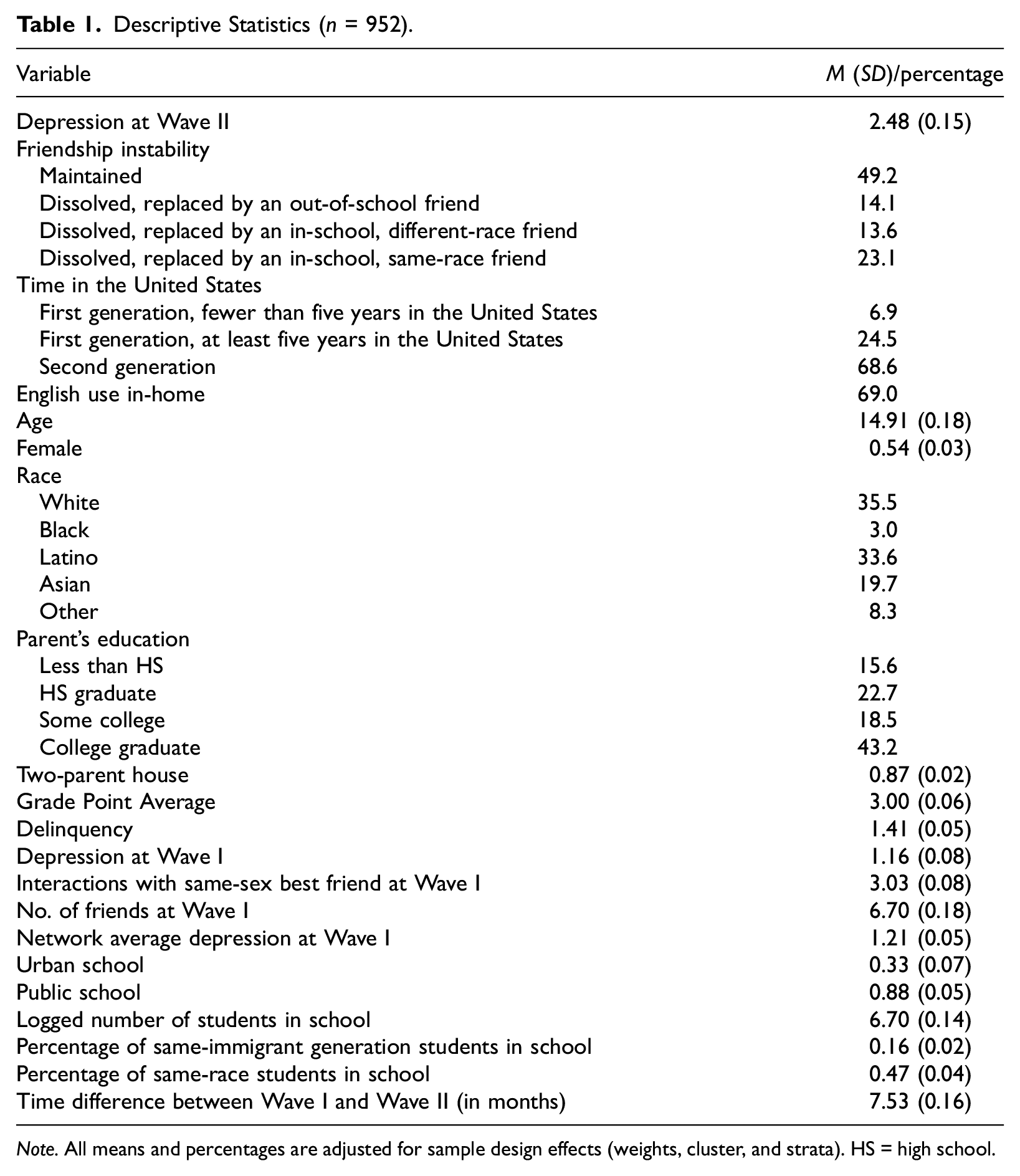
Note. All means and percentages are adjusted for sample design effects (weights, cluster, and strata). HS = high school.
Table 2 reports regression coefficients from models predicting depressive symptoms among immigrant adolescents. We begin with an investigation of the general patterns of depressive symptoms by respondent’s levels of acculturation, controlling for covariates. Model 2.1 examines the distribution of depression in the baseline wave (W1). First-generation adolescents with fewer than five years in the United States reported less depression compared with their second-generation counterparts (β = 0.469; p < .05). Speaking English at home is not significantly associated with depression. However, Model 2.2 shows that the first-generation advantage in depressive symptoms waned in W2, as recently arrived first-generation adolescents reported a relatively higher level of depressive symptoms at W2 than their second-generation counterparts (β = –1.406; p < .05). Together, these models suggest that first-generation adolescents with fewer than five years of migration indeed experienced a significant mental health decline over the W1–W2 period.
Mixed-effects Ordinary Least Square Regressions Predicting Depressive Symptoms at W2 (n = 952).
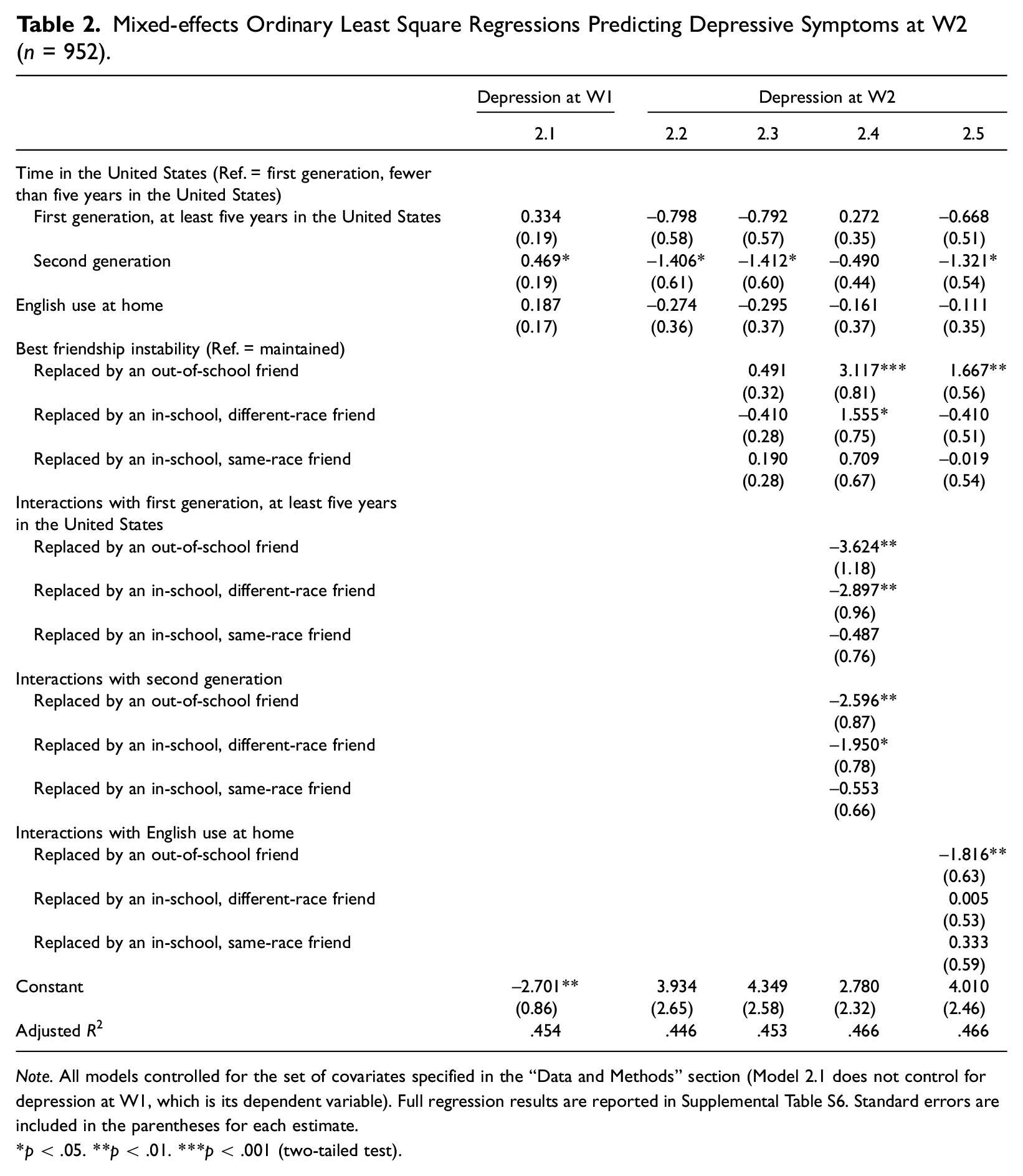
Note. All models controlled for the set of covariates specified in the “Data and Methods” section (Model 2.1 does not control for depression at W1, which is its dependent variable). Full regression results are reported in Supplemental Table S6. Standard errors are included in the parentheses for each estimate.
p < .05. **p < .01. ***p < .001 (two-tailed test).
Models 2.3–2.5 investigate the potential explanatory role of friendship instability in the associations between depressive symptoms and acculturation. Model 2.3 includes the friendship instability variable, which does not significantly predict depressive symptoms. Coefficients for acculturation measures remain virtually unchanged. Additional mediation analyses suggest that friendship instability does not have a significant indirect effect on the associations between acculturation measures and depressive symptoms (results are presented in Supplemental Table S3). These findings do not support hypothesis H1.
The next two models examine the moderating effects of friendship instability on acculturation. Model 2.4 includes interaction terms between friendship instability and time in the United States. Results indicate that foreign-born youths with fewer than five years in the United States experienced a significant increase in depressive symptoms after dissolving the tie with their W1 best friends. For first-generation adolescents with at least five years in the United States and second-generation adolescents, the associations between depression and these two types of friendship instability were significantly lessened, supporting H2. Specifically, when their in-school best friend was replaced by an out-of-school friend, the level of depression significantly increased (β = 3.117, p < .001). This finding supports H3 by demonstrating that the association between friendship instability and depressive symptoms depends on the in-school context of the replacement tie. Replacing the W1 best friend with another in-school, different-race peer was also associated with more depressive symptoms (β = 1.555; p < .05).
Figure 1 shows predicted values of depressive symptoms by adolescents’ friendship instability and time in the United States, based on Model 2.4. Among immigrant adolescents with fewer than five years in the United States, higher depression was observed for those who replaced their W1 best friend with an out-of-school friend (5.71) or a different-race friend in school (4.15), compared with those who maintained the friendship (2.59). By contrast, friendship instability did not result in higher depression among youths with more years in the United States. Indeed, their depressive symptoms improved after replacing the W1 friendship with an in-school, different-race friend (1.52), compared with maintaining the original friendship (2.86) or replacing it with an in-school, same-race friend (3.09; p < .05). For second-generation adolescents, replacing their friendship with an in-school, same-race friend also predicted lower levels of depressive symptoms (1.71) vis-à-vis the replacement with an out-of-school friend (2.62; p < .05). These results support H3 by showing that the mental health implications of friendship instability depend on the racial characteristics of the replacement friendship.
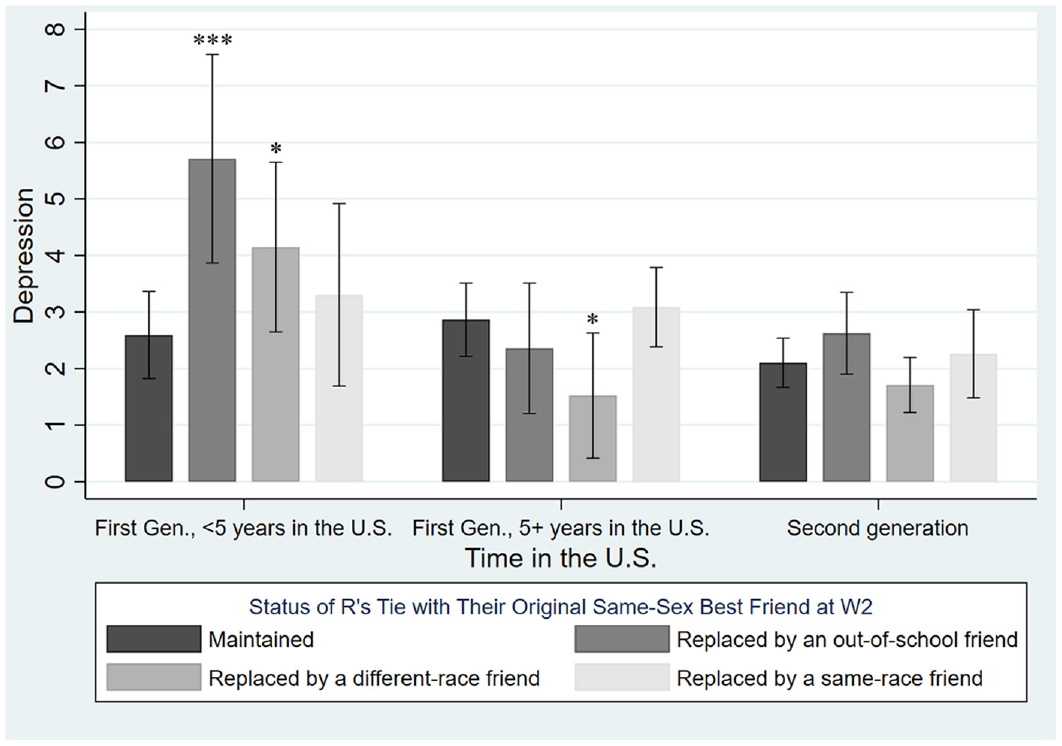
Predicted values of depressive symptoms, by friendship instability and time in the United States
Model 2.5 investigates the interaction between friendship instability and English use in-home. Replacing the W1 best friend with a friend outside school predicted more depression for adolescents who did not speak English at home (β = 1.667; p < .01). The effect was fully attenuated, however, for immigrant adolescents who spoke English with their family members (β = –1.816; p < .01), supporting H2.
Figure 2 presents predicted values of depressive symptoms by the interactions between friendship instability and English use in-home. Immigrant adolescents who spoke another language at home reported significantly higher levels of depressive symptoms when replacing their W1 friend with a friend outside of school (4.07), as compared with maintaining the W1 tie (2.40). For those who spoke English at home, however, the same pattern was not observed. Instead, having a new in-school, different-race friend improved depressive symptoms (1.88), compared with forming a new same-race tie (2.60; p < .05). This pattern also supports H3.
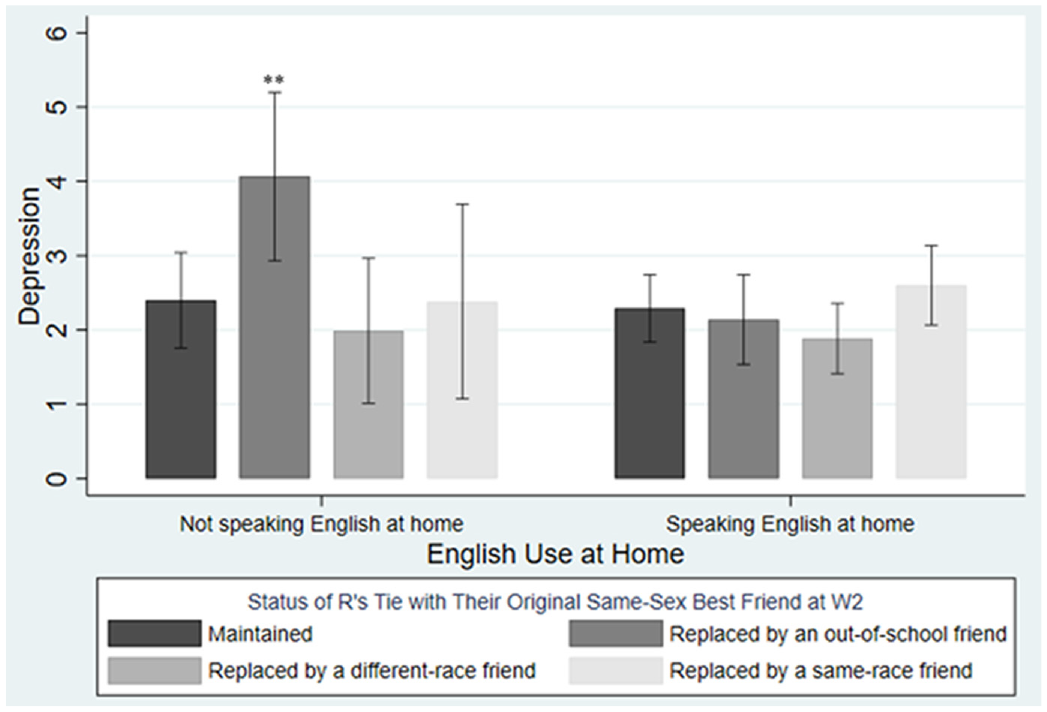
Predicted values of depressive symptoms, by friendship instability and English use in-home.
In supplemental analyses, we employed alternative coding strategies of friendship instability and investigated their role in immigrant adolescents’ depressive symptoms. First, friends’ immigrant generation may have a strong association with immigrant adolescents’ mental health (McMillan 2019). The alternative friendship instability measure thus captured the immigration generation status of the respondent’s in-school best friend at W2 (i.e., whether the friendship at W1 was replaced by a different-generation or a same-generation friend). As shown in Supplemental Table S4, replacing the W1 friend with either a different-generation or a same-generation friend did not predict any significant differences in depressive symptoms.
Second, it is possible that the race of adolescents’ original best friends also factored into the mental health consequences of friendship instability. We coded friendship instability to account for the racial background of the respondent’s W1 best friend. The variable consists of four categories: (1) respondent reported a same-race best friend in W1 and maintained the tie through W2; (2) respondents dissolved the tie with their W1 same-race best friend; (3) respondents reported a different-race best friend in W1 and maintained the tie through W2; and (4) respondents dissolved tie with their different-race best friend. Presented in Supplemental Table S5, regression analyses using this variable did not yield significant results, suggesting that the mental health consequences of friendship instability depend more on the characteristics of new ties that replaced the old ties.
Discussion
Drawing on the Add Health data, this study analyzed the implications of friendship instability for depressive symptoms among immigrant adolescents. Our results suggest that friendship instability moderates the association between levels of acculturation and depressive symptoms. Specifically, adolescents who recently arrived in the United States (i.e., fewer than five years) reported more depressive symptoms when they replaced their best friendship in school with an out-of-school friend, or another in-school friend who was of a different racial/ethnic origin. Replacing an in-school best friendship with an out-of-school friend also predicted more depressive symptoms among immigrant youths who did not speak English at home. By contrast, friendship instability was not associated with depressive symptoms for more acculturated immigrant adolescents, as indicated by more time in the United States and English use at home.
These results imply that friendship instability may constitute a form of acculturative stress for immigrant adolescents with low levels of acculturation, especially when it results in a loss of in-school peer connections. Scholars have proposed that experiences of strained relationships constitute an important dimension of acculturative stress (Berry et al. 1987). Adopting a temporal perspective, this study suggests that instability in personal ties may also produce stress that uniquely affects immigrant adolescents in the early stages of acculturation. These adolescents have yet to adjust to the host social environment and may have found the dramatic changes in their social lives—including new experiences in education and interactions—to be psychologically taxing (Cherng 2015). Friendship instability might also disrupt social support from peers, which is crucial for immigrant adolescents to buffer stress from their educational experiences (Berry et al. 1987; Morey et al. 2021).
Friendship instability might also contribute to the waning mental health advantage among immigrant adolescents over time. Previous research found that foreign-born adolescents tend to report better mental health than their native-born peers, but this advantage deteriorates as they spend more years in the United States (Harker 2001). Indeed, our analyses found that recently arrived immigrant adolescents indeed reported lower depressive symptoms than their second-generation counterparts at the baseline, but they no longer saw a mental health advantage at the later time point. This pattern may arise in part from their higher vulnerability to the disruption of their best friendship ties. Whereas friendship instability could be common to adolescents (Flashman 2012), a lack of acculturation into the U.S. secondary schools might lead immigrant youths to perceive them in a negative light and, thus, see a higher risk of psychological distress.
Yet it should be noted that not all forms of friendship instability led to more psychological distress for immigrant adolescents. We find that switching to an out-of-school best friend was especially harmful to these adolescents’ well-being, potentially reflecting marginalization from in-school peer networks. By contrast, the replacement of the original best friendship with another in-school, same-race friend did not predict more depressive symptoms, even for lowly acculturated immigrant adolescents. This pattern indicates that friendship instability translates into immigrant adolescents’ psychological distress primarily through compounding their social disintegration from the school environment.
Indeed, individuals’ loss of social connections over time is found as an important mechanism that underlies the harmful psychological consequences of personal network instability (Chan and Poulin 2009). Our findings contribute to this discussion by highlighting that context-specific social (dis)integration—in this case, the school context—may be crucial for understanding the mental health implication of friendship instability among immigrant adolescents. As secondary educational institutions constitute a crucial source of their socialization experiences in the host society (Kao 2004), experiences of friendship instability that gravitate immigrant youths out of the in-school peer network could be especially detrimental to their mental health. Social support provided by friends outside of school also could not replace those provided by in-school friends, in terms of their buffering effects of stress from the learning experience.
Conversely, more acculturated immigrant youths did not see worse mental health after experiencing friendship instability, potentially because they have adapted to the volatile friendship networks in U.S. secondary schools (Flashman 2012). Additionally, when their original friend was replaced with an in-school interracial friend, those youths reported fewer depressive symptoms. More acculturation enhances immigrant youths’ ability to socialize with peers of different racial/ethnic backgrounds (Rumbaut 2004). It avails immigrant adolescents of a wider range of friendship choices and, thus, better provision of social capital. These factors may promote the quality of their interracial friendships and facilitate integration into the school environment, thus contributing to lower risks of depression (Kao 2004).
The present study has several limitations. First, the first two waves of Add Health were conducted in the 1990s. The age of the data may therefore limit the generalizability of our findings to the experiences of immigrant adolescents today. With the expansion and increasing diversity of the immigrant population in the United States, along with efforts to promote inclusion in secondary educational institutions throughout the past two decades, we speculate that immigrant adolescents today—including those with a low level of acculturation—might experience lower risks of frequent friendship instability, and therefore experience fewer depressive symptoms as a result of this network phenomenon. To the best of our knowledge, however, Add Health remains the most recent dataset that includes longitudinal friendship network data from a nationally representative sample of immigrant adolescents in the United States.
Second, due to data collection errors in Add Health (Rude and Herda 2010), we are not able to investigate instability in respondents’ entire friendship networks. It should be noted, nonetheless, that adolescents’ best friendship instability constitutes more robust predictors of depressive symptoms than dynamics in secondary friends, according to prior research (Chan and Poulin 2009). Third, reverse causality could be an issue in our analyses. Previous research suggests that depression per se may lead to personal network loss (Perry and Pescosolido 2012). Our analysis investigates the association between friendship instability between W1 and W2 and depression at W2, controlling for depressive symptoms at W1. Even so, it is possible that friendship instability resulted from respondents’ depressive symptoms at the baseline. Future studies could advance this line of research by using data collected at more than two time points. Finally, our study examines friendship instability and depressive symptoms using two waves of data, which limits our analysis to investigate only between-individual variations. Examining the dynamics of adolescents’ friendships over a longer period and over multiple time points will allow researchers to capture within-individual differences in friendship networks, which may have important mental health implications.
Overall, our study suggests that friendship instability may constitute a distinct form of acculturative stress, whose association with depressive symptoms is independent of other friendship network characteristics. Specifically, it captures social relation stress through a longitudinal lens, thereby speaking to the temporal dynamics of immigrants’ lived experiences in the host society. Through interrogating the roles of persistence, dissolution, and replacement of personal network ties, we provide unique insights into how social relationships shape immigrants’ mental health over time as they are at different stages of the acculturation process.
We recommend that future research on immigrant health further examine the consequences of personal network instability. Longitudinal surveys on immigrants could benefit from collecting personal network data. Cross-sectional surveys could also develop items on respondents’ self-reported instability in their personal ties. For example, survey items could ask respondents whether they “lost friends due to language barrier or cultural differences,” or “found it hard to maintain relationships due to their immigrant background.” These items may shed important light on the patterning of mental health among the immigrant population.
Supplemental Material
sj-docx-1-smh-10.1177_21568693231221513 – Supplemental material for Acculturation, Depressive Symptoms, and Friendship Instability among Immigrant Adolescents
Supplemental material, sj-docx-1-smh-10.1177_21568693231221513 for Acculturation, Depressive Symptoms, and Friendship Instability among Immigrant Adolescents by Yezhen Li and Alyssa W. Goldman in Society and Mental Health
Footnotes
Acknowledgements
The authors sincerely thank Michel Guillot, Wendy Roth, Jason Schnittker, and participants of the Adolescent Social Ties and Well-Being Session of the 2023 Population Association of America’s Annual Meeting, for their generous feedback and support of this study. They also appreciate the suggestions made by the editors and anonymous reviewers of Society and Mental Health.

Supplemental Material
Supplemental material for this article is available online.
Notes
References
Supplementary Material
Please find the following supplemental material available below.
For Open Access articles published under a Creative Commons License, all supplemental material carries the same license as the article it is associated with.
For non-Open Access articles published, all supplemental material carries a non-exclusive license, and permission requests for re-use of supplemental material or any part of supplemental material shall be sent directly to the copyright owner as specified in the copyright notice associated with the article.
