




Abstract
The growing field of mattering has established that a sense that we matter is crucial to well-being and that it is informed by interactions with close others. However, few studies investigate how mattering may be shaped by our work relationships. Since many adults spend much of their time performing paid work, addressing this research gap may provide insights for enhancing employee well-being. This study uses data from the 2021 Baylor Religion Survey, collected during the early months of 2021, and a sample of employed U.S. adults (n = 564) to test how a worker’s perceived respect from their employer and their closeness to coworkers relate to their general sense of mattering, as well as whether mattering may act as a mediator between work relationships and psychological distress (assessed as symptoms of depression and anxiety). Results indicate that feeling highly respected by one’s employer and one’s perceived closeness to coworkers are positively linked with mattering among workers. Additional analyses also imply that mattering mediates a portion of the relationship between workplace relations and psychological distress. In total, this study suggests that further research into work relationships and mattering is warranted, especially since both factors seem tied to workers’ mental health.
Introduction
A new buzzword proclaimed by various media outlets during the COVID-19 pandemic has been “the Great Resignation.” Although some news sources report caveats to the dramatic statistic of millions of U.S. Americans quitting their jobs since spring 2021 (Rosalsky 2022), the media coverage around employment still led to renewed interest in worker and employer relationships as well as to the larger question of what constitutes meaningful work. As Kim Parker and Juliana Menasce Horowitz (2022) reported based on Pew survey data, issues that drove many workers to leave their work positions included low pay, a lack of opportunities for advancement, and feeling disrespected at work. While the ability to quit a job carries a certain amount of privilege and a price that some workers simply cannot afford to pay (The Lancet 2020), public discussions around fair wages and worker shortages also target the work lives of low-income workers. With the COVID-19 pandemic also shifting as many as 42 percent of workers to working from home (Bureau of Labor Statistics 2021) and bringing along a drastic restructuring of caregiving duties (Collins et al. 2021; Dunatchik et al. 2021), much has changed about how people navigate work and how the public perceives paid work.
Altogether, the COVID-19 pandemic was a unique stressor that impacted both work and family lives. As schools and childcare centers shut down, and many employed parents were forced to work remotely, parents often ended up steering their children’s educational endeavors, on top of rapidly adjusting to change in their own work conditions (Fan and Moen 2022; Montazer et al. 2022). In a matter of days, many family homes were transformed from places of unpaid work and leisure into multipurpose contexts, serving as the central site for all major life activities, including school, childcare, paid work, unpaid work, and leisure. Unsurprisingly, and perhaps partially due to these enhanced forms of stress in both the work and family domains, the pandemic also impacted individuals’ mental health, leading to increases in symptoms of depression and anxiety (e.g., McGinty et al. 2020; Montazer et al. 2022; Zheng et al. 2021) as well as to increased feelings of social isolation and loneliness (e.g., Bierman and Schieman 2020; Bierman, Upenieks, and Schieman 2021; Krendl and Perry 2021).
With this context in mind, we argue that studying the concept of mattering, the general sense of one’s significance to others and a concept which is strongly linked to mental well-being and our social interactions with close others, may be especially relevant to understand the association between work and well-being during these stressful times. In fact, some scholars highlight that a sense of mattering to other people can be especially crucial during times of change and crisis (Flett and Zangeneh 2020; Pearlin and Bierman 2013). The general pattern in the literature suggests that a sense of mattering shows great benefits in terms of mental health and more broadly defined well-being indicators, which further suggests that studying mattering in the context of work during the time of a mental health crisis may be especially relevant.
Furthermore, notable research gaps still exist around how work relationships impact a person’s sense of mattering. For instance, several of the studies on work and mattering were conducted on samples from specific occupational groups or on certain age groups (e.g., Baguri et al. 2022; Froidevaux, Hirschi, and Wang 2016; Richards et al. 2018), and few studies integrate a focus on psychological distress when studying work relationships and mattering, targeting factors such as job satisfaction and stress instead (e.g., Connolly and Myers 2003; Rayle 2006; Richards, Washburn, and Hemphill 2019). A unique feature of this study is also the inclusion of two different relational measures of work relationships: those with one’s employer and those with one’s colleagues. Overall, the aim of this study is to elucidate how a person’s relationship with their employer and their coworkers is connected with their sense of mattering, and whether mattering may act as a mediator between workplace relationships and mental health. Using the stress process model as a theoretical framework and data collected from U.S. adults during the early months of 2021, we employ structural equation modeling (SEM) to test the relationships between workplace relations, mattering, and psychological distress. Given the great relevance of work for general well-being and the large amount of time most adults spend performing paid work (Lennon and Limonic 2009), this study provides additional nuance to the relationship between workplace relationships and mental well-being as well as information for potential interventions.
Background
The term “mattering” is commonly accredited to Morris Rosenberg, who, together with B. Claire McCullough, describes mattering as “the direct reciprocal of significance” (Rosenberg and McCullough 1981:163). Expanding on this notion, Morris Rosenberg and B. Claire McCullough (1981) emphasized that mattering is founded on three key dimensions: the attention we receive from others, the importance others place on us, and the dependence of others on us. Other facets of mattering include a sense that one would be missed if absent and a sense of ego-extension, where others view the individual as a part of themselves (Rosenberg 1985). Mattering can be seen as an element of the self-concept, but has received much less scholarly attention compared to other aspects of the self-concept, like mastery or self-esteem, within the sociological enterprise (Fazio and Nguyen 2014; Schieman, Ellison, and Bierman 2010). A sense of mattering is greatly influenced by our interactions with significant others (Pearlin and LeBlanc 2001; Rosenberg and McCullough 1981), but can also be affected by larger groups and social institutions (Rosenberg 1985; Schmidt et al. 2020). More generally, mattering is a highly social construct, and is closely tied to role occupancy and the reflection of others unto the self (Fazio 2009). Furthermore, drawing on Rosenberg’s writings on the sociological relevance of the self-concept, we may envision mattering as both a “social product” and a “social force” (see Rosenberg 1981:593). In other words, mattering may be understood not only as an outcome of social interactions, but also as a guiding force that shapes how an individual will in turn view, interpret, and interact with the social world around them.
Unsurprisingly, numerous studies show that mattering is tied to various mental health indicators, such as symptoms of depression (Dixon, Scheidegger, and McWhirter 2009; Pearlin and LeBlanc 2001; Taylor and Turner 2001; Wight et al. 2015) or anxiety and social phobia (Flett et al. 2016; Rosenberg and McCullough 1981). Moreover, an enhanced sense of mattering has been tied to better physical health (Raque-Bogdan et al. 2011; Taylor, McFarland, and Carr 2019), greater happiness (Demir et al. 2011), and a diminished sense of loneliness (Flett et al. 2016; McComb et al. 2020). And although mattering has been established as empirically and conceptually distinct from related concepts, such as self-esteem or social support, it shares significant positive correlations with these concepts (Elliott 2009), which are also known to be favorably linked to health (e.g., Stinson et al. 2008; Uchino 2006).
Despite the progress in research on mattering and well-being, notable research gaps remain when it comes to the connections between mattering and work. Even though Rosenberg and McCullough’s (1981) early study of mattering was primarily concerned with parental mattering among adolescents, they also briefly discuss how mattering—and especially its dependence aspect—may relate to retirement. They suggest that, one problem of retirement is that one no longer matters; others no longer depend on us. [. . .] The reward of retirement, involving a surcease from labor, can be the punishment of not mattering. Existence loses its point and savor when one no longer makes a difference. (Rosenberg and McCullough 1981:179–80)
Indeed, paid work and the worker role may be an important source of mattering since mattering may not only depend on feeling valued, but also on a sense of adding value (Fazio 2009; Prilleltensky and Prilleltensky 2021).
Noteworthy research has been conducted in the arena of mattering and its influence on work-related well-being, which indicates that further exploration could prove highly insightful. For example, a study by Kathleen M. Connolly and Jane E. Myers (2003) among 82 employees showed a positive correlation between mattering and job satisfaction, but the effect was small and paled in comparison to other tested measures, including general wellness, and was insignificant once other variables, such as job tenure and age, were controlled for. In a meta-analysis of 558 studies of organizational support, James N. Kurtessis et al. (2017) found that employee perceptions concerning the extent to which the organization values their actual contributions strongly predicted positive orientation toward the organization, along with work productivity and employee well-being. Similarly, Andrea Dixon Rayle (2006) found that school counselors who hold a stronger sense of interpersonal mattering at work reported greater job satisfaction and lower job-related stress. Among certain occupations or age groups, mattering has also been shown to correlate with social support at work and life satisfaction (Froidevaux et al. 2016), a decreased risk for burnout (Haizlip et al. 2020), and with less emotional exhaustion and role conflict (Richards et al. 2019). The interest in mattering at work has also led to the development of a specific “Work Mattering Scale” (Jung and Heppner 2017). Analyses using this scale emphasize the connection between mattering at work and work satisfaction, life satisfaction, organizational commitment, positive affect, and reduced intentions to withdraw (Jung and Heppner 2017). Furthermore, researchers have composed and validated an “Organizational Mattering Scale” (Reece et al. 2021), with the specific goal of targeting the felt impact of an employee’s work on their organization. Based on their analyses, organizational mattering was correlated with increased job and life satisfaction, along with greater retention (Reece et al. 2021). In addition, mattering has been investigated in its relation to unpaid household labor, and may play a role in the perception of fairness in the division of household labor between romantic partners (Kawamura and Brown 2010; Lachance-Grzela 2012).
With these diverse and extensive benefits of a sense of mattering in mind, some studies also target mattering as an outcome measure, testing the influence of work-related measures on a sense of mattering. For instance, one study shows that social support at work correlates positively with mattering among older workers (Froidevaux et al. 2016). Moreover, a larger study of Toronto-based workers indicates that work/home conflict, especially among women, can have a detrimental effect on workers’ sense of mattering (Schieman and Taylor 2001). The same study also reveals that job autonomy, job fulfillment, and supervising others hold a positive relationship with mattering, while job routinization shows a negative relationship with mattering (Schieman and Taylor 2001). The research thus demonstrates that issues of job tasks and felt autonomy may play a role in informing a sense of mattering, but it also points to relational aspects of work making an impact. In the next section, we center in on how mattering may explain the relationship between various forms of workplace social relationships and mental health.
Work and Well-Being: The Mediating Role of Mattering
Contemporary research supports the importance of workplace dynamics for workers’ emotional welfare. What workers do in their jobs and how they do it have strong effects on well-being. For instance, the relationship between the demands of work and the ability to meet those demands is of crucial importance to well-being (e.g., Karasek and Theorell 1990; Kohn and Schooler 1983). Robert Karasek and colleagues (Karasek and Theorell 1990; Karasek 1979) outlined a “demand/control” model for explaining worker well-being that has received a great deal of empirical support (e.g., Häusser et al. 2010; Tausig 2013). The worker who experiences a high level of job demands but has little flexibility in how they can meet those demands is at a higher risk of developing signs and symptoms of psychological distress. The substantive complexity of jobs is another recognized feature of work that affects psychological well-being. Jobs that require more complex thinking to complete tend to be associated with lower rates of anxiety and greater self-esteem and life satisfaction (Kohn and Schooler 1983; Tausig 2013). In addition, issues of job insecurity (Burgard and Seelye 2017; Lam, Fan, and Moen 2014) and perceived work-to-family conflict (Young, Schieman, and Milkie 2014) have been linked with worse mental health outcomes as well.
Yet, it is important to recognize that work is also a social setting. Generally, in most forms of work, employees talk with coworkers and supervisors throughout the day. Workers may also develop important friendships with coworkers that may be engaged in outside of working hours. While the opportunity to talk with one’s co-workers and supervisors fills the human need for socializing, researchers are pointing out that support from workplace relationships is an integral ingredient to maintaining a sense of dignity at work (Hodson 2001) and in dealing with work stresses (House 1981; Karasek and Theorell 1990). It is therefore unsurprising that a host of positive outcomes have been associated with higher levels of workplace support, including enhanced job satisfaction (Ducharme and Martin 2000; Michel and Hargis 2008).
Workplace Relationships, Mattering, and the Stress Process
According to Leonard I. Pearlin (1989), stressors may under some circumstances turn into stress, and subsequent distress, if unmitigated by context and potentially intervening stress buffers. Work can be a source of stressors, as can be the absence thereof (i.e., unemployment; Lennon and Limonic 2009). While work qualities and the economic resources provided by work are crucial factors relevant to the study of stress and work, workplace relationships can also be situated in the stress process. On the one hand, work relationships and interactions could act as stressors for the worker, including everything from broadly feeling “out of place” or socially excluded to instances of specific workplace bullying and harassment. Relevant to the study at hand, feeling disrespected by supervisors and employers or disconnected from colleagues may be conceived of as a potential stressor, and one may envision that both conditions could catalyze feelings of anger, sadness, a lack of meaning, or social isolation in workers. The stress from these conditions may even be amplified during the recent COVID-19 pandemic which may be conceptualized as a macro level stressor. On the other hand, workplace relationships, along with the social support and integration they can provide, may play an important role as a potential stress buffer in the stress process (Linnabery, Stuhlmacher, and Towler 2014; Thompson et al. 2004).
Relatedly, workplace relationships may build or undermine a general sense of mattering, which may act as a psychosocial resource with the ability to buffer stress, thus decreasing the chance of suffering distress (Fazio and Nguyen 2014). Indeed, mattering, as a self-concept measure, may be situated in the stress process as a potential mediator or moderator, and its heavy reliance on social interactions and role occupancy may make it a particularly useful concept for understanding the social dynamics of the worker role (Fazio 2009). For many workers, mattering, along with a sense of meaning and dignity, is one of the core constructs of the work experience helping the worker feel a sense of connection and contribution (Blustein 2011). Accordingly, mattering has been conceptualized as a potential mechanism linking social ties with mental health outcomes (Thoits 2011), and has been examined as a mediator of this pathway in several studies (e.g., Demir et al. 2011; Raque-Bogdan et al. 2011; Wight et al. 2015).
Given this background, we would expect that workplace connections should have an impact on a person’s sense of mattering, and that mattering may act as a mediator between workplace relationships and mental health. Several scholars have emphasized the importance of perceived mattering in the work context. For example, Mark L. Savickas (2004:1) argued that the purpose of work is “to produce significance and validation.” K. Andrew R. Richards et al.’s (2018) qualitative study among physical education teachers exemplified how a sense of mattering was constructed in the lives of these teachers based on interactions with students, colleagues, administrators, and parents, but also based on broader institutional messaging surrounding the marginalization of their subject. In total, mattering at work implies the importance of relational aspects of work. A relational theory of work approaches “working as an inherently relational act” (Blustein 2011:1). This emphasis on the connection between relationships and work suggests that relationships are the main source of attaining “meaning, matter, and dignity” (Blustein 2011:4). It would be difficult to imagine a scenario in which employees know that either they or their work does not matter to their organization, yet still continue to be motivated, feel satisfied, and add value to their organization. That one’s actions matter at work is therefore a simultaneous concern for organizations, supervisors, and employees alike, and has the potential to be a key mediating factor in outcomes related to worker mental well-being.
Although research has targeted mattering in relation to work, several gaps remain in the existing literature. First, several of the studies in this area were conducted on samples of workers in a specific occupational group, such as teachers (Baguri et al. 2022; Richards et al. 2018; Richards et al. 2019), school counselors (Rayle 2006), or nurses and nurse practitioners (Haizlip et al. 2020). Some worker samples were also restricted to certain age groups (e.g., Froidevaux et al. 2016; Schieman and Taylor 2001). Second, few studies that focus on mattering and work also incorporate a focus on psychological distress as measured with symptoms of depression and anxiety. Instead, a significant share of the literature targets mattering at work in its relation to job satisfaction and stress (Connolly and Myers 2003; Rayle 2006; Richards et al. 2019), job characteristics (Reece et al. 2021; Schieman and Taylor 2001), or resilience (Baguri et al. 2022; Haizlip et al. 2020). We believe that adding this angle is a necessary extension of the existing literature, which points to the importance of mattering at work for other well-being indicators. Third, we employ measures of workplace relationships that target both relations with workplace superiors (i.e., employers) and relationships with peers (i.e., coworkers), and are able to examine the association of these factors with mattering and psychological distress separately. Last, few empirical studies target the issue of work and mattering during the COVID-19 pandemic (see Ezza Mad Baguri et al. (2022) for an exception). At the same time, scholars point to the significance of mattering during times of crisis and change (Flett and Zangeneh 2020). Given the societal changes to the workplace as well as the increase in mental health problems during the pandemic, we argue that the timing of our study may also add to the knowledge on mattering during situations of crisis, even though we cannot make claims regarding temporal changes in either mattering or distress based on the cross-sectional data we use. More broadly, insights into the relationship between workplace relations, mattering, and psychological distress could provide information for interventions to target issues such as retention, productivity, and morale at work.
Study Objectives and Hypotheses
In this study, therefore, we address three research questions: (1) How is a worker’s relationship with their employer associated with their sense of mattering?, (2) How does a worker’s perceived closeness with their coworkers relate to their sense of mattering?, and (3) Could mattering act as a mediator between workplace relationships and mental health? Because a sense of mattering includes how much we feel others pay attention to us and how important we feel to others, an employer who transmits a sense of appreciation and respect to employees should correlate positively with a worker’s sense of mattering. Following this, we hypothesize that,
HYPOTHESIS 1: Feeling respected by one’s employer is linked with an increased sense of mattering among workers.
We would expect that all underlying aspects of mattering (importance, attention, and dependence) could be strengthened by a worker’s perceived closeness with coworkers. Coworkers may be a source of positive interactions and may make an individual feel like they are filling an important void in their work environment. By contrast, few significant relationships among coworkers would suggest that no significant sense of mattering may be derived from a work environment, given that mattering is a highly social construct. Thus, we hypothesize that,
HYPOTHESIS 2: Heightened feelings of closeness with coworkers are linked with an increased sense of mattering among workers.
Due to mattering being closely connected with mental health, we also test how the abovementioned workplace relationships may impact symptoms of psychological distress via a pathway of mattering. In other words, we envision that feeling respected by one’s employer and closeness to one’s coworkers impact mental health, and that a portion of this relationship will be explained due to the impact of workplace relationships on a worker’s sense of mattering. Relatedly, we hypothesize that,
HYPOTHESIS 3: Mattering will act as a mediator in the relationship between workplace relationships and mental health as measured by symptoms of psychological distress.
Data and Methods
Data
The data for this study stem from the 2021 Baylor Religion Survey, which was administered by Gallup. Data collection lasted from January 27, 2021 to March 21, 2021, during which time frame 11,000 surveys were sent out to 50 U.S. states and the District of Columbia using an address-based sampling technique. Data were collected with either a mailed or an online questionnaire, which were available in English and Spanish. The result was a random sample of 1,248 U.S. adults (response rate of 11.3 percent; based on the American Association for Public Opinion Research response rate calculation method AAPOR1). A comparison with the 2018 General Social Survey shows similarities across several key demographic measures 1 and sampling weights were added to reduce the risk of bias. 2 The survey was selected since it was collected recently, is national in scope, and offers appropriate measures for the study at hand.
Prior to conducting analyses, 11 cases who selected the “other” category when asked for their gender were dropped since this group was too small to allow for separate analyses. In addition, respondents who stated they are not currently employed (n = 468) or are working in a family business for pay (n = 16) were also dropped. The latter category was excluded since the relationships with family members as coworkers may be a special case when it comes to their influence on mattering—family and work roles are likely more conflated in these cases. It is also unclear if individuals working in a family business feellike they have a clearly designated employer and, if so, whether their relationship with their employer is comparable with those who are not employed by family members. Also excluded from our sample were individuals who showed missing values on the employment measure (n = 103) and those who are self-employed (n = 145), since it is uncertain whether they have a person they consider a permanent employer and, if so, if they share the same type of relationship with them as other workers would. Following this rationale, the analytic sample only includes individuals who state they are currently employed for pay in a for-profit private company, business, or for an individual; for a nonprofit, tax-exempt, or charitable organization; or for a local, state, or federal government (n = 599).
Measures
Dependent variables
Mattering was assessed with a general mattering scale based on answers to the following prompts: “How much do you feel other people pay attention to you?,”“How much do you feel others would miss you if you went away?,”“How interested are people generally in what you say?,”“How much do other people depend on you?,” and “How important do you feel you are to other people?.” Response options included 1 = “not at all,” 2 = “a little,” 3 = “somewhat,” and 4 = “a lot.” The five measures showed a high alpha reliability coefficient of .81 and were summed to form a scale ranging from 5 to 20. These same measures were used successfully in prior research (e.g., DeForge and Barclay 1997; Taylor et al. 2019; Wight et al. 2015), and have also been employed in research targeting work-related measures (e.g., Froidevaux et al. 2016; Schieman and Taylor 2001). The general mattering scale tends to show fairly high Cronbach’s alpha values among a variety of samples (see Flett 2018:84).
Mental health was assessed with a scale targeting psychological distress. For this scale, items measuring symptoms of depression and anxiety were combined. To assess symptoms of depression, respondents were queried, “In the past WEEK, about how often have you had the following feelings?” with relevant items including “I felt depressed” and “I felt sad.” Symptoms of anxiety were measured with the same prompt and subsequent statements of “I worried a lot about little things,”“I felt tense and anxious,” and “I felt restless.” Response categories included 1 = “never,” 2 = “hardly ever,” 3 = “some of the time,” and 4 = “most or all of the time.” The decision to create a scale founded on both symptoms of depression and anxiety was based on the following considerations: few measures were available to test for symptoms of depression, the optimized Cronbach’s alpha when the items were combined, and the combined scale working well with this study’s objective in testing mattering as a mediator between workplace relationships and mental health, since both symptoms of anxiety and depression would signal a diminished sense of mental well-being and correlate highly with each other. The combined scale ranges from 5 to 20, with a reliability coefficient of .88.
Key independent variables
To target workplace relationships, two items are included. Respondents were asked, “How often do you feel: Well respected by your employer?” Response categories ranged from 1 = “never” to 4 = “most or all of the time.” Responses of “don’t know/does not apply” were coded as missing and response options of “never” and “hardly ever” were combined to form the reference group due to sample size considerations, which is contrasted with the “some of the time” and “most or all of the time” categories. Perceived closeness to coworkers was assessed by prompting respondents with “How close do you feel to,” with the relevant follow-up term of “your coworkers.” Response categories were recoded to combine categories of “not close at all” and “not too close” as the reference group to present a similar comparison group as with the respect from one’s employer measure, which is contrasted with the categories of “somewhat close” and “very close.”
Control variables
Control variables include age (in years) and dichotomous measures for sex (female = 1), race and ethnicity (racial or ethnic minority = 1), education (holding at least a four-year college degree = 1), marital status (married or in a domestic partnership = 1), and children residing in the household (having at least one child in the home = 1). Income was assessed with a four-category variable, using those with annual household incomes of less than $35,000 as the reference category. Last, due to the timing of the survey, we also added a control for working from home due to the COVID-19 pandemic. The original measure was recoded into a binary measure where working from home at least some of the time = 1.
Plan of Analysis
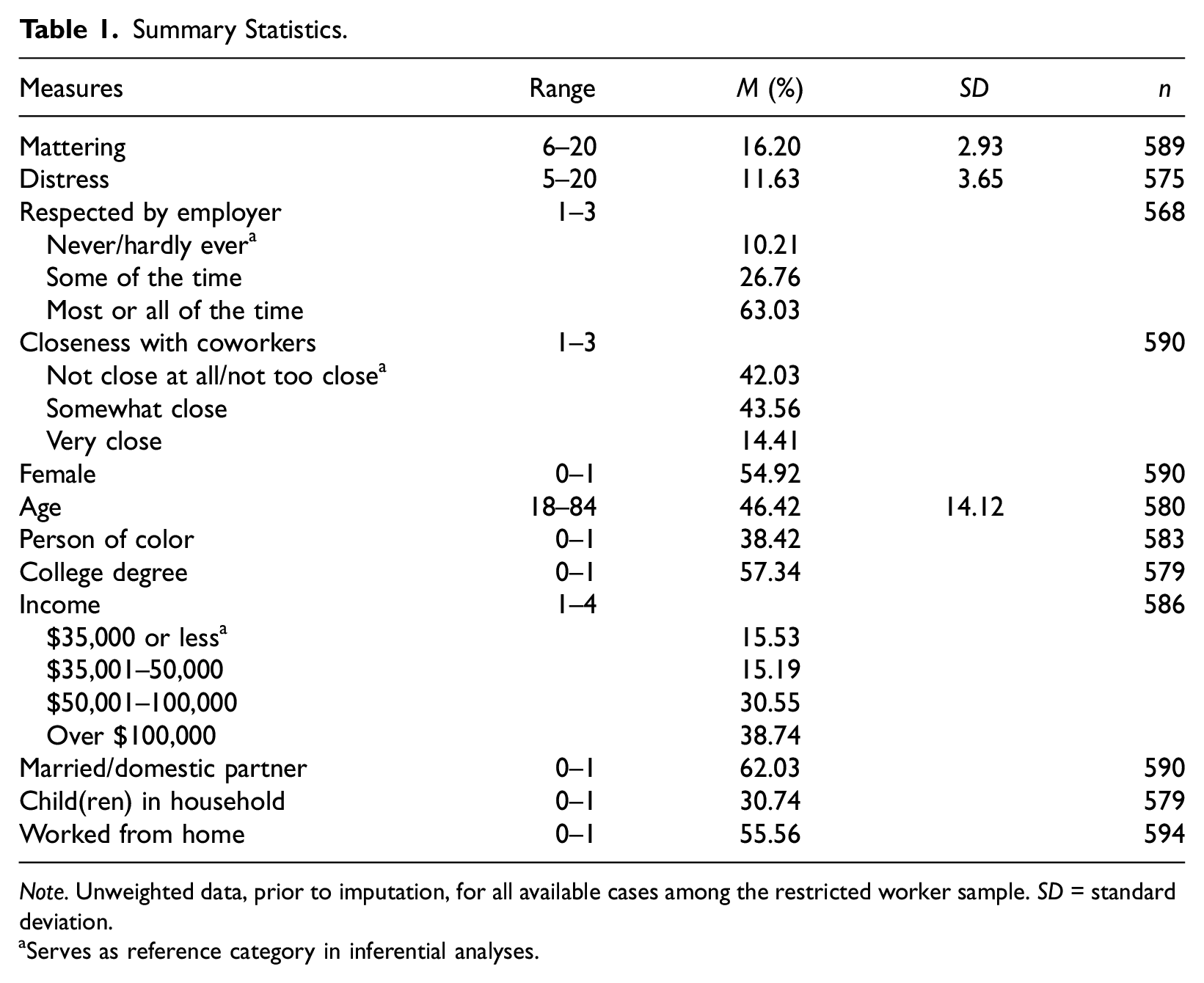
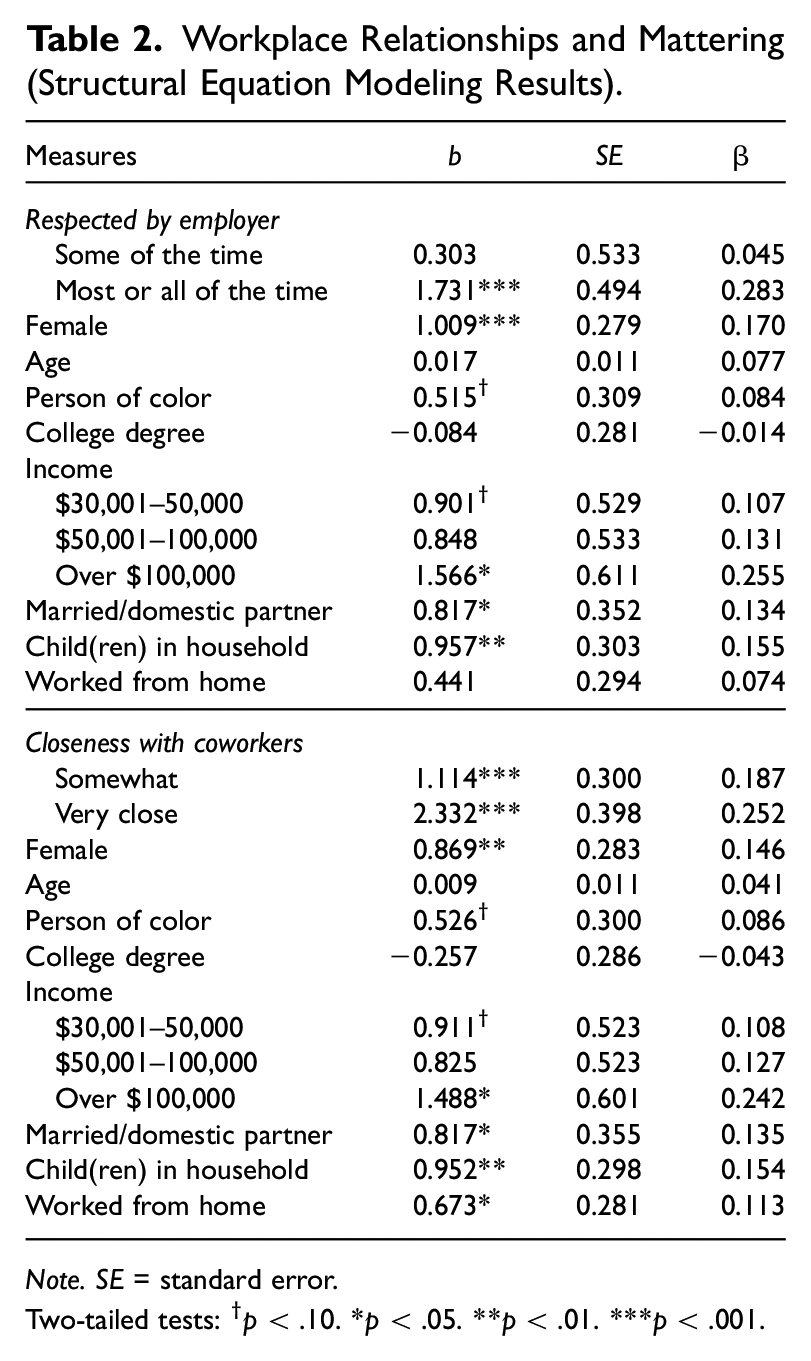
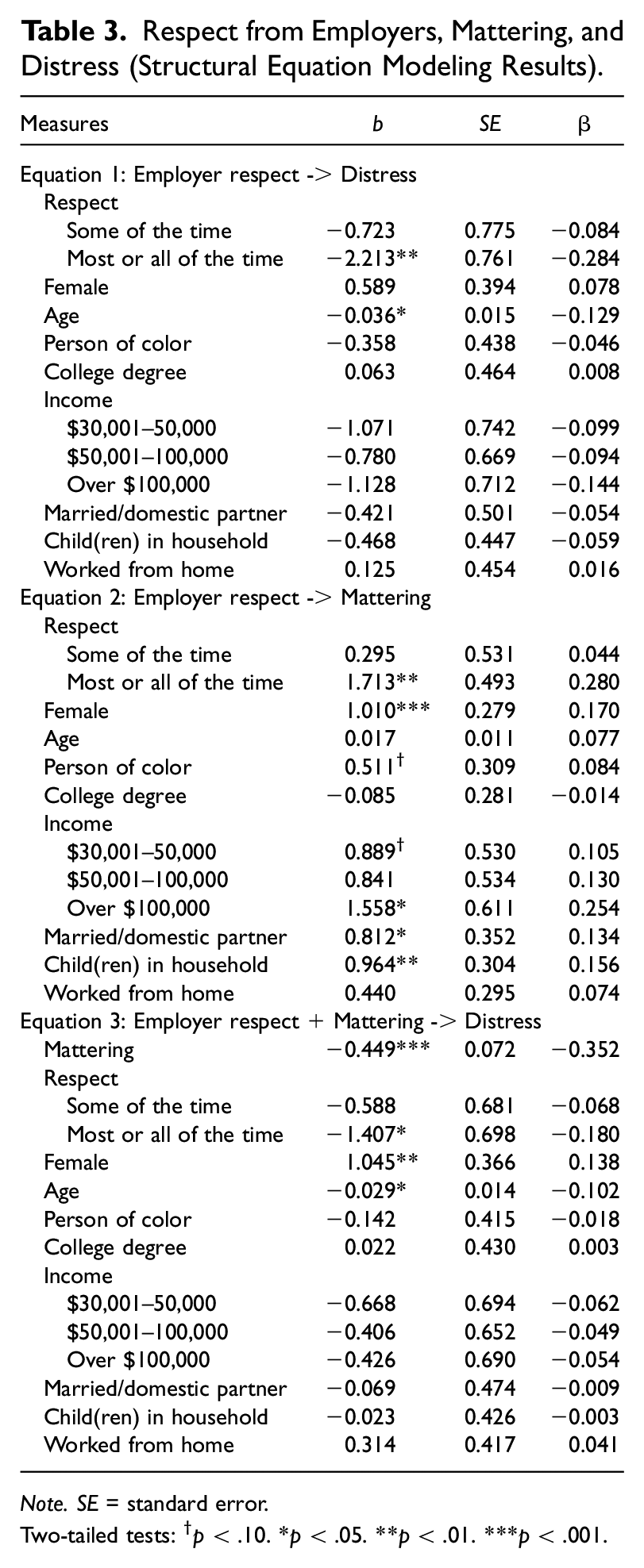
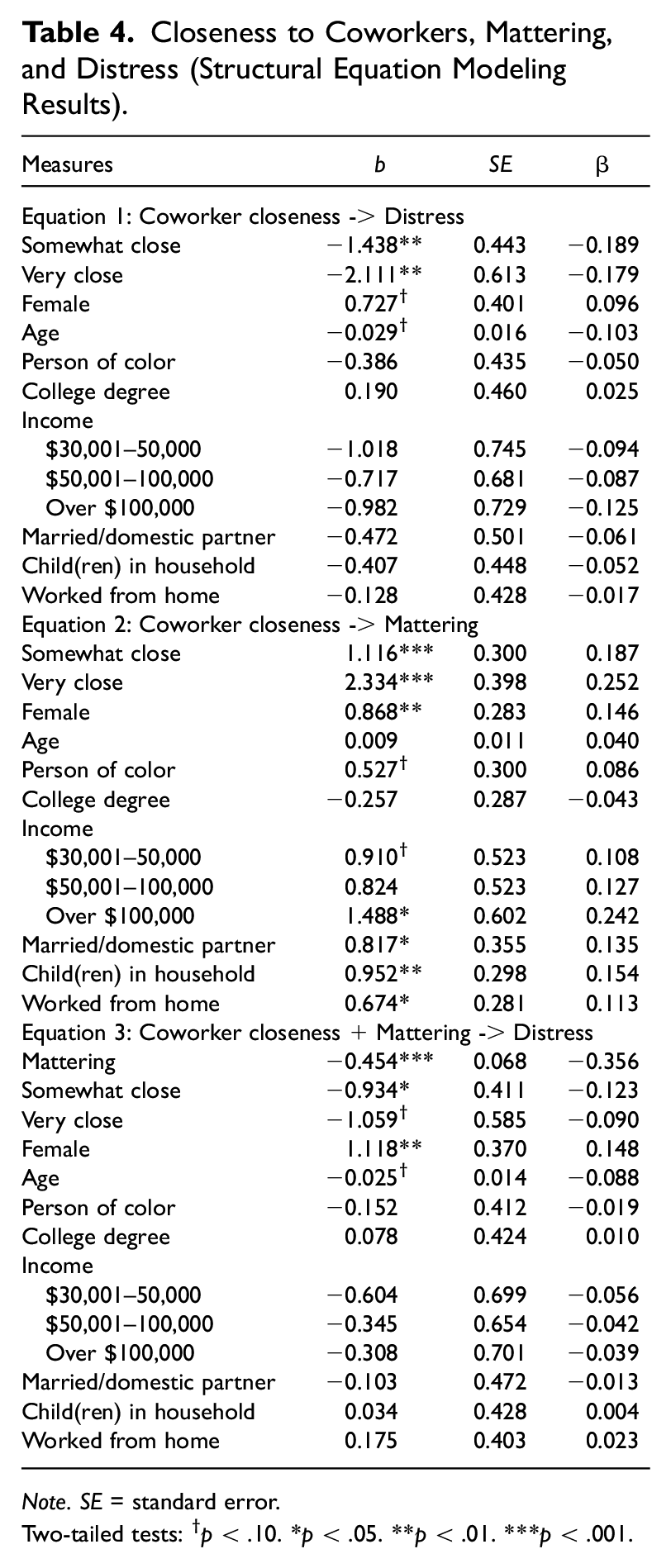
Unweighted summary statistics for all available cases in our sample of workers are shown in Table 1. SEM was employed to test Hypotheses 1–3. First, we display results for the influence of workplace relationships on mattering in Table 2, addressing Hypotheses 1 and 2. Tables 3 and 4 use a more elaborate path model to test for Hypothesis 3. For both key independent measures, a first pathway examines the link between the relevant workplace relation and psychological distress. Subsequently, we display the associations between workplace relationships and mattering. Last, we show how the investigated workplace relationships impact mental health while also accounting for mattering. Finally, analyses were conducted to test for mediation of mattering using the estat teffects command in Stata.
Summary Statistics.
Note. Unweighted data, prior to imputation, for all available cases among the restricted worker sample. SD = standard deviation.
Serves as reference category in inferential analyses.
Workplace Relationships and Mattering (Structural Equation Modeling Results).
Note. SE = standard error.
Two-tailed tests: †p < .10. *p < .05. **p < .01. ***p < .001.
Respect from Employers, Mattering, and Distress (Structural Equation Modeling Results).
Note. SE = standard error.
Two-tailed tests: †p < .10. *p < .05. **p < .01. ***p < .001.
Closeness to Coworkers, Mattering, and Distress (Structural Equation Modeling Results).
Note. SE = standard error.
Two-tailed tests: †p < .10. *p < .05. **p < .01. ***p < .001.
Prior to conducting analyses, cases missing on the dependent variables (mattering, distress) and those missing on the weight variable were dropped and full information maximum likelihood was used to deal with missing data, 3 resulting in a sample of n = 564. Robust standard errors and sampling weights were applied to inferential analyses. All analyses were conducted in Stata 17.
Results
Unweighted descriptive statistics for all variables and prior to imputation are shown in Table 1. Based on our restricted sample of workers, the average mattering score was fairly high at 16.2 (SD = 2.93), while the mean distress score was 11.63 (SD = 3.65). Most respondents report feeling at least some respect from their employers, yet a sizable portion (42.03 percent) shares that they did not feel particularly close to their coworkers. Over half of our sample was female and the average age in our sample of workers was a bit over 46 years old. Over one-third of respondents indicated that they are an ethnic or racial minority member, and over half of our sample hold at least a college degree. A majority of sample respondents are married or in a domestic partnership (62.03 percent) and around 30 percent report having at least one child under the age of 18 years reside in the same household. A slight majority of our sample also indicate that they worked from home due to the pandemic at least some of the time (55.56 percent). Correlations between the key variables of interest used in our analyses are shown in the Appendix.
Table 2 details the results of using the two workplace relationship measures to predict a sense of mattering. Based on these findings, feeling respected by one’s employer some of the time, compared to never or rarely, shows no statistically significant relationship. However, feeling respected most or all of the time does: here we find that feeling strongly respected is linked with a marked and highly statistically significant increase on the mattering scale among the workers in our sample (b = 1.731, β = 0.283, p < .001). By contrast, closeness to coworkers does not show a similar threshold. Feeling somewhat close and very close, compared to not close at all, both show positive associations with mattering, yet feeling very close shows the larger coefficient, with an average of two units higher on the mattering scale compared to disconnected workers (b = 2.332, β = 0.252, p < .001).
Turning to the results shown in Table 3, we find that feeling respected by one’s employer most or all of the time, in contrast to never or rarely, is also linked with markedly decreased distress, as shown under Equation 1 (b = −2.213, β = −0.284, p < .01). In Equation 2, we find, similarly as before, that feeling respected most or all of the time shows positive associations with a sense of mattering (b = 1.713, β = 0.280, p < .01). Adding mattering in Equation 3, we find that mattering shares a negative link with distress (b = −0.449, β = −0.352, p < .001). Furthermore, feeling respected by one’s employer most or all of thetime is still a significant correlate of distress, but the coefficient has decreased in size since matteringwas added to the equation (b = −1.407, β = −0.180, p < .05).
Table 4 targets the influence of closeness with coworkers on distress. We find that feeling somewhat close to one’s coworkers is, on average, linked with lower distress (b = −1.438, β = −0.189, p < .01), as is feeling very close to one’s coworkers (b = −2.111, β = −0.179, p < .01). Equation 2 treats mattering as the outcome measure. Again, any increase in closeness is associated with an increased sense of mattering. Workers in our sample who report feeling somewhat close to their coworkers, compared to not very close, show on average about one score higher on the mattering scale (b = 1.116, β = 0.187, p< .001). Feeling very close to coworkers appears with an even greater coefficient (b = 2.334, β = 0.252, p < .001), mirroring the findings for distress. Equation 3 adds mattering as an independent measure, which shows a negative relationship with distress (b = −0.454, β = −0.356, p < .001). Feeling somewhat close to one’s coworkers is still statistically significant, and the coefficient indicates that even feeling somewhat close to coworkers seems to be linked with lower distress, even when accounting for mattering and other covariates (b = −0.934, β = −0.123, p < .05). Feeling very close to one’s coworkers is now only marginally statistically significant (b = −1.059, β = −0.090, p < .10) and shows a markedly smaller coefficient compared to Equation 1.
There is some evidence for a mediating influence of mattering in the association between work relationships and psychological distress. The coefficient for feeling respected by one’s employer most or all of the time decreases in both size and statistical significance once mattering is added (b = −2.213, p < .01 in Equation 1 to b = −1.407, p < .05 in Equation 3), although the measure still maintains a significant direct link with psychological distress even when matteringis accounted for. Similar trends can be observed when considering closeness to co-workers: coefficients for both categories drop in both size and statistical significance once mattering is controlled for, and the change appears especially strong for those feeling very close to their coworkers. Analyses were conducted to formally test for mediating influence of mattering (see Table 5). Based on estimates for Equation 3, dividing the indirect effects by the total effects for the employer respect measure showed that mattering mediated about 35 percent of the relationship between feeling highly respected by one’s employer and psychological distress. The indirect effect of feeling respected some of the time was not statistically significant. For the closeness to coworkers measure, mattering mediated the relationship between feeling somewhat close and psychological distress by about 35 percent, and by about 50 percent for those feeling very close.
The Mediating Influence of Mattering.
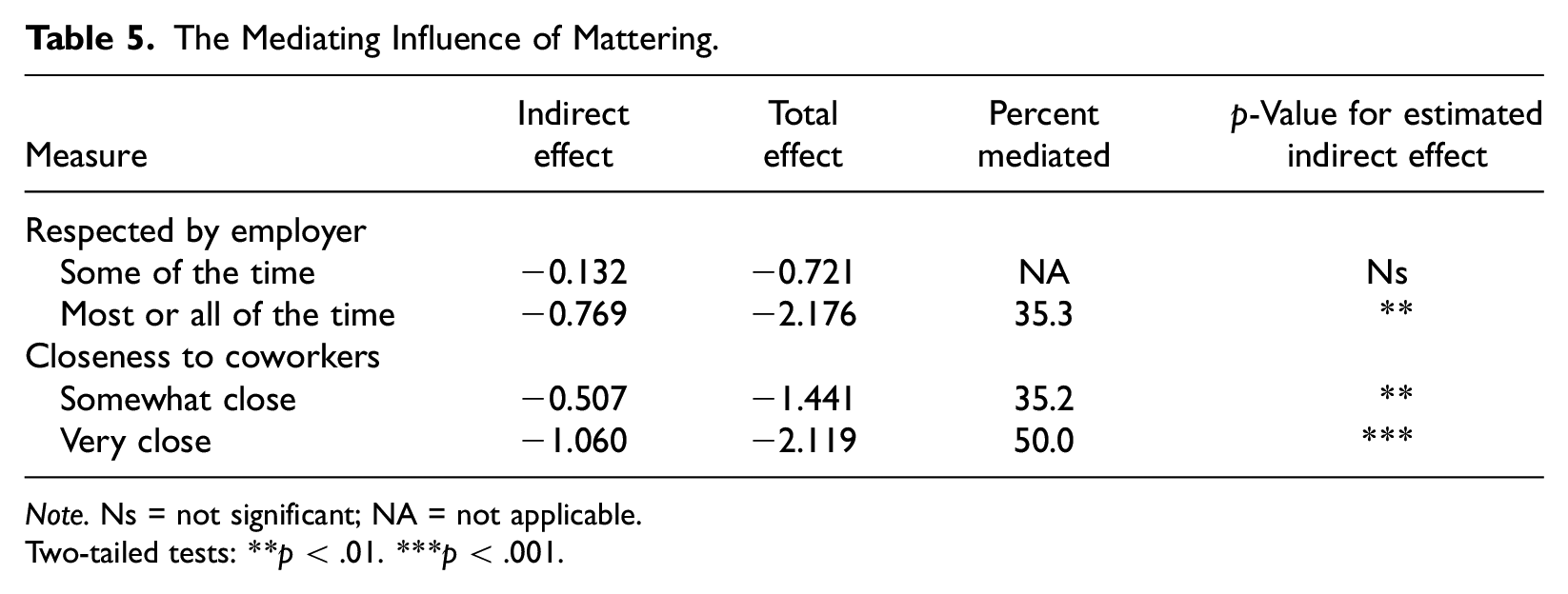
Note. Ns = not significant; NA = not applicable.
Two-tailed tests: **p < .01. ***p < .001.
Discussion
This study examined how certain workplace relationships relate to an employee’s sense of mattering. Using national data of employed U.S. adults who are neither self-employed nor working for a family business, this study suggests that feeling highly respected by one’s employer is positively linked with a worker’s general sense of mattering. In addition, closeness to one’s coworkers was highly correlated with an enhanced sense of mattering in the studied sample. These insights contribute to the nascent field dedicated to the study of mattering by showcasing the potential importance of work relationships for a sense of social significance. Furthermore, this study suggests that mattering may play an important role in the association between workplace relationships and mental health.
Our first key finding was that feeling respected by one’s employer most or all of the time, in comparison to never or rarely, was linked with an enhanced sense of mattering. Interestingly, the contrast between feeling respected some of the time and never/rarely was not statistically significant in any of the model constellations, suggesting a certain threshold that must be met in terms of perceived respect to correlate positively with one’s sense of mattering. Some psychological research suggests that a certain ratio of positive vs. negative interactions must be attained for interactions to lead to positive perceptions of that relationship. We speculate that the pattern shown in the literature on marital interactions may be insightful here. The popular marriage researcher John Gottman and his colleagues (1998) found that the ratio of positive to negative interactions may make a marked difference in terms of marital happiness, and at least one study suggests that positive/negative interaction ratios may also matter in workspaces (Losada and Heaphy 2004). We ponder whether a similar theme may be at play when it comes to interactions with supervisors at work: feeling respected only some of the time may not be enough to associate with mental health benefits.
By contrast, the evidence for Hypothesis 2 is clearer. Indeed, in comparison to feeling not very close to coworkers, even feeling somewhat close to one’s colleagues was positively linked with mattering. However, the difference is greater for those who reported feeling very close toco-workers. Prior research suggests—unsurprisingly— that closeness to family, friends, and neighbors can behighly beneficial to a person’s sense of mattering (Bonhag and Froese 2022). After all, mattering is bolsteredby interactions with others that signal to the individual that they are seen as important and that others depend on them. Feeling close to one’s coworkers will likely correlate with more frequent interactions and more emotionally intimate communications, which should have a greater potential to affect a person’s sense of mattering. Feelings of closeness to one’s coworkers could also specifically target the dependence and being missed if absent aspect of mattering: strong closeness with colleagues may correspond with holding a valued role in the worker network and that one’s absence would not only be noticed, but also seen as a detriment to the group. Supplementaryanalyses (not shown) revealed that perceived closeness to coworkers was not as strongly correlatedwith mattering as perceived closeness to family or friends but shared a stronger association with mattering than perceived closeness with neighbors. Thus, although family and friends may act as the key informants for our sense of mattering, the influence of work relationships should not be discarded, and, as shown by our results, can have a marked impact on the general sense of mattering among employees.
On a sidenote and related to the pandemic context, we found that working from home showed a positive link with mattering when testing the association between closeness with coworkers and mattering, but not in other models. The working from home context may have uniquely shaped employees’ work interactions. In supplementary analyses (not shown), working from home was linked with mattering in unadjusted regression models. 4 Working from home could have signaled to workers that their safety mattered to their organization and be linked to perceived respect from their employers or organizations. Given that this measure was only significant in certain models, we encourage further research into how the ability to work from home was perceived by employees during the pandemic and beyond.
We found some evidence for our third hypothesis that mattering plays a mediating role between workplace relationships and psychological distress. Mattering appeared to be a partial mediator of this association. This finding aligns with prior research unspecific to the work context that found mattering could act as a mediator between relationship quality and well-being (e.g., Demir et al. 2011; Raque-Bogdan et al. 2011). As David L. Blustein (2011) argued, relationships within the workplace, encompassing both coworkers and employers, are the main avenue by which employees achieve a sense of dignity. As with our main effects models, we only observed a mediating trend for the category of feeling respected most or all of the time when considering respect from one’s employer, which again suggests an important threshold effect. While speculative, it is possible that a higher sense of mattering attained by greater support from coworkers and respect from one’s employers could buffer against work-related stress (Fazio and Nguyen 2014; Pearlin 1989), allowing workers to maintain a sense of importance and connection in the face of demanding tasks or an overwhelming workload.
In addition, our results further confirmed the connection between a sense of mattering and mental health. Relative to other psychosocial resources in the stress process model, such as mastery, social support, and self-esteem, mattering has received considerably less attention (Fazio and Nguyen 2014). Mattering was a significant correlate of our psychological distress scale even when a variety of demographic factors were held constant. Speaking on the centrality of mattering, Morris Rosenberg (1985:219) remarked that, Why mattering matters is still uncertain, but its association with psychological well-being appears to be beyond dispute. The person low on mattering feels irrelevant, unimportant, or peripheral in the minds of others. He is the invisible man who passes through unnoticed, whose presence evokes no emotional response—either positive or negative—and whose absence is unremarked.
Since our data were collected during the COVID-19 pandemic, our study builds on previous findings connecting mattering and mental health by showing that the pain of not mattering may be especially hard to bear during times of societal upheaval and rapid changes to the roles that may imbue us with a sense of significance. At the same time, a solid sense of mattering may be able to shield us from stresses associated with change and loss during turbulent times (Flett and Zangeneh 2020; Pearlin and Bierman 2013). This study was conducted during a time when individuals faced many changes to their daily routines, roles, and assumptions, including drastic changes to their work lives (e.g., Collins et al. 2021; Moen 2022; Montazer et al. 2022). Although we cannot test with the data on hand whether mattering mattered more or whether work relationships were more impactful on mental health before, during, or after the COVID-19 pandemic, we speculate that in times of increasing social isolation and loneliness it may have been an especially crucial psychosocial resource.
Limitations and Conclusion
Despite providing new insights, this study has several limitations. First, we are limited to cross-sectional data and thus cannot make definitive statements regarding causality. It could be that individuals with an increased sense of mattering view their interactions with others, including work-others, in a more positive light, or that individuals with high levels of mattering engage in behaviors that further facilitate closeness with coworkers. In fact, Gordon L. Flett (2018) suggested that a sense of mattering could tint our outlook on life as well as change how we perceive interactions with others and how motivated we are to engage in certain actions. A cyclical effect between loneliness and a propensity to view interactions with others more skeptically has also been hinted at in research on loneliness (Hawkley and Cacioppo 2010). Thus, more research is warranted when establishing causal relationships related to mattering. Second, the sample only included certain types of workers and is limited to a U.S. context, limiting its generalizability and warranting further validation. The data we employed also came with limitations in regard to survey methodology and scarcity of work-related measures beyond the ones we employ in our analyses. Future research on the topic should also include measures related to other workplace characteristics such as job demands. Finally, the data for this study were collected during a global pandemic, which means that the results may not necessarily translate to less unique circumstances. It is possible that closeness to coworkers and respect from one’s employer could be more influential for a person’s sense of mattering during a time of crisis. Here, again, we encourage replication and expansion on the results of this study.
These limitations aside, this study makes important contributions to the current literature on mattering, work, and mental health. We employed a national data set of working U.S. adults and were not limited to certain occupations or smaller regions. Furthermore, to our knowledge, this is the first study that considered both respect from one’s employer and closeness to coworkers in their relation to mattering, while also testing for the mediating powers of mattering between work relationships and psychological distress. We show that felt respect from one’s employer and closeness to coworkers did not impact mattering in exactly the same way. Although both factors were important to mattering and distress, it seems to particularly matter that workers feel respected by their employers most of the time to confer benefits to employees.
The indication that mattering may act as a mediator between workplace relationships and mental health means that further research regarding how to strengthen workplace relationships and a sense of mattering among workers couldlead to meaningful improvements for worker mental health and well-being. 5 Indeed, Morris Rosenberg (1981) framed the self-concept, which includes a sense of mattering, as both a social product and a social force, and highlights the important place of the self-concept in sociological studies. Extending this thought and acknowledging this potential dual nature of mattering— mattering as a product of social interaction and status, as well as an internal guiding framework which may shape how individuals think about, react to, and interact with the world around them—could lead to important progress in the scholarly literature on work and well-being, and ultimately yield benefits for workers, employers, and organizations beyond mental health.
Due to the relevance of workplace conditions and their ties to well-being for a large proportion of the population, we encourage further research into potential mediators between workplace characteristics and mental health. After all, mattering explained only a portion of the relationship between workplace relations and psychological distress. Among other potential mediators we want to suggest the examination of perceived dignity (Andersson and Hitlin 2022; Hitlin and Andersson, 2023), which may also be highly relevant for the work context (see Crowley 2013; Hodson 2001). Furthermore, we speculate that enhancing workers’ sense of mattering could also have important implications for worker productivity, quality of work, and worker retention, and encourage research on mattering-centered workplace interventions to test the potential of this important concept.
In conclusion, feeling significant to those around us, or feeling like we matter in this world,is a crucial building block to a healthy and resilient sense of self. A sense of mattering may be most strongly influenced by significant others—romantic partners, family members, close friends, etc. With people spending significant amounts of time in the workplace, our relations at work may also impact a general, interpersonal sense of mattering. This study indicates that feeling respected by one’s employer and feeling close to one’s coworkers share a positive relationship with a sense of mattering. In turn, mattering may mediate a portion of the relationship between work relationships and psychological distress. Investing in a sense of mattering in the workplace may be a valuable endeavor for employers and institutions, as it appears to share positive relationships with workers’ mental health.
Supplemental Material
sj-docx-1-smh-10.1177_21568693231165786 – Supplemental material for Working Only for the Weekend? How Workplace Social Connections Impact Workers’ Sense of Mattering and Mental Health
Supplemental material, sj-docx-1-smh-10.1177_21568693231165786 for Working Only for the Weekend? How Workplace Social Connections Impact Workers’ Sense of Mattering and Mental Health by Rebecca Bonhag and Laura Upenieks in Society and Mental Health
Footnotes
Acknowledgements
We would like to thank Dr. Paul Froese for his feedback on an earlier version of this manuscript, as well as the anonymous reviewers for their helpful comments.

Supplemental Material
Supplemental material for this article is available online.
Notes
References
Supplementary Material
Please find the following supplemental material available below.
For Open Access articles published under a Creative Commons License, all supplemental material carries the same license as the article it is associated with.
For non-Open Access articles published, all supplemental material carries a non-exclusive license, and permission requests for re-use of supplemental material or any part of supplemental material shall be sent directly to the copyright owner as specified in the copyright notice associated with the article.
