




Abstract
Background
The role of school counselors has undergone a considerable evolution in response to societal, economic, and cultural shifts, with the aftermath of the COVID-19 pandemic standing as a particularly significant period of change. With students reentering formal school environments after prolonged isolation, disruptions in learning, and potential trauma, the importance of social skill development has become paramount.
Objectives
This study aimed to explore school counselors’ perceptions and experiences related to students’ social skills after the pandemic. To understand the multifaceted role of school counselors in supporting this development, we drew on Bronfenbrenner’s ecological systems theory, emphasizing the interconnected layers of influence on a child’s development.
Research Questions
1. How do school counselors’ experiences in post-pandemic classrooms relate to students’ social development? 2. How do school counselors perceive students’ social needs in post-pandemic classrooms?
Methods
The study employed a qualitative constructivist grounded theory approach to gather in-depth data. We conducted focus groups with 48 school counselors across the United States, organized into nine groups based on grade levels (elementary, middle, high) and school settings (rural, suburban, urban).
Results
Two major themes emerged: (a) interpersonal/communication skills and (b) online communication, with school counselors highlighting the need for targeted interventions in both areas.
Conclusion
The findings underscore the common social challenges faced by school counselors nationwide with K–12 students in post-pandemic classrooms. They emphasize the need for adapting classroom lessons to address students’ evolving social needs. Future research should further explore this topic, particularly in online contexts, and incorporate culturally responsive approaches.
Keywords
The global COVID-19 pandemic significantly increased concerns for students’ social/emotional well-being as schools transitioned to remote or hybrid education (Alexander et al., 2022; Singh et al., 2020; YouthTruth, 2021). Researchers found alarming trends in emergency room visits for self-directed violence during 2020 and 2021, compared to similar timeframes in 2019, prior to the COVID-19 pandemic (Yard et al., 2021). Other recent studies also expressed concern for the deterioration of students’ mental health “largely due to social isolation, anxiety, depression, grief, and trauma brought on by COVID-19” (Alexander et al., 2022, p. 5).
Research on youth mental health has seen significant growth in the literature after the pandemic (Samji et al., 2022; Zolopa et al., 2022). However, limited attention has been given to the impact of the pandemic on students’ social skills development. As students develop social competence, cognitive flexibility, and communication skills through peer interactions (Cole et al., 2009; Dennis & Kelemen, 2009; Supplee et al., 2011), having opportunities to practice social skills becomes critical. We see a pressing need to pay special attention to social development because many K–12 students could not attend in-person classes during the pandemic, leading to reduced face-to-face peer interactions and gaps in their social networks (Spinelli et al., 2020). Literature highlights school counselors’ significant role in addressing students’ social/emotional development (American School Counselor Association [ASCA], 2019). School counselors understand the need to support students’ social/emotional competence as they develop to support their long-term success (Greenberg et al., 2017).
Wijaya and colleagues (2022) illustrated how social isolation during the pandemic negatively affected children’s social development by restricting their growth in social awareness, interpersonal relationships, and responsible decision making. Lemay and colleagues (2021) also highlighted challenges related to communication experienced by precollege students amidst the pandemic. Consequently, the lack of opportunities for students to make inferences about their social, emotional, and communicative functions during the pandemic may have impeded their development of critical social skills (Wijaya et al., 2022).
This is a serious concern because peer relationships and social skills play critical roles in adolescents’ self-esteem, well-being, and behavior (Gorrese & Ruggieri, 2013; Harris & Orth, 2020). Literature has consistently underscored the importance of youths’ relationships with adults and peers to promote prosocial behavior and decrease problematic behaviors (Anderson et al., 2004; Gorman-Smith et al., 2000; Risisky et al., 2019). Poor social skills pose a significant barrier to students’ creating and maintaining meaningful relationships for optimal social and emotional functioning. Therefore, investigating the social needs and challenges that K–12 students face in the post-pandemic era is vital.
Literature Review
Importance of Social Skills in the Classroom
Literature has long acknowledged the importance of age-appropriate social skill use in the classroom (e.g., Gresham, 1982; Mayer, 1995; Peacock Hill Working Group, 1991). Research has highlighted the connection between age-appropriate social skill use and increased academic achievement (Caprara et al., 2000; Malecki & Elliot, 2002; Wentzel, 1993). To illustrate, Caprara and colleagues (2000) found that eighth-grade academic achievement was better predicted by teachers’ rating of prosocial behavior (e.g., social skills) in third grade than the students’ third-grade academic achievement level. Correspondingly, negative outcomes have been identified for students who lack critical social skills (Casillas et al., 2012; Cole, 1990; Malecki & Elliot, 2002). Specifically, students with deficits in social skills have been found to be at risk for experiencing lower achievement and grades (Casillas et al., 2012; Malecki & Elliot, 2002), internalizing behaviors (Cole, 1990), and externalizing behaviors (Huaqing Qi & Kaiser, 2003). In the school setting, social skills are considered academic enablers, suggesting that they positively correlate with academic performance (Gresham et al., 2012). As such, school professionals should seek to increase students’ use of academic enablers (i.e., social skills) to bolster students’ academic performance.
Previous Studies/Reviews on Social Skills in Schools
Although research has highlighted the impact of social skills on students’ short- and long-term outcomes, these skills are often viewed as the hidden curriculum, meaning they are considered common knowledge but may not explicitly be taught (Lee, 2011; Myles & Simpson, 2001). Despite the possible lack of direct instruction on these skills, educators often view social skills as important in their classrooms. For example, Lane and colleagues (2006) identified five social skills that were rated as necessary by teachers across all grade levels. These were (a) following directions, (b) attending to instructions, (c) controlling temper in situations of conflict with peers, (d) controlling temper in situations of conflict with adults, and (e) responding appropriately to physical aggression from peers. Unfortunately, research suggests that varying levels of deficits in social skills are widely prevalent for students across grades K–12 (Gresham et al., 2010). Given the suggested effects of the COVID-19 pandemic on students’ social skills, we predict that its impact further hindered students who were already at varying levels of deficits in social skills.
Review of Literature in School Counseling Related to Social Skills
Although different school personnel might help students to develop social skills, including teachers and social workers (Alvarez & Anderson-Ketchmark, 2009; Durlak et al., 2011), school counselors have the unique responsibility to address and support K–12 students in their social skills related to their academic, career, and social/emotional development. School counselors have directly targeted students’ development of social skills through school-wide initiatives (Betters-Bubon & Donohue, 2016), delivery of classroom lessons (Ziomek-Daigle, 2016), small group counseling (Mehaffey & Sandberg, 1992; Stephens et al., 2010; Tuttle et al., 2020), and individual interventions (Ciechalski & Schmidt, 1995) and continue to do so in their implementation of comprehensive school counseling programs (ASCA, 2019).
Within the direct services that they provide to students, school counselors have the unique role of addressing students’ social/emotional development through preventative classroom levels at the Tier 1, school-wide level (ASCA, 2019). School counselors have historically collaborated with teachers to address students’ social skills in the classroom environment (Maag, 1994) and continue to address students’ social skills via classroom lessons as the field develops (Ziomek-Daigle, 2016; Ziomek-Daigle et al., 2016). To date, no standard comprehensive social skill curriculum appears to exist for school counselors to implement, despite recommendations for the use of the Second Step curriculum (Sabens & Zyromski, 2009), which focuses on the development of students’ social competence (Frey et al., 2000).
A key component of social skills competency includes one’s ability to effectively regulate experienced emotions in peer interactions (Séguin & MacDonald, 2018). As students mature, school counselors play an integral role in empowering and helping them to develop their internal locus of control (Epstein & Van Voorhis, 2010; Gysbers & Henderson, 2014). Tadlock-Marlo (2011) described mindfulness as an approach school counselors use with students to target cultivation of social skills, empowering students to take ownership of their internal emotional process and develop awareness of their interactions with others. School counselors have also utilized evidence-based curriculums to target students’ social competence, including the efficacious Student Success Skills program (Evans, 2020; Webb & Brigman, 2006).
During the pandemic, school counselors persisted in providing direct services to students even as schools shifted to hybrid or virtual learning (Strear et al., 2021). However, Günindi (2022) found that students learning in face-to-face instruction exhibited significantly higher social adaptability than those receiving online instruction, advocating for implementing social skills interventions. Despite school counselors’ efforts in virtual settings, they faced numerous barriers, including limited student access, confidentiality concerns, and difficulty developing meaningful connections with students (Alexander et al., 2022). These impediments highlight the multifaceted challenges in supporting students during the COVID-19 pandemic.
Cultural-Specific Nature of Social Skills
We emphasize that diverse groups appraise “social skills” differently and the nature of these skills is heavily influenced by the setting and context in which communication about them occurs. Variability in social behavior is well documented across cultures, including differences in eye contact (Yuki et al., 2007), facial expressiveness (Marsh et al., 2003), nonverbal communication, and emotional expression (Elfenbein, 2013; Zebrowitz et al., 2010). These examples underscore that social behavior is culturally specific (Cartledge & Loe, 2001; Gendron et al., 2014). However, research in this area remains limited. Past studies have primarily examined social skills and communication between individuals from distinctly different cultures (Furnham, 1989; Genkova et al., 2021) rather than exploring the subtle cultural differences between White students and students of color or among students of color with diverse cultural and familial backgrounds. In the school setting, the focus on cultural considerations is critical when assessing and teaching social skills to racially diverse students, including those with autism spectrum disorder, suggesting a significant need for the development of culturally competent interventions (Davenport et al., 2018).
Gaps in Social Skill Development Literature for Black, Brown, and Indigenous Youth
Although research on social skills development is extensive, a notable gap exists in the literature specifically addressing the unique experiences and needs of Black, Brown, and Indigenous youth. This gap is concerning, given the disproportionate impact of the pandemic on minoritized populations due not to individual behaviors or cultural differences but rather to longstanding structural inequalities (Bonilla-Silva, 2022). The pandemic exacerbated extant inequities in health, education, and economic outcomes for these students and their parents. Concurrently, the racial violence and protests during the pandemic (e.g., the murder of George Floyd) created additional trauma for minoritized students.
This literature gap is also concerning given the cultural specificity of social skills and the potential for misinterpretation of behaviors when viewed through a dominant cultural lens (Ladson-Billings, 1995). Social skills are not universal, but deeply rooted in cultural norms and expectations. Ladson-Billings (2021) argued that the current educational system, including approaches to social/emotional learning, often fails to account for the diverse cultural backgrounds of Black, Brown, and Indigenous youth. This oversight can lead to misinterpretations of their social behaviors and competencies, potentially reinforcing deficit perspectives. Similarly, Mayes and colleagues (2022) argued the need to reimagine social/emotional learning through an antiracist lens, emphasizing the importance of cultural affirmation and strengths-based approaches. These approaches are vital for changing the conversation, especially in the context of the COVID-19 pandemic, when Black, Brown, and Indigenous populations were disproportionately exposed to adverse effects. Thus, although the pandemic is over, Ladson-Billings’ call for a “hard reset” (2021) in education that centers on marginalized students’ cultural knowledge and experiences remains relevant. These gaps in the literature highlight the urgent need for more research that centers on the experiences of Black, Brown, and Indigenous youth in social skills development, particularly in the context of school counseling interventions. Future studies should prioritize culturally sustaining approaches (Paris & Alim, 2017) that affirm students’ cultural identities while fostering the skills necessary for success in diverse social contexts.
Online Communication
The prevalence of online communication among today’s youth is not solely a result of the COVID-19 pandemic. Even before the pandemic, researchers noted that students live in a culture where online interactions have become more common than face-to-face social contact (Mesch, 2012; Reich et al., 2012). The pandemic, however, accelerated the shift by necessitating school closures, which led to increased reliance on digital and online tools for learning (Rice & Cun, 2023). The pandemic also created new social norms, facilitating the use of technology such as online classrooms and video conferencing software (Lim, 2021). Consequently, school closures are suggested to have increased adolescents’ dependency on online social networks (Kee et al., 2022).
Earlier studies presented mixed findings regarding the impact of social media and digital communication on students’ social/emotional development (Best et al., 2014; Ivie et al., 2020). Although some research suggested that social media can reduce loneliness and enhance adolescents’ sense of belonging (Knowles et al., 2015), recent studies indicated that increased time spent on social media may lead to a sense of isolation from social reality and a decline in real-life relationships (Hudimova, 2021). Nilsson and colleagues (2022) proposed that adolescents turned to gaming and social media as coping mechanisms for stress and boredom induced by COVID-19 restrictions. In light of this recent scholarly literature, exploring how online communication influences students’ social/emotional development is imperative, especially in the post-pandemic era marked by a significant rise in digital communication.
Another consideration is researchers’ discoveries of new findings and patterns related to online communication in youth since the pandemic. Cyberbullying, already a rising social problem before the pandemic (PACER, 2022), saw a significant increase during COVID-19 (Kee et al., 2022). Researchers attributed this increase to adolescents spending more time online to stay connected with others (Gordon, 2020; Marciano et al., 2022). This trend is particularly troubling, because bullying victimization can lead to severe outcomes, such as heightened anxiety, depression, and suicidal ideation among students (Patchin & Hinduja, 2020).
Addressing the evolving challenges in online communication among K–12 students necessitates consideration of digital citizenship. For the present study, this term aligns with the definition provided by Martin and colleagues (2020), emphasizing the knowledge and skills for demonstrating appropriate online behavior. Although research on digital citizenship for K–12 students was already limited before the pandemic (Gleason & Von Gillern, 2018; Jones & Mitchell, 2016; Martin et al., 2020), the importance of this research has heightened in post-pandemic classrooms due to increased reliance on digital technology (Buchholz et al., 2020; Fredrick et al., 2023). As students spend more time online after the pandemic (Perrin & Atske, 2021), understanding their engagement in the digital space and its relation to appropriate online behavior remains a pressing issue.
Theoretical Framework
Exploring the intricacies of school counselors’ experiences with K–12 students’ social development in post-pandemic classrooms necessitates understanding the interplay of individual, interpersonal, and environmental factors. To facilitate this, we employed Bronfenbrenner’s (2000) ecological systems theory (EST) to guide our analysis. This framework allowed us to consider how multiple variables and factors influence school counselors’ perceptions of students’ social skills in the post-pandemic classroom environment. By acknowledging these diverse contexts, we gain insight into the multifaceted nature of social skills and their development within unique ecological settings.
EST is a framework for understanding human development in the context of the complex and often overlapping systems of relationships that form in people’s interpersonal environments. This theory posits that individuals are nested within a series of interrelated systems, each with a unique influence on an individual’s development. Today, the online technological revolution has shifted how students communicate, interact, and understand themselves. Because digital space is a significant means for social interaction and learning for students, expanding the original EST framework to include the digital space is a vital step to understanding students’ social development. The complex nature of digital space allows it to influence students in all ecological systems due to its dynamic interplay within diverse contexts (Patel & Quan-Haase, 2022). Therefore, the current study considered digital space to examine the holistic and diverse influence of factors at all ecological levels on students’ social development. Visually (see Figure 1), these systems are organized into concentric circles, which include the (a) microsystem, (b) mesosystem, (c) exosystem, (d) macrosystem, and (e) chronosystem. Adapted ecological systems theory (EST). Note. Source: Bronfenbrenner (1979).
The microsystem represents the immediate environment, which, for K–12 students, may include their family, peers, and teachers. Social interactions and relationships are pivotal in shaping students’ social development. Here, we pay particular attention to how students’ immediate environments were altered during the pandemic. For example, most students’ interactions with teachers and peers moved from in-person to virtual. Even before the pandemic, students’ immediate social networks began to involve digital space.
The mesosystem includes the interactions between the various microsystems. Understanding how these systems interact sheds light on the factors that influence social skills, emotional regulation, and social support networks. Attention to the mesosystem prompts questions about the relationship between home and school environments and how they were altered during the pandemic. For example, how did the shift to online learning influence parent–teacher communication?
The exosystem comprises factors that indirectly affect the student. At this level, our attention turns to issues such as parental job shifts due to the pandemic and reduced access to commonly available resources, like libraries or after-school sports and recreation programs, that can influence students’ experiences and opportunities for socialization. It also highlights the influence of school district policies (e.g., curriculum choices, school hours, remote learning resource allocation, health and safety measures), which shape schools’ social and learning environments.
The macrosystem refers to broader contexts such as societal and cultural norms. For example, the pandemic changed societal views on public health policy and attitudes toward social interactions (e.g., social distancing).
Finally, the chronosystem highlights the role of temporal events and students’ stage of life. For example, attention to the chronosystem spurs thinking about how the timing and duration of school closures and online educational modalities influence student experiences. This can be considered not only in terms of students’ age and grade level but also in relation to the long-term impact of the pandemic on their social skill development.
Research Questions
Although the importance and benefits of social skills have long been demonstrated in the literature (Casillas et al., 2012; Cole, 1990; Gresham, 1982; Malecki & Elliot, 2002; Mayer, 1995; Peacock Hill Working Group, 1991; Risisky et al., 2019; Séguin & MacDonald, 2018; Wijaya et al., 2022), little attention has focused on the process of how school counselors can support and implement classroom curriculums to address this concern. Literature that explores the subjective experiences of school counselors related to students’ social skills in a post-pandemic context is also scarce. Thus, elevating school counselors’ voices about social skills development is necessary, particularly as school systems adjust to the post-pandemic world.
The purpose of the present study is to contribute to the school counseling literature by exploring how school counselors can support and facilitate students’ social development within classrooms. Therefore, this study aimed to address this gap in the literature by exploring school counselors’ experiences related to students’ social skills and social needs and examining how classroom interventions can evolve to meet these needs in a post-pandemic era. Two research questions guided the present study: 1. How do school counselors’ experiences in post-pandemic classrooms relate to students’ social development? 2. How do school counselors perceive students’ social needs in post-pandemic classrooms?
Method
Data for this study was drawn from a more extensive research program focused on the evolving role of school counselors. Although the larger study collected qualitative and quantitative data, we used in this study only focus group data relevant to understanding (a) the influence of the pandemic on school social environments, (b) school counselors’ experiences in post-pandemic classrooms, and (c) school counselors’ perceptions of students’ social needs in post-pandemic classrooms.
Sample
Focus Group Demographic Characteristics (N = 48).

Interview Participant Demographics.
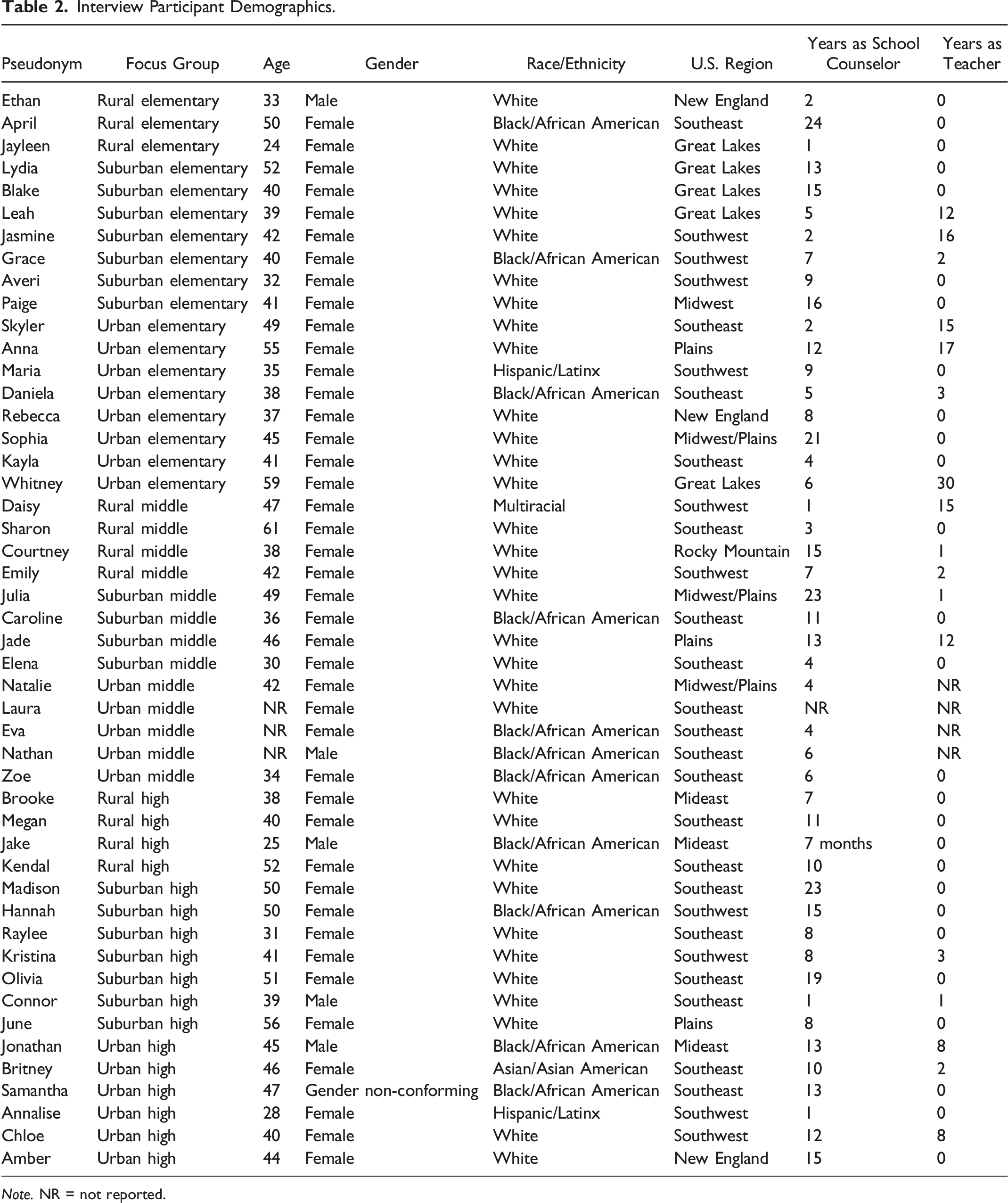
Note. NR = not reported.
Data Collection
The current study utilized focus groups to collect school counselors’ knowledge of and experiences with social development in classroom curriculums. For the nine focus groups, participants were assigned based on grade levels (i.e., elementary, middle, high) and school settings (i.e., rural, suburban, urban). Focus groups lasted 60–90 minutes, and each participant received compensation of a $100 gift card for their participation. Focus group interviews were conducted via Zoom to accommodate participants who were geographically spread across the United States. Teams of faculty and doctoral students facilitated focus groups. Each focus group was recorded and transcribed verbatim.
Data Analysis
For this investigation, we drew from elements of a constructivist grounded theory (CGT) approach to analyze the data (Charmaz, 2014). CGT is a contemporary version of grounded theory that stresses the importance of “social contexts, interaction, sharing viewpoints, and interpretive understandings” (Charmaz, 2014, p. 14). We found this approach useful because CGT acknowledges the subjectivity of social life and the interconnection of knowing, learning, and perceptions of social life. Data analysis proceeded in four stages. First, our team members read and reread the focus group interview transcripts to familiarize themselves with the data set. Next, we used open coding to identify a set of initial codes. Specifically, we read each transcript, noting how our participants communicated about social development in the classroom curriculum and experiences with students’ social and emotional development. Third, we engaged in axial coding. We reread each transcript and used the initial codes from open coding to compare participant experiences across focus groups. Finally, we selected distinct codes salient across multiple focus groups and organized them into themes. Only themes relevant to exploring school counselors’ perceptions of how they can support and facilitate students’ social development post-pandemic are presented here. The focus group data presented in our findings section exemplify these themes.
Trustworthiness
We pursued multiple strategies to ensure the trustworthiness of our investigation. These included coordinated communication and coding cross-checking for our research team; member checking; and rich, thick descriptions (Creswell & Creswell, 2023). Specifically, each research team member was assigned primary and secondary data analysis responsibilities.
After completing the first round of analysis, each team member offered either a new analysis of each focus group transcript or a review of the primary analysis. As a result, each participant interview was analyzed at least twice and reviewed at least once. This allowed for multiple reviews and richer interpretations of the data. We also used member checking to ensure that the collaborative research data analysis resulted in accurate interpretations of participant experiences. Specifically, we checked in with our participants at multiple points in the research process. We asked them to reflect on whether and how well our rendering of their experiences represented their realities. This collaborative approach validated our research team’s interpretations and allowed participants to clarify or expand on their original contributions.
Finally, we used rich, thick descriptions to provide a detailed account of our participants’ contexts and experiences. These descriptions included complex narratives that captured the nuances of the participants’ experiences in their respective schools and state contexts. In concert, these methods helped us assure the trustworthiness of our interpretations.
Positionality
Acknowledging the research team’s presence and positionality throughout the research process is also essential. Our team included three faculty members and four doctoral students. Author 1 is a South Korean female doctoral student whose research focuses on exploring the sense of belonging among marginalized students in educational settings. Author 2 is a Southeast Asian American female doctoral student whose research explores sense of mattering for underrepresented students. Author 3 is a White male doctoral student whose research centers on organizational culture, socialization, and leadership within higher education. Author 4 is a White female doctoral student whose research explores social skills interventions. Author 5 is a Black male faculty member whose work centers on equity, diversity, and the role of interpersonal relationships in the success of college and university stakeholders. Author 6 is a White female faculty member whose work centers on school counselor education and the scholarship of teaching and learning. Author 7 is a White male faculty member whose scholarship focuses on academic belonging and advocating for school counselors to conduct more mental health services in K–12 settings, related explicitly to counseling interventions that strongly emphasize marginalized youth and social justice initiatives.
Our identities, backgrounds, and perspectives differ, so reflexivity was essential to our process. Each time we met as a team, we shared our interpretations of the data, acknowledging the different entry points and understandings based on our perspectives. Our individual and collective perspectives on school counselors’ roles in post-pandemic classrooms evolved throughout this project. This undoubtedly affected our sensitivity to specific concepts in the data and our decisions as we wrote this article. We have continued to engage each other’s perspectives throughout the writing process, examining how our respective histories and experiences influence our results.
Results
Themes/Subthemes.

Theme 1: Interpersonal/Communication Skills
The first theme revolves around interpersonal and communication skills and yielded four subthemes: (a) role shift in school counselors, (b) social regression, (c) emotion regulation, and (d) the need for classroom lessons on social skills and emotion regulation. These subthemes reflect interactions across multiple ecological systems. School counselors have the unique opportunity to help students navigate and connect with multiple microsystems within their lives, including relationships with family, peers, teachers, counselors, and other school personnel. Participants recognized that the COVID-19 pandemic, a major sociohistorical event at the chronosystem level, severely disrupted students’ social development.
Role Shift in School Counselors
With changes in academic settings during the pandemic due to various lockdowns and a switch to hybrid or virtual learning, students had limited access to multiple relationships and supports within their microsystems. Given these changes, school counselors reported a significant shift in their role, placing greater emphasis on teaching students basic social skills after the return to in-person schooling. This shift reflects changes in the immediate environment of students’ microsystems. As Lydia, an elementary school counselor, shared: And I think, for some of our students, at least in the past 2 years, between my kindergartners and my first graders, the lack of social skills that they have come in with and the lack of educational skills because they've missed preschool and they don't know how to communicate to one another—so I’ve noticed that my role has changed a lot in that. Even mornings at breakfast, I’ll go sit with kids and show them how we’re supposed to talk to one another because I don’t know what happened, but I think everybody forgot that that’s what we’re supposed to do. So I think our role has changed especially because of COVID.
Likewise, several high school counselors reported feeling a shift in their roles to address students’ in-person communication skills. For instance, Chloe, a high school counselor, reported: I know communication skills are big right now. Not just typing but face-to-face communication. So many of my kids have social anxiety right now, and we could literally role-play how to ask the teacher to look over their essay before they turn it in. Because they’re so used to Google classroom messaging or emailing their teacher from being at home learning virtually that they’ve kind of gotten out of habit of talking to people face to face, and it adds a level of stress or anxiety for them.
Social Regression
School counselors observed a regression in students’ social behaviors, indicating disruptions in the mesosystem interactions between home and school environments. Many participants indicated that the social behaviors exhibited by students were below the age-appropriate standards established before the pandemic. For example, Madison, a high school counselor, shared: I feel like, with the pandemic . . . when these kids come in from our middle school, it’s like they’re not even really like ninth graders. It’s almost like getting a seventh grader. Their behaviors and the discipline referrals have been through the roof. It’s nonstop. Our administrators are running around chasing kids all day. And we’re seeing behaviors that, normally, you would see in elementary and middle school kids, we’re seeing at the high school. It’s almost like they’re stunted, developmentally. It’s not just academically. At least, I mean, that’s what I’ve seen this past year.
This phenomenon was also echoed in focus groups with elementary and middle school counselors. For instance, Sophia, an elementary counselor, said: I don’t know if it’s the most critical, but I know I have seen a huge increase in the need for social skills. Kids are about 2 years younger than they should be socially, and they’re really struggling with how to get along with each other.
Emotion Regulation
In particular, many of the school counselors noted a significant increase in incidents of relational aggression due to emotional dysregulation, demonstrating a lack of respect exhibited toward teachers and peers. Participants emphasized the need for equipping students with coping skills to address their challenges in emotion regulation. This increase in students’ difficulties with emotion regulation reflects challenges in the microsystem (individual emotional experiences) and mesosystem (interactions between peer and school environments). For instance, Elena, a middle school counselor, expressed: I would just want to echo that because I have felt like this past year was dealing with situations where students felt like—or I felt like they were going from zero to 60 in a matter of seconds. Sitting in the cafeteria and somebody bumps into them, and they stand up and say profanities, and I'm going to fight you when we get outside. . . . So I definitely echo the need for coping skills because it just feels a lot like we’re putting out fires, so I want to be more proactive this school year in trying to lead some of those things so that we’re not having to deal with them as much.
Need for Classroom Lessons on Social Skills and Emotion Regulation
To address the evolving social needs of students, school counselors emphasized the need to integrate lessons on relationship building, communication skills, and emotion regulation into the classroom curriculum. This reflects the need for changes in the exosystem, particularly in curriculum and instructional approaches. For example, Eva, a middle school counselor, suggested: I think building healthy relationships is another topic that they need, because a lot of kids don’t know what that looks like or even what that means in terms of friendships, family, and even social media. How do I interact with somebody? Is this kind or unkind? Is this loving or not loving? Oh, well, maybe they’re not a friend because they just did X, Y and Z. A lot of our kids don’t understand interpersonal interactions. So I think healthy relationships with boundaries, interpersonal interactions is a big one, [inaudible] growth mindset. And then I do a critical thinking one to help them start to kind of understand how to begin to connect the pieces.
Theme 2: Online Communication
The second theme explores issues related to online communication, encompassing three subthemes: (a) digital citizenship, (b) social media, and (c) the need for classroom lessons on digital citizenship. Of the various concerns regarding the impact of online communication, most participants expressed that the heightened reliance on social media for communication during the pandemic had further complicated students’ social skills development.
Digital Citizenship
School counselors noted how social media has evolved into a platform for cyberbullying and disrespect toward peers, contributing to the worsening of youth mental health. This was coupled with conversations about the importance of digital citizenship in students’ online social interactions. For example, Laura, a middle school counselor, reported: I’ve been having a lot of conversations with my students just talking to them about what you put out there [social media] really doesn't go away. You have Snapchat, TikTok, and they think it just ends up in the cloud or it disappears and I’m like, “If you go viral and everyone sees that, and they search up your name—“ so I’m constantly having conversations around digital citizenship, which also, I think, ties a lot with what we’re seeing with cyberbullying, and then kids just experiencing depression, anxiety.
These conversations are evidence of a shift in the macrosystem of social expectations around online communication and behavior.
Social Media
Several school counselors noted that their students struggled to establish meaningful connections with their schools and peers in the aftermath of the pandemic. Participants emphasized that social challenges and feelings of disconnection in classrooms could be attributed to the increased prevalence of social media usage among students since the pandemic. Students’ increased reliance on social media for communication reflects a change across multiple levels, including the microsystem (social media is a more prominent part of students’ daily interactions), macrosystem (broader cultural shifts have occurred in how we use and view technology in the educational system), and the chronosystem (the pandemic is a significant life event that has altered the course of development for countless students). To illustrate this point, Eva, a middle school counselor, shared: They [students] already used social media a lot before the pandemic. And then that became their only form of communication, so I think a lot of kids don’t know how to interact or engage with people in an appropriate way.
Need for Classroom Lessons on Digital Citizenship
School counselors stressed the importance of integrating lessons on digital citizenship into the school counseling curriculum to address the social challenges students face in today’s digital age. Given the widespread use of social media and digital communication among students, participants viewed these lessons as essential for promoting socially appropriate behavior online. This reflects necessary changes in the exosystem (school curriculum) and macrosystem (social norms around technology use). For example, Caroline, a middle school counselor, offered: And then how to handle yourself on social media and how something that could seem so minor, so minute, when put out there into the universe, it’s there. And I say those things in those order because there are some things that are happening on socials that impact respect for self and respect for others. So all of those, kind of tied together. I do feel like there are great curriculums out there for school counseling, but I do feel like they are outdated. And there’s really nothing in this whole 2022 realm, where I feel like I'm adding current stuff to the current curriculums that we have.
Discussion
The current study examined the perceptions and experiences of school counselors related to students’ social skills within post-pandemic classrooms. We also explored participants’ recommendations concerning classroom lessons designed to address students’ social needs. Adopting a CGT approach (Charmaz, 2014), we aimed in this study to explore and amplify the voices and insights of school counselors. This approach allowed us to gain a deeper understanding of their experiences within post-pandemic classrooms and to explore their visions for the evolution of classroom lessons in response to the challenges presented.
Our findings indicate clear themes related to school counselors’ experiences with students’ social challenges after the pandemic. Across all focus groups, counselors consistently observed a significant decline in students’ interpersonal and communication skills. This decline was attributed to the disruptions caused by the COVID-19 pandemic, presenting as social regression, emotion dysregulation, and a rise in inappropriate social interactions and behaviors within school settings. These findings align with existing literature that underscores the substantial barriers students face in developing social skills for fostering positive relationships at school during virtual learning (Alexander et al., 2022; Günindi, 2022). Our study reinforces recent literature indicating that prolonged restriction of in-person social contact and community engagement potentially hindered students’ social skills.
In response to this emerging social need, school counselors recommended teaching healthy relationships, emotion regulation, and conflict resolution in classrooms to support students’ ability to navigate social interactions effectively. Although various studies have emphasized the significance of addressing these skill sets through small groups or school-based programs (Betters-Bubon & Donohue, 2016; Stephens et al., 2010; Tuttle et al., 2020), we noted a gap in the literature explicitly discussing the importance of classroom lessons delivered by school counselors to nurture these skills among students. This study emphasizes the pivotal role of school counselors in shaping students’ social/emotional development through targeted classroom interventions.
Further, participants expressed concerns about students’ online engagement, linking increased social media use during the pandemic to social skills deficits. They particularly stressed the need to address cyberbullying and inappropriate online interactions, aligning with existing research on the rise of such incidents during the COVID-19 pandemic (Kee et al., 2022). Although our findings resonate with the literature indicating heightened social media use during school closures (Hudimova, 2021; Kee et al., 2022; Nilsson et al., 2022), research that establishes a direct causal relationship between online engagement and social skills is scarce. Our study suggests that students’ reliance on social media during the pandemic may have further limited opportunities for social skills development.
As challenges with social skills persist in the post-pandemic era, characterized by virtual learning and online interactions, understanding students’ engagement in the online environment is crucial. School counselors emphasized the importance of adapting classroom lessons to address appropriate online behaviors, preparing students to navigate the challenges of the digital environment. This aligns with existing literature advocating for teaching digital citizenship to K–12 students in schools (Martin et al., 2019, 2020). The present study emphasizes the vital need for school counselors to implement classroom lessons to cultivate students’ digital citizenship in the post-pandemic era.
Implications
These qualitative findings offer valuable implications for school counselors in post-pandemic K–12 education, highlighting key areas of social/emotional development that would be particularly helpful to focus on in classroom lessons. Approaching this inquiry from the EST perspective, we see that forces at all system levels impact students and school counselors in their navigation of social interactions in various contexts. This includes the intrapersonal difficulties for both students and school counselors and their interactions with and responses to their immediate and global environments. Given that our findings highlight the far-reaching consequences of the pandemic on students’ social development, school counselors should emphasize social skills, specifically relationship skills and emotion regulation, in their classroom lessons. The latter will help students reconnect to their in-person peers and community as they navigate the ever-present challenges of social media and the digital world, even after schools have returned to their typical in-person functions (Waterschoot et al., 2023).
Our findings contribute to the existing literature by highlighting the substantial benefits of using classroom interventions to foster students’ social skills both within and beyond the classroom. School counselors, who are already tasked with implementing classroom curricula (ASCA, 2019), can effectively incorporate lessons that promote students’ social communication and emotion regulation skills. This benefit is reflected by previous studies demonstrating the positive impact of classroom interventions on teaching social and emotional skills (Caldarella et al., 2019; Green et al., 2021; Slaten, Lee, et al., 2024). Further, our findings suggest that, despite the significant challenges counselors have reported in delivering classroom lessons in the post-pandemic era (Slaten, Wachter-Morris et al., 2024), schools and policymakers can promote the widespread adoption of this approach by actively supporting its development and implementation.
Building on these insights, it is essential to consider the broader context in which these interventions are applied. The pandemic not only affected how youth socialize but also heightened awareness of racism and social unrest in America. The resulting racial, economic, and academic disparities highlight the need for school counselors to embrace culturally responsive approaches to social/emotional learning (Ladson-Billings, 2021). To deliver effective classroom lessons on social skills, school counselors must acknowledge and value the diverse cultural backgrounds of their students by facilitating inclusive discussions and activities. This approach can help validate and sustain the cultural experiences of all students, especially those from marginalized communities. School counselors should strive to create interventions and programs that acknowledge and actively support their students’ diverse cultural practices. This may involve reimagining traditional social skills curricula to include culturally diverse examples, communication styles, and problem-solving approaches. By prioritizing cultural competence and sociopolitical awareness, school counselors can more effectively support the social development of all students.
Furthermore, adopting an antiracist stance in social/emotional learning, as outlined by Mayes and colleagues (2022), requires school counselors to critically examine how systemic racism may be impacting their students’ social development and actively work to dismantle these barriers. This could include advocating for more equitable school policies, providing targeted support for students of color who may have been disproportionately affected by the pandemic, and facilitating discussions about race and racism as part of social skills development. By integrating antiracist practices, school counselors can create more inclusive and effective interventions that better serve all students in the post-pandemic educational landscape.
Finally, the extension of EST to school counselors and their charges aids in thinking about key social relationships in the context of a global rearrangement of business operations in families, schools, and communities. Our research suggests that the increased use of online communication may have restricted the opportunity for students to develop critical social learning competencies, such as social awareness, relationship skills, and responsible decision making. This emphasizes the need for critical evaluation of online communication in K–12 education and the potential outcomes of its usage in social development. This suggestion is also consistent with the recommendations provided by the Collaborative for Academic, Social, and Emotional Learning (CASEL, 2012), highlighting the significance of holistic development and learning in students.
Limitations and Future Research
Because the scope of this study was limited to the reflections, stories, and perceptions collected from school counselors, these qualitative findings may be limited in their generalizability. The participants’ identities may have shaped their perceptions and responses regarding students’ social skills. School counselors’ race, culture, and personal experiences can influence their judgments about appropriate social skills; therefore, these potential biases cannot be fully accounted for in this study. Further, the study does not include input from teachers, parents, or other school personnel who may have alternative perceptions of students’ social needs. Insight into students’ own lived experiences also is lacking in this study. Although integrating these perspectives might have facilitated a greater understanding of students’ social needs in post-pandemic classrooms, it would have altered the study’s main objectives.
Future research should involve a more diverse sample of school counselors and utilize mixed or quantitative methods to address current limitations and offer a more comprehensive understanding of students’ social skills. Scholars should also continue to examine how students from marginalized groups socialize and communicate with dominant groups, and explore cross-racial interactions. The pandemic has intensified these dynamics, making consideration of these ecological systems crucial when assessing students’ social skills. Future research also should focus on developing culturally and contextually responsive practices for teaching social skills to ensure they do not perpetuate racism, bias, and oppression (Bonilla-Silva, 2022; Ladson-Billings, 2021; Simmons, 2021).
Another aspect of future research should be inclusion of multiple viewpoints to develop a more comprehensive perspective of students’ social needs. Our study design and interview questions strongly emphasized classroom lessons, and this may have exclusively skewed participants’ responses toward discussion within classroom contexts. Future research should consider individual and small-group interventions, particularly regarding social skills development in the post-COVID-19 era.
Because this study’s data was collected in 2022, a year after students returned to in-person classrooms, the results reflect the immediate concerns following students’ return to school after a prolonged period of remote learning. In other words, participants might provide different results if the study was conducted in the current context with additional years following the return to full-time, in-person learning. The study is also limited in providing insights into the evolving needs of students over extended periods. Thus, future researchers could design a longitudinal study that facilitates a greater understanding of students’ social needs and their respective evolution year to year. This could provide valuable insight into how post-pandemic classrooms evolve, given the effects of the COVID-19 pandemic.
Last, although our study was based on Bronfenbrenner’s EST model, we expanded the original framework by integrating the digital environment. Our findings account for the historical events and crises (i.e., the COVID-19 pandemic) that influenced the means and prevalence of students’ online engagement, leading to difficulties with in-person social interactions. Thus, our findings confirm that digital media has become an intrinsic aspect of students’ daily lives, and that online and offline spaces interact in complex ways. Future studies employing EST should concentrate on the mesosystem, which considers interactions between the varying microsystems. Further, as evidenced by the findings of this inquiry and as research progresses regarding digital citizenship, newer iterations of EST can consider how the online environment influences students’ social/emotional skills as the consequences of the pandemic continue to shape student development in K–12 education.
Conclusion
This study aimed to expand on the recent scholarship regarding students’ distinct social needs and concerns after the COVID-19 pandemic by delving into school counselors’ experiences and perception. Although the literature consistently emphasizes the significance of social skills (Casillas et al., 2012; Cole, 1990; Gresham, 1982; Malecki & Elliot, 2002; Mayer, 1995; Peacock Hill Working Group, 1991; Risisky et al., 2019; Séguin & MacDonald, 2018; Wijaya et al., 2022), research has been lacking regarding how school counselors can effectively implement classroom curriculums to address this matter. Specifically, the subjective experiences of school counselors regarding students’ social skills in the post-pandemic context remained underexplored. This qualitative study provides novel insight by demonstrating how school counselors across the nation share common experiences related to K–12 students’ social challenges in the aftermath of COVID-19. This study can guide school counseling researchers, stakeholders, and teachers in supporting school counselors in delivering classroom lessons adapted to current students’ social needs by emphasizing social skills and digital citizenship development. Future research should expand the scope of literature and intervention studies on social skills, with a specific emphasis on online environments and culturally responsive and sustaining approaches, ensuring inclusivity and relevance to diverse student populations.
Footnotes
Declaration of Conflicting Interests
The author(s) declared no potential conflicts of interest with respect to the research, authorship, and/or publication of this article.
Funding
The author(s) disclosed receipt of the following financial support for the research, authorship, and/or publication of this article: This work was supported by the Missouri Department of Elementary and Secondary Education.
