




Abstract
A junior/senior high school counselor used an innovative psychoeducational group counseling curriculum based on cognitive behavioral therapy to meet the social/emotional needs of identified students. This article provides a summary and evaluation of the small group plan conducted via practitioner research. Results indicated that, although participants’ overall feelings of anxiety did not significantly improve, the curriculum enabled study participants to meet defined learning objectives. We discuss implications for school counselors.
Many children struggling with anxiety have persistent fear, worry, and other debilitating symptoms that can impede school performance (Centers for Disease Control and Prevention [CDC], 2022). Even prior to the onset of the COVID-19 pandemic, researchers found that students struggling with anxiety were likely to experience symptoms that could negatively affect their involvement in school (American Academy of Child & Adolescent Psychiatry, 2017). Further, COVID-19 resulted in an increase in anxiety across academic, personal, and social/emotional areas (Chardavoyne & Olympia, 2021). The decreased contact with peers, instability in school attendance, and challenging home situations related to the pandemic contributed to an increased difficulty with school performance (Fegert et al., 2020).
School counselors have an ethical responsibility to utilize evidence-based best practices that will address students’ social/emotional needs and remove barriers to learning (American School Counselor Association [ASCA], 2022). As an integral part of a comprehensive school counseling program, group counseling is one time-efficient modality that has proven effective in meeting the needs of multiple students grouped together to achieve similar goals (Zyromski et al., 2018). Cognitive behavioral therapy (CBT) has long been established as an effective treatment for the reduction of anxiety (Chowdhury & Khandoker, 2023). Therefore, group CBT may be an ideal treatment in a school setting “because it is evidence based and is a more efficient treatment modality than individual counseling” (Thompson et al., 2013, p. 227). This article describes one junior/senior high school counselor’s effort to implement a CBT-based group counseling plan with students experiencing feelings of anxiety.
Cognitive Behavioral Therapy to Minimize Anxiety
Although anxiety is a pervasive mental health concern affecting society, it is highly treatable with appraisal and evidence-based practices, such as CBT (American Psychological Association [APA], 2013; Rose, 2019). In fact, CBT has been established as a highly effective, evidence-based intervention for treating anxiety and is even considered the gold standard for treatment (Chowdhury & Khandoker, 2023). The theoretical rationale underlying CBT is based on the interrelationship between thoughts, behaviors, and feelings. When an individual experiences dysfunctional thoughts, they may also suffer psychologically. This is generally explained by the Cognitive Model (Beck, 2020), which illustrates that distorted perceptions lead to unhealthy emotions and behaviors. Relating to the presence of anxiety specifically, the Risk/Resource Model (Clark & Beck, 2010) is a more specified cognitive model that provides additional information about how distorted perceptions can lead to overwhelming fear and anxiety. According to the Risk/Resource Model, anxiety can develop when the distorted perception is one that amplifies the risk to the individual and underestimates the resources available to help overcome that risk. This model provides a framework for understanding the development of anxiety and a practical, two-pronged counseling approach for treatment: When individuals strive to have a more realistic view of the risk and an increased recognition of their resources to help face that risk, anxiety should decrease.
Research has long backed the use of CBT as an effective treatment modality to combat anxiety. In a meta-analysis of 41 studies, Carpenter et al. (2018) found that CBT is one of the most effective therapeutic treatments for persons with mild to profound anxiety. Likewise, from a systematic review of 66 studies, Ost et al. (2023) found that CBT interventions had superior results when included in routine clinical care for anxiety disorders. Furthermore, studies have shown CBT to have sustained positive effects long after treatment cessation; with decreased impairment, increased life satisfaction, increased employment, and better overall functioning reported 6.5 years posttreatment (Swan et al., 2018).
The long-term benefits of CBT interventions with children and adolescents, specifically, are apparent. According to Mukund and Jena (2022), CBT techniques proved to help children and adolescents overcome cognitive, emotional, and behavioral aspects of anxiety. Similarly, Swan et al. (2018) found positive, long-term results when early intervention and CBT treatment were implemented with anxious youth. In a school setting, CBT techniques can be adapted and applied to the needs of students with or without a clinical diagnosis of anxiety (Joyce-Beaulieu & Sulkowski, 2019). In fact, compared to those without a cognitive component, school-based interventions that included CBT were found to be more effective in reducing anxiety and improving coping mechanisms (Collins et al., 2014). Further, schools can be an ideal setting to implement preventive CBT interventions to school-aged children, with access to a larger population to identify those in need and at risk (van Loon et al., 2020). The school setting also provides opportunities for regular check-ins, learning to recognize triggers, practicing self-regulation techniques, adapting strategies for stressors, and gradually facing fears in a controlled environment.
CBT interventions can also be used in a group counseling format, increasing the benefits for overall improved wellness. In one study of a CBT group for anxiety, not only did participants’ anxious feelings decrease, but participants reported feelings of relief and pleasant surprise to meet and interact with individuals experiencing similar challenges (Christensen et al., 2023). School counselors can follow this example and provide opportunities for support and collaboration for students. Data from one study validated the need for small-group counseling approaches that target the social/emotional needs of students (Steen et al., 2022). As an integral part of a comprehensive school counseling program (ASCA, 2019), group counseling effectively serves more students and addresses the demands of rising school counselor caseloads with evidence-based practices (Springer et al., 2018).
As an experienced school counselor and counselor educator, the first author created a CBT model for which the name, BREAK FREE (Mitchell et al., 2023), offers a helpful mnemonic and systematic approach to understand and minimize anxiety. The first author presented the BREAK FREE model at professional development trainings, universities, and counseling conferences and later converted it into a small-group counseling curriculum for adolescents called BREAK FREE and Fly (BFF). As a practicing school counselor, the fourth author of this article noticed a rise in general anxiety concerns within the student body, even prior to COVID-19. Not only were student self-referrals increasing, but teachers and parents were expressing more concerns, and the small, rural school and community had limited mental health services. This school counselor saw the necessity to offer additional resources to meet this increasing demand, particularly with interventions that were evidence based and time efficient.
In collaboration, the school counselor (fourth author) and the BFF creator (first author) decided to cofacilitate a small BFF counseling group. The systematic application of a CBT approach to help minimize anxiety was received positively by the students and their parents. Shortly after this group was conducted, COVID-19 occurred and the rise in student anxiety in the general population became even more apparent. Upon returning from virtual learning, the fourth author decided to offer the BFF group again, this time as the sole facilitator and including a pre-/post-intervention survey. The purpose of this practitioner research is to analyze the results of the BFF group counseling curriculum for effectiveness and possible modification for future use.
Method
A CBT psychoeducational group counseling curriculum was implemented to meet the social/emotional needs of identified students in one school setting. Practitioner research is a form of action research that school counselors can conduct to evaluate and improve their selection of direct services for a particular population or need (Kaffenberger, 2012). This form of research can inform the school counseling profession about barriers and benefits of interventions, adapting methods, and improving practices (Sheikhattari et al., 2022) for the success of students. Because the data was obtained for quality assessment purposes and used as archival data, our research team submitted an IRB application; however, approval was not required.
Participants
The fourth author implemented the BFF psychoeducational group counseling plan for identified students attending a rural junior/senior high school in the northeastern United States. The school has approximately 365 students enrolled in Grades 7–12. The racial/ethnic makeup of the student population is 94% White, 1% Black, 2% Hispanic, 1% Asian, and 2% identifying as two or more races. The socioeconomic background for the school population is primarily lower to middle class, with 39% eligible for free or reduced lunch.
In response to the increased student needs, the school counselor surveyed teachers to identify students who would benefit from participating in the BFF group. The school counselor also advertised the group to the student body and allowed students to self-refer for the counseling group. Eight students were referred or self-referred and returned a signed informed consent and parent permission to participate in the group.
Although this was not the school counselor’s intent, all eight of the participants were seventh-grade female students. Of the eight, seven were White and one was multiracial. Two of the students were included in the free and reduced lunch program. One participating student had a 504 Plan and two had an IEP. During the screening process, all eight students reported generalized feelings of anxiety, worry, and/or fear. One student described a sometimes debilitating struggle with a specific, weather-related phobia.
Intervention
The BFF curriculum is based on the BREAK FREE approach, which is grounded in the assumptions of the Risk/Resource Model (Clark & Beck, 2010). To lay a foundation for the BFF curriculum, we provide a brief overview of the BREAK FREE model and refer readers to the seminal article by Mitchell et al. (2023) for a more comprehensive review. The BREAK FREE approach leads practitioners through a comprehensive application of CBT techniques to improve self-regulating strategies, identify faulty thought processes, and evaluate and challenge an escalated perception of the risk, as well as an underestimated perception of resources and strengths. B = Breathe R = Recognize the fear E = Evaluate the evidence A = Acknowledge your resources K = Know it! F = Form your motivation R = Recalibrate your mind E = Embrace an experience E = Expect good things (Mitchell et al., 2023, p. 605)
In the first step, Breathe, individuals learn to recognize the physical and behavioral symptoms of anxiety and the need to regulate the heightened physiological response to fearful stimuli (Field et al., 2015). The group introduces calming techniques such as deep breathing, grounding techniques, and mindfulness exercises, and explores contributing factors such as nutrition (Norwitz & Naidoo, 2021), movement (Mikkelsen et al., 2017), and sleep (Harvey et al., 2011).
In the second step, Recognize the Fear, individuals identify any irrational fear(s) leading to their feelings of anxiety and work to externalize the fear as an entity that is separate and changeable (White & Epston, 1990). Subsequently, in Evaluate the Evidence, participants evaluate the identified fear as a faulty perception that must be challenged. Through Socratic questioning, school counselors can help individuals assess the evidence supporting and contradicting the fear. As a result, individuals can move from an irrational, exaggerated perception to a more realistic perception of fear. For example, catastrophic thinking and a fear of rejection during the college application process could result in maladaptive coping mechanisms such as avoidance. Through careful evaluation, a high school student can recognize the existing, distorted thought pattern and come to a reasonable perception of the risk.
The next step, Acknowledge Your Resources, encourages individuals to address the resource side of the Risk/Resource Model (Clark & Beck, 2010). In this step, school counselors can support increased awareness of personal resources, both internal and external, that individuals have available to help them meet any realistic risk. Using the same example, the high school student can recognize their previous achievements and who or what was helpful when a goal was not easily met in the past. Next, in Know It!, school counselors can assist students in modifying the unhealthy core belief contributing to the distorted thinking patterns. Thought records can help to uncover patterns, and repetition can support replacement of irrational thinking with healthier thought processes.
When exposure techniques are incorporated into counseling, the effects on decreasing anxiety are long lasting (Parker et al., 2018). Thus, the remainder of the BREAK FREE approach prepares and guides students through this process. In Form Your Motivation, individuals determine personal goals that may be inhibited by existing fear. Through a cost–benefit analysis, they determine what can be gained by confronting their fear. Next, in Recalibrate Your Mind, participants consider how they view success and failure and work to adopt a growth mindset, which values effort over success (Dweck, 2017). This is followed by Embrace an Experience, during which the school counselor and student can collaboratively plan small steps to gradually face a fear deemed valuable and essential for confrontation. In the example of the high school student afraid of college rejection, the student may choose to first apply to a school that they view as less desirable and perceive as less risky. The school counselor and student should also implement problem solving here to help overcome barriers that may be contributing to anxiety. For example, in this case, does the student have the skills needed to complete an application and admissions essay, and to gather the required documents?
Finally, in Expect Good Things, school counselors work with individuals to follow through with established goals and celebrate attempts and progress. Attention is given to the idea of anxiety tolerance and normalization of all emotions, with emphasis on the expectation of good outcomes, rather than perfect outcomes. The student can also use any newly created evidence produced in these accomplishments to challenge remaining irrational fears and dysfunctional thoughts.
The CBT-based BFF psychoeducational group counseling plan was structured into 10 sessions with the first session giving an overview of anxiety, the Cognitive Model (Beck, 2020) and the Risk/Resource Model (Clark & Beck, 2010). Also in the first session, the school counselor and group members collaborated on group rules to establish feelings of safety and security for the group members. Sessions 2 through 10 were designated for each of the nine BREAK FREE steps. Appendix 1 provides an overview of the 10 sessions, including the learning objectives, activities, and resources/materials. The group plan contains learning objectives intentionally aligned to the following ASCA Student Standards (ASCA, 2021): B-SMS 6. Ability to identify and overcome barriers, and B-SMS 7. Effective coping skills. The group is also designed to promote the mindset M 1. Belief in development of whole self, including healthy balance of mental, social/emotional, and physical well-being.
Students completed the pre-test (see Appendix 2) during the first session and then took the same survey as a post-test in the final session. The group met once a week with each session lasting approximately 45 minutes. Each group began with a check-in to gauge how members were feeling or progressing since the previous meeting. The school counselor then shared a summary of the previous session and asked members to share how they had implemented any of the skills and concepts since their last time together. Bridging was used to connect the sessions and the BFF group plan was followed accordingly, with a variety of activities, reflection exercises, and/or roleplay to engage students in the session content. At the end of each session, group members debriefed and summarized what had been learned and established personal goals for the week to come. The school counselor encouraged members to ask questions throughout the session and used feedback to adjust group plans and discussions as needed.
Measures
The first author created a pre- and post-intervention survey (see Appendix 2) to gather perception data on student progress and the effectiveness of the BFF group. Care was taken to create developmentally appropriate phrases that would contribute to student readability and comprehension (Hardy & Ford, 2014). Because offering too many response options can limit the internal consistency and test-retest reliability (Simms et al., 2019), the item responses used a 5-point Likert-type scale ranging from 1 (strongly disagree) to 5 (strongly agree). The 10 survey questions were: (a) I experience anxiety daily, (b) Anxiety affects my ability to focus at school, (c) Anxiety affects my desire or ability to participate in activities, (d) Anxiety affects my ability to make friends, (e) I try to avoid school because of my anxiety, (f) I know what triggers my anxiety, (g) It’s my thoughts that make me feel anxious or stressed, (h) I can identify faulty thought processes that can lead to stress and anxiety, (i) If I change my thoughts, my anxiety will decrease, and (j) I can identify at least three positive coping strategies that help with my anxiety.
To add clarity, the survey defined anxiety as “feelings of worry, nervousness, or unease.” It also explained the physical symptoms of anxiety as “increased heartbeat, rapid breathing, sweating, trembling, or a ‘nervous’ stomach.” It explained the psychological symptoms of anxiety as “trouble concentrating or thinking about anything other than our present worries.” The school counselor used Questions 1–5 to determine each students’ level of need. Questions 6–10 allowed the school counselor to see progress on the learning objectives and identified ASCA Student Standards (ASCA, 2021). To protect student identity, the school counselor removed all identifiable information from the pre- and post-tests before sharing them with the other three authors.
Results
Pre-Test and Post-Test Means and Percent Change.
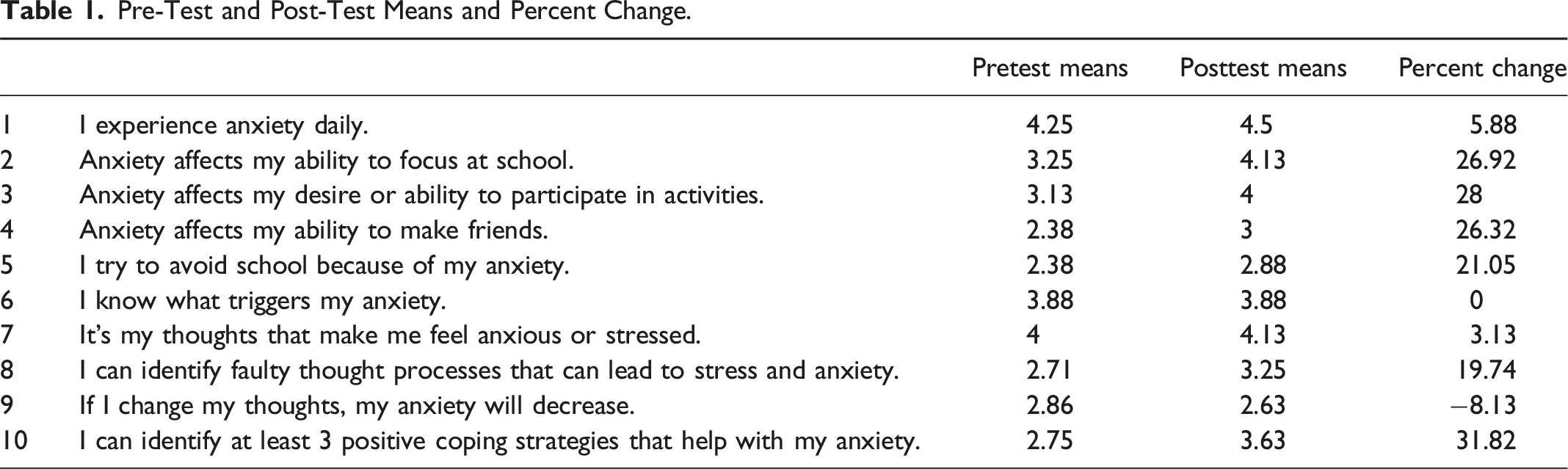
Questions 1–5 did not show significant changes or reductions on the posttest scale. For example, no students experienced a decrease in daily anxiety (Question 1). Most students (n = 7) reported an increased or stagnant score on the post-test when asked if anxiety affects their ability to focus at school (Question 2). Results showed a 28% increase for “Anxiety affects my desire or ability to participate in activities” (Question 3) and a 26% increase for “Anxiety affects my ability to make friends” (Question 4). Most students (n = 7) reported little or no change in trying to avoid school because of anxiety (Question 5), and results showed no change in knowing what triggers their anxiety (Question 6). In response to Question 9, “If I change my thoughts, my anxiety will decrease,” most students (n = 6) reported little or no difference.
Discussion
The BFF group curriculum was designed and implemented as a psychoeducational group and not a psychotherapy group; therefore, we had differing goals in analyzing the perception data. The primary goal of psychoeducational small counseling groups is to gain knowledge and new skills that will lead to long-term change. When analyzing participant data in this study, we found that students reported an increased awareness on the connection between cognitions and feelings (Question 7). Specifically, students showed an increase in the ability to identify faulty cognitions that lead to stress and anxiety (Question 8), a central tenet of CBT. This growth relates to the learning objectives in BFF sessions 1, 3, 4, and 6. Further, these results align with the ASCA Student Standard M1. Belief in development of whole self, including healthy balance of mental, social/emotional, and physical well-being, and address the standard B-SMS 6. Ability to identify and overcome barriers (ASCA, 2021). Identifying faulty cognitions is a vital step toward overcoming anxiety, priming the student for continual growth after the group has ended. In this study, the school counselor noted that one student who had experienced social anxiety learned to better recognize social cues and no longer assumed she was the negative focus of any group of people who were laughing/talking. This student reported fewer cognitive distortions and anxious feelings in social situations.
In Question 10, results showed participants’ increased ability to identify at least three coping strategies to help reduce anxious thoughts. This question relates to the ASCA Student Standard B-SMS 7. Effective coping skills (ASCA, 2021). In alignment with the Risk/Resource Model (Clark & Beck, 2010), when students preventively employ healthy coping skills and face their fears, maladaptive perceptions of risks are minimized and anxiety is reduced. In our study, the school counselor noted that several students articulated application of learned skills beyond the conclusion of the group. For example, one student described an ability to employ coping mechanisms and experienced less fear when working through a weather-related phobia. Another student in the group specifically applied the BFF steps to their fear of separation and no longer sought counseling for this concern.
In further analyzing the pre-test and post-test data from the BFF group, we noted that results did not reflect improvement in reported anxiety symptoms. Questions 1–5 showed an increase on the post-test survey indicating a rise in symptoms and effects of anxiety. However, these results can also be indicative of the increased self-awareness and knowledge assessed in Questions 7 and 8. The data suggest a paradoxical effect of the improvement, in which the self-reported results more accurately reflect how anxiety impacts the students’ daily lives. As a result of the BFF group, students better understood the impact of anxiety on their ability to focus (Question 2), participate in social and/or school activities (Question 3), and make friends (Question 4). Another consideration of this outcome could be potential bias in self-reporting due to social desirability. Extraneous factors also must be considered, such as one student reporting relationship difficulties at the time of the posttest survey.
Implications for School Counselors
In alignment with current literature, this CBT school counseling group curriculum for anxiety was effective in addressing the learning objectives. When the BFF group plan was implemented as part of a comprehensive school counseling program, the school counselor efficiently imparted information to achieve learning objectives and positively impact the social/emotional development of multiple students within her large caseload. The Cognitive Model (Beck, 2020) and Risk/Resource Model (Clark & Beck, 2010) provided a framework to help students understand the development of anxiety and how to counteract the cognitive distortions that led to anxious symptoms. Students acquired positive coping strategies that helped various forms of anxiety, including social anxiety, separation anxiety, and a specific fear or phobia.
Although CBT approaches have long proven to be effective in reducing anxiety (Chowdhury & Khandoker, 2023), researchers have reported an implementation gap in the use of exposure-based interventions, a central component in CBT and a vital element in reducing anxiety in children and adolescents (Sars & Minnen, 2015; Waters & Craske, 2016). The BFF group curriculum addresses this implementation gap by providing school counselors with a step-by-step process for utilizing exposure-based interventions. This approach provides an opportunity to identify debilitating fears and their negative impact on students’ lived experiences. From this identification, students then work to systematically reduce the distorted perception of the fear, increase their confidence and coping mechanisms, and build the motivation to face the fear. Continuing through the BFF steps, students and school counselors can then collaborate on a plan for the students to slowly expose themselves to the fear, celebrate small achievements that help to build confidence, and further minimize their distorted perceptions. This exposure-based process is the mechanism underlying CBT that leads to a long-term reduction in anxiety (Sars & Minnen, 2015).
One of the greatest benefits of implementing the BFF group was students’ grasp of the simplified understanding of the Cognitive Model (Beck, 2020) and the Risk/Resource Model (Clark & Beck, 2010), which could be utilized school wide. Therefore, implementing the BFF plan across all levels of a multitiered system of supports framework would help to systematically meet varying needs of the student body. Supporting individual and group counseling, school counselors can adapt this curriculum for classroom instruction and school-wide programming as part of a comprehensive school counseling program. By utilizing the BFF curriculum for prevention and early intervention, school counselors can teach students lifelong skills that will aid in their wellness and development. For example, after the group in this study, participating students expressed appreciation for the activities, exercises, and the discreet and light-hearted BFF group name. Further, the easily recalled BREAK FREE acronym and common language could be used by teachers, coaches, and parents when supporting students with anxiety. When used school wide, the culminating content in Session 10, Expect Good Things/Fly It Forward, supports school initiatives of character education and positive behavior.
Another implication of the BFF curriculum is that school counselors will systematically engage with students and learn more about their specific needs. Although school counselors don’t provide long-term counseling for psychological disorders, they can recognize students who need more assistance than what is provided and offer referrals. Finally, when meeting the social/emotional needs of students, school counselors must also keep in mind that student anxiety could be the result of a real risk, not a perceived risk. When school counselors recognize that a risk is real, such as in situations of abuse or bullying, the counseling goals change. No longer is the goal to minimize the perception of the risk; instead, the goal is assessment, intervention, advocacy, and support.
Limitations and Future Research
Practitioner research provides a framework for school counselors to systematically and intentionally reflect upon practice to further understand what is effective and what can be improved (Sheikhattari et al., 2022). Therefore, we share the limitations of this study, such as the lack of a control group or an additional group conducted by a different school counselor, to examine the possible influence of the group leader’s personality and skill. Also limiting were the small number of participants and the homogeneity of the participant group. Future research that includes a larger sample size and/or a more diverse body of students would offer a more robust analysis of the BFF group curriculum.
Another limitation to consider is the validity of the data collected in the pre- and post-intervention surveys. The survey data have a potential for reporting bias because students may have self-reported low or high in the initial survey, which would lessen the significance of any increase or decrease. Further, students gaining knowledge and awareness throughout the group could have contributed to a higher rating of related items on the post-intervention survey. School counselors choosing to implement the BFF curriculum may want to select a different measurement tool or adjust the survey items to more accurately evaluate the learning objectives and psychoeducational nature of the group. For example, instead of having students self-report on a Likert-type scale survey, school counselors could ask students to list learned coping mechanisms at the end of the group. This information would give a clearer representation of the skills gained. To support student perception data, school counselors could collect outcome data such as absenteeism and frequency of visits to the school counseling office. Qualitative feedback from students, teachers, and parents would also provide helpful information as well. Finally, a case study would add contextual depth and allow researchers to capture the lived reality of a student engaging in the BFF group counseling experience.
Conclusion
Anxiety remains a pervasive experience for students, and school counselors require useful tools such as the BFF curriculum to address and reduce this barrier to student success. Group counseling has been recommended as a key component of a comprehensive school counseling program (ASCA, 2020) and CBT interventions are some of the most effective approaches for reducing feelings of fear and anxiety (Norton & Price, 2007). However, implementation gaps are not uncommon (Sars & Minnen, 2015). The current study measured students’ feelings and knowledge of anxiety before and after participating in a CBT-based, psychoeducational, small-group counseling intervention designed to align with ASCA Student Standards (ASCA, 2021). The intervention was successful in helping students obtain knowledge and learn helpful coping mechanisms, both of which are crucial steps toward a long-term reduction in anxiety. Finally, when implemented as part of individual, group, and school-wide programming, this evidence-based CBT approach could benefit all students.
Footnotes
Declaration of Conflicting Interests
The author(s) declared no potential conflicts of interest with respect to the research, authorship, and/or publication of this article.
Funding
The author(s) received no financial support for the research, authorship, and/or publication of this article.

Appendix
BREAK FREE and Fly (BFF) Small-Group Sessions.
ASCA Student Standards: Mindsets & Behaviors (ASCA, 2021)
• M 1. Belief in development of whole self, including healthy balance of mental, social/emotional, and physical well-being
• B-SMS 6. Ability to identify and overcome barriers
• B-SMS 7. Effective coping skills
Session topics
Learning objectives
Activities
Resources/materials
Session #1:
Introduction and OverviewStudents will describe the role of perception in the development of emotions.
Students will describe the error in perception that can result in fear and anxiety.
Students will identify two common faulty thought processes.Complete the “Two Truths
Discuss the role of perceptions in the development of emotions.
Discuss the error in perceptions that can lead to fear and anxiety.
Discuss common faulty thought processes (e.g., all-or-nothing thinking).• Student folders
• Session 1 worksheets
• Pencils
Session #2:
BreatheStudents will identify three symptoms of anxiety.
Students will select three calming strategies for future use.Define and discuss deep breathing, grounding techniques, mindful coloring, worry containment, and other strategies.
Practice deep breathing and grounding technique.
Practice mindful coloring on BFF cover sheet.• Student folders
• Session 2 worksheets
• BFF cover sheet
• Colored pencils or markers
Session #3:
Recognize the FearStudents will describe a situation that evokes anxiety.
Students will identify the fear underlying common forms of anxiety.
Students will explain that their fear is a changeable emotion.Discuss common forms of anxiety and what fear is underlying that anxiety.
Discuss the power of naming and externalizing your fear.• Student folders
• Session 3 worksheets
• Pencils
Session #4:
Evaluate the EvidenceStudents will assess an identified fear based on the Risk/Resource Model.
Students will evaluate the evidence supporting and discrediting the identified fear.Discuss the importance of evaluating the evidence that supports the fear and the evidence that discredits the fear.
Define and discuss fact-checking, looking at historical evidence, and what is known to be true.
Discuss the worst that could happen, the best that could happen, and the most likely.• Student folders
• Session 4 worksheets
• Pencils
Session #5:
Acknowledge Your ResourcesStudents will list two internal resources available to help them face identified fear.
Students will list two external resources.Discuss how resources are overlooked.
Define and discuss external and internal resources.
Complete the Resource Scavenger Hunt.• Student folders
• Session 5 worksheets
• Pencils
Session #6:
Know it!Students will revise a faulty thought and create a healthy replacement for it.
Students will create three Reality Reminders (positive affirmation cards) that support the healthy thought.Discuss the importance of replacing faulty, automatic thoughts with healthy ones.
Create Reality Reminders (personal affirmations).• Student folders
• Session 6 worksheets
• Pencils
Session #7:
Form Your MotivationStudents will identify 5 personal values.
Students will compile a list of advantages and disadvantages of facing their fears.Discuss facing fears as the best way to discredit them.
Complete the value sort activity and discuss how fear could be limiting these areas of life.
Complete a cost-benefit analysis and discuss benefits of avoiding fear and benefits of facing a fear.• Student folders
• Session 7 worksheets
• Value sort activity
• Cost-benefit analysis worksheet
• Pencils
Session #8:
Recalibrate Your MindStudents will explain how one’s perceptions can become skewed.
Students will explain the difference between a growth mindset and a fixed mindset.Discuss the importance of testing fearful thoughts.
Discuss the importance of a growth mindset vs. a fixed mindset.• Student folders
• Session 8 worksheets
• Pencils
Session #9:
Embrace an ExperienceStudents will identify a fear they would like to conquer.
Students will identify and analyze one small step toward facing their fear.Discuss the realities the group has discovered about identified fears.
Discuss creating and taking small steps toward facing a fear.
Discuss creating a SMART goal and the help of a reward system.• Student folders
• Session 9 worksheets
• Pencils
Session #10:
Expect Good Things/Fly It ForwardStudents will discuss information gained, new tools discovered, and plans for the future.
Students will consider shifting from a self-focused to an other-focused perspective.
Students will prepare to use their new tools to help others.Discuss and celebrate growth and learning that has taken place over last 10 weeks.
Define and discuss a self-focused perspective and an other-focused perspective.
Discuss BREAK FREE and Fly, and BREAK FREE and Fly it Forward.• Student folders
• Session 10 worksheets
• Pencils