




Abstract
Anti-transgender school policies have proliferated in the United States from 2019 to 2024, impacting school climate for transgender and nonbinary learners. In this quantitative study, we examined differences in the experiences of school climate factors (e.g., safety, mattering, mental health outcomes, etc.) between male, female, and nonbinary high school students in Virginia (N = 219,233) using a gender minority stress framework. Nonbinary students reported greater exposure to distal and proximal minority stressors and worse mental health outcomes than male or female students. We explore implications for school counselors.
Introduction
More adolescents in the United States openly identify as lesbian, gay, bisexual, transgender, and queer/questioning (LGBTQ+) than ever before, with between 9.5% and 15.9% of youth identifying as LGBTQ+ (Conron, 2020; Jones, 2021). Among people aged 13 to 18 who identify as LGBTQ+, as many as 26% identify as nonbinary and another 20% are exploring whether they may be nonbinary (Trevor Project, 2021). Despite progress in Americans’ attitudes toward LGBTQ+ people (Fetner, 2016), nonbinary people face unique stigma related to their gender identity (Russell, 2021). Nonbinary youths’ school experiences are important elements of well-being (Kelley et al., 2022), yet a record number of school policies targeting transgender and nonbinary youth were introduced in 2023 (Choi, 2023).
Nonbinary youth experience serious mental health inequities compared with their cisgender peers. In 2022, 53% of nonbinary youth seriously considered suicide and nearly 20% attempted suicide (Trevor Project, 2022). Nonbinary and transgender youth endorse more symptoms of generalized anxiety disorder and major depressive disorder than do cisgender youth (Trevor Project, 2022). Studies have also shown that nonbinary youth experience worse outcomes than their binary transgender peers (i.e., transgender men and women). In a comparison of youth who identified as cisgender, transgender, or nonbinary, Aparicio-Garcia et al. (2018) found that nonbinary participants received less social support, experienced more cyberbullying, and felt more isolated and unhappy compared to both the cisgender and transgender groups. Another study found that nonbinary youth experienced greater anxiety and depression compared with binary transgender youth, and reported lower self-esteem despite no significant differences in social support (Thorne et al., 2019).
These disparities are of particular relevance to school counselors, whose roles as advocates include supporting LGBTQ+ students (American School Counselor Association [ASCA], 2022b). Qualitative and quantitative research suggests that school counselors have positive attitudes toward LGBTQ+ students (Beck & Wikoff, 2020; Simons & Cuadrado, 2018; Wikoff & Wood, 2022), yet they may lack self-efficacy and competence in implementing advocacy and counseling interventions for this population (Abreu et al., 2022; Shi & Doud, 2017; Simons & Cuadrado, 2018). Even less is known about school counselor preparedness to support transgender and nonbinary students specifically, although the role of school counselors as advocates is highlighted across conceptual applications of school counseling for this population (e.g., Gonzalez & McNulty, 2010; Meyer et al., 2021). Given the importance of school climate to nonbinary students’ well-being and the role of school counselors in supporting these students, we aim to explore how school climate may impact mental health disparities among nonbinary students, with implications for school counselors.
Gender Minority Stress Theory
One explanation for inequitable mental health outcomes among nonbinary youth is Gender Minority Stress Theory, which posits that gender and sexual minority people encounter unique social stressors based in societal stigma and discrimination specific to their marginalized identities (i.e., minority stressors; Meyer, 2003; Testa et al., 2017). Distal minority stressors involve objective events or contextual conditions, such as exposure to stigma, discrimination, or victimization, whereas proximal minority stressors involve subjective personal processes related to self-identity (Meyer, 2003). Testa et al. (2017) identified distinct distal stressors (e.g., gender-related discrimination, gender-related rejection, gender-related victimization, non-affirmation of gender identity) and proximal stressors (e.g., internalized cissexism, negative expectations, identity concealment) impacting gender minority people. Nonbinary youth experience these stressors and the normative stressors encountered by peers their age, while also experiencing stressors related to other minoritized identities.
Understanding how gender minority stressors negatively impact nonbinary youths’ mental health is essential. Hatzenbuehler (2009) proposed the Psychological Mediation Framework to help explain the mechanisms by which minority stress negatively impacts sexual minority people’s health; this frame has been applied in subsequent iterations of minority stress theory (e.g., Testa et al., 2017). Essentially, nonbinary adolescents are exposed to distal stressors because of pervasive cissexism in U.S. culture; this exposure to distal stressors leads to exposure to proximal stressors via psychological processes (Hatzenbuehler, 2009). For example, if a nonbinary student encounters gender-related rejection from teachers and peers (a distal stressor), they may begin to expect rejection in interpersonal interactions (a proximal stressor). Psychological processes, including adaptive and maladaptive coping, then mediate the effects of the distal stressors on mental health outcomes (Hatzenbuehler, 2009).
Research related to nonbinary youths’ mental health outcomes supports Gender Minority Stress Theory. For example, not using a nonbinary person’s pronouns is a form of non-affirmation of gender identity, a distal stressor in Gender Minority Stress Theory (Testa et al., 2017). In 2021, nonbinary youth who reported that none of the people in their lives respected their pronouns were 2.5 times more likely to attempt suicide compared with nonbinary youth who experienced support from most of the people that they knew (Trevor Project, 2021). Accessing gender-affirming care also decreased rates of mental health symptoms among transgender and nonbinary youth, including symptoms of anxiety, depression, and suicidality (Tordoff et al., 2022). These findings suggest that exposure to stressors may contribute to poorer mental health among nonbinary youth, whereas affirmation and support may improve outcomes.
The Impact of School Climate
School climate, or the quality and character of school life (National School Climate Council, 2007), may be a source of minority stress or support for nonbinary students. Accepting school climates are associated with decreased risk of suicide attempts among nonbinary and transgender students, but only half of these students identified school as a gender-affirming place (Trevor Project, 2022). Nonbinary students miss school more often and are more likely to fail a subject compared with binary youth (Durbeej et al., 2021), possibly due to discrimination experienced at school. Nearly a third of LGBTQ+ students reported missing at least one day at school in a given month due to feeling unsafe, and more than three in four LGBTQ+ students avoided school functions and extracurricular activities for the same reason (Kosciw et al., 2020). Although Kosciw et al.’s (2020) data were not broken out by gender identity, nonbinary students reported more hostile school environments than did cisgender sexual minority students.
School systems that empower school counselors to support LGBTQ+ students are one clear example of positive school climate, and school counselors highlighted the importance of supportive climates in past research. In a qualitative study of school counselors, Simons and Cuadrado (2018) found that subjective norms in participants’ school settings were often barriers to engaging in advocacy on behalf of LGBTQ+ students. School counselors who worked at schools with a Gender-Sexuality Alliance (GSA), perceived the environment to be welcoming, and had collaborative relationships with their principals were more likely to engage in LGBTQ+ advocacy than those who did not (Wikoff & Wood, 2022). Similarly, Abreu et al. (2022) found that school counselors in schools with GSAs were more likely to have LGBTQ+-specific postgraduate training and to feel more prepared to work with LGBTQ+ students.
Despite the evidence that positive school climate is associated with better outcomes for nonbinary students (Trevor Project, 2022), few studies have explicitly explored nonbinary students’ experiences in schools. This paucity of research is concerning, particularly given the recent proliferation of policies targeting transgender and nonbinary youth in K–12 settings in the United States (Choi, 2023). In 2023, 600 bills were introduced in the United States targeting transgender people, primarily youth, 87 of which passed into law (Trans Legislation Tracker, nd). States across the country passed laws or issued guidance in 2023 that prohibited schools from withholding student information about gender identity from parents and guardians (e.g., Florida HB 1557, 2022; Alabama SB 184, 2022; Oklahoma State Department of Education, 2023). Other laws and regulations include restricting transgender and nonbinary students from participating in sports associated with their gender identity (e.g., Wyoming SFO133, 2023/SEA No. 92, 2022) and prohibiting the use of students’ pronouns and chosen names (e.g., North Dakota HB 1522, 2023).
Indeed, as of April 2024, half of U.S. states have laws or regulations banning transgender athletes from playing sports associated with their gender, 24 ban best practice medical care for transgender youth, 10 ban transgender youth from using bathrooms and facilities consistent with their gender identity, and 26 have no discrimination protections for LGBTQ+ students (Movement Advancement Project, nd). These policies reflect potentially hostile school climates at a national level that may inhibit nonbinary students’ educational attainment, well-being, and growth and development.
The Present Study
A recent example includes the proposed Virginia 2022 Model Policies on the Privacy, Dignity, and Respect for All Students and Parents in Virginia’s Public Schools regulation (Virginia Department of Education [VDOE], 2022). The proposed regulation would replace the 2021 Model Policies for the Treatment of Transgender Students, a policy that protected transgender youth in schools by ensuring use of their chosen name and pronouns, protecting access to bathrooms and locker rooms, and enacting antibullying policies specific to gender identity. The new policy would require school personnel to disclose transgender children’s identities to their family, require use of bathrooms and locker rooms associated with one’s sex assigned at birth regardless of current gender identity, and prohibit participation in prosocial activities such as sports associated with one’s gender identity. These new policies may increase exposure to minority stressors for nonbinary students in Virginia.
Therefore, investigating nonbinary students’ experiences in schools is necessary to better understand how school climate impacts mental health and other important developmental constructs. We conducted a secondary analysis of school climate data drawn from high school students to address the following research questions: 1. How does the experience of safety in school (including bullying) differ between gender nonbinary and gender binary students? 2. How does the experience of belongingness and connection in school differ among gender nonbinary and gender binary students? 3. How does the experience of mental health (including suicidality) in school differ for gender nonbinary and gender binary students?
Methods
The purpose of this study was to understand mental health and well-being of nonbinary youth and to determine the relationship between gender identity and perceptions of wellness. We were interested in whether gender identity of students explains differences on the Patient Health Questionnaire-4 (PHQ-4), which measures the core symptoms of depression and anxiety. This study received human subjects approval by the research team at Virginia Polytechnic Institute and State University Institutional Review Board.
Data Collection
All schools in Virginia are required to complete an annual safety audit that details the safety conditions of each school (Virginia Code §22.1-279.8). To achieve this legislative directive, the Virginia Department of Education (DOE) and Virginia Department of Criminal Justice Services’ (DCJS) Virginia Center for School and Campus Safety annually administers the Virginia School Survey of Climate and Working Conditions to students in middle schools (odd number years) and high schools (even number years).
Data used in the current study came from the 2022 administration of this survey, administered to 219,233 high school students attending Virginia secondary schools during the 2021–2022 academic year. All students within sample schools were eligible to participate. The principal sent an information letter to the parents or guardians of each student invited to participate in the survey. The letter explained the purpose of the survey and offered an option to decline participation. The survey was administered January through March 2022. All surveys were completed online using school-specific access codes. Division and school name were confirmed by the participant. An online survey response tracking system was used to monitor response rates in near real-time. School and division leaders and the survey administration team used this system to monitor progress throughout the survey administration period. Electronic and phone communication were used to communicate with points of contact to improve response rates.
Study Measures
The 2022 Virginia School Survey of Climate and Working Conditions is a valid and reliable tool used to identify patterns of perceptions among students and adults on the school climate and working conditions. The survey was available in English and Spanish versions, and “read along” instructions were provided for students who required accommodations. The survey consisted of 113 total items. For purposes of this study, we used the student survey and data only, focused specifically on items included in the climate and mental health sections of the survey. The complete student survey is available online at the Virginia DCJS public website (https://www.dcjs.virginia.gov/virginia-center-school-and-campus-safety/programs/virginia-school-survey-climate-and-working). We describe study variables and their associated measures in greater depth below.
Gender Identity
Gender is the central independent variable in this study and a primary axis for data analysis. The dataset measured gender as a categorical variable through a single item that asked participants “Are you male or female?” The response options were: Male, Female, Nonbinary, and Prefer Not to Disclose. For the purpose of this study, we created a single gender binary group consisting of students who selected male or female. The gender nonbinary group represents students who selected nonbinary on the survey item. We did not include in this study those who selected Prefer Not to Disclose.
Mental Health
We measured the subjective mental health of student respondents using the Patient Health Questionnaire-4 (PHQ-4), one of the most commonly used screeners for anxiety and depression (Kroenke et al., 2009). This ultra-brief screener combines items from the Patient Health Questionnaire-2 (PHQ-2), the most validated 2-item screener for depression (Kroenke et al., 2003), and the Generalized Anxiety Disorder Scale (GAD-2), with items representing core anxiety symptoms (Plummer et al., 2016). PHQ-4 scores are operationally categorized as normal (0–2), mild (3–5), moderate (6–8), and severe (9–12). Although an elevated PHQ-4 score does not serve diagnostic purposes, the tool is an early indicator of core symptoms of anxiety and depression. Previous research supports the PHQ-4 as a reliable and valid screener for anxiety and depression (Cano-Vindel et al., 2018; Kroenke et al., 2009; Mills et al., 2015), including with adolescents (Materu et al., 2020; Sander et al., 2021; Watson et al., 2020). Kroenke et al. (2009) found the PHQ-4 had strong correlations with longer instruments (e.g., Short Form Health Survey [SF-20]) and internal reliability (Chronbach’s α) above .80. Construct validity was assessed by analysis of covariance to examine associations between symptom severity on the PHQ-4 scale and SF-20 functional status scales. Factorial validity was established through confirmatory factor analysis and showed two distinct factors.
Suicidality was another relevant mental health variable for this study, measured using a single, dichotomous item. The item asked participants to consider the most recent 12 months and indicate whether they had seriously considered attempting suicide during that time. The response options were Yes and No.
Climate Indicators
We measured mattering, a proximal stressor, using the survey’s Belongingness measure. This 7-item scale included “I feel like I belong at this school,” “I regularly attend school-sponsored events,” and “I regularly participate in extracurricular activities.” Response options to each item were rated on a scale of 1 (strongly disagree) to 6 (strongly agree). Reliability was estimated at the individual (.83) and school (.82) levels with Cronbach’s alpha. Construct validity was estimated with standardized factor loadings from a two-level confirmatory factor analysis (CFA). Thirty thousand cases were randomly selected to estimate the loadings. Items ranged from .59 to .91 at the student level and .58 to .97 at the school level.
We also measured prevalence of bullying, a distal stressor, using a 6-item scale that included items focused on overall perception of bullying at the school and bullying that targets groups based on social or cultural characteristics (i.e., race/ethnicity, sexual orientation, physical appearance, having too much/too little money, disability). Response options were identical to the belongingness scale items. Reliability was estimated at the individual (.92) and school (.92) levels with Cronbach’s alpha. Construct validity was estimated with standardized factor loadings from a two-level CFA. Thirty thousand cases were randomly selected to estimate the loadings. Items ranged from .82 to .88 at the student level and .96 to 1.00 at the school level.
Participant Characteristics
The data represents responses from 219,233 high school students in grades 9 (n = 65,336), 10 (n = 57,439), 11 (n = 52,360), and 12 (n = 44,098) across 99.4% of eligible schools in the Commonwealth of Virginia (66.3% response rate). The sample includes 7791 (3.6%) who identified as nonbinary; this is consistent with prior studies estimating that between 1.8% (Johns et al., 2019) and 9.2% (Kidd et al., 2021) of high school students identify as gender diverse, including nonbinary identity. Male (n = 101,054, [46.3%]) and female (n = 98,612 [45.2%]) responses were consistent with the population of students in the Commonwealth. Of the respondents, 10,670 (4.9%) selected “prefer not to disclose,” while 0.05% did not respond to the gender identity question.
Data Analysis Procedures
Each research question was addressed in succession. We used analysis of variance (ANOVA) to determine if statistically significant differences existed between each continuous dependent variable and a gender identity. Specifically, we conducted a series of one-way ANOVAs to compare mean scores between binary and nonbinary identity groups. Where the results of the one-way ANOVA test revealed a significant difference (p < .05) between the gender mean scores, we conducted a post hoc test to determine where the differences in the mean scores occurred.
For the one-way ANOVA, we evaluated the standard statistical assumptions of normality and homogeneity. Normality assumes the scores were normally distributed; we assessed this using the Shapiro-Wilks test. If the Shapiro-Wilks test generates a p value greater than 0.05, the data are considered normally distributed. Homogeneity assumes both groups have equal error variances; we assessed this using Levene’s test for the Equality of Error Variances. If the Levene’s test generates a p value greater than 0.05, the data are considered homogeneous. Our data met these requirements for all analyses. We also examined several chi-square tests to assess the relationship between gender identity and students’ experiences related to suicide. We conducted separate analyses on suicidal ideation and suicide attempts.
Results
Descriptive Statistics
ANOVA Comparisons of Survey Measures.

*p < .001.
Research Question 1: Experiences of Safety
Table 1 illustrates ANOVA results of how students experienced safety in schools. As illustrated, student perceptions of safety in school significantly differed (p < .001) across gender identity, F (3, 216450) = 2565.92, p = .000, η2 = 0.34, with nonbinary students indicating significantly lower perceptions of safety in school (M = 4.13, SD = 1.22) than male (M = 4.89, SD = 0.95) or female (M = 4.78, SD = 0.93) students. Experiences of bullying also varied across student groups, F (3, 218123) = 4840.699, p = .000, η2 = 0.041. Gender nonbinary students reported significantly more (p < .01) encounters with bullying (M = 3.89, SD = 1.33) as compared to their gender binary peers (male: M = 2.96, SD = 1.23; female: M = 3.4, SD = 1.25).
LSD Test for Nonbinary Participants.
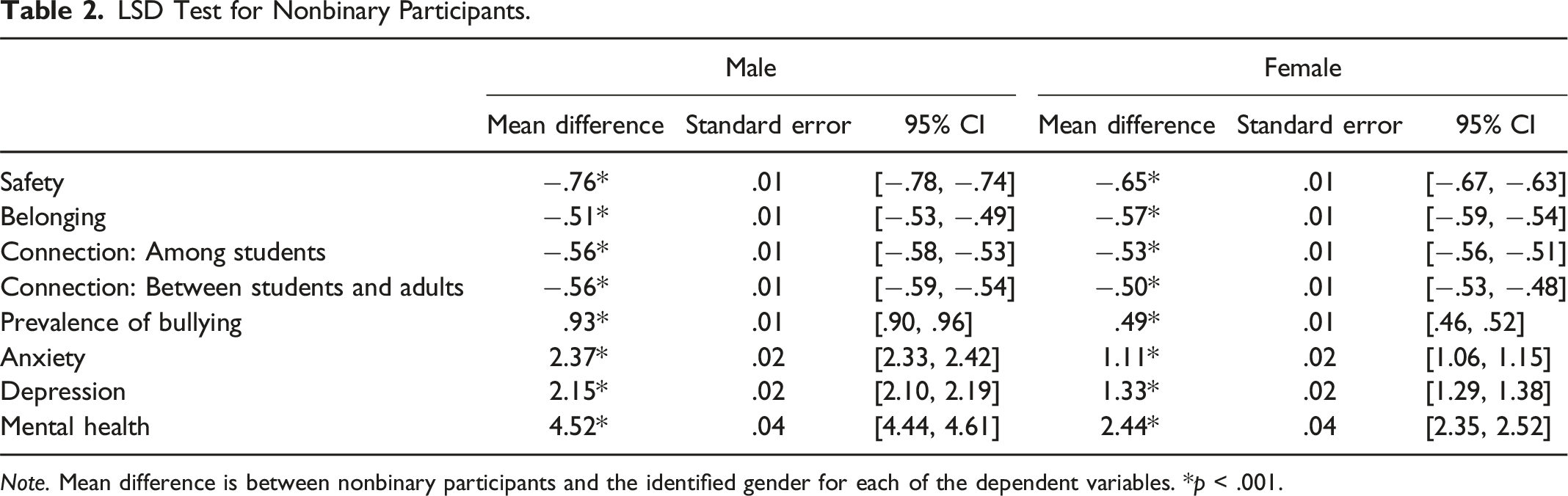
Note. Mean difference is between nonbinary participants and the identified gender for each of the dependent variables. *p < .001.
Student Perceptions of School Climate.

Research Question 2: Sense of Belongingness and Connection
Select items of the survey assess whether students feel a sense of belonging and connection in their school. We first explored the relationships among students. Results indicated that gender nonbinary students reported lower quality relationships among students, F (3, 218123) = 1285.795, p = .000, η2 = 0.017, as compared to gender binary peers. We found similar results between students and adults, with reports of lower quality relationships between nonbinary students and adults at school, F (3, 218123) = 1504.912, p = .000, η2 = 0.02, as compared to male and female students.
Our study also explored nonbinary students’ sense of belongingness at school. Results of the one-way ANOVA of belongingness indicated significant mean differences between male, female, and gender nonbinary students, with gender nonbinary students reporting a significantly lower sense of belonging than their peers, F (3, 218123) = 1536.795, p = .000, η2 = 0.021. Beyond the concept of belonging is a sense of mattering, and students’ belief that adults in the school building care about them. Our analyses indicated that only 71.9% of nonbinary students felt they matter to adults at school, compared to 85.8% of male and 83% of female students who felt they matter and would be noticed if absent. Further, in contrast to their male (34.8%) and female (37.2%) counterparts, the majority of gender nonbinary students (56.1%) did not feel other students at their school care about them.
Research Question 3: Mental Health
Student Mental Health Flags.

Student Suicidal Ideation by Gender.

χ2(3) = 8648.575, p < .001.
We also found a significant relationship between gender identity and suicide attempts over the past year, χ2 (12) = 306.784, p < .001, with 23.2% of nonbinary students (n = 3560) indicating they attempted suicide two or three times and 12.9% (n = 1103) reporting six or more suicide attempts. One survey item asks students to indicate if there is an adult to whom they can turn to for help if they feel sad or hopeless, to which more than half of nonbinary students (55.2%) indicated no or not sure.
Discussion
Our findings provide insight into how school climate may operate in a gender minority stress context for nonbinary high school students. Nonbinary students indicated that they encounter both distal and proximal stressors in their school climates at higher rates than their male or female counterparts. Using a gender minority stress framework (Testa et al., 2017), these minority stressors may explain the inequitable mental health outcomes for nonbinary students observed in our sample.
Among distal stressors, nonbinary students endorsed poorer quality relationships with other students and adults in their schools and higher experiences of bullying. Both represent external factors that may negatively influence their mental health and contribute to proximal stressors through psychological mediation processes (Hatzenbuehler, 2009). Previous research demonstrates that these concerns are not limited to this sample. In a qualitative study, transgender and nonbinary youth reported encountering lack of knowledge from students and teachers, cisnormative school cultures, and even inappropriate comments both from other students and from adults in the schools (Kelley et al., 2022). These experiences may lead to poorer quality relationships and less perceived social support in school settings. Compared with binary transgender students, nonbinary students have indicated that they are less likely to be out to teachers or to use teachers as a support (Allen et al., 2020). Experiences of bullying are also prevalent among transgender and nonbinary youth. Day et al. (2018) found that transgender students in California experienced more victimization in schools than cisgender students, with transgender students having odds of gender-related bullying more than three times higher compared with their peers.
Exclusionary state and school policies may also contribute to experiences of distal stressors. Notably, data in Day et al.’s (2018) study were collected between 2013 and 2015 and respondents were located in California, where legal protections have existed for transgender students since 2013 (Mahoney et al., 2015). In Virginia, however, most public schools rejected inclusive transgender policies in 2021 (Cline, 2022), leaving nonbinary students in our sample without protections from school policy. Although it is evident that even inclusive policies do not protect against experiences of individual bias, anti-transgender policies—such as not allowing students to use the bathroom associated with their gender identity or preventing students from using a chosen name and pronouns—have deleterious effects on transgender and nonbinary students’ mental health (Richgels et al., 2021). These policies also make it more challenging for students to have recourse when they encounter bullying, rejection, and discrimination (Richgels et al., 2021). In contrast, schools that are inclusive of sexual and gender minority students appear to have positive effects on transgender and nonbinary youth. For example, engagement with GSAs was associated with more support and greater socialization for both cisgender and transgender youth (Poteat et al., 2016).
Distal stressors represented by negative experiences in schools, along with policies that leave students vulnerable, may increase exposure to proximal stressors via psychological processes, as posited by Hatzenbuehler (2009). Nonbinary students experienced less belonging and less safety in their schools compared with students who identified as male or female. These perceptions may reflect internalization of the students’ negative experiences in schools. Hatchel and Marx (2018) found that peer victimization, such as bullying, predicted decreased belongingness in school contexts for nonbinary students; this supported gender minority stress processes as a potential pathway for the negative effects of school climate on nonbinary students’ mental health. That nonbinary students lacked a sense of belonging in school is especially alarming, given that having affirming or supportive adults is a well-documented protective factor for transgender and nonbinary youth (Trevor Project, 2021, 2022).
Nonbinary students’ exposure to minority stressors in school settings is reflected in inequitable mental health outcomes between gender binary and nonbinary students, as would be expected by Gender Minority Stress Theory (Hatzenbuehler, 2009; Testa et al., 2017). Indeed, nonbinary students in our sample endorsed significantly more anxiety and depression than did their male and female counterparts. This is aligned with previous findings about nonbinary youth (Trevor Project, 2021) and for transgender youth more broadly (Borgogna et al., 2019; Tordoff et al., 2022). Given the disparities in experiences of school climate, safety, and belonging among nonbinary students in our sample, disaffirming and/or unsupportive school systems likely contribute to these negative mental health outcomes. Nationally, only half of nonbinary and transgender students identify their schools as gender affirming (Trevor Project, 2022), and many of these schools are likely located in places that provide formal protections for transgender and nonbinary students. In school systems without such legal or policy protections, additional efforts may be needed to adequately support nonbinary students in K–12 settings.
Implications for Teachers and Staff
School climate and school-specific stressors appear to contribute to minority stress for nonbinary high school students. Nonbinary students reported poorer relationships with adults in schools, including teachers and staff, and a decreased sense of belonging compared with binary students. Therefore, a key way that teachers and staff can reduce minority stressors for nonbinary students is through building intentional relationships to facilitate a greater sense of belonging. Perhaps one of the most important ways to do so is to use nonbinary students’ names and pronouns correctly (Trevor Project, 2021); however, teachers receive minimal training related to LGBTQ+ topics (Clark & Kosciw, 2022), including nonbinary identity, which may introduce challenges when trying to create affirmative school environments for nonbinary students. Further, teachers have reported that they are not confident engaging in LGBTQ + -inclusive teaching, especially in regard to teaching other educators how to support LGBTQ+ students (Clark & Kosciw, 2022). Therefore, professional development for teachers and other school staff are a key intervention that may improve school climate for this population (CDC, nd).
Implications for School Counselors
School counselors serve as advocates for all students, including transgender and nonbinary students, and play an active role in nurturing a positive school climate (ASCA, 2022b). School counselors can support nonbinary students through direct and indirect services. For example, direct services may include creating affirming spaces in the counseling office (e.g., displaying pride flags or rainbow artwork in districts where pride flags are disallowed) and developing support groups and classroom lessons specifically for nonbinary students. A Delphi study of 14 school counseling experts identified specific strategies for supporting LGBTQ+ students that included conducting classroom lessons focused on heteronormativity, reducing hetero- and cissexism, and antibullying specific to LGBTQ+ identity (Strear, 2017).
A key finding in our study was that nonbinary students experience less belonging and mattering than students whose gender identity falls on the binary. School counselors can play a key role in increasing belonging. For example, school counselors may consider sponsoring support groups such as GSAs to create formal spaces of recognition. Strear (2017) also recommended that school counselors develop peer leadership or peer counseling groups to facilitate older LGBTQ+ students mentoring younger LGBTQ+ students, which could also support nonbinary students’ sense of belonging. In disaffirming contexts, explicit services for nonbinary student groups may not be possible; therefore, some school counselors may consider developing small groups focused on processing experiences with bullying and developing social connections, and target nonbinary students in the school for inclusion in the group intervention.
Indirect services are another way school counselors can support nonbinary youth, including consultation, collaboration, and referrals. As mentioned above, teachers may have limited knowledge on how best to support LGBTQ+ students. Therefore, school counselors can advocate on behalf of students by providing consultation and psychoeducation to increase school personnel’s knowledge and skills for supporting nonbinary students (Strear, 2017). School counselors may also find collaborating with mental health counselors in the school or community to be an effective way to increase their own capacity for addressing the increased mental health needs of nonbinary youth. Indeed, a primary recommendation from the Delphi study of school counseling professionals was to develop knowledge of LGBTQ+-affirming resources in the community as referral sources (Strear, 2017). This is especially relevant in K–12 contexts with disaffirming policies, where explicit LGBTQ+ support may be impossible. Although school counselors can focus on implementing Tier 1 and Tier 2 interventions, such as whole-school programming to build a positive school climate and small groups to build students’ resiliency, school-based and community mental health counselors can provide more individualized Tier 3 interventions such as long-term individual counseling sessions.
School counselors may also engage in legislative advocacy to support transgender-inclusive policies in K–12 contexts (Strear, 2017). When policies related to LGBTQ+ identity are introduced in state legislatures, school counselors can contact their representatives to express support for inclusive bills and opposition to exclusive bills. Providing data, such as the points discussed in this article, alongside stories from their own practice may be beneficial in helping legislators determine whether to vote for or against a specific bill. Similarly, when bills are signed into law, more opportunities for regulatory advocacy arise (Westcott et al., 2023). Regulatory bodies will propose rules (i.e., VDOE, 2022) indicating how a bill will be enacted, allowing school counselors to provide public comment. Furthermore, contacting school board members and attending school board meetings are effective ways to influence how an individual school district might implement these policies.
Finally, our findings have implications for the system of school counseling, including school counselor education (e.g., counselor education programs, the Council for Accreditation of Counseling and Related Educational Programs [CACREP]) and school counseling professional organizations (e.g., ASCA). School counselors are often situated in challenging contexts, where school policies may be in conflict with their code of ethics (ASCA, 2022a) and training standards (CACREP, 2024). Updated guidance from ASCA and CACREP on how to navigate anti-LGBTQ+ and anti-transgender school policies while maintaining an affirmative stance toward nonbinary students would provide support to school counselors engaged in services with and advocacy for this population. Greater attention to integrating LGBTQ+ educational content in CACREP’s (2024) standards may also arm school counselors with greater knowledge and skills to advocate for and intervene with nonbinary learners. ASCA may also consider integrating LGBTQ+-specific content in continuing education opportunities, such as through webinars and the national conference.
Implications for Administrators
Administrators also have a vital role in creating safe environments for nonbinary students to grow. Evidence-based approaches that promote safety for all LGBTQ+ students include antibullying policies that explicitly include sexual and gender minority identities, teacher professional development related to LGBTQ+ issues, the development and promotion of GSAs, and LGBTQ+-inclusive curricula and spaces within the school system (Russell et al., 2021). Affirming policies may also help at the school level. For example, policies that ensure students can use their chosen name and pronouns, have access to bathrooms and locker rooms that best align with their gender identity (including gender neutral bathrooms), and can play on sports teams that best align with their gender identity enhance transgender and nonbinary students’ well-being in school settings (e.g., Rusell et al., 2021). Administrators and school board members can help develop and implement such policies, allocate funding for initiatives like teacher training and GSAs, and embody affirming attitudes toward LGBTQ+ students that influence school cultures.
Limitations and Areas of Future Research
We identify important methodological limitations in this study that warrant attention. The first is related to the sample. Respondents could indicate that they were male, female, or nonbinary. Therefore, although some of the respondents who indicated that they were male or female may have identified as transgender, the majority likely were cisgender male or cisgender female. Similarly, some transgender participants may not identify as nonbinary but selected that term because it felt more accurate than male or female. Some students who identify as transgender may also have selected other options including “prefer to not respond.” Comments recorded in this and previous study administrations indicate that many students feared that they would be identified through their responses. Future research should include multiple gender categories (e.g., cisgender male, cisgender female, transgender male, transgender female, nonbinary, another identity) to better explore nuances related to gender identity and experiences of school climate.
Second, this study relies on self-reported data, which is known to insert bias into the estimation. Perceptions of bullying, for example, may be over-reported for some groups and under-reported among other groups. Third, we did not control for added factors such as school locale (e.g., rurality) or size of school. School level characteristics likely influence student experiences. Finally, participants in this study were located in Virginia. Although school policies related to transgender identity in Virginia are similar to many other Southern states (e.g., Alabama SB 184, 2022; Florida HB 1557, 2022; Oklahoma State Department of Education, 2023), nonbinary students’ experiences in Virginia are influenced by additional contextual factors that may or may not be present in other states. Future inquiry should explore whether these relationships hold in other states with similar policies, and whether transgender-inclusive policies are protective in other contexts.
These findings also highlight additional areas of needed study. First, given the increase in legislation targeting transgender and nonbinary youth in K–12 settings, further inquiry is needed to understand how the implementation of such policies impacts school safety and nonbinary students’ mental health. Future research should also explore other relevant intersections, given that many nonbinary students are marginalized in more than one way and therefore exposed to multiple intersecting forms of oppression. For example, nonbinary students of color likely experience the intersection of cissexism and racism in school settings, which may exacerbate negative experiences of school climate. The type of school context also may have differing effects on school climate, and researchers should consider differences in public and private settings, urban and rural settings, and school size to understand how these factors influence nonbinary students’ experiences. Finally, K–12 education research has a need for greater inclusion of LGBTQ+ identities, both broadly and specifically in the context of school climate. Exploring how minority stress related to sexual and/or gender minority experiences impacts students is an important step to supporting this population for better educational and mental health outcomes.
Conclusion
Nonbinary identity is increasingly represented among high school students (Trevor Project, 2021), yet nonbinary students face unique stigma negatively impacting their mental health through gender minority stress processes. Because school climate is an important factor in adolescent mental health, we sought to understand how school climate may contribute to minority stress among nonbinary high school students. We found evidence of disparities for nonbinary students compared to male and female students for both distal and proximal minority stressors, and worse mental health outcomes among nonbinary students in our sample. These findings illustrate the negative effects of school climate for nonbinary students, likely due to minority stress experienced in school settings. Therefore, educators, administrators, and school counselors should consider affirming school policies that protect nonbinary students and contribute to positive mental health outcomes.
Footnotes
Declaration of Conflicting Interests
The author(s) declared no potential conflicts of interest with respect to the research, authorship, and/or publication of this article.
Funding
The author(s) received no financial support for the research, authorship, and/or publication of this article.
