




Abstract
Meeting the needs of gifted students is particularly challenging for school counselors. This practitioner action research study examined the effectiveness of implementing complete universal mental health screening with early college high school students. Using a complete mental health approach, we classified students into need-based groups. The groups were then aligned with the school’s multitiered system of supports (MTSS) and results identified 64 students (20.1%) as needing services beyond Tier 1. The correlational analysis demonstrated a strong negative correlation between social/emotional well-being and internalizing psychopathology (r = −.579, p < .05). These findings further support the gifted population’s need for tailored identification and can be used to support the expansion of targeted school counseling services, because this group often is overlooked due to their high functioning in certain areas.
Keywords
Introduction
With increases in mental health problems concentrated among youth, demand is growing to develop early identification practices and effective interventions to improve mental health outcomes (Divin et al., 2018). The school system is an ideal setting in which to identify those at risk for developing mental health disorders and intervene early to prevent them from reaching clinically significant levels (Humphrey & Wigelsworth, 2016). Effective multitiered system of supports (MTSS) frameworks use universal screening as a Tier 1 practice (Donohue et al., 2015; Moore et al., 2019) to ensure all students are screened and provided the same opportunity for potential early identification and service utilization (Dowdy et al., 2015). School teams also can use this evidence-based data to inform decisions within MTSS, aiming to improve mental well-being, prevent social/emotional and behavioral problems, and ensure all students’ access to a continuum of counseling supports (Romer et al., 2020). Universal screening also informs resource allocation, program design, and selection of evidence-based practices that align at each tier to meet students’ needs (Belser et al., 2016; Connors et al., 2022).
With this practitioner research study, we sought to examine the use of universal mental health screening using a dual-factor approach for early identification of at-risk, high-achieving students in early college high school (ECHS). We also used the universal screening data to inform the comprehensive school counseling program and collaborate with stakeholders to meet the needs of students. We present an overview of the history of universal mental health screening and practice and discuss implications for this population, study implementation, and implications for practice.
Universal Mental Health Screening
The goal of universal screening is consistent with the MTSS initiative and a promising approach toward proactive and data-informed decision making. Traditional approaches to student mental health within educational settings have been mostly reactive, resulting in missed opportunities for student identification and support (Wood & McDaniel, 2020). For example, many schools rely on office discipline referrals to assess the need for additional interventions for at-risk students (Bruhn et al., 2014). However, monitoring discipline referrals is not a preventative method (Donohue et al., 2015), has a tendency to be unfairly applied to students of color (Belser et al., 2016), and only captures students who display externalizing behaviors, overlooking those with internalizing symptoms (Bruhn et al., 2014; Merikangas et al., 2011). Further, universal mental health screeners have historically focused exclusively on risk factors or symptoms of mental disorders (Dowdy et al., 2015; Moore et al., 2019); however, deficit-based measures only identify the 20% of students in need of additional support (Furlong et al., 2018). Now, a more complete mental health approach has expanded the understanding of mental health to include both strength indicators and psychopathology (Furlong et al., 2018; Moore et al., 2019; von der Embse, 2018).
Despite favorable empirical findings (Belser et al., 2016; Bruhn et al., 2014; Dowdy et al., 2015; Suldo & Shaffer, 2008; von der Embse, 2018), the majority of schools are not using any sort of mental or emotional health screeners (Wood & McDaniel, 2020). Bruhn and colleagues (2014) investigated the prevalence and type of school-wide screening practices employed within 454 K–12 schools in the United States and found that only 12.6% of schools were actively screening for social/emotional concerns. Similarly, Burns and Rapee (2021) found that only 14.8% of school psychologists reported having worked in a school with a mental health screening program. Wood and McDaniel (2020) conducted a statewide survey with 248 school principals and found that 98.8% of respondents reported that their school does not actively conduct universal mental health screening despite approximately 75% reporting a moderate to extreme level of interest in doing so.
The Dual-Factor Approach
The dual-factor model suggests that examining psychopathology and well-being assessments together is a more accurate process for identifying all students’ level of functioning at each MTSS tier (Suldo & Shaffer, 2008). Using a dual-factor classification system, students are sorted into one of four groups according to the severity of their psychopathology symptoms and their levels of strength or well-being (Suldo & Shaffer, 2008). The complete mental health group (low psychopathology, high strengths) refers to youth with optimal wellness (Suldo & Shaffer, 2008) and is the largest group to emerge across individual samples (Suldo et al., 2016), likely to benefit from universal Tier 1 support alone (Moore et al., 2019). Students with complete mental health are often more successful in terms of academic skills and engagement (Suldo & Shaffer, 2008). The symptomatic group has elevated psychopathology and strengths (Moore et al., 2019). Research on this group suggests that positive strength indicators may act as a protective factor to poor mental health outcomes (Suldo et al., 2016). The troubled group experiences high psychopathology and low levels of strengths, and often has the worst outcomes of the four (Moore et al., 2019). Finally, the vulnerable group is those who report low levels of psychopathology and low levels of strengths (Moore et al., 2019). Students in this group are typically excluded from intervention services in a traditional model of mental health assessment (Suldo & Shaffer, 2008). However, despite their low levels of mental health distress, these students tend to have poor peer relationships, lower self-concepts, and poor academic achievement compared to the symptomatic group (Suldo et al., 2016).
Unmet Needs in Gifted and Talented Adolescents
Individuals identified as gifted and talented make up one of many groups that counselors, educators, and parents need to specifically consider when providing student support (Kennedy & Farley, 2018). The National Association of Gifted Children (NAGC, 2019) defines gifted and talented individuals as those who “perform or have the capability to perform at higher levels compared to others of the same age, experience, and environment in one or more domains” (p. 1). A range of situations put these students at unique risk for developing mental health problems (Colangelo & Wood, 2015; Cross & Cross, 2015). Scholars have suggested that high-achieving individuals can encounter challenges related to: (a) asynchronous development, (b) affective and psychological responses stemming from their traits/characteristics, and (c) belonging to a special population (Colangelo & Wood, 2015). Due to these internal and external challenges, studies with gifted students have highlighted many concerns, including trauma, stress, anxiety, fear of making mistakes, suicidal ideation, bullying, academic underachievement, poor coping skills, social isolation, and career-development impasse (Cross & Cross, 2015; Peterson, 2009; Peterson & Lorimer, 2011).
Understandably, gifted individuals require modifications to their educational experiences to learn and realize their potential, such as access to appropriate learning opportunities and counseling to develop socially and emotionally (NAGC, 2019). However, decades of positive stereotyping surrounding this population has led some schools and parents to believe that high ability precludes difficulties and negative life events (Colangelo & Wood, 2015; Peterson, 2015). Unfortunately, this leads to many gifted students’ needs being overlooked (Kennedy & Farley, 2018; Peterson, 2015). Positive stereotyping also contributes to gifted students being more reluctant to ask for help (Peterson, 2009) and maintaining a façade of invincibility (Peterson & Lorimer, 2011), leaving this population vulnerable to social isolation, stigmatization, and mental health distress. Without universal screening, many gifted students who are reluctant to seek help for their mental health issues may go underserved or undetected. Another factor is the COVID-19 pandemic, which has caused substantial disruptions in the lives of students in higher education, with negative impacts to academic performance and overall mental health (Li, 2022).
At present, little attention in counselor education is given to the social/emotional development of the gifted population (O’Brennan et al., 2019). Therefore, acknowledging the increased risks from COVID-19 disruptions combined with the pervasive themes outlined in the literature, we aimed to proactively evaluate the mental health and well-being of ECHS students using universal screening methods. The comprehensive school counseling team consisted of three certified school counselors, one licensed mental health counselor, one college academic advisor, one data specialist, and one school administrator. The lead researcher was a part of the comprehensive counseling team and served as the mental health counselor. With students attending a traditional high school setting in Grade 9 and then being fully immersed on the college campus for Grades 10–12, developing collaborative partnerships between the high school and university was imperative. Therefore, the college academic advisor was housed within the university’s advising services to work with students on completing requirements for their college degrees while bridging pathways for students to explore majors and career goals. The licensed mental health counselor worked within the university’s Counseling and Psychological Services center to provide group and individual counseling. To further improve coordination among the student support team, weekly team meetings were established, providing an integrated, cohesive, and holistic approach to supporting students’ academic and social/emotional well-being as they navigated both college and high school demands simultaneously.
Method
Universal mental health screening was implemented as part of the comprehensive school counseling program at one diverse ECHS program in the southeastern United States during the 2021–2022 academic school year. In August 2021, the early college high school student body (N = 668 students) consisted of 22% free or reduced lunch eligible students and 16% first-generation college students. The demographic breakdown included 35% White non-Hispanic, 27% Hispanic, 17% Asian or Pacific Islander, 13% Black non-Hispanic, and 7% Multiracial students. Of the student population, 58% identified as female and 42% identified as male.
This ECHS is a public, accelerated precollegiate program with all of its students working toward a cost-free bachelor’s degree and high school diploma simultaneously. By Grade 10, students are enrolled in full-time college course schedules (minimum of 12 college credits per semester) with the general undergraduate student population at a large public university in the southeastern United States. Unlike dual enrollment programs, ECHS programs generally provide additional support services to students and are designed to serve students that are traditionally underrepresented in higher education. Admission into the program is highly selective, with an average of more than 800 eligible applicants for approximately 160 ninth-grade spots each year. Applicants are evaluated based on the following criteria: standardized test results, academic achievement, interview, writing samples, resilience, social maturity, and letters of recommendation. As a result, students enrolled in the program are uniquely advanced, with exceedingly high academic achievement, advanced maturity, and personal initiative.
Participants
The general population represented in this study were 9th- to 12th-grade high school students enrolled in one diverse ECHS program in the southeastern United States. Students with consent were eligible to participate in this study and complete the universal screening measures. In the fall 2021 semester, 533 students completed the universal screeners and in the spring 2022 semester, 309 students completed the universal screeners.
Screening Instruments
Depression Anxiety Stress Scales-21 (DASS-21)
The DASS, developed by Lovibond and Lovibond (1995), is a self-report measure designed to evaluate the internalizing symptoms of depression, anxiety, and stress. Because the dual-factor model calls for assessment of both well-being and distress, we chose the DASS-21, an existing distress measure useful for screening. The DASS-21 comprises 21 items, with seven items dedicated to each of the three subscales, Depression, Anxiety, and Stress. Respondents rate the applicability of each item over the past week using a 4-point scale ranging from 0 (did not apply to me at all) to 3 (applied to me most of the time). A total score is created for each scale and then doubled to correspond to the scores on the original 42-item DASS. The measure includes cutoff criteria to aid in interpreting symptom severity. Research indicates high internal consistency across adult and adolescent samples for Depression (α = .97 to .88), Anxiety (α = .92 to .79), Stress (α = .95 to .81) and total scales (α = .93), with strong correlations reported across all subscales (Antony et al., 1998; Tully et al., 2009). The DASS–21 also has strong convergent validity (ranging from .68 to .79) with other measures assessing internalizing symptoms (Antony et al., 1998). Overall, the counseling team chose the DASS-21 due to its brevity, excellent psychometric properties, ability to measure internalizing constructs effectively, and accessibility within the public domain.
Social Emotional Health Survey-Secondary (SEHS-S)
The SEHS-S is a 36-item self-report measure that assesses positive psychological traits among adolescents aged 13–18 years (Furlong et al., 2013). We chose the SEHS-S to assess the well-being dimension; the scale is recommended to be used in conjunction with a distress measure to assess students’ complete mental health in alignment with the dual-factor model (Furlong et al., 2020). It has 12 subscales representing positive social/emotional health constructs, grouped into four general traits: emotional competence, engaged living, belief in self, and belief in others. These first-order traits are combined to create an overall comprehensive strengths score known as covitality. Furlong et al. (2013) defined covitality as a “synergistic effect of positive mental health resulting from the interplay among multiple positive psychological building blocks” (p. 3). Participants assess themselves on a 4-point scale ranging from 1 (not at all true) to 4 (very much true). Scores are then categorized as low, low average, average, high average, or high in social/emotional health based on a validated national student sample (Furlong et al., 2020). The survey reports high internal consistency reliability scores for the four first-order traits: emotional competence (α = .78), engaged living (α = .87), belief in self (α = .76), and belief in ithers (α = .81; Furlong et al., 2013). The SEHS-S has demonstrated robust psychometric properties across diverse samples, including its higher order structural model across various socio-cultural groups (You et al., 2014) and international populations (Lee et al., 2016). The survey is free to administer and has been used in school-based mental health screening (Furlong et al., 2020).
Study Procedures
The comprehensive school counseling team met during the summer of 2021 prior to the implementation of universal screeners to solidify the screening timeline, consent process, and implementation and response plan. The team planned to implement the mental health screeners two times per academic year (fall and spring) to initially screen for social/emotional health and then as a progress monitoring tool to evaluate interventions. Those selecting screening instruments should ensure that measures are developmentally and contextually appropriate, psychometrically sound, aligned with the screening goals, and usable (ASCA, 2023; Siceloff et al., 2017). Ultimately, the team’s selected screeners were chosen due to their open access in the public domain, reliability and validity with high school students, fit within the dual-factor approach, ability to assess internalizing symptoms, and brevity of scoring. Finally, encouraging the involvement of parents/guardians and school staff to maximize buy-in before asking for consent was extremely important (Substance Abuse and Mental Health Services Administration [SAMHSA], 2019, p. 37). Therefore, the team provided parent workshops and staff professional development trainings in order to: (a) describe the purpose and intended use of screening, (b) communicate screening processes and procedures, (c) provide psychoeducation on recognizing the early signs and symptoms of mental illness, and (d) make data-informed decisions based on the ASCA National Model (2019).
The counseling team then sent home parent opt-out consent forms as a part of the administration’s annual enrollment packets. We used passive consent or opt-out consent (nonresponse indicating consent) to ensure the largest percentage of the school population was included (Moore et al., 2019). This early-college program, housed on a state university campus, is part of a developmental research school, where students, faculty, and parents are readily asked to engage in research to improve education for diverse student populations through innovative, faculty-developed curriculum and research initiatives. In alignment with the Protection of Pupil Rights Amendment (PPRA), survey materials were available for inspection by parents and guardians and ample opportunity for student opt-out was provided (U.S. Department of Education, n. d) The counseling team was aware that any further screening or intervention that was identified by the universal screeners would require additional consent.
Grade 9 to 12 students enrolled in the ECHS who had obtained parental consent were instructed to complete the mental health screeners in the third week of school in the fall 2021 semester and again in the third week of school in the spring 2022 semester. The screeners were administered at times that would created minimal instructional impact. Students required 10–15 minutes to complete both instruments (DASS-21, SEHS-S). Due to the nontraditional nature of early college programs, the Grade 9 to 12 students completed the screeners via computer-based administration using Qualtrics. Computer-based administration can reduce the time it takes to collect and interpret data (Moore et al., 2019) and allows greater accessibility to reach nontraditional students who do not follow a standardized school schedule. Moreover, Qualtrics is password protected, which allowed the team to limit access and maintain privacy to sensitive student data and results.
Data Analysis
Once data was collected and the results were analyzed, the data specialist classified students into four distinct priority groups (complete, symptomatic but content, vulnerable, or troubled) based on social/emotional well-being scores (assessed by the SEHS-S) and total internalizing psychopathology scores (assessed by the DASS-21)
Results
Groups Yielded From a Dual-Factor Model of Mental Health.
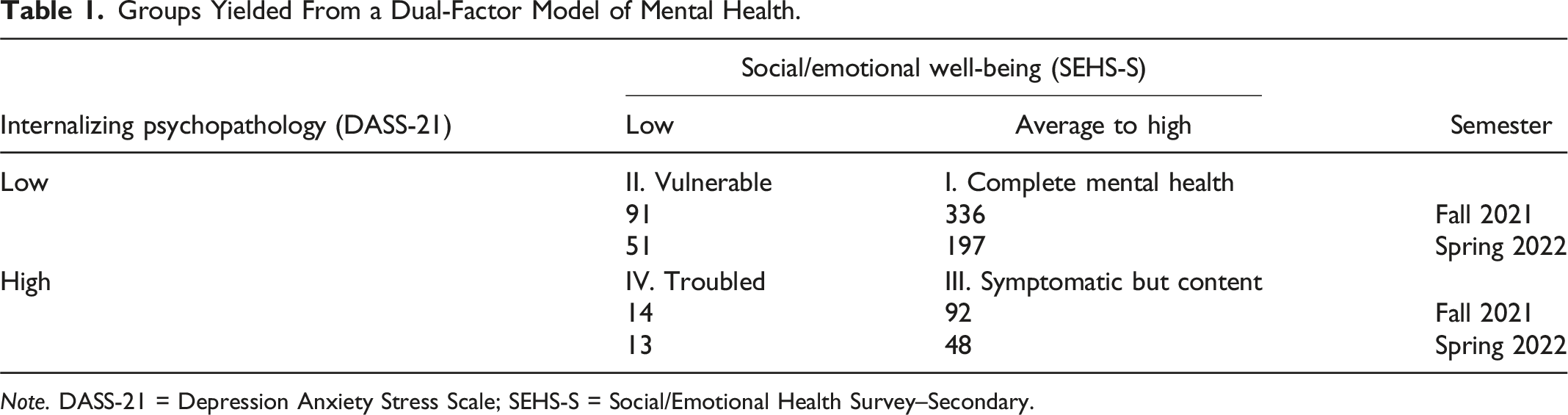
Note. DASS-21 = Depression Anxiety Stress Scale; SEHS-S = Social/Emotional Health Survey–Secondary.
A decrease in overall participation from fall 2021 to spring 2022 occurred primarily due to the nontraditional nature of the ECHS program. Students are enrolled in various college courses and not housed on a traditional high school campus. In fall 2021, students were instructed to complete the universal screeners while engaged in one of their mandatory class meetings. Comparatively, in the spring 2022 semester, students were instructed to complete the screeners via online communications. Therefore, it may be concluded that computer-based completion with only virtual instruction was less effective in participant completion.
Discussion
The counseling team met immediately after data analysis was completed to review the results. An important part of the screening process is having a deep understanding of school and community resources to address the mental health needs of students and families (SAMHSA, 2019). The school team used resource mapping, a system-building strategy to identify and align school-based and community resources across a three-tiered system of support (Lever et al., 2014). Resource mapping also ensured that school staff and counselors were aware of the available school-based and community resources and knew how to make appropriate referrals for students. The resource mapping, or listing process, also helps identify gaps in services and informs new outreach opportunities (Lever et al., 2014).
Using a triage approach, we addressed the students in high priority groups (troubled and vulnerable) first. It is best practice to consider multiple sources of data when identifying students in need of social/emotional intervention (Romer et al., 2020; Zyromski & Mariani, 2016). Therefore, the counseling team followed up with parents and guardians via phone meetings, determined which of these students were already receiving services, and compared the universal screening results with other existing data points (attendance, grades, behavioral issues, etc.). Parents and guardians were provided an explanation of what their child’s screening results showed as far as severity and areas of concern. For example, if a student showed high levels of psychopathology and low levels of social/emotional well-being, further assessment might be recommended and assistance in making appropriate referrals to school-based services or community resources would be provided. Parents were reminded that universal mental health screeners differ from formal diagnostic mental health assessments; they only identify whether a student may be at risk for a mental health concern and inform decisions about needed services. School counselors documented parent communication and referral efforts so that they could follow up and provide continuity of care.
Interventions were based upon the needs of the student, level of severity, and availability and resources and services (SAMHSA, 2019). Appropriate counseling services for gifted students might address issues related to characteristics of high ability, such as perfectionism, anxiety, depression, and underachievement (Florida Department of Education, 2019). Approximately 15% of the students screened were recommended to Tier 2 group counseling services. Of those referred, approximately 25% of opted into school-based counseling groups each semester. When counseling is delivered in a group format, students selected for certain risk factors are likely to find peers to whom they can relate and likely feel similarly (Horowitz et al., 2007). School counselors led counseling groups aimed at stress and anxiety management or building social skills. Other students, including those with moderate to significant psychopathology, were recommended for an evidence-based, small group, cognitive behavioral therapy (CBT) intervention led by the school-based mental health counselor that focused on decreasing internalizing symptoms through its focus on perfectionism. Studies have recognized perfectionism as a critical vulnerability factor that acts as a maintaining factor across disorders (Egan et al., 2011). School counselors also partnered with community mental health providers to connect Tier 3 identified students to accessible assessment and treatment. Interestingly, when school counselors contacted parents of students (identified as high need) to notify them of the results and to recommend further assessment or referral options, they found that 24 of these students were already connected to mental health services in the community.
A key consideration in universal screening procedures includes sharing results with key stakeholders in a timely manner (SAMHSA, 2019). This may include parents, teachers, and/or district leaders. We presented aggregate data across groups of students (i.e., grade, demographic characteristics) and schoolwide patterns at parent workshops and staff meetings to inform school staff and parents how the mental health screening results are informing interventions and supports to improve student outcomes. For example, the universal screening results showed that in fall 2021, 40.2% of students indicated moderate to severe levels of anxiety. Therefore, anxiety-management and mindfulness skills via MindUp and CBT for Perfectionism interventions were implemented throughout the year via weekly classroom delivery by the school counselors. The school-based mental health counselor also provided psychoeducation and training to the school counselors, parents, and teachers in regard to identifying social/emotional and mental health concerns in gifted students and how to better encourage stress and anxiety management within their classrooms. Parents responded positively to this education and mental health screening data, with many requesting additional resources. The universal screening data also provided significant support for continuing to prioritize life skills, social/emotional learning and resiliency curriculum schoolwide. Specifically, the data showed that students who had higher levels of social/emotional strength indicators had lower levels of mental health distress. Gifted students tend to be reluctant to ask for help due to stigma, even when in despair (Peterson, 2009), so the school counselors allocated more time and resources to the existing peer mentoring program. Research shows peer outreach and psychoeducation interventions that address mental health stigma are the most effective help-seeking interventions (Velasco et al., 2020). Sharing results can help schools and school districts leverage support and additional funding opportunities to acquire resources (Romer et al., 2020). Overall, this study’s screening was positively received by parents and school personnel and continued to inform the comprehensive school counseling program the following year.
Procedural, Ethical, and Legal Considerations
School counselors should follow ethical standards, best practice considerations, district policies, and federal and state laws regarding the use of universal mental health screeners (ASCA, 2023; Belser et al., 2016). Prior to starting this process, school-based screening teams need to identify procedures for conducting, scoring, analyzing, and implementing universal screening data (Romer et al., 2020). This includes informing teachers, parents, and students about the purpose of universal screening data and providing the option for parents and students to decline if they do not wish to participate. In alignment with the Individuals with Disabilities Education Improvement Act (IDEA; 2004), screening that is used to determine curriculum or is being done as part of regular school activities does not require parental consent (Romer et al., 2020). According to Romer et al. (2020), “the majority of evidence-based screening procedures fall under the umbrella of typical assessments for regular school activities, therefore written consent would not be required” (p. 17). In addition to considering federal laws and regulations, screening teams need to consult with district statutes and state guidelines that may impact consent.
Finally, procedural components related to the following factors must be carefully planned and addressed: allocation of resources, clarification of staffing roles and responsibilities, selection of screeners, implementation timeline and frequency, training and professional development, data storage and confidentiality, and coordinating services. For example, the Federal Educational Rights and Privacy Act of 1974 allows access to student data only to those school officials with a legitimate educational interest. Therefore, school-based screening teams need to ensure their screening data systems protect students’ right to privacy and are only accessed by appropriate personnel (Romer et al., 2020). Further, when sharing data with stakeholders, aggregate data should be used rather than individual and identifiable data (ASCA, 2023).
Implications for School Counselors
Based on the findings of this study, school counselors are encouraged to tailor approaches to best identify, service, and support gifted and talented students (Kennedy & Farley, 2018). Gifted students are typically able to sustain academic achievement in accelerated courses despite social/emotional problems by applying high-ability habits (Peterson, 2015; Suldo et al., 2016). Unfortunately, this ability may divert counselors’ attention away from recognizing these students’ struggles (Peterson, 2015). Results of this study revealed that internalized symptoms may be ignored or left untreated because they are less pronounced compared to externalized symptoms (Merikangas et al., 2011). To effectively meet the needs of the gifted population, school personnel may need to adjust their approaches with regard to evaluating needs, determining areas for support, and implementing counseling techniques (Kennedy & Farley, 2018). School counselors must recognize and acknowledge students’ giftedness as a part of their identity and consider how this aspect impacts their overall health and well-being (Kennedy & Farley, 2018). First, school-based counselors and mental health personnel would benefit from being properly educated and trained in how to best determine the needs of all students (including specific populations); track their academic, behavioral and emotional progress; and intervene with evidence-based approaches when necessary. Counselor education programs might also consider providing counselors in training with specific coursework devoted to working with gifted students in accelerated programs (O’Brennan et al., 2019). Further, school counselors must be aware of the legal and ethical standards pertaining to universal screening, consent, record keeping, and referrals. Once students are identified as vulnerable or troubled, school personnel can provide and match them with appropriate support services, properly documenting recommendations, follow-ups, and referral sources.
ECHS literature indicates pervasive themes of increased academic pressure (Shepard et al., 2009), difficulty adjusting, and internalizing problems such as depression and anxiety (Dai et al., 2015; Ebbert et al., 2019). However, the needs of gifted students in accelerated curricula are often not prioritized in research or practice (Suldo et al., 2016). Few studies on ECHS address student success outcomes and general counseling approaches geared toward the majority of students may not meet the needs of gifted students in ECHS programs (Bakar & Ishak, 2014). Although support abounds for CBT-based approaches, further research is needed on incorporating and implementing this counseling framework with gifted youth. Considering the unique comprehensive school counseling model within ECHS, proactive universal mental health screening and program assessment is warranted and further research is needed to identify approaches to support this population (Colangelo & Wood, 2015). Findings from this study could help school counselors in ECHS recognize the value of collaborating with their university’s resources to meet students’ mental health needs. Utilizing university resources and personnel, such as the college counseling center, can bolster the number of services offered and students served, particularly given high student-to-school-counselor ratios. The primary focus of any helping profession should be finding the proper fit between the student (client) needs and the most beneficial intervention or support.
Conclusion
Results of this study support the use of universal mental health screening with gifted students in ECHS programs. Overall, this study can help to inform comprehensive school counseling programs and demonstrate the importance of implementing more targeted identification for gifted populations that meet their social/emotional and developmental needs. Results of this study can be used to support the expansion of school counseling services to a wider population that includes gifted students, a group often overlooked due to their high functioning in certain areas, including academics and behavior.
Footnotes
Declaration of Conflicting Interests
The author(s) declared no potential conflicts of interest with respect to the research, authorship, and/or publication of this article.
Funding
The author(s) received no financial support for the research, authorship, and/or publication of this article.
