




Abstract
This study surveyed 225 school counselors to investigate the college and career readiness (CCR) supports they provide, with a focus on whether these supports vary based on students’ disability status. The results reveal that school counselors deliver CCR supports related to resource coordination, life-readiness instruction, and career assessment and planning services more frequently than supports for entering employment and college. Moreover, school counselors reported providing a greater number and frequency of CCR supports to students without disabilities compared to those with disabilities across all CCR domains and offered explanations for these differences. These results suggest a need for better preparation of school counselors to support the college and career readiness of students with disabilities.
Keywords
High school counselors are uniquely positioned to promote the college and career readiness (CCR) of all students (Li et al., 2017). They possess expertise in instruction, counseling, appraisal, advisement, and collaboration, making them integral team members in preparing students for postsecondary education and employment. Studies also have shown that school counselors positively impact students’ postsecondary outcomes (e.g., Hurwitz & Howell, 2014; Velez, 2016). However, school counselors’ current role and practices in supporting postsecondary transitions are not adequately understood (Lapan & Harrington, 2010; Li et al., 2017). Furthermore, given that school counselors often feel unprepared to assist students with disabilities (Milsom, 2002; Parikh Foxx et al., 2022), determining whether a lack of self-efficacy impacts their delivery of CCR supports to this student population is critical.
Provision of College and Career Readiness Supports
Supporting CCR is fundamental to school counselors’ work. CCR supports, as used in this article, encompass a range of activities, such as instruction, appraisal and advisement, counseling, resource provision, and planning. These activities aim to help students transition successfully from school to postsecondary education, work, and adult roles and responsibilities. CCR supports may also be referred to as postsecondary transition services.
The American School Counselor Association (ASCA) professional and ethical standards guide school counselors in providing CCR supports. The ASCA position statement The School Counselor and Individual Student Planning for Postsecondary Preparation (ASCA, 2017) emphasizes the importance of collaborating with families, teachers, school administrators, staff, and community members “to ensure all students have the opportunity to design a rigorous and relevant academic and career program preparing them to be college and career ready” (para. 5). ASCA Ethical Standards for School Counselors (ASCA, 2022a) emphasizes the need for school counselors to create a culture of postsecondary readiness by working with stakeholders to examine gaps in college and career access and to address personal biases related to students’ postsecondary choices. ASCA Student Standards: Mindsets & Behaviors for Student Success (ASCA, 2021b) provides a framework for school counselors to align their CCR practice with desired student mindsets and behaviors. For example, school counselors are expected to encourage students to recognize the significance of postsecondary education and lifelong learning for achieving long-term success (mindsets) and to foster self-confidence and positive attitudes toward work (behaviors). Collectively, these ASCA standards set clear guidelines for the responsibilities of school counselors in preparing students for postsecondary education, careers, and adulthood.
The Council for Accreditation of Counseling and Related Educational Programs (CACREP, 2015), an accrediting body for counselor training programs, requires preparation programs to cover career development and postsecondary planning. This requirement includes providing school counseling students with instruction on career development theories, career assessment and information resources, and supervised opportunities to apply career counseling skills through practicums or internships. As such, school counselors are in a distinct position to assist students in setting and achieving their postsecondary goals. The established professional standards and accreditation requirements set clear expectations for school counselor responsibilities in this area.
Although providing CCR activities is part of school counselors’ scope of practice as defined by ASCA (2019a), research indicates that school counselors spend limited time on such activities (Anctil et al., 2012). In a recent study, Novakovic et al. (2021) found that although school counselors view CCR counseling as highly important, they feel ill-equipped to provide it. A national survey of school counselors revealed that middle school and high school counselors feel unprepared to implement CCR activities (Bruce & Bridgeland, 2012), and research by Parikh Foxx et al. (2020) suggested that school counselors in elementary settings express even less confidence in their ability to enhance students’ CCR readiness than their counterparts in secondary settings. This mismatch between expectations and reality is compounded by the fact that school counselors’ time is often dominated by other responsibilities, such as administering state tests and creating schedules (Dogan et al., 2021; Neyland-Brown et al., 2019). Consequently, school counselors may spend only a small portion of their time on CCR activities. For example, research indicates that counselors in public secondary schools devote only 22% of their time to postsecondary admissions counseling and 6% to occupational counseling and job placement (National Association for College Admission Counseling, 2023). These constraints may be due in part to the ambiguous nature of school counselors’ roles and responsibilities and to large student caseloads, which further limit the time available for CCR activities (Adkison-Bradley et al., 2007; Gilfillan, 2018; Lauterbach et al., 2018; Woods & Domina, 2014). In short, ambiguity surrounding school counselors’ daily responsibilities often creates a gap between ASCA expectations and counselors’ ability to fulfill them.
Provision of CCR Supports to Students With Disabilities
Students with disabilities require special attention to ensure they are ready for college and careers because they often lag behind their peers without disabilities in terms of postsecondary preparation and adult outcomes. For example, studies show that students with individualized education programs (IEPs) are less likely to take college entrance exams, report plans to enroll in postsecondary education or training, and have recent paid work experience, compared to students without disabilities (Lipscomb et al., 2017). They are also less likely to enroll in postsecondary education or be employed as adults (Newman et al., 2011; U.S. Bureau of Labor Statistics, 2023). Recent findings also demonstrate that students with disabilities have less access to CCR supports than those without disabilities (Lombardi et al., 2022). Addressing these disparities requires an examination of the types and effectiveness of CCR supports provided to students with disabilities.
Parallel to the emergence of school-wide CCR initiatives, postsecondary transition planning for students with disabilities became a central aspect of special education policy and practice with the passage of the Individuals with Disabilities Education Act (IDEA) of 1990 (Morningstar et al., 2018). Transition planning starting no later than age 16 (or earlier in some states), a required component of the IEP for students with disabilities, includes measurable postsecondary goals and a coordinated set of services and activities that prepare students to accomplish those goals (IDEA, 2004). To effectively implement a coordinated set of transition activities, collaboration between the school, student, family, and community agencies is essential (Kohler et al., 2016). A key collaborator in this effort is the school counselor. With their specialized knowledge of career counseling and postsecondary planning, school counselors have a vital role to play in preparing students with disabilities for life after high school.
ASCA (2019a, 2022b) has established standards for school counselors to assist all students, including those with disabilities, in achieving college, career, and life readiness. These standards align with the transition planning requirements of IDEA (2004), which provides a framework for collaborative service delivery to meet the transition needs of students. For example, the expectation that school counselors help students develop academic, career, and social/emotional goals (ASCA, 2021b, Standard B-LS 7) corresponds to IDEA’s transition-planning requirement for the IEP team to assist students with disabilities in developing postsecondary education, employment, and independent living goals. Similarly, the expectation that school counselors help students develop self-management skills for independent work (Standard B-SMS 3) aligns with IDEA’s expectation for increasing independence in preparation for postsecondary life. An important aspect to examine is how well the alignment between ASCA standards and IDEA transition-planning requirements translates into a coordinated provision of CCR supports to students with disabilities.
Research reveals that school counselors have long struggled to meet the career development and transition needs of students with disabilities (Adkison-Bradley et al., 2007; Milsom, 2002, 2007). For instance, Milsom (2002) found that nearly one third of the high school counselors surveyed did not participate in postsecondary transition planning for students with disabilities. A more recent study by Parikh-Foxx et al. (2022) asked school counselors to rate the importance of 20 transition practices identified in special education research and their belief in their ability to implement them. On average, school counselors rated the transition practices as important but expressed lower confidence in their ability to implement them. This finding is consistent with earlier research that found that school counselors feel unprepared to serve students with disabilities (Kolodinsky et al., 2009; Milsom, 2002; Romano et al., 2009). Given the limited research in the past 15 years on school counselors’ role in providing CCR support to students with disabilities, further investigation is necessary.
Purpose of the Study
The purpose of this study was to investigate the CCR supports school counselors provide to high school students and whether these supports differ depending on whether or not students have disabilities. The study addressed the following research questions and hypotheses: 1. What postsecondary transition services do school counselors provide most frequently? Hypothesis 1: School counselors will report providing postsecondary transition services that align with the ASCA National Model and position statements most frequently. 2. Does the pattern of postsecondary transition services school counselors provide differ based on student disability status? Hypothesis 2: School counselors will report providing postsecondary transition services more frequently to students without disabilities than to those with disabilities. Hypothesis 3: School counselors will report providing a broader range of postsecondary transition services to students without disabilities than to students with disabilities. 3. How do school counselors perceive their responsibilities in preparing students with disabilities for postsecondary transition? Hypothesis 4: School counselors will report that students with disabilities receive a greater number of specific postsecondary transition services from non-school-counselor sources than do students without disabilities.
Method
We collected the data presented here as part of a larger study exploring the contemporary role of school counselors in preparing high school students with and without disabilities for adult life. The cross-sectional survey results elucidate school counselors’ perceptions of their responsibilities and activities supporting students’ college and career readiness.
Procedure
Ohio school counselors with at least one year of experience working at the high school level were recruited to participate in the study. We used two methods to recruit study participants. First, an email invitation with a link to an online survey was distributed through the Ohio School Counselor Association (OSCA) membership Listserv in April 2022 to approximately 250 high school counselors. A reminder email was sent via the Listserv 2 weeks after the initial email. Second, we gleaned a list of Ohio high school counselors’ names and school district information from publicly available Ohio Department of Education databases, and used this information to locate email addresses for 1629 school counselors on public school websites. We emailed the survey link to this list in May 2022, with two reminder emails sent at approximately 1-week intervals to those who had not completed the survey. Of the approximately 1879 high school counselors invited to participate, 225 completed the survey, resulting in a response rate of 12%.
Before beginning research activities, we secured approval from our university’s Institutional Review Board and OSCA’s research committee. The survey was delivered through the Qualtrics cloud-based survey platform (https://www.qualtrics.com). No personally identifying information was requested on the survey. As a recruitment strategy, we offered participants the chance to win one of three sets of Apple AirPods Pro. Participants who chose to enter the raffle were directed to a separate Qualtrics survey to provide their contact information. This enabled us to maintain the confidentiality of participant study responses.
Participants
Demographic and Employment Characteristics of School Counselors (N = 225).

aN = 210.
To set the parameters for the generalization of obtained study results, we compared the demographic and employment characteristics of the sample with ASCA’s (2021a) national data set of practicing school counselors. The study participants were comparable to the national sample in terms of age and years of experience as school counselors; however, they were more likely to be male (23% vs. 11%) and White (90% vs. 77%). Regarding school characteristics, study participants were more likely than respondents in the national sample to work for public, non-charter schools (96% vs. 88%) but were similarly likely to work in suburban, rural, or urban school districts. Student-to-school-counselor ratios for high school counselors (Grades 9–12) were also comparable, with the majority of high school counselors in this study and the national study serving 350 or fewer students, 61% and 64%, respectively.
We also sought to assess whether the school counselors in this study reported serving a percentage of students receiving special education services comparable to national and state prevalence rates. According to the National Center for Education Statistics (2022), the percentage of public school students served under IDEA in School Year 2020–2021 was 14.5% nationally and 16.5% for Ohio. A comparison estimate for the study sample was calculated by dividing the number of students with IEPs served by caseload size. The mean value across participants was 12.8% (Mdn = 10.6%), somewhat lower than national and state averages.
School Counselor Postsecondary Transition Services Survey
Survey Development
We developed a self-administered survey to measure variables of interest in the study. Survey items requesting school counselor demographics, school characteristics, student-to-school-counselor ratios, and student demographics were modeled after ASCA’s (2021b) state-of-the-profession survey items. Data presented in this article relate to the CCR supports school counselors provide to high school students. Item development began with a review of information from two sources: (a) the extant literature on career counseling and postsecondary transition planning activities (Adkison-Bradley et al., 2007; Frazier et al., 2020; Milsom, 2007) and (b) school counselor standards and practices identified by ASCA (ASCA 2017; 2019a; 2019b; 2021b; 2022a; 2022b). We developed the initial set of ASCA-referenced items to capture both recommended practices and practices considered outside the school counselor’s scope of professional practice.
The first author, a teacher educator in secondary transition, developed the initial survey items. The second and third authors—a school counselor educator and a teacher educator in special education—who both have school counseling experience, conducted a critical systematic review of the survey items (Fowler & Conseza, 2008). Following this review, we pre-tested the survey with seven practicing school counselors. After each section of the survey, pre-test participants were asked four questions: (a) “Are there unclear or poorly worded items? If so, can you suggest better wording?”; (b) “Are there items that you think school counselors would be unable to answer?”; (c) “Does a question need another response option (i.e., another possible answer from which to choose)?”; and (d) “Are there questions that should be added?” Pre-testing enabled us to assess individual item clarity and instruction clarity, survey navigation, section formatting, and completion time (Fowler, 2014). Based on the review of pre-test results, we added definitions for terms unfamiliar to school counselors, revised some item response options, added or removed several items, and made minor wording changes to some items.
Survey Description
The first set of items asked respondents if they engage in 22 activities to support the postsecondary transition of students without disabilities. Following an affirmative response to an item, respondents reported how often they engage in the activity: daily, weekly, monthly, or less than monthly. Following a negative response to an item, respondents selected a reason for not engaging in the activity: not in the school counselor scope of practice, someone else does this, the activity is not necessary/helpful, or other. A second, identical set of 22 items asked respondents about their activities to support the transition of students with disabilities. Five additional items about disability-related supports were included: “I attend IEP meetings,” “I provide input for IEP transition plans,” “I write and/or coordinate implementation of 504 plans,” “I teach students to advocate for their right to nondiscrimination,” and “I connect students to college accessibility services.” Finally, an open-ended question at the end of the survey asked: “Do you have any additional comments you would like to make about preparing high school students for the transition to college, careers, and adulthood?”
Component Measurement
Principal component analysis (PCA) with varimax rotation was used to reduce the dimensionality of the postsecondary transition services data, as described by Tabachnick and Fidell (2019). We selected PCA over factor analysis because we took an empirical, rather than theoretical, approach to determining the latent structure underlying the set of variables. The labels applied to the derived components serve as practical descriptors of the variables they encompass rather than reflecting an underlying process or theory. We chose orthogonal varimax rotation, as opposed to oblique rotation methods, to facilitate a clearer interpretation of the components (Tabachnick & Fidell, 2019). Because PCA concentrates on capturing as much variance in the data as possible without the presumption of correlated underlying factors, the application of orthogonal rotation techniques offers a more intuitive and straightforward analytical approach.
We conducted separate analyses for students-without-disabilities and students-with-disabilities item sets. Mean substitution was used to replace missing values (<1%). Bartlett’s test of sphericity and the Kaiser-Meyer-Okin measure of sampling adequacy indicated that the item sets were suitable for PCA. Items with minimum component loadings of .40 and loadings below .40 on other components were considered eligible for inclusion on that component. Nineteen items met this criterion and were retained. For both item sets, the first four principal components had eigenvalues greater than 1.0 and were extracted. These four components explained 64.4% and 68.7% of the variation in students-without-disabilities and students-with-disabilities data, respectively.
Results From a Principal Components Analysis of Postsecondary Transition Services Provided to Students With Disabilities.
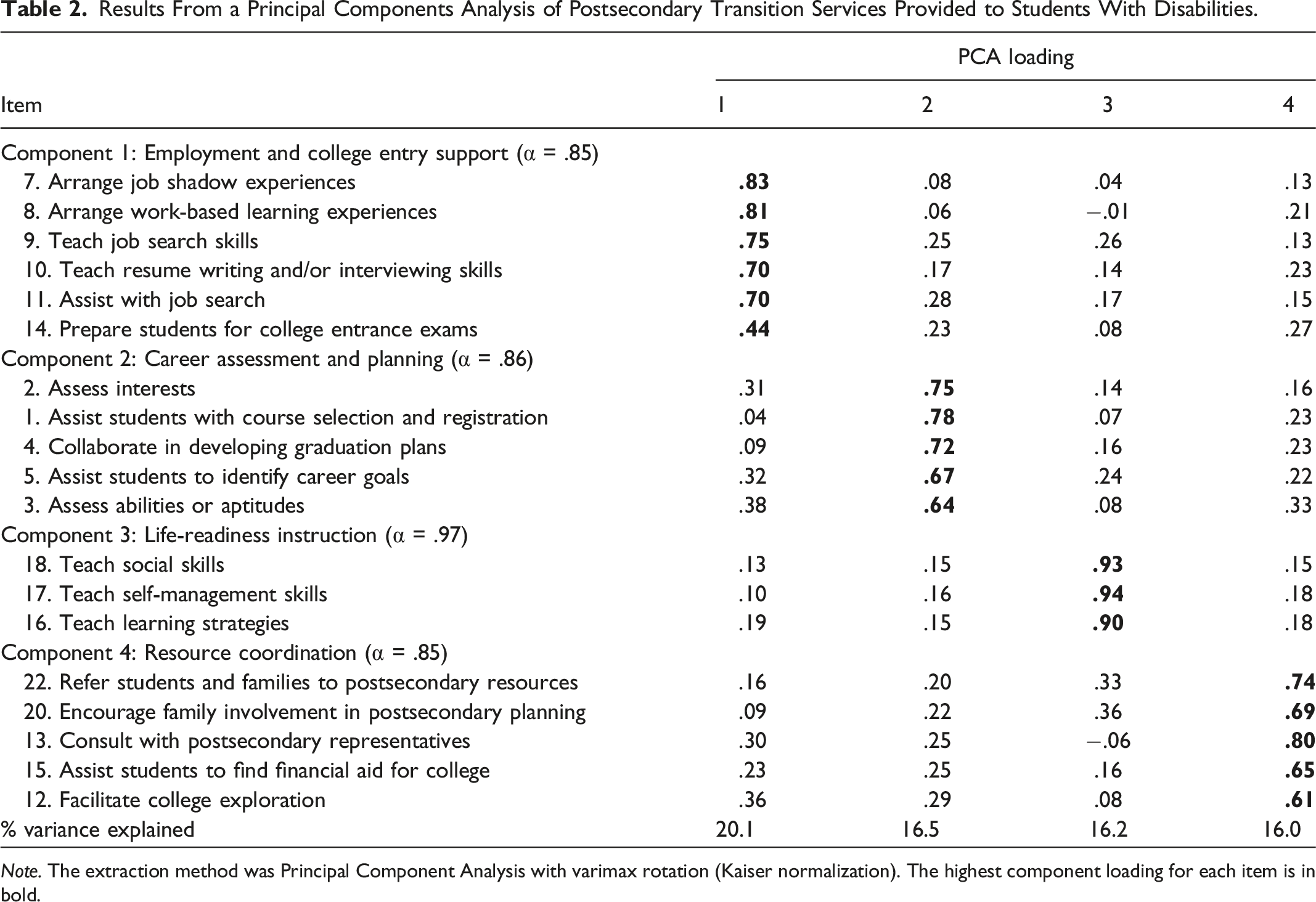
Note. The extraction method was Principal Component Analysis with varimax rotation (Kaiser normalization). The highest component loading for each item is in bold.
Data Analysis
Quantitative data were analyzed using SPSS 26.0. We screened the data prior to component measurement and analysis of the research questions. The total number of survey respondents was 239, with usable response sets totaling 225. We defined a usable response set as one in which the respondent answered more than 90% of the questions in each survey section. Not finishing the final sections of the survey was the most common reason for a response set being determined unusable.
We generated descriptive statistics to address Hypothesis 1, that school counselors most frequently provide postsecondary transition services aligned with ASCA standards and position statements. We calculated the frequency distributions and medians to show how often school counselors reported providing 19 specific postsecondary transition services, separated by disability status. Frequency distributions and medians were also tallied for the provision of disability-related postsecondary transition services. If a respondent indicated they did not provide a service, this was coded as 1 (never). The remaining response categories were coded as 2 (less than monthly), 3 (monthly), 4 (weekly), and 5 (daily).
To test Hypothesis 2, that school counselors provide postsecondary transition services more frequently to students without disabilities than to those with disabilities, we conducted matched samples t tests using principal component scores as dependent variables. We subsequently tested differences in frequencies for individual postsecondary transition services using Wilcoxon signed-ranks tests. To calculate effect sizes for the paired Wilcoxon signed-rank tests, we calculated matched pairs rank biserial correlations following the steps suggested by Kerby (2014). Bonferroni correction was applied to all multiple comparisons presented in this study to control for the family-wise error rate.
If Hypothesis 2—that school counselors provide postsecondary transition services more frequently to students without disabilities—was supported, this finding could be due to the greater number of students without disabilities on school counselor caseloads. In other words, even if counselors serve all students on their caseload with equal frequency, spending more hours overall providing services to students without disabilities is a reasonable assumption. To rule out this alternative explanation, we tested Hypothesis 3, which examines whether school counselors ever provide individual services.
To test Hypothesis 3, which suggests that school counselors are likely to provide a broader range of postsecondary transition services to students without disabilities compared to those with disabilities, the postsecondary transition services items were initially re-coded as dichotomous (yes/no) variables. Composite scores were then generated by adding the scores on the recoded items within each principal component. Matched samples t tests were conducted using the composite scores, followed by the use of the McNemar test (McNemar, 1947) to assess differences in the provision of individual services.
The final research question explored how school counselors perceive their responsibilities in preparing students with disabilities for postsecondary transition. We examined descriptive statistics to determine the primary reasons given for not providing individual postsecondary transition services, including disability-related postsecondary transition services. Hypothesis 4—that school counselors are more likely to report that students with disabilities receive postsecondary transition services from non-school-counselor sources than do students without disabilities—was examined using a set of McNemar tests.
To better understand school counselors’ perspectives on supporting students’ college and career readiness, we analyzed responses to the open-ended survey question. Participant responses were entered into a spreadsheet, and we used axial codes to organize comments by research question (Saldaña, 2016). Saldaña suggested that examining patterns in qualitative responses helps to support and explain quantitative results. Therefore, we include exemplar quotes for each research question to elucidate the quantitative findings.
Results
Postsecondary Transition Services
Descriptive statistics reveal the services most frequently provided by high school counselors to meet students’ postsecondary transition needs. Figure 1 displays the frequency distributions for 19 services provided, disaggregated by disability status. The four panels show results for groups of items that load on the underlying dimensions determined through principal components analysis. Hypothesis 1 was that school counselors most frequently provide postsecondary transition services aligned with the ASCA National Model and position statements (ASCA, 2017; 2019a; 2022b). Our results were consistent with this hypothesis. The item medians in Table 3 reveal that participants reported providing services associated with resource coordination (Mdns: 3–4), career assessment and planning (Mdns: 2–4), and life-readiness instruction (Mdns: 2–3) more often than supports associated with helping students enter employment and college (Mdns: 1–2). Frequency distributions for the provision of postsecondary transition services disaggregated by student disability status. Postsecondary Transition Service Provision by School Counselors Disaggregated by Student Disability Status. Note. SWOD = students without disabilities; SWD = students with disabilities; Z = Wilcoxon signed-ranks test; rc = matched-pairs rank-biserial correlation; χ2 = McNemar test. *p < .005. a1 = never, 2 = less than monthly, 3 = monthly, 4 = weekly, 5 = daily. byes or no. cNegative Z score indicates that the median score is higher for students without disabilities. d% of school counselors who provide a service. eExact p value corrected for ties.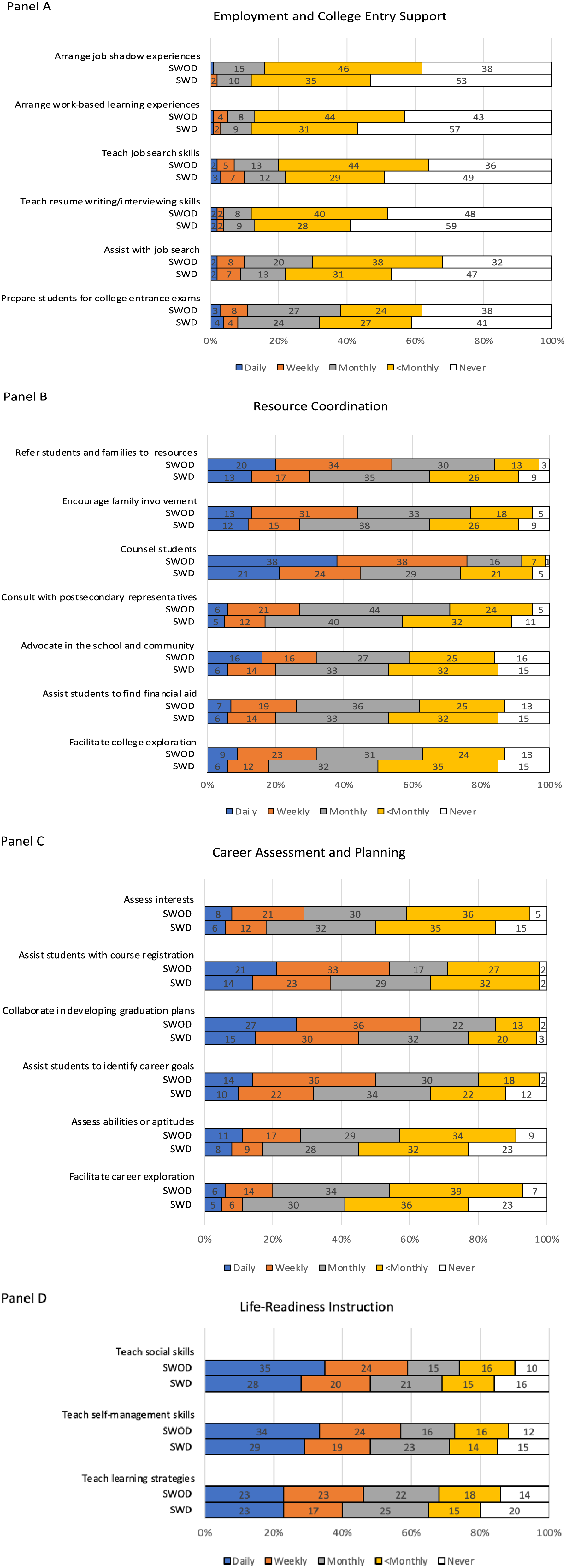

Figure 2 displays the frequency distributions for the provision of disability-related postsecondary transition services. On average, school counselors reported providing disability-related services monthly or less than monthly (Mdns: 2–3). They reported attending IEP meetings and writing and/or implementing 504 plans most frequently, with more than half of respondents indicating engagement in these activities at least monthly. The latter finding runs counter to our hypothesis because the ASCA (2022b) position statement on students with disabilities identifies writing and coordinating the implementation of 504 plans as outside the school counselor’s scope of practice. One participant’s open-ended response specifically addressed school counselor responsibilities: Unlike a lot of districts, mine tasks guidance counselors with writing and reevaluating 504s. State testing has gotten bigger and more time-consuming. Keeping track of graduation requirements has gotten more complex. We give ACT exams now as a district. . . . Again, the number of things counselors are tasked with affects our ability to meet students’ needs more than knowledge and preparation. Frequency distributions for the provision of disability-related postsecondary transition services.
Thirty percent of participants reported that they do not provide input for IEP transition plans, although ASCA (2022b) designates this activity as a school counselor’s responsibility. One participant acknowledged this gap in practice, offering the comment: “Like any other school counseling program, I do wish we had the capacity to do more. This would allow us to align with the ASCA National Model.”
Postsecondary Transition Services by Disability Status
Hypothesis 2 was that school counselors provide postsecondary transition services more frequently to students without disabilities than to those with disabilities. To test this prediction, we conducted matched samples t tests using principal component scores as dependent variables. Across all four components, mean scores for students without disabilities were significantly higher at the specified .0025 alpha level than mean scores for students with disabilities, with small to medium effect sizes (Cohen, 1988): • Employment and college entry support, t = 5.05 (223), 95% CI [0.08, 0.19], d = .34 • Career assessment and planning, t = 9.31 (224), 95% CI [0.30, 0.46], d = .62 • Life-readiness instruction, t = 4.27 (223), 95% CI [0.11, 0.30], d = .29 • Resource coordination, t = 8.51 (223), 95% CI [0.26, 0.41], d = .57
Median frequencies for the 19 postsecondary transition services disaggregated by disability status are presented in Table 3. Individual Wilcoxon signed-ranks tests (Z) at the specified .005 alpha level revealed that participants reported providing services to students without disabilities significantly more frequently than to students with disabilities for all but four items: (a) “teach job search skills,” (b) “teach resume writing and/or interviewing skills,” (c) “prepare students for college entrance exams (e.g., ACT),” and (d) “teach learning strategies (e.g., decision making, time management, goal setting).” The effect sizes for the 15 significant differences, mean rc = .58 (SD = .09), represent the difference between the proportion of favorable and unfavorable pairs/signed ranks (Kerby, 2014). Some participants commented on the frequency of services for students with and without disabilities. For instance, one participant stated, “Depending on the needs of students on an IEP, I am not as up to date on services that colleges provide. I wish I knew what services were available in college for students on an IEP.” Another participant addressed a possible cause of less frequent services to students with disabilities: “In my district/county, there is a lack of resources to adequately help prepare students with disabilities to transition to postsecondary education options.”
To test Hypothesis 3, that school counselors provide a greater number of distinct postsecondary transition services to students without disabilities than to students with disabilities, we used component scores as dependent variables in matched samples t tests. Across all four components, mean scores for students without disabilities were significantly higher at the specified .0025 alpha level than mean scores for students with disabilities, with small to medium effect sizes (Cohen, 1988): • Employment and college entry support, t = 7.43 (223), 95% CI [0.08, 0.14], d = .50 • Career assessment and planning, t = 5.55 (224), 95% CI [0.05, 0.10], d = .37 • Life-readiness instruction, t = 3.31 (223), 95% CI [0.02, 0.08], d = .22 • Resource coordination, t = 3.81 (223), 95% CI [0.02, 0.07], d = .26
We subsequently performed a set of McNemar tests (1947) to evaluate differences in providing individual postsecondary transition services by disability status. Mean scores across all services were higher for students without disabilities than those with disabilities. A review of significance tests (χ2) at Bonferroni-corrected alpha levels in Table 3 indicates that school counselors were statistically more likely to provide 11 of 19 services to students without disabilities. All differences had large effect sizes (OR ≥ 3.00). We found differences for most items assessing each principal component, except for items assessing resource coordination. One participant tacitly acknowledged the gap in services for students with disabilities when they commented that they “would love to collaborate with area colleges to discuss postsecondary enrollment goals and opportunities for students with disabilities.”
Perceived Responsibility for Serving Students with Disabilities
Postsecondary Transition Services
School counselors who reported not providing a postsecondary transition service were asked to indicate a reason: someone else does this, not in the school counselor scope of practice, activity is not necessary/helpful, or other. Descriptive statistics revealed that 76% of the time participants reported not providing a service, they indicated that someone else provides it. A closer look revealed that 20%–50% of participants reported that someone else provides each of six services related to employment and college entry support (e.g., teach job search skills, prepare students for college entrance exams), while an average of only 5% reported that someone else provides services related to resource coordination, career assessment and planning, and life-readiness instruction.
To test Hypothesis 4—that school counselors report that students with disabilities receive a greater number of specific postsecondary transition services from non-school-counselor sources than do students without disabilities—we performed a set of McNemar tests. Significance tests (χ2) at the Bonferroni-corrected alpha level (α = .005) supported this hypothesis for 10 of the 19 services. Nine of the 10 services related to assessing students’ career interests and abilities and preparing students for employment; the final item pertained to resource coordination: “refer students and families to postsecondary resources.” A large effect size (OR ≥ 3.00) was found for “assess interests.” Participants were equally likely to report that students with and without disabilities receive life-readiness instruction from others.
Disability-Related Services
Participants who reported not providing a disability-related postsecondary transition service were asked to indicate their reason for not doing so. The reason selected 90% of the time was either “someone else does this” or “not in school counselor scope of practice.” For example, 37% said someone else teaches students with disabilities to advocate for their rights to nondiscrimination, while 7% said this activity is not within their scope of practice. Eighteen percent said someone else provides input into transition plans, while 6% said this activity is not within their scope of practice. One participant’s comment exemplifies these findings: It is not my job to sit in IEP meetings all day. I provide the same services geared toward students on their individual levels of disabilities, giftedness, ELL, or any other needs they may have. School counselors do not have the time, nor is it in their job description, to do what special education coordinators and intervention teachers should be handling.
Discussion
First and foremost, the results indicate that school counselors’ CCR practices align with the ASCA National Model and ASCA position statements (ASCA 2017; 2019a; 2022b). CCR supports most often provided by school counselors were related to resource coordination, career assessment and planning, and life-readiness instruction. These supports were provided more frequently than supports associated with helping students find employment and enter college. This finding is consistent with previous research by Li et al. (2017), which found that counselors prioritize goals related to the ASCA National Model in their high school counseling programs. These results suggest that school counselors may experience less role ambiguity than previously identified by researchers (Pérusse et al., 2004). However, Gilfillan (2018) maintained that a disconnect still exists between the roles students and professional organizations expect of school counselors and how counselors actually spend their time. Our data support this statement. For instance, although school counselors view CCR counseling as important (Novakovic et al., 2021), the majority of our sample reported providing most CCR activities no more than monthly. Examples of these activities include assisting students with identifying career goals, facilitating college and career exploration, finding financial aid, and consulting with postsecondary representatives.
The results also reveal that high school counselors provide CCR supports more frequently to students without disabilities than to students with an IEP or 504 plan. This difference was significant for 15 of the 19 services for which comparisons were made. Counselors also reported providing a greater number of distinct CCR supports to students without disabilities, particularly those related to career assessment and planning and preparation for college and the workforce. For example, 90% of participants assessed the aptitudes or abilities of students without disabilities, but only 76% assessed the aptitudes or abilities of students with disabilities. Similarly, 62% of participants arranged job shadow experiences for students without disabilities, but only 47% arranged such experiences for students with disabilities.
These findings seem to contradict ASCA’s mandate for school counselors to provide academic and career planning services to all students (ASCA, 2017) and to close opportunity and achievement gaps (ASCA, 2019a). School counselors may engage in fewer CCR activities with students with disabilities because they lack confidence in meeting students’ postsecondary transition needs (Goodman-Scott et al., 2019). Large caseloads and noncongruent counseling roles, such as responsibility for managing 504 plans, may impede school counselors’ ability to implement a comprehensive school counseling program (Goodman-Scott & Boulden, 2020). Further, counselors may assume that other school staff, such as transition coordinators and special educators, are providing CCR supports to students with disabilities. For example, our study participants were more likely to report that someone else provides more than half the distinct CCR supports to students with disabilities compared to students without disabilities, particularly supports related to assessing interests. However, the fact that students with disabilities have less access to CCR supports overall than their peers without disabilities (Lombardi et al., 2022) suggests that school counselors may be incorrect in assuming that others are meeting the postsecondary transition needs of students with disabilities.
IDEA's (2004) transition planning requirements and ASCA’s (2017, 2022b) position statements on postsecondary preparation and students with disabilities offer a clear roadmap for school counselors to deliver disability-related transition services. Based on these provisions, school counselors can support students with disabilities in reaching their full potential by (a) providing college and career readiness counseling, (b) assisting in developing transition and postsecondary plans, (c) collaborating with other professionals to deliver transition services, and (d) advocating for them within the school and the community. Our study found that 55% of the sample attended IEP meetings at least monthly, but fewer reported this level of involvement in providing input for IEP transition plans (38%), teaching students to advocate for their rights to nondiscrimination (24%), and connecting students to college accessibility services (38%). Almost half of the school counselors reported that they do not teach students to advocate for their nondiscrimination rights, and about one third said they do not provide input for IEP transition plans. Moreover, 6%–7% of respondents indicated that they believe these activities are not within the school counselor’s scope of practice, which is alarming. These results raise concerns about how well school counselors meet the transition services requirements for students with disabilities.
Implications
This study revealed disparities between service provision to students with disabilities and to those without disabilities. This discrepancy highlights the need for school counselors and counselor educators to prioritize equitable opportunities for all students to access CCR supports.
Practicing School Counselors
School counselors have a critical role in supporting the postsecondary success of all students, including those with disabilities. To effectively address the CCR needs of students with disabilities, school counselors must reflect on their current practices and identify areas for improvement. Research indicates that CCR factors are generally similar for students with and without disabilities (Milsom & Dietz, 2009). Therefore, one key consideration for counselors is whether students with disabilities are fully included in school-wide CCR initiatives. School counselors are encouraged to involve students with disabilities in the full range of CCR activities, such as developing individual graduation plans, providing life-readiness instruction, and hosting college and career fairs. Collaboration with other support professionals, such as transition coordinators and special educators, is also essential to ensure that students with disabilities have equitable access to CCR activities.
An example of inclusive CCR activities is partnering with transition coordinators and special educators to organize college fairs that meet the specific needs of students with disabilities. These events typically allow students to meet college representatives and gather information on admissions requirements, financial aid, academic programs, student support services, and student life. To make these fairs more inclusive, college and agency representatives can share tailored information that covers topics such as financial planning for college, self-advocacy, accessibility of campus facilities, accommodations, and disability support services (Bowerman et al., 2014). As one participant noted, understanding college accessibility services requires special effort on the part of school counselors. When counselors are out of date on transition services, this inherently inhibits access to CCR supports for students with disabilities.
School counselors can also leverage their college and career planning knowledge to provide transition services to students with disabilities, including developing transition and postsecondary plans for those with IEP and 504 plans (ASCA, 2022b). Because school counselors are often the only school-based professionals with formal career development training, their involvement with students with disabilities is critical (Milsom, 2007). Counselors can provide direct services, such as advisement, appraisal, and career counseling, and indirect services, such as consultation, collaboration, referrals, and advocacy on behalf of students (ASCA, 2019a; Milsom & Dietz, 2009). Recent calls for integrating CCR and transition practices (Lombardi et al., 2022; Morningstar et al., 2018) hold promise for improving postsecondary outcomes for all students, and school counselors are key partners in fulfilling this promise.
School Counselor Educators
The findings of this study suggest that school counselor education programs need to provide more instruction and practice related to delivering CCR supports. Despite CACREP’s requirement that these programs cover career development and postsecondary planning, counselors in the study reported providing many CCR activities infrequently. This finding could be due to counselors feeling unprepared to implement these activities (Bruce & Bridgeland, 2012; Novakovic et al., 2021), especially for students with disabilities (Goodman-Scott et al., 2019; Milsom, 2002; Parikh Foxx et al., 2022). Indeed, our results showed that school counselors provide CCR supports less frequently to students with disabilities than to those without disabilities.
To address this issue, school counselor educators should prioritize the preparation of counselors in training to serve students with disabilities in postsecondary transition services and all aspects of a comprehensive school counseling program. Although some states have licensure standards related to meeting the needs of diverse learners, programs are encouraged to examine their course content to ensure counselors in training receive consistent practice to develop CCR supports for students on IEPs and 504 plans. This includes providing instruction on helping students to advocate for themselves and connecting them to postsecondary services. Furthermore, school counselor educators can collaborate with local school districts to offer professional development for practicing school counselors on these topics.
In conclusion, school counselors play a crucial role in promoting the postsecondary success of all students. By reflecting on their current practices, ensuring inclusivity in CCR initiatives, and seeking out additional professional development opportunities, school counselors can better meet the needs of their students and support their future success.
Limitations and Future Research
Several limitations should be considered when interpreting these findings. First, the study’s participants were a convenience sample of high school counselors from one Midwestern state. Thus, the sample’s views and experiences may not represent all school counselors in the state or country. Second, the data were collected using a survey instrument, which has inherent limitations due to its reliance on self-reporting. These limitations include biases related to social desirability, response tendencies, and memory recall (Paulhus & Vazire, 2007). For example, participants may have unintentionally biased the results by either over- or underreporting their frequency of involvement with students with disabilities. Third, although the internal consistency of the postsecondary transition service components was assessed and yielded acceptable alpha values (α range of .78–.97), further evidence regarding the validity and reliability of the measures is necessary to increase confidence in the findings.
To address the limitations of this study, future research could adopt several approaches. First, a larger, nationally representative sample of high school counselors would enhance the generalizability of the findings. Second, data collection methods less reliant on participants’ memory, such as real-time recording of the provision of specific CCR supports, would minimize the biases associated with retrospective self-reported survey data. Third, conducting additional psychometric analyses and exploring alternative measures validated in previous studies would improve the validity and reliability of the measures used in the study.
Further research is needed to determine whether school counselors who have received preservice and in-service training on career development and working with students with disabilities demonstrate higher levels of self-efficacy and provide more comprehensive CCR supports. Examining differences in CCR services provided to students on IEPs compared to those on 504 plans might also have implications for school counselor practice. Further, interviewing practicing school counselors could provide valuable insights into how they perceive their role in supporting students’ postsecondary transitions, including their collaborative practices in service delivery for students with disabilities.
This study focused solely on CCR supports provided by school counselors rather than the full range of supports received by students. To gain a more comprehensive understanding, further research is needed to assess school-wide CCR efforts involving school counselors, general educators, special educators, transition coordinators, career and technical educators, pre-employment transition services (pre-ETS) providers, and others. The school counselors in this study reported providing more CCR supports to students without disabilities than to those with disabilities. However, they also reported that students with disabilities receive more CCR supports from non-school-counselor sources than do those without disabilities. Recent research by Lombardi et al. (2022) challenge this finding. Their research, based on a nationally representative sample, revealed that students with disabilities had less access to several CCR supports compared to their peers without disabilities. Further research would identify any potential gaps in services and provide valuable insights for creating a roadmap to effectively meet the transition needs of all students.
Moreover, future research should establish an evidence base of CCR counseling practices that predict postsecondary success (Brown et al., 2016). This could be achieved through longitudinal designs that examine the long-term effects of CCR supports on student outcomes related to postsecondary education, employment, and overall success and well-being.
Conclusion
This study sheds light on the current efforts of school counselors to prepare students for college, careers, and adult life. It also provides insights into counselors’ perspectives regarding their role in IEP transition planning and service provision for students with disabilities. Although the findings suggest that school counselors’ CCR practices align with the ASCA National Model, they also reveal disparities in service provision between students with disabilities and those without disabilities. These disparities highlight the need for school counselors to prioritize equitable opportunities for all students to access CCR supports. Counselors should fully include students with disabilities in school-wide CCR initiatives and provide disability-related transition services within the scope of the school counseling program. By doing so, school counselors can help all students achieve postsecondary success and reach their full potential.
Footnotes
Declaration of Conflicting Interests
The author(s) declared no potential conflicts of interest with respect to the research, authorship, and/or publication of this article.
Funding
The author(s) received no financial support for the research, authorship, and/or publication of this article.
