



Abstract
We examined data from a national sample of 917 school counselors to determine the factor structure of the School Counselor STEM Advocacy Survey. An exploratory and confirmatory factor analysis supported use of the two-factor model. Survey scores demonstrated good internal consistency and convergent validity. We discuss differences between key demographics and school counselors.
Inequalities in science, technology, engineering, and mathematics (STEM) professions remain difficult for racial and ethnic groups. For example, Latinx and Black professionals “make up less than 9% of the STEM professionals who have a postsecondary education and degree” (National Science Foundation [NSF], 2017, as cited in Shillingford et al., 2017, p. 1). This underrepresentation of racial/ethnic groups in STEM professions “continues to be an issue and persists across educational settings from K–12 through postsecondary, inevitably affecting the STEM workforce” (National Science Board [NSB], 2018; as cited in Shillingford et al., 2017, p. 2). From a pipeline standpoint, despite the significant educational investments in STEM-related school programs and workforce training (National Career Development Association, 2009), ongoing concerns exist regarding students’ desire for, commitment to, and perseverance in STEM. Careers in STEM offer encouraging futures for America’s youth. People employed in science and engineering occupations tend to have higher wages and lower rates of unemployment than other occupations (NSB, 2018). However, the number of U.S. students choosing to pursue “STEM-related college degrees and occupations is relatively low, with STEM majors comprising only 24% of all the bachelor’s degrees awarded” (National Center for Education Statistics [NCES], 2014; as cited in Falco, (2017), p. 359). Furthermore, of those students who graduate with a degree in STEM, “most will end up employed in a non-STEM field” (NCES, 2014; as cited in Falco, (2017, p. 359). These data demonstrate the need for school counselors to engage in advocacy efforts to increase student participation in STEM activities.
Careers in STEM offer encouraging futures for America’s youth. People employed in science and engineering occupations tend to have higher wages and lower rates of unemployment than other occupations (NSB, 2018). However, the number of U.S. students choosing to pursue STEM-related college degrees and occupations is relatively low.
As school counselors engage in advocacy, the field has a critical need for data-based research to demonstrate how advocacy is conceptualized in the profession (Trusty & Brown, 2005). To that end, scholars have developed general advocacy instruments for use with school counselors. For instance, Clemens et al. (2011) created a School Counselor Self-Advocacy Questionnaire and an exploratory and confirmatory factor analysis of responses from 188 school counselors identified a single factor that the authors identified as Advocacy. Haskins and Singh (2016) wrote a School Counseling Advocacy Assessment; their exploratory factor analysis of 332 participants’ responses identified five factors: (a) Collaboration with School Groups, (b) Political and Social Actions to Change the System, (c) Individual Student Empowerment, (d) Actions to Reduce Achievement Barriers, and (e) Media Advocacy. However, no current instrument has helped school counselors assess whether they advocate for equity and access regarding K–12 students’ coursework and postsecondary opportunities in STEM and other careers. A school counselor STEM advocacy instrument would ideally (a) identify STEM advocacy dimensions that enhance comprehensive school counseling programs, (b) aid in future studies to test the STEM advocacy dimensions and related measures and outcomes, and (c) help determine how school counselor STEM advocacy differs and aligns with other advocacy frameworks (the following section was excerpted, adapted, and reproduced from Young & Bryan, 2018, p. 236–238). This study is an attempt to meet the need for such an instrument.
A school counselor STEM advocacy instrument would ideally (a) identify STEM advocacy dimensions that enhance comprehensive school counseling programs, (b) aid in future studies to test the STEM advocacy dimensions and related measures and outcomes, and (c) help determine how school counselor STEM advocacy differs and aligns with other advocacy frameworks.
The purpose of the current study is fourfold (Note. which was replicated and modeled from Young & Bryan, 2018, p. 236–245 study and method section): (a) to discuss the development of a School Counselor STEM Advocacy Survey (SC-STEM-AS) measure, (b) to determine whether the previously found two-factor structure of the SC-STEM-AS from our exploratory factor analysis (EFA) fit the data from a large national sample of school counselors via a confirmatory factor analysis (CFA), (c) to examine the convergent and divergent validity of the SC-STEM-AS with a measure on the School Counselor Self-Efficacy Scale (SCSE), and (d) to examine demographic differences on the SC-STEM-AS. The findings for the total sample, and for the status group categories within the total sample listed in the participants section below, were derived from participants’ responses to an inventory designed to measure SC-STEM-AS related to advocating for STEM equity and access programming for students. The rationale for the demographic information was to compare the participants’ responses across a host of important variables that may identify challenges to be addressed. We identified three main categories of demographic variables: (a) school counselor characteristics (e.g., ethnicity), (b) employment context (e.g., school size), and (c) school counselor perception (e.g., perceived challenges of not having enough time to advocate for STEM).
We anticipated that the two-factor structure found in the exploratory analysis would be replicated through our CFA. We also expected that the measures on the SC-STEM-AS would be related to the measures on the SCSE. Based on findings from the CFA study, we hypothesized that school counselor characteristics (i.e., background, educational attainment, and experience), employment context (i.e., grade and school level, school size, and school demographics), and school counselor perception (i.e., training and support) differences would exist among school counselors on the SC-STEM-AS by each of the 14 comparison categories, with only significant categories being reported.
Development and Initial Validation of the SC-STEM-AS
The School Counselor STEM-Advocacy Survey (SC-STEM-AS; Parikh-Foxx et al., 2019 was created with inspiration from and in alignment with the development and initial validation of a measure by Young and Bryan (2018, p. 236–243) and Boateng et al. (2018)) was developed to measure the STEM advocacy practices of school counselors, based on an extensive review of existing educational advocacy models, the school counselor advocacy literature, STEM models, STEM literature, and findings from field studies with preservice and practicing school counselors and school counselor educators (Byars-Winston, 2013; Dahir et al., 2009; Mau & Li, 2018; Schmidt et al., 2012). The development and initial validation of the SC-STEM-AS comprised a three-step process that enhanced interrater, test–retest, parallel forms, construct, and internal consistency reliability of our measure and study. During Step 1, we developed survey items through an extensive review of the literature (Hinkin, 1998) and feedback from focus groups that included school counselors, school counseling supervisors, and school counseling graduate students. During Step 2, we selected 25 items from an item pool and conducted a pilot study with 120 school counselors to examine the initial validity of the items. An exploratory factor analysis using principal component analysis suggested a two-factor solution of STEM advocacy dimensions with the Kaiser–Meyer–Olkin measure of sampling adequacy of .79 and Bartlett’s test of sphericity (p < .01) suggesting that the items were appropriate for factor analysis. To improve content validity after the pilot study, a panel of K–12 school counselors (n = 5) and counselor education experts (n = 3) reviewed the 25 items for clarity and comprehensibility, which resulted in the deletion of two items and retention of 23 items on the SC-STEM-AS.
In Step 3, we tested the dimensionality of the SC-STEM-AS in an initial exploratory study using a subsample of 200 school counselors who were members of the American School Counselor Association (ASCA). Data collection from a stratified sample from one organization was a limitation; however, the large data sampling was an advantage. In following DeVellis’ (2012) recommended steps, the larger sample of 797 participants was randomly split in two and the second subsample of 597 participants retained for the current study to examine the construct validity of the SC-STEM-AS. Splitting a sufficiently large sample into two and using one subsample for the primary development of the instrument and item selection and the other subsample to replicate the results and provide further valuable information is a common approach (DeVellis, 2012). In the initial study of the SC-STEM-AS, we conducted a principal factor analysis (with a promax rotation) that yielded a two-factor solution with Kaiser–Meyer–Olkin measure of sampling adequacy of .80 and a significant Bartlett’s test of sphericity (p = .001), indicating that the items were adequate for factor analysis. The two factors met the statistical criteria for retention (i.e., eigenvalues greater than 1, number of factors before the rapid drop on the scree plot, factor loading greater than .40, and commonalities above .30; Tabachnick & Fidell, 2007).
The two factors were conceptually meaningful based on the advocacy literature and we named them (a) Promoting STEM Access and (b) Promoting STEM Equity. Three items were dropped from the SC-STEM-AS due to low loadings and another five due to cross-loadings. We retained 15 items with factor loadings equal to or greater than .40 and with communalities of .30 or higher for CFA in this study. The two factors had Cronbach’s coefficient αs ranging from .86 to .87, suggesting good internal consistency. Factor scores were created using the regression method; therefore, factor scores for each STEM advocacy dimension were standardized with a mean of zero and a standard deviation of one. The factor loadings ranged from .51 to .89, which suggests distinction yet interconnectedness among dimensions. Two dimensions emerged as underlying the items on the SC-STEM-AS: Promoting STEM Access and Promoting STEM Equity. Fitting with our review of the literature, these two dimensions appear to capture key aspects of school counselor STEM advocacy.
Dimensions of School Counselor STEM Advocacy
A function of school counselor STEM advocacy is to ensure that all students have equitable access to the educational opportunities required for STEM careers and pathways (National Academies of Science & Engineering, and Medicine, 2019). Factor 1 is associated with school counselors’ advocacy in promoting STEM access for all students. We define access as ensuring all students have access to STEM-related coursework and programming. School counselors use their counseling and advising skills to help students understand and connect coursework to future postsecondary and career pathways in STEM and the requirements needed to transition into a STEM career or vocation. School counselors also influence key stakeholders (i.e., teachers, administrators, boards, and community members) by attending key stakeholder meetings and district decision-making meetings for the purpose of creating policy and programmatic changes that increase access to services and resources in STEM for their students and parents in the school community (ASCA, 2019a). School counselors demonstrate promoting STEM access when they engage students with information about themselves—as being competent to succeed, being related to others in STEM settings, and being capable learners.
Factor 2 captures school counselors’ advocacy in promoting STEM equity. We define STEM equity as ensuring all students have a fair and equitable chance to engage in and be successful in STEM-related programming. School counselors may advocate for underrepresented students so that they can take advanced courses or receive college- or career-planning resources as frequently as students who come from more privileged backgrounds (Engberg & Gilbert, 2014). School counselors should actively engage in equitable practices that address inequitable school, sociopolitical, and economic conditions that impede the academic, social/emotional, and career/postsecondary development of students (ASCA, 2019b). School counselors challenge and promote the elimination of policies and practices that negatively affect students, parents, and other stakeholders who aspire for STEM pathways but might be marginalized due to socioeconomic status, disability, gender, race or ethnicity, sexual orientation, or other sociocultural identity.
Method
Participants
We collected the demographic data via a series of questions at the beginning of the electronic survey the participants received and completed via Qualtrics. A grand total of 4,000 school counselors were recruited to complete the survey, of whom 1,703 responded (23% response rate). Of the 1,703 respondents, 786 were not included in the data analysis. First, 542 participants were dropped from analyses as a result of recent retirement, administrator status, emailing the authors to have their results removed from the study, recently changed careers, or not disclosing work setting and region. Second, we excluded 244 participants for having missing data or possessing mean scores on the survey that were more than three standard deviations above or below the mean on one or more of the study’s variables. We also examined whether the missing data had any pattern, using Little’s (1988) missing completely at random test at the variable level (Berry et al., 2010; Tabachinik & Fidell, 2007). The final number of participants for analyses was 917. Of the final sample, 721 (79%) were female and 196 (21%) were male. The age range was from 25 to over 60 years: 33% in the 25–40 range, 54% in the 41–60 range, and 13% were over 60 (M = 51.50; SD = .92). The distributions of regions in which the school counselors worked was 31% South, 26% East, 23% Midwest, and 20% West, which all represented national averages for gender, age, and regions (Bridgeland & Bruce, 2011). Table 1 provides the remainder of the demographic data from Steps 2 and 3 of measurement development.
Demographic Data for Steps 2–3.
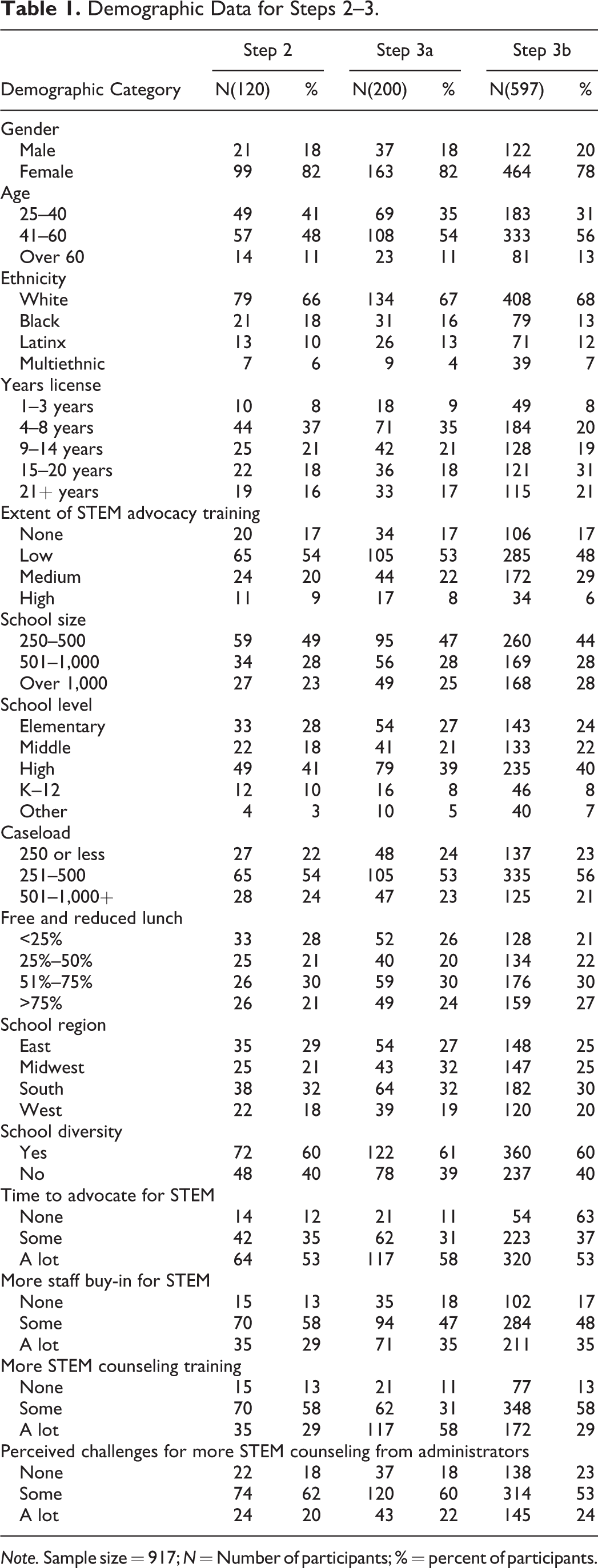
Note. Sample size = 917; N = Number of participants; % = percent of participants.
Instrument
Demographic data
The demographic data summarized previously and in Table 1 were collected via a series of questions at the beginning of the electronic survey the participants received and completed via Qualtrics. That survey also included the inventories described immediately below.
School Counseling-STEM-Advocacy Scale (SC-STEM-AS)
The SC-STEM-AS (Parikh Foxx et al., 2019) was designed to measure the STEM advocacy practices of school counselors. Each of the items on the two subscales (Promoting STEM Access and Promoting STEM Equity) was assessed with a 5-point, Likert-type scale: 1 = rarely or none of the time, 2 = a little of the time, 3 = some of the time, 4 = a good part of the time, and 5 = most or all of the time. In line with Young and Bryan’s (2018, p. 238) and Boateng’s (2018, p. 2) survey development approach, participants were asked to consider their current behavior or practice, rather than practices they would like to obtain, when responding to each statement. Examples of the items are in Table 2. Content validity was achieved through an extensive review of the literature and refined during Steps 1 and 2 through discussions with school counselors, school counseling supervisors, counselor educators, and consultation experts.
Bollen–Stine Bootstrap Factor Loadings and Confidence Intervals for the School Counselor STEM Advocacy Scale (SC-STEM-AS).

Note. x.xx = Original items deleted in the final 15-item version of the SC-STEM-AS due to standardized residual above 2.0.
a Standardized regression weights.
SCSE
Bodenhorn and Skaggs (2001) developed the SCSE to measure school counselor self-efficacy for use in research, to identify training needs for practicing school counselors, and as a potential outcome measure for school counseling education programs. The 43-item instrument asks respondents to indicate their level of confidence in performing various responsibilities using a 5-point, Likert-type scale with responses ranging from not confident to highly confident. Respondents are instructed to indicate their confidence in performing activities based on how they feel at their current school, not their anticipated (or previous) ability or school(s). Sample items include “Consult and collaborate with teachers, staff, administrators, and parents to promote student success” and “Implement a program which enables all students to make informed career decisions.” The reliability coefficient (i.e., Cronbach’s coefficient α) for the SCSE was .97 and resulted in a five-factor model.
Procedure
Participant recruitment and data collection
We determined sampling procedures by two methods. First, the Bernese sampling method (Mohler-Kuo et al., 2011) indicated that sending the survey to approximately 4,000 participants would lead to a distribution of ASCA members across school levels representative of the ASCA membership. Second, a power analysis indicated that the final sample size should be at least 395 participants (Bonett, 2002) with a 95% confidence interval [3.01, 3.02].
After obtaining approval from the university institutional board, we sent invitations to 4,000 members of ASCA. E-mail format, wording, and timing of delivery adhered to the Tailored Design Method for electronic surveying methods (Dillman et al., 2009; Smyth et al., 2009). The e-mail provided potential participants with a brief description of the study and a link to participate. The survey was hosted on the Qualtrics survey management website. Respondents reviewed the consent to participate, and if they agreed to participate in the investigation, they were provided a link to the survey.
Data analysis
Following the data analysis plan outlined by Young and Bryan (2018, p. 240–245), we replicated their approach by conducting a CFA on the SC-STEM-AS items using Mplus 8 to assess a two-factor measurement model (see Figure 1) identified a priori based on theory and previous research. Prior to conducting the CFA, we assessed the univariate normality and joint multivariate normality of the items on the SC-STEM-AS. We examined skewness, kurtosis statistics, and critical ratios, and used Bollen–Stine bootstrap p values along with the usual maximum-likelihood-based chi-square (

Initial two-factor model with standardized path coefficients. Note. Variable labels correspond to the items on the School Counselor STEM Advocacy Scale listed in Table 1; Promoting STEM Access (STEM-A); Promoting STEM Equity (STEM-E).
We conducted model modifications using the modification indexes and standardized residuals as guidelines to develop a better fitting and more parsimonious model (Byrne, 2009; Tabachnick & Fidell, 2007). The x 2 modifications were made incrementally, and we compared the x 2 difference and the Akaike’s information criterion (AIC) between the initial and modified model at each step to assess whether the modified model provided a significantly better fit. Correlated error terms indicated shared variance unique from the construct being measured or that might result from similar wording or meaning in the item. Given a strong theoretical rationale for correlating the five pairs of error terms, we determined that they posed no threat to fit (Byrne, 2009). Standardized residuals should be close to zero in a well-fitted model (Byrne, 2009), and standardized residuals greater than 2.0 could indicate items for deletion on each of the two-factor scales.
Following the CFA, we examined correlations between the factor scales on the SC-STEM-AS and SCSE to assess for evidence of convergent validity using Pearson correlation analysis. Finally, we generated descriptive statistics to summarize the status variables (e.g., age, gender, ethnicity) and SC-STEM-AS variables used in this study. For each status group, we determined subsample sizes, means, and standard deviations, and we conducted inferential statistical analyses to test null hypotheses related to differences between the status groups on the total SC-STEM-AS scale scores. We applied a corresponding null hypothesis that the means of the variables being compared were equal for the analysis of variance (ANOVA). For the data analyses, we averaged item responses for all total SC-STEM-AS scores so that each would range from 1 (low) to 5 (high) on a continuous, interval scale, reflecting the range of the item scales. We used Scheffe’s post hoc tests to determine which pairs of means were significant on total SC-STEM-AS scores when the F statistic led to rejecting the null hypothesis that the means being compared were equal. Eta-squared statistic was used to determine effect sizes for ANOVA tests.
Results
Most of the skewness and kurtosis critical ratios were greater than 2.0, as was the multivariate normality critical ratio, indicating multivariate nonnormality of the data, so we assessed overall model fit using the Bollen–Stine correlated p value and used the Bollen–Stine bootstrap to generate parameter estimates, standard errors of parameter estimates, and significance tests for individual parameters. Table 2 presents the means and standard deviations for each of the items on the SC-STEM-AS and the Bollen–Stine bootstrap standardized weights (i.e., factor loadings) and Bollen–Stine 90% confidence intervals for each item.
Initial Model
The hypothesized model was overidentified with 91 parameters and 134 degrees of freedom. One factor was scaled to a parameter of 1.0. The model included two factors: Promoting STEM Access and Promoting STEM Equity. All loadings were significant at the p < .001 level (see Table 2). The
Modified Model
We made modifications to the model to determine whether a stronger model fit could be attained. Based on a review of the modification indexes and standardized residuals, we first correlated the five pairs of error terms (a4–a8, a2–a10, a11–a10, a22–a6, and e20–e14). Consistent with advocacy theory/research (Bodenhorn & Skaggs, 2001), the first four pairs of items (i.e., a4–e8, a11–a10, a20–a14, a22–a6) appear to be measuring STEM advocacy (see Figure 1), an aspect of advocacy that is related to but independent of promoting STEM access. The second pair of items (i.e., e2–e10) appears to be measuring another important STEM advocacy characteristic that is related to but independent from promoting STEM equity.
Correlating the five error terms resulted in an improved and moderate fit,
The scores on the SC-STEM-AS comprised two factors (see Table 2 and Figure 1): Promoting STEM Access (11 items,
Subsequent to the CFA, we tested correlations between the factor scales on the SC-STEM-AS and the SCSE to evaluate for evidence of convergent validity using Pearson correlation analysis. Finally, we examined mean differences on the total SC-STEM-AS scores by school counselor characteristics, employment context, and school counselor perceptions
Convergent and Divergent Validity
To assess the degree to which factors of school counselor STEM advocacy were related to school counselor self-efficacy, we examined the correlations between the two subscales on the SC-STEM-AS and SCSE Scale used in this study. The correlations between the scales on the SC-STEM-AS and SCSE was .42, significant at the .001 level. Both of the subscales on the SC-STEM-AS (i.e., Promoting STEM Access and Promoting STEM Equity) had correlations below .50 with the SCSE scale (r ranged from .36 to .41).
SC-STEM-AS Scores and Results Across Demographic Variables
The average SC-STEM-AS composite score for the sample (N = 597) was 2.68 (SD = .75) on a scale of 1 (low) to 5 (high). In the following section, we present findings from the demographic variables in relation to the status variable. Null hypotheses were rejected for 10 of the 14 demographic categories. Those findings are presented below only for significant total SC-STEM-AS scores. Means and standard deviations for significant categories are presented in Table 3.
Means and Standard Deviations for Significant Demographic Categories on Total SC-STEM-A.

Note. n = Sample size; M = mean; SD = standard deviation.
* p < .05; **p < .01; ***p < .001.
School counselor characteristics
Ethnicity
The null hypothesis that the means for all ethnicity categories on total SC-STEM-AS score were equal was rejected, F(3, 594) = 6.84, p < .001. The Scheffe post hoc revealed that total SC-STEM-AS scores were significantly higher in Latinx participants compared to White participants (.27 ± .09, p < .05), Black participants (.48 ± .12, p < .001), and Multi-ethnic participants (.52 ± .15, p < .01). No other mean differences occurred. The effect size was .50 (medium).
Years of experience
The null hypothesis that the means for all years of experience categories were equal was rejected, F(4, 593) = 6.60, p < .000. The Scheffe post hoc revealed that total SC-STEM-AS scores were significantly higher in those with 0–3 years of experience compared to 4–8 years of experience (−.41 ± .12, p < .05); 15–20 years of experience (−.44 ± .12, p < .01), and 21-plus years of experience (−.57 ± .13, p < .001). Post hoc tests also revealed that participants with 21-plus years of experience had significantly higher SC-STEM-AS scores compared to those with 9–14 years of experience (−.33 ± .09, p < .05). No other mean differences occurred. The effect size was .66 (medium).
Extent of STEM advocacy training
The null hypothesis that the means for the STEM advocacy training categories were equal was rejected, F(3, 594) = 20.79, p < .001. The Scheffe post hoc score was significantly higher in those participants who identified as having no STEM advocacy training compared to school counselors who had low (.42 ± .12, p < .001), medium (.64 ± .09, p < .001), and high (.76 ± .14, p < .001) levels of STEM advocacy training. The effect size was .10 (small).
Employment context
School size
The null hypothesis that the means for the school size categories were equal was rejected, F(2, 595) = 4.69, p < .01. The Scheffe post hoc revealed that total SC-STEM-AS score was significantly higher in those participants with a school size of 501–1,000 compared to a school size of fewer than 500 students (.22 ± .07, p < .01). Post hoc tests also revealed that school counselors from schools with 501–1,000 students had significantly higher SC-STEM-AS scores than those from schools with more than 1,000 students (−.19 ± .08, p < .05). No other mean differences occurred. The effect size was .05 (small).
School level
The null hypothesis that the means for the school size categories were equal was rejected, F(5, 592) = 3.68, p < .01. The Scheffe post hoc revealed that total SC-STEM-AS score was significantly lower in those participants who identified as high school counselors compared to elementary school counselors (−.29 ± .08, p < .01). No other mean differences occurred. The effect size was .09 (small).
Caseload
The null hypothesis that the means for the caseload categories were equal was rejected, F(2, 595) = 3.86, p < .05. The Scheffe post hoc revealed that total SC-STEM-AS score was significantly higher in those participants who identified as having a caseload of 251–500 students compared to having a caseload of 250 or fewer (.20 ± .08, p < .05). No other mean differences occurred. The effect size was .09 (small).
Free and reduced lunch
The null hypothesis that the means for the free and reduced lunch categories were equal was rejected, F(3, 594) = 3.01, p < .05. The Scheffe post hoc revealed that total SC-STEM-AS score was significantly lower in those participants who identified as coming from a school that had over 75% of students on free and reduced lunch compared to school counselors from schools with 50%–75% free and reduced lunch (−.022 ± .8, p < .05). No other mean differences occurred. The effect size was .07 (small).
School diversity
The null hypothesis that the means for the school diversity categories were equal was rejected, F(1, 596) = 12.76, p < .01. The Scheffe post hoc revealed that total SC-STEM-AS score was significantly lower in those participants who identified as having a diverse school compared to school counselors who did not have a diverse school population (−.22 ± .06, p < .001). No other mean differences occurred. The effect size was .02 (small).
School counselor perception
Perceived challenges for not having enough time to advocate for STEM
The null hypothesis that the means for not having enough time to advocate for STEM categories were equal was rejected, F(2, 595) = 6.91, p < .001. The Scheffe post hoc test indicated that school counselors who expected no time for STEM programming had significantly higher total STEM-AS means than both school counselors who had a lot of STEM planning time (.39 ± .11, p < .001) and those who had some STEM planning time (.29 ± .11, p < .01). The effect size was .68 (medium).
Perceived challenges for more staff buy-in for advocating for STEM
The null hypothesis that the means for staff buy-in to advocate for more STEM categories were equal was rejected, F(2, 595) = 9.33, p < .001. The Scheffe post hoc test indicated that school counselors who expected no buy-in from staff had significantly higher total STEM-AS means than those who perceived having a lot of STEM buy-in (.39 ± .09, p, .001) and some STEM buy-in (.26 ± .08, p, .01). The effect size was .68 (medium).
Discussion
The scores on the SC-STEM-AS demonstrated strong psychometric properties with strong internal consistency and moderate to strong intercorrelations among the two factors. These correlations are consistent with previous research regarding school counselors’ role in creating access to STEM careers and the SCSE, which indicated that “school counselor STEM advocacy dimensions or practices are moderately to strongly correlated” (Bodenhorn & Skaggs, 2001, as cited in Young & Bryan, 2018, p. 245). The scores on the SC-STEM-AS also indicated convergent validity with the two subscales on the SCSE. These correlations between the SC-STEM-AS dimensions and SCSE indicate that school counselors who have high scores on the advocacy dimensions are also “confident in their ability to perform their school counselor responsibilities in the areas of promoting STEM access and equity” (Young & Bryan, 2018, p. 245). In this sample of school counselors, group differences emerged with respect to school counselor characteristics, employment context, and school counselor perceptions. These group differences ranged from small to medium in terms of effect size. However, differences did exist across 10 of the 14 null hypotheses.
School counselors who have high scores on the advocacy dimensions are also confident in their ability to perform their school counselor responsibilities in the areas of promoting STEM access and equity.…Group differences emerged with respect to school counselor characteristics, employment context, and school counselor perceptions.
School Counselor Characteristics
One interesting finding was that school counselors who reported the least amount of experience in the field reported higher levels of STEM advocacy. This may be related to school counselor preparation programs increasing their focus on college and career readiness training and including STEM-related careers (National Career Development Association, 2009). College and career readiness training has become a national focus and a priority emphasized by counseling organizations and researchers (Lapan et al., 2017). The wide availability of jobs in STEM fields has also attracted much attention (Mau & Li, 2018). Even if newly trained counselors have not had specific STEM career education, they may realize how crucial college and career readiness is for their students, recognize that preparation for STEM-related jobs is a promising career path for students, and consequently engage in STEM advocacy. Career development professionals have urged school counselors to encourage students to consider STEM-related careers (Schmidt et al., 2012).
In a qualitative study of the promotion of STEM career development, school counselors stated that their graduate programs included training on career development, but that they had received little to no STEM-related career education either in those programs or by their school districts (Shillingford et al., 2017). Shillingford et al. (2017) shared that these counselors reported acquiring basic knowledge of STEM professions and necessary requirements and skills mainly from their own self-directed searches. These efforts to increase their knowledge of STEM professions suggest a realization of the importance of making students aware of STEM-related careers and recommended prerequisites. According to Byars-Winston (2013), increasing and diversifying participation in STEM is an “equity imperative.” Therefore, school counselors should use the following recommended strategies and interventions to achieve that goal: familiarizing themselves with STEM-related fields (e.g., professional development, collaboration with STEM industry partners, active involvement in school-based STEM career pathways) and incorporating their learning into school-wide career-related events and classroom and small-group instruction.
Finally, related to school counselor ethnicity, SC-STEM-AS scores were significantly higher in Latinx participants compared to White, Black, and Multiethnic participants. These findings differ from a previous study that found Black and Multiethnic participants had higher self-efficacy for career and college readiness advising (Parikh Foxx et al., 2020). However, in both studies, the White participants reported the lowest self-efficacy scores. This outcome could imply that minority counselors tend to work in more urban settings and thus have more experience working with diverse students (Parikh Foxx et al., 2020). Counselor education programs and district supervisors should introduce curriculum and experiences that provide students and practitioners the opportunities to increase self-efficacy for comprehensive school counseling services and advocacy.
Employment Context
Results of this study indicate that school counselors’ level of STEM advocacy differs among key factors that describe the context in which school counselors work. These findings are significant given the call for school counselors to support the career development of all students, particularly students who are traditionally underserved and underrepresented in STEM fields (McFarland et al., 2019). In terms of school size, results indicate that school counselors working in schools with 500–1,000 students have higher levels of STEM advocacy compared to school counselors in schools with fewer than 500 or more than 1,000 students. As with school size, school counselors’ caseload size was related to level of STEM advocacy. Results indicate that school counselors with a caseload of 251–500 have higher levels of STEM advocacy than school counselors with a caseload of 250 students or fewer. Taken together, results related to school size, caseload size, and school counselors’ level of STEM advocacy highlight some interesting dynamics that need further exploration. For instance, differences in STEM advocacy related to school size and ratio may be influenced by other school counselor characteristics such as advocacy role perception, time allocation, school setting (e.g., rural vs. urban), school level (e.g., elementary vs. high school), or district initiatives (Mau & Li, 2018).
In terms of school size, results indicate that school counselors working in schools with 500–1,000 students have higher levels of STEM advocacy compared to counselors in schools with fewer than 500 or more than 1,000 students. As with school size, school counselors’ caseload size was related to level of STEM advocacy.
In terms of school level, elementary school counselors had higher levels of STEM advocacy than high school counselors. This finding seems contrary to what might be expected, given that high school counselors work directly with students planning for and soon to be pursuing postsecondary education and career pathways in the STEM fields. However, this finding is consistent with previous literature highlighting that the way school counselors implement school counseling programs is impacted by school level (Dahir et al., 2009). In the past, school counselors working with older students (e.g., high school) advocated less due to needing more time to set academic and career goals, conduct advising sessions, and ensure students are prepared for graduation and postsecondary opportunities (Gysbers & Henderson, 2012). Research has also shown a growing emphasis on elementary school counselors facilitating the exploration and development of students’ career and college interests and leading classroom lessons to develop students’ knowledge and skills (Lopez & Mason, 2017).
A key aspect of STEM advocacy is increasing underrepresented students’ exposure to, interest in, and entrance into STEM fields. However, the number of students pursuing STEM fields remains low, particularly for Black, Latinx, American Indian, and low-income students (NSF, 2017). Results of our study indicate that school counselors who work in schools with greater than 75% of students receiving free or reduced-price lunch have lower levels of STEM advocacy than school counselors working in schools with 50%–75% of students on lunch programs. This result is concerning given that postsecondary enrollment, required for many jobs in the STEM field, is significantly lower for students from low-income backgrounds (McFarland et al., 2019). Further, school counselors can play a vital role in advocating for underrepresented students’ pursuit of postsecondary opportunities and careers in STEM fields (McFarland et al., 2019). Thus, district supervisors could provide ongoing professional development that educates school counselors on current context and future trends in STEM fields. In turn, school counselors can identify talent and advocate for students to participate in STEM-related coursework and extracurricular activities.
Another interesting finding from our study is that school counselors who identified as working in a diverse school reported lower levels of STEM advocacy. Given the unique needs in educational attainment between underrepresented students and their more advantaged peers, particularly in terms of race and ethnicity, school counselors may not have the requisite knowledge, contextual understanding, and skills needed for developing and delivering career and college readiness programming focused on STEM (Parikh Foxx et al., 2020). Another explanation may be that school counselors are forced to allocate more time to addressing students’ academic and social/emotional needs rather than focusing efforts on career and college readiness (NCES, 2014). To address the challenges of high ratios and time allocation, school counselors can organize the delivery of STEM-focused career and college readiness efforts within an existing multitiered system of supports framework in which all students participate in school-wide career events and classroom instruction (i.e., Tier 1), some students participate in small groups focused on addressing elevated career and college readiness needs (i.e., Tier 2), and a few students receive individualized wraparound supports for intensive needs (i.e., Tier 3; ASCA, 2018; Goodman-Scott et al., 2019; Parikh Foxx et al., 2020).
School Counselor Perceptions
ASCA (2019b) recommends that school counselors spend 80% of their time on direct or indirect services. Such services include counseling, collaboration, and appraisal. However, previous research indicates school counselors lack sufficient time to provide such services related to implementation of ASCA-aligned activities or mental health (Carlson & Kees, 2013). Similarly, in our examination of time related to STEM advocacy, a majority of the school counselors reported having many challenges for time. Not surprisingly, these participants also reported the lowest mean scores on the SC-STEM-AS. In contrast, those who reported no challenges had higher scores on the SC-STEM-AS. These findings demonstrate that school counselors’ self-efficacy to engage in these tasks is based on having the time to implement services. Therefore, the use-of-time calculator (ASCA, 2019a) could help school counselors prioritize college and career readiness activities.
Another significant finding in this study regard the perceived challenges for staff buy-in: A majority of participants perceived a lot of challenges and those participants also had lower scores on the SC-STEM-AS. Previous research has examined how staff support influences advocacy. For example, Mau and Li (2018) found that school counselors felt they could engage in Lesbian, gay, bisexual, and transgender-related advocacy because of staff support. Furthermore, Bemak and Chung (2008) described “nice counselor” syndrome and how it stems from fear of backlash or fears that administrators and teachers may see the school counselor’s role as supplemental rather than central to student achievement. The present study clearly indicates that lack of staff buy-in creates a barrier for school counselors to engage in STEM advocacy. To address this challenge, school counselors can collaborate with teachers to integrate career and STEM-focused school counseling curriculum into the academic curriculum (Kozlowski, 2013). Classroom lessons and group counseling can focus on STEM self-efficacy and teaching students that having more people in STEM professions will support their community (Falco, 2017).
How School Counselors Can Use the SC-STEM-AS
Based on our findings, school counselors may find taking the SC-STEM-AS themselves beneficial for assessing their individual level of STEM advocacy and identifying ways to improve their work with students and adjust their program planning accordingly. Further, school counseling district coordinators/leaders might use the SC-STEM-AS to assess all school counselors in their district to develop tailored professional development opportunities to increase STEM advocacy. Counselor educators may consider using the SC-STEM-AS in their research related to STEM career development and to implement experiential learning experiences for school counseling students to prepare them to be strong STEM advocates. Professionals interested in using the instrument may contact the first author.
Limitations and Future Research
Although the study’s results indicate that the SC-STEM-AS has good construct validity, internal reliability, and convergent validity in a national sample of school counselors, numerous research limitations need to be considered (Young & Bryan, 2018). The SC-STEM-AS is a self-report survey that is subject to response bias and social desirability. Whether participants responded to the survey due to interest in the subject or commitment to contribute to the literature is unknown. For instance, a respondent who believes STEM is important may score higher than a respondent who doesn’t have a personal interest in STEM. Another limitation is that findings might not be generalizable to all school counselors. School counselors who are not members of ASCA might not respond similarly. ASCA member school counselors might respond higher on advocacy items due to the focus on advocacy principles throughout the ASCA National Model (ASCA, 2019a, p. xi). Researchers should also conduct other construct validity studies to examine the relationship of the SC-STEM-AS to other school counseling, school, and student assessments (Young & Bryan, 2018).
Irrespective of the limitations, these data show that the SC-STEM-AS can be an effective measure for identifying school counselors’ practices (Young & Bryan, 2018). The preliminary data suggest practical implications for school counseling personnel and stakeholders. Further, the SC-STEM-AS provides an opportunity for scholars to conduct research on school counselor advocacy with an instrument developed in the school counseling setting that has good reliability and validity data.
Footnotes
Declaration of Conflicting Interests
The author(s) declared no potential conflicts of interest with respect to the research, authorship, and/or publication of this article.
Funding
The author(s) received no financial support for the research, authorship, and/or publication of this article.
