




Abstract
Through the development and implementation of a trauma-sensitive comprehensive school counseling program, school counselors can be essential in meeting the mental health needs of youth in foster care. The multitiered systems of support (MTSS) framework is one potential strategy in achieving this goal. We offer recommendations on how school counselors might deliver a trauma-informed care approach utilizing the MTSS framework to support the mental health needs of youth in foster care who have experienced trauma.
Access to mental health services has proven to be of dire need for youth in the U.S. foster care system. According to Larsen et al. (2018), one in two children in foster care have a mental illness with high comorbidity. These children are also significantly more likely to have at least one lifetime mental illness diagnosis (Baker et al., 2017). Up to 80% of youth in foster care have clinically significant psychological problems (Stoner et al., 2015) and higher rates overall of anxiety, depression, post-traumatic stress disorder (PTSD), and aggression (Baker et al., 2017). Mental illness, coupled with various social obstacles facing these youth transitioning into young adulthood, puts them more at risk for negative life circumstances such as dropping out of school, unemployment, homelessness, drug abuse, and health issues (Villagrana et al., 2018). Foster care, also known as out-of-home care, is described as a temporary living situation provided by a state’s child welfare system for children who cannot live with their families (Childwelfare.gov, n.d.). These youth may be placed with relatives, with people to whom they are not related, or in a placement setting such as a group home or residential care facility. For children and adolescents who are in child welfare custody, their primary caregiver typically makes decisions regarding the initial removal of the child and the particular placement setting that can provide the appropriate level of care (Lardner, 2015). According to data provided by the Adoption and Foster Care Analysis and Reporting System (2019), approximately 437,283 youth were in foster care in 2018, with 262,956 of these youth entering care that year. Data show that every day, 681 children are removed from their homes and placed in foster care due to various safety concerns (Shaw et al., 2015). Safety reasons may include child neglect, abuse, or abandonment; other reasons can include the death of a parent or parental incarceration (Shaw et al., 2015).
Youth in foster care may experience trauma, which further impedes their mental stability. Traumatic events may include but are not limited to child abuse and neglect, the death of a loved one, exposure to domestic violence, or community violence (Dorsey et al., 2012). The trauma exposure rate for youth in foster care is upward of 82%, with a lifetime prevalence of PTSD that is twice as high for transition-aged youth than the general population (Salazar et al., 2013). Many of these children also experience disoriented and disorganized relationships with their biological parents, such as abuse and neglect or parental absence. However, Berrick and Hernandez (2016) reported that children who are separated from their biological parents regularly experience emotional trauma whether they experienced abuse by their parents or not. Furthermore, Mitchell (2018) stated that youth in foster care may also experience trauma upon being separated from siblings and friends. Batsche et al. (2014) found that emotional and behavioral issues stemming from trauma, abuse, and neglect in their home environment contribute to inadequate educational outcomes among youth in foster care. Moreover, exposure to trauma and chronic stress may have a major impact on their social/emotional, cognitive, and academic growth (Odhayani et al., 2013).
School counselors are in the ideal role to not only provide academic, social/emotional, and career services to students (American School Counselor Association [ASCA], 2019), but, with the appropriate training, also may be able to link and provide mental health services to students. According to Collins (2014), school counselors improve the mental health of students, which thereby improves their overall social/emotional development, career development, educational success, and overall functioning (e.g., Goodman-Scott et al., 2015; Masia Warner et al., 2016; Reinbergs & Fefer, 2018). ASCA (2016) specified that school counselors are essential in promoting a trauma-sensitive environment in schools and are uniquely positioned to identify those students who may have been affected by a traumatic event and provide the necessary support and resources. According to Cole et al. (2013), a trauma-sensitive school is one where all students feel safe, supported, and welcomed. Youth in foster care are one population of students who may benefit from a trauma-sensitive school model.
School personnel may provide a strong connection between foster youth and their formal education; however, school personnel sometimes have little awareness of students’ foster care status, their familial background, and the barriers they face in their home environment (Morton, 2016). As key members of the school support staff, school counselors must be knowledgeable about the multiple barriers facing youth in foster care, their varying needs, and specific programming that may facilitate their educational, mental health, and emotional needs. Specifically, using a trauma-informed approach to enhance social/emotional skill building behaviors via a comprehensive school counseling program may help to improve the overall health and well-being of this vulnerable population.
The multitiered systems of support (MTSS) framework offers school counselors opportunities to make responsive, evidence-based decisions to improve the learning and social/emotional functioning of all students (Sink, 2016). Using the MTSS framework, school counselors can serve youth in foster care in the roles of advocate, supporter/intervener, and change agent (Ockerman et al., 2012). In the supporting role, school counselors can provide services that are wrapped around a trauma-sensitive comprehensive school counseling program.
The multitiered systems of support (MTSS) framework offers school counselors opportunities to make responsive, evidence-based decisions to improve the learning and social/emotional functioning of all students (Sink, 2016). Using the MTSS framework, school counselors can serve youth in foster care in the roles of advocate, supporter/intervener, and change agent (Ockerman et al., 2012). In the supporting role, school counselors may provide services that are wrapped around a trauma-sensitive comprehensive school counseling program.
School counselors might explore trauma’s impacts on the overall development of youth in foster care. Doing so will help school counselors further understand the barriers that these children experience in order to provide adequate counseling services that speak to their mental health needs. Specifically, our goal is to recommend how school counselors might use the MTSS framework to deliver a trauma-informed care approach to support the mental health needs of youth in foster care who have experienced trauma. One strategy is for school counselors to receive appropriate trauma-informed training that will help them develop a trauma-sensitive comprehensive school counseling program.
School counselors might explore the implications trauma can have on the overall development of youth in foster care. Doing so will help school counselors further understand the barriers that these children experience in order to provide adequate counseling services that speak to their mental health needs.
Specifically, our goal is to recommend how school counselors might use the MTSS framework to deliver a trauma-informed care approach to support the mental health needs of youth in foster care who have experienced trauma.
Trauma-Sensitive Comprehensive School Counseling Programs
The development of healthy brains and healthy children requires consistent interaction with a nurturing adult (Brooks, 2014). This adult may be a caregiver, but for many youth in foster care, it may be a school counselor or other school professional. Learning about the impact of trauma is essential for school counselors to identify appropriate responses to students’ challenges with learning, behavior, or relationships and to improve overall access to learning. The main goal of implementing a trauma-sensitive school counseling program is to maximize the time in which a child has access to learning through safety and engagement. Ensuring that school personnel can obtain appropriate trauma-informed training is crucial for enhancing the learning environment. Trauma-informed training can maximize safety, school attachment, and, ultimately, access to educational content for youth in foster care (Cole et al., 2013). In trauma-sensitive comprehensive school counseling programs, a trauma-informed school counseling workforce understands how trauma affects the brain and access to learning (Cole et al., 2013). Given that the relationship between mental health and academic achievement is bidirectional and highly correlated, a trauma-informed school counseling program nurtures this relationship while maintaining its primary focus on educational outcomes (NCTSN, 2017).
Trauma-Sensitive School Counseling Programs and MTSS
A trauma-sensitive school counseling program is rooted in MTSS, a multitiered approach for the early identification and support of students with learning and social/emotional needs (Sulkowski & Michael, 2014). In an MTSS framework, all students receive Tier 1 services, a smaller group with more specific needs receives Tier 2 services, and only students with specific need for strategic intervention receive Tier 3 services (ASCA, 2018). These tiers of support occur across the various levels of prevention efforts (primary, secondary, and tertiary; Center on Response to Intervention, n.d.). Trauma-sensitive school counseling programs infuse all three of the tiers with trauma-informed concepts and practices. Such a program also “recognizes and addresses the broader contexts in which these tiers operate” (i.e., school environment/culture, community, and partnerships; Shepard et al., as cited in NCTSN, 2017, p. 4).
The MTSS framework attempts to break down the complexity of a school system and its environment into discrete components, with no single core domain (i.e., academic, social/emotional, and career) viewed in isolation (e.g., ASCA, 2018; Sink, 2016). “Only in totality can the framework help create, support, and sustain a trauma-informed school” (Shepard et al., 2013, as cited in NCTSN, 2017, p. 4). Within each of the tiers are strategies that are critical to creating a trauma-informed comprehensive school counseling program. These include school counselor practices that influence the day-to-day interactions among school staff, students and families, organizational policies and procedures, and community capacity-building strategies. All of these—within the school and in family and community contexts—are essential to support the overall culture, practice, and structures for a trauma-informed school (Shepard et al., 2013). School counselors within this trauma-informed MTSS framework realize the widespread impact of trauma and understand pathways to support and recognize trauma signs and symptoms. They respond by integrating knowledge about trauma into all facets of the system. School counselors can also resist retraumatization of impacted students “by decreasing the occurrence of unnecessary triggers (i.e., trauma and loss reminders) by implementing trauma-informed policies, procedures, and practices (Substance Abuse and Mental Health Services Administration, 2014). A school counseling program rooted in MTSS provides trauma awareness, knowledge, and skills as part of the fabric of the school culture. It also includes practices and policies and acts in collaboration with those who are involved with the student, including families, community agencies, court agencies, and law enforcement” (NCTSN, 2017, p. 7). Furthermore, a school counseling program built on the MTSS framework uses the best available science to facilitate and support the academic, social/emotional, and career opportunities for students and the school. Although education and mental health perspectives on serving students’ social/emotional needs may differ, the framework we present (see Figure 1, taken, reduplicated, and modeled from NCTSN, 2017, p. 5). is intended to integrate these perspectives while highlighting the core areas necessary to implement and sustain trauma-informed practices in a comprehensive school counseling program to support youth in foster care (NCTSN, 2017).
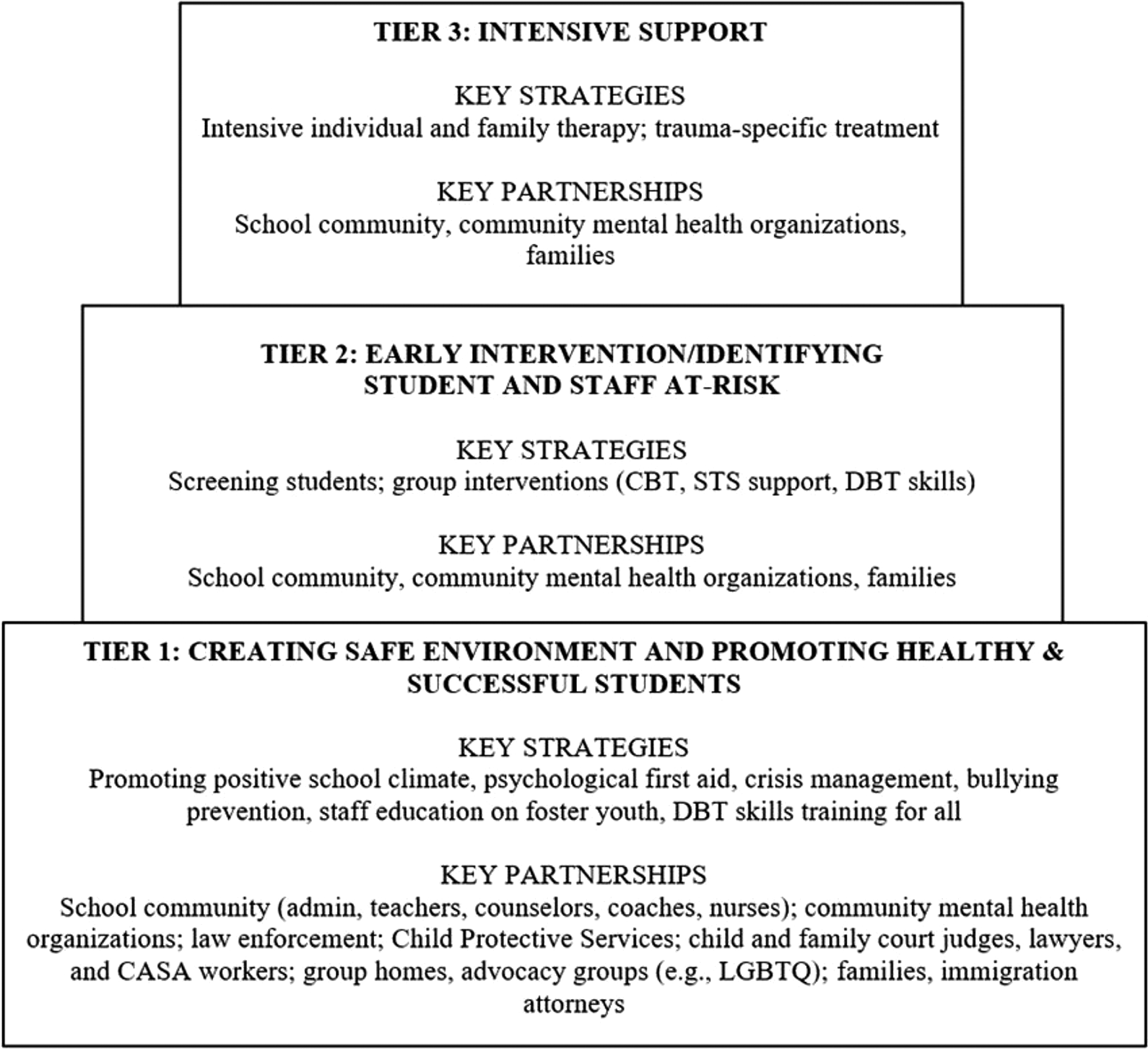
Multitiered systems of support (MTSS) framework pyramid. Note. (adapted from Creating, supporting, and sustaining trauma-informed schools: A system framework. Los Angeles, CA, and Durham, NC: National Center for Child Traumatic Stress, by National Child Traumatic Stress Network, Schools Committee, 2017. https://www.nctsn.org/resources/creating-supporting-and-sustaining-trauma-informed-schools-system-framework). MTSS framework pyramid is a multitiered approach for the early identification and support of youth in foster care. Tier 1: Comprehensive school counseling programs transform on multiple levels to create and support safe environments that promote healthy and successful students and staff. School counselors work in Tier 1 of the MTSS pyramid support strategies across the entire pyramid. Tier 2: Comprehensive trauma-informed school counseling programs identify and respond to students and staff who are at risk or have been exposed to trauma and/or separation/loss in ways that meet their unique exposures, experiences, and developmental and personal needs. Tier 3: Comprehensive trauma-informed school counseling programs provide support to students in foster care whose behaviors and experiences necessitate intensive interventions and aim to meet their unique exposures, experiences, and developmental and personal needs.
Although school counselors may be aware of the adversity faced by their students, they may not feel adequately equipped to respond to students’ mental health needs (Bronstein et al., 2012). Having the proper trauma-informed training—such as addressing compassion fatigue, creating partnerships with outside stakeholders, and changing the school culture surrounding the idea of trauma-informed approaches without discipline components—will allow school counselors to create a trauma-sensitive school counseling program (O’Grady, 2017). Thus, school counselors can be instrumental in delivering evidence-based interventions that address mental health including coping with trauma (Reinbergs & Fefer, 2018).
Developing and Delivering a Trauma-Sensitive School Counseling Program for Youth in Foster Care Using MTSS
Due to trauma exposure that youth in foster care may experience, implementing trauma-sensitive prevention practices through an MTSS framework may be helpful for school personnel. According to Cole et al. (2013), in addition to professional development and training on trauma, learning, and the brain, trauma-sensitive comprehensive school counseling programs could focus attention and resources on: a multidisciplinary team approach to assess individual student cases; expanded counseling and mental health services; referrals to outside support services; parent and family workshops on the effects of adverse childhood experiences (ACEs); conflict resolution training for both teachers and students; consultation with local hospitals, mental health facilities, women’s shelters, and other community-based organizations; school/district administrative support for establishing a trauma-sensitive environment; academic instruction techniques for teaching traumatized students; and development or revision of school policies to be more trauma sensitive.
Given the research related to trauma experienced by youth in foster care and trauma-sensitive school counseling programs, we identify the core areas of such a program as (a) trauma education and awareness, (b) identifying and assessing traumatic stress, and (c) addressing and treating traumatic stress. Figure 1 presents the relevant MTSS-tiered approaches that school counselors may use to support youth in foster care who have experienced trauma.
Trauma Education and Awareness
A trauma-informed comprehensive school counseling program is one in which school counselors recognize and respond to the potentially negative social/emotional, relational, and academic impact of traumatic stress on those within the school system (Chafouleas et al., 2016). More specifically, “it is one in which administrators, staff, students, families, and community members recognize and respond to the potentially negative behavioral, relational, and academic impact of traumatic stress on those within the school system” (National Child Traumatic Stress Network Schools Committee, 2017, p. 7).
Developing a trauma-sensitive school counseling program that provides professional development for teachers, administrators, allied professionals, and partners within surrounding communities will create a shared understanding of trauma’s impact on the educational outcomes for youth in foster care and what is needed to build their coping and protective skills. This might be accomplished by using a whole-school, inquiry-based approach to creating trauma-sensitive schools (Chafouleas et al., 2016). School counselors may facilitate collaboration within the school and district “to create local policies that (a) support trauma-informed practices, (b) ensure adequate staffing to perform trauma screenings, (c) provide traumarelated services, and (d) create an effective infrastructure for providing support for youth in foster care who have experienced trauma” (NCTSN, 2017, p. 7). This will allow schools to achieve the administrative functions necessary for effective implementation of trauma-informed policies, practices, and procedures that support foster care youth within their schools.
Tier 1: Define
A school counseling program may address trauma, and behaviors associated with exposure to trauma and loss, as essential to improve the academic outcomes of youth in foster care who are impacted by trauma. This is at the foundation of creating, establishing, and sustaining a trauma-sensitive school counseling program that supports all students (Chafouleas et al., 2016). Having a trauma-sensitive school counseling program should be emphasized within the mission and vision of the comprehensive school counseling program to share its importance with the school community. In this regard, the school community and parents/guardians should be able to easily identify what a trauma-sensitive school counseling program is, how the program supports their child, and the interventions and resources that might be made available in the event a child has experienced trauma exposure.
Tier 1: Professional development
Trauma literacy is a key component in the professional development of trauma-informed school counselors. Building on a “strong foundation of counseling and crisis management practice in schools, trauma literacy helps staff recognize the continuum of trauma in children and its impact on academic achievement and development. Leadership and staff must share an understanding of trauma's stress on the brain and body, impact on student learning and behavior, and the need for a school-wide approach to develop students' skills for coping with such stress” (NCTSN, 2017, p. 7). This information further supports the foundational knowledge to identify the signs of trauma and toxic stress that youth in foster care may experience (Cole et al., 2013).
In providing this base knowledge of trauma literacy, school counselors must then learn how youth in foster care are specifically impacted by trauma, given their high frequencies of ACEs. For instance, in a study conducted by Turney and Wildeman (2017), more than 75% of children exposed to foster care experienced 2.5 more ACEs, on average, than children not in foster care. This information further illustrates the importance of school counselors understanding the mental health needs of youth in foster care who have experienced trauma.
Tier 1: Psychoeducation on the effects of stress and trauma on students
School counselors must provide health and psychoeducation to youth in foster care about the effects of stress and trauma on the body, “share how to develop healthy coping skills for managing stress, promote associations and activities that nurture healthy peer and family relationships and connections to community organizations, and incorporate practices to increase youths’ resilience and protective factors” (Chafouleas et al., 2016, as cited in NCTSN, 2017, p. 7). For youth in foster care who have recently experienced a loss, school counselors may provide grief-specific psychoeducation and supports. Psychoeducation might empower students to seek the school counselor’s services when necessary.
Tier 2: Developmentally appropriate trauma-informed responses
School counselors must recognize that trauma may impact development (Zeanah & Humphreys, 2019). In this regard, when addressing the educational needs of youth in foster care, school counselors should consider the child’s developmental level including classroom structure and individualized supports. Additional support from adults is necessary to assist younger students in foster care and help them thrive. A trauma-informed perspective also recognizes that some youth in foster care may have developmental delays or intellectual disabilities that require specialized trauma responses (NCTSN, 2017).
Identifying and Assessing Traumatic Stress
A trauma-informed school counselor must recognize and value the identification of youth in foster care who are vulnerable to traumatic events. This requires implementing a tiered approach to identifying students’ “trauma-related mental health concerns when indicated. Such factors include but are not limited to significant changes in key developmental domains (i.e., physical/health, cognitive, behavioral, and social/emotional) and disruption in the student's academic performance, attendance, behavior, or pattern of school engagement” (NCTSN, 2017, p. 7). A tiered approach includes a diversity of strategies beginning with the school counselor, parent/guardian, family, social worker, courts, and probation personnel and sustaining engagement throughout the process.
Tier 1: Systematic assessment, practices, and protocols for considering trauma exposure
School counselors must assess the trauma exposure and trauma-informed practices and protocols within their school communities. In this regard, they may be trained on trauma-informed assessments (see Table 1) that systematically assess school-wide, trauma-informed practices, policies, and/or procedures to support youth in foster care, the general student population, and staff (Conradi et al., 2011; Kataoka al., 2018). School counselors may also follow the standard protocols for considering trauma exposure by utilizing the Child Trauma Toolkit for Educators (National Child Traumatic Stress Network, 2008). They also may obtain knowledge on building trauma-informed classrooms that can then help them create a safe school environment where youth in foster care can thrive (Pickens & Tschopp, 2017). School counselors’ primary response to behavioral referrals may include “screening for traumatic experiences and traumatic/loss stress reactions among youth in foster care using evidence-based screening tools” (see Table 1; NCTSN, 2017, p. 6-7). When traumatic exposure or traumatic/loss stress reactions are identified with certain students, school counselors can conduct a more comprehensive assessment to direct future interventions.
Trauma Screening Measures.

Note. IC = internal consistency reliability; TRT = test–retest reliability; VC = validity coefficient; DMV-IV = Diagnostic and Statistical Manual of Mental Disorders, Fourth Edition; PTSD = post-traumatic stress disorder.
Tier 2: Trauma screening and behavioral referrals
As a primary way to address youth in foster care receiving behavioral referrals, school counselors may include a “screening for traumatic experiences and traumatic/loss stress reactions using evidencebased screening tools” (see Table 1; NCTSN, 2017, p. 6-7). For instance, if a student in foster care experienced a high number of behavioral issues at school within a short period of time and had multiple barriers that impeded their education, the school counselor could use the Trauma Symptom Checklist Child Version–Posttraumatic Stress subscale ( Briere, 1996) to screen for trauma symptoms. When the school counselor identifies traumatic exposure or traumatic/loss stress reactions, “a more comprehensive assessment would be necessary to direct future interventions for the student” (Conradi et al., 2011; Kataoka et al., 2018; NCTSN, 2017, p. 7).
Tier 3: Referral and ongoing monitoring of traumatic stress responses
School counselors may provide ongoing assessment aligned with interventions for traumatic stress reactions in youth in foster care who are experiencing continued academic, behavioral, and mental health challenges. To accomplish this, school counselors must create a formalized network for referrals to community counseling for these students. This includes collaborating with local counseling and psychological services that can provide more comprehensive screening and monitoring of the child’s trauma (see, e.g., Hendricks et al., 2011; Zaenah & Humphreys, 2019).
School counselors also may be trained to coach teachers and administrators to react differently to problem behaviors of youth in foster care who have experienced traumatic stress. This alternative response may allow the educator to increase the student’s sense of safety, exploring why the student reacted in a particular way in the classroom or school community. A trauma-informed school counselor “recognizes the relationship between and alignment of trauma-informed core areas with social/emotional and behavioral learning practices, disciplinary response, classroom management, and student and professional supports” (NCTSN, 2017, p. 12). Trauma-informed school counselors also acknowledge the impact that “mental health may have across all major developmental domains (i.e., physical/health, cognitive/learning, behavioral, and social/emotional) both inside and outside of the classroom, and how the scholastic experience may influence the mindset and behaviors of youth in foster care” (NCTSN, 2017, p. 4; Zaenah & Humphreys, 2019).
Addressing and Treating Traumatic Stress
Adequate supports should be available for all school stakeholders—students, families, teachers, administrators, and other school personnel—“who have directly or indirectly experienced traumatic events or are at risk for exposure. Referral and access to evidence-based prevention and intervention resources should be available and adapted to the needs of service recipients” (NCTSN, 2017, p. 6). Provision of services may be systematically linked to protocols for “identifying individuals exposed to trauma and loss” (NCTSN, 2017, p. 7). Conducting routine reviews of service referral and provision can ensure its effectiveness.
Tier 1: Destigmatizing self-referral options
Youth in foster care and school counselors should be aware of support services that are available within the community. Trauma-sensitive school counseling programs must provide options for self-referral that reduce the stigma around mental health and system involvement. Research has indicated that some youth in foster care believe that receiving mental health treatment would open them up to discrimination or being devalued (Villagrana et al., 2018). Youth in that study also believed they would have dual stigma if they were both receiving mental health services and in foster care (Villagrana et al., 2018). Thus, many youth in foster care are hesitant to receive mental health services out of fear of being labeled mentally unstable. School counselors must encourage these students to connect with services when deemed necessary, crucial for development, and legally appropriate. School counselors may also advocate for school-based mental health services within the school community to reduce the stigma surrounding self-seeking of mental health treatment. To this end, school counselors might designate a private office space for a clinician to provide school-based mental health services at their school site. This approach can make service options available to youth in foster care that support both their access to mental health care and privacy preferences.
Tier 2: Proactive intervention
Based on screening results, school counselors would provide “trauma-informed, evidence-based, and resiliency-building early interventions to youth in foster care. These may include dialectical/cognitive behavioral skills or mindfulness strategies or treatments for those youth identified as at risk for traumatic stress, grief, or depression. School counselors may also provide opportunities for educators to employ in-class supports that address students' behavior in a trauma-informed manner” (NCTSN, 2017, p. 4).
School counselors must also make appropriate referrals to trauma-informed services that address behaviors in youth in foster care. In this regard, school counselors must be aware of appropriate community-based counseling service providers who can provide evidence-based trauma treatment for youth. Clinicians may use baseline screening data from a trauma assessment tool (see Table 1) to help decipher the type of treatment for youth in foster care who have been exposed to trauma. Examples of evidence-based therapy for the treatment of trauma symptoms include trauma-focused cognitive behavioral therapy (Cohen et al., 2006); child–parent psychotherapy (Lieberman et al., 2005); and attachment, self-regulation, and competency (Kinniburgh et al., 2005).
Tier 2/3: Behavioral support plans
For youth in foster care who have a 504 Plan or a student support team, school counselors may have their behavioral support planning team incorporate an understanding of trauma and reminders of trauma and loss among youth experiencing traumatic stress. The team may also incorporate the impact of trauma on key developmental domains and evidence-based practices into the positive behavioral support planning process.
Tier 2/3: Special education response
For youth in foster care who have an Individualized Education Plan (IEP), school counselors may consult IEP team members to incorporate into the IEP planning process an understanding of trauma and reminders of trauma and loss among youth experiencing traumatic stress. They may also consult IEP team members to assess the impact of trauma on key developmental domains and to incorporate evidence-based practices for supporting these foster care youth.
Tier 3: Referral
School counselors may refer youth in foster care to “evidence-based, trauma-informed treatments on an asneeded basis when school personnel are unable to meet the student's mental health needs” (NCTSN, 2017, p. 4). School counselors can also help their school develop strong relationships with community providers who have considerable experience providing trauma-informed care to children and adolescents. Furthermore, the school counselor may designate a liaison who can help strengthen partnerships among the school and community service providers. The school counselor can invite community providers to introduce their resources via brief presentations at school staff meetings. Inviting community providers to meetings may also help providers learn more about the school’s needs related to developing a trauma-informed school community and about the issues experienced by youth in foster care within their particular school community. For instance, a community clinician could use information from such a meeting to assist school personnel in identifying the specific symptoms of youth in foster care who have experienced trauma. This may then help to reduce school personnel’s misinterpretations in identifying behaviors displayed by these students as negative.
Conclusion
Few events outside of the classroom have had as profound an impact as adverse and traumatic life experiences on the multiple domains of development among youth in foster care. Understanding children’s responses to these challenges and having trauma-informed responses are essential for school counselors aiming to support youth in foster care who have experienced trauma (Chafouleas et al., 2016). Becoming trauma informed and developing and delivering a trauma-sensitive school counseling program using an MTSS framework is an effective approach. Specifically, school counselors can build an MTSS framework that focuses on the areas of trauma education and awareness. They can also identify, assess, address, and treat traumatic stress to support the mental health needs of youth in foster care youth who have experienced trauma. To support school counselors in becoming more trauma informed, school districts can provide district-wide professional development sessions for school support personnel that focus on topics such as identifying trauma and referral practices in schools; implementing academic and behavioral practices such as social/emotional learning and positive behavioral supports; promoting safe, stable, and nurturing relationships; identifying community resources related to trauma; and learning policies, procedures, and behaviors in supporting youth in foster care who have experienced trauma.
Although this proposal focuses on supporting youth in foster care, school counselors may use the ideas presented to serve a diverse population of students who may have experienced trauma and toxic stress. Therefore, we suggest that researchers explore school counselors delivering a trauma-sensitive school counseling program to support K–12 students from various populations. Furthermore, although our proposal focuses on three primary areas related to trauma-sensitive school counseling programs and youth in foster care, additional areas for further research may include creating a trauma-informed learning environment, cultural responsiveness, emergency management/crisis response, staff self-care and secondary traumatic stress, and school discipline policies and practices.
Examining collaborations between school counselors and clinical mental health counselors (particularly those who specialize in trauma counseling and are certified in delivering trauma-focused cognitive behavioral therapy or dialectical behavioral therapy/skills training) might help to provide further support for students in foster care who have experienced trauma. Providing such interventions and contributing to evidence-based research can only improve the social/emotional and educational outcomes of these students. School counselors can lead the way in this effort by becoming trauma informed and by implementing a trauma-sensitive school counseling program that benefits these youth.
Footnotes
Declaration of Conflicting Interests
The author(s) declared no potential conflicts of interest with respect to the research, authorship, and/or publication of this article.
Funding
The author(s) received no financial support for the research, authorship, and/or publication of this article.
