




Abstract
Xerostomia is a common problem, particularly in an elderly population, with a range of causes that affect important aspects of life, such as chewing, swallowing, and speaking. Xerostomia has been explained in traditional medicine throughout history. Traditional Persian medicine, with more than 4000 years of history, consists of the sum total of all the knowledge and practices used in diagnosis, prevention, and exclusion in Iran from ancient times to the present. Based on leading Persian medical manuscripts, the current study focuses on the medieval concept of xerostomia as an important general disorder to review the aetiology of xerostomia and xerostomia types, the control and treatment of xerostomia by lifestyle modification, and medicinal plants for xerostomia suppression according to the theory and practice of traditional Persian medicine. Xerostomia was treated with 3 major approaches in traditional Persian medicine: lifestyle modification, simple single herbal remedies, and compound medicines. It appears that all the factors that cause xerostomia in current studies can be described by using the theories of traditional Persian medicine; furthermore, therapies aimed at both medicines (current and traditional) focus on protecting salivary glands and salivary flow. As a conclution while current managements of xerostomia are still inadequate and traditional approaches have found experimental support over the centuries, some of these traditional treatments may still be useful to current medicine as alternative medicine.
Keywords
Introduction
Xerostomia is the subjective sensation of dry mouth and has been demonstrated to affect sufferers’ oral health–related quality of life. 1 Dry mouth is a common problem with a range of causes. The symptom might be due to a reduction in the quantity of saliva produced, or a change in the composition of saliva, but a feeling of dry mouth may also be present in people with normal saliva production. 2 Dry mouth is a common problem with an estimated incidence of between 10% and 26% in men and between 10% and 33% in women, which may or may not be due to reduced saliva secretion. 3 Xerostomia is more common in middle-aged and elderly people, and its main causes are anxiety, fear, stress, depression, and the use of some drugs, as well as autoimmune disease, viral or bacterial salivary gland infections, salivary gland tumours, radiotherapy and chemotherapy, diabetes mellitus, AIDS, hepatitis C virus infections, and hormonal disturbances such as menopause and climacteric conditions. 4 Many commonly prescribed medications are associated with a feeling of dry mouth, despite normal saliva production. 2
Xerostomia affects important aspects of life such as speaking, the enjoyment and ingestion of food, and the wearing of dental prostheses. These impacts on the daily lives of patients lend assistance to the assertion that dry mouth is an important condition that merits concerted research attention in order to further understand how best to prevent and treat it. 5 Despite the advantages in current medications for treatment of xerostomia, there is no completely effective treatment for xerostomia; so many patients consider searching for complementary or alternative treatment methods. 6
The traditional Persian medicine was combined by different medical traditions from Egypt, Greece, India, and China over more than 4000 years and merged to form what became the nucleus and foundation of medical practice in Europe in the 13th century. 7 During the Renaissance, in the transition from humoral medicine to more popular paradigms of medicine, many traditional practices from ancient times fell out of favour or were forgotten. Traditional Persian medicine consists of the sum total of all the knowledge and practices used in diagnosis, prevention, and exclusion in Iran from ancient times to the present. Traditional Persian medicine or humoral medicine was based on the 4 humors; every humor has a specific temperament, comprising balgham or phlegm (cold and wet qualities), dam or blood (hot and wet qualities), safra or yellow bile (hot and dry qualities), and sauda or black bile (cold and dry qualities). Every humor is a substance made from digestion and permutation of foodstuffs in the gastrointestinal system. 8 The imbalance in body temperament and humors leads to the onset of disease. 9 There is information and data in traditional Persian documents or books about medicinal herbs that are used by traditional Persian medicine scientists for the treatment of xerostomia. 10 A review of historical manuscripts on medical science proposes that approaches and medication developed over centuries of human experience have the potential to improve conventional medical approaches and practices. 11
In ancient sources of traditional Persian medicine, xerostomia was identified as a feeling of oral dryness, which is a symptom of the existence of an abnormality in the mouth, salivary glands or in other organs such as the head, stomach, and liver. Dry mouth is one of the most recognizable symptoms and its treatment is based on treating the related disease. 12 –14
The present review discusses the aetiology of xerostomia and xerostomia types, the control and treatment of xerostomia by lifestyle modification, and medicinal plants and pharmaceutical forms for xerostomia suppression according to the theory and practice of traditional Persian medicine.
Materials and Methods
In this literature research, we investigate some important Persian medical and pharmaceutical manuscripts from the 9th to the 19th century
Results
In the medieval period the humor theory of health was a widely held belief. Traditional Persian practitioners believed that dry mouth follows the dry temperament. In traditional Persian medicine manuscripts, dry mouth was discussed in the section of mouth disorders. In the tongue chapter of the Al-Qanoon fi al-Tibb by Avicenna, he asserted that, there was a relationship between dry mouth and the function of other organs.
In traditional Persian medicine, dry mouth is defined as 2 types: real and nonreal (True or False). In real xerostomia, the body’s fluid is low; consequently salivary flow will also be low. This type is due to the hotness and dryness of temperament; and in nonreal types, salivary flow is not low, but it is thick (which might be associated with a change in the composition of saliva); so patients feel dry mouth. 12,16
According to traditional Persian medicine texts, causes of dryness in the body include: use of whatever is creating heat and dryness ipso facto in the body, such as some kind of food and spices (which have hot and dry qualities, so they create heat and dryness in the body), eating less and the failure to supply food to the organs (which can cause reduction in body moisture and consequently take body toward dry temperament), use of whatever has the potential of creating dryness inside or outside of the body such as excessive movement, excessive awakening, excessive copulation, etc. Each of the above causes can lead to dryness of the body, and dry mouth can occur consequently; therefore, according to the texts of traditional Persian medicine, treatment is based on creating moisture in the body.
Treatment Approaches
The management of xerostomia employs 3 main approaches. The first is lifestyle modification. Administration of simple herbal medicines and other natural remedies is the second approach, while the last is treatment with pharmaceutical formulations of 2 or more bioactive substances.
Lifestyle Modification
Traditional Persian medicine has given more attention and importance to the prevention of disease rather than its cure.
There are 6 factors that are essential for the maintenance of good health, referred to as the 6 essential factors (Setteh-e-Zaruriea in traditional Persian medicine). These essential factors are as follows: Air Food and drink Sleep and wakefulness Evacuation and retention Body movement and repose Mental movement and repose
Lifestyle modification is based on Setteh-e-Zarurieah, such as using moisturizing foods like rice cooked with milk, 12 fresh fish, goat meat, foods that are prepared with pumpkin and spinach as well as purslane. The best fruits for patients with xerostomia are almonds, figs, grapes, peaches, and fresh broad bean. 15 Sleep and comfort are also very useful. 13 Salty, sour, and sharp edibles were considered harmful 12 and patients should avoid excessive movement, exercise, and walking in the sun. Furthermore, they should avoid stresses such as anger, sorrow, and excessive fear. 15
Simple Medicines
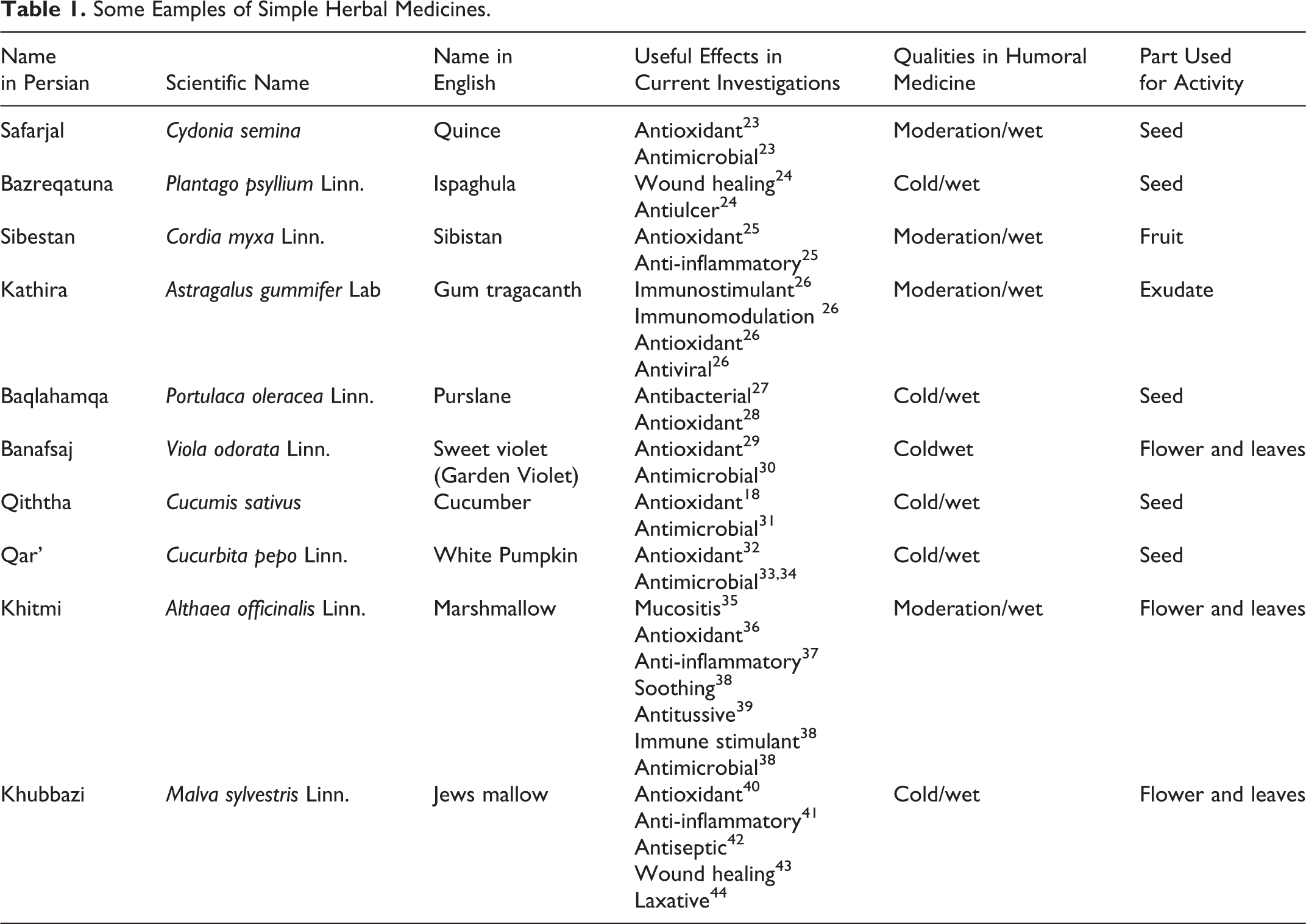
Simple medicines are a single mineral, botanical, or animal agent that are generally preferred to compound medicines in traditional Persian medicine, because they usually cause fewer undesirable side effects, which leads to higher patient compliance. 14 In traditional Persian manuscripts, a lot of plants were used in various ways for treating xerostomia; some of these simple medicines, which were most important and commonly used, are demonstrated.
One of the known forms of application for treating dry mouth, via topical or systemic administration, is medicinal mucilages prepared from numerous medicinal herbs. 13
Gargling simple mucilage medicinal herbs such as ispaghula (Plantago psyllium Linn.), quince seed (Cydonia semina), and gum tragacanth (Astragalus gummifera Lb.) was suggested. 16 Also gargling extract of purslane (Portulaca oleracea Linn.) seeds or extract of purslane and cucumber (Cucumis sativus) has known beneficial effects. 12 Another form of application for treatment of dry mouth, are medicinal oils, such as sweet violet (Viola odorata Linn.) and pumpkin (Cucurbita pepo Linn.). In addition, sipping some fresh juice such as barley juice, pumpkin juice, and cucumber juice is considered helpful for improving xerostomia. 12
Compound Medicines
The third line of treatment in traditional Persian medicine is administration of compound medicines comprising 2 or more bioactive substances in pharmaceutical dosages, which are synergistic effects or reducing side effects of each other.
14
When the xerostomia was not improving, compound preparations were prescribed by Persian practitioners, such as the following: Oral administrations and topical uses of quince seed combined with White Water Lily (Nymphaea alba Linn.) and sugar Combine the above with the extract of pumpkin (Cucurbita pepo Linn.) seeds and/or purslane (Portulaca oleracea Linn.) seeds Gum tragacanth (Astragalus gummifera Lb.) combined with sugar (especially if dry mouth is due to passing air through the mouth) Oral administration and/or gargle mucilage of ispaghula with mucilage of quince seeds and/or gum tragacanth (Astragalus gummifera Lb.) Gargling ispaghula mucilage with apple lemon oxymel (sikanjbeen; known as sikanjbeen-e-tufahi-limonee in traditional Persian medicine; oxymel is a Persian word, which is composed of vinegar or acetic acid (sirka) and honey (angbeen). Therefore, it is called sikanjbeen. It is a type of syrup in which vinegar or acetic acid (sirka) is an essential part of this formulation. In ancient times it was prepared from vinegar and honey but nowadays it is prepared from sugar, too; which is called simple oxymel (sikanjbeen sada). If other ingredients are included then it may be referred to as apple oxymel (sikanjbeen e tufahi) due to its apple ingredient.) Gargling a mixture of pumpkin seeds and cucumber seeds that are half pounded, soaked in fresh goat’s milk, then the extraction is taken and mixed with quince seeds and Sibestan (Cordia myxa Linn.) that are boiled in water.
12
Discussion
Medieval Persian physicians were aware of the 2 comprehensive forms of xerostomia, relied on etiological theories and treatments 16 that are similar to general classification in current medicine for xerostomia. 19 According to traditional Persian medicine texts, dry mouth can occur following the increasing heat and/or dryness in the mouth, and more important, increasing heat and/or dryness in essential organs such as liver, heart, and brain can causes xerostomia. 13 As previously mentioned, the causes of heat and dryness are whatever is creating heat and dryness in the body and that result in dry and hot temperaments, thus creating an imbalance in body temperament and humors. 13 Whereas, the causes of dry mouth in studies are physical and mental stresses such as anxiety, fear, depression, use of some drugs, some disease such as autoimmune and salivary gland infections, salivary gland tumours, radiotherapy, and chemotherapy. 4 Mentioned causes for xerostomia in studies, from the perspective of traditional Persian medicine, can increase heat and/or dryness in the body, and create dry mouth subsequently. 12,13
Some of the causes of xerostomia in current medicine are psychology disorders (such as anxiety, fear, depression), which play an important role in traditional Persian medicine. Avicenna stated that psychology disorders affect the body more than any other factors. 13 In Persian traditional books psychology disorders are known as Aaraz-e-nafsani and include happiness, sadness, anger, joy, fear, and embarrassment; sadness, anger, fear, and embarrassment can lead to dryness of the body. 13,14
In current medicine, xerostomia may be caused by many drugs, such as some antidepressants, antipsychotics, sedatives, anti-parkinsonians, antiseizures, antispasmodics and analgesics, some antihypertensives (diuretics, calcium channel blockers, alpha- and beta-blockers, angiotensin converting enzyme inhibitors), and cytotoxic agents. Most of the drugs mentioned have anticholinergic effects and as they cause salivary dysfunction, they subsequently cause dry mouth. 20 Also, in traditional Persian medicine some medications act as something that has the potential to cause dryness in the body, so they cause dry temperament and dry temperament may cause salivary dysfunction and consequently dry mouth. 13
Several studies have reported a higher prevalence of xerostomia in elderly populations; in the elderly, the long-term use of medications and aging are regarded as major causes of xerostomia 21 ; that are according to ancient Persian scholars who believed that as a person gets older, his or her body moisture is reduced, so dry temperament is more common in middle-aged and elderly people; and in addition to dry mouth, dryness occurs in other parts of the body, including the eyes, vagina, and lungs among others. In order to prevent this situation, traditional Persian medicine physicians recommended the use of foods with high moisture content as well as a little hot and dry qualities after the age of 40 years. 13
Studies mention that dry mouth occurs in some systemic problems, such as systemic autoimmune disorder (eg, Sjogren's syndrome), infectious diseases and diabetes. These systemic disorders are associated with inflammation of epithelial tissues, particularly exocrine glands, on which salivary dysfunction causes xerostomia. 20 These results are in accordance with the ideas of Persian traditional physicians, that the inflammatory process produces heat in the body, which causes dryness.
Overall, it seems that most of the factors that cause xerostomia in current studies can be described by using the theories of traditional Persian medicine.
Therapies aimed at both medicines (current and traditional) have been protecting salivary flow. Conventional medical treatments for dry mouth try to maintain salivary flow in normal range in various ways such as protection of salivary glands against radiation, infections, inflammation, and so on, or stimulate salivary glands to secrete saliva. 22 In traditional Persian medicine, according to traditional Persian manuscripts, treatment is based on creating moisture in the body, to make balance in body temperament and humors. 12
Xerostomia was treated with 3 major approaches in traditional Persian medicine: lifestyle modification, simple single herbal remedies, and compound medicines.
13
Lifestyle modification prevents the causes of xerostomia. When somebody has been suffering from xerostomia, treatments included simple single or compound herbal medicines. In these approaches, medicinal plants containing mucilage were often used. It seems that medicinal mucilages can be used for treatment of xerostomia because of 2 causes: Since saliva includes muslin secretion for lubrication and protection of mucus membranes, and has antimicrobial effects, it is expected to have the lubricating, antioxidant, anti-inflammatory, and antimicrobial effects of mucilage plants, which may ameliorate some xerostomia symptoms. According to traditional Persian medicine, mucilage plants have been used for treatment of xerostomia, as have some other medications, such as barley juice, pumpkin juice, and cucumber juice that have wet and cold/moderating qualities (Table 1). Therefore, they act against hotness and dryness, which are the main causes of xerostomia, and rebalance the humors in the body, thus improving the symptoms of xerostomia.
Some Eamples of Simple Herbal Medicines.
The first cause is similar to current concepts, but the second can just be described by using the theories of traditional Persian medicine.
Treatment of xerostomia in current medicine includes oral hygiene, salivary stimulation, and salivary substitutes (such as sugar-free chewing gum, candies, and mints), prescription sialagogues (pilocarpine, cevimeline), artificial salivary replacements, lubricants applied to the lips, and acupuncture. 20 If prognosis for restoration of normal salivation is poor, such as radiation-induced xerostomia (which is one of the most common causes of dry mouth complaints), approaches include the use of preventive agents and radioprotectors, advances in radiation delivery, promising new approaches for restoration of salivary gland function, medications to stimulate the residual function of salivary glands, acupuncture, and oral lubricants and saliva substitutes. 22
Conclusion
While current managements of xerostomia are still inadequate and traditional approaches have found experimental support over the centuries, some of these traditional treatments may still be useful to current medicine as alternative medicine.
Footnotes
Authors’ Note
This research was derived from an ongoing PhD thesis at the School of Traditional Medicine, Shahid Beheshti University of Medical Sciences.
Author Contributions
I am Ghazaleh Heydarirad, a Ph.D student of Iranian traditional medicine and this article is a part of my PhD theses. Rasool Choopani is my professor.
Declaration of Conflicting Interests
The authors declared no potential conflicts of interest with respect to the research, authorship, and/or publication of this article.
Funding
The authors received no financial support for the research, authorship, and/or publication of this article.
Ethical Approval
The study was approved by the relevant local research ethics committees (Office of Research Affairs, Deputy of Research and Technology, Shahid Beheshti University of Medical Sciences; reference number 143) and registered with the Iranian Registry of Clinical Trials (IRCT2014012415860N1).