




Abstract
The aim of this report is to provide the reader an overview of the complex therapy currently used within the German health system. Complex therapies in inpatient care in Germany establish the basis for an integrative and interdisciplinary provision of services. They define minimal criteria for the organization of a hospital, enable the integration of different therapeutic approaches, and therefore, lead to an intensive and holistic treatment by a specially trained team. The German model can be viewed as a pilot program for the introduction of integrative patient-centered care in other hospitals around the world.
Keywords
The demand for integrative medicine has increased in many countries worldwide. 1 –4 Also, the number of evidence-based studies is increasing. 5 –8 Almost all the acute care hospitals in Germany are obliged to use diagnosis-related groups, in principle fixed prices for their invoices. For each of the 1148 diagnosis-related groups in the year 2014, a specific economic case value has been prescribed.
Diagnosis-related groups are classification systems. They group individuals according to the consumption of resources required for their treatment in inpatient and outpatient care. Diagnosis-related groups as a part of hospital payment systems should motivate providers to treat individuals in need of care and to deliver an adequate number of necessary services.
In order to map different therapy services into different therapy configurations, specific complex codes were created in collaboration with medical professional associations in Germany. The official German Operationen- und Prozedurenschlüssel or OPS (Operation and Procedure Code) is used to code operations and other medical procedures in inpatient care. The OPS is an adaptation of the International Classification of Procedures in Medicine of the World Health Organization. It forms the official procedure classification for verification of performance and settlement of accounts in German hospitals. The OPS is an important basis for the flat-rate pay system diagnosis-related group. It is on behalf of self-government partners in the health care provided by the Institute for the Hospital Remuneration System (InEK) and used in inpatient care.
Naturopathic and anthroposophic medical complex therapy (OPS 8-975) is remunerated in specialized German hospitals. Naturopathic complex treatment for patients is applicable in the case of pronounced chronicity, symptom strength, and complexity of the disease.
The complex treatments included in the OPS define specific minimum criteria for the quality of organization, procedures, and outcomes. The structural and practical implementation of the Procedure 8-975 therefore involves 8 therapeutic areas with therapeutic methods that are performed by an interdisciplinary team.
Treatment must involve a minimum of 120 minutes of therapy per day administered by a clinical naturopathic team led by a specialist who is additionally qualified in naturopathy and who has at least 3 years of experience in the field of classical naturopathy. In addition to specialist doctors, the team must include specially trained nursing staff with at least 6 months experience of naturopathy. Moreover, the team must include members of at least 3 professional groups, including physiotherapists (physiotherapist, masseur, and medical pool attendant; sports trainer), ergo therapists, psychologists, nutrition scientists/diet assistants, and art therapists/music therapists. At the beginning of the treatment, a specific naturopathic diagnostic and therapeutic concept must be defined. At least twice a week, a team discussion must take place of somatic, lifestyle-regulative therapeutic, and social aspects with patient-related documentation of the therapeutic outcome to date, and of the further therapeutic targets. As an additional criterion, extended naturopathy care by qualified nursing personnel must be ensured. At least twice a week, a team discussion must take place based on the patient-related documentation of the therapeutic results to date and the further therapy targets, and taking account of somatic, lifestyle-regulative therapeutic, and social aspects. In addition, naturopathic extended care must be ensured by qualified nursing staff. As a minimum requirement, 5 of the following 8 fields of therapy must be applied: nutrition therapy, hydrotherapy/thermotherapy, other physical methods, phytotherapy, lifestyle-regulative therapy, exercise therapy, detoxification procedures or an additional procedure (manual therapy, acupuncture/Chinese medicine, homoeopathy, neural therapy, and art therapy (art and music therapy). Simultaneous acute medical diagnosis and therapy must be ensured and coded separately (OPS 2014). 9
In order to meet these requirements, which derive from the procedure, structural changes are defined for the hospital (special qualifications for the doctors, specially trained nursing staff and therapists). The therapy density and period of hospitalisation are also defined and are mandatory. There are three different alternatives within this complex treatment in Germany (Figure 1).
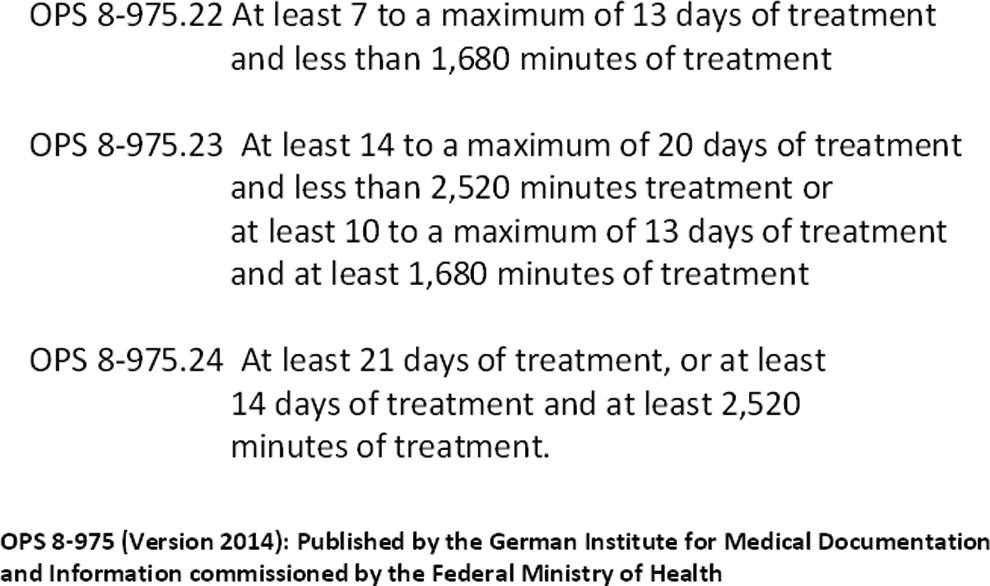
OPS 8-975: Naturopathic and anthroposopfoc medical complex therapy.
In order to meet the requirements of the procedure OPS 8-975 and to ensure reimbursement by the health insurance of the additional costs involved, it is useful to structure the treatment process.
Structuring the Procedural Requirements by Means of a Basic Structure of a Care Pathway
Structuring can be accomplished by means of an integrative clinical pathway. As an example, a basic structure of a clinical pathway of this kind—on the basis of which, several thousand patients in German were already treated—will be presented (Figure 2) in order, and to give the reader a better overview of the procedural components. Clinical pathways are models describing the template of a procedures plan for implementing a medical treatment or complex process, which, in addition to structuring, is intended to improve the quality of the outcome and to save costs.10,11

Basic structure of a care pathway: Inpatient naturopathy.
First, the doctors responsible for admissions check whether the patient needs to be hospitalized. The German Appropriateness Evaluation Protocol and its preamble provide decisive criteria as to when admission to a hospital as an inpatient is definitely and unarguably necessary. This catalogue of criteria, was already developed in the 1980s by Gertmann and Restuccia. 12
The German Appropriateness Evaluation Protocol takes special account of the severity of the disease and the treatment the patient needs. The checklist of criteria includes a preamble. The preamble was added because these criteria are unable to describe everything that needs inpatient treatment (eg, subacute conditions, acute exacerbation of chronic diseases). That can also apply to cases in which a concentration of diagnostic and therapeutic measures is expected to produce significant additional benefits in an inpatient setting, and this is clearly documented.
A check must also be made of whether all outpatient therapies relevant to the clinical picture have been administered to a sufficient extent. If there is a need for inpatient treatment, the patient passes through a structured, indication-related admission management process. For pain patients, for example, this includes measurement of the pain intensity, 13 quality of life, 14 mental condition, 15 severity, 16 and the degree of pain chronification. 17
The use of the therapeutic methods is oriented on the therapy areas defined by OPS 8-975. Both evidence-based and best-practice therapies are used. The individual therapy areas will be discussed in greater detail below. Therapeutic targets, condition of the patient, and adaptation of the therapy plan are discussed in interdisciplinary team meetings, which are mandatory and which take place twice a week (Figure 3a and b).

(a and b) Structure of team sessions.
Overview of the Use of Therapeutic Methods From the Therapy Areas (OPS 8-975)
Nutritional Therapy
The aim of inpatient nutritional therapy as an integral component of naturopathic complex therapy is the indication-related use of foods and dietary measures for maintaining health and for therapy. Nutritional therapy is especially valuable in the complementary treatment of currently increasing widespread diseases such as diabetes mellitus, 18,19 rheumatic diseases, 20 –22 cardiovascular diseases, 23 –25 and chronic intestinal diseases. 26
The nutritional therapy is led by qualified nutritionists or dietary assistants. The dietary counseling provided also includes lifestyle regulative therapy aspects of nutrition (eg, eating behaviour, meal times, chewing, preparation, etc).
Hydro-/Thermotherapy
As a further therapy area of naturopathic complex therapy, indication-related methods from hydro-/thermotherapy are used. There is evidence for the efficacy of methods of hydrotherapy, especially in the treatment of diseases of the musculoskeletal system 27,28 with mental comorbidities. 29 The application of thermal therapy is also part of the OPS 8-975, both regionally 30 and as whole-body hyperthermia. 31,32
Other Physical Methods
Further methods used are massage therapies, especially in the case of rheumatic diseases 33 and pain conditions 34 ; these can also lead to improvements in the mental state and in sleep quality. 35
The use of lymph drainage in oncological diagnoses, 36 and so too in musculoskeletal diseases 37 is a therapeutic component included in the interdisciplinary provision of treatment. Lymph drainage differs from ordinary massage. The aim is to stimulate or move the excess fluid away from the swollen area so that it can drain away normally.
Phytotherapy
Phytotherapy is a mandatory pillar of complex therapy and plays an important role in integrative care. The complementary use is not restricted to mental comorbidities alone, 38 but also plays a complementary role in other therapies. 39,40
Phytotherapy is not automatically safe simply because it is natural. Some products used can be dangerous when they are taken by patients for whom they are contraindicated. For patients it is important to work with a specialized doctor.
Lifestyle Regulative Therapy
Many diseases are promoted or triggered by a disordered lifestyle. The factors involved can include high professional stress, unhealthy eating, and lack of exercise. It often proves necessary to reorganize the patient’s entire lifestyle. Targeted methods of behavioral therapy are taught by qualified doctors or therapists and help the patient to discard old habits and acquire new, healthy ones. In doing this, the patient takes on an active role and, after the period of hospitalisation, should be able to implement the lifestyle regulative therapeutic methods learned as an expert in his or her own disease. 41
Movement Therapy
This means in general the targeted use of methodical movement sequences for the maintenance and restoration of the performance of the musculoskeletal system, taking into account the mental experience and the participating functions of circulation, metabolism, and respiration. 42
Detoxification Methods
These are components of many traditional ethnomedical methods. They include various forms of cupping, 43,44 leech therapy, 45 and Baunscheidt therapy. The last-named method involves stimulating an area of the skin and the subdermal tissue and is primarily administered to the back. The indications for the Baunscheidt therapy are reported on the basis of experience since up to now no data from controlled studies is available.
Additional Methods of the Operation and Procedure Code 8-975
Additional methods specified are manual therapy, acupuncture/Chinese medicine, homoeopathy, neural therapy, and art therapy (art and music therapy). It is not required that every method be used.
Manual therapy belongs to the reflex therapies. It involves a therapeutic approach in which functional disturbances of the musculoskeletal system are investigated and treated. Manual therapy is based on special holds and mobilisation techniques intended to alleviate the pain and cure impaired mobility. In Germany, manual therapy may be performed by physiotherapists or physicians who have acquired the necessary additional qualification and is used, in particular, for pain conditions, for example, of the back 46 or in musculoskeletal diseases. 47
As a well-known partial area of traditional Chinese medicine, acupuncture is used in a diversity of clinical scenarios. 48 This method was included in the complex therapy because in the setting of a multimodal interdisciplinary therapeutic approach, it can be effectively deployed as a complementary method to the conventional measures of orthodox medicine. 49
Homoeopathy can and is also used only as a complement to other therapies in specific clinical pictures, for example, rheumatic diseases or asthma. 50 Medical histories are recorded by qualified doctors. In the routine performance of homeopathic amnesias it is possible to detect an intensification of the doctor–patient relationship and an improved compliance; which can certainly be associated with the greater time spent with and attention paid to the patient by the doctor. Statements to the external validity will be taken account of in further studies. 51
Neural therapy is a method of therapeutic local anesthesia, 52 which has been an established therapeutic method in Germany for many years 53 ; it is used as complementary treatment not only in patients with various pain conditions 54 but also in vegetative and functional diseases. 55 Further miscellaneous methods in the sense of OPS 8-975 are music and art therapy, which are already the subject of scientific investigation. 56 –58 Both therapies are used to effect positive changes in the cognitive, psychological, physical, or social functioning of patients.
Summary Outlook
As a final observation applying to all therapy areas, it should be stated that these are used according to indication in the setting of an integrative multimodal therapeutic approach in the sense of a holistic and patient-centered application, and are complementary to the methods of orthodox medicine.
An integrative therapeutic approach in the sense of holistic medicine is used in acute care hospitals in Germany in addition to the methods of orthodox medicine and also in the changed situation of a case tariff fee system in Germany. As part of inpatient hospital care in Germany, attempts are being made to use the complex therapy to ensure interdisciplinary and integrative treatment and a holistic approach of mostly multimorbid patients with acute states of chronic diseases.
A systematic evidence-based procedure, as prescribed in the procedures catalogue of the provision of inpatient care in the German health system, could contribute toward improving quality and patient compliance. 59,60
The German model can be viewed as a pilot program for the introduction of integrative medicine in other hospital systems around the world. The patient-centered care informs and involves individuals in medical decision making and self-management. The model comes from a growing recognition that high-tech medicine, although widely successful in some areas, cannot fully address the growing epidemic of subacute states and acute exacerbation of chronic diseases.
Footnotes
Author Contributions
TR made substantial contributions to conception and design of the study. HS participated in drafting the article and revising it critically for important intellectual content.
Declaration of Conflicting Interests
The authors declared no potential conflicts of interest with respect to the research, authorship, and/or publication of this article.
Funding
The authors received no financial support for the research, authorship, and/or publication of this article.
Ethical Approval
This study did not warrant institutional review board review as no human subjects were involved.