




Abstract
The goal of this study was to explore the aerial parts of Artemisia scoparia (crude extract, total flavonoid contents, and aqueous fraction) for protein denaturation potential. The crude extract provoked marked attenuation of thermal-induced denatured protein in a concentration-dependent manner with maximum inhibition of 54.05 μg/mL at 500 μg/mL and IC50 of 449.66 μg/mL. When total flavonoid contents were studied, it illustrated most dominant activity concentration dependently with maximum amelioration of 62.16 μg/mL at 500 μg/mL and IC50 of 378.35 μg/mL. The aqueous fraction also exhibited significant activity with maximum of 56.75% inhibition at 500 μg/mL and IC50 of 445.10 μg/mL. It can be concluded on the basis of the results that the crude extract, flavonoid contents, and aqueous fraction of the plant possessed significant inhibition on thermal-induced denatured protein.
Introduction
The genus Artemisia L. consists of approximately 522 species that are found throughout the northern half of the world including the Mediterranean coast of Europe, Southwest of Asia, and Africa. 1 Various therapeutic properties of the aerial parts of the plant have been reported including as hypoglycemic, hypolipidemic, diuretic, antiulcer, and anti-inflammatory activities. 2 The traditional healers also employ the plant as antiseptic, antibacterial, cholagogue, diuretic, purgative, and as a vasodilator. 3,4 The essential oils of Artemisia scoparia show strong insecticidal activity against stored-product insects. Similarly, the aerial parts of the plant exhibit significant antimalarial, free radical scavenging, insecticidal, and urease inhibitory activities. 5,6
Phytochemical analysis of the genus has led to the isolation of several coumarins, flavonoids, phenylpropanoids, sterols, and terpenoids (especially sesquiterpenes and monoterpenes), and their glycosides. 5 While considering the traditional use of the plant in inflammatory conditions, the current study was planned to explore the anti-inflammatory effect of the crude methanolic extract, total flavonoid content, and aqueous fraction of the aerial parts of Artemisia scoparia in an in vitro model on inhibition of protein denaturation.
Materials and Methods
Plant Material
The fresh plant of Artemisia scoparia was collected from Parachinar Valley, Pakistan. The taxonomic identity of the plant was determined by a qualified plant taxonomist at the Department of Botany, Kohat University of Science and Technology, Pakistan. The plant was washed 2 to 3 times with running tap water followed by shade-drying. The plant material was powdered for extraction.
Preparation of Solvent Extraction
Two kilograms of the shade-dried powder of plant materials were soaked separately in methanol for 10 days, extracted 3 times at room temperature in the same solvent, and then filtered. The diluted extracts were concentrated on a vacuumed rotary evaporator under reduced pressure at a temperature of 46°C to give a residue (extract), which was further suspended in water and partitioned to get the aqueous fraction. All the extracts were concentrated using rotary flash evaporator. 7 After complete solvent evaporation, each of these extract was weighed and stored in airtight bottles for further use.
Extraction of Total Flavonoid Contents
Flavonoid content of the crude extract of the aerial parts of Artemisia scoparia was estimated using our previously reported method. 8 Briefly, 10 g was extracted repeatedly with 10 mL of 80% aqueous methanol at room temperature. The resulting solutions were filtered through Whatman filter paper No. 42 (125 mm). The filtrate was then transferred to a crucible and evaporated in a water bath and weighted to account for total flavonoid content.
In Vitro Protein Denaturation Assay
The protein denaturation assay was used for the estimation of anti-inflammatory potential of decoction of teas. Egg albumin (0.2 mL) was mixed with 2 mL of varying concentrations of decoctions (50-500 μg/mL) and 2.8 mL of phosphate-buffered saline at pH 6.4 to get a reaction mixture of 5 mL. The mixtures were incubated at 37 ± 2°C for 15 minutes and then heated at 70°C for 5 minutes. The resulting solutions were cooled and absorbance was taken on a spectrophotometer at 660 nm by using vehicle as blank.
9,10
Distilled water served as control with aspirin as a standard. Finally, the % inhibition of protein denaturation was calculated.

The IC50 values were calculated using statistical software GraphPad PRISM 6.
Statistical Analysis
The resulting data were expressed as the mean ± SEM (n = 3) in each group. To determine the differences between groups, one-way analysis of variance was performed (GraphPad PRISM 6; San Diego, CA) using the least significant difference test at P < .5 or P < .01.
Results and Discussion
The effect of crude extract of Artemisia scoparia on inhibition of protein denaturation is illustrated in Figure 1. It elicited profound concentration-dependent inhibition with maximum of 54.38% effect at 500 μg/mL. The estimated potency was IC50 = 449.66 μg/mL (Table 1).

The percent effect of crude extract of Artemisia scoparia against protein denaturation.
The Effect of Crude Extract, Flavonoid Contents, and Aqueous Fraction of Artemisia scoparia Against Protein Denaturationa.

aThe resulting data are shown as mean + SEM of 3 independent assays. The level of significance was *P < .05. or **P < .01, ***P < .0001.
As shown in Figure 2, the total flavonoid contents showed marked inhibition of protein denaturation in a concentration-dependent with maximum of 61.11% effect. The IC50 for total flavonoid contents was 378.35 μg/mL (Table 1).
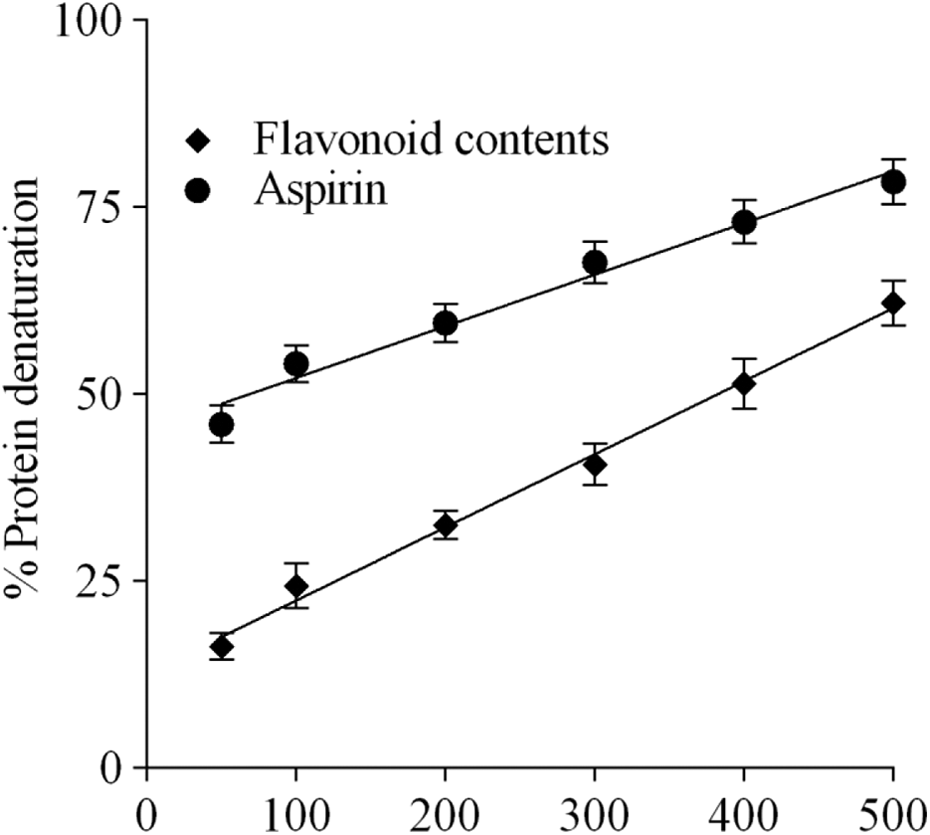
The percent effect of flavonoids of Artemisia scoparia against protein denaturation.
The protein denaturation caused by the aqueous fraction of Artemisia scoparia is illustrated in Figure 3. It demonstrated marked attenuation of protein denaturation in a concentration-dependent manner with maximum action of 56.75% at 500 μg/mL. The estimated IC50 value for the aqueous fraction was 445.10 μg/mL (Table 1).

The percent effect of the aqueous fraction of Artemisia scoparia against protein denaturation.
The development of an inflammatory response is a complex but well-regulated process. Arachidonic acid is a polyunsaturated fatty acid that is liberated from cell membrane phospholipids via the hydrolysis by phospholipase A2 enzymes. The arachidonic acid is then metabolized by 2 distinct enzymatic pathways: cyclooxygenase into prostaglandins and lipoxygenase into leukotrienes. 11 –14 Prostaglandins are members of the eicosanoid family produced by almost all cells of the human body—the principal mediator of inflammation in most of the inflammatory diseases. 15,16 The inflammatory mediators approach from plasma proteins or cells including mast cells, platelets, neutrophils, and monocytes/macrophages, which are activated by bacterial products or host proteins. They bind to specific receptors and elicit vascular permeability, neutrophils chemotaxis, stimulate smooth muscle contraction, excite pain, or mediate oxidative damage. Most of the mediators are short-lived but produce harmful effects. 11,17
Nonsteroidal anti-inflammatory drugs are among the most widely prescribed medicine in the management of inflammatory conditions. Clinically, they are useful for symptomatic relief 18,19 by acting through several mechanisms though causing various side effects. 20,21 It has already been proved that conventional nonsteroidal anti-inflammatory drugs like phenylbutazone and indomethazine do not act only by the inhibition of endogenous prostaglandins production by blocking cyclooxygenase enzyme but also by prevention of denaturation of proteins. 9,10
Protein denaturation is a practice in which proteins are unable to maintain their structural integrity in the presence of external stimuli such as strong acid or base, concentrated inorganic salt, an organic solvent, or thermal treatment. It has been observed that proteins lose their biological potency on denaturation. Denatured proteins are considered as one of the inflammatory mediators; therefore, agents that cause prevention of precipitation of denatured protein aggregates and protein condensation are useful in diseases like rheumatic disorders, cataract, and Alzheimer’s disease. 22
In the present study, the crude extract, total flavonoid contents, and aqueous fraction of Artemisia scoparia exhibited marked attenuation of thermal-induced protein denaturation. Of the tested extracts, total flavonoid contents of the plant were most dominant in the inhibition of protein denaturation. It could therefore be suggested that the pharmacologically active constituents of the plant may be flavonoid. At the same time, the isolation of pure secondary metabolites will be more beneficial in understanding the chemical background of effective compounds.
In summary, the aerial parts of Artemisia scoparia possessed strong inhibition of thermal-induced protein denaturation. Among the test extracts, the total flavonoid contents of the plant were most dominant in prevention of protein denaturation; therefore, the current finding could be attributed mostly to plant flavonoid.
Footnotes
Author Contributions
Murad Ali Khan, Shafiq Ahmad Tariq and Samreen Pervez collected the plant material, processed, performed experimental work and draft initial MS. Haroon Khan help in project design, data processing, and finalized the MS for submission.
Declaration of Conflicting Interests
The authors declared no potential conflicts of interest with respect to the research, authorship, and/or publication of this article.
Funding
The authors received no financial support for the research, authorship, and/or publication of this article.
Ethical Approval
Ethical approval is not required for this study as no human subjects were involved.