




Abstract
The study validated the antidyslipidemic, antioxidant, and antihyperglycemic effects of Lagenaria siceraria fruit extract in human subjects with dyslipidemia along with subjects of normal health. A total of 200 mL of freshly prepared Lagenaria siceraria fruit extract was administered daily on empty stomach for 90 days. Significant reductions (P < .01) were found in triglycerides and total cholesterol levels in blood. Cardiac risk ratio, atherogenic coefficient, and atherogenicity index of plasma were also improved. Appreciable reductions in body mass index (P < .01) and blood pressure (systolic P < .01, diastolic P < .05) along with a significant reduction (P < .05) in fasting blood glucose levels were also observed in these subjects. Lagenaria siceraria fruit extract exhibited significant antioxidant activity in dyslipidemic subjects as evident from elevations in SOD (P < .05) and GSH levels (P < .01) with marked improvement in catalase (P < .01) and TBARS levels (P < .05). Phytochemical screening confirmed the presence of saponins, glycosides, flavonoids, terpenoids, and phenolic compounds. Lagenaria siceraria fruit extract serves as dietary adjunct in treatment of human dyslipidemia and cardiovascular disease.
Introduction
Hyperlipidemia is characterized by elevation of serum lipids such as triglycerides, cholesterol, and lipoproteins. Hyperlipidemia builds up oxidative stress and may predispose the individual to many serious health conditions, 1 such as atherosclerosis, coronary artery disease, diabetes mellitus. 2 Treatment of hyperlipidemia includes chemotherapy, dietary changes, weight reduction, and exercise. Medications most commonly used to treat hypercholesterolemia and hypertriglyceridemia are statins 3 and fibrates, respectively. 4 Both the drugs, though effective, may cause side effects such as myositis (inflammation of the muscles), joint pain, stomach upset, and liver damage 5 in long run. Nutraceuticals and functional foods are gaining acceptance for their ability to address lifestyle disorders such as hyperlipidemia, metabolic syndrome, diabetes mellitus, and so on. Previous studies have shown that fresh garlic (Allium sativum) and garlic supplements may lower cholesterol levels, prevent blood clots, and prevent plaque formation. However, more recent studies show no effect of garlic on cholesterol, and as garlic can increase the risk of bleeding it is not advocated for those taking blood-thinning medication. Lagenaria siceraria (Molina) Standley fruit (bottle gourd), a commonly used vegetable in India, is traditionally considered to have cardioprotective and cardiotonic effects. 6 Different varieties of Lagenaria siceraria are known to exist; the sweet variety is generally used as a vegetable and for preparation of sweets and pickles, whereas the wild variety is bitter and is preferred for the medicinal use. 7 The fruits of the sweet variety are widely used in home therapies in India; drinking 1 or 2 glasses of fresh raw bottle gourd juice in the morning on an empty stomach is one such practice, particularly in India, to deal with obesity-associated disorders. 8 Over the past decade, considerable focus of the research community has been directed towards enhancing our understanding of functional foods as diet therapies for lifestyle-related disorders. The objective of the present study was to validate the antihyperlipidemic, antihyperglycemic, and antioxidant effects of Lagenaria siceraria fruit extract in human subjects with dyslipidemia and oxidative stress and normal healthy subjects.
Methods
Study Population
The subjects in the age group of 30 to 60 years attending Weekend Diabetic Clinic run by the School of Studies in Biochemistry at Jiwaji University, Gwalior, India, were screened for dyslipidemia. Twenty-five subjects with dyslipidemic condition, that is, with either elevated triglycerides (>150 mg/dL) or elevated cholesterol (>200 mg/dL) or elevated low-density lipoproteins (>130 mg/dL) based on ATP III criteria, 9 were selected for the study. Subjects with elevation of any one or more parameters were considered “dyslipidemic.” Equal number of healthy subjects in the same age group served as “normolipidemic.” The study design and experimental protocols were approved by the Institutional Human Ethics committee.
Exclusion Criteria
Subjects were excluded if they were on medications for any chronic disease (cancer, cardiovascular disease, diabetes mellitus, or even dyslipidemia). Persons who reported having taken lipid-lowering drugs, high-dose dietary supplements/herbal supplements, during the preceding 3 months were also excluded. Pregnant and lactating mothers were also excluded from the study.
A written consent was obtained from each participant before registering for the study. All the participating subjects were explained the health benefits of Lagenaria siceraria fruit extract consumption, verbally as well as with the help of paper handouts. Subjects registered for the study were asked to refrain from other herbal or nutritional supplements as they might overlap with the effect of Lagenaria siceraria fruit extract. Subjects were asked to maintain their usual diet, physical activity, and lifestyle while enrolled in the study.
Preparation of Lagenaria siceraria Fruit Extract
A sweet variety of the fruits of Lagenaria siceraria was used to prepare Lagenaria siceraria fruit extract and was purchased from a local vendor in Gwalior city, India. It was ensured that the fruits were from same source every time (same field). Fruits were examined for any infection or injury and washed thoroughly before slicing. A commercial fruit juice extractor was used for extracting juice.
Administration of Lagenaria siceraria Fruit Extract
A total of 200 mL of freshly prepared Lagenaria siceraria fruit extract was administered daily for 90 days on empty stomach to each participating subject between 7.00 and 9.00
Anthropometry
Body weight, height, blood pressure, and waist and hip circumference measurements were done at the time of enrolment and at monthly intervals thereafter. Systolic and diastolic blood pressure was measured in mm Hg using a sphygmomanometer. Participants were asked to sit and relax comfortably for 5 to 10 minutes before measuring blood pressure.
Blood Collection
Fasting blood samples (about 2.5 mL) were drawn in morning hours (6.30 to 8.30
Biochemical Analyses
Blood glucose was estimated by glucose oxidase-peroxidase method. 11 Plasma triglyceride was estimated by glycerol-3-phosphate oxidation-peroxidase method. 12 Total cholesterol was estimated by cholesterol-oxidase and p-aminophenazone method. 13 High-density lipoprotein cholesterol level was estimated by the phosphotungstate method. 14 The low-density lipoprotein and very-low-density lipoprotein levels were calculated using Friedewald’s equation. 15 The atherogenic indices 16,17 are as follows: cardiac risk ratio = total cholesterol/high-density lipoprotein cholesterol; atherogenic coefficient = (total cholesterol − high-density lipoprotein cholesterol)/high-density lipoprotein cholesterol; and atherogenicity index of plasma = Log(triglycerides/high-density lipoprotein cholesterol).
Markers of Oxidative Stress
Analyses of biomarkers of oxidative stress were done using standard laboratory techniques. SOD, TBARS, and catalase activities were measured in the erythrocyte lysates using a UV-VIS Spectrophotometer. Super oxide dismutase, 18 catalase, 19 reduced glutathione, 20 and lipid peroxidation 21 were monitored once at the beginning (0th day) of the study and at the end of the study (ie, 90th day).
Chemicals
All the chemicals used in the experiments were of analytical grade; the kits and chemicals used in this experiment were purchased from E. Merck India Limited (Mumbai, India).
Feedback of the Subjects
Feedback on acceptability and the viewpoints of participating subjects were recorded at the end of the study.
Phytochemical Screening
Phytochemical analysis was done before administering the Lagenaria siceraria fruit extract only once as the bottle gourd was procured always from same source (field).
Sample Preparation
Lagenaria siceraria fruit extract was dried in vacuum rotatary evaporator (Roteva, India) at 35°C to 40°C to form a thick slurry, which was then lyophilized (Operon, Korea) at −55°C.
Qualitative Phytochemical Analysis
The lyophilized plant powders were subjected to qualitative phytochemical analysis by following standard analytical procedures. Detection of flavonoids was done by the Shinoda test, cardiac glycosides by the Kellar-Killani test, and terpenoids by Harbone’s method. 22 Detection of saponins and phenolic compounds were analyzed by using method given in the CCRAS manual. 23
Statistical Analysis
Results are expressed as mean ± standard deviation. And the data were analyzed by paired t test. The statistical analysis was carried out using SPSS (PASW statistics 17) software.
Results
Effect of Lagenaria siceraria Fruit Extract Administration on Lipid Profile
Serum total cholesterol triglycerides, low-density lipoprotein cholesterol, and very-low-density lipoprotein cholesterol were significantly reduced (P < .01) in dyslipidemic subjects with an appreciable change in normal subjects at the end of 3 months of Lagenaria siceraria fruit extract therapy. A reduction in high-density lipoprotein cholesterol level was observed in dyslipidemic subjects in contrast to marginal improvement in high-density lipoprotein cholesterol level in subjects with normal healthy subjects (Table 1). Cardiac risk ratio and atherogenicity coefficient were reduced (P < .05) in dyslipidemic subjects. Atherogenicity index of plasma was significantly reduced (P < .05) in normal subjects with an appreciable reduction in dyslipidemic subjects (Table 1).
Effect of Lagenaria siceraria Fruit Extract Administration on Fasting Blood Glucose Levels and Lipid Parameters in Human Subjects.

Abbreviations: HDL-C, high-density lipoprotein cholesterol; LDL-C, low-density lipoprotein cholesterol; VLDL-C, very-low-density lipoprotein cholesterol.
**P < .05, *P < .01, as compared to 0th day values. Data were analyzed by using paired t test.
Effect of Lagenaria siceraria Fruit Extract Administration on Blood Glucose Level
Administration of Lagenaria siceraria fruit extract for 3 months led to significant (P < .05) reduction in blood glucose levels of dyslipidemic subjects with a mean change of 5.52% (Table 1).
Effect of Lagenaria siceraria Fruit Extract Administration on Oxidative Stress
Significant elevations in enzymatic markers of oxidative stress were recorded in dyslipidemic subjects following Lagenaria siceraria fruit extract administration for 3 months. A marked improvement of antioxidants, viz, GSH, catalase (P < .01), SOD (P < .05), was recorded in dyslipidemic subjects. There was also marked improvement in antioxidant status of normal healthy subjects, though not to a statistically significant level. TBARS level was significantly reduced (P < .05) in dyslipidemic subjects (Table 2).
Effect of Lagenaria siceraria Fruit Extract Administration on Biomarkers of Oxidative Stress in Human Subjects.

**P < .05, *P < .01, as compared to 0th day values. Data were analyzed by using paired t test.
Effect of Lagenaria siceraria Fruit Extract Administration on Body Weight and Blood Pressure
There was reduction in body weight and body mass index of the subjects in normal health and dyslipidemic subjects. Significant decrease (P < .01) in body mass index was observed in the dyslipidemic group (mean difference 2.43%) as well as in the normal healthy subjects (mean difference 1.63%) at the end of Lagenaria siceraria fruit extract therapy. Waist–hip ratio remained unchanged in both the groups. A significant fall (P < .01) in systolic as well as diastolic blood pressures (P < .05) was observed in dyslipidemic subjects, whereas a significant decrease (P < .05) in systolic blood pressure and a marginal decrease (mean change 1.53%) in diastolic blood pressure of normal subjects following Lagenaria siceraria fruit extract therapy was noticed (Table 3).
Effect of Lagenaria siceraria Fruit Extract on Anthropometric Parameters and Hypertension in Human Subjects.

**P < .05, *P < .01, as compared to 0th day values. Data were analyzed by using paired t test.
Phytochemical Screening of Lagenaria Siceraria
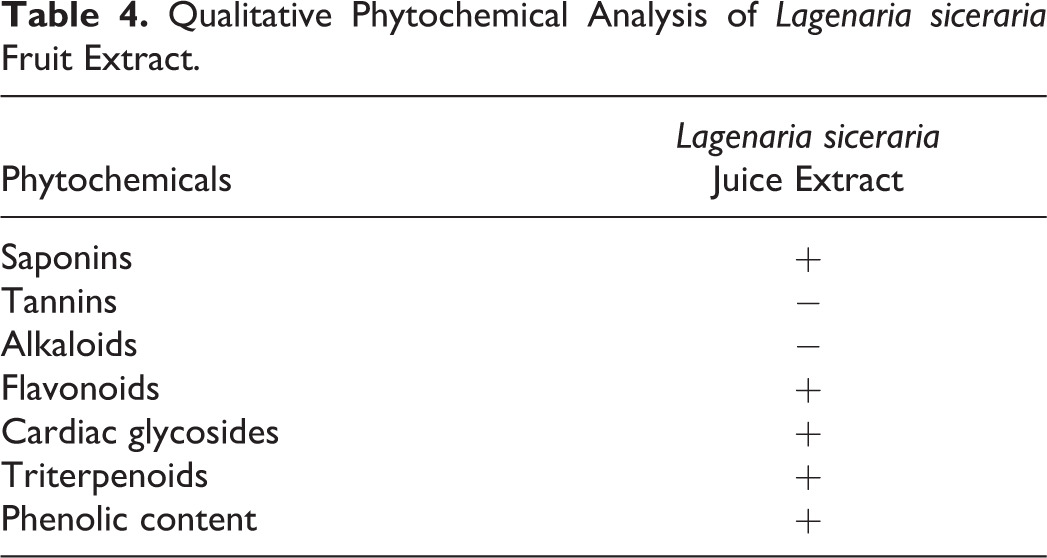
Phytochemical analysis of Lagenaria siceraria fruit extract indicated the presence of saponins, flavonoids, cardiac glycosides, terpenoids, and phenolic compounds (Table 4).
Qualitative Phytochemical Analysis of Lagenaria siceraria Fruit Extract.
Discussion
Lowering of blood lipid levels reduces the risk of heart disease and stroke. The present study validated systematically the antihyperlipidemic, antihyperglycemic, and antioxidant functions of freshly prepared fruit extract of Lagenaria siceraria in human subjects with dyslipidemia and hyperglycemia. Daily oral administration of Lagenaria siceraria fruit extract for over a period of 3 months to dyslipidemic subjects resulted in significant reductions in total cholesterol, triglycerides, low-density lipoprotein cholesterol, and very-low-density lipoprotein cholesterol and fasting blood glucose levels (Table 1). A phytochemical and pharmacological review of Lagenaria siceraria reports that 4 different extracts, viz, petroleum ether, chloroform, alcoholic, and aqueous extracts, were prepared. Oral administration of the extracts to triton induced hyperlipidemic rats dose-dependently inhibited the total cholesterol, triglycerides, and low-density lipoproteins levels and significantly increased the high-density lipoproteins level. 24 Phytoconstituent screening of Lagenaria siceraria fruit extract revealed the presence of saponins and flavonoids. Saponin binds with cholesterol in intestinal lumen affecting its absorption, and saponin also increases lipoprotein lipase activity. 25 Flavonoids regulate blood lipids by enhancing activity of lecithin acyl transferase, which plays a key role in the incorporation of free cholesterol into high-density lipoprotein and transferring it back to very-low-density lipoprotein and low-density lipoprotein, which are taken back later in liver cells. 26 Besides phytoconstituents, Lagenaria siceraria fruit extract contains more proportion of soluble dietary fibers than insoluble fibers. Soluble dietary fibers have a profound effect in lowering serum cholesterol, which also reveals that the pectin is a predominant component of soluble fibers in Lagenaria siceraria fruits. 27 Atherogenic indices are powerful indicators of the risk of heart disease: the higher the value, the higher the risk of developing cardiovascular disease and vice versa. 16,17,28 In this study, it was observed that the extract reduced atherogenic indices cardiac risk ratio and atherogenicity coefficient. Low atherogenic indices are protective against coronary heart disease. 28
Oxidative stress is known to be associated with all lifestyle disorders including coronary heart diseases. 29 The study confirmed that regular consumption of freshly prepared aqueous extract of bottle gourd fruit results in marked improvement in biomarkers of oxidative stress. Our observations on antioxidant potential of Lagenaria siceraria fruit extract corroborates with the observation of earlier worker. 6 Oxidation of low-density lipoprotein is a risk factor and plays an important role in development of atherosclerosis. A decrease in oxidative stress and protection of low-density lipoprotein from oxidation might therefore be a strategy with great promise for prevention of atherosclerosis-associated cardiovascular disease. 30 Free radicals have been shown to be harmful as they react with important cellular components such as proteins, DNA, and cell membrane. 31 Administration of Lagenaria siceraria fruit extract improved the biochemical marker levels as evident from increased blood levels of GSH, SOD, and catalase with concomitant decrease in lipid peroxidation (Table 2).
The flavonoids present in fruit extract of Lagenaria siceraria possess free radical–scavenging ability. The ingested flavonoids are extensively degraded to various phenolic acids, some of which still possess a radical-scavenging ability. Both the absorbed flavonoids and their metabolites exhibit antioxidant activity in vivo. 32
Glycosides are an important class of bioactive compounds responsible for the specific medicinal values that are present in various medicinal plants like digitalis, liquorices, and such other pants. The glycoside molecules contain a sugar that is bound to a noncarbohydrate moiety, which play numerous important roles in living organisms; many plants store chemicals in the form of inactive glycosides and these can be activated by enzyme hydrolysis. 33
Hypertension is one of the risk factors for angina and myocardial infarction. Control of blood pressure is advocated in patients with angina. In the current study, Lagenaria siceraria fruit extract administration brought a significant decline (P < .05) in systolic and diastolic blood pressure in dyslipidemic subjects (Table 3). Aqueous soluble extract of Lagenaria siceraria has been reported to increase urine volume. 34 The diuretic activity of Lagenaria siceraria has been attributed to ion content. Diuretics are known antihypertensive agents. It is reported that long-term treatment (51 days) of Lagenaria siceraria fruit powder (500 mg/kg) partially reversed dexamethasone-induced hypertension in rats. 35
None of the dyslipidemic subjects in the study were on lipid-lowering medication and also no significant dietary and lifestyle changes in participating subjects were noted during the course of study. The present study, which is one of the pioneering studies administering fresh Lagenaria siceraria fruit extract under personal supervision to dyslipidemic human subjects continuously for 90 days, confirmed the antihyperlipidemic, antihypertensive, and antioxidant functions of fresh Lagenaria siceraria fruit extract. The Lagenaria siceraria fruit extract may be used as potent adjunct therapy in human hyperlipidemia and possibly also in cardiovascular disorders. The active principles associated with lipid-lowering functions and their cellular targets in human subjects needs further investigations.
Conclusion
The Lagenaria siceraria fruit extract can serve as a powerful Nutraceutical with significant lipid-lowering and antioxidant functions and may find useful as a prophylactic measure for subjects with cardiovascular risk. This study confirmed that regular intake of Lagenaria siceraria fruit extract reduces atherogenic indices, viz, cardiac risk ratio and atherogenicity coefficient and oxidative stress, and may be of therapeutic use in addressing lifestyle disorders.
Footnotes
Acknowledgments
The financial support extended by University Grants Commission, New Delhi, in the form of a major research project is duly acknowledged. The authors are thankful to the research staff for their assistance and support in conducting this study. The authors sincerely thank all the subjects who participated in the study with enthusiasm and for following the guidelines sincerely.
Author Contributions
SS, SA, AZJ, SKS, DY, and NS were involved in the experimental work, registration, follow-up, collection of blood specimens, and supervision of the bottle gourd juice administered. CK, PSB, and GBKSP were associated with the study design, execution, and preparation of the article.
Declaration of Conflicting Interests
The authors declared no potential conflicts of interest with respect to the research, authorship, and/or publication of this article.
Funding
The authors disclosed receipt of the following financial support for the research, authorship and/or publication of this article: The study was funded by the University Grants Commission, New Delhi, India (UGC Letter No. F-34-116/2008(SR), dated December 29, 2008).
Ethical Approval
The study design and experimental protocols were approved by the Institutional Human Ethics Committee.