




Abstract
Fibromyalgia syndrome presents with widespread chronic pain and other symptoms. Approaches in alternative medicine offer promising results in managing fibromyalgia symptoms. Qigong exercise is a mind–body therapy originating in Chinese medicine that can benefit patients with fibromyalgia. We report 2 case studies of patients with fibromyalgia who completed a 6-week Qigong exercise program. In both cases, patients’ fibromyalgia symptoms improved after the Qigong exercise program. The patient in case 1 also experienced a drastic decline in the serial measurement of CA-125 (a biomarker for ovarian cancer) after the 6-week Qigong exercise. In case 2, the patient’s uncontrolled crying also significantly improved. These observations indicate that Qigong exercise can bring about wide-ranging benefits to patients with fibromyalgia.
Keywords
Fibromyalgia syndrome is characterized by a history of widespread chronic musculoskeletal pain. 1,2 Pain and other symptoms, such as sleep disturbances, fatigue, and depression, contribute to a high level of vocational disability in patients with fibromyalgia. 3 Symptom management includes identifying and treating all pain sources, addressing other symptoms, and improving the patient’s function and global health status. 4 Nonpharmacologic interventions, including exercise, 5 –7 yoga, 8,9 and tai chi, 10,11 are often recommended in rehabilitation of patients with fibromyalgia.
Qigong exercise rooted in Traditional Chinese Medicine could be a promising treatment in the fibromyalgia population. In general, Qigong refers to a self-training method or technique that integrates meditation, deep breathing, and rhythmic smooth body movement to achieve optimal status of both mind and body. A few clinical studies have examined the effect of Qigong exercise on patients with fibromyalgia. Two pilot studies without control groups reported positive results. 12,13 However, 2 randomized clinical trials reported conflicting results. 14,15 A critical limitation in these past studies was that patients were not instructed to practice Qigong exercise daily. Qigong exercise is believed to have a cumulative effect through daily practices. Recently, 2 patients with fibromyalgia learned a specific Qigong exercise, that is, 6 hearing sound Qigong (see a Web page in Wikipedia for more details: http://en.wikipedia.org/wiki/Liu_Zi_Jue), from an experienced instructor in 2 training sessions. Over the next 6 weeks, patients performed Qigong exercise at home twice a day. The Short-Form McGill Pain Questionnaire, 16 Multidimensional Fatigue Inventory, 17 Pittsburgh Sleep Quality Index, 18 Fibromyalgia Impact Questionnaire, 19 and Beck Depression Inventory 20 were used to measure outcomes in pain, fatigue, sleep quality, functional limitations, and depression before and after the 6-week Qigong exercise. 21 The patients were provided with an exercise diary, in which they recorded their daily exercise sessions as well as daily level of pain, fatigue, and sleep quality over the 6-week period. In this report, we present changes in fibromyalgia symptoms of the 2 patients, along with other changes in their biological and psychological systems after the Qigong exercise.
Case 1 Presentation
Case 1 was a 55-year-old woman who was diagnosed with fibromyalgia in 2007. She had long-standing chronic pain that was initially attributed to lumbar radiculopathy. She developed widespread pain in 2007 while undergoing 6 months of chemotherapy after an ovarian cancer diagnosis 1 year earlier. Her major complaints were severe upper back and arm pain to the point where she was unable to hold a phone. She had severe sleeping problems as well, often requiring several hours to fall to sleep, frequent wake ups, and occasionally being unable to get back to sleep. Her pain was aggravated with minimal physical exertion. She took early retirement after working as a teacher for 27 years due to her chronic pain and fatigue.
Her past medical history included ovarian cancer and Sjögren syndrome. She had one sister with a diagnosis of fibromyalgia and another sister who had chronic pain. Her daily medication included pregabalin (3 × 75 mg), milnacipran (50 mg), and duloxetine (60 mg) for pain; zolpidem (5 mg) and desyrel (50 mg) for sleep; levothyroxine (50 mg) for thyroid; and cyclobenzaprine (10 mg) for muscle relaxation.
After the 6-week Qigong exercise, the patient felt her health was better than even before her cancer diagnosis. When the postintervention assessment was conducted, she was just back from a vacation and was excited to report that she tolerated bike riding while in Key West. She had even returned to some summer school teaching. The biggest change had been her sleep as she was now able to fall sleep in 30 to 45 minutes and was able to sleep through the night. In this same time period, the patient, in fact, faced increased stress in her life as her mother was placed on hospice and she was assisting in her care several hours every day. Scores on all questionnaires reduced, indicating improvement in all measured symptoms (Table 1). More than a 50% reduction was observed in pain, fibromyalgia impact, and depression scores. Changes over time can be seen from the weekly mean scores of pain, fatigue, and sleep quality recorded in patient’s exercise diary during the 6-week Qigong exercise program (Figure 1).

Changes over time in averaged scores of pain, fatigue, and sleep quality were recorded on diaries of the patient in case 1.Pain score ranged from 0 to 10 (0 = no pain, 10 = extremely painful). Fatigue score ranged from 0 to 10, with 10 indicating maximum fatigue. Sleep quality was scored from 1 (very restless sleep) to 5 (very sound sleep).
Scores of Short-Form McGill Pain Questionnaire (SF-MPQ), Multidimensional Fatigue Inventory (MFI-20), Pittsburgh Sleep Quality Index (PSQI), Fibromyalgia Impact Questionnaire (FIQ), and Beck Depression Inventory (BDI-II) Recorded From the 2 Cases Before and After the 6-Week Qigong Exercise Program

Although not included in our assessments, the patient provided us the records of her CA-125 tests before and after the Qigong exercise. She had taken a series of tests of blood concentration of CA-125 (cancer antigen-125) to monitor the risk of ovarian cancer reoccurrence. Her CA-125 level had been stable at 14 after her cancer treatment but rose between July and December of 2009 from 14 to 24 (Figure 2). After her participation in the Qigong exercise program from February to March 2010, her CA-125 level dropped to 11, 11, and 9 in the tests conducted in March, June, and October 2010, respectively. Because of the decrease in CA-125, she was able to avoid a chemopreventive therapy. During the time period of significant reduction in CA-125, she did not change type or dose of her medications, was not involved in other therapeutic or exercise programs, or did not experience any significant life event.

Changes in the serial tests of CA-125 were recorded from April 2009 to September 2010 The dotted vertical line indicates the beginning of Qigong exercise.
Case 2 Presentation
Case 2 is a 63-year-old woman who was diagnosed in 2009 with fibromyalgia. She presented with severe pain all over her body that had been getting progressively worse over several years. She described the pain as stabbing and burning in her upper back and shoulders extending down to her low back. She also reported pain in the front of her thighs, both hips, and lower legs with swelling in both knees. Sleep was also a problem as she often needed an hour to fall asleep at night and often awoke several times with pain. The patient found herself sleeping throughout the day to try to catch up and then struggling to get to sleep later. She described other symptoms including decreased memory, itching throughout her body, and hypersensitivity to lotions, fabrics, and jewelry. She had feeling of sadness and daily uncontrolled progressive crying spells. Prior to the Qigong exercise program, she cried on awakening every day often for over an hour. She typically cried 4 to 5 more times each day for 10 to 15 minutes per episode. During crying, she would feel severe emotional distress and often feel sorry for herself.
The patient described several stressors in her life: (a) In December 2008, she noticed visual problems that made driving at night difficult. She ultimately lost her job and was in litigation with her prior employer. (b) She needed cataract surgery but had to postpone the surgery due to poorly controlled blood sugar and blood pressure levels. (c) She had been taking classes in a massage therapy certificate program but had to take a leave of absence due to her pain and difficulty driving to evening classes.
Her past medical history included hypertension, diabetes mellitus, cataracts (right eye surgery 11/09), clenching of teeth, depression, falls, and recently diagnosed rheumatoid arthritis affecting her back, knees, and neck.
After the 6-week Qigong exercise program, she reported a reduction in the stabbing and burning pain severity and frequency. She still described having tender points in her back, rib cage, and thighs but felt that the Qigong exercise had helped her take her mind off the pain. Her sleep had also improved as it took only 10 minutes for her to fall asleep, and she only awoke once at night to go to the restroom. She was able to tolerate walking exercise and had returned to most of her household chores including cooking, unloading the dishwasher, and cleaning the kitchen. Her scores in all measurements reduced after the Qigong exercise program (Table 1). Her diary revealed a reduction in pain and fatigue and an improved sleep quality over the 6-week period (Figure 3).
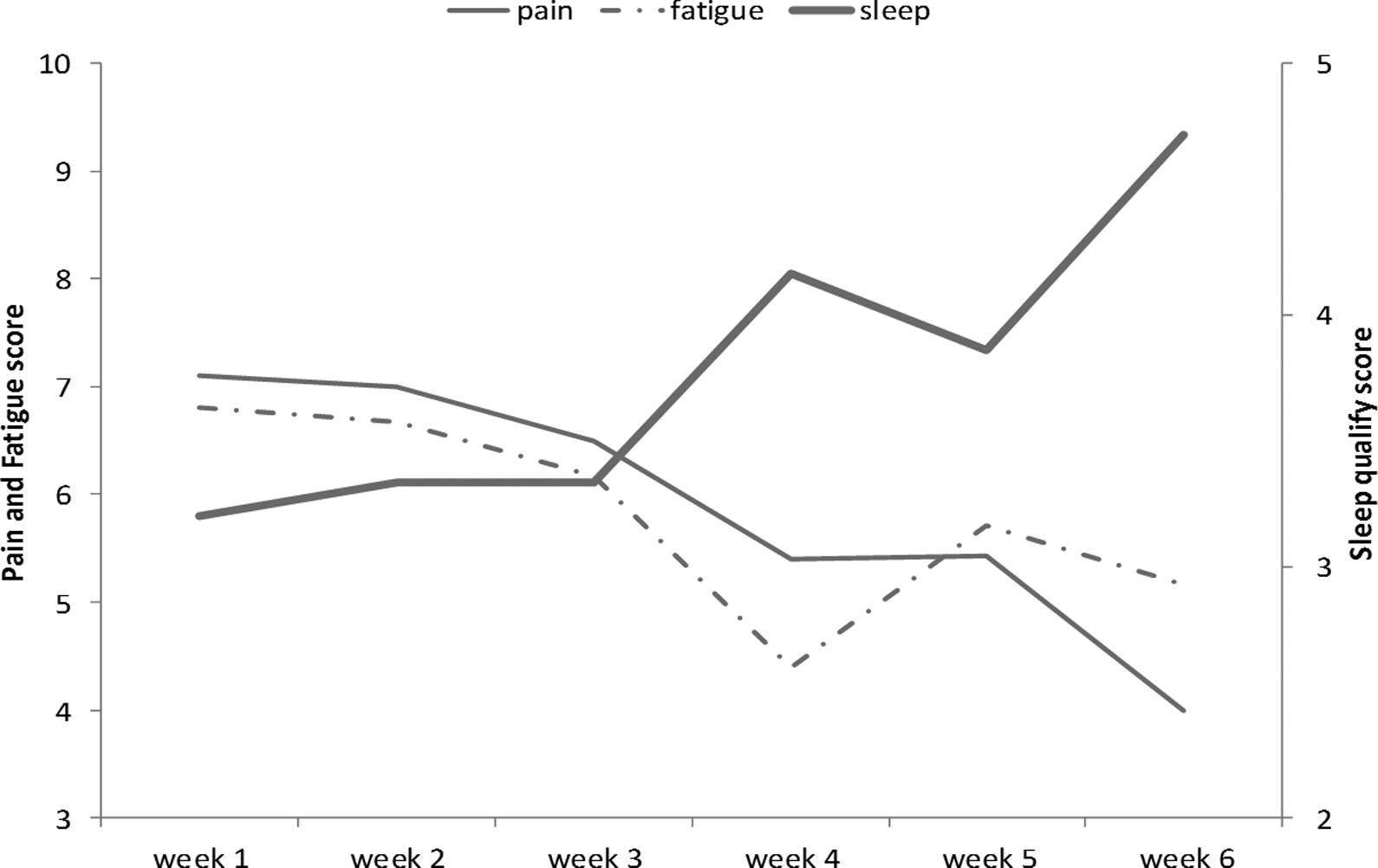
Changes over time in averaged scores of pain, fatigue, and sleep quality were recorded on diaries of the patient in case 2 Pain score ranged from 0 to 10 (0 = no pain, 10 = extremely painful). Fatigue score ranged from 0 to 10, with 10 indicating the maximum fatigue. Sleep quality was scored from 1 (very restless sleep) to 5 (very sound sleep).
In addition, the patient reported the disappearance of her morning crying episodes along with a decrease in crying episodes during the day to only 1 to 2 times per day for a shorter duration. She stated that the Qigong exercise helped her body relax and improved her attitude about her own condition. 17
Before and during the 6-week program, the patient was on stable doses of her prescription medications including glucophage (1000 mg), lisinopril (2 × 40 mg), baby aspirin (91 mg), cyclobenzaprine (10 mg), and etodolac (200 mg). She also used regular fish oil supplements, vitamin D, and biofreeze ointment. After the Qigong exercise program, based on recommendations from her physician, the patient replaced cyclobenzaprine with tramadol (50 mg) for her muscle spasms/pain and reduced her dose of etodolac for inflammation.
Discussion
In both case studies, the patients showed significant improvement in fibromyalgia symptoms after the 6-week Qigong exercise. This result is in agreement with previous reports of Qigong exercise in patients with fibromyalgia. 12 –14 In these 2 cases, improvement after Qigong exercise is comparable with the improvement reported in some drug trials. For instance, a 19% improvement in sleep quality was reported in patients with fibromyalgia using a high dose of pregabalin. 22 The 2 patients in the current report improved their sleep quality by 41% and 67%. A clinical trial of the effect of an experimental drug, Esreboxetine, reported an average improvement in Fibromyalgia Impact Questionnaire score of 15.63. 23 The 2 patients in this report reduced their Fibromyalgia Impact Questionnaire score by 37.7 and 34.5. More research is required to explore the potential of Qigong exercise in managing fibromyalgia symptoms.
The change in serial measurements of CA-125 levels in case 1 suggests a change in human endocrine system after Qigong exercise. CA-125 is often elevated in ovarian cancer patients. Although tests of CA-125 showed only moderate specificity in detecting early stage of ovarian cancer, 24 serial measurements of CA-125 levels over time significantly increased the sensitivity of ovarian cancer prediction. 25 Normalized CA-125 after cancer treatment predicted future improvement and overall survival of patients. 26 An increase in CA-125 in case 1 before the Qigong exercise was an alarming sign of possible risk of ovarian cancer recurrence. The patient was very pleased with the drastic decline and the sustained low level of CA-125 after the Qigong exercise program. Except the Qigong exercise program, the patient was unable to name any other recognizable life events that might have led to the drastic decrease in CA-125. Although some past investigations have shown that Qigong exercise might help cancer patients in improving their immune function and extending their tumor-free survival, 27 –30 it is not clear how the Qigong exercise reduced the CA-125 level and prevented cancer recurrence in ovarian cancer survivors. In a search of the literature it appears that changes in endocrine function after Qigong exercise can contribute to changes in CA-125 levels. Past studies have shown that Qigong exercise led to changes in stress hormone in adults with or without hypertension. 31 ,32 Endocrine dysfunction has been reported in patients with fibromyalgia in the hypothalamic-pituitary-adrenal axis 33 –36 and was significantly associated with level of fatigue, sleep disturbance, and psychological distress. 37 Improved sleep quality and fatigue in case 1 implied an improvement in the hypothalamic-pituitary-adrenal axis. The serum CA-125 is significantly associated with endocrine function in hypothalamic-pituitary-gonadal axis including menopausal status, a history of hysterectomy, and a history of hormone replacement therapy in postmenopausal women. 38 Past studies have revealed direct interplay on various levels between hypothalamic-pituitary-adrenal and hypothalamic-pituitary-gonadal axes in humans. 39,40 Indirectly, numerous studies have demonstrated a reciprocal relationship between hypothalamic-pituitary-adrenal axis and immune system 41 and between hypothalamic-pituitary-gonadal axis and immune system. 42 It is an interesting question for future research whether improved hypothalamic-pituitary-adrenal axis after Qigong exercise led to an improvement in hypothalamic-pituitary-gonadal axis, and as a consequence the CA-125 decreased.
Anxiety and depressed mood are common in patients with fibromyalgia. 43 Risk of a lifetime anxiety disorder is approximately 5-fold higher among women with fibromyalgia. 44 Depressive symptoms in fibromyalgia patients are associated with higher pain perception and worse quality of life. 45 The crying phenomenon in case 2 was probably due to her depression. The patient’s depression score before the Qigong exercise was 28, which still fell into the category of moderate (20-28) but was at the upper limit close to severe depression. 20 Her depression score decreased to the minimal range (0-13) of depression after the Qigong exercise, along with improvement in crying spells. This suggests a potential role of Qigong exercise in reducing depressive symptoms in patients with fibromyalgia.
The 2 cases presented in this report point to another interesting hypothesis to be tested in future research. Patients with fibromyalgia commonly present with widespread pain, fatigue, sleep disturbance, and depression. 46,47 Some investigators have suggested that there can be a common pathophysiologic phenomenon underlying those symptoms. 48 Both patients improved all measured variables after Qigong exercise (Table 1). The time course of pain, fatigue, and sleep quality recorded in patients’ diaries showed a simultaneous occurrence of improvement during the Qigong exercise program (Figures 1 and 3). Perhaps Qigong exercise altered the biological environment of the central nervous system, such as hypothalamic-pituitary-adrenal axis, leading to reduced central sensitization for pain and decreased level in multiple fibromyalgia symptoms. Alternatively, it is possible that an isolated improvement in pain might have lead to other improvements since those symptoms have strong influence on each other. For instance, pain in patients with fibromyalgia often leads to fatigue and sleep disturbance and conversely fatigue and poor sleep quality increase pain. 49 –51 Future research is needed to extend this case study to a large sample to determine the clinical effectiveness of the intervention. It will be also important to test a hypothesis on the change in endocrine function after Qigong exercise.
Footnotes
Authors' Note
The authors alone are responsible for the content and writing of this article.
Author Contributions
Patient assessment and intervention reported here were conducted in the University of Kansas Medical Center. WL conducted the intervention and wrote the first draft of this article. LZ performed patient assessment and interview. YW conducted clinical evaluation of the patients. All three authors worked on the design of the study, data analysis, and revision of the article.
Declaration of Conflicting Interests
The authors declared no potential conflicts of interest with respect to the research, authorship, and/or publication of this article.
Funding
The authors received no financial support for the research, authorship, and/or publication of this article.
Ethical Approval
The patients involved in this report consented using an institutional review board–approved consent form.The study is approved by the Human subject committee (HSC# 11889).