




Abstract
Red yeast rice is a commonly used supplement in North America, primarily promoted for lowering cholesterol. The fermentation process for producing red yeast rice naturally produces a small concentration of lovastatin and related compounds. The authors evaluated label information and contacted manufacturers to inquire about lovastatin content in 117 commercially available red yeast rice supplement products. Only 14% of the products evaluated included information about lovastatin content on the label. More than 80% of the products had no information on the label and the manufacturer was not able or willing to provide any information about lovastatin content. Many consumers who choose to take red yeast rice choose to do so in order to avoid conventional prescription medications such as statin drugs. Most of these consumers do not realize that red yeast rice can contain the prescription drug lovastatin. Red yeast rice manufacturers often do not disclose to consumers that these products contain lovastatin.
Red yeast rice is a food substance dating back to the Tang Dynasty in 800 AD. It was used at that time as a remedy for minor stomach pains. 1 Today it is consumed as a common food component of many traditional Chinese meals. In North America, red yeast rice is also used in dietary supplements, typically promoted to lower cholesterol and improve heart health.
Monascus purpureus yeast is fermented over rice to form red yeast rice. The process results in a product that contains several monacolins or mevinic acids, lovastatin (monacolin K or mevinolin) being one of them. 2 Lovastatin is a prodrug that is hydrolyzed to an active metabolite that works by inhibiting the enzyme 3-hydroxy-3-methyl-glutaryl-coenzyme A reductase and blocking cholesterol synthesis.3,4
Lovastatin is the active ingredient in the prescription drug Mevacor, which is a US Food and Drug Administration (FDA)–approved drug for the treatment of hyperlipidemia. Average doses of prescription lovastatin range from 10-80 mg/day. 4
The fermentation process to produce red yeast rice naturally produces approximately 0.4% of monacolins or mevinic acids. Therefore, a red yeast rice supplement taken in a typical dose of 1200-2400 mg daily is thought to naturally contain approximately 5-10 mg daily of lovastatin. 2
In May 1998, the FDA changed the status of a red yeast rice product, Cholestin, from a dietary supplement to an unapproved drug due to the lovastatin content of this product and the fact that it was being marketed as a treatment for hyperlipidemia. 5 The concern was that any lovastatin-containing product has the potential to cause serious muscle and liver problems, similar to prescription lovastatin. Also, these supplements taken with other prescription medications can increase the risk of these adverse side effects. Patients could be unaware of the amount of lovastatin they are consuming. 6
The FDA has stated that red yeast rice products containing more than a “trace” amount of lovastatin are considered unapproved drugs. However, the FDA has not defined what is meant by “trace” amount. 7
We undertook an assessment of red yeast rice products to determine (a) if lovastatin or mevinic acid content was described on product labels and (b) when it was not listed on the label, if manufacturers were aware of or would disclose the lovastatin content in their products.
Methods
A survey of dietary supplements listing red yeast rice as a primary ingredient was conducted to determine if the label and product information described the specific lovastatin or mevinic acid content of the product.
Red yeast rice–containing products were initially identified by searching Natural Medicines Comprehensive Database (www.naturaldatabase.com). This database indexes more than 85 000 commercial dietary supplement products from around the world and provides detailed ingredient information. A structured Google search was also conducted using keywords red yeast, red yeast rice, and Monascus to identify any additional products.
Once the product list was compiled, product label information, especially ingredient information, was reviewed using the manufacturer’s Web site. If a manufacturer's Web site was not available or not identified, another electronic source, such as Natural Medicines Comprehensive Database, Walgreens.com, CVS.com, or Drugstore.com, was used to identify ingredient information. Details about the lovastatin or mevinic acid content were recorded and tabulated for each of these products.
For products that did not list lovastatin or mevinic acid content on the label or through another source, the manufacturer was first contacted by email and specifically asked for this information. If an email response was not obtained within 24 to 72 hours and a telephone number was available, the company was contacted via telephone. Companies with overseas phone numbers were not contacted via telephone. Manufacturer responses were recorded and tabulated.
Results
A total of 117 unique red yeast rice–containing products were identified and selected for inclusion. Of these, 16 (14%) of the products listed the specific amount of lovastatin or mevinic acid content on the product label or in other product information (eg, manufacturer Web site).
The manufacturers of the remaining 101 products were contacted by email. From these contacts, 46 email responses were received. Manufacturers for the remaining 55 products were contacted by telephone. Of the product manufacturers contacted by email or phone, 6 (6%) provided the concentration of lovastatin or mevinic acid contained in their product.
Of the remaining manufacturers, 10 stated that the product contained no lovastatin or mevinic acid, 6 stated that they did not know the content of lovastatin or mevinic acid, and 11 refused to disclose the amount of lovastatin or mevinic acid contained in their product. The lovastatin or mevinic acid content of the remaining products could not be identified due to a variety of reasons provided by manufacturers (Table 1 ).
Responses From Manufacturers Who Were Contacted by Email or Telephone
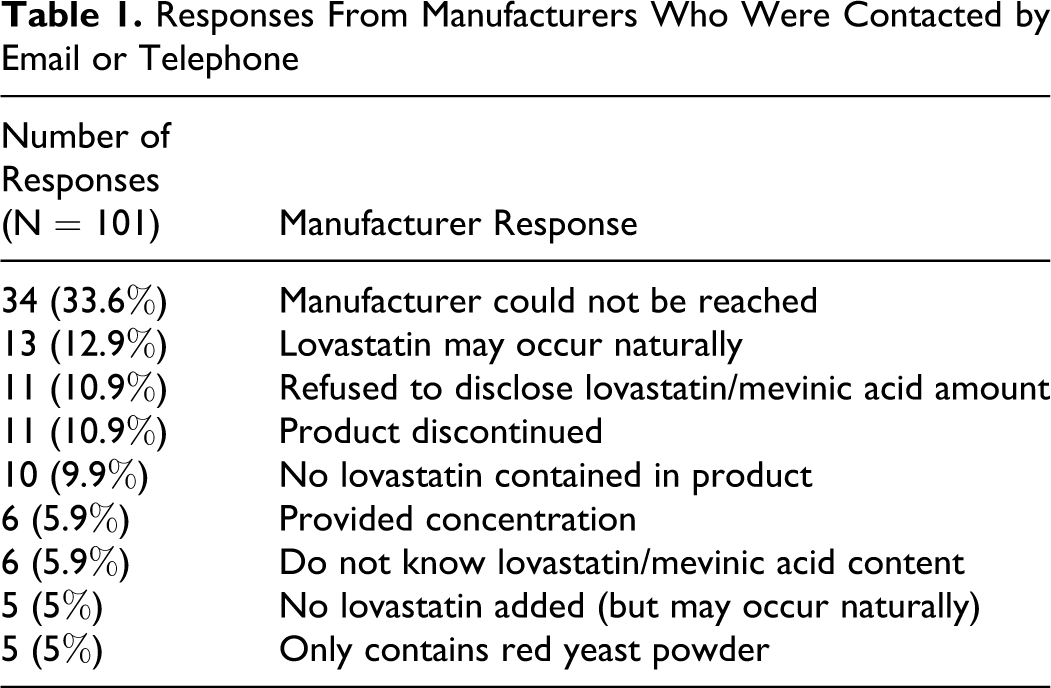
Overall, a total of 22 (19%) red yeast rice products had specific data available about the concentration of lovastatin or mevinic acid. In most of these cases, this information was attainable on the product label. Contacting the manufacturer rarely provided additional information.
For products with information about lovastatin or mevinic acid concentration, the concentration most commonly reported was 0.4%. However, the reported concentration ranged from 0.1% to 1.7% (Table 2 ). Based on these concentrations, a typical dose of 600 mg twice daily of red yeast rice would provide from 1.2 to 20 mg daily of lovastatin or mevinic acids.
Lovastatin and Mevinic Acid Content of Red Yeast Rice Products Providing This Information

The majority of red yeast rice products assessed (81%) provided no specific information about lovastatin or mevinic acid concentrations, either through product labeling or through contact with the manufacturer.
Discussion and Conclusion
Clinical trials have shown that red yeast rice products containing lovastatin can significantly reduce cholesterol levels compared with placebo.1,8–10 This is not surprising since these products contain a modest amount of lovastatin. However, data are lacking to determine whether red yeast rice products can reduce the risk of cardiovascular disease–related morbidity and mortality, as has been shown with conventional prescription statins.
There are also growing concerns about the safety of using red yeast rice products containing lovastatin. A recent report describes a case of a 62-year-old woman who developed drug-induced hepatitis following 4 months of treatment with a red yeast rice–containing product. Symptoms improved when the product was discontinued. 11 Reports have also linked red yeast rice products to cases of myopathy and rhabdomyolysis.12–14 From April 2002 to December 2007, an Italian adverse drug reaction database collected 9 reports of myopathy related to natural products. Of these 9 reports, 7 related to red yeast rice products. 13
The rate of adverse events with red yeast rice appears to be substantially lower than with conventional prescription statins. This would be expected, however, considering that the concentration of statins in red yeast rice products is much lower than the statin doses taken by most patients with hyperlipidemia. The sheer number of patients taking conventional statins is also likely to be substantially larger than the number of patients taking red yeast rice products. Additionally, adverse events related to natural products are thought to be substantially underreported.
In our experience, many patients turn to natural products for cholesterol reduction due to fear about the side effects of conventional drugs such as statins. In many cases, patients take red yeast rice with the assumption that these products are safer than conventional drugs. However, the majority of patients are likely not aware that red yeast rice products contain a statin drug and related chemicals.
Based on our assessment, 81% of red yeast rice products do not specifically disclose that the product contains a statin drug. Only 14% provide information on the product label indicating the concentration of lovastatin or related compounds.
A laboratory analysis of 10 commercial red yeast rice products by Consumerlab.com shows that 100% of products evaluated contained some concentration of lovastatin and related compounds. The concentration varied by over 100-fold, from 0.1 to 10.6 mg per capsule. 7 In another laboratory analysis, 12 commercial red yeast rice products were analyzed for monacolin content. This analysis found total monacolin content ranging from 0.52% to 1.86%. The lovastatin content ranged from 0.017% to 1.68%. 15
These findings suggests that products not listing lovastatin on the label or not disclosing information about lovastatin content likely still contain some quantity of lovastatin. This also suggests that there can be wide variation in the concentration of lovastatin provided by red yeast rice products.
Patients should be advised that “natural” red yeast rice products can contain the same drug as the prescription statin drug, lovastatin. Although some products could be relatively safe due to low concentrations of statins, other red yeast rice products can contain prescription level doses of lovastatin and result in similar side effects. Additionally, due to the inconsistency in lovastatin concentrations and the lack of appropriate and accurate labeling information, patients should generally be advised to avoid red yeast rice products.
Footnotes
PG designed the study and developed the first draft of the manuscript; RP collected data and contributed to manuscript development; ZRC, AW, and AA contributed to manuscript development.
The authors declared no potential conflicts of interest with respect to the research, authorship, and/or publication of this article.
The authors received no financial support for the research, authorship, and/or publication of this article.