



Abstract
Objectives
Research literature rarely examines the differences in attitude toward the police among minority group members living in ethnically homogenous localities as opposed to heterogeneous ones. The present study examined differences in police legitimacy and willingness to help it prevent crime among members of a minority group by comparing those living in homogeneous localities with those living in heterogeneous ones, as well as with the majority group.
Methods
The present study is based on data collected during a telephone survey on public attitudes toward the police conducted among a random and representative sample of 1,000 Israelis.
Results
A series of multivariate linear regression analyses showed that Arab minority respondents living in heterogeneous localities exhibit the lowest levels of police legitimacy and willingness to help it prevent crime compared to both Arabs living in homogeneous localities and Jews. These findings remain significant when controlling for procedural justice and participants’ socioeconomic characteristics.
Conclusions
Living in a heterogeneous locality uniquely affects the attitudes of minority group members toward the police. Police effectiveness and procedural justice do not explain differences between minority members living in homogeneous versus heterogeneous communities in their obligation to obey and assist the police in crime prevention.
Keywords
Introduction
In recent years, research has reflected a surging interest in police legitimacy and willingness to assist law enforcement in crime prevention among ethnic minority groups (Camero et al., 2023; Reisig et al., 2023). Police legitimacy represents the idea of the soundness of force—the belief that the police, as an institutional body charged with defending the rule of law, has the right and authority to possess this power (Suchman, 1995), and is commonly measured using two indicators: trust in the police and the obligation to obey it (Chan et al., 2025; Sunshine & Tyler, 2003). These two indicators have implications for the strength and nature of community partnerships with the police.
As for community willingness to assist the police in crime prevention, the public's cooperation with the police is a desirable civil goal in a democratic regime. It helps the police by improving its capabilities in a wide range of areas (Khatchatourian et al., 2022), such as: addressing issues of severe violent crimes, incivilities and public order (Hughes & Rowe, 2007); collecting information and establishing sufficient evidence against lawbreakers (Bolger & Walters, 2019); recruiting officers and encouraging police diversity (Weitzer & Hasisi, 2008).
The literature highlights two factors that significantly predict and promote police legitimacy and willingness to assist law enforcement in crime prevention—procedural justice and police effectiveness (Sunshine & Tyler, 2003). The procedural justice factor engages in “citizens’ subjective interpretation of the extent of fairness embodied in the way police exercise their authority” (Jonathan-Zamir & Perry, 2021, p. 169). Perceptions of police effectiveness, however, focus on police performance, particularly as manifested in its ability to prevent crime, maintain public order, identify offenders and prosecute them (Sunshine & Tyler, 2003).
Over the past two decades, there has been a significant increase in research examining whether there are differences in the predictors of police legitimacy and willingness to assist the police in crime prevention between majority and minority groups (Jackson et al., 2013; Madon et al., 2017; Peck, 2015; Reynolds et al., 2018). Despite this growing body of research, most studies conducted on these topics apply a one-dimensional approach, focusing on respondents’ ethnicity as a key variable in the analysis of their views on the police, and treating minority groups as homogeneous. This one-dimensional approach overlooks the diversity within minority groups, and fails to consider how these internal differences may shape their perceptions and attitudes toward the police, despite previous studies having discovered that such differences do indeed exist. Subsequently, a rival approach has emerged, whereby the differences in attitudes toward the police between and within various racial groups should be discussed beyond the classic division by ethnicity or race. Particularly, this includes examining differences between minority group members living in ethnically heterogeneous localities and those living in homogeneous ones (Hitchens et al., 2023; Weitzer, 2010).
One key contextual factor influencing these subgroup differences is the social environment, specifically the racial or ethnic composition of the localities where minority members reside. Environmental criminology's perspective assumes that social settings affect crime patterns, as well as the relations between the community and the law enforcement system (Bottoms & Wiles, 2002); in other words, civilians’ place of residence could affect their views on the police (Boehme et al., 2022). Indeed, one of the attributes of a minority group found to potentially impact its members’ views on the police is the racial composition characteristic of the locality in which they live, and according to which minority group members may be classified as living in ethnically mixed (heterogeneous) localities or non-mixed (homogeneous) ones (Hipp, 2007; Weitzer, 2010). Heterogeneous ethnic localities are communities in which members of a minority group reside alongside at least one more group that is ethnically different. In contrast, ethnically homogeneous localities are composed solely of the minority group. Ethnically diverse localities frequently exhibit strained relationships between minority and majority populations (Adelman & Elman, 2014).
The importance of noticing whether or not the locality in which minority group members reside is ethnically diverse (homogeneous or heterogeneous) lies in racial heterogeneity's potential effect on the extent to which police is perceived as legitimate, as well as the willingness to help law enforcement in crime prevention (Hipp, 2007).
Accordingly, the present study examines whether residing in ethnically mixed or homogeneous localities predicts perceptions of police legitimacy and willingness to assist law enforcement in crime prevention, beyond the established effects of procedural justice and police effectiveness. To answer this question, the differences in police legitimacy and willingness to assist law enforcement in crime prevention between Arab minority group members living in Israel in mixed localities and those living in homogeneous ones were examined and compared to the Jewish majority group.
The Arab Minority in Israel: Historical and Cultural Context
The Arab minority in Israel comprises some 21% of the general Israeli population, and is composed of Muslims, Christians, Druze, and Circassians (Factor, 2018). This ethnic minority is indigenous and distinguishable from the Jewish majority by a wide range of attributes, such as nationality, religion, language, and culture (Moore, 2000). Israel defines itself as a Jewish state, and its national symbols—including the national anthem, flag, holidays, heroes, and collective memory—reflect exclusively Jewish identity and culture, thereby leaving the Arab minority unrepresented (Rekhess, 2007; Saban, 2003). This exclusive national identity increases the sense of alienation toward the State of Israel among Israeli Arabs.
For more than 100 years, the Palestinian people have been engaged in a violent and ongoing national conflict with the Jewish national movement and, later, with the State of Israel. Immediately upon its establishment following the war in 1948, the State of Israel endorsed full, formal citizenship for members of the Arab minority who continued to reside in Israel. However, the national Palestinian identity of the Arab minority transformed them, in the eyes of the Jewish majority, into a group affiliated with the enemy, and perceived as possessing “dual loyalty” (Hasisi, 2008b).
Consequently, this population ranks lower on the socioeconomic ladder, is typically weaker, and lacks nationwide political clout (Factor, 2024; Hasisi & Weitzer, 2007). Members of the Arab minority perceive the Israel Police as an agency that exclusively serves the needs and interests of Jewish majority citizens, while failing to meet theirs. Their views on the police are therefore more negative than those prevalent in any other group within Israeli society (Factor, 2018).
Many among the Israeli Arab population also view the Jewish majority as an immigrant community of settlers, having owned most of the lands on which the State of Israel was established in 1948. The Arab minority's ownership of lands, and the state's desire to take them over, have led to many land disputes, contributing to the tension between the Israeli Arab minority and the government, as well as the state institutions, particularly the Israel Police. This tension has been aggravated further by Israel having declared itself the nation state of the Jewish People (Rekhess, 2007). Moreover, the Jewish majority is intimidated by the Arab minority, especially in mixed cities, as the two populations interact more frequently (Monterescu & Rabinowitz, 2007). One example is the events of May 2021, during which widespread and intense riots erupted, characterized by violent clashes and severe confrontations between Jewish and Arab Israeli citizens, effectively resembling a form of civil conflict and leaving the police caught in the middle. Although these confrontations took place across the country, they were particularly fierce and violent in mixed cities, where Jewish and Arab citizens live side by side (Israel State Comptroller, 2022).
Mixed Cities in Israel
A mixed city is defined by Israel's Central Bureau of Statistics as one in which a significant Arab minority, which exceeds 10% of the city population, lives alongside an overwhelmingly Jewish majority. In accordance with this definition, the following eight localities have been declared as mixed cities by the Central Bureau of Statistics: Jerusalem, Tel Aviv-Jaffa, Ramla, Lod, Nof HaGalil, Haifa, Acre, and Ma’alot Tarshiha. In Israel, 10% of the Arab population live in cities defined as mixed (Israel Central Bureau of Statistics, 2013).
The fact that Israel has been defined a Jewish state has arguably more prominent implications in mixed cities than homogenous Arab localities, and the same is also true for gaps in life areas between Jews and Arabs. First, Arabs living in mixed cities feel the implications of the 1948 War, which followed the establishment of the State of Israel, more acutely. These repercussions are not only perceived as historical memory, but as a vivid lived experience on the ground. Every day, they pass by abandoned houses, mosques, and churches; seeing Hebrew names replacing Arab neighborhood and street names. In contrast, Arabs residing in homogeneous localities are less exposed to processes of spatial nationalization that emphasize Jewish identity (Monterescu & Rabinowitz, 2007). Second, segregation between Arabs and Jews is apparent in mixed Israeli cities, despite their heterogeneity. In most cases, Arabs and Jews live in geographically separate neighborhoods, so that the daily interaction between the two populations is relatively limited (Hasisi, 2008a). The Arab neighborhoods in mixed cities are often poorer, with inadequate physical conditions, compared to the Jewish ones that are well-kept, with better conditions in terms of infrastructure, lighting, parks, and so on. This residential segregation hones the gaps between Arabs and Jews in the various life areas, particularly the socioeconomic, thereby enhancing the effect of relative deprivation among Arabs living in mixed cities, as opposed to those living in homogeneous localities, who are less frequently exposed to the same gaps since they live in localities that are disconnected from the Jewish majority (Gurr, 1970; Mentovich et al., 2020; Monterescu & Rabinowitz, 2007; Runciman, 1966).
Relative deprivation is not the only factor that distinguishes Arabs in mixed cities from those living in homogeneous ones; social cohesion is another point of contrast between these two types of Arab Israelis. Social cohesion often manifests in high levels of trust among community members, mutual responsibility, interest in one another's opinions and actions, as well as high preparedness for joint action (Goudriaan et al., 2006; Sampson et al., 1997). Furthermore, research literature reveals a positive correlation between the perceived levels of informal social control in the community and positive attitudes toward the police (Khatchatourian et al., 2022). The breakdown of pre-Israel mixed cities due to the mass departure of Arab residents and families in 1948, coupled with the arrival of other Arab immigrants over the years who, having come from elsewhere, had their own range of customs and values, has led to the disintegration of social cohesion in Arab communities living in mixed cities (Monterescu & Rabinowitz, 2007). The deterioration in social cohesion has led to the erosion of informal mechanisms within the Arab population living in mixed cities, and negatively impacts the attitudes of local minority group members toward the police. In contrast, homogeneous Arab localities are often traditional villages where residents belong to a hamula (family clan) or extended family characterized by high levels of solidarity and social cohesion (Hasisi, 2008a; Monterescu & Rabinowitz, 2007).
Together, relative deprivation, social cohesion, the perceived threat posed by Arabs to Jews, and residential segregation in mixed cities shape Arab residents’ attitudes toward the police. This comprehensive framework establishes the foundation for the current study.
The Current Study
The current study explores police legitimacy and the willingness to assist law enforcement in crime prevention while addressing the differences within the Arab minority in Israel and comparing it to the Jewish majority. These differences were examined by dividing the Arab minority into groups according to the type of locality in which they live, thereby distinguishing between heterogeneous (mixed) and homogeneous ones.
Thus, based on literature, the study hypotheses are:
Hypothesis 1: A correlation will be found between the locality type (heterogeneous or homogeneous) and obligation to obey the police among members of the minority group, so that the level of obligation will be lower in heterogeneous localities than in homogeneous ones. Moreover, in both, levels will be lower than among Jews. Hypothesis 2: The locality type and level of willingness to assist the police in crime prevention will emerge as correlated, with lower levels of willingness found among Arabs living in heterogeneous localities than among Arabs living in homogeneous ones. Moreover, in both, levels will be lower than among Jews. Hypothesis 3: A correlation will be found between members of the minority group's locality type and obligation to obey the police beyond procedural justice and effectiveness, so that the level of obligation will be lower in heterogeneous localities than in homogeneous ones. In both, levels will be lower than among Jews. Hypothesis 4: The locality type and level of willingness to assist the police in crime prevention will emerge as correlated among members of the minority group beyond procedural justice and effectiveness, so that levels will be lower among Arabs living in heterogeneous localities than among Arabs living in homogeneous ones. In both, levels will be lower than among Jews.
Methods
Data and Sample
The present study is based on data collected from a telephone survey conducted in December 2013 and January 2014 to discern public attitudes toward the police. It consisted of a random representative sample of 600 Arab citizens and 400 Jewish ones, with the Arab citizens oversampled to ensure an adequate sample size for each group, thereby increasing the statistical power of our analyses, and reducing standard errors (Weisburd & Britt, 2014). The Arab citizens’ sample was divided into Arabs living in Arab localities (438) and Arabs living in mixed cities (162). In the present study, the Arab participants defined as living in mixed cities come from Israeli cities that have been so defined by the Central Bureau of Statistics (Tel Aviv-Jaffa, Ramla, Lod, Nof HaGalil, Haifa, Acre, and Ma’alot Tarshiha); whereas the Arab participants living in homogeneous localities come from approximately 110 such localities, representing all regions in Israel—central Israel, southern Israel, northern Israel, and the area known as the Triangle. The survey respondents did not receive anything in exchange for their participation, and the response rate was 51%, which is common in studies of this kind (Reisig et al., 2007). The survey was conducted by a university survey institute and approved by the Institutional Review Board.
Study Variables
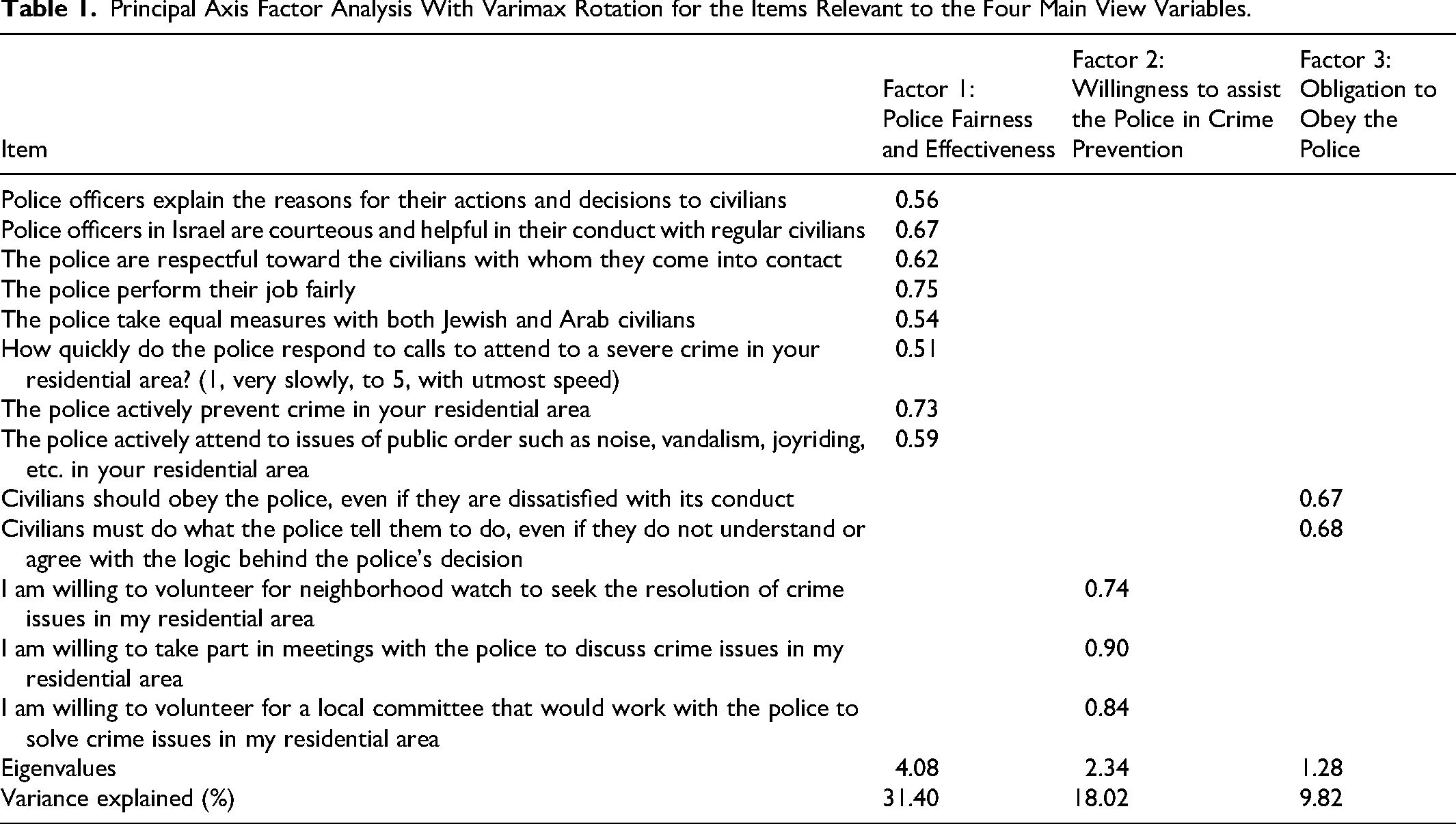
The survey questionnaire contains items that were based on previous studies, and validated tools (Sunshine & Tyler, 2003) designed to examine the Israeli public's views on the Israel Police. Answers to these items were provided using the Likert Scale (1‒5), with 1 being Not at all and 5 being to a large extent. The study examined two dependent variables: police legitimacy and willingness to assist the police in crime prevention. As mentioned above, police legitimacy is commonly measured using two indicators: trust in the police and the obligation to obey (Sunshine & Tyler, 2003). However, recent literature debates this approach, arguing that these are two separate variables (Gau, 2011). While definitions vary, obligation to obey remains a key predictor of perceived legitimacy. Accordingly, and in consistency with previous studies, the present research measures citizens’ obligation to obey as an indicator of police legitimacy (Reisig & Lloyd, 2009). In this study, the variable obligation to obey the police was measured using two items, and the variable willingness to assist the police in crime prevention was measured using three items (see Table 1). The main independent variable in the present study is ethnicity by locality type. This variable is divided into three categories: Arab citizens living in mixed cities, Jewish citizens living across Israel, and Arab citizens living in homogeneous cities (omitted category). The following two additional variables, found in the literature to be associated with obligation to obey the police and willingness to assist the police in crime prevention, were also assessed: Procedural justice was assessed using five questionnaire items, and police effectiveness was assessed using three.
To examine the validity of the main study variables’ structure, a factor analysis was conducted on the 13 questionnaire items. As can be seen in Table 1, the analysis revealed three distinct factors that explain 59% of the standard variance, with all factor loadings exceeding the acceptable 0.4 threshold (Reisig et al., 2007). Cronbach's alpha for each of the variables was between 0.7 and 0.88, all exceeding the acceptable 0.7 threshold, and supporting the variables’ internal reliability (DeVellis, 2003). As expected, the third factor included all the items assessing the obligation to obey the police. The second factor contained all the items assessing willingness to assist the police in crime prevention. However, Table 1 shows that the items belonging to procedural justice and effectiveness are combined together under the first factor, and are, in effect, indistinguishable. Thus, in the present study, and similarly to other studies (e.g., Hasisi et al., 2012; Weisburd et al., 2024), we have decided to unite procedural justice and police effectiveness to form one independent variable called general police fairness and effectiveness assessment.
Finally, for each of the three factors, the mean of the items comprising it was calculated in order to establish the three main research variables.
Principal Axis Factor Analysis With Varimax Rotation for the Items Relevant to the Four Main View Variables.
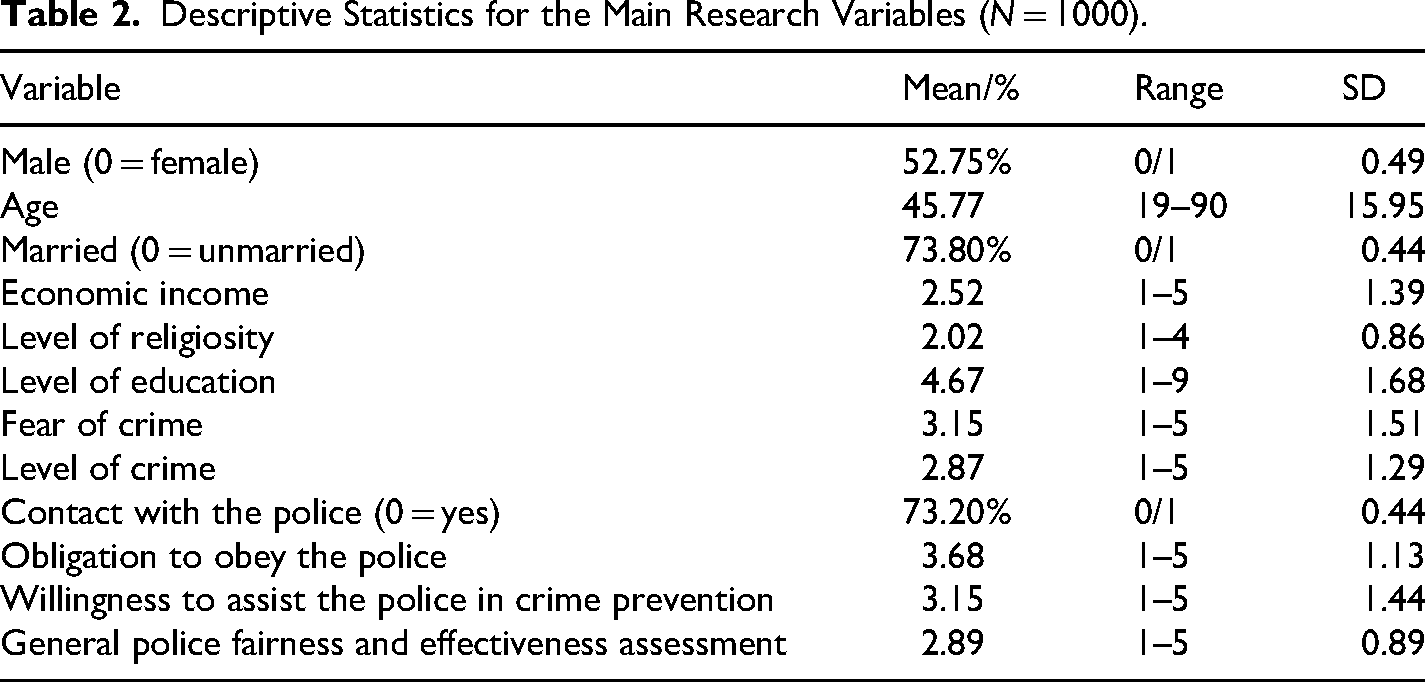
Ten additional control factors that could affect the public's views on the police (Brown & Benedict, 2002) were added to the statistical models. Table 2 presents descriptive statistics of these study variables. For more information on the indicators that comprise the control variables, please see the supplementary materials document provided with this paper.
Descriptive Statistics for the Main Research Variables (N = 1000).
Analytic Strategy
To answer the study questions, ANOVA tests were first conducted to examine the differences in obligation to obey the police and willingness to assist the police in crime prevention between the three groups of respondents. Next, a series of multivariate linear regressions were performed in two steps to measure the obligation to obey the police and willingness to assist the police in crime prevention by ethnicity and locality type (Arabs living in mixed cities, Arabs living in homogeneous cities) as well as the control variables. In addition, to better understand and demonstrate the differences in obligation to obey the police and willingness to assist the police in crime prevention between Arabs living in mixed cities and those living in all-Arab localities, and in comparison to Jews, we used the two regression models to produce predictions for these values, given that the other variables in the model remain fixated in their mean (Fox, 2015).
Results
Table 3 presents descriptive statistics and ANOVA tests comparing the means of the obligation to obey the police and willingness to assist the police in crime prevention across all three groups. It shows significant differences (p < .001) between them, with the lowest levels of obligation to obey the police (3.16), willingness to assist the police in crime prevention (2.87), and general police fairness and effectiveness assessment (2.71) being among Arabs living in mixed cities. In the following step, we attempted to examine whether these differences exist when other variables are controlled for via multivariate analysis, and explain these differences using the regressions.
Mean of Main View Variables by Locality Type (Jewish, Arab and Mixed) and ANOVA Tests (N = 1000).
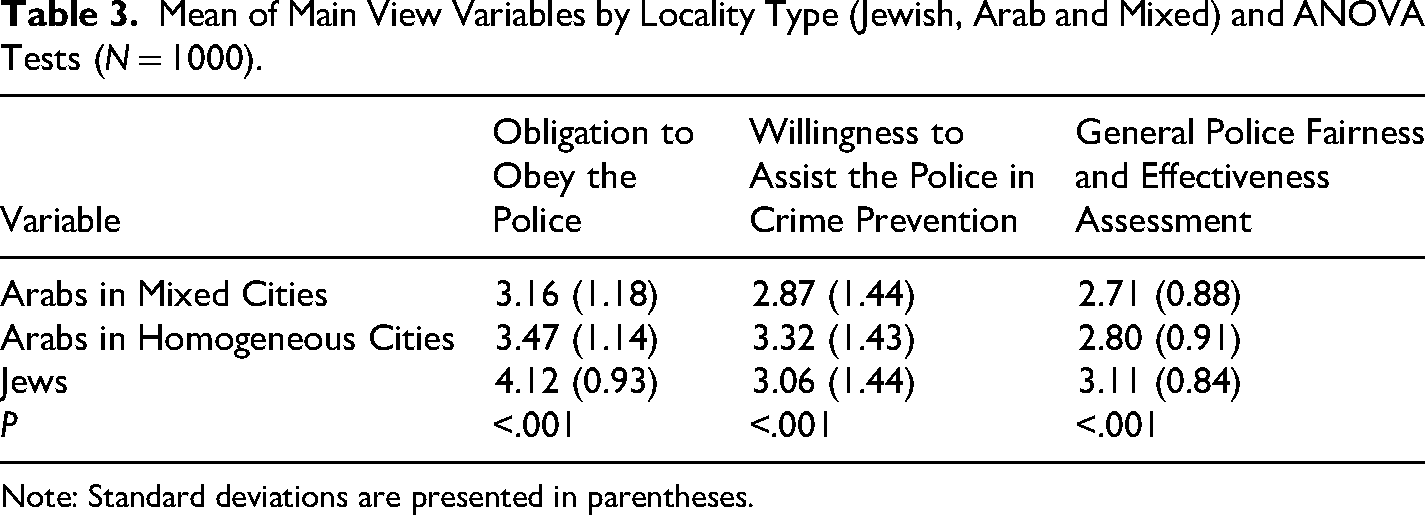
Note: Standard deviations are presented in parentheses.
Table 4 presents two linear regressions, each of which consists of two models. The first is for obligation to obey the police by ethnicity according to locality type (Model 1), control variables, and general police fairness and effectiveness assessment (Model 2). The second is for willingness to assist the police in crime prevention by ethnicity according to locality type (Model 1), control variables, and general police fairness and effectiveness assessment (Model 2). The findings in Model 1 of the regression for obligation to obey the police show that Arab respondents from mixed cities exhibit a significantly lesser obligation to obey the police compared to Arab respondents living in homogeneous (non-mixed) localities (b = −0.31, p < .01), whereas Jewish respondents are significantly more obligated to obey the police than Arab respondents living in homogeneous localities (b = 0.65, p < .001). The Model 1 findings of the regression for willingness to assist the police in crime prevention show that Arab respondents in mixed cities exhibit significantly lower levels of willingness to assist the police in crime prevention compared to Arab respondents living in homogeneous (non-mixed) localities (b = −0.46, p < .01). Interestingly, Jewish respondents exhibit significantly lower levels of willingness to assist the police in crime prevention than Arab respondents living in homogeneous (non-mixed) localities (b = −0.26, p < .01). It is also illuminating to discover that these trends do not change even when the independent variable general police fairness and effectiveness assessment and control variables are introduced into the model.
Linear Regressions of Obligation to Obey the Police and Willingness to Assist the Police in Crime Prevention for Ethnicity by Locality Type (Jewish, Arab, and Mixed), Procedural Justice and Effectiveness, as Well as Control Variables (N = 1000).
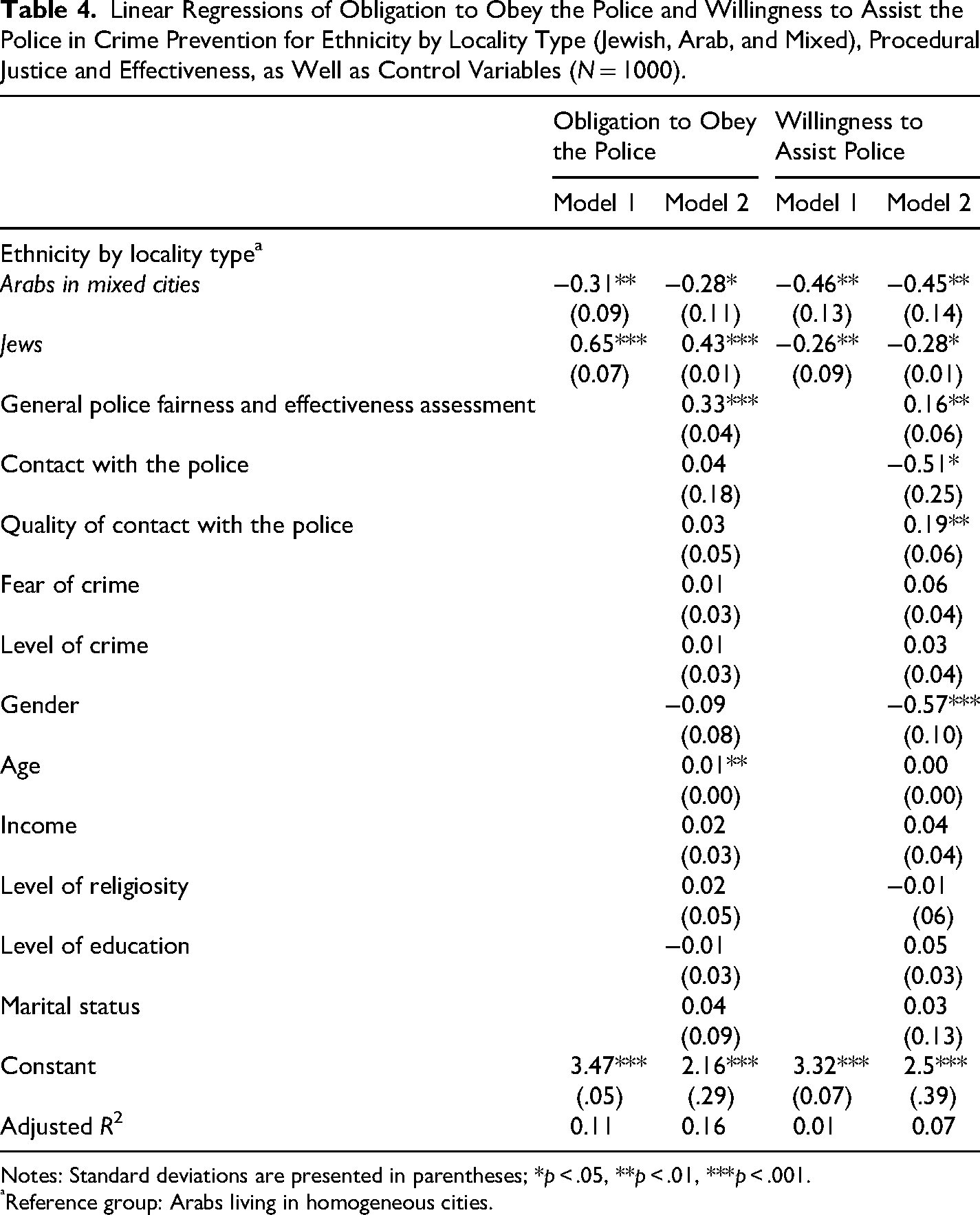
Notes: Standard deviations are presented in parentheses; *p < .05, **p < .01, ***p < .001.
Reference group: Arabs living in homogeneous cities.
Differences in the level of obligation to obey the police and willingness to assist the police in crime prevention across ethnicity and locality type can be seen clearly in Figure 1, which shows the predicted level of obligation to obey the police and willingness to assist it in crime prevention by ethnicity and locality type based on Model 2. The predicted level of obligation to obey the police among Arab citizens living in mixed cities is 3.26, whereas that of Arab citizens living in homogeneous localities is 3.54. Thus, the reported level of obligation to obey the police in mixed cities is 8.24% lower than that reported by Arabs who do not live in mixed cities. Moreover, the predicted level of obligation to obey the police among Jewish citizens, which is 3.98, is 19.89% higher than that of Arab citizens living in mixed cities (and 11.70% higher than that of Arabs living in homogeneous localities).
Figure 1 also provides insights into the differences in levels of willingness to assist the police in crime prevention by ethnicity and locality type. The level of willingness to assist the police in crime prevention among Arab citizens living in mixed cities is 2.92, whereas that of Arab citizens living in homogeneous localities is 3.37. Thus, the level of willingness to assist the police in crime prevention among Arabs living in mixed cities is 14.31% lower than that of Arabs who do not live in mixed cities. Furthermore, the level of willingness to assist the police in crime prevention among Arabs living in mixed cities is 5.66% lower than that of Jewish residents. Conversely, the level of willingness to assist the police in crime prevention among Arab citizens living in homogeneous localities is 8.67% higher than that of Jewish residents. These findings reveal that locality type predicts willingness to assist the police in crime prevention so that, on average, members of the Jewish respondent group express less willingness to assist the police in crime prevention than members of the Arab minority who live in homogeneous localities. In contrast, the level of willingness to assist the police in crime prevention among Arab citizens living in mixed cities is the lowest of all three groups.
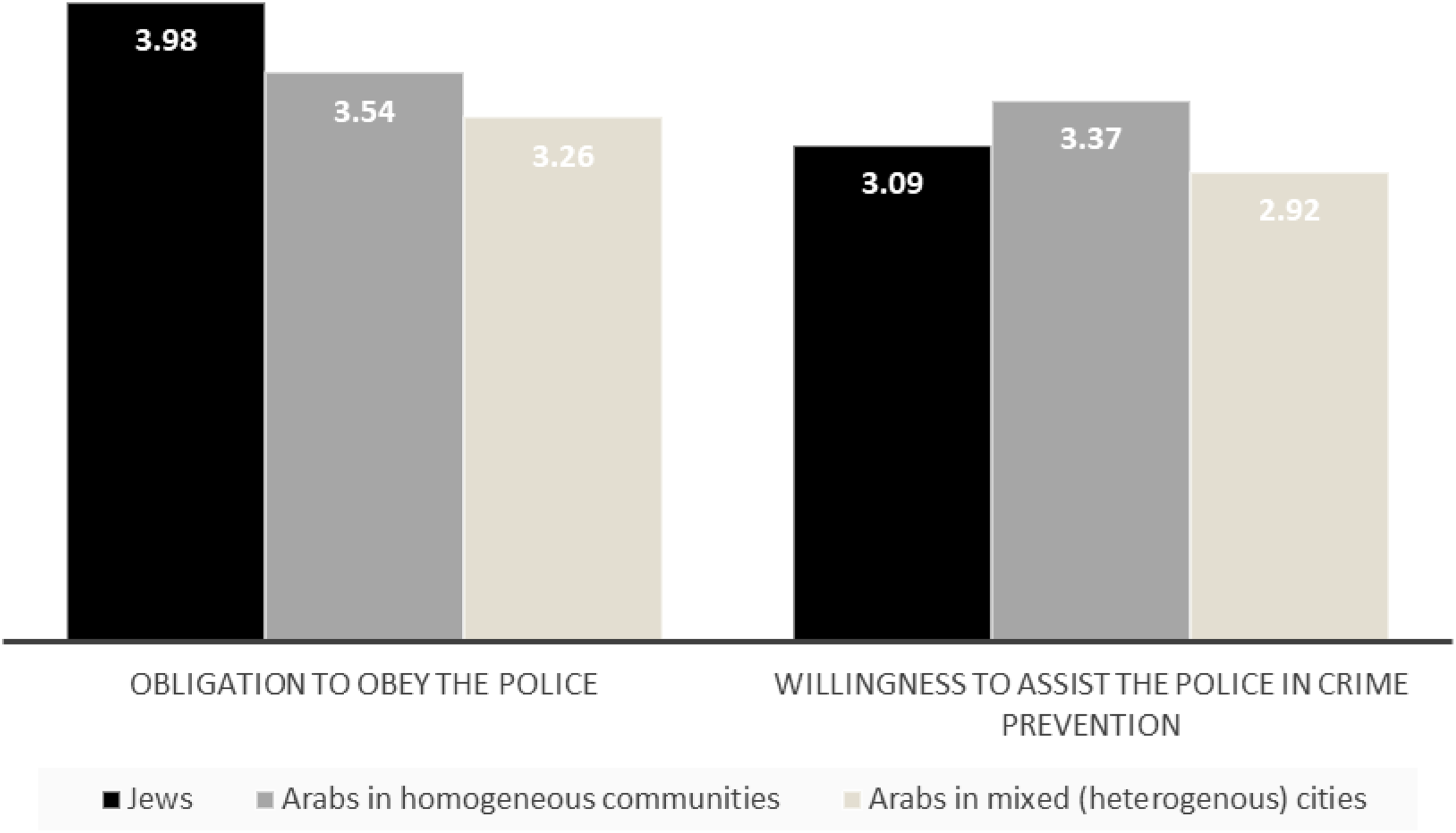
Predictions of obligation to obey the police and willingness to assist the police in crime prevention by ethnicity and locality type in Model 2.
To conclude, the present findings clearly support the first hypothesis whereby the level of obligation to obey the police among members of a minority living in mixed cities is lower than that found among members of a minority living in homogeneous localities. Furthermore, the level of obligation to obey the police among both is lower than that found among members of a majority. The third hypothesis is also supported by the findings, as a correlation was indeed found between locality type (mixed or homogeneous) and the obligation to obey the police among members of the minority group living there beyond procedural justice and effectiveness. However, the findings do not support the second and fourth hypotheses, since Arabs living in homogeneous localities are reportedly more willing to assist the police in crime prevention than Jews.
Discussion
The findings of the attitude survey showed differences in views on the police in accordance with locality type, with Arabs exhibiting less obligation to obey the police than Jews, whether or not they live in mixed cities. This finding is congruent with academic literature, whereby minority group citizens express low levels of obligation to obey the police compared to the majority groups (Hasisi & Weitzer, 2007). Our study's contribution pertains to the exploration of variance in obligation to obey the police within the minority groups themselves, and lies in our finding that Arabs living in mixed cities report lower levels of obligation to obey the police than Arabs living in homogeneous localities.
As for willingness to assist the police in crime prevention, similarly to the obligation to obey the police, it is noteworthy that the findings of this study reveal that Arabs living in mixed cities report the lowest levels in this context. This finding, too, is in keeping with the academic literature, whereby members of minority groups exhibit lower levels of willingness to cooperate with the police than the majority group (Sunshine & Tyler, 2003). In Israel, Arabs also traditionally express lower levels of willingness to cooperate with the police than Jews (Factor et al., 2014).
However, surprisingly, and contrary to the literature (see e.g., Factor et al., 2014), the findings of the present study reveal that Arabs in non-mixed (homogeneous) cities exhibit greater willingness to assist the police in crime prevention than Jews. One of the main reasons for this finding could be traced back to the fact that, over the last two decades, Arab society has been suffering from social disarray that could lead to high crime and severe violence rates. Arab residents have had enough, and seem to have begun to realize that they would not be able to end this violence unless they help the police prevent crime (Ali et al., 2020). But the time has yet to come for mixed cities to engage in such cooperation. And it is not as if mixed cities are free of violence, on the contrary; however, it would appear that the complexities of these cities, some of which have been mentioned in our literature review, inhibit the willingness of their Arab residents to assist the police in crime prevention, despite their unprecedentedly high crime and violence rates. It should be noted in this context that Jewish society does not suffer from such high rates of severe violence, meaning that this motivation to assist the police in crime prevention is less relevant for Jews (Kochel, 2018). The study conducted by Bradford and Jackson (2016) could lend support to this explanation, for they found that residents’ tendency to cooperate with the police increases when crime soars and their safety is under greater threat.
Another factor that could explain this finding may be associated with the fact that, in the present study, willingness to assist the police in crime prevention was measured by the inclination to join a neighborhood watch group or local committee, and not necessarily by helping the police personally. This distinction between personal assistance and group-community assistance is very important in our study. A review of research literature shows that residents of homogeneous Arab localities are typically more traditional, sharing a stronger community life and higher social interaction, compared to Arab residents living in mixed cities, as well as to Jews (Monterescu & Rabinowitz, 2007). These characteristics could encourage residents to report their willingness and desire to partake in social and community initiatives, or be on a certain neighborhood committee that promotes the local community (Goudriaan et al., 2006).
The findings of the present study remain significant even when the impact of known predictors of police legitimacy and willingness to assist the police in crime prevention—namely procedural justice and effectiveness—as well as respondents’ socioeconomic characteristics, are controlled for. This means that, although the findings show that police effectiveness and procedural justice are significantly linked to the obligation to obey the police and willingness to assist the police in crime prevention, the former do not fully explain the differences found between the latter among minorities living in different types of localities. Further evidence supporting this notion is that the percent of variance explained (R2) was found to be relatively low. Thus, other factors, beyond varying degrees of effectiveness and procedural justice, have an impact, namely locality type and characteristics. The main implication of this finding is that there is a need to conduct comprehensive follow-up studies to examine these factors, and explore these explanations thoroughly.
The present study findings have several theoretical and practical implications. On the theoretical level, this study contributes to the literature, adding to the empirical knowledge on police legitimacy and willingness to assist the police in crime prevention among minorities in general, and those living in heterogenous (mixed) localities in particular. It further illuminates differences within minority groups, revealing that members of such a minority who live in mixed cities exhibit the lowest levels of obligation to obey the police and willingness to assist the police in crime prevention. On the practical level, the study provides information to policymakers and law enforcement agencies that could help build future workplans designed to improve the relationship and increase trust between members of the minority and majority groups, as well as the police. At the same time, such programs could also aim to improve law enforcement among minority groups, while placing an emphasis on mixed cities. Thus, the present study supports and underscores the examination of police practices in mixed cities by offering special training and study programs for police officers working in mixed cities that will focus on educating the officers to consider the local cultural diversity. The findings highlight the need to differentiate between minority groups rather than viewing them uniformly, and apply different policing to suit the needs and characteristics of every group, in this case – in alignment with the locality being homogeneous or heterogeneous.
Having said that, the present study is not without limitations, either. First among them is the fact that the data was gathered a decade ago, in 2013–2014. Nevertheless, it is noteworthy that this is merely a preliminary exploratory study designed to examine whether there are any differences worth noting as suggested by the research literature. Naturally, a study based on more up-to-date data is necessary to validate the original findings, especially in view of the significant increase in violent cases in Arab society in recent years. Second, the purpose of the current study was to estimate the correlation between ethnic heterogeneity and police legitimacy and the willingness to assist the police. However, other mechanisms—such as relative deprivation, social cohesion, informal social control, and racial threat—may also influence this relationship (Hipp, 2007). These factors were beyond the scope of the current study and should be addressed in future research.
Conclusion
The present study shows the unique effect that living in a mixed (ethnically heterogeneous) city has on its minority group residents’ obligation to obey the police and willingness to assist the police in crime prevention, compared to both members of the same minority group living in homogeneous localities, and the majority group. In it, we found that members of the minority group living in ethnically heterogeneous cities currently express the most negative views among Israeli Arabs on law perception and contact with the police. This finding demonstrates the combustibility of the relations in the context of local and regional crisis outbreaks, manifested in violent conflicts in mixed cities. The present study sought to shed light specifically on the mixed localities that are often overlooked both by the majority and the minority itself, while highlighting double marginality and its effect on attitudes toward obeying the police and assisting the police in crime prevention.
Supplemental Material
sj-docx-1-raj-10.1177_21533687251397629 - Supplemental material for Sharing the Space, Living Apart: Views on Police Legitimacy and Willingness to Assist in Crime Prevention Among Arabs in Mixed Israeli Cities
Supplemental material, sj-docx-1-raj-10.1177_21533687251397629 for Sharing the Space, Living Apart: Views on Police Legitimacy and Willingness to Assist in Crime Prevention Among Arabs in Mixed Israeli Cities by Shadi Akariya, Badi Hasisi and Roni Factor in Race and Justice
Footnotes

Funding
The authors received no financial support for the research, authorship, and/or publication of this article.
Declaration of Conflicting Interests
The authors declared no potential conflicts of interest with respect to the research, authorship, and/or publication of this article.
Supplemental Material
Supplemental material for this article is available online.
Author Biographies
References
Supplementary Material
Please find the following supplemental material available below.
For Open Access articles published under a Creative Commons License, all supplemental material carries the same license as the article it is associated with.
For non-Open Access articles published, all supplemental material carries a non-exclusive license, and permission requests for re-use of supplemental material or any part of supplemental material shall be sent directly to the copyright owner as specified in the copyright notice associated with the article.
