



Abstract
Research on courts and sentencing shows an inextricable link between race and criminal history, which is often cited as a key driver of disparities in outcomes. Despite robust academic evidence of the detrimental effects of prior record policies, sentencing commissions and policymakers generally have demonstrated no interest in making changes to sentencing policies to address the disparities that flow from prior record penalty enhancements. One notable exception is the Pennsylvania Commission on Sentencing whose eighth edition guidelines drastically restructured that system's prior record score (PRS) to reduce the impact of criminal history on punishment recommendations. Rooted in Du Bois's sociological criminology perspective, the current study employs a qualitative analysis of ten years of documentation (2013–2023) to investigate the motivations, challenges, and ultimate achievements of this significant punishment policy reform. Sources of documentation include internal and publicly available reports, presentations, and transcripts from over 50 hours of recorded Commission meetings and public hearings. Findings reveal a lengthy, thoughtful, and at times, challenging journey from initial proposals to the adopted version of PRS. The results have strong implications for policymaking in jurisdictions reconsidering the role of criminal history in punishment and looking to reduce racial and ethnic disparities.
Introduction and Background
Among W. E. B. Du Bois's many prescient observations of “sociological criminology” were his critiques about how the criminal justice system both embodies and perpetuates racial disparities in punishment outcomes. Scholars have investigated racial disparities in punishment for decades. The current state-of-the-discipline emphasizes the importance of accounting for indirect effects, such as the downstream impacts of being detained pretrial, as well as the influence of often unobserved upstream decisions such as prosecutorial dismissals and charge reductions (e.g., Kutateladze et al., 2014; Spohn, 2000). An emerging emphasis is the perpetuation of racial disparities in punishment through the operation of prior record enhancement policies, especially in jurisdictions that formalize the use of these enhancements through sentencing guidelines (e.g., Frase & Roberts, 2019; King, 2019; Mitchell et al., 2023).
The appropriate role for prior record in punishment decisions has been ambiguous from both punishment philosophy and policy perspectives. Policymakers and academic researchers have often considered a defendant's criminal history to be one of the leading punishment considerations, along with the severity of the conviction offense and related factors. Sentencing research consistently finds prior record and offense severity to be among the most salient predictors of punishment outcomes. Although awareness of the problematic nature of enhancing punishment for prior record has been building for well over a decade, there has been very little in the way of policy reform related to criminal history. One significant exception is the work of the Pennsylvania Commission on Sentencing, which passed sweeping changes to its prior record policies in the eighth edition sentencing guidelines (effective January 2024). Rooted in a Du Boisian framework, the current paper is a case study of this significant policy change, highlighting the role that discussions of racial equity had in the reform, and providing guidance for other jurisdictions.
Theoretical Framework
W. E. B. Du Bois on Sociological Criminology and Racial Disparities in Punishment
During a time in which anthropological criminology—a group of theories attributing Black offending primarily to racial ancestry (Henderson, 1893; Lombroso, 1876; MacDonald, 1893)—was the predominant scientific perspective, W. E. B. Du Bois developed what is now termed “sociological criminology.” Under this perspective, Du Bois emphasized the utility of interdisciplinary investigations that combine qualitative and descriptive statistical methods, placing careful emphasis on history and context (Du Bois, 1898/1982).
One of his seminal works, The Philadelphia Negro (Du Bois, 1899), is considered one of the first applications of sociological criminology and a formidable challenge to the anthropological school. Through extensive and methodical data collection, Du Bois analyzed systemic social, economic, and educational barriers facing the Black community in Philadelphia, making prescient observations about race, crime, policing, punishment, and recidivism—many of which still resonate. Du Bois noted, for example, the differential policing practices in Black neighborhoods that often resulted in more arrests for low-level crimes (which their White counterparts were perceived as more likely to thwart). Discussed in further detail below, Du Bois (1899) also noted the statistical differences in court and sentencing outcomes between White and Black Philadelphia residents, illustrating to the reader what are now termed racial “disparities” and “disproportionalities” disfavoring Black defendants.
Much of Du Bois’ work focused on the U.S. criminal justice system as both an embodiment and mechanism of racial disparity. He wrote at length about the criminogenic urban conditions in which much of the Black population resided, especially in the North (see, e.g., Du Bois, 1901; 1911/1982). Du Bois decried these conditions as an unjust manifestation of “The Color Line,” which produced racial segregation that channeled Black urban populations into less desirable areas, fostering crime. In his own words: …[I]t is safe to conclude from the fact that in [New York] in 1890 every 10,000 Negroes furnished 100 prisoners that there is much serious crime among Negroes. And, indeed, what else should we expect? What else is this but the logical result of bad homes, poor health, restricted opportunities for work, and general social oppression… (1901, p. 150)
Du Bois noted that Black communities suffered the dual impacts of crime and a biased criminal justice system. Recognizing that the police and courts were not even-handed with regard to race, Du Bois noted that nearly one-fifth of crimes committed by Black individuals were for disorderly conduct (Du Bois, 1927/1983). As noted by Gabbidon (2007), Du Bois was certain that “many of the legal violations were frivolous and merely constituted a breaking of the ‘etiquette’ that developed during the slave era in the United States” (p. 47). Du Bois also noted the influence of burgeoning Southern industries (e.g., mining, lumber, agriculture) and their demand for ‘cheap’ labor via convict lease systems, suggesting that law enforcement officials had particular motivation to “find Black criminals” in “suitable quantities” (as cited in Gabbidon, 2007, p. 40). This would suggest that there was no greater criminality within the Black community, but rather, that Black individuals are instead “more often arrested, convicted and mobbed” (Du Bois, 1906, p. 1).
Du Bois (1911/1982) concluded, as do many researchers still today, that when Black individuals enter the justice system, they experience harsher punishments than their White counterparts: Negroes are more easily convicted in court and receive longer sentences. … Over half the prisoners … sentenced to prison for life are Negroes. This might be explained by the greater gravity of Negro crimes, but this does not seem true. (Du Bois, pp. 104–105)
Further exploring this possibility, Du Bois co-authored the publication Morals and Manners Among Negro Americans (1913) with his student Augustus G. Dill. Du Bois and Dill (1913) refuted the notion that the Black community was punished more harshly due to committing more serious crimes (an official explanation offered by the U.S. Census Bureau). They countered that prejudice among the White community, carried out by those in official capacities, was to blame. As an example, Du Bois and Dill (1913) noted that when Black individuals are arrested for multiple crimes, they are “indicted often for the graver of two possible offenses” (p. 39). Du Bois and Dill (1913) further refuted the Census Bureau's explanation, noting that length of sentence factored into the severity with which a crime was classified (“minor” versus “major,” akin to today's “misdemeanors” and “felonies”). They compared the average sentence length for White (roughly 3.5 years) and Black (nearly five years) individuals, providing a key lesson regarding the measurement of criminal involvement—one to which Du Bois remained committed.
Du Bois focused heavily on developing accurate estimates about Black criminal involvement and punishment through statistical analysis. He recognized that small tweaks to calculation methods could lead to big differences in descriptive statistics, and, in turn, very different conclusions. Du Bois and Dill (1913) explained: If in communities A and B five men a year are arrested but B punishes her men by twice as long terms as A, by the method of enumeration of prison population on a certain day community B appears on a given day with twice as many criminals as community A, when as a matter of fact there is no difference in the number of crimes committed. The better method is to count the number of [crimes] committed within a certain time period. (p. 37)
Du Bois and Dill (1913) applied their suggested method using Census-derived estimates, noting that Black individuals accounted for only 16% of the commitments, as opposed to 33% using the former method. This is one example of many in which Du Bois used analytically sophisticated methods to assess the relationship of race, crime, and punishment—a subject of research and policy conversations still today. In suggesting that the justice system perpetuates disparities, Du Bois emphasized the position and responsibility of this very system to address them.
Prior Record Problems
The Du Boisian perspective directs scholars to a concern for how the criminal legal system reflects and reproduces racial inequities. The connections between criminal history, race, and punishment raise exactly these concerns. For many years punishment scholarship viewed a defendant's prior record as a legitimate legal factor that could explain a portion of racial disparity in sentencing (Mitchell et al., 2023). However, scholars have increasingly questioned that view (Frase & Roberts, 2019; King, 2019; Roberts, 1997; Ulmer et al., 2016; Yan & Walker, 2022), 1 and have called for more nuanced investigations of how criminal history affects racial disparities (e.g., Franklin & Henry, 2020; Galvin et al., 2024; Spohn, 2000; Ulmer, 2012). As a result, the field is now re-evaluating the efficacy of prior record and raising specific issues related to: (1) the unequal distribution of criminal histories by race (and to a lesser extent, ethnicity), (2) the likelihood of unfair accumulation of prior record due to over-policing of minority neighborhoods, and (3) the poor punishment justifications for prior record enhancements.
Prior record punishment policies raise concerns because criminal histories are not evenly distributed among White and Black defendants. Around a quarter of Americans have some form of criminal record, with an estimated 20 million having a felony conviction (Roberts et al., 2023); according to Jacobs (2015), in some cities up to 80% of young Black men have a criminal record. In recent times Black men have had as high as a one in three likelihood of being incarcerated (Bonczar, 2003) (although Robey et al. [2023] find that trend is mitigating somewhat). Frase and Roberts (2019) found that among four guideline jurisdictions, Black defendants had significantly longer criminal histories than White defendants (about 20% to 30% longer depending on the state), and the Black: White differences in prior record were substantially more pronounced than those differences in offense severity level. These disparities also hold true under the Pennsylvania guidelines for the period of study relevant to the current study. Under the seventh edition sentencing guidelines (in effect 2013–2023), Black defendants had a mean prior record score (PRS) of 2.21–42% greater than the mean White defendant score of 1.56. 2
Not only do Black defendants have more extensive records, but research consistently finds that more extensive prior records correspond to greater sentencing disparities for Black (and to some extent, Latino) individuals (Ulmer, 1997; Wooldredge, 1998). Frase's (2009) comprehensive assessment in Minnesota found that the largest share of racial disparities in sentencing guidelines punishment recommendations rested in the PRS, accounting for about two-thirds of the disparity. More recent research also upholds these findings (Omori & Petersen, 2020; Ulmer et al., 2016).
Black individuals could have more extensive prior records because they are more likely to be involved in crime, or it could be that they are more likely to be monitored, stopped, and arrested. There is ample evidence of differential policing, which some scholars argue is a form of structural racism, both directly through differences in the likelihood of apprehension, but also indirectly through the accumulation of prior record which will once again disproportionately impact some minority defendants at some future conviction (Alexander, 2011; Mauer & Nellis, 2018; Rios, 2011). Unequal monitoring and apprehension compound into cumulative disadvantage and systemic bias as decision-makers impose more severe outcomes on justice-involved individuals due to seemingly neutral considerations (prior records) which have latent bias baked in (Hickert et al., 2022; Kurlychek & Johnson, 2019). As Omori and Petersen (2020) contend: [P]olicies disproportionately impacting Black (and Latino) people are institutionalized through organizational practice and decision-making by individual actors. For example, given that stop-and-frisk policing in Miami disproportionately targets low-income Black residents for low-level offenses and drug crimes, prior record acts as a key driver of conviction inequalities, and then is reinforced through court actor decisions reflecting racialized ideas about “marking” criminality.” (p. 701) (Emphasis in original; internal citations omitted)
Scholars have questioned even the basic premise of punishing individuals more due to their prior record. Prior record enhancements—the additional punishment allotted on account of a defendant having previous convictions—are generally justified under either a retributive or utilitarian rationale (Frase & Roberts, 2019). Under the retributive account repeat offenders must be more blameworthy than first-time offenders and thus deserve more punishment. But retributive scholars have struggled to articulate why prior convictions—for which an individual has already satisfied their debt to society—make a person more blameworthy for a current offense (see, e.g., Hester et al., 2018; Roberts & von Hirsch, 2010). No compelling version of the theory has materialized, and some retributivists argue that prior record should play no role in determining an appropriate punishment for a current offense.
Under the utilitarian account those with more extensive criminal histories may pose a greater public safety threat and thus merit more severe punishment. However, here too scholars have questioned this seemingly intuitive account. While past behavior is a predictor of future behavior in a general sense, Hester (2019) found that the Pennsylvania guidelines PRS was a comparatively poor predictor of recidivism, improving a 50/50 guess whether a person would recidivate by only 9%. At a more foundational level, marginal increases in punishment dosage do not appear to deter those punished over lower dosages, and may even have a criminogenic effect (Cochran et al., 2014; Meade et al., 2013; Mitchell et al., 2017; Nagin et al., 2009; Nagin & Snodgrass, 2013).
Policy Paralysis and the Pennsylvania Exception
These issues—unequal distributions of prior records, over-policing, and questionable justifications—have created a rising tide of concern over the use of criminal history at sentencing. However, sentencing commissions and policymakers to date, while noting these concerns, have put forth virtually no effort to reform prior record policies (see REDACTED, forthcoming). Marie Gottschalk (2015) pointed to a key problem—the fact that, despite much talk of abating mass incarceration and buy-in from contingents like the right on crime movement, “[t]he limited sentencing reforms enacted so far have been directed almost exclusively at the non, non, nons—that is, the non-serious, non-violent, non-sex related offenders” (p. 41). This concept could be expanded to the “four non nons” with the inclusion of non-recidivists for much the same reasons—political actors have been unwilling to advocate for smart-on-crime policies for any offending areas that might be met with contention or construed as soft on crime by the public. Yet as Pfaff (2017) argues the nation is unlikely to turn the ship of mass incarceration around without addressing these more contentious offending areas.
Against this backdrop, Pennsylvania's recent eighth edition sentencing guidelines revision stands out as a pioneering punishment reform. Pennsylvania was among the first states to enact sentencing guidelines in 1982, and the Commission has made ongoing efforts to monitor and revise them over time. The seventh edition guidelines took effect in 2012 but were only a modest adjustment to the sixth edition passed in 2005. The eighth edition (2024) marked a substantial overhaul some ten years in the making, including dramatic changes to the calculation and weighting of offense severity and prior record—the two main components of the guidelines matrix. The eighth edition proposals were inspired by leading research in the field of sentencing, including the American Law Institute's Model Penal Code: Sentencing (MPCS), and a growing body of research calling for the reconsideration of the role of prior record at sentencing.
Set against the work of Du Bois and prior sentencing research, the current study considers the motivations, challenges, and achievements resulting from Pennsylvania's eighth edition sentencing guidelines overhaul, with a focus on racial equity and prior record enhancement revisions. This addresses a large gap in knowledge given that virtually no other guideline jurisdictions have reformed their prior record policies. As one of 19 states that employ a guidelines system (as categorized by Frase & Mitchell, 2018), lessons from Pennsylvania can be applied in other jurisdictions that may be considering related policy reforms. Pennsylvania is a particularly appropriate site of study given its transparent process; since the adoption of the 1st edition guidelines in 1982, the Pennsylvania Commission on Sentencing has maintained an unparalleled breadth and depth of documentation. The current study capitalizes on the availability of such materials to develop novel insights on race, prior record, and policy.
Method
The current study employs a qualitative analysis of secondary documentation from the Pennsylvania Commission on Sentencing (PCS) and its collaborators, including reports, publications, presentations, and meeting transcripts that involve discussions of racial equity. The analysis begins with descriptions of key efforts during the early and middle phases of the eighth edition reform period (2013–2021), setting the stage for many of the priorities and conversations occurring later on and illustrating the volume of work completed in preparation for the eighth edition.
The study continues with a thematic analysis of Commission meeting transcripts from the final reform period (2021–2023) preceding the adoption of the eighth edition. This is an analysis of over 50 h of transcripts from 22 meetings that occurred between March 4, 2021, and March 9, 2023, all of which explicitly and primarily dealt with proposed eighth edition reforms. Meeting transcripts were provided by PCS staff or produced from the recordings uploaded to the PCS YouTube channel (Pennsylvania Commission on Sentencing, n.d.) using Notta.ai software (Notta, n.d.). Transcripts were cleaned and uploaded to NVivo for qualitative analysis.
The inductive thematic analysis followed grounded theory (Corbin & Strauss, 1990). One coder identified 35 emergent categories (note that for the current project only segments containing the categories “racial equity” and/or “PRS” were analyzed). Two coders independently developed themes from the categories, and then convened to share, revise, and combine themes. To promote the accuracy and completeness of findings, the final themes were reviewed by expert witnesses to the policy change process and refined as needed.
Results
A Description of Early and Middle Reform Efforts (2013–2021)
Ten years of work preceded the 2024 implementation of Pennsylvania's eighth edition sentencing guidelines, much of it coinciding with work on unrelated policy mandates (see Figure 1). Three major endeavors specifically targeted issues of racial equity and prior record: the Strategic Planning Work Group, Offender-Related Subcommittee, and the Academic Review Panel (ARP). The descriptions of their efforts below provide helpful context for the thematic analysis of Commission meeting transcripts to follow.
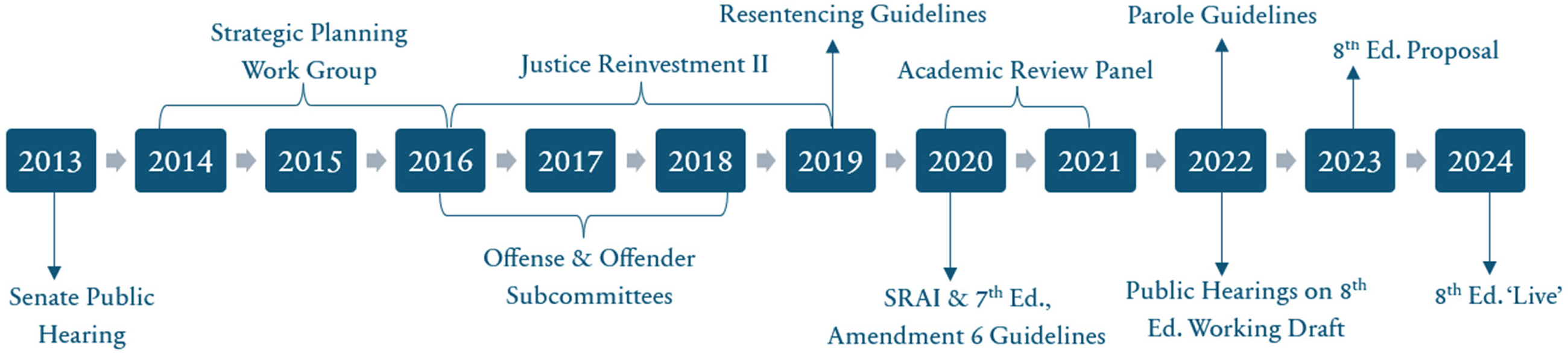
Timeline of Commission Activities, 2013–2024.
Thematic Analysis of Commission Meeting Transcripts (2021–2023)
Against the backdrop of this prior work, we provide a thematic analysis of PCS meeting transcripts. Several varieties of meetings were included: regular (quarterly) commission meetings, special policy meetings, and public hearings. Meetings were sometimes conducted in person and other times remotely via Zoom, with interim work by PCS staff to address questions and concerns from Commissioners. Commission meetings were primarily attended by Commissioners and PCS staff, while public hearings also featured the voices of community members, advocates, practitioners, and even incarcerated individuals. We first present the themes as they emerged, and then relate the findings to prior research and the works of Du Bois in the Discussion.
The qualitative analysis produced four emergent themes: (1) PRS is a key mechanism of racial/ethnic disparity, (2) race/ethnicity data play a valuable role in policy discussions, (3) the PRS can be measured and weighted in different ways, each with implications for the size of disparities, and (4) diverse voices are important to include in policy discussions. While it appears as though some perspectives are represented more than others (e.g., PCS staff), these individuals are often quoted while reporting back on the work carried out by other Commission staff and academic collaborators. In this way, the voices of many individuals beyond those who are quoted are represented within these findings. Furthermore, while our discussion of disparities to this point has largely focused on race (reflective of Du Bois’ work as well as much of the punishment scholarship to date), the analysis that follows also reveals emergent related concerns about ethnicity).
Across the board there's increases in sentence recommendations … based on an increase in the prior record score. But that's disproportionately the case with Blacks as compared to Whites, so one of the efforts here in rebuilding the prior record score is to try to reduce that difference, that disproportionality.
Upon examining descriptive statistics, PCS staff and Commissioners noted that specific crime types (e.g., drug-related felonies) play an outsized role in inflating PRS for minority defendants. They suggested that such crimes should receive careful attention and analysis during the revision process to forecast the impacts of any potential changes.
In another meeting, a staff member highlighted the Commission's responsibility in attempting to reduce the impact of race on sentencing that operates, in part, through PRS. They stated, “If part of our job is to think seriously about trying to neutralize the impact of race, we have to look particularly at prior record score.” This sentiment is in line with the Commission's enabling legislation, which calls on them “to create and maintain a consistent and rational statewide sentencing policy through the adoption of guidelines (42 Pa.C.S. §2154) that promote fairer and more uniform sentencing throughout the Commonwealth” (Pennsylvania Commission on Sentencing, n.d., emphasis added) This language places explicit responsibility on the Commission to address within the guidelines the factors, like PRS, that are known to exacerbate disparities.
Some participants acknowledged that reducing the impact of PRS on sentencing for all cases is a win-win policy choice; it reduces the influence of race on sentencing and refocuses sentence recommendations on the instant offense (represented here as the offense gravity score or “OGS”)—a primary goal of the eighth edition revision. A PCS staff member emphasized while delivering a presentation, “Probably the most important of the concepts here is that the primary driver of the sentencing recommendation for [the proposed eighth edition guidelines] is OGS.”
In PRS discussions, participants spoke often about how to determine appropriate “baseline” punishments through prescriptive or descriptive approaches. A prescriptive approach requires policymakers to use their “common sense” in alignment with their preferred punishment philosophies (e.g., retribution). A descriptive approach involves anchoring such decisions in historical data. Participants often discussed how to balance the two, as using one or the other could lead to decisions that are based on insufficient information. A prescriptive-only approach might misalign with what seems appropriate for the “typical” case. A descriptive-only approach might not capture shifts in punishment priorities according to developing crime trends and social issues (e.g., opioid epidemic, gun violence).
During one meeting, Commission staff supplemented a prescriptive discussion of prior record with a visual overlaying the proportions of each race group falling within each cell of the sentencing matrix (i.e., a descriptive method). This illustrated to Commission members the disproportionate distribution of race across levels of PRS and animated discussions on the need for reform. With the visual was displayed, a Commission staff member explained: We wanted to consider … what the proportion of White offenders and minority offenders, how they array currently on the guidelines. And what we saw is that the proportion of White offenders decline[s] as you move higher on PRS and higher on OGS.
In summary of theme one, Commission members and staff recognized the role of PRS in perpetuating disparities in sentence recommendations, as well as their duty to address these issues. They proposed several actionable strategies, for example, by reducing the impact of PRS on sentence recommendations for all and considering its relationship to crimes in which disparities appear the largest (e.g., drug). Balancing prescriptive and descriptive methods for establishing baseline punishments was also a consistent area of focus; PCS staff supplemented discussions on the theoretical fairness of a given sentence (prescription) with data and visualizations (description) to help Commission members understand how their policy choices could impact disparities. A descriptive approach, however, requires access to data—the subject of theme two.
Because SGS [Sentencing Guidelines Software] Web [the mechanism through which counties report their sentences to the Commission] users increasingly import case information from AOPC [Administrative Office of Pennsylvania Courts], the number of cases in the ‘Hispanic’ category has declined since 2008. AOPC captures ethnicity (Hispanic) in a separate field from race, so it is not pulled into the SGS Web race category. Although SGS Web users may edit the race field, “Hispanic” appears to be under-utilized in SGS data since about 2008. (Pennsylvania Commission on Sentencing, 2019, p. 13)
As a result of this disconnect, it is likely that a sizeable portion of Latinos in PCS data sets are marked “White” without the proper additional distinction of Latino ethnicity. The results of race/ethnicity-specific analyses may then mask differences in the application or potential impacts of the guidelines. PCS staff acknowledged these concerns during meetings in which such data were presented, stating, “We’ve been working…to improve the quality of our data…. We’re trying to figure out ways to more accurately reflect race and ethnicity in the information we either collect or that we obtain from others.” They went on to note the difficulties of reconciling these fields across multiple data sources (e.g., police, courts, corrections), a necessary step for exploring concerns involving prior record, risk, and recidivism: And there are oftentimes … conflicts where we’ll have multiple sources of data about an individual and they’re differing, you know, race and ethnicity findings. So we have to work on that. … The Latinx population is one of those areas where I think it's probably weakest in terms of data and there is a lot of work that has to be done on that.
Indeed, work has been done to address these data limitations; the Commission has recruited postdoctoral fellows to improve these data retrospectively using supplemental data and new statistical methodologies like surname analysis and Bayesian Improved Surname and Geocoding. PCS leadership has noted, however, that these efforts (while important) are secondary to developing prospective solutions, which can be challenging when their reporting system (SGS Web) imports data from multiple sources.
In summary of theme two, PCS staff and Commissioners emphasized the utility of race/ethnicity data to inform policy discussions as they relate to reducing disparities. Staff noted the limitations of administrative data, however, and made efforts to address these limitations to the extent possible. Descriptive analyses enabled Commissioners to visualize how even small changes to the calculation of prior record could impact disparities. The implications of prior record measurement are explored in more depth under theme three.
A big innovation is moving from a point-based system to a categorical system. And this classification … is based upon the highest statutory grade of the prior convictions and consideration if there are multiple priors of that same type or if there are more than one victim involved in those prior convictions.
This change was based on the recognition that more granular differences among those with varying degrees of prior record do not translate to clear policy directives either in terms of utilitarian or retributive punishment purposes (Hester et al., 2018). Prior to landing on this final method of calculation for PRS, staff members also noted that alternative formulae were tested specifically for their influence on racial/ethnic (and other forms of) disparities and resource utilization. The results of these efforts are available on the PCS website and indicate that, under the revised formulations of PRS (and OGS), there is lower utilization of state confinement overall, and a slightly greater reduction in state confinement for Black individuals (as compared to White).
PCS staff, Commissioners, and collaborators also debated at length the appropriate weighting of PRS in sentence recommendations. According to the work of Frase et al. (2015), by one method of calculation the PRS component of the PA sentencing grid accounted for about a 700% increase in the minimum recommended sentence as one moved horizontally across the matrix from left to right (i.e., from a first-time offender to one in the maximum PRS category). Various prior record scholars have proposed a limit of a 200% (or doubling maximum) on such a premium, under the logic that a person's prior crimes (for which they’ve already been convicted of, sentenced for, and in most cases satisfied the sentence thereof)—should never account for more of the punishment recommendation for a new crime than the current offense itself. This recommendation was supported and set forth by the ARP, though not every Commission member agreed, as one judge stated: Why philosophically is [reducing the weight of PRS] something that the Commission wants to do? …To me, someone that continues to reoffend should be punished more severely than the person that's never been in trouble for the same offense … who are [the ARP] to decide that?
As evidenced here, PCS staff had to navigate the delicate balance of expertise from two unique sources: research and practice. In general, however, the “two-times” rule (and other recommendations rooted in past research) received support from the Commission and guided descriptive explorations of the data. Eventually this principle was roughly applied to the eighth edition matrix, effectively refocusing sentence recommendations on the severity of the current offense.
As is well-documented in past research, courts inherit disparities from earlier case processing stages (Hickert et al., 2022; Kurlychek & Johnson, 2019), complicating their pursuit of race-neutral sentencing. This was discussed at length and perhaps most notably leading up to the implementation of the Sentencing Risk Assessment Instrument (SRAI) in 2020 (see REDACTED, forthcoming). During the late eighth edition revision period (2021–2023), Commissioners reflected on relevant discussions from these earlier conversations. One such discussion focused on the use of prior convictions versus arrests in the PRS formula as a method of reducing “baked-in” disparities from earlier case processing. As one judge and Commission member expressed: On the question of arrest versus convictions, based on everything we went through … for the [SRAI] … there were a lot of concerns with the racial disparity … I think we would do a disservice to make it arrest, I think it's best to just go with convictions for the calculation.
PCS staff emphasized, based on these prior experiences, that this method of calculating prior record reduced but did not eliminate disparities, tempering the Commission's expectations: When we did the study of risk assessment, what we did find was that by moving from arrest to conviction we reduced racial disparity, [but] didn’t eliminate [it] … the speculation was that … there were just more arrests that didn’t lead to convictions, in a more disparate way.
Discussions of “baked-in” disparities inspired other potential solutions, for example the adoption of lapsing policies. Lapsing policies via “decay” (i.e., the automatic removal of a conviction following a look-back period) and “gap” (i.e., the removal of a conviction following a crime-free look-back period) likewise aim to reduce the accumulation of criminal history. Lapsing policies were adopted as a part of the eighth edition revision, but only after much debate about such factors as length of time for the look-back periods, crime type, and offender age.
In summary of theme three, participants debated the merits of various formulae for PRS, adopting several important innovations intended to simplify and increase fairness in its calculation. These debates were informed by extensive analyses and presentations by Commission staff that assessed the size of disparities and differences in resource utilization under various versions of the guidelines. Eventually, a down-weighted, categorical measure of PRS, accompanied by lapsing policies, was adopted to reduce disparities and refocus sentence recommendations on the current offense in service of a more retributive framework. Even with these changes, some participants expressed the desire to see more diverse voices in policy conversations—the subject of theme four.
I’m just noticing the folks here today and I see that I seem to be the only person of color …I know this is just one hearing, but I really think you’re losing access to a lot of information when you don’t have people who have had first-hand experience in incarceration and been able to become successful after that … I really think you should expand the Commission to bring this information into the room.
One Commission member countered this assertion, offering the explanation that this particular virtual meeting was poorly attended (and so not representative of the group), and that multiple previous public hearings have been held at Pennsylvania Department of Corrections (PADOC) facilities to include the voices of impacted people. As a matter of fact, the Commission arranged several public hearings in PADOC facilities, each with individuals from four or five separate institutions. These were held, in part, due to positive feedback from previous parole guidelines public hearings in which incarcerated individuals from the first hearing were invited back to a second hearing so that they could provide feedback on the changes proposed. In addition to including incarcerated voices, the Commission has also collaborated with the Interbranch Commission for Gender, Racial, and Ethnic Fairness, presenting information on the proposed guidelines during their meetings (which were not included in the current analysis).
Even still, Commissioners and PCS staff echoed this community member's assertion that diverse voices are valuable and important, and shared about the ways in which they have been intentional in soliciting diverse perspectives. This included connecting with representatives from Historically Black Colleges and Universities (HBCUs) in Pennsylvania, as one judge stated: I think it has some value to … connect with [HBCUs] … and keep them in mind as we move forward so that there could be more minority participation in the work that we do.
In response, the Commission Chair at the time noted: We partnered with some of the [HBCUs] to ensure that they had representation on that Academic Review Panel because we wanted to hear that perspective from people of color….
Indeed, representatives from both Pennsylvania HBCUs, Lincoln and Cheyney Universities, participated in the ARP (as described previously). As summarized by one PCS staff member after meeting with an HBCU Professor, “…We were just looking for opportunities to continue to work with them, whether it leads to something like a partnership like we have with [other Universities]…I don’t know what will happen, but we talked about opportunities.”
While not defined by racial or ethnic identity, academic partnerships as well as those with experts from external jurisdictions represent another important form of diversity to bring into policy discussions. PCS often charged such collaborators with sharing their varied experiences and expertise, and conducting research to supplement the Commission's decision-making: …[O]ne of the things we talked about was … speaking to some experts from other states who worked on the Federal guidelines to see if there's any other configurations or things that we might be able to do that could [reduce disparities], or if this is just the way it is … and prior record score will unfortunately reflect differences between Whites and Blacks.
In summary of theme four, community members, Commissioners, and PCS staff alike concluded that 1) diverse perspectives are important to solicit during policy conversations, and 2) that the Commission set an example for other policymaking bodies by taking clear steps to include voices from local HBCUs and other universities, correctional facilities, advocacy groups, and members of the public in their discussions of the eighth edition guidelines proposals.
Discussion
Research shows there is a strong link between race and criminal history, and policies that formalize the inclusion of prior record policies in sentencing are credited with exacerbating disparities. Following the example of W. E. B. Du Bois, scholars have raised these concerns and questioned the role of prior record enhancements in sentencing policy. It should be noted that there are important differences between the context in which Du Bois conducted much of his work (e.g., Jim Crow laws), and that of today. Though racial disparities remain, their existence is far less likely to be denied outright and, according to our analysis, even serves as a key argument for reducing the reliance on criminal records in formulating punishment recommendations. Broader societal shifts in racial sympathy (and therefore public opinion on punitiveness, see Hannan et al., 2022) and a growing preference for a smaller, fairer justice system (Hannan et al., 2023) render this a prime moment in the U.S. for conducting deeper investigations of sentencing policy, impacts, and solutions to inequities.
Despite these historical shifts, very little has been done to address the disparities that are rooted in prior record. Using a qualitative case study methodology, we analyzed secondary documentation to highlight the work done by the Pennsylvania Commission on Sentencing on their eighth edition guidelines revision. Transcripts from the two years preceding the adoption of Pennsylvania's eighth edition sentencing guidelines (2021–2023) generated important conclusions about PRS as a primary mechanism of disparity (that can be creatively measured and even down weighted in sentence recommendations), the value of high-quality data and analysis, and the importance of seeking diverse voices to inform policy discussions. Given prior research on race and punishment, however, these conclusions are not entirely original. Some, in fact, have throughlines dating back to when Du Bois first championed sociological criminology over a century ago. This inspires two important takeaways, that: 1) the pathways to reducing racial disparities in punishment may be just as complicated as their varied contributors, and 2) it is one exercise to debate the merits of a given reform, and entirely another to do the work necessary to achieve the reform. That is where the work of PCS is perhaps the most informative and novel—their process, as described here, provides a strong example of what it takes to do this work in earnest.
Du Bois emphasized the role of the justice system in exacerbating racial disparities and suggested therefore its responsibility to mitigate them. No matter the jurisdiction, courts inherit racial disparities through prior record enhancements (Bushway & Forst, 2013; Ulmer et al., 2016), though historically they have done very little to reform these polices. The Commission, it appears, has accepted their call to promote fairness in sentencing, as evidenced by their multifaceted, decade-long undertaking to develop the revised guidelines—one that focused on reconfiguring prior record (as an identified mechanism of racial disparity) amidst many competing priorities.
Du Bois questioned the purpose of a justice system that unfairly and discriminatorily arrests young and vulnerable members of the Black community for what are often low-level offenses. Such offenses, he held, accumulate and portray a highly-criminal class that is more deserved of harsh punishments—a line of inquiry some have likened to a critical criminology perspective (see, e.g., Gabbidon, 2007). The Commission's discussions did not invoke a critical perspective, though they did address important questions about the purposes of punishment and the role of prior record in formulating punishment recommendations. Descriptive analyses supplemented these discussions to show how different formulations of PRS and lapsing policies would impact the size of disparities, helping Commission members envision a guidelines matrix that better achieves retribution through shifting the influence on punishment recommendations from the prior record to the instant offense severity component. The appropriate “weight” for prior record remains a topic of debate still today, though PCS generally followed guidance from past research and their own subcommittees (Frase & Roberts, 2019). By reducing the impact of PRS overall, the Commission addressed long-held concerns about prior record policies, including the unequal distribution of criminal histories by race/ethnicity (Frase & Roberts, 2019; Ulmer et al., 2016), the likelihood of unfair accumulation of prior record due to over-policing of minority neighborhoods (Alexander, 2011; Mauer & Nellis, 2018; Rios, 2011), poor punishment justifications for prior record enhancements (Hester et al., 2018), and potential interaction effects between race and prior record for some cases (Painter-Davis & Ulmer, 2020).
Through innovative data collection and analysis, Du Bois pioneered the ways in which we measure justice issues today. Proper statistical methods, he suggested, were essential for understanding the race and justice problem and identifying potential solutions. Through small adjustments, such as including convictions instead of arrests in prior record calculations, PCS found large differences in the size of disparities in sentence recommendations. One of the Commission's more impactful exercises involved overlaying the distribution of race and ethnicity onto different versions of the sentencing grid—similar to analyses by Du Bois and colleagues which mapped the distribution of race over different levels of sentence severity. Simple visuals such as these seem useful to policymakers, as evidenced by feedback from Commissioners.
Like some members of the public and of the Commission, it is reasonable to suggest that Du Bois would call for more racial and ethnic diversity among policymakers, particularly considering the disproportionate involvement of minority groups across the justice system (Kurlychek & Johnson, 2019). While this remains a challenge to policymaking bodies across the U.S., the Pennsylvania Commission on Sentencing provides concrete examples of welcoming diverse voices into these conversations via their ARP and public hearings.
The current study provides an in-depth exploration of policymaking around race, prior record, and sentencing in one jurisdiction: Pennsylvania. Future research should evaluate Pennsylvania's prior record policy changes to assess whether they were successful in reducing disparities. Given the complicated nature of policy implementation, future research should also evaluate the implementation of these reforms, which would help to characterize for other jurisdictions why the reforms do, or do not result in less disparity. Last, researchers should conduct similar studies in other states and in the Federal system, as such an undertaking might contribute to the literature on “best practices” in prior record policymaking.
Footnotes
Acknowledgments
The authors would like to thank the Pennsylvania Commission on Sentencing for their assistance with obtaining meeting transcripts (note: points of view presented in this article are those of the authors and do not necessarily represent the official position of the Pennsylvania Commission on Sentencing). The authors would also like to thank the Drexel University student research assistants for their contributions (Marisa Melnick, Abryana Kevelier-Williams, Ritika Anthony, and Katelyn Miller). Elements of this research were originally presented during the 2024 Annual Meeting of the American Society of Criminology in San Francisco, CA.
Declaration of Conflicting of Interests
The author declared no potential conflicts of interest with respect to the research, authorship, and/or publication of this article.
Funding
The author(s) disclosed receipt of the following financial support for the research, authorship, and/or publication of this article: This project was generously supported by the National Institute of Justice (award #15PNIJ-23-GG-01365-NIJB).
