



Abstract
Tense relations between police and racialized youth, especially those who use drugs, are ongoing concerns in Canada and other countries, with greater incidents of racial profiling and discrimination resulting in reduced trust and police legitimacy. While there have been calls for various forms of defunding police, some youth who use drugs (YWUDs) have highlighted the need for police to have stronger connections with the community to create better relationships between YWUD and police. The concept of “community policing” may be a viable and promising approach to reimagining law enforcement. A rapid review of grey and peer-reviewed literature was used to highlight promising community policing models, and identify gaps, strengths, and approaches to promote positive relations between police and racialized YWUD. We found that very few programs offered comprehensive, culturally safe training curriculums or initiatives that involve consultation or co-development with community members themselves. Furthermore, few program models are empirically supported by evidence-based outcomes and were largely based on anecdotal evidence. These findings may inform future practice with recommendations for enhanced law enforcement training in trauma-informed harm reduction, youth psychosocial development, prosocial communication and crisis de-escalation techniques, reconciliation, and cultural safety.
Keywords
Introduction
Growing socioeconomic disparities, police-involved shootings, and civil rights movements (i.e., Black Lives Matter [BLM]) amidst a worldwide pandemic have increased sociopolitical tensions and heightened attention to debates in police reformation circulating in public discourse. A 2021 report released by the British Columbia Office of the Human Rights Commissioner (BCOHRC) in Canada, confirmed what many have already known: systemic racism in policing is ubiquitous across jurisdictions. For years community advocacy movements and organizations have issued calls to action calling for police reform. Reports such as the Truth and Reconciliation Commission ([TRC], 2015) and National Inquiry into Missing and Murdered Indigenous Women and Girls (2019), have called for enhanced education and training initiatives that promote decolonization and cultural safety practices or specific Indigenous-led and self-governed police forces, ensuring federal money is spent effectively to support these initiatives (McKay, 2024). Similarly, burgeoning public debates on policing services have oscillated between defunding (redistributing funds towards preventative or diversionary public supports) to abolishment, such as substituting police systems with alternative community-based response services (Joseph-Salisbury et al., 2020).
Recent data released from the BCOHRC reveals the detrimental impacts on Indigenous and racialized populations, who are disproportionately targeted and overrepresented in Canada's criminal justice system, resulting in intergenerational trauma, mental illness, substance use issues, injury, and death (2021). State violence, surveillance, and over-incarceration among racialized populations is a pervasive human rights concern within Canada and abroad (Government of Canada, 2021a; NAACP, 2021; Owusu-Bempah et al., 2021; Statista, 2022; Stelkia, 2020). For example, based on the 2012–2018 novel US reporting data, (Edwards, Esposito and Lee (2018) found the risk of being killed by police is between 3.2 and 3.5 times higher for Black men and between 1.4 and 1.7 times higher for Latino men relative to White men. Indigenous people in the United States were 3.5 times more likely to be killed by police than White people (U.S. Commission on Civil Rights, 2018). While only 3.5% of Canada's population, Black people accounted for 7.2% of federal offenders in 2018–2019 (Government of Canada, 2021a; Maheux & Do, 2019). In Ontario in 2010, Black men were 5 times more likely to be incarcerated than White men (Owusu-Bempah et al., 2021) while Black people in Toronto were over-represented in use of force cases (28.8%), shootings (36%), deadly encounters (61.5%), and fatal shootings (70%) (Ontario Human Rights Commission, 2018). Indigenous youth in Canada accounted for 46% of admissions to correctional services in 2016/2017, while representing 8% of the general youth (Department of Justice Canada, 2018). A British Columbia (BC) study found that 80% of young Indigenous youth who use drugs (PWUDs) had been previously detained by police (Spittal et al., 2007), with serious allegations of police misconduct in northern BC (Eby, 2011; Human Rights Watch, 2013; Pan et al., 2013).
Tense relations between police and individuals with marginalized identities (i.e., refugees, migrants, LGBTQ2S, Indigenous, and racialized populations) are ongoing concerns in Europe (such as Austria, France, Greece, and Italy), the United Kingdom (UK, i.e., England and Wales), Australia, and New Zealand with greater incidents of racial profiling and discrimination resulting in reduced trust and police legitimacy (Amnesty International, 2021; Council of Europe, 2020; European Union Agency for Fundamental Rights, 2020; Farrell, 2022; O’Brien, 2021; Robinson, 2020). In addition, discrimination against drug use among marginalized populations are exacerbated by pervading stigmas of substance use and racism (Beckett, 2012; Khenti, 2014). Specifically, Indigenous youth in Canada (Card et al., 2021; Government of Canada, 2021b) and Australia (Productivity Commission, 2021) are more likely to be handcuffed or taken into police custody while in the United States, Black, and Hispanic youth form a smaller percentage of drug offenders but constitute a significantly greater percentage of drug arrests (Mitchell & Caudy, 2015).
As part of the Youth Experiences Project (YEP) in 2018, researchers collected feedback from 449 youth (16–30 years of age) to explore the impact of policing among young people in Victoria, Chilliwack, Prince George, and British Columbia (Selfridge et al., 2019). Results from YEP found that YWUDs with experiences of homelessness had frequent encounters with police officers (Greer et al., 2021a). Selfridge et al. (2020)[13] and Greer et al. (2021b) found that among these encounters with YWUD and police, youth perceived officers as authoritative, aggressive, paternalistic, or threatening, with experiences of stigmatization and mistreatment, impacting youth mistrust and legitimacy of the police. In addition, among YWUD in BC with risks of overdose, youth reported negative experiences of police first responders who used their power in a manner that was dispassionate and disrespectful (Greer et al., 2021b). Youth-identified suggestions to improve police interactions with YWUD included respectful communication and action, enhanced training and accountability, and stronger connections to community (Selfridge et al., 2022).
In response to these recommendations, officers shared that limited time, resources, demands, and distress most often impacted the degree of positive engagement with youth (Selfridge et al., 2022). Officers also cited other factors such as inadequate or outdated training programs that emphasize the use of force instead of trauma-informed communication, cultural safety, or harm reduction practices (Selfridge et al., 2022). Many shared that institutional mandates impeded their ability to connect with community members in positive and meaningful ways. For example, the BC Safe Streets Act was cited as a legislative barrier to prosocial interaction with members of the public as officers are required to divert or deter many individuals with experiences of homelessness and mental health-related issues away from communal spaces (Selfridge et al., 2022). Drug decriminalization was another area mentioned as an opportunity to work with, instead of against community members to reduce harm. The concept of “community policing,” was mentioned as a viable and promising approach to reimagining law enforcement. The purpose of this rapid review is to highlight innovative community policing models, and to identify gaps, strengths, and approaches to promote positive relations between law enforcement officials and racialized and other YWUD.
The Emergence of Community Policing
Influenced by the emergence of community safety and plural or tiered policing initiatives in Europe and the United Kingdom in the early 1980s, Canada issued a national strategy to address underlying conditions in 1993 (known as the Horner Report; Government of Canada, 2021a). Recommendations included collaborative partnerships and shared information across all government and public agency sectors (Jones & Newburn, 2005; McKenna, 2014).
In an initial attempt to shift from reactive law enforcement to proactive reinforcement in the mid-1990s, many police departments began to endorse the term “community policing” within agency mandates; however, few carried through to implementation (Government of Canada, 2021a; Hylton, 2005). Similarly, in 2002, the Youth Criminal Justice Act (YCJA) included principles attempting to mitigate underlying causes related to youth-involved crime, specifying the need for public provisions that incorporated multidisciplinary approaches, guidance, and support for young people (Government of Canada, 2021c).
Community Policing Defined
Corresponding feedback collected by youth and law enforcement officials who participated in YEP closely reflect many of the principles and practices of community policing identified throughout the literature. While definitions of community policing vary across publications and law enforcement agencies, the following characteristics guided the basis of this review. Community policing is primarily defined through proactive engagement, problem-solving partnerships, relationship building, and accountability between local law enforcement officials and community members (Government of Canada, 2021a; Hylton, 2005; Nilson & Mantello, 2019; Public Safety Canada, 2012; Peyton et al., 2019). These strategies seek to reduce fear and increase trust and confidence in the police and willingness to intervene in community problems (Weisburd et al., 2019). Community policing requires a shift in knowledge and perception (i.e., social determinants of health and biopsychosocial addiction models), attitude, prosocial communication, and coordination between law enforcement, citizens, and public stakeholders (Government of Canada, 2021a; Hylton, 2005; Nilson & Mantello, 2019; Public Safety Canada, 2012).
Organizational and jurisdictional structures in community policing require a redistribution of power from top-down, bureaucratic siloes to horizontal, decentralized, integrated approaches that reflect the diverse and unique needs of local communities and the people who live there (Dias Felix & Hilgers, 2020; Government of Canada, 2021a; Hylton, 2005; Nilson & Mantello, 2019; Public Safety Canada, 2012). For example, a more integrative, collaborative approach may take the form of community consultation committees that include elders and/or youth, comprehensive recruitment and screening processes, and police officer participation in community and cultural events (e.g., potlach or sweat lodge ceremonies) (Hylton, 2005; Nilson & Mantello, 2019; Public Safety Canada, 2012). Accountability measures could involve shared interagency resources and demographic data collection, outcome measurement tools, and community updates (Hylton, 2005; Nilson & Mantello, 2019; Public Safety Canada, 2012).
Impacts of community policing are mixed and success may be defined differently, based on the stakeholders and the community it takes place in (Davoust et al., 2021) and the ways community policing efforts are implemented in different locations (Dias Felix & Hilgers, 2020; Fisher et al., 2022). The Summary Report published by the National Academies of Sciences, Engineering, and Medicine on Proactive Policing in the United States found that community policing led to modest improvements in the community's view of policing and the police in the short term, especially for community satisfaction and less for perceived disorder, legitimacy and fear of crime (Weisburd et al., 2019). Similarly, meta-analyses from Gill et al. (2014) found that community policing improved the perceived legitimacy of police, but it did not have an actual effect on reducing crime and the fear of crime, while Hinkle et al. (2020) found that problem-solving styles of community policing initiatives significantly reduced crime and disorder but had limited effects on fear and perceived legitimacy of police.
Community policing has demonstrated merit for PWUD or people experiencing a mental health crisis. Police-based drug offense diversion efforts have been shown across studies to be effective at preventing criminal offending and potentially improving the health of PWUD and reducing social costs (Décary-Hétu et al., 2022). A scoping review of Canadian police partnerships that respond in tandem with mental health professionals have showed reduced involuntary hospital transport, improved referrals, and decreased emergency department wait times, but did not demonstrate a reduction in the use of force or meeting the client's needs in the community (Ghelani et al., 2023).
One type of community policing within youth populations that has been evaluated is the use of school resource officers (SROs), and sworn law enforcement officers assigned to specific schools (Javdani, 2019; Fisher et al., 2022). Fisher et al. (2022) argue that the limited effectiveness and racialization and criminalization of schools and students seen in evaluations of SROs is due to the conflict in the roles and a lack of unifying framework for the work.
To the best of our knowledge, this review is the first to date to highlight key findings of innovative community policing programs in response to the needs and recommendations identified by racialized YWUD. The initiatives explored in this review demonstrate exemplary methods, practices, and approaches to community policing with areas to strengthen and envision future possibilities and promising pathways towards improved outcomes in police engagement with racialized YWUD. The primary research question explored in this review is: What innovative strategies have policing organizations in Canada (and abroad) implemented to improve relationships with racialized and other young people who use drugs?
Methods
Search Strategy and Selection Criteria
This rapid review was informed by basic principles and guidelines outlined by the Cochrane Rapid Reviews Methods Group (2020) and the World Health Organization (WHO) Alliance for Health Policy and Systems Research (2018). As the name suggests, rapid reviews narrow the scope of the review in order to provide an evidence synthesis product more quickly and are likely to be less comprehensive than a systematic review (Cochrane Rapid Reviews Methods Group, 2020; Moher et al., 2009). Considering the time and funding available to the research team this seemed more appropriate in order to provide examples of innovative programs to local and provincial police leadership. The methodological process included the following stages: identification of the research question; locating and selecting relevant sources; collating and charting the data; and summarizing and reporting the results.
A scan of grey and peer-reviewed literature took place between December 2021 and January 2022 through PsychInfo; the Canadian Policing Catalogue; the National Criminal Justice Reference Service; Medline; and Google. The search included a combined variation of the following terms: polic*, “law enforcement”; “innovative”; “model”; “training”; “program”; “community policing”; “harm reduction”; Indigen* or Aboriginal* or First Nations, Inuit, Métis; “Black”; “substance use.” A limitation was noted after the analysis was complete. The key terms in the search did not include racial*, POC, or drug use. An exploratory review was done with these terms to search for expanded relevant results but did not find other programs to include. Search specifications were limited to include sources in English, from 2000 to 2021, with search results ranging from 600 to 900. Of these, ∼120 relevant sources were scanned and narrowed down to locate sources with relevant programs according to the criteria outlined below. A manual search of relevant references from identified sources and peer recommendations were also reviewed.
Data Extraction, Appraisal, and Synthesis
Exemplary models were selected according to contemporary relevance; that is, well-developed programs initiated between 1980 and 2021, some of which remain ongoing. Models of “community policing” were identified using the definition above. In order to identify exemplary models a series of criteria were created. “Innovative” initiatives were identified as a variety of alternative approaches and practices that were unique and effective in meeting the specified needs of our target population. These included but were not limited to hubs; mobile crisis teams; specialized teams, liaison officers, or outreach units; culturally relevant community engagement initiatives (camps and recreational/educational initiatives); and training curricula. Approaches were identified that incorporated elements focused on harm-reduction; upstream, pro-active, prevention; diversion; trauma-informed practice; cultural-safety; wraparound models, or integrative partnerships.
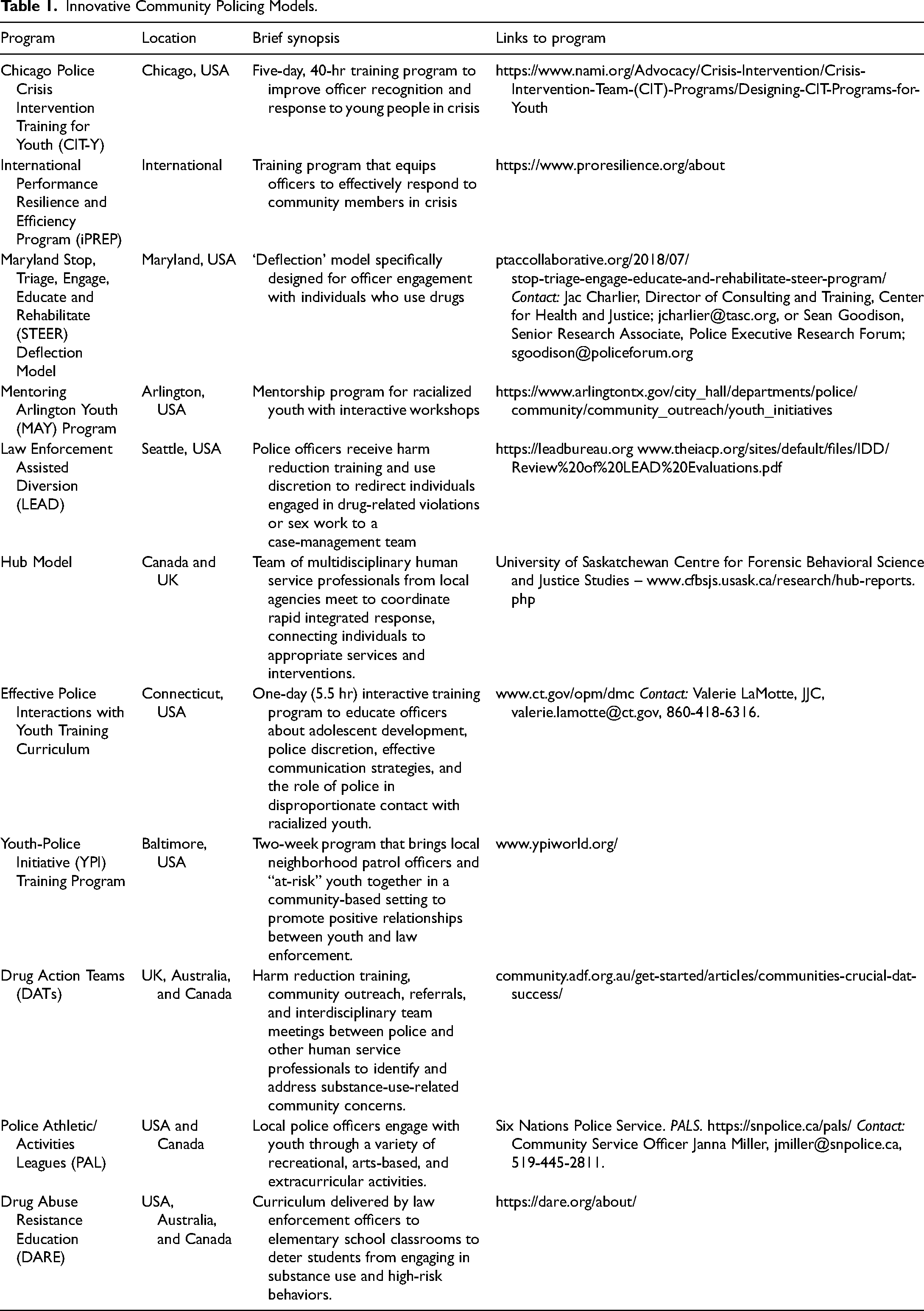
Geographical parameters were nonrestrictive; however, programs were considered by potential relevance to Canadian policing, so programs that were implemented within Canada, the United States, the United Kingdom, and Australia were prioritized. Programs included direct police involvement and police-led initiatives that facilitated positive interactions with youth. The definition of youth was based on ages 12–25 years of age, and the sample size of program was greater than five participants. While behavior (i.e., criminal/non-criminal), pathology, frequency, type, or amount of substance use were not relevant for the purpose of this study, terminology related to general substance, drug use, and addiction (including “at-risk”) were prioritized in the selection of programs. For the purpose of this study, “racialized youth” includes Black, people of color, and Indigenous peoples with self-identified roots to ancestral lands prior to colonization. First Nations, Métis, and Inuit (FNMI) is used in geographical reference to the Indigenous peoples of Canada. A diverse sample of program models and approaches were rated and selected according to demonstrated evidenced-based outcomes reported, frequent references throughout the literature, and close proximity to the population. Program data was charted and organized according to these characteristics given in Table 1.
Innovative Community Policing Models.
Results
While locating programs that met all aspects of our criteria proved elusive—of the 63 programs identified throughout the literature, a total of 10 programs that met all criteria are organized in reverse chronological order, followed by six notable programs from police departments across Canada that met many of the criteria. Each program is briefly summarized in the following paragraphs.
Chicago Police Crisis Intervention Training for Youth (CIT-Y)
The CIT-Y program is a five-day, 40-hour training program, developed by the Chicago Police Department and the National Alliance on Mental Illness to improve officer recognition and response to young people in crisis (OJJDP, 2018; Skorek & Westley, 2016). Officers learn to apply developmentally appropriate strategies and de-escalation techniques with the goal of reducing harm to youth, families, and officers, while diverting youth away from the criminal justice system toward community-based treatment and supports (OJJDP, 2018; Skorek & Westley, 2016). In an evaluation conducted by Kubiak et al. (2019), survey results revealed an 86% improvement in officer knowledge and attitudes toward youth with mental-health-related issues.
International Performance Resilience and Efficiency Program (iPREP)
A similar program, while not specifically focused on officer engagement with racialized YWUD, known as the International Performance Resilience and Efficiency Program (or, iPREP), is an evidence-based training program that equips officers to effectively respond to community members in crisis (www.proresilience.org). Created by team of researchers led by Dr. Judith Andersen at the University of Toronto in collaboration with Ontario's Peel Regional Police, Toronto Police Emergency Task Force, the Illinois State Police, and the Finnish National Police, iPREP is designed to reproduce realistic situations and settings, and a method that improves individual bio-awareness, and provides tools to regulate stress responses, toimprove decision-making and de-escalation strategies before applying use-of-force techniques (Anderson & Gustafsberg, 2016). Outcomes include enhanced officer resilience, physiological control, and situational awareness (Anderson & Gustafsberg, 2016; www.proresilience.org).
Maryland Stop, Triage, Engage, Educate and Rehabilitate (STEER) Deflection Model
The Montgomery County (Maryland) Police Department and the Police Executive Research Forum developed a “deflection” (or diversionary) model specifically designed for officer engagement with people who use drugs (Centre for Health & Justice, 2018; NASW, 2020). Officers trained in addiction and behavioral health who encounter individuals involved in potential drug use employ the Proxy Risk screening tool and high treatment need profile (or CAGE substance use screen [Ewing, 1984]) to aid decision making in making a referral or criminal charges (Centre for Health & Justice, 2018; NASW, 2020). Charges may be withheld should the individual voluntarily accept a referral, which may be potentially coercive. Referred individuals are assigned a mobile service coordinator who conducts a clinical assessment and facilitates rapid access to community-based biopsychosocial supports (Centre for Health & Justice, 2018; NASW, 2020). Program goals include improved community relations and well-being. Although an evaluation was discussed in early reports, none is available for review.
Mentoring Arlington Youth (MAY) Program
The Arlington Police Department in Texas designed a mentorship program for racialized youth with interactive workshops focused on building prosocial relationships, teamwork, leadership skills, education, and career development. Program objectives include goals to motivate, monitor, and mentor youth; to increase police legitimacy among youth through positive interaction and problem-based learning; and to create and influence positive behavioral support while building sustainable relationships (Arlington Police Department, 2021). While no formal evaluation has been completed to determine improved outcomes of police-youth engagement, parent surveys reported improvements in youth decision-making, behavior, and communication (International Association of Chiefs of Police [IACP], 2018).
Law Enforcement Assisted Diversion (LEAD)
Launched in Seattle, Washington in 2011, LEAD was formed in a response to move away from a War on Drugs paradigm and to reduce racial disparities in police enforcement (LEAD National Support Bureau, 2021). The LEAD program utilizes a harm reduction approach in its model, focusing on individual and community wellness rather than sobriety and abstinence (Cloud & Davis, 2015; NASW, 2020). Police officers receive harm reduction training and use discretion to redirect individuals engaged in drug-related violations or sex work to a trauma-informed case-management team that offers crisis supports, and psychosocial needs assessments, to connect individuals to long-term, comprehensive services, including mental health and substance use treatment (LEAD National Support Bureau, 2021; NASW, 2020). Police officers and prosecutors may continue to be involved with clients and coordinate with case managers following program referrals (LEAD National Support Bureau, 2021).
Program participants reported improvements in equitable treatment, interactions, and positive perceptions of police (Clifasefi & Collins, 2016; Malm et al., 2020). Other data demonstrated improvements in individual and community wellness; reduced substance-use; drug-related harms; recidivism; public expenditures; and racial disparities in law enforcement (Collins et al., 2015). Variability across settings in police attitudes, discretion, and support of LEAD involving individuals who use drugs emphasized a need for enhanced training and officer input to improve outcomes (Worden & McLean, 2018).
Hub Model
The Hub Model, also known as the Prince Albert Hub or Situation Table, was initiated in Glasgow, Scotland in 2008 in response to growing crime rates, with demonstrated success (McFee & Taylor, 2014; Nilson, 2016). The program was adopted in Prince Albert, Saskatchewan in 2011, expanding to other jurisdictions across Canada, including Alberta, Manitoba, Nova Scotia, and Ontario (with over 70 variations of the model; McFee & Taylor, 2014; Nilson & Mantello, 2019; Nilson, 2016). A SWOT analysis (framework for identifying strengths, weaknesses, opportunities, and threats) is typically conducted to assess community needs and resources (McFee & Taylor, 2014; Nilson & Mantello, 2019). A team of multidisciplinary human service professionals from local agencies are formed, including police officers, social workers, child and youth workers, and teachers. Meetings are conducted twice weekly for 90 min. Police work alongside other team members to determine situations where individuals or families may be exposed to elevated risk, including substance use-related harm or victimization. Following a collaborative assessment, team members coordinate a rapid integrated response, connecting individuals to appropriate services and interventions (usually within 1 to 2 days; McFee & Taylor, 2014; Nilson & Mantello, 2019; Nilson, 2016). Program benefits include adaptability across settings and populations while mobilizing existing community resources. Another benefit of the model is its ability to merge institutional silos and share limited identifiable user data while providing a comprehensive community-based response unique to each individual's needs.
Variations of the model have been implemented among three First Nations communities with the inclusion of “intervention circles,” which involve Elders, service providers, and community members (Nilson, 2016). One notable First Nations’ model includes the Samson Cree Hub located on a reserve in central Alberta. Nilson (2016) found the Hub aligned well with First Nation values, improved police connections to community, fostered engagement and understanding of complex issues, and facilitated opportunities to utilize a proactive instead of reactive approach to policing. Another hub model known as the Selkirk Team for At-Risk Teens (START) in Manitoba, is specifically designed for interagency collaboration with adolescents and their families (Nilson & Mantello, 2019).
Effective Police Interactions with Youth Training Curriculum
In response to federal requirements of police data collection of inequitable treatment of racialized young people, (termed “disproportionate minority contact,” or DMC) with strategies to address it, the Connecticut Office of Policy and Management and Juvenile Justice Advisory Committee designed the Effective Police Interactions with Youth Training Curriculum (EPIYTC) to enhance police-youth interactions (State of Connecticut Office of Police and Management, 2021). The EPIYTC is a one-day (5.5 h) training program with videos, discussions, and role-playing activities, facilitated by two police trainers (youth officers or school liaisons) who educate officers about adolescent development, police discretion, effective communication strategies, and the role of police in disproportionate contact with racialized youth (State of Connecticut Office of Police and Management, 2021). An evaluation of program outcomes indicated enhanced officer knowledge of DMC, improved attitudes, and strategies for interacting with youth (LaMotte et al., 2010).
Youth-Police Initiative (YPI) Training Program
Created by the North American Family Institute in Baltimore in 2003, YPI is a two-week program that brings local neighborhood patrol officers and “at-risk” youth together in a community-based setting to promote positive relationships between youth and law enforcement (OJJDP, 2018; Watts & Washington, 2014). The first week is focused on developing youths’ communication skills. Police officers join the youth in the second week, where they learn about interacting and building relationships with the youth. Team-building activities and conversational exercises create space for open and difficult dialogues between youth and police to develop rapport and mutual understanding (OJJDP, 2018; Watts & Washington, 2017). While data are limited, Fischer (2020) noted improved attitudes among youth and police.
Drug Action Teams (DATs)
First developed in the UK, and later in Australia (in the mid-1990s) DATs involve a collaborative partnership between local police officers and community-based social service agencies (Midford et al., 2002; OHTN, 2016). The initiative focuses on harm reduction training (Khorasheh et al., 2019; OHTN, 2016), community outreach, referrals, and interdisciplinary team meetings between police and other human service professionals to identify and address substance-use related concerns in the community (Midford et al., 2002; OHTN, 2016). The DAT model includes Drug Reference Groups (DRGs), comprised of community members and public stakeholders who offer guidance, support, and knowledge regarding local substance-related harms (Midford et al., 2002).
In Canada, various police departments employ similar program models such as the Timmins’ Police Service Addiction Outreach Community Safety Team with liaison officers who conduct outreach and referrals to individuals who use drugs, including youth, as well as a Mobile Crisis Rapid Response Team (Hoggett, 2020).
Police Athletic/Activities Leagues (PAL)
Started in the United States in 1991, PAL is a program where local police officers engage with youth through a variety of recreational, arts-based, or extracurricular activities. Some of these roles include coaching athletic leagues, homework help, and adventure-based education programs. According to an early longitudinal analysis conducted by the Baltimore Police Department's Division of Planning and Research, youth victimization and arrest rates decreased, with anecdotal evidence suggesting improved youth perception of police (cited in National Crime Prevention Centre [NCPC], 2008). Another 2002 study indicated improved police officer attitude toward youth (Rabois and Haaga; cited by OJJDP, 2018).
An adaptation of PAL, known as the Police Athletic League for Students (PALS) has been implemented by the Six Nations Police Service in Ohsweken, Ontario. The goal of the program is to foster positive relationships between Indigenous youth and local police officers through weekly after-school programs that incorporate local Indigenous cultures, languages, and traditions (Six Nations Police Service, 2017).
Drug Abuse Resistance Education (DARE)
Originally established as a partnership program between the Los Angeles Police Department and the Los Angeles Unified School District in 1983, the DARE curriculum is delivered by law enforcement officers to elementary school classrooms to deter students from engaging in substance use and high-risk behaviors (D.A.R.E. America, 2021). Initially a by-product of Nancy Reagan's “Just Say No” campaign and America's “War on Drugs” (Berry, 2021), the program was adapted and modified with improved outcomes in positive youth perceptions of police and opportunities for prosocial engagement and open communication between police and youth (Office of Juvenile Justice and Delinquency Prevention [OJJDP], 2018).
The Royal Canadian Mounted Police (RCMP)'s Aboriginal Strategic Home Intervention and Early Leadership Development (SHIELD) program, is a variation of the DARE model. The SHIELD program is used to educate young people from FNMI communities about substance-use-related harms. The program's curriculum goal is “to reflect the diversity of Aboriginal cultures and to incorporate the latest facts about Canadian drug issues, including emerging social challenges” with developmentally and culturally appropriate activities (Institute for Integrative Science & Health, 2006, paragraph 3).
Innovative Community Policing Departments
The following police departments provide innovative examples of various policies, practices, procedures, services, and roles in their approach to community policing and engagement with racialized young people who use drugs.
In British Columbia, the Delta Police Department has a
The
The
Discussion
In our review, we found that very few programs offered comprehensive, culturally safe training curriculums or initiatives that involve consultation or co-development with community members themselves. While community policing definitions often include collaboration with community (Hylton, 2005; Nilson & Mantello, 2019; Public Safety Canada, 2012), more investment in consultation is required to ensure programs meet the diverse needs of youth who use drugs and BIPOC youth who face increased attention and criminalization. Furthermore, few program models are empirically supported by evidence-based outcomes and were largely evaluated based on anecdotal evidence. Many police departments in Canada may include youth programming initiatives such as adventure camps and wilderness retreats, however, little information is available and program evaluations are sparse, lack validity, or are nonexistent. A limited number of programs specifically measured outcomes in police and youth attitudes. Many agencies and programs operate in isolation from one another, with little if any coordination, data collection, shared information, or resources (Hylton, 2005). Police organizations may not be aware of programs that attempt to improve relationships with youth and are unsure if initiatives will actually create the changes hoped for. Collaboration among police officers, agencies, and community stakeholders is often limited due to conflicting interests, values, and goals (OHTN, 2016). Some mandated programs (such as LEAD and STEER) that utilize hubs or integrative models raise concerns regarding coercion, control, and confidentiality in terms of state surveillance and regulation of marginalized communities (Goetz & Mitchell, 2006; Tallon et al., 2016; Worden & McLean, 2018).
Training programs that focus on harm reduction are sparse (Khorasheh et al., 2019) and needed to support youth who use drugs, considering the drastic increase of toxic drug poisoning in US and Canadian populations (Spencer et al., 2024; Special Advisory Committee on the Epidemic of Opioid Overdoses, 2024). A 2013 US census found that new law enforcement recruits received only 10 hr of instructive training versus 71 hr for firearms skills (OJJDP, 2018).
Few curricula focus primarily on law enforcement interactions with youth toward enhanced police legitimacy and procedural justice among racialized populations, despite the continued targeting of BIPOC youth by police (Card et al., 2021; Government of Canada, 2021b; Mitchell & Caudy, 2015). Furthermore, many program referrals and outcome measurements that rely on Eurocentric, endogenous assessment tools (census or actuarial) associated with “risk” can perpetuate discrimination by deflecting collective responsibility unto marginalized populations without accounting for cross-cultural factors, structural conditions, and intersectionality (Crenshaw, 1995; Dhamoon & Hankivsky, 2011; Hankivsky et al., 2010; McCall, 2005). Without more significant changes in training and program development, efforts to increase trust and improve interactions between racialized and other youth who use drugs will be incremental.
Despite these limitations, many of these programs demonstrated improved interactions between police and YWUD. These outcomes were mutually beneficial for both police and youth. For YWUD, improved relations with law enforcement have implications for improved well-being across various social determinants of health (e.g., physical safety, diversion from the criminal justice system with rapid access to needed supports). Similarly, police officers also report improved resiliency, reduced stress, and positive morale.
Strengths and Limitations
One of the strengths of this analysis was the combination of peer-reviewed and grey literature. This meant that many initiatives without a formal research process and peer-reviewed journal articles were discovered that may support a wider exploration of initiatives and resources for readers. Several limitations were identified that impact the findings and their reflection of the scope of community policing initiatives. The nature of rapid reviews that limit or restrict searches meant that the searches were not exhaustive, and innovative programs may be missing. While rapid reviews often involve knowledge users in the process (Cochrane Rapid Reviews Methods Group, 2020), knowledge users were not consulted, and their insights are missing in the analysis. The key terms in the search did not include racial*, POC, or drug use. An exploratory review was done with these terms to search for expanded relevant results. However, nothing further was found that met the criteria. The results of our search strategy in identifying innovative community programs that addressed the needs of racialized YWUD were limited to specific communities and not broadly available. There appears to be relative inconsistency in the definition, understanding and implementation of “community policing” across policing agencies and the literature (Nilson & Mantello, 2019).
Conclusion
This rapid review highlighted innovative methods, practices, and approaches to reimagine future directions and possibilities toward improved outcomes in police engagement with racialized YWUD. According to the results of our findings, future recommendations include enhanced law enforcement training in trauma-informed harm reduction, youth psychosocial development, prosocial communication and crisis de-escalation techniques, reconciliation, and cultural safety. Furthermore, community policing programs and affiliative agencies could benefit from developing a SWOT analysis alongside local community members, youth, and leaders, with involvement in the planning, development, implementation, and oversight of community policing programs.
As traditional policing approaches are increasingly questioned within sociopolitical realms alongside movements to defund or abolish police, innovative community policing models offer promising approaches for future policy and implementation. However, such models are best supported by applying an intersectionality lens (Crenshaw, 1995; Dhamoon & Hankivsky, 2011) alongside a nonpunitive justice system with policies and programs grounded in harm-reduction (e.g., Portugal's health and human-centered approach to drug decriminalization). Successful indicators of equitable justice should rely on public accountability measures that track demographic data and diversion rather than rates of arrest and incarceration.
Some of the programs mentioned in this review have created open-access tools and resources that can be utilized by other agencies and programs. These include: the Connecticut Office of Policy and Management Tool to detect disproportionate contact with racialized populations; the Vera Institute of Justice's “Bias Crime Assessment: A Tool and Guidelines for Law Enforcement and Concerned Communities”; and the IACP's “Youth Focused Policing: Agency Self-Assessment Tool” (see “Further Resources” section).
Further Resources
Connecticut Office of Policy and Management Tool for agencies to measure “disproportionate minority contact” (DMC): https://portal.ct.gov/OPM/CJ-JJYD/Just-Start/Just-START-Tool-for-Programs
International Association of Chiefs of Police (IACP) Youth Focused Policing: Agency Self-Assessment Tool: https://www.theiacp.org/resources/youth-focused-policing-agency-self-assessment-tool
The Vera Institute of Justice Bias Crime Assessment: A Tool and Guidelines for Law Enforcement and Concerned Communities: https://www.ojp.gov/pdffiles1/nij/grants/252011.pdf
Footnotes
Acknowledgments
Funding for this research was gratefully received from the Law Foundation of British Columbia (2019-LRF-1961). The funders had no role in study design, data collection, analysis, or interpretation, or in the decision to publish the findings. Many thanks to Prof. Alissa Greer who helped with many of the steps along the way with this project and the research assistants who supported this project.
Declaration of Conflicting Interests
The author(s) declared no potential conflicts of interest with respect to the research, authorship, and/or publication of this article.
Funding
The author(s) disclosed receipt of the following financial support for the research, authorship, and/or publication of this article: This work was supported by the Law Foundation of British Columbia (grant number 2019-LRF-1961).
