



Abstract
Racial disparities in disciplinary outcomes are a salient educational policy and equity issue. Most of the research on school discipline focuses on teachers rather than school leaders and prior studies have largely examined principals’ attitudes. This study uses data from a mid-sized urban district to examine how student-school leader race interactions influence the likelihood of receiving suspensions conditional on receiving an infraction, with specific focus on Black, Latinx and White students and both principals and assistant principals (APs). The results indicate that the prevalence of exclusionary discipline is similar for schools with Black and White principals, but slightly higher in schools with White principals (this is the case for both elementary and high schools, but not middle schools). Black-White discipline disparities are higher in schools with White principals and APs, compared to schools with Black principals and APs. But there are no clear patterns for Latinx-White disparities. The probability of students receiving suspensions varies substantially across infraction type, principal race, AP race, and schooling level. The findings illustrate the nuances between the overall and discriminatory use of suspensions and highlight the need for closer attention to the types of suspensions and infractions. States and districts should also invest in initiatives that diversify school leadership given the importance of diversity for students’ disciplinary experiences.
Plain Language Summary Title
School Discipline and School Leaders
The results suggest that the probability of students receiving suspensions varies substantially across offense type, principal race, AP race, and schooling level. The prevalence of exclusionary discipline is similar for schools with Black and White principals, but discipline disparities are slightly higher in schools with White principals (this is the case for both elementary and high schools, but not middle schools). Black-White discipline disparities are higher in schools with White principals and APs, compared to schools with Black principals and APs. But there are no clear patterns for Latinx-White disparities. The proportion of ODRs, OSSs, and ISSs for subjective offenses is slightly lower for Black principals compared to White principals (regardless of student race), but there is no clear pattern by principal race regarding the proportion of ODRs for subjective/non-subjective offenses that lead to OSS/ISS.
Keywords
Social control in society and social control in schools are two interrelated phenomena that shape the life trajectories of people of color and students from traditionally marginalized backgrounds. Scholars have highlighted the disturbing similarities and connections between the presence of social control in schools via disciplinary systems and social control via the criminal justice system (Irby, 2014; Little & Welsh, 2022). Racial disparities in students’ disciplinary outcomes are a salient educational policy and equity issue in American schools. In the most recent national discipline results in 2017–2018, African American students accounted for 15.1% of student enrollment but 31.4% of in-school suspensions (ISS) and 38.2% of out of school suspensions (OSS) (Civil Rights Data Collection, 2021). In contrast, White students were 47.3% of enrollments but only 38.8% of ISSs and 32.9% of OSSs (Civil Rights Data Collection, 2021). A sizeable body of studies has established that Black students are being referred and suspended at rates higher than their enrollment across a range of districts (Little & Welsh, 2022; Owens and McLanahan 2020; Rodriguez & Welsh, 2022; Shi & Zhu, 2022; Welsh & Little, 2018). Some scholars have posited that the racial disparities in exclusionary disciplinary outcomes matter for student achievement as well as longer term educational and social outcomes, particularly for Black students (Bacher-Hicks et al., 2019; Gregory et al., 2010). Prior studies have linked suspensions to adverse outcomes in the short term such as worse achievement and involvement in juvenile justice system (Gregory et al. 2010; Mowen & Brent, 2016; Welsh & Little, 2018) as well as long-term outcomes including adult incarceration and adult health, social and economic outcomes (Bacher-Hicks et al., 2019; Davison et al., 2022; González et al., 2019). Alternative approaches to exclusionary discipline have not led to differential benefits for Black students and this raises important conceptual and empirical questions about the complex path to reducing racial disparities in disciplinary outcomes (Cruz et al., 2021; Welsh & Little, 2018).
Although discipline disparities are explained by several factors, recent evidence underscores the importance of school-level factors (Skiba et al., 2014; Welsh & Little, 2018). A growing number of studies have examined the importance of school leadership (principals and assistant principals) in students’ disciplinary outcomes (DeMatthews et al., 2017; Kinsler, 2011; Mukuria, 2002; Skiba et al., 2014; Williams et al., 2020). Prior studies have placed principals at the center of school's disciplinary decisions and found that the differences in discipline gaps across schools are partly attributed to school leadership (DeMatthews et al., 2017; Kinsler, 2011). Yet, little attention has been paid to racial congruence and school leadership (Davis et al., 2016; Edwards et al., 2023), particularly the extent to which racial congruence with school leaders shapes students’ disciplinary experiences. Most of the research on school discipline focuses on teachers rather than school leaders and prior studies have largely examined principals’ attitudes. Studies examining school discipline practices have illustrated the central role that teacher-student racial mismatch, as well as teachers’ perceptions, beliefs, expectations, and bias of students, play in contributing to racial disparities in suspensions (Bradshaw et al., 2010; Grissom et al., 2009; Lindsay & Hart, 2017; Okonofua et al., 2016).
The bureaucratic representation and human capital of school personnel may have important implications for the disciplinary process (Hughes et al., 2020; Lindsay & Hart, 2017). Prior research has highlighted the importance of teacher diversity – Black students with Black teachers get suspended less (Lindsay & Hart, 2017). However, the degree to which the diversity of school leaders (principals and assistant principals) contributes to the use of exclusionary discipline remains relatively overlooked. Given that race is a pivotal factor in school discipline and discipline disparities are a function of school-based decisions, there is a need for a comprehensive understanding of how the diversity of school leaders may shape the school disciplinary process and student outcomes.
This study examines the relationship between race, school leadership, and school discipline. Using infraction-level discipline data and information on school leaders’ race from a mid-sized urban district in Southeastern U.S., this study analyzes how Black and Latinx students’ disciplinary experiences vary by school leaders’ race. In particular, logistic regression analyses are used to examine how student-school leader race interactions influence the likelihood of receiving suspensions conditional on receiving an infraction with specific focus on Black, Latinx and White students and both principals and assistant principals. Granular insights on contributors to the rates and disparities in exclusionary discipline are necessary to inform effective alternative approaches to exclusionary discipline, eliminate discipline disparities, and improve student education outcomes. The analyses are guided by the following research questions:
To what extent does the use of office discipline referrals (ODR), in-school suspensions, and out of school suspensions vary by school leaders’ (principals and assistant principals) race and schooling levels? To what extent do student, school, and school leaders’ characteristics predict the likelihood of receiving exclusionary discipline (ODR, ISS, and OSS)?
Race, School Leaders, and School Discipline
A salient mechanism through which racism may be manifested in public education is school discipline. Differential processing – Black and White students receiving different disciplinary consequences for similar infractions – is increasingly viewed as evidence of racial bias in school discipline (Kinsler, 2011; Shi & Zhu, 2022). There are growing concerns about race and bias in school discipline among not only teachers but school leaders (Barrett et al., 2021; Okonofua et al., 2016; Shi & Zhu, 2022). There is mounting evidence of bias and discrimination along racial lines in school discipline (Barrett et al., 2021; Little & Welsh, 2022; Shi & Zhu, 2022; Skiba et al., 2014). The majority of attention has been paid to Black-White differences in disciplinary experiences with relatively little attention to the disciplinary experiences of Latinx students (Welsh & Little, 2018) and these results have been inconsistent and mixed (Welch & Payne, 2018). Although the prevalence of exclusionary discipline is lower for Latinx students compared to Black students (in 2017–2018, Latinx students were 27.2% of student enrolments, 23.2% of ISSs and 21.7% of OSSs (Civil Rights Data Collection, 2021), it is important to examine the disciplinary experiences of Latinx students.
Concerns about racial bias in schools manifesting in disparities in exclusionary discipline have led to a focus on the racial congruence between educators and students (Grissom et al., 2009; Lindsay & Hart, 2017). Prior research on racial congruence in school discipline has largely focused on teachers. Lindsay and Hart (2017) used a longitudinal student-level dataset from North Carolina to predict the extent to which student-teacher matching is associated with risk of exclusionary discipline (suspensions and expulsions) for Black students and found consistent results that exposure to Black teachers significantly reduces the risk of exclusionary discipline for Black students, across elementary and middle and high schools, and especially for “willful defiance” infractions which are considered more subjective.
Most studies on principals and school discipline have examined the relationship between principals’ attitudes or disciplinary philosophy and suspension rates (Ferguson et al., 2023; Mukuria, 2002; Skiba et al., 2014). There is substantial variation in the disciplinary philosophies of principals within the same school district (The Civil Rights Project, 2000) and suspension rates are linked to principals’ attitudes (Mukuria, 2002; Skiba et al., 2014). DeMatthews and colleagues (2017) categorized the 10 principals in their study into three different groups when critically analyzing race and their responses to disciplinary infractions among Black students: a) overt racial justifiers who relied on deficit views of Black children to justify harsh punishment, b) rigid rule enforcers who used a neutral stance to maintain institutional racism towards Black students, and c) flexible and cognizant disciplinarians who used discipline as a teaching and learning tool, considered the welfare of the students involved, and were responsive to students’ needs. Ferguson et al. (2023) used a random national sample of 234 principals to investigate how principal beliefs about the purpose of discipline (exclusion or prevention mindset) would predict their responses to hypothetical student misbehavior and their school suspension rates and found that principal exclusion beliefs predicted more severe discipline responses and higher suspension rates, but there were no race-related disparities in results.
Overall, little attention has been paid to principal characteristics outside of their attitudes such as race and gender and how student-school leader race interactions (whether principals or assistant principals) have shaped students’ disciplinary outcomes (Sorensen et al., 2022). Few studies have linked school leaders’ race to disciplinary outcomes in elementary, middle and high schools (Edwards et al., 2023; Kinsler, 2011; Roch et al., 2010). Roch et al. (2010) used a longitudinal school-level sample from all Georgia public schools to investigate the extent to which school ethnic representation (operationalized as indices measuring the extent to which school teacher and school administrators reflect the study body) predict school use of ISSs, OSSs, and expulsions and found that teacher representation is associated with reduced expulsions and OSSs but increased ISSs, while administrator representation was not a significant predictor. Using 1 year of data from North Carolina, Kinsler (2011) examined how student-principal race interactions contribute to discipline disparities and found differences in principal-student race interactions across schooling levels – in elementary schools, Black principals are more likely to use suspensions and Black students are more likely to be suspended and the results are opposite for high schools. Kinsler (2011) also found that Black students were not treated differentially based on principal race. Recently, Edwards et al. (2023) used longitudinal student-level data from Texas to investigate how student-principal racial match is associated with student likelihood of ISS, using linear probability models and controlling for student and school characteristics and school-year fixed effects. They found a small but meaningful reduction in the likelihood of ISS for Black students in urban schools with a Black principal relative to having a White principal, but they found the opposite for suburban, town, and rural schools (Black students had a lower likelihood of ISS if they had a White principal). They also found no meaningful relationship between student-leader racial match and discipline outcomes for either Latinx or Asian students.
Additionally, the role of assistant principals in school discipline has been largely overlooked even though a growing number of studies highlight their importance (Welsh, 2023a; Williams et al., 2020). For instance, Williams et al. (2020) studied the experiences of five assistant principals (two Black and three White) in two urban middle schools with at least 30% Black students, to investigate how they dealt with issues of race when disciplining Black students. The author found that each AP had difficulty addressing color blindness (i.e., assuming neutrality and not accepting the possibility of racial bias in teacher discipline referrals) and struggled to balance the demands of consistently enforcing school discipline policies while also having time to individualize disciplinary practices toward Black students.
Punishing Students Differently: Bureaucratic Representation and Discipline Disparities
One of the possible contributors to racial inequality in school discipline is educators’ responding differently to similar behavior by Black and White students. Racial congruence between students and school personnel may influence the prevalence and racial disparities in exclusionary discipline through the response to student misbehavior and the administering of suspensions. Racial discrimination by street-level managers such as teachers and school administrators may play an important role in the differences in students’ disciplinary outcomes (Haider-Markel et al., 2022). The racial diversity of principals and assistant principals may directly influence the interpersonal relationships between students, educators and school staff, which in turn, have implications for how interactions and perceived misbehavior is addressed within school disciplinary systems (Davis et al., 2016; DeMatthews et al., 2017).
Scholars have conceptualized and operationalized school personnel-student racial congruence in several ways (Davis et al., 2016; Edwards et al., 2023; Roch et al., 2010). Davis et al. (2016) stated that “principal–student racial congruence exists in a school when the race of the principal matches that of the largest race group among the student population.” (p.554). Yet given the increasingly diverse students in public schools and the lack of diversity of public school leaders, White principal-student matches occur more frequently than other congruency (Davis et al., 2016).
When one applies theories on bureaucratic representation (Haider-Markel et al., 2022) to school discipline, school leaders can be viewed as workers with significant contact with clients (students) with considerable discretion and autonomy to influence the sanctions and benefits that clients receive. Although students may have less frequent interactions with school leaders than teachers, the reasons why teachers’ characteristics may affect students’ disciplinary outcomes (Lindsay & Hart, 2017) are applicable to principals and assistant principals. Studies that isolate the effect of racial matching such as the Lindsay and Hart (2017) study provide reliable evidence that increasing student-teacher racial congruence could lower discipline disparities, although more research is needed to better understand the confluence of mechanisms that may explain this association including: (a) rapport and relatability, (b) perceptions of misbehavior, and (c) more tolerance for perceived misbehavior. The same logic applies to school leaders and school discipline. I hypothesize that exposure to Black school leaders is related to the disciplinary outcomes for Black students. Similar to exposure with same race teachers (Lindsay & Hart, 2017), exposure to same race school leaders is hypothesized in this present study to reduce rates of exclusionary discipline for Black and Latinx students.
This study adds to the robust school discipline literature by providing insights on the understudied relationship between school leadership, race and school discipline in several ways. Prior studies on differential processing that control for disciplinary infractions have largely overlooked the race of school leaders and the role of student-school leader racial congruence may play in the disciplinary process (Little & Welsh, 2022; Rodriguez & Welsh, 2022; Davis et al., 2016). Similarly, previous studies generally focus on a singular disciplinary outcome (ODR or OSS or ISS), include either principals or assistant principals, and are limited to a singular schooling level without emphasis on the type of disciplinary infraction. Most of the prior studies have focused on OSS or suspension length with little attention to ISS as a disciplinary outcome of interest (Edwards et al., 2023; Welsh, 2022a).
In this study, longitudinal data that link students’ infractions to disciplinary consequences and school leaders’ race are used to examine the extent to which school leaders’ race and school leader-student racial congruence influence the likelihood of suspensions. This study contributes to a growing body of work on differential processing and a handful of studies linking school leaders’ race to the administering of discipline. The focus on multiple disciplinary outcomes such as ODR, ISS and OSS provide a fuller view of the complex disciplinary process in schools (Welsh, 2022). Additionally, given the possible differences in school discipline across schooling levels (Welsh, 2022), the examination of elementary, middle and high schools probes important variations in the disciplinary process. The study also pays particular attention to the type of infraction (subjective versus non-subjective offenses), the type of suspension (ISS and OSS), and racial congruence with Black students given that prior studies have found that Black students are more likely to receive an ODR and/or suspension for subjective infractions (Shi & Zhu, 2022; Welsh, 2022a).
Data and Methods
Research Site
Peach State School District (PSSD) (a pseudonym) reflects the racial composition and school discipline trends facing urban districts. PSSD has less than 13,000 students enrolled with African American students accounting for 48% of the student population, followed by Latinx (25%), White (21%), Multi-racial (5%), and Asian (2%) students). As in other “urban emergent” districts nationwide (Milner, 2012; Welsh & Swain, 2020), school discipline is an important educational equity challenge in PSSD. Black and Latinx students are more likely to receive suspensions than their peers for similar infractions, and thousands of instructional days are lost to suspensions (Welsh, 2020, 2022).
PSSD has a diverse school leadership relative to districts nationwide and this provides useful variation to unpack the school leaders’ practices in the disciplinary process. Districtwide, most principals are female (68%) and Black (55%). Similarly, most assistant principals (APs) are female (79%). In elementary schools, school leaders are mostly female whereas in high school, school leaders are mostly male, thus the gender of school leaders changes with grade levels. Unlike most districts nationwide, roughly half of principals (and assistant principals) in PSSD are African American.
Data
This study uses a 5-year (2014–2015 to 2018–2019) panel of student-level data from all K-12 schools in PSSD, which is the period of pre-Covid PSSD data for which comparable discipline data is available. The period includes 23,497 unique students, 72,098 student-years, 21 unique schools, and 105 school-years.
Students are linked to schools over years using unique student and school identifiers. The de-identified student-level data include school discipline, demographic, and achievement. Discipline data contain (a) date of incident, (b) type of infraction (e.g., student incivility, weapons), (c) disciplinary outcome/consequence (e.g., OSS, ISS), and (d) length of consequence in school days. The discipline records are as reported by schools thus consistency in reporting and under-reporting are pertinent considerations.
Student-level demographic data include race/ethnicity (Asian, Black, Latinx, Multi-Racial and White), gender, special education status, limited English proficiency, homelessness status, and gifted and talented status. Student-level data also include test scores, used as an additional covariate. In elementary and middle schools, students are tested in math and ELA in grades 3–8 and science/social studies in grades 5 and 8. In high schools, students take the End of Course (EOC) exam in ninth grade literature, American Literature, Algebra, and Geometry. I use ninth grade literature and composition and coordinate Algebra as ELA and math test scores respectively in high schools (most students are tested in grade 9). Students’ test scores are standardized by grade and year relative to the district and school.
School-level covariates include (a) school size (enrollment) and demographic composition (percentage of African American students enrolled in schools etc.), and (b) school achievement (percent proficient students in math and ELA).
Analytic Strategy
Similar to prior studies (Skiba et al., 2014; Welsh, 2020, 2022a), this study classifies similar infraction types into groups. Infractions were classified into two main groups: subjective offenses and non-subjective offenses. Subjective offenses encompass infractions that typically have a more ambiguous definition and affords educators much discretion in dispensing disciplinary consequences including student incivility, breaking rules, and disorderly conduct. Non-subjective offenses refer to offenses that are typically seen as more objective as they involve less educator discretion including staff and student assault and property-related offenses (battery, breaking and entering, arson, bullying, computer trespass, fighting, physical aggression, threat/intimidation, larceny, vandalism, verbal aggression, sexual offenses); possession offenses (alcohol, drugs, tobacco); weapons-related offenses (handgun, knife, other firearm) and; attendance, academic, and dress related offenses (attendance related, academic dishonesty, and dress code violations). The main distinction between subjective and non-subjective offenses is the extent of discretion in the perception of the offense and subsequent disciplinary decision making.
Starting with school-level analyses, the study compares the prevalence and disparities in suspensions across school leaders’ race and schooling levels. The prevalence of ODRs and suspensions is measured using a rate-based metric. For example, the proportion of unique students suspended for each suspension type (ISS and OSS) separately. This is calculated as the number of unique students disciplined divided by the total number of students enrolled within the school. The discipline risk index (Girvan et al., 2019) represents the proportion of students from a target racial or ethnic group (e.g., Black, Latinx) who have experienced the type of exclusionary disciplinary action being examined. The discipline risk index for Black, Latinx, and White students is calculated as the number of unique students suspended in a target group divided by the total number of students in that target group within a school. The Absolute Risk Difference (ARD) is used to assess disproportionality in students’ disciplinary outcomes (Girvan et al., 2019; Rodriguez & Welsh, 2022). The ARD operationalizes disparity in terms of the difference in risk indices across two groups of students, A and B
Next, infraction-level data and logistic regression analyses are used to examine whether student and school leader characteristics predict the likelihood of receiving exclusionary discipline after controlling for infractions. Similar to Skiba et al. (2014), I use student suspension as the outcome variable, and school and student characteristics (including type of infraction) as predictor variables, but with a focus on principal and assistant principal race as the school-level predictor variables of interest. The following equation was estimated separately for principals and assistant principals in elementary, middle, and high schools.

Similar to prior studies on racial congruence in schools (Edwards et al., 2023), this study uses “interactions in our main analytic models, allowing us to avoid creating separate and additional binary measures of race/ethnicity matching and allowing for more flexible modelling” (p.320). Given that the focus is whether different students are more likely to be suspended conditional on the same infraction, interactions of infractions, student characteristics, and school leader race are included (in separate models),
Results
The Prevalence of and Disparities in ODRs and Suspensions
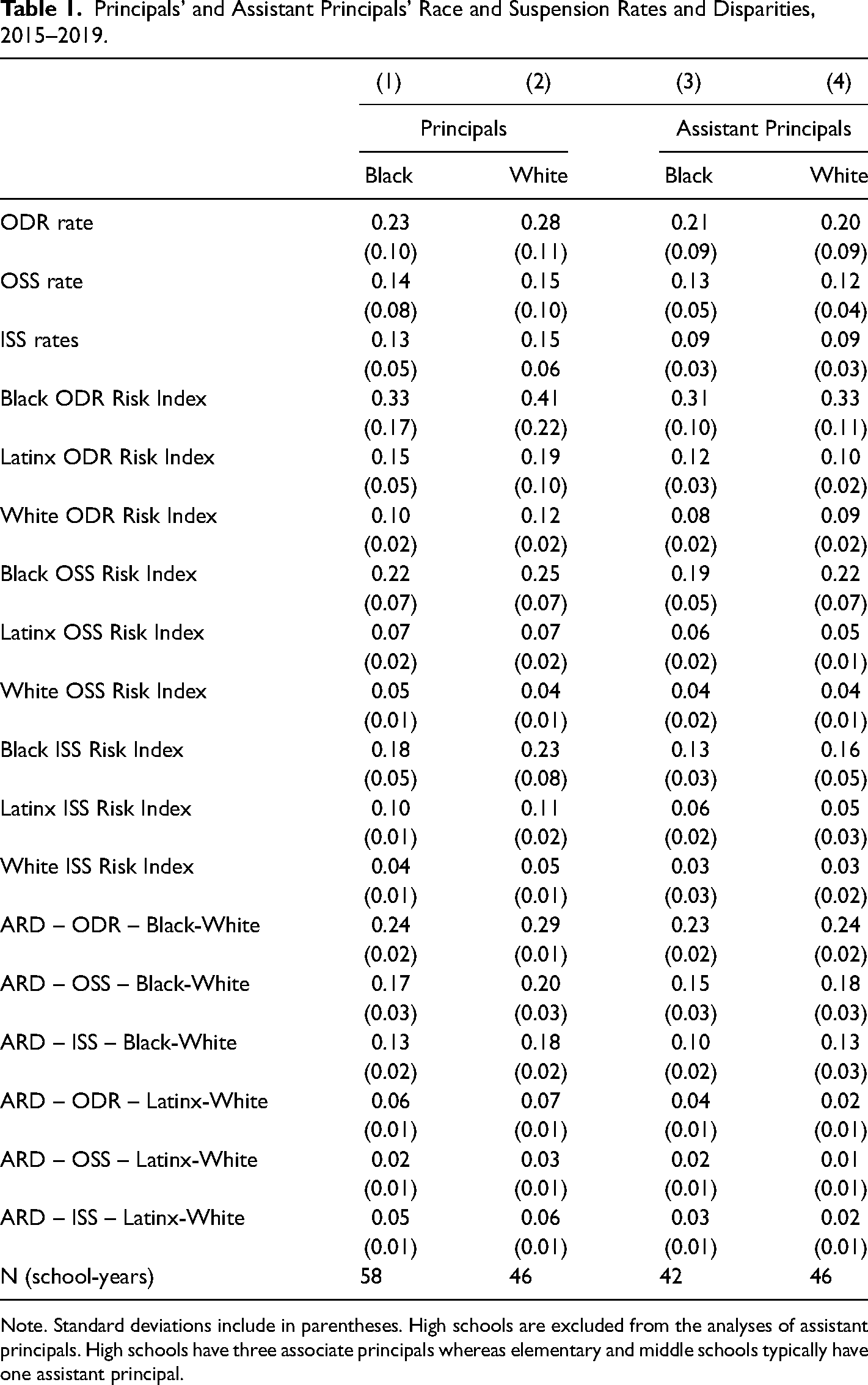
Table 1 presents overall ODR and suspension rates, risk indices by student race/ethnicity and racial disparities by principal (columns 1–2) and assistant principal (columns 3–4) race. The overall prevalence of exclusionary discipline is similar for schools with Black and White principals, with discipline rates in schools with White principals being slightly higher, most notably for ODR. On average, in schools with Black principals 23% of students receive an ODR, 14% receive an OSS, and 13% receive an ISS, compared to in schools with White principals where 28% of students receive an ODR, 15% receive an OSS, and 15% receive an ISS.
Principals’ and Assistant Principals’ Race and Suspension Rates and Disparities, 2015–2019.
Note. Standard deviations include in parentheses. High schools are excluded from the analyses of assistant principals. High schools have three associate principals whereas elementary and middle schools typically have one assistant principal.
There are instructive differences by principal race, especially for ODRs, when disciplinary outcomes are disaggregated by student race/ethnicity. The Black ODR, ISS, and OSS risk indices are also slightly higher in schools with White principals compared to schools with Black principals. The Black student ODR rate is 33% in schools with Black principals but 41% in schools with White principals. The Latinx ODR risk index is slightly higher in schools with White principals than it is in schools with Black principals, but the risk of suspensions is practically the same. The ODR, ISS, and OSS risk indices are similar for White students regardless of principal race.
Black-White disparities (as measured by the ARD) for ODR, ISS and OSS are slightly higher in schools with White principals, compared to schools with Black principals. The most striking difference is that the Black-White ISS ARD for Black principals is 0.13, but for White principals it is 0.18. The Latinx-White discipline disparities are about the same across principal race, with disparities being only very marginally higher in schools with White principals.
Table 1 (columns 3–4) also compares school-level discipline metrics across the race of APs. The ODR, OSS, and ISS overall rates and disaggregated by race are similar regardless of AP race. The Black-White discipline disparities are marginally higher in schools with White APs compared to in schools with Black APs.
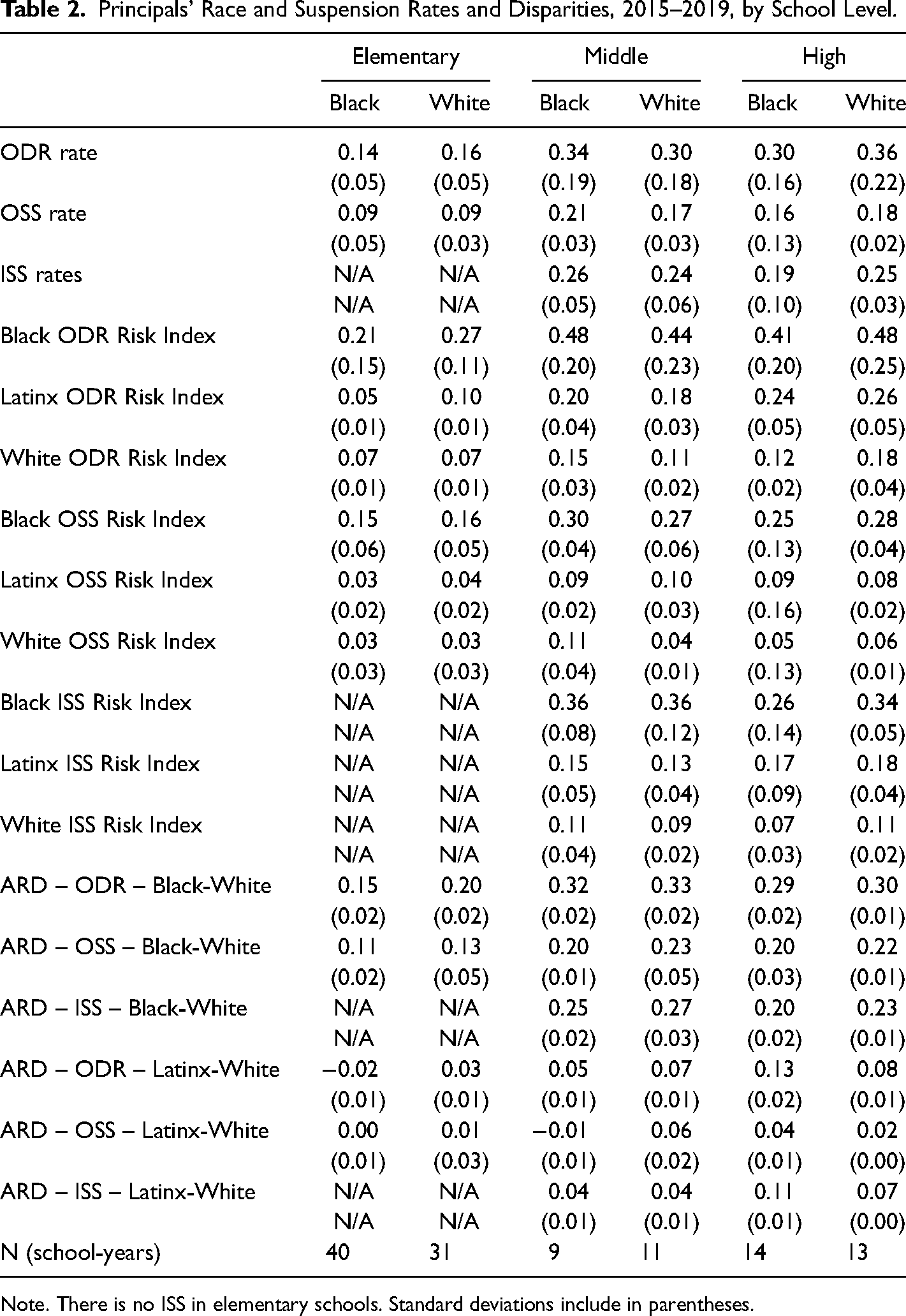
In Table 2, the results for principals are disaggregated by schooling level across elementary, middle, and high schools. In elementary schools, there is little variation in ODR or suspension rates by principal race. Both Black and White principals have a higher Black OSS risk index relative to Latinx and White students. Latinx and White students have similar ODR and suspension rates regardless of principal race. Black-White disparities are considerably larger than Latinx-White disparities, regardless of principal race. The results suggest that Black-White and Latinx-White disparities are higher in elementary schools led by White principals.
Principals’ Race and Suspension Rates and Disparities, 2015–2019, by School Level.
Note. There is no ISS in elementary schools. Standard deviations include in parentheses.
In middle schools, ODR and both types of suspension rates are higher in schools led by Black principals. On average, schools led by Black principals had 21% of students receive an OSS compared to 17% in schools with White principals. The Latinx OSS risk index is similar regardless of principal race. However, there are marked differences in the Black and White OSS risk indices across principal race. Black principals suspend White students at markedly higher rates than White principals. The White OSS risk index in schools led White principals is 4% relative to 11% in schools with Black principals. There is a similar but less clear trend for ISS. Black-White and Latinx-White disparities in ODR, ISS, and OSS are larger in middle schools led by White principals. In high schools, the ODR, OSS, and ISS rates are higher in schools with White principals, across student race. Schools led by White principals have a noticeably higher ODR (36%) and ISS (25%) rates than schools with Black principals (30% ODR rate and 19% ISS rate). The Black ISS risk index in high schools with White principals (34%) is much more than the Black ISS risk index in schools with Black principals (26%).
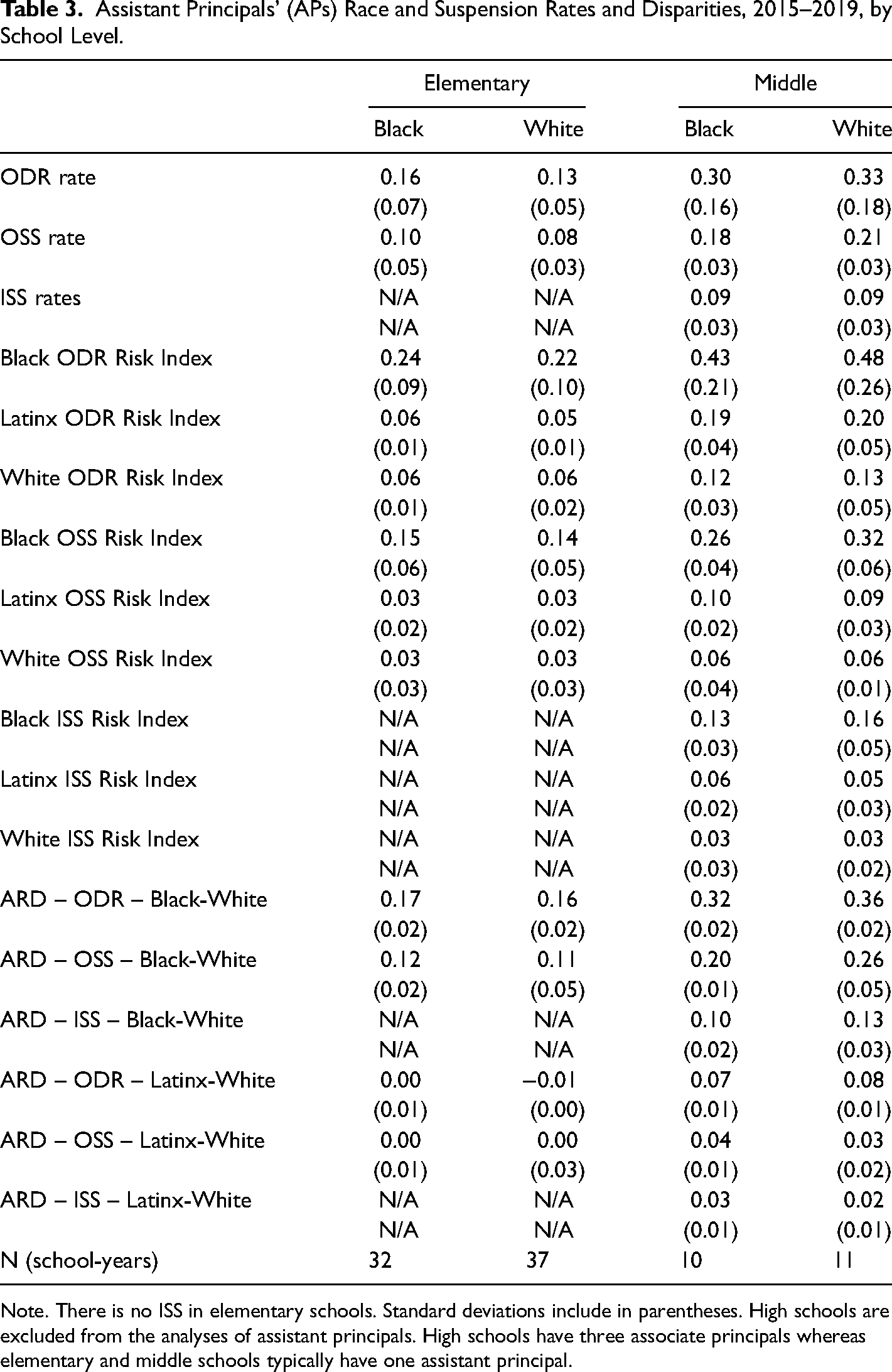
Results for assistant principals are disaggregated by schooling level in Table 3. Elementary schools with Black APs have slightly higher overall ODR and OSS rates than schools with White APs. Elementary schools with White APs have similar Black-White and Latinx-White disparities to schools with Black APs. In middle schools, White APs have a higher overall ODR and OSS rates as well as Black ODR, OSS, and ISS risk indices than schools with Black APs. The Black-White ARD for ODR, OSS, and ISS is higher for White APs than for Black APs, whereas the Latinx-White ARD is similar regardless of discipline measure or AP race.
Assistant Principals’ (APs) Race and Suspension Rates and Disparities, 2015–2019, by School Level.
Note. There is no ISS in elementary schools. Standard deviations include in parentheses. High schools are excluded from the analyses of assistant principals. High schools have three associate principals whereas elementary and middle schools typically have one assistant principal.
Punishment for Subjective and Non-Subjective Offenses
Next, the type of infraction is considered, namely how subjective and non-subjective offenses vary by school leader race. Figure 1 presents the breakdown of ODRs, ISSs, and OSSs for subjective and non-subjective offenses by principal and student race. Figure 1 illustrates that Black principals are marginally less likely than White principals to give ODRs and suspensions for subjective offenses.
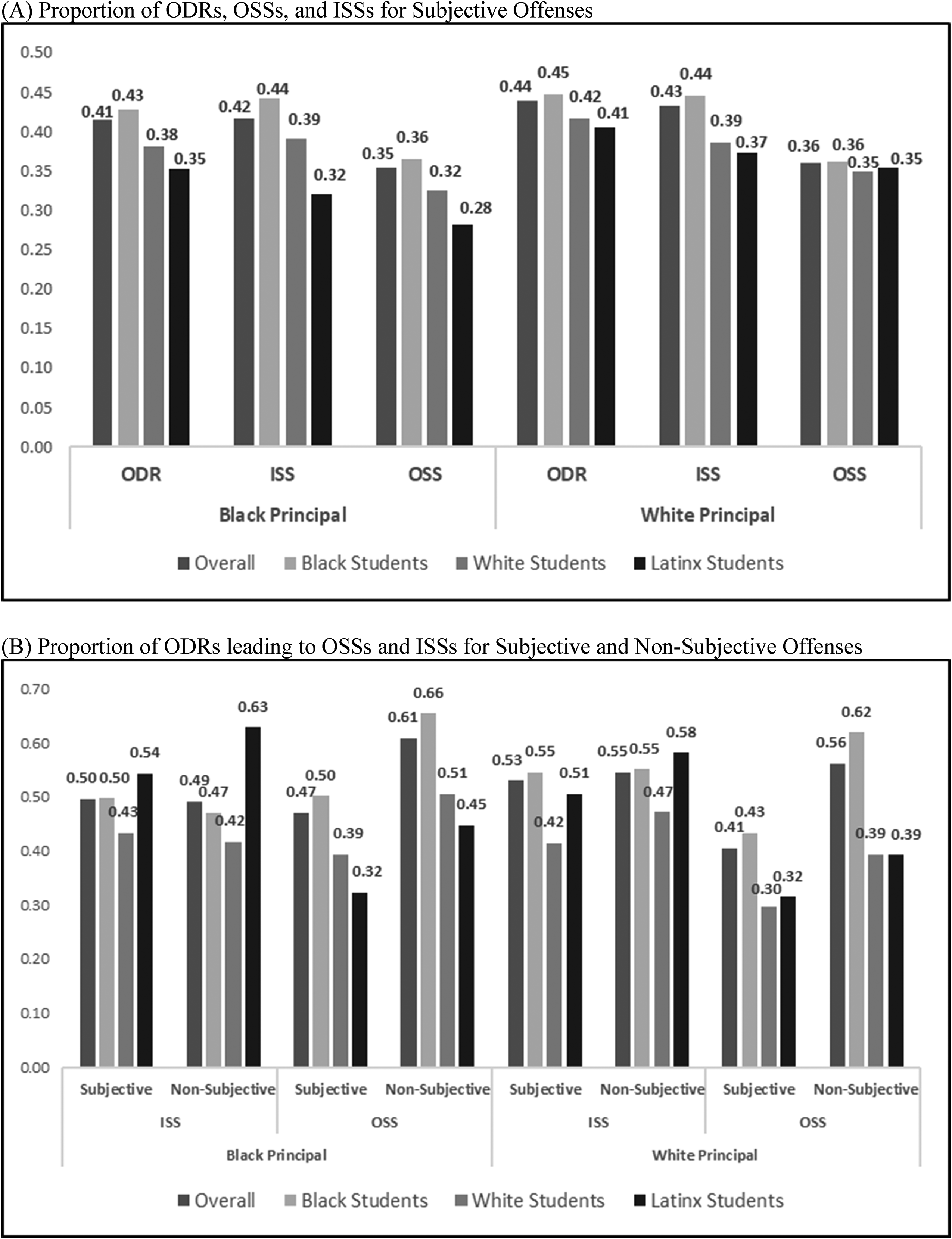
Subjective and non-subjective offenses leading to ODR and suspension, by principal and student race.
The proportion of ODRs, OSSs, and ISSs for subjective offenses is slightly lower for Black principals compared to White principals, regardless of student race (panel A). There is no clear pattern by principal race regarding the proportion of ODRs for subjective or non-subjective offenses that lead to OSS or ISS (panel B). The proportion of ODRs for subjective offenses that result in ISS is slightly lower overall and for Black students in schools with Black principals, but is slightly higher for Latinx and White students in schools with Black principals. The proportion of ODRs for subjective offenses that lead to OSS is consistently marginally lower in schools with Black principals than in schools with White principals, regardless of student race. Figure A1 in the appendix presents the results for assistant principal race, which are very similar to those for principal race, again with no clear overall patterns.
The Likelihood of Receiving ISS or OSS
Tables A1-A4 in the Appendix present the predicted probabilities of receiving an OSS or ISS by principal-student and assistant principal-student race for subjective and non-subjective offenses, while accounting for student and school characteristics as well as the disciplinary infraction. In middle schools, Black, Latinx and White students consistently have a lower probability of receiving an OSS for subjective than non-subjective offense regardless of principal race (there is no consistent pattern in elementary or high schools).
The results indicate that across elementary, middle, and high schools Black and White students are disciplined in significantly different ways by Black and White principals, as shown in Figure 2.
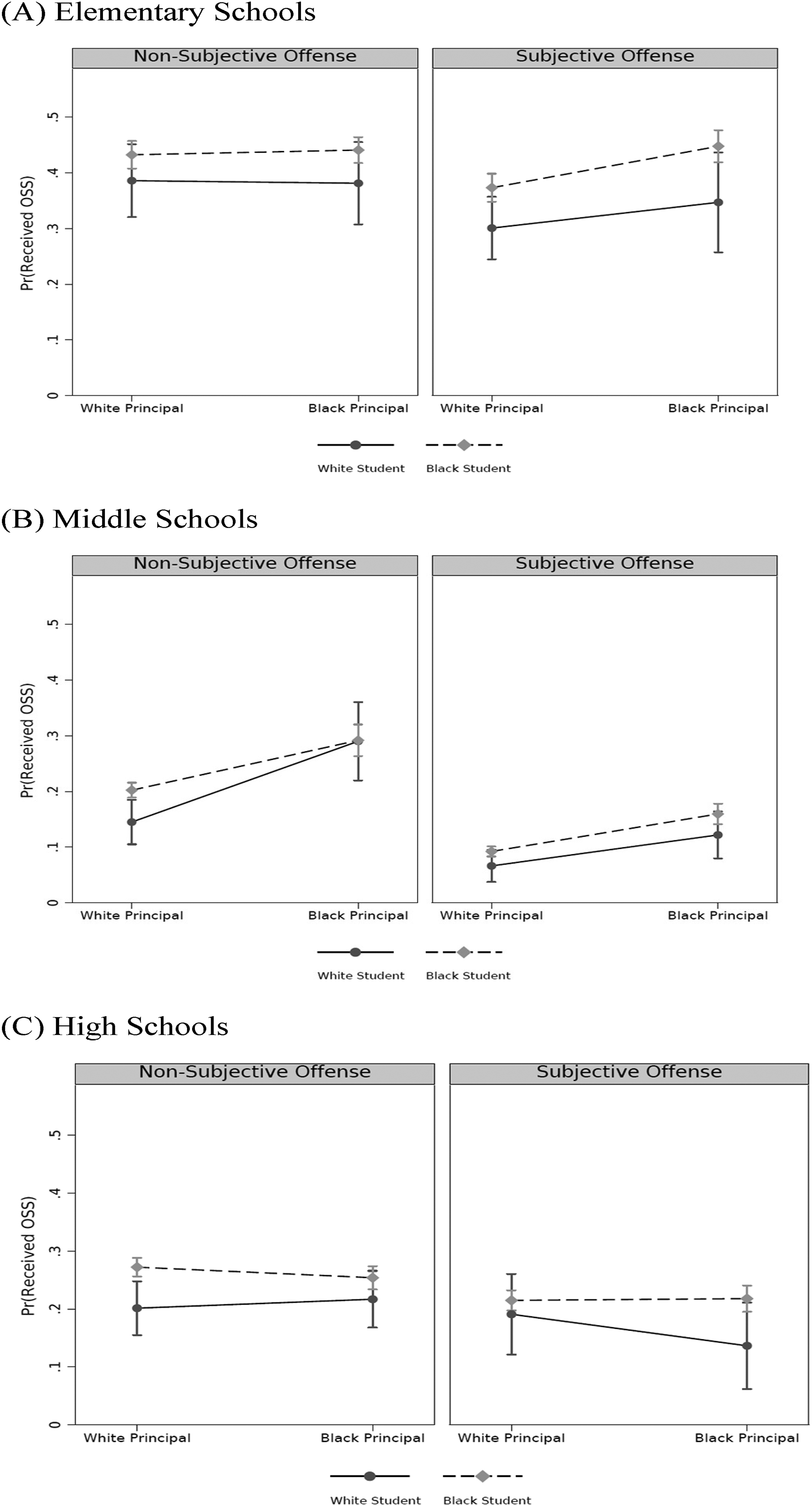
Predictive probabilities of subjective and non-subjective offenses leading to OSS, by principal and student race.
In elementary schools (panel A) the probability of receiving OSSs for non-subjective offenses are similar across principal race, while there is an increased probability of OSS associated with having a Black principal with this increase being slightly larger for Black students compared to White students. However, there is a different pattern in middle schools (panel B). Although students in middle schools with a Black principal may have a higher likelihood of receiving an OSS for non-subjective offenses, there are no disparities by student race in the probability of being punished. Whereas even though students in schools with a White principal have a lower probability of receiving an OSS for non-subjective offenses, there are significant differences by student race with Black students being more likely to receive an OSS. White students are less likely to be suspended for non-subjective offenses than Black students, when their principal is White. For Black students committing a non-subjective offense, there is a statistically significant higher likelihood of receiving an OSS with White principals than for White students (0.21 vs. 0.15). For subjective offenses there is a marginally higher probability of OSS for both Black and White students if they have a Black principal. In high schools (panel C), Black students are less likely to be suspended for non-subjective offenses if they have a Black principal, while White students are less likely to be suspended for subjective offenses if they have a Black principal.
Figure 3 shows the results for APs. In elementary schools (panel A), it is apparent that having a Black AP makes it less likely for a student to be punished for subjective offenses and White students appear to benefit more from this non-punitive disposition in elementary schools. Black students are less likely to receive OSS for subjective offenses if their AP is Black than if their AP is White. At the same time, White students are less likely to be suspended for subjective offenses than Black students when their AP is Black. For non-subjective offenses, Black students are less likely and White students are more likely to receive an OSS if they have a Black principal (Black-White disparities in likelihood of OSS for non-subjective offenses in elementary schools disappear with Black APs).
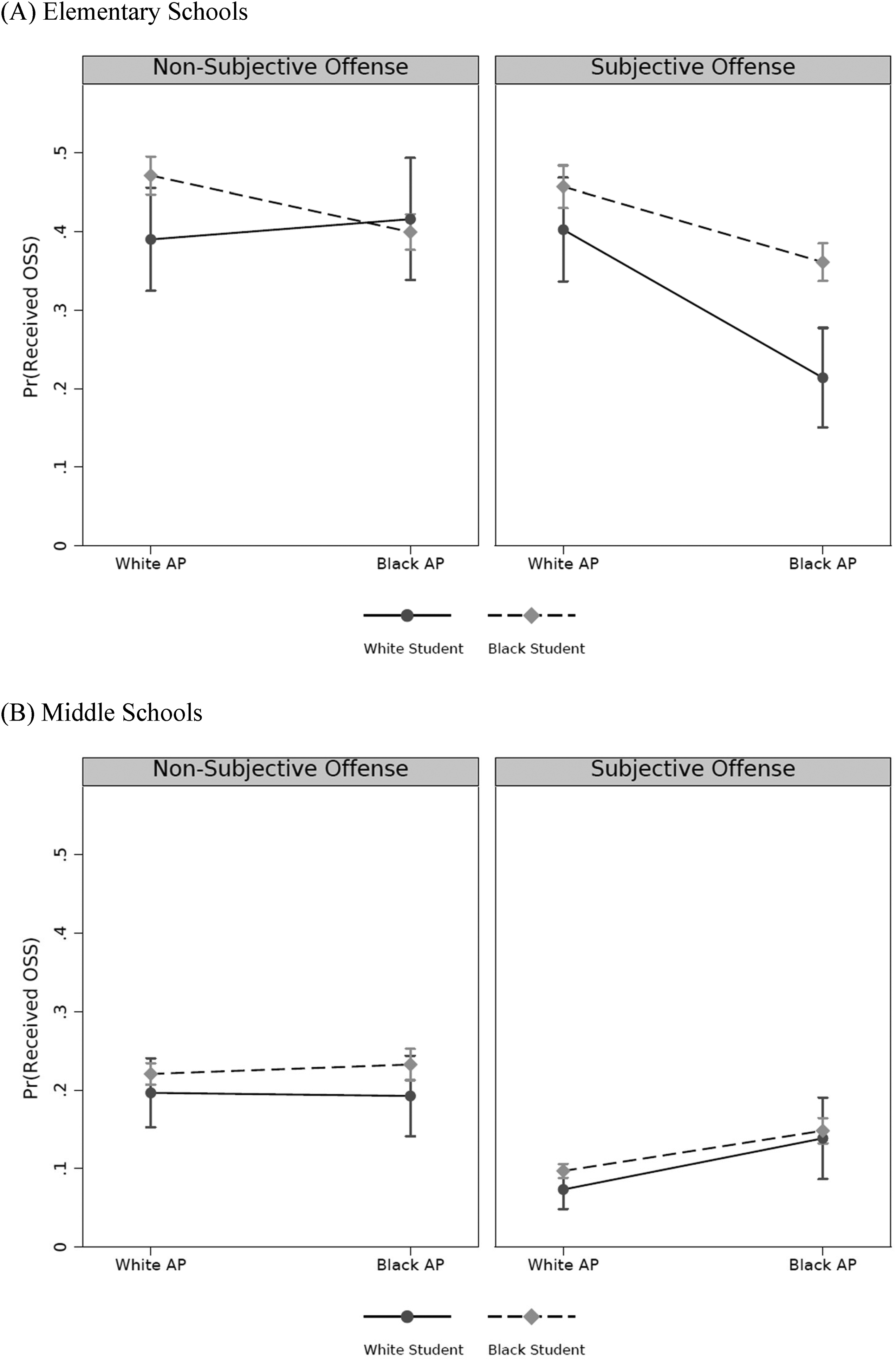
Predictive probabilities of subjective and non-subjective offenses leading to OSS, by assistant principal and student race.
However, these patterns are not the same in middle schools (panel B). In middle schools, students are less likely to receive an OSS for subjective offenses than non-subjective offenses, regardless of student or AP race. The results also indicate that Black and White students are slightly more likely to be suspended, regardless of severity of infraction, if the AP is Black than if the AP is White. There are basically no racial disparities in student likelihood of receiving an OSS for subjective offenses if the AP is Black. Similarly, White students are less likely to be suspended for non-subjective (but not subjective) offenses if their AP is Black.
There are no consistent patterns across school types for Latinx students with Black or White principals or APs (Tables A1-A2). In elementary schools, Latinx students are less likely to receive OSSs for non-subjective offenses but more likely to receive OSSs for subjective offenses in schools with Black principals, compared to in schools with White principals (in middle and high schools Latinx student likelihood of OSSs for subjective/non-subjective offenses are similar across principal race). Regarding AP race, Latinx students in elementary schools are less likely to receive an OSS for subjective or non-subjective offenses if they have a Black AP, while in middle schools they are less likely to receive an OSS for non-subjective offenses if they have a White AP. Similar patterns of significance by principal or assistant principal and student race and subjective/non-subjective offense are found for ISS (Tables A3-A4).
Discussion
This study contributes a more granular understanding of the factors that influence the disproportionate use of ODRs, ISS and OSS in schools with an emphasis on the role of school leaders’ race and schooling levels. The prevalence of exclusionary discipline is similar for schools with Black and White principals, but discipline disparities are slightly higher in schools with White principals (this is the case for both elementary and high schools, but not middle schools). Black-White discipline disparities are higher in schools with White principals and APs, compared to schools with Black principals and APs. But there are no clear patterns for Latinx-White disparities. The proportion of ODRs, OSSs, and ISSs for subjective offenses is slightly lower for Black principals compared to White principals (regardless of student race), but there is no clear pattern by principal race regarding the proportion of ODRs for subjective/non-subjective offenses that lead to OSS/ISS. The regression results controlling for student and school characteristics suggest that the probability of students receiving suspensions varies substantially across offense type, principal race, AP race, and schooling level. Among the clearest patterns found, in middle schools both Black and White students have a higher likelihood of receiving OSS if they have a Black principal – for both subjective and non-subjective offenses – although there are no racial disparities for non-subjective offenses in schools with Black principals. In addition, Black elementary school students have considerably lower likelihood of receiving OSS if they have a Black principal, regardless of offense type.
A growing number of studies raised concerns about the linkages between school discipline and criminal justice amid evidence of persistent racial disparities and the hardening of schools in the post-COVID era (Addington, 2023; Welsh, 2022b; Dunbar et al., 2022; Hughes et al., 2022). This study adds to an expanding set of studies highlighting the importance of educators - both teachers and school leaders - in the disciplinary process (Welsh, 2023a). Similar to the police (Watson & Stevenson, 2022), adults in schools have tremendous authority and leeway in how they interpret and respond to the actions of students. Similar to prior studies (Sorensen et al., 2022), the results indicate that principals vary considerably in their use of suspensions. The findings illustrate that Black principals use less suspensions and have lower Black-White discipline disparities are in contrast to Kinsler's (2011) cross-sectional study (finding that there is no differential treatment for Black students by principal race), and suggest that Black and White principals discipline students differently and this contributes to differences in students’ disciplinary outcomes. Similar to prior studies (Edwards et al., 2023), the findings suggest that school leader-student racial congruence matters for school discipline. While I find inconsistent results depending on schooling level (elementary, middle, and high), Edwards et al. (2023) found a reduced likelihood of ISS for Black students with Black principals in urban schools but the opposite in other schools (suburban, town, and rural). In addition, similar to Edwards et al. (2023), I do not find any evidence that having a Black principal has a differential association with suspension for Latinx students. My findings also contrast with Roch et al.'s (2010) study which found that racial congruence between students and school administrators was not a significant predictor for suspensions.
The findings highlight the nuances between the overall use versus possible discriminatory and unequal use of suspensions. The results suggest that White students may get a pass with non-subjective offenses with White principals in middle schools. This is congruent with prior studies on discretion in decision making in the disciplinary process (Barrett et al., 2021; Sorensen et al., 2022) such Barrett et al.'s (2021) finding that Black students involved in fights in Louisiana are punished more harshly than the White students. The differences in the predicted probabilities of receiving an OSS for Black and White students with White principals can be interpreted as discrimination based on race, especially when Critical Race Theory is applied to contextualize the findings (Rodriguez & Welsh, 2022). The results suggest that although they use OSS at higher rates than White principals, Black principals are not discriminatory in dispensing OSS for non-subjective offenses. The results also underline the systemic nature of racial inequality in K-12 school discipline. Regardless of schooling level or principal race, there are Black-White disparities in ODR, OSS, and ISS.
The results also reiterate the importance of studying the range of disciplinary infractions not only subjective offenses as well as both suspension types (ISS and OSS). The results suggest that in elementary schools, Black APs are beneficial for Black students but even more so for White students, in terms of how subjective offenses are processed. Thus, similar to elementary schools, Black APs also benefit White students in middle schools. Although there are differences in the predicted probabilities of receiving an OSS by the race of the AP, there is no evidence of discrimination by student race. The results suggest that APs may affect different categories of disciplinary infractions differently – APs may have more influence on subjective offenses than non-subjective offenses.
Implications and Directions for Future Research
First, the findings indicate that educational policymakers and researchers should also pay closer attention to both suspension types – ISS and OSS. There are differences in the use of ISS and OSS across Black and White principals. A growing number of studies have drawn attention to ISS (Cholewa et al., 2018; Welsh, 2022) and this study underscores the importance of examining the use of different suspension types in school discipline studies and policymaking. Similarly, the findings compel educational policymakers and researchers to focus on both subjective and non-subjective disciplinary infractions given that differential processing in non-subjective offenses in middle schools may also contribute to racial disparities in exclusionary discipline.
Second, the results also suggest states and districts should invest in initiatives that diversify the school leadership pipeline as the diversity of school leaders may be important for not only academic achievement but also school discipline. The findings add to a growing body of work documenting the benefits accrued to minoritized students from having race-congruent teachers and school administrators (Davis et al., 2016; Edwards et al., 2023; Lindsay & Hart, 2017). Indeed, the racial divide between educators and students coupled with pervasive and persistent racial disparities in exclusionary discipline in schools raise important concerns about anti-Black racism in public education. Data from the 2020–2021 school year from the National Center for Education Statistics (NCES) illustrates the magnitude of the demographic mismatch in K-12 schools in America. Most principals are White (77%) and female (56%). Only 9% of principals are Latinx and 10% are African American (National Center for Educational Statistics, 2023). Yet, most public school students are non-white (54%). In essence, the diversification of the student population has not been matched by school leadership.
An important contribution of this study is that assistant principal race matters, above and beyond principal race. Further, the extent to which student-school leader race matching matters depends upon the subjectivity of the infraction and the schooling level. Notwithstanding, there are a few noteworthy limitations of the study. First, there may be other salient school-level factors such as school climate or the experience of school leaders and tenure in their current schools that are excluded from the analyses that may influence the relationship between school leader-student racial congruence and students’ disciplinary outcomes. Second, the results are not causal (I consider variation between schools with different race principals, not change in the race of principals within the same school) and provide little insights on the potential mechanisms through which racial congruence between school leaders and students matter for school discipline. Finally, data on student-teacher racial congruence were not included in the analyses. Given the importance of interactions between teachers and school leaders in the disciplinary process (Welsh, 2023b), a fruitful direction for further inquiry is examining how racial congruence with the range of adults in schools (teacher, school administrators, social workers, guidance counselors, etc.) may influence students’ disciplinary outcomes.
Future studies can provide further insights into the mechanisms that may explain the association between principal race and likelihood of suspension. Although Black principals use OSS more frequently, there is no evidence they are using suspensions discriminately. Black educators’ perspectives on the disciplinary experiences of Black students also warrant closer examination to garner insights on the school discipline practices of Black educators. Racial matching does not necessarily mean that there will be shared values, beliefs, or behaviors between teachers, school leaders, and students. Bradshaw et al. (2010) found that Black male students were more likely to receive ODRs in classrooms with Black male teachers. This suggests that Black male teachers may have higher expectations of Black male students, or that economic or other cultural mismatching may outweigh the positive effects of racial matching (Bradshaw et al., 2010). Similar trends may be happening in PSSD where Black principals have different standards of behavior for Black students and thus higher OSS rates. Future research can focus on the counterstories of Black educators and provide granular insights on how Black school leaders navigate complex legacies of racism and contemporary waves of anti-black racism as they craft and refine their disciplinary perspectives and practices.
Supplemental Material
sj-docx-1-raj-10.1177_21533687241227176 - Supplemental material for School Leadership, Race, and School Discipline: Examining the Relationship Between School Leader-Student Racial Congruence and the Likelihood of Exclusionary Discipline
Supplemental material, sj-docx-1-raj-10.1177_21533687241227176 for School Leadership, Race, and School Discipline: Examining the Relationship Between School Leader-Student Racial Congruence and the Likelihood of Exclusionary Discipline by Richard O. Welsh in Race and Justice
Footnotes
Declaration of Conflicting Interests
The author declared no potential conflicts of interest with respect to the research, authorship, and/or publication of this article.
Funding
The author received no financial support for the research, authorship, and/or publication of this article.

Supplemental Material
Supplemental material for this article is available online.
Author Biography
References
Supplementary Material
Please find the following supplemental material available below.
For Open Access articles published under a Creative Commons License, all supplemental material carries the same license as the article it is associated with.
For non-Open Access articles published, all supplemental material carries a non-exclusive license, and permission requests for re-use of supplemental material or any part of supplemental material shall be sent directly to the copyright owner as specified in the copyright notice associated with the article.
