



Abstract
Building on research demonstrating significant differences in how Black and White Americans view law enforcement, this study assesses how those differential views shape potential jurors’ decision-making in the context of a federal drug conspiracy case in which the primary evidence against the defendant is provided by an FBI agent and an informant cooperating with the agent. A sample of 649 Black and White jury-eligible U.S. citizens were exposed to the case, in which a Black defendant is being tried, and where the informant-witness race (Black or White) was varied. Participants determined verdict, evaluated evidence, and completed additional measures. Results indicated that Black participants were significantly less likely to convict than White participants, especially in the White informant condition; rated the law enforcement witness as less credible, and viewed police more negatively across three composite measures. Exploratory analysis of how juror race and gender interacted indicates Black women largely drove racial differences in verdicts. Perceptions of police legitimacy mediated the relationship between juror race and verdict choice. We conclude that it is critical that citizens are not prevented from being seated on juries due to skepticism about police, given the risk of disproportionate exclusion of Black potential jurors. The legal processes relevant to juror excusals need to be reconsidered to ensure that views of police, rooted in actual experience or knowledge about the problems with fair and just policing, are not used to disproportionately exclude persons of color, or to seat juries overrepresented by people who blindly trust police.
A growing body of research has documented that jurors’ assessments of evidence and testimony may be shaped by their own experiences and identities, empirically disconfirming the legal myth that the impartial juror is a “blank slate” (Kassin & Wrightsman, 2013, p. 6). Rather, in accordance with a substantial body of research, laypersons come to the juror task with individualized sets of “expectations, beliefs, and experiences that predispose [them] to reject particular arguments or find particular types of evidence persuasive” (Ellis & Diamond, 2003, p. 1036; see also Devine, 2012). Black and White jurors are especially likely to differ from each other in their assessments of evidence generated by law enforcement, thereby impacting how they determine verdicts, given that attitudes and views about whether the police are trustworthy, fair, and unbiased significantly diverge as a function of perceivers’ race (Costanzo et al., 2010; Gramlich, 2019; Lerman & Weaver, 2014; Peck, 2015; Tyler & Huo, 2002; Weitzer & Tuch, 2002, 2005).
In this paper, we extend our recent work on juror race and decision-making to examine the mechanisms underpinning jurors’ race-based differences in evaluations of law-enforcement-generated evidence and testimony, and in verdict judgments. In the previous study, jury-eligible adults viewed a federal drug-trafficking conspiracy case that involved testimony by law enforcement agents, and by an informant who worked with the FBI to set up the defendant in a drug transaction (Shaw et al., 2021). Participants were assigned to small groups that deliberated to reach a verdict, then each participant completed a series of individual measures. We found that White mock jurors were more likely to support convicting the defendant than were jurors of color, with Black jurors the least likely to convict. An exploratory analysis suggested that differential credibility assessments by White and Black jurors of the law enforcement witnesses underpinned the differences in verdicts (Shaw et al., 2021). We also found suggestive evidence that Black jurors were most likely to acquit when a White informant, who was working with law enforcement on the “hope for leniency” in his own drug case, testified against a Black defendant (Shaw et al., 2021).
In the present paper, we report on findings from a follow-up study that seeks to more directly examine whether attitudes and beliefs about law enforcement help explain the racial gap among jurors in support for conviction. We also further examine whether the race of a key prosecution witness—an informant who agrees to work with law enforcement to set the defendant up in a drug sting—influences outcomes, consistent with previous research on race of prosecution witnesses (e.g., Abshire & Bornstein, 2003; Conley et al., 2000). We first review the research on citizens’ views of police, then the very limited research on how jurors assess law enforcement testimony, focusing in particular on differences between Black and White laypersons. After delineating our specific hypotheses, we describe the current study, including methods and procedures, then present our findings. We conclude with a discussion of the implications of our findings, limitations of this research, and suggested next steps in this line of research.
Race & Perceptions of Law Enforcement
Varied research has demonstrated a large and consistent racial gap in Americans’ attitudes about the police. In particular, a substantial body of research indicates that White Americans are much more satisfied with and trusting of police across a range of dimensions than are non-White Americans, including about their equitable racial treatment of citizens (Hurwitz & Peffley, 2005; Morin & Stepler, 2016; Peck, 2015; Taylor et al., 2015; Warren, 2011; Weitzer & Tuch, 2002, 2005). The gap is consistently largest among Black and White Americans (Lai & Zhao, 2010; Skogan, 2005; Wheelock et al., 2019), wherein Black Americans view police as substantially less fair, procedurally just, and legitimate than do White Americans (e.g., Gau et al., 2012; Gramlich, 2019).
Among White respondents, attitudes about the police appear to be tied both to broader measures of racial identity, and to measures of racial resentment and racism. For instance, Johnson and Lecci (2020) found that Whites who strongly identify with being White were less likely to feel empathy for a Black victim of a fatal police-shooting, relative to Whites with lower levels of White racial identity. White support for police use of force is also positively related to racial resentment (Carter et al., 2016), while support for the Black Lives Matter movement (Drakulich et al., 2021) and concerns about police bias are negatively related to measures of racism (Matsueda & Drakulich, 2009). This comports with a broader body of research linking Whites’ racial bias with perceptions and judgments on a whole range of justice issues (e.g., Cullen et al., 2021; Drakulich, 2015; Hetey & Eberhardt, 2014; Soss et al., 2003).
Conversely, Black citizens’ views of police are more closely associated with both direct and vicarious negative contact with police (Brunson, 2007; Gau & Brunson, 2010; Rosenbaum et al., 2005). Black Americans report more direct and vicarious negative experiences with police than do White Americans, and the source of the vicarious experience is more often friends and family (rather than media), relative to Whites (Rosenbaum et al., 2005). These experiences, in turn, shape perceptions of police (Warren, 2011), and produce high rates of fear of police among Black citizens, as compared to White citizens (Pickett et al., 2022). Similarly, Black and Hispanic youth experience more direct and vicarious negative police contact than do White youth, and contact (especially direct contact) produces cynicism about the police. Even after controlling for level of contact, Black and Hispanic youth come to hold more negative views of police than do their White counterparts (Geller & Fagan, 2019; see also, Brunson & Miller, 2006). Moreover, the significant racial gap in who actually experiences biased treatment produces a kind of blindness to system bias among Whites that is difficult to overcome (Hetey & Eberhardt, 2018). More systemically, the treatment of Black and poor communities by the police produces group-level legal estrangement (Bell, 2017), a sense of distrust that comes from widespread unjust treatment, marginalization, and exclusion from legal protection.
Despite these differences, given the increased public attention to, and awareness of, the problem of bias in criminal justice (Do, 2000; Dunivin et al., 2022; Kahn & Martin, 2016), some limited evidence suggests that laypersons from all racial groups are increasingly skeptical about the fairness of police in their treatment of Black citizens. Following the murder of George Floyd by Minneapolis police officers, favorability toward police declined by “27% of a standard deviation” in a national panel survey of Americans, although that effect disappeared among White respondents within 100 days of Floyd's death (Reny & Newman, 2021, p. 1501). Similarly, among matched samples of American adults, Curtis (2022) found that police favorably dropped 32% following the Floyd killing compared to just months before, although little change was observed among those in rural areas.
On the other hand, other high-profile police killings of Black men have not shifted views of law enforcement to the same degree. Thus, in a repeated panel survey of St. Louis County residents, Kochel (2019) found a significant decline in views that police are procedurally just and legitimate after the Michael Brown killing by police in Ferguson, but only among Black respondents. White et al. (2018) found no erosion in perceptions of police trustworthiness, legitimacy, or procedural justice among matched majority-Black samples of Baltimore residents before and after the Freddie Gray killing by police, a finding partly explained by the very negative views held about the police among Baltimoreans, such that there was “little room for change in views in the context of Freddie Gray” (White et al., 2018, p. 847).
Law Enforcement Evidence & Testimony in the Trial Context
Despite the centrality of police testimony in many criminal prosecutions, relatively little research directly examines how laypersons assess police as potential or actual witnesses in court cases (Cole, 2018). The limited existing research does suggest that jurors’ assessment of law enforcement plays an important role in judgment. Analyses of data from one of the few large-scale studies of actual jurors in criminal trials find that attitudes about police trustworthiness (Farrell et al., 2013), as well as case-specific evaluations of police testimony (Garvey et al., 2004), significantly predicted jurors’ first votes for guilt. Trust in police was especially predictive of votes among Black jurors (Farrell et al., 2013). Differential assessment of law enforcement may therefore help explain the racial gap between Black and White jurors in conviction-proneness, especially when the defendant is non-White (Anwar et al., 2012; Farrell et al., 2013; Garvey et al., 2004; Williams & Burek, 2008).
To that end, studies examining the relationship between mock juror race and assessments of law enforcement witnesses, as well as prosecution witnesses more generally, have found credibility ratings of those witnesses to be demonstrably lower among jurors of color, relative to White jurors. In an early experiment of this kind, Abshire and Bornstein (2003) found that Black jurors were more skeptical about both of the prosecution witnesses—a detective and an eyewitness who testified against a Black defendant charged with murder—but found the defense's alibi witness more credible, relative to White jurors in the study. In a more recent study, Ewanation et al. (2021) found that the odds of convicting a defendant who allegedly killed a police officer during a use-of-force incident were twice as high for White mock jurors relative to jurors of color. They also found that the relationship between juror race and verdict was partially mediated by participants’ perceptions of police legitimacy. Our previous findings (Shaw et al., 2021) similarly find that Black jurors were significantly more skeptical about the credibility of prosecution witnesses, including two law enforcement officers and a cooperating informant, than were White jurors, resulting in significantly more votes for conviction among the White jurors.
The race of suspects, defendants, and witnesses can also influence how laypersons perceive law enforcement. Using an experimental paradigm, Pica et al. (2020) found that their majority-White student participants were twice as likely (51% to 25%) to view a discretionary police arrest for loitering as justified when the arrestee was White compared to a Black arrestee, and were significantly more likely to view the arrest as racially-motivated when the arrestee was Black, relative to a White arrestee (ηp2 = .63). Participants’ individual attitudes about police legitimacy and fairness were significantly related to their assessments of whether the arrest was race-based. Our previous study also found that mock jurors of all races viewed law enforcement witnesses, as well as the informant, as significantly less credible when the defendant was Black compared to when the defendant was White. Moreover, Black jurors were the most likely to acquit in the Black defendant-White informant condition (Shaw et al., 2021), which comports with Abshire and Bornstein’s (2003) finding that Black jurors were significantly less likely to find a White eyewitness credible relative to a Black eyewitness, whereas White jurors did not distinguish between the eyewitnesses as a function of race. Conversely, though, Maeder and Yamamoto (2017) found that their majority-White participants were more likely to vote guilty against the Black defendant when an informant who received a benefit for cooperating was White compared to when he was Black. There was no race of informant effect when the informant did not receive an incentive of either money or a reduced sentence to testify.
The Present Study
Our primary aim with the present study is to further examine how laypersons’ race impacts judgment, focusing specifically on differences between Black and White potential jurors. Building on our prior research in this area, we assess whether, and to what degree, differential views of police underpin observed differences in outcomes for a Black defendant charged in a drug-trafficking conspiracy case. Moreover, given divergent findings on whether and how the race of witnesses shapes juror judgment in Black defendant cases (Abshire & Bornstein, 2003; Conley et al., 2000; Maeder & Yamamoto, 2017; Shaw et al., 2021), we also examine whether race of an informant witness influences verdict decisions.
We test six hypotheses, as follows:
Consistent with prior research demonstrating that White jurors are more conviction-prone than jurors of color (e.g., Abshire & Bornstein, 2003; Anwar et al., 2012; Garvey et al., 2004; Shaw et al., 2021; Williams & Burek, 2008), Black jurors will be significantly less likely to convict the defendant than will White jurors. Consistent with Conley et al.'s (2000) finding that convictions are lowest when all court actors are White in Black defendant cases, the White informant witness will produce fewer convictions overall than will the Black informant. Consistent with Abshire and Bornstein (2003) and suggested by our previous findings, Black jurors will be less likely to convict than White jurors in the White informant condition, but not in the Black informant condition. Consistent with research indicating jurors of color are more skeptical of prosecution witnesses including law enforcement (Abshire & Bornstein, 2003; Shaw et al., 2021), Black jurors will view the prosecution witnesses as less credible than will White jurors. Consistent with extensive research on the Black-White racial gap in perceptions of police (e.g., Gramlich, 2019; Hurwitz & Peffley, 2005; Morin & Stepler, 2016; Peck, 2015; Warren, 2011; Weitzer & Tuch, 2005), Black jurors will hold more negative views of the police than White jurors across our measures of police perceptions. Consistent with Ewanation et al. (2021), perceptions of police will mediate the effect of juror race on verdicts.
In this study, we also manipulated whether or not the informant testified that he “hoped for” leniency for his cooperation with law enforcement and testimony against the defendant to examine whether the “hope for” testimony would reduce convictions. This testimony about a potential incentive for cooperation reflects a common practice whereby such witnesses are not promised anything specific so they do not need to reveal a concrete incentive while testifying (Cassidy, 2004). This form of “incentive” had not been previously tested, despite its ubiquity in actual practice. While we did not make any specific predictions about how this manipulation would interact with either juror race or informant race, Maeder and Yamamoto's (2017) research indicates that informant race and incentive may interact in Black defendant cases. In this study, we obtained virtually no main effect (the conviction rate was 72.1% without the incentive and 72.2% with the incentive; OR = 1.006; p = .973), nor any interaction effects with juror race and/or informant race. Indeed, most participants across conditions assumed the informant would benefit from testifying. Therefore, we collapsed those cells in the analyses reported here.
Participants
We contracted with Qualtrics’ research panel services to obtain a participant pool limited to Black and White federal jury-eligible citizens, and that specifically over-sampled Black citizens for inclusion. Based on the findings from our previous study (Shaw et al., 2021), we sought a minimum of 220 participants in each racial group for the present study to uncover a main effect of juror race, our primary interest. The specific criteria for inclusion in our study were: Black or White U.S. citizens, 18 or older, eligible to vote, with no felony convictions. Participants were paid according to panel provider rates, and also received a $10 gift card award if they successfully completed the study. Qualtrics recruited participants based on our eligibility criteria, and we then confirmed eligibility at the start of our Qualtrics presentation, prior to our informed consent process. Potential participants were asked their gender, race/ethnicity, age, whether they are a U.S. citizen, and about any prior convictions (nothing other than traffic; misdemeanor; and/or felony). Those who met the criteria continued on to the study.
A total of 775 qualified participants completed the study. Of those, 95 participants were removed from the final sample for failing our manipulation check on informant race, and an additional 31 were removed for either providing a nonsensical response to our open-ended question regarding their decision-making; appearing to complete the study a second time; and/or completing the study in less than half the median time of the soft launch completions by 35 participants. Due to a technical glitch in Qualtrics, the assigned informant condition for two additional participants was unavailable. We included these two participants in our final sample for our analyses using juror race alone as a predictor, but they are necessarily excluded from any analyses that include informant race.
Our final sample included 649 mock jurors, of whom 65% (421) identified as White and 35% (228) as Black. The majority of participants (75%) were women; 25% were men, and 1 participant identified as another (unspecified) gender. We would have ideally had a more balanced gender distribution in our participant pool; however, our primary interest was in examining differences between Black and White participants, reducing our concern about the gender breakdown. Overall, there was not a significant difference in conviction rates between women (71%) and men (74%; p = .49). The mean participant age was 52, and 75% of our participants attended at least some college. Approximately 27% of the participants identified as Republican, 45% as Democrat, and 24% as Independent. The remaining 4% either had another political affiliation or no affiliation at all. Fully 31% of the participants had previously served on a jury.
Design & Materials
The study employed a 2 × 2 factorial design, in which the race of informant witness (Black or White), and incentive for testifying was varied, creating four experimental conditions. In the incentive condition, the informant testified on cross-examination that he hoped to receive a break from the potential 10-year sentence he faced for his cooperation, but was telling the truth. This testimony was not included in the no-incentive condition. As previously noted, in the present analysis we collapse the incentive conditions, since there was no measurable difference between these conditions, and our primary interest in this analysis is in the relationship between juror race and judgment. In all conditions, the defendant was Black.
Except for the informant's testimony, the case materials were presented through a written slide show presenting the abbreviated trial transcript, supplemented with photographs of the case participants. The direct and cross examination of the informant was presented as an audio recording over a quickly moving photo slideshow of the informant testifying. We opted to present the informant testimony through the more visually rich audio-visual slideshow to help ensure our participants remained engaged and were attentive to the race manipulation.
A casting call was used to recruit actors who filled the Black and White informant roles; actors were selected based on matched age, size, and appearance. Prior to and during the photo shoot, an acting coach worked with the selected pair to calibrate and synchronize their movements and gestures to ensure we could match their photos on posture and expression. They were also dressed in identical clothing. The voice recordings for the attorneys and informant were completed using trained actors. We used the same voice actor for the informant across the two race conditions to control for all extraneous variations in speech that would naturally occur if using two separate voice actors. The trained voice actor identified as a Black/African-American and White mixed-race man and modulated his voice to be racially ambiguous in his testimony. To capture the four experimental conditions, the versions of the slide show varied only on the racial characteristics of the informant and the incentive condition; otherwise, the materials were identical across conditions. While we recognize the trade-offs in using only one actor for each role (Wells & Windschitl, 1999), due to the more complex presentation of our stimulus, it was not feasible to produce multiple versions of the informant testimony and we had protocols in place to ensure matching on appearance and poses of the informant actors.
The trial presentation was loosely based on an actual federal narcotics conspiracy trial transcript. The defendant in the case, Harold Williams, was charged with conspiracy to distribute cocaine in the Central District of California. The government alleged that Mr. Williams entered into an agreement to sell 500 grams of cocaine to an associate, Sheldon Smith, for $10,000. Unbeknownst to the defendant, the associate himself had been arrested and was operating as a confidential informant for the FBI. The trial presentation began by specifying the charge for which Mr. Williams was being tried, then moved to opening statements from the prosecutor and defense attorney, followed by the testimony of two prosecution witnesses.
The first witness was the FBI agent, who testified about her experience working in narcotics and managing informants, then about specifics of the case. She testified about text messages the defendant sent to the informant to arrange the drug sale, and how the defendant was ultimately arrested with marked cash from the informant that was exchanged for drugs. The second witness was the informant, Sheldon Smith, who testified about his prior history selling drugs for the defendant and about his plan to acquire drugs from the defendant as part of the FBI sting operation. Both witnesses were subjected to cross-examination by the defense after their direct examination testimony. After the witness testimony was presented, the judge read the relevant jury instructions that explained the duties of jurors, the burden of proof and the presumption of innocence, considerations of witness credibility, and the defendant's right not to testify, and the elements of the specific offense charged that must be proved. 1 The trial concluded with closing arguments by the prosecution and defense. All case participants besides the defendant and the informant (in one of the two conditions) were White.
Procedures and Measures
Those who passed our screening for inclusion moved on to the study information sheet describing the study, and informing them of their rights as research participants. They then proceeded to read and listen to the case materials. After viewing the case materials, participants completed an electronic survey that began with the verdict decision and a measure of confidence in that verdict, then assessed individual perceptions of the evidence, witnesses, attorneys, defendant, and judge; comprehension of jury instructions; attitudes about a variety of issues; and demographic information. After participants completed the individual measures, they were debriefed and provided the gift card award and payment by Qualtrics. The mean time for completing the study was 51 min, and the median time was 38 min.
Key independent variables for this analysis were juror race (Black or White) and informant race (Black or White). Key dependent measures were verdict, a dichotomous variable with the options of “guilty” or “not guilty”; the witness credibility measures; and the police perceptions measures. Specifically, participants’ views of how credible the two prosecution witnesses, the FBI agent and the informant were assessed, using a 7-point scale ranging from 1 = not at all credible to 7 = very credible. The police perceptions measures tapped into three distinct components. First, series of four police legitimacy items were drawn from Hinds and Murphy (2007). Next, a series of three “fairness and equity” items that assessed participants’ confidence in the police to treat different racial groups equally, and to refrain from using excessive force, were drawn from Pew Research Center (2014). Finally, we created a third set of three measures that assessed participants’ perceptions about police engagement in misconduct, such as planting evidence and lying on the job.
Results
Verdicts by Juror Race & Informant Race
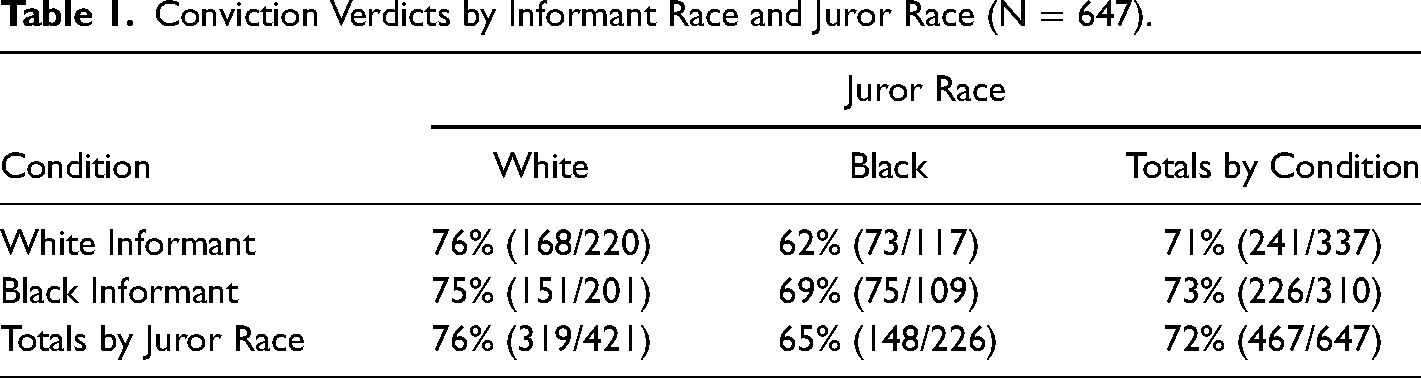
In Hypothesis 1, we predicted that Black jurors would be significantly less likely to convict the defendant overall than White jurors. Across conditions, 65% of Black jurors convicted the defendant, compared to 76% of White jurors (see Table 1 for breakdown by condition).
Conviction Verdicts by Informant Race and Juror Race (N = 647).
Perceptions of Witness Credibility by Juror Race.
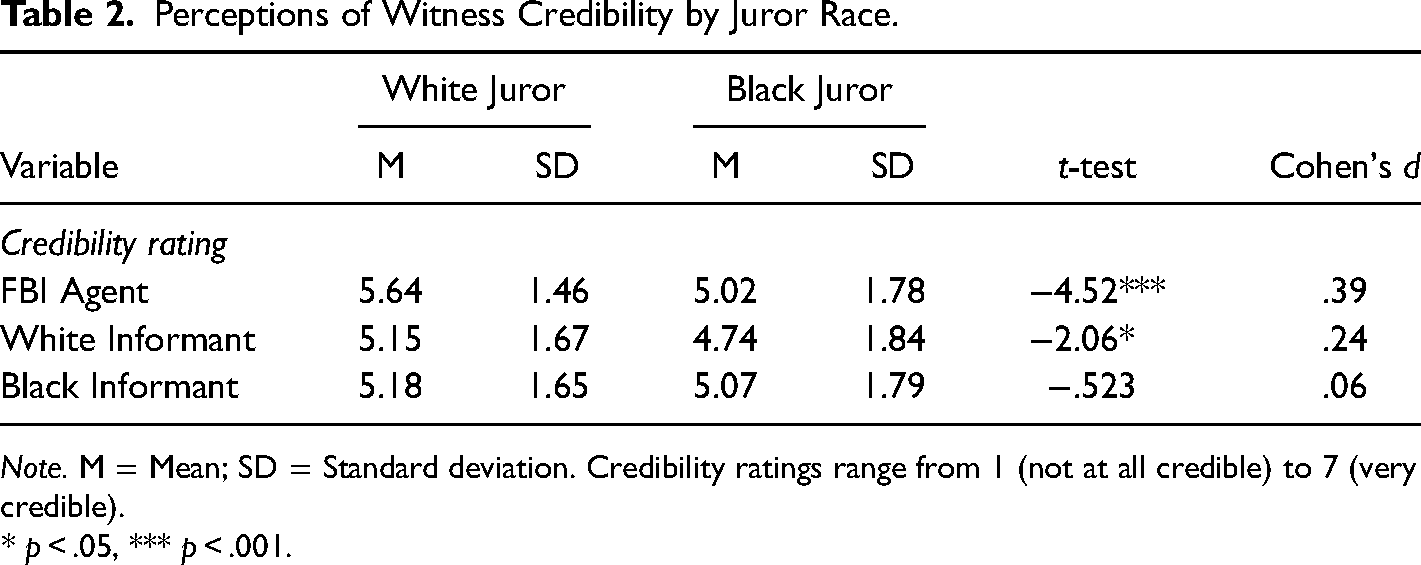
Note. M = Mean; SD = Standard deviation. Credibility ratings range from 1 (not at all credible) to 7 (very credible).
* p < .05, *** p < .001.
We ran a logistic regression with verdict (guilty vs. not guilty) as the dependent variable, and entered juror race and informant race as predictor variables. Because by design all jurors in our study self-identified as either White or Black, we used a dichotomized juror race variable to compare the responses of jurors by race (White = 1, Black = 0), and a dichotomous informant race variable (White = 1, Black = 0). Verdict responses were also dichotomous (guilty = 1, not guilty = 0). The overall model was significant χ2 (2, N = 647) = 7.78, p = .02. Juror race significantly predicted verdict outcomes (OR = 1.65, 95% CI [1.16, 2.35], Wald = 7.69, p = .006), in support of Hypothesis 1. There was no main effect for informant race, disconfirming Hypothesis 2 (OR = .93, 95% CI [.66, 1.32], Wald = .17, p = .68). Although we did not originally hypothesize about whether juror gender and race might intersect, the data indicate that the juror race effect is driven by Black women (see Figure 1). Black women significantly differed from both White men (OR = 1.75; p = .04) and White women (OR = 1.81; p = .004) in their verdicts. Black men, however, did not differ from any other group (ps ranged from .27 to .67). 2
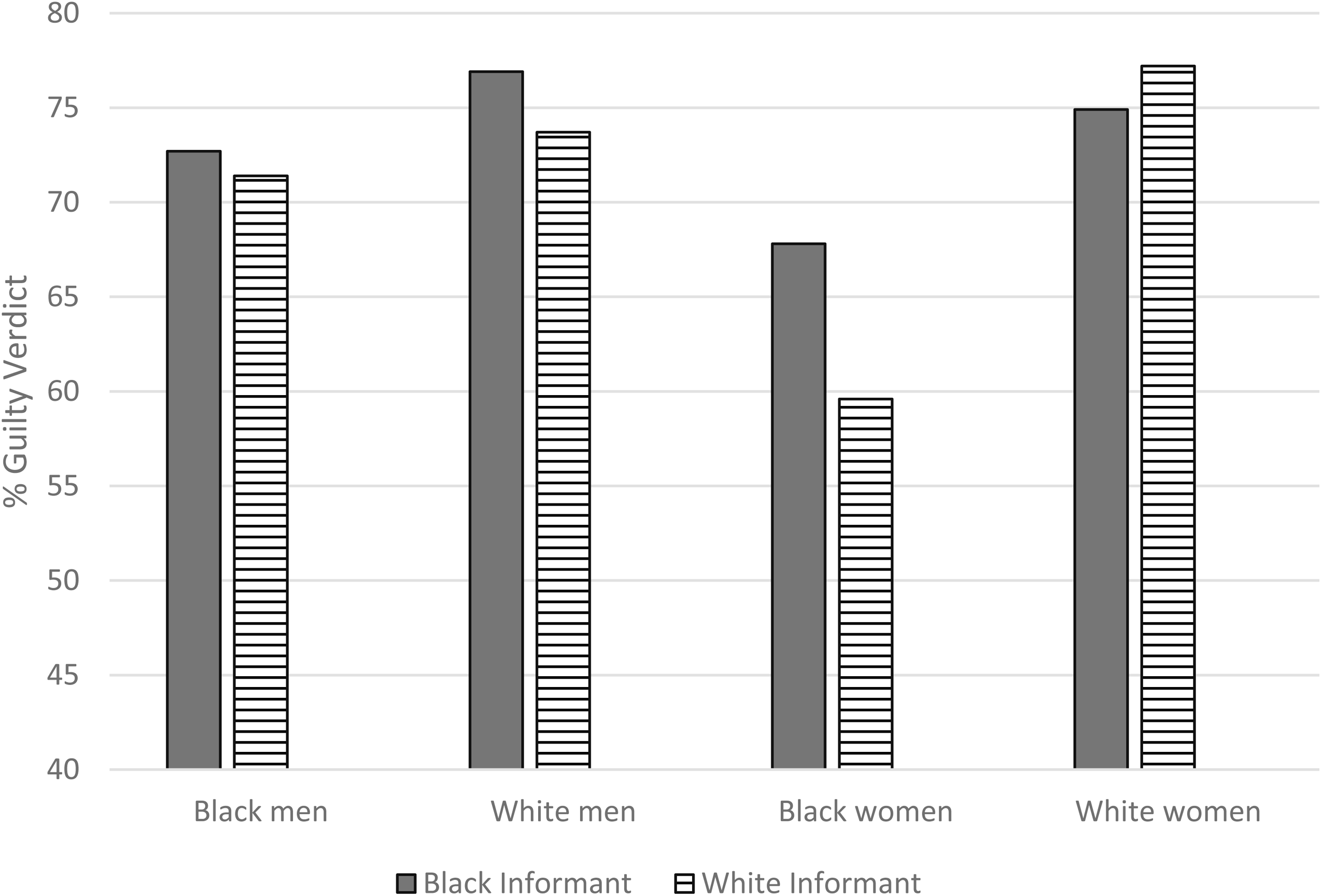
Verdicts by juror race & gender.
To test Hypothesis 3, we first examined whether Black participants in the White informant condition convicted at a lower rate than those in the other three conditions. A logistic regression specifying the Black juror/White informant condition as the reference category was run. The overall model was significant χ2 (3, N = 647) = 8.73, p = .03. Black jurors in the White informant condition had significantly lower conviction rates relative to White participants in both the White (OR = 1.95, 95% CI [1.20, 3.17], Wald = 7.21, p = .007), and Black (OR = 1.82, 95% CI [1.11, 2.98], Wald = 5.69, p = .017) informant conditions. Black jurors in the White informant condition did not significantly differ from Black jurors in the Black informant condition (OR = 1.33, 95% CI [.77, 2.31], Wald = 1.03, p = .31). We then ran a second binary logistic regression specifying the Black juror/Black informant as the reference category. Results indicated that it did not differ from the White juror conditions with either the Black (OR = 1.37, 95% CI [.82, 2.29], Wald = 1.42, p = .23) or White (OR = 1.46, 95% CI [.88, 2.44], Wald = 2.14, p = .14) informant. Again, the lower conviction rate among Black jurors in the White informant condition effect appears to be largely due to Black women, as illustrated in Figure 1. Black women were significantly less likely to convict, relative to the others, in the White informant condition (OR = .47; p = .004), whereas they did not differ from the others in the Black informant condition (p = .21).
Juror Race and Witness Credibility
Hypothesis 4, that Black jurors will view both prosecution witnesses as less credible than will White jurors, was partially supported. Consistent with our prediction, Black jurors rated the FBI agent as significantly less credible than did White jurors (see Table 2). Again, there was an interaction between the race and gender of participants (F = 4.16; p = .042). Black women (mean = 4.90) significantly differed in their mean rating of the FBI agent's credibility from both White men (mean = 5.58) and White women (mean = 5.66), but not from Black men (mean = 5.44). A two-way ANOVA that included juror race and informant race indicated that Black jurors found the informant only marginally less credible than did White jurors (F = 3.444; p = .06), and there was no main effect of informant race on credibility ratings (F = 1.644, p = .20). As is illustrated in Table 2, however, there was a split in credibility ratings of the informant, as a function of informant race. Black jurors found the White informant significantly less credible than did the White jurors, whereas there was no difference in the ratings of the Black informant. No race x gender interactions were detected in the assessments of either the Black or White informant.
Juror Race and Perceptions of Police
Hypothesis 5 predicted that Black jurors will hold more negative views of the police than White jurors across our police perceptions measures. In order to test this, we prepared several variables to examine the relationship between juror race and police perceptions. To create our measure of police legitimacy, we averaged the scores for four items derived from Hinds and Murphy (2007) and used in subsequent studies (e.g., Fedina et al., 2019; Jackson et al., 2021; Murphy et al., 2008), that were on a 5-point scale from “strongly disagree” (1) to “strongly agree” (5): “Police do their job well,” “I have confidence in the police,” “I have great respect for the police,” and “I’m very satisfied with services provided by police.” A principal component analysis with a varimax rotation was used to assess the suitability of these four items for combining into a single scale. This produced a one-factor solution with an Eigenvalue of 3.38, and the model explained 85% of the cumulative variance, indicating that the four items tap one unified construct with a Cronbach's alpha of .939. Greater scores on this composite measure indicated more a positive view of police legitimacy.
To assess perceptions of police misconduct, we created three measures of attitudes about police misconduct, using a 5-point scale from “never” (1) to “always” (5): “Police officers plant evidence—like drugs or weapons—on people they are investigating,” “Police officers lie to avoid trouble,” and “Police officers tell the truth in court.” The third item was reverse-coded, and then all three measures were averaged together to produce a single scale reflecting perceptions of police misconduct. Another principal component analysis with a varimax rotation was used to assess the suitability of these three items for combining into a single scale. This produced a one-factor solution with an Eigenvalue of 2.10, and the model explained 70% of the cumulative variance, indicating that the three items tap one unified construct with a Cronbach's alpha of .785, which is considered acceptable (Cortina, 1993). Higher scores on this misconduct measure reflect greater distrust of police officers.
To create our measure of perceptions of police fairness and equity, we used three items developed by Pew Research Center (2014) and regularly used in national polls that assess participant confidence using a 4-point scale from “very little” (1) to “a great deal” (4): “How much confidence do you have in police officers in your community to treat blacks and whites equally?,” “How much confidence do you have in police officers in your community to treat Hispanics and whites equally?,” and “How much confidence do you have in police officers in your community to not use excessive force on suspects?”. All three measures were averaged together to produce a single scale reflecting perceptions of police fairness. Another principal component analysis with a varimax rotation was used to assess the suitability of these three items for combining into a single scale. This produced a one-factor solution with an Eigenvalue of 2.53, and the model explained 85% of the cumulative variance, indicating that the three items tap one unified construct with a Cronbach's alpha of .908. Higher scores on this police fairness scale reflect greater confidence that police officers are fair and unbiased.
We then examined whether juror race predicted the composite measures of police attitudes (legitimacy, misconduct, and fairness) as hypothesized, using two-way ANOVAs that included both juror race and informant race. In each analysis, both informant race and the informant race x juror race interaction were nonsignificant, while juror race significantly predicted each of the police perceptions measures. Table 3 illustrates the means by juror race and effect sizes for the three composite measures. The effect sizes for the legitimacy composite measure and the fairness composite measure are very large (Cohen's d = .91 and .85, respectively), indicating that the differences between the groups are substantial. As illustrated in Figure 2, Black women had significantly lower police legitimacy and police fairness ratings than all the others and had significantly higher police misconduct ratings relative to White participants. Black men also significantly differed from White participants in their police misconduct and police fairness ratings. They also significantly differed from White men in police legitimacy scores.
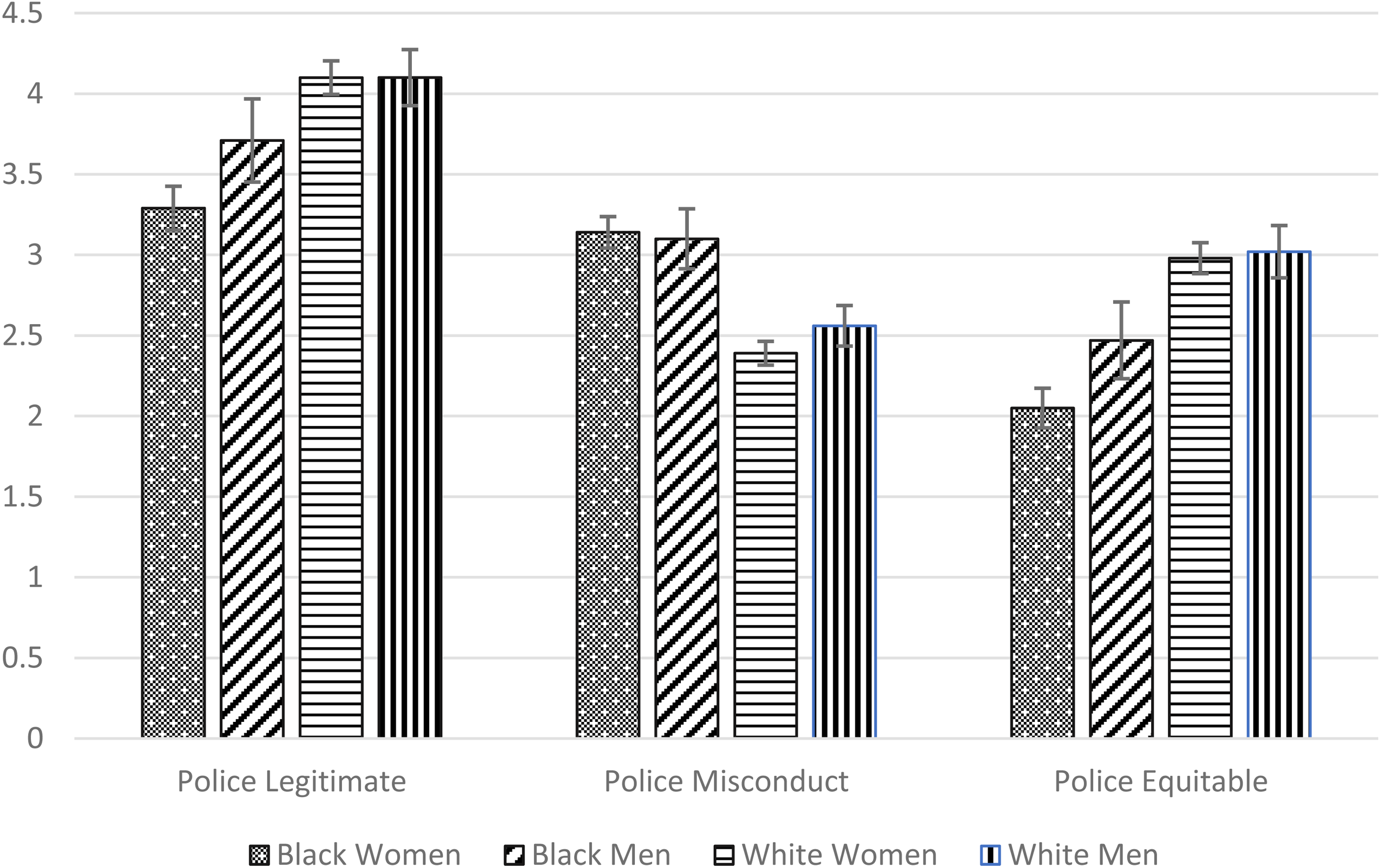
Views of police by juror race & gender. Note: Error bars represent 95% confidence intervals.
Views of Police by Juror Race.
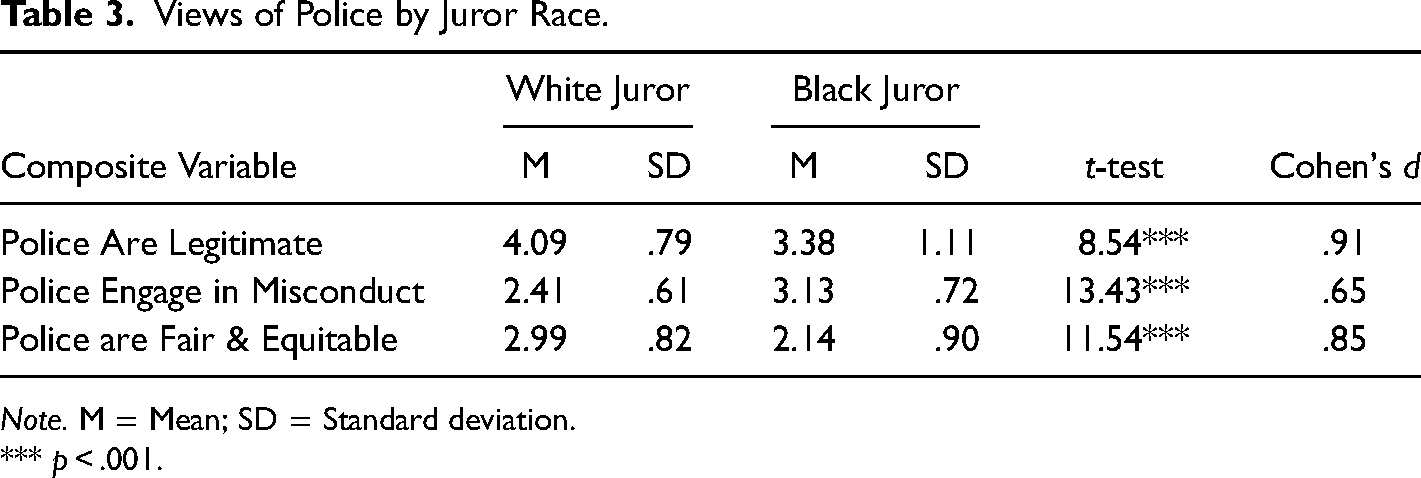
Note. M = Mean; SD = Standard deviation.
*** p < .001.
Perceptions of Police as Mediator of Juror Race Effect
A primary goal of this study was to identify a potential pathway through which juror race could shape verdict responses, in order to help explain differences by juror race in verdict outcomes, as observed in prior studies. Therefore, in Hypothesis 6, we predicted that the relationship between juror race and verdict would be mediated by perceptions of police. To test this hypothesis, we examined whether two of our composite measures – police legitimacy and perceptions of police fairness – mediated the impact of juror race on verdicts.
While we administered the perceptions measures after jurors had viewed the case and rendered their judgment, we are confident in the validity of using these two composite measures as mediators of the impact of juror race on verdicts. We assume that jurors participating in this study began with pre-existing, relatively stable attitudes toward the police on these two dimensions, and were not significantly influenced by the facts of this case toward one verdict or another (see e.g., Tyler & Weber, 1982 on stability of symbolic attitudes such as those on criminal justice issues). We also ran two-way ANOVA tests to examine if mean scores by juror race on the police perceptions measures differed as a function of informant race. They were nonsignificant (ps ranged from .37 to .57), suggesting that the study participation did not substantially impact these measures. Moreover, as Ewanation et al. (2021) have demonstrated, police legitimacy attitudes do not appear to be influenced by order of measurement. In their study, there was no significant difference in police legitimacy scores between those measured before the stimulus materials and those measured after (see also, Hayes & Rockwood, 2020). 3
Therefore, given that both police fairness attitudes and police legitimacy attitudes, especially respect for and confidence in police, represent normative attitudes that reflect broader values and that tend to be relatively stable, we examined whether these attitudes mediated the juror race effect on verdicts. Because the police misconduct composite measure includes an item about the possibility of police planting drugs or money, and one directly related to credibility (that police tell the truth in court), we did not use this measure in our mediation analysis. We reasoned that, given the fact pattern of the case, both of these may have been related to assessments of the evidence and testimony made by participants, thereby directly shaping the verdict decision. As such, this composite measure runs the risk of measuring perceptions of the case itself, rather than more deeply held attitudes.
We present a model that tests the potential for police legitimacy and perceived fairness of the police to operate as distinct mediators of the relationship between juror race and verdict. While the two scales were correlated (.633; p < .001), the two composite measures tap into different underlying attitudes. Perceptions of police fairness among Whites, and in particular, the belief that Black and White citizens are treated equally by police, are associated with measures of both explicit and “symbolic” racism, as well as with political party affiliation (Matsueda & Drakulich, 2009). Likewise, police legitimacy and its constituent components can function as an expressive or normative attitude, reflecting views about social cohesion and moral authority (Jackson & Bradford, 2009; Jackson & Sunshine, 2007; Sunshine & Tyler, 2003).
We first tested the role of police legitimacy and perceptions of police fairness on verdicts by performing a binary logistic regression predicting verdicts using juror race, the police support scale and the police fairness scale. The overall model was significant, χ2 (3, N = 649) = 39.12, p < .001. Juror race was no longer significant in the model (p = .856), while the police legitimacy scale and police fairness scale both significantly predicted verdicts (police legitimacy: OR = 1.42, 95% CI [1.14, 1.78], Wald = 9.62, p = .002; police fairness: OR = 1.30, 95% CI [1.01, 1.67], Wald = 4.15, p < .04).
We used the PROCESS plug-in created by Andrew Hayes (2022) to analyze our mediation model in SPSS to determine if the impact of juror race on verdicts was mediated by the police fairness and police legitimacy measures. As is illustrated in Figure 3, based on the bootstrap confidence intervals derived from 5000 samples, juror race was significantly associated with both police perceptions measures (police legitimacy: B = .714, SE = .076; 95% CI [.565, .862], p < .001; police fairness: B = .841; SE = .070; 95% CI [.704, .978]; p < .001), and the police perceptions measures were, in turn, significantly associated with verdict (police legitimacy: B = .353; SE = .114; 95% CI [.130, .577], p = .002; police fairness: B = .261; SE = .128; 95% CI [.010, .511]; p = .04). The direct effect of race on verdict was not significant (B = .037; SE = .206; 95% CI [-.366, .441], p = .86). The indirect effect coefficient for police legitimacy was significant (B = .252; 95% Boot CI [.082, .457]), whereas police fairness was not (B = .219; 95% Boot CI [-.005, .449]). This suggests that the relationship between juror race and verdict was mediated by perceptions of police legitimacy, thus partially supporting our hypothesis.
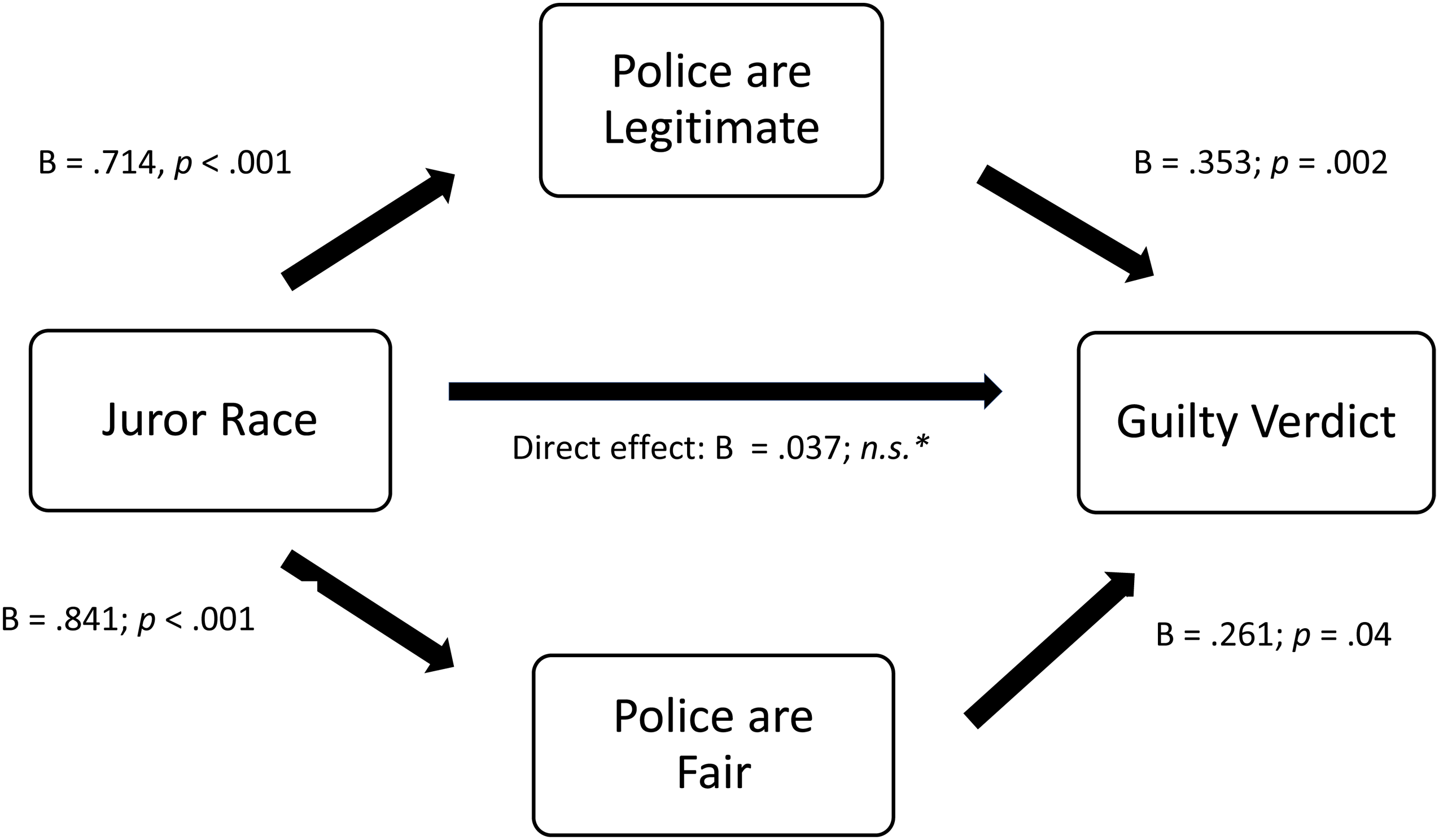
Mediation model predicting verdicts. * Indirect effect via police legitimacy: B = .252; 95% Boot CI [.082, .457]; indirect effect via police fairness: B = .219; 95% Boot CI [-.005, .449].
Discussion & Conclusion
Taken together, this study's findings link and extend three previous areas of research. Specifically, we add to the nascent body of work on law enforcement as trial witnesses, and demonstrate the role that views of police plays in predicting verdict outcomes. We also replicate the robust, well-documented finding that Black laypersons hold much more negative views of police than White laypersons, and demonstrate its effect on juror judgments. Finally, we contribute to the literature on the interaction of witness race and juror race. We also explored the intersection of gender and race in evaluation of testimony, perceptions of police, and verdicts.
Consistent with our predictions and consistent with previous work (Abshire & Bornstein, 2003; Shaw et al., 2021), White jurors behaved differently than Black jurors, especially Black women, in this study. Black women were the least likely of all groups to support a guilty verdict, and they gave lower credibility ratings to the FBI witness relative to the White participants. White participants were also marginally more likely to find the informant credible overall. Black participants were especially skeptical of the White informant witness, consistent with prior research that indicates Black jurors are less likely than White jurors to convict Black defendants when the prosecution witnesses are White (Abshire & Bornstein, 2003). The finding that Black participants found the White informant significantly less credible than did White participants and were less likely to convict when the informant was White also suggests that Black, but not White participants, may have been sensitive to the “racial ecology” of the case, wherein laypersons are sensitized to the appearance of the state ganging up on a Black defendant when all the court actors and witnesses are White (Conley et al., 2000).
Our Black and White participants also significantly and substantially differed in their views of police. Black participants expressed less confidence in and respect for police, thereby viewing police as less legitimate, relative to White participants. Black participants had less confidence that police treat citizens equally regardless of race and that they refrained from using excessive force. Finally, Black participants were more likely than White participants to expect that police engage in misconduct. Again, Black women differed the most dramatically from others in their perceptions of police, although Black men also differed from White participants in their views. In the end, the differential in views of police appeared to account for the difference in verdict decisions by juror race. Specifically, the composite measure of police legitimacy appeared to mediate the relationship between juror race and verdict choice. This suggests that differential perceptions of police can influence how law enforcement evidence is evaluated and verdicts are rendered, and this is manifested as differences by juror race. As previous research indicates, those racially divergent views, though, are at least partly produced through both direct and vicarious negative police contact that is disproportionately experienced by Black Americans (Brunson, 2007; Rosenbaum et al., 2005; Warren, 2011). Thus, racially unequal treatment by police itself influences how potential jurors orient to criminal cases.
Implications for Jury Selection & Composition
Our findings have important implications for police legitimacy in the criminal court context, especially in the wake of multiple, egregious incidents of racialized police violence, including the killings of Michael Brown, Freddie Gray, George Floyd, Tyre Nichols, Breonna Taylor, and others. These events have a cumulative impact on the public's trust in police that, coupled with citizens’ own negative experiences with police, increasingly creates challenges for prosecutors who rely on law enforcement as key witnesses. The remedy, of course, is not to rid criminal juries of all who view police with skepticism. That effectively “whitewashes” (Semel et al., 2020) criminal juries, ensuring that Whites are over-represented, and potentially colliding with constitutional protections for both defendants (Batson v. Kentucky, 1986; Foster v. Chatman, 2016) and citizens who come to serve (J.E.B v. Alabama, 1994). Such a strategy also runs the risk of seating juries whose members will disproportionately harbor racial bias (Matsueda & Drakulich, 2009) and/or who are blind to racial inequities in the system (see generally, Hetey & Eberhardt, 2018), which is especially a threat to fair justice for Black defendants. Moreover, given the divergent constitutional make-up of attitudes about the police, with White support associated with measures of White racial identity, and racial bias and resentment, and Black cynicism and estrangement associated with experiential knowledge about how police treat those in poor and Black communities (Bell, 2017; Brunson & Miller, 2006), removing jurors due to their skepticism about the police runs the high risk of seating a biased jury.
Rather, it is critical that juries represent the diversity of the communities from which venire members come. As such, they can bring a race-conscious (Do, 2000) lens to the decision-making task, that may well include a variety of prior experiences with, and understandings of, police. Diversity in the jury room improves the quality of deliberation (Sommers, 2006), and can ensure that the jury functions in its democratic role as a check on state power, including that wielded by police (Carroll, 2015). To that end, as more members of the public come to recognize and condemn anti-Black police violence and other forms of biased law enforcement practices (Pew Research Center, 2020), it may be that the jury will become a more robust democratic check on justice system bias in an era of declining police legitimacy.
Ultimately, our findings suggest that the legal processes that are used to excuse jurors from service, either peremptorily or for cause, need to be reconsidered to ensure that views of police, included those rooted in actual experience or knowledge about the problems with fair and just policing, are not used to disproportionately exclude persons of color, or to seat juries overrepresented by people who blindly trust and support police (Hetey & Eberhardt, 2018). Recent policy developments in several states, beginning with Washington, have done just that. In 2018, the Washington State Supreme Court adopted General Rule 37, which declares that the use of peremptory challenges to remove venire members for “having prior contact with law enforcement officers; expressing a distrust of law enforcement or a belief that law enforcement officers engage in racial profiling; [or] having a close relationship with people who have been stopped, arrested, or convicted of a crime” is presumptively invalid, as those reasons unfairly exclude jurors based on race or ethnicity (Washington Courts, n.d., pp. 1–2). The California legislature subsequently enacted A.B. 3070, modeled after General Rule 37, to strengthen protections against discriminatory juror exclusion on the basis of race or ethnicity. It includes this same language, declaring peremptory challenges used to excuse potential jurors for views of, and experiences with, police to be presumptively invalid (California Legislature, 2020).
Limitations & Future Directions
This study is not without limitations. First, we only examined one type of crime—an arranged drug conspiracy that was set up by law enforcement—that may have been especially likely to produce skepticism about both the FBI agent and informant, particularly for a Black defendant, as in our scenario. This scenario directly called on our participants to consider system actors’ veracity in making a verdict determination. And, as is the case with all juror simulation studies, external validity is a limitation with regard to both consequentiality and engagement. In particular, unlike our previous study upon which we are building, this study collected participant data exclusively online, and did not include a group deliberation component. Although individual verdict preferences have been shown to be a consistent predictor of group outcomes (Devine, 2012), it is possible that the results would vary if a group deliberation component was used (see Garcia et al., 2021; Salerno & Diamond, 2010). Participants in this study were also aware that they were not actually reaching a verdict that would impact the life of a real defendant, and it is possible that jurors would be more attentive to a trial scenario with actual consequences for the defendant (see Bornstein & McCabe, 2005). At the very least, this is a feature that distinguishes experimental jury research from actual trials. This online participant group also appears to be relatively well-educated, with 75% having at least some college education, and it was more Democratic than the nation's population (Gallup, n.d.). However, prior research suggests that differences between online and in-person studies tend to be minimal (see Irvine et al., 2018).
We also want to reiterate that our findings in regard to the intersection of race and gender are exploratory, and were not part of our original hypotheses. Consequently, among other concerns, we do not have sufficient power, especially regarding Black men as a subgroup, to draw conclusions about their relative role in the overall race effects we found. It is clear, however, that the findings related to Black women were robust, to the extent that they stood out in their negative views of police, assessments of the FBI witness, and in their verdict determinations.
These findings suggest several future lines of research. First, given the juror race effects we obtained in this and our previous study (Shaw et al., 2021), it is imperative to further examine whether attitudes about law enforcement, and justice system fairness more broadly, underpin the differences between White and non-White potential jurors. Our study was one step in this endeavor, but more work remains to be done using different kinds of cases, including civil matters related to law enforcement (such as civilian lawsuits against police agencies). And to the degree that some White Americans’ support for law enforcement, and denial of system bias, is associated with forms of racism (Carter et al., 2016; Matsueda & Drakulich, 2009), it is critical to further examine how jury diversity may mitigate the risk of biased decision-making. In addition, while we did not set out to examine how juror race intersects with gender, it does appear that Black women, in particular, drove the differences in verdicts, and were the least supportive of guilt in the White informant condition. Thus, future studies should further explore how race and gender intersect in juror judgment. Finally, while we can hypothesize that increased sensitivity among the public to the problem of anti-Black bias by criminal justice actors may reconfigure how juries evaluate cases and come to verdicts in cases that rely heavily upon law enforcement-generated evidence, future studies should more directly test whether different kinds of law enforcement-generated evidence may raise doubts about its veracity or credibility, especially when the defendant is Black.
Footnotes
Author's Note
Emily V. Shaw is also affiliated at Decision Analysis, Inc., Topanga, CA, USA.
Declaration of Conflicting Interests
The author(s) declared no potential conflicts of interest with respect to the research, authorship, and/or publication of this article.
Funding
The author(s) disclosed receipt of the following financial support for the research, authorship, and/or publication of this article: This work was supported by the National Science Foundation (grant number 1624943), and National Institute of Justice (grant number 2017-IJ-CX-0044).
