




Abstract
This paper presents in-depth research into the reading lists used by a new criminology Bachelor of Arts degree programme at a post-92 English University. Previous research into structural inequalities in relation to race, ethnicity, and gender that exist within academia in relation to scholarly outlets, and that have focussed on scholarly influence, have charted the most cited or most significant texts in the field or explored gender and race discrepancies within elements of the publication process. In this paper we explore how scholarly work is included in our teaching practice and the impact reading lists have on the student experience of criminology. We highlight a distinct lack of representation and diversity within the authorship of texts in the context of both core and recommended reading for students. We found reading lists to be overwhelmingly white and male. Work by women and people of colour only tended to feature on distinct modules which focussed on gender or ethnicity, race, and crime. Voices from the global majority are excluded from fundamental concepts and criminological theory modules. This paper will discuss our research findings in depth, highlighting where Black and female voices are neglected, marginalised, and excluded in the criminology curriculum.
Introduction
The colonial nature of criminology and the white, male, straight, cis-gendered lens through which criminological topics have been viewed, alongside the impenetrable focus on the global north, has long been problematised (Agozino, 2003; Blagg & Anthony, 2019; Carrington et al., 2018; Connell, 2007; Cunneen & Rowe, 2014; Parmar, 2017). Numerous calls to action from feminist and critical race theorists (Carpenter et al., 2021; Coyle, 2010; Cunneen & Tauri, 2016; Walklate et al., 2020; Wonders, 2020) have meant that some space within the discipline has been reclaimed, however, the criminology curriculum remains overwhelmingly white and male. This paper presents analysis of reading lists to highlight that in our teaching of criminology the space for marginalised and excluded voices is discrete, issues of race and gender are contained within specific specialist modules or limited to certain weeks of teaching.
This research is part of an ongoing body of work exploring the criminology curriculum. As two white, working class, female academics working at predominately white institutions (in terms of staff, students, and governance) in the United Kingdom (UK), we were inspired to start this work because we were teaching on a new criminology programme developed at a university that espouses social justice: the rainbow pride flag flies high; trans-inclusive spaces and policies for staff and students were being created; there were attempts to address the gender gap, albeit with deep-rooted structural inequalities still impacting; but where there was a distinct inability to see whiteness (Eddo-Lodge, 2018). We were inspired by Arday and Mirza (2018) and a talk that they gave on ‘Dismantling Race in Higher Education’ at Durham University (on 01/03/2019) which urged us to take collective responsibility; and highlighted that white academics need to push for change and not force academics with identities which have been racialised and oppressed to take on all the work required to make change happen. They argued that decolonising the university is much more than throwing out the work written by dead white men, instead it is about allowing those who are excluded and marginalised to have a voice. We thereby began this project by exploring whose voices were represented, who was marginalised and who was excluded, with a focus on intersectionality in relation to gender and ethnicity, whilst also recognising other intersections, for example, class, sexuality, and gender identity. In this paper we look to, and acknowledge, the academic and emotional work that has already been done by Black and feminist scholars and present new empirical data to demonstrate how, despite this work, little has changed within our criminology curriculum. In order to do this research, we have had to categorise our academic colleagues as they either identify as, or are perceived to be, men or women, and white or Black and Minority Ethnic (BME). It is this perception in relation to gender and ethnicity that allows for analysis of the structural inequalities happening within the curriculum. We have used the term BME because it is used officially in the UK as an umbrella term for individuals and communities, living and working in Britain, that have historically been racialised and marginalised due to their ethnicity, race, culture and/or religion (Mirza, 2018: 4). While the implied aim of establishing the term BME officially, via UK government sources, is to enable racist and prejudicial language rooted in Britain's colonial traditions to be eliminated, this new terminology remains problematic (Alexander, 2017; Mirza, 2018). Although we use the term in this paper, we wholly recognise that racial, ethnic, and religious identities are complex and entrenched amongst ‘social, political, historical and symbolic’ circumstances (Hall & Schwartz, 2017, p. 6). Fundamentally, the construction of race, and associated discourses, in the UK have continuously been and, even with the term BME, remain ‘complex and troubled’ (Hall & Schwartz, 2017, p. 194).
Previous research has examined the structural barriers deeply embedded within academic publishing and knowledge production in criminology and criminal justice (Fahmy & Young, 2017; Potter et al., 2011). Research highlighting the exclusion of African American scholars’ contribution to criminology and criminal justice was documented by Young and Sulton (1991). In a follow-up study a decade later, Gabbidon et al. posit that significant developments were taking place, particularly in relation to the greater accessibility and availability of African American scholarship giving the discipline less of an opportunity to say ‘I just didn't know this literature was out there’ (2002, p. 389). Yet research shows that white and male authors still dominate the mainstream texts (Gabbidon & Martin, 2010). This paper therefore explores which texts have been incorporated into reading lists and are being used by students studying for a criminology degree in an English University. We will present our research findings in the context of commodified Higher Education in the United Kingdom and the expansion of criminology as a discipline to critically discuss the causes and consequences of the lack of diversity within criminology course literature. Whilst reading lists are only one small (and some would argue tokenistic) part of decolonising the criminology curriculum, our analysis highlights how new criminology programmes are being developed and validated, and a full programme of teaching is implemented that perpetuates global minority views. This paper aims to make visible the extent to which current criminology courses are excluding and marginalising Black, female, and intersectional voices. We argue that criminology needs to pay greater attention to the literature drawn on here to facilitate criminological teaching and learning.
Literature Review
Higher Education
‘Education and liberation were always bound together’ (Davis, 1998, p. 316). Indeed, Higher Education (HE) has the potential to be transformative by providing learners with the consciousness, understanding, and means to question the domination of capitalism as well as the related production of harmful and divisive ideologies (Brookfield, 2003; Davis, 1974). Both Davis and hooks highlight the importance of transformative education being an inclusive and group process which must recognise and act against the ideological domination which operates through education (Brookfield, 2003; Davis, 1974; hooks, 1994). Yet, increasingly, the HE sector in the United Kingdom, like in many countries internationally, is impacted significantly by the continued advancement of neoliberalism (Bottrell & Manathunga, 2019; Heller, 2016; Maisuria & Cole, 2017). Neoliberal political and economic ideology, which has been applied and advanced in the UK since the 1970s, centres on market rule, reduction in public spending on social services, deregulation, privatisation, and individualisation (Garland & Sparks, 2000; Maisuria & Cole, 2017; Martinez & García, 2000). Application of such principles to the HE sector has transformed the way that universities function (Bottrell & Manathunga, 2019). Principally, universities have become market competitors, promoted by state and corporate actors, to directly participate in ‘economic productivity of the country’, and commodify academic knowledge (Barton et al., 2010; Frauley, 2005; Maisuria & Cole, 2017, p. 604; Tombs & Whyte, 2003). Corporatisation of universities has developed considerably in the UK over the last two decades resulting in a new HE context (Winkle, 2014). As Maisuria and Cole highlight, ‘UK universities are now part of the Department of Business, Innovation & Skills’ suggesting that ‘HE is subsumed under a broader remit beyond education for education's sake’ (2017: 606).
Alignment of the HE and business sectors in the UK, in terms of governance and principles, has significantly impacted the conditions in which academic knowledge, teaching, and learning exist and operate. Reforms to English universities in 2012 saw tuition fees rise to £9,000 per year, and simultaneously the UK government initiated the relaxation of its controls over student enrolment numbers (Murphy et al., 2019). By 2015, all restrictions regarding the number of students that universities were allowed to enrol had been removed (Murphy et al., 2019). Resultantly, it is in the interest of universities, as profit orientated corporations, to enrol as many students as possible, and regardless of increased fees, student numbers continue to rise (Murphy et al., 2019). Marketisation and privatisation of HE in the UK has not only caused an increasing number of students attending university, but it has also resulted in new, corporate like, methods to continuously assess and rank universities in the name of Quality Assurance (Maisuria & Cole, 2017). While universities in the UK have historically been required to uphold benchmarks set by the QAA (Quality Assurance Agency for Higher Education), in recent decades, additional corporate orientated measures have been introduced, such as: The Research Excellence Framework (REF), The Teaching Excellence Framework (TEF), and the National Student Survey (NSS). Ultimately, these measures provide multiple ways in which universities, departments, and individual academics, can be ranked in terms of teaching and research. As Barton et al. (2010) argue, the marketisation of HE has changed both the purpose of academic work and students’ expectations of a degree. In doing so, neoliberalisation of HE accentuates and perpetuates structural inequalities for academic staff and students by positioning economic value over knowledge development.
Such changes to HE, particularly the removal of restrictions on enrolment numbers, aimed to improve access to university education for people from a range of backgrounds (Department for Business, Innovation and Skills, 2014). In principle, the neoliberal academy, centred on equal access and opportunities for all, should benefit the pursuit of liberating, inclusive, and transformative education. However, corporate quality assurance measures imposed on HE in the UK, combined with profit-orientated decision making, arguably encourages the facilitation of what Freire (1970) termed ‘banking education’. Through this process education ‘becomes an act of depositing, in which students are the depositories and the teacher is the depositor’ (Freire, 1970, p. 45). In this context students, paying for HE in pursuit of skills and understandings to enable successful employment, understandably prioritise employability over knowledge for knowledge's sake and view their degree somewhat as a transaction (Barton et al., 2010; Freire, 1970). For academic staff, the neoliberal university breeds uncertainty through the casualisation of academic work, precarious contracts, and continuous measurement of their ability to supply ‘quality’, measurable, research and teaching (Lopes & Dewan, 2015; Maisuria & Cole, 2017). Such conditions and experiences, for both staff and students, arguably do not support the development of already marginalised individuals to succeed in academia. Nor do the constraints placed on education by commodification support the development of curricula which is anti-racist and intersectional.
Just as profit-orientated HE promotes the transactional nature of learning, and arguably changes the perception of academic knowledge among students, so too does it impact the conditions in which academic staff work. Increasingly academic teaching and research contracts are temporary (fixed term) rather than permanent (open ended), impacting academics’ work life quality, working conditions, wellbeing, career prospects, and approaches to teaching (Fontinha et al., 2018; Lopes & Dewan, 2015); The use of temporary employment contracts impacts the career of women academics more so than men (Bryson, 2004). Lopes and Dewan (2015, p. 30) highlight that the negative impacts of neoliberal HE affects BME staff more than non-BME staff. Indeed, BME staff academics and researchers report that they often experience discrimination based on their race, isolation, high workloads, poor support in relation to professional development, and higher levels of scrutiny than white colleagues (Lopes & Dewan, 2015; Mirza, 1997; Wright et al., 2007). Further, the precarious nature of work for many academics impacts their approach to planning, designing, and delivering teaching (Lopes & Dewan, 2015). Particularly, the amount of time that academics have to prepare lectures and curriculum content prior to delivery, the need to take on modules which are not within an individual academic's specialism, and limited access to relevant resources or lack of time to access such resources (Lopes & Dewan, 2015). Therefore, not only can conditions within the neoliberal academy impact the wellbeing and working environment of many academic staff, it also does not provide a situation which supports the creation and development of an effective, thorough, curriculum.
The Role of Reading Lists
Reading lists continue to be central to teaching and learning in HE in the UK, primarily reading lists facilitate knowledge development which Freire suggests ‘emerges only through invention and re-invention, through the restless, impatient, continuing, hopeful inquiry human beings pursue in the world, with the world, and with each other’ (1970, p. 45). Freire (1970) noted that reading lists, which set resources that students should engage with during their studies, can potentially transform topics for students through enquiry and exploration. By encouraging students to explore and understand new ideas and perspectives, prescribed reading can bring topics to life and inform students in new ways (Freire, 1970). In doing so, reading lists can positively support the production of knowledge, which, as Freire argues, should develop through ‘authentic education’ which ‘gives rise to views or opinions’ about the world (1970, p. 66). However, Freire (1970) highlights that reading lists can also have a negative impact on education by promoting ‘banking education’, encouraging students to passively learn what is prescribed to them and not to authentically understand, explore, and question topics or existing knowledge. Reading lists are often underappreciated yet constitute an important component within the relationship between students and academic staff (Brewerton, 2014; Swain, 2006). Therefore, while reading lists are central to the teacher/student relationship in higher education, they can have both positive and negative impacts on the learning experience and production of knowledge (Freire, 1970).
Regardless of the way reading lists produce knowledge, they have been, and continue to be, an enduring element of ‘most institutions of higher education in the UK’ (Brewerton, 2014: 78). Yet, like many other aspects of the academy that have transformed in recent decades, the role of reading lists has changed (Stokes & Martin, 2008; Swain, 2006). While academic literature regarding reading lists in higher education is lacking, changes to their role has been attributed to technical advancement, different contexts and experiences of learners, introduction of validation and quality assurance measurements, and the altered structure of reading lists (Stokes & Martin, 2008). As Stokes and Martin highlight, the traditional ‘notion of a student “reading for a degree”, in a changing world of higher education … has grown considerably more complex’ (2008, p. 113). The pedagogical value of reading lists is often unrecognised by lecturers, Brewerton (2014) argues institutions need to recognise their importance and develop formal strategies and best practice guidelines.
Important to this paper is the development and governance of reading lists. Whilst guidelines may exist in some institutions and are developing within some academic communities, for instance Wendy Belcher and Kishonna Leah Gray-Denson's inclusive citation test, or ‘Gray Test’ which sets the minimum standard that ‘a journal article must not only cite the scholarship of at least two women and two non-white authors but also mention it meaningfully in the text’ (Belcher, 2019, p. 184), the only current scrutiny and oversight of course content is at programme validation. Here we shall explore the influence of the validation process on the way reading lists are produced. Programme validation, also referred to as programme approval, is a ‘formal process through which a degree-awarding body [e.g., university] decides that a programme of study (content, teaching/learning and assessment) is of appropriate standard and quality to lead to one of its qualifications’ (QAA, 2018, p. 27). All modules which make up a degree programme must be audited as part of the validation process (Stokes & Martin, 2008). Therefore, during the validation of each module within a programme the corresponding reading list is scrutinised by the academics validating the module (Freeman & Parker, 2004; Stokes & Martin, 2008). However, the specific criteria used to scrutinise reading lists as part of the validation process are not stipulated, and there is ‘little in-depth discussion of the principles, or discussion of the perceptions and assumptions which underpin […] debates’ regarding the contents of reading lists during the validation process (Stokes & Martin, 2008, p. 115). Thus, the validation process for modules, and degree programmes, does not require that specific consideration is given to voices and perspectives included within reading lists. Decision making regarding the validation of reading lists is at the discretion of academic staff within the respective criminology department. Resultantly, there is no top-down mechanism which aims to ensure that validated criminology degree programmes include the perspectives of academics and authors from a range of backgrounds.
Academic Publishing
A further critical element to consider is that of ‘gatekeeping’ within academic publishing itself i.e., whose works are published in the first place. In exploring the lack of representation and diversity in the content of criminology reading lists it is important to understand and acknowledge the deep structural inequalities within academic publishing. Whilst these are widely recognised and discussed in relation to STEM (science, technology, engineering, and maths) subjects, there is less research within the social sciences. Yet, a substantial gender gap in relation to criminological publications has been established. Both gender and race impacts on scholarly productivity with men and white faculty in criminology/criminal justice programmes having greater number of publications compared to women and faculty of colour (Potter et al., 2011). Criminological ideas by people of colour, women (and intersections of these) are less likely to be published and cited: criminology presents an imperialist version of crime and justice (Agozino, 2003; Blagg & Anthony, 2019) and masculinity bias within criminology has limited women's representation (Belknap, 2015; Eigenberg & Whalley, 2015). Citation tracking is a useful tool to examine the growth of knowledge within criminology (Cullen, 2015) and can give insight into what the field values (Graham et al., 2019, p. 349) and the influence in directing the field's research, scope, and direction (Cohn et al., 2020, p. 581). Cullen argues that citation analysis is an ‘under-utilized tool for unravelling the onset, persistence, and desistance of criminological ideas’ (2015, p.13). Yet, for a citation to be made, the work first needs to appear in print, be read by scholars, deemed worthy of being cited by those scholars, and then time must be given for the new article to be published and references electronically indexed (Graham et al., 2019, p. 349). Citations are therefore socially produced (Cullen, 2015, p. 12) and have the same structural inequalities embedded within the processes as those which exist within society.
Research to understand the most significant works, both journal articles and books, in criminology and criminal justice have established that white and male voices continue to dominate. Graham et al. (2019) considered journal articles published between 2010–2015 tracked for ‘early onset’ of impact (i.e. the measurement of growth and transmission of knowledge through citation factors) and highlighted that ‘scholarly influence in criminology and criminal justice [as with other academic fields] is ‘highly concentrated’ with male authors comprising two thirds of the highly cited works examined, with this figure rising to seven in 10 for first authored works’ (2019, p. 361–2). Research by Cohn et al. (2020) exploring the top ten most cited scholars across six leading criminology and criminal justice journals between 1986 and 2015 also supports this finding with most-cited scholars being ‘overwhelmingly’ written by men and that nearly all are white or white-presenting. Moving beyond journal articles we can see that similar patterns exist when tracking the most significant books in the field (Gabbidon & Martin, 2010). Providing a comprehensive analysis of books considered by faculty staff in American universities as ‘essential reading’ for students and scholars in criminology and criminal justice Gabbidon and Martin (2010) specifically consider the most significant books by women and minorities in their analysis. Their findings show the discipline's focus on traditional ‘mainstream’ work, and urges that classical works by African-American scholars and women be included into the criminological canon (Gabbidon & Martin, 2010, p.365) What is important to note is that research highlighting the dominance of white and male scholars in the field four decades ago also provided readings and resources (Barak, 1991; Young & Sulton, 1991), yet follow up research shows that whilst there has been some progress (Gabbidon et al., 2004) texts by white men still dominate the discipline (Gabbidon & Martin, 2010).
Exploration of editorial boards gives further insight into gendered and racial inequalities across the publication process. The gender composition of editors and editorial boards in top criminal justice and criminology journals from 1985–2017 showed just 14% of all Editors-In-Chief are women (Lowe & Fagan, 2019). Research by Young and Sulton (1991) highlighted how African American scholars were excluded from editorial boards; follow up analysis by Gabbidon et al. (2004) a decade later showed 16 African American scholars had served on editorial boards of the leading criminology and criminal justice journals since 1992, yet some journals still had no representation. Importantly when an African American does serve as an associate or deputy editor on an editorial board then African American representation increases (Gabbidon et al., 2004, p. 395). Research by del Carmen and Bing (2000) found the number of publications in criminology and criminal justice journals is not representative of African and American scholars in the field, of the 2,328 issues across 600 journals published between 1987 to 1998 only 36 publications (2%) were by African American authors. del Carmen and Bing cite numerous reasons for this under-representation including reservations about the treatment of journal editors, ‘editorial resistance’ to work by African American scholars, and questions regarding ‘biased processes’ including how anonymous peer-review processes are in practice (2000, p. 247). Similarly, Lowe and Fagan's research shows the impact that representation on the editorial team has on papers published: criminology and criminal justice journals with no female editors have the fewest number of papers by women (2019, p. 428). Furthermore, Eigenberg and Whalley (2015) highlight the importance of analysis where women's voices are published; their research shows that women comprise 34% of the authorship of mainstream criminology and criminal justice journals, yet in two specific feminist journals analysed they make up 72–76% of the authorship. It is therefore important not only to consider if voices from those historically marginalised are featuring within the academy but where.
In conclusion, there are clear structural barriers and biases within academic publishing, these influence what is published, where it is published, and what is deemed significant. The publication of texts is the final stage of deep-rooted inequalities; the UK system both contributes towards a discriminatory working environment for academics of colour and women (thereby hindering research and publication opportunities) and promotes a transactional learning environment for learners and educators. In doing so, the HE sector itself accentuates and perpetuates structural inequalities. Reading lists are one element of this, yet they have an important role in the production of knowledge in teaching and learning. There have been numerous attempts to highlight the biases inherent within criminology as a discipline, and in the works that form the mainstream of the discipline. There has been some progress with some journals diversifying their editorial boards and publishing more work by women and scholars of colour. Equally some books by authors of colour, and women are receiving some recognition for their significance and contribution to the field. Yet there has been little exploration as to how that translates into teaching, and which works are being recommended as essential reading for students. This is particularly important in a UK context where there has been a significant growth in the number of criminology courses and number of students studying criminology. Given the relative freedom of academic staff to select and include material from a wide range of resources for reading lists, an in-depth analysis of reading list content helps to understand how and where biases may be perpetuated in teaching.
Methods
The university where this research took place centres its mission on inclusion, equality, and diversity. Given this university-wide objective and that, as explained, the undergraduate criminology degree involved in this research was new to the university, the researchers believed that this offered an important opportunity to examine inclusion and diversity within the criminology curriculum. While the research taking place in relation to one undergraduate criminology programme means that this is a small study, in the context of criminology curricula in UK HE more broadly, it provides an important starting point to consider the voices included in new criminology courses. This study examined the composition of core reading lists for all modules offered as part of a new undergraduate criminology degree (BA) programme at a post ‘92 university. In the UK a post ‘92 university refers to a Higher Education institution, such as a polytechnic or college, which was given university status following reforms to the Higher Education sector via the UK government's Further and Higher Education Act 1992 (Armstrong, 2008). The university where this study took place was previously a teaching and education college with a 175-year history. The former teaching college was given university status in 2006, and the criminology degree programme launched in September 2016. When established, the programme faculty comprised of three academics, this had grown to approximately 17 academics when the research took place. The faculty was predominantly male and wholly white. In the UK prior to a degree programme being offered, all modules must go through a curriculum validation process to ensure the course is well-designed and provides a high-quality academic experience for students (QAA, 2018). Programme re-validation then takes place every five years following the initial validation (QAA, 2018). The process of programme validation and revalidation involves internal programme and departmental leaders as well as external subject specific academics who are invited by the department to review the programme.
This study involved the collection and analysis of module reading lists submitted and validated as part of the programme certification process. Reading lists at this point are indicative and produced by the programme teaching team. Any consultation with subject librarians would typically be in relation to cost and availability of texts. In total 105 core texts were submitted in the validation process, made up by approximately five texts submitted for each of the 13 core modules, and eight optional modules. Some (n = 14) of the indicative texts were suggested for more than one module, meaning there were 91 different texts in all: it is not uncommon for criminology textbooks aimed at supporting undergraduate learning to appear on the reading lists across a range of modules. In the UK undergraduate criminology degree programmes occur over a three-year period (for students enrolled full time on their degree programme). In the first and second year, students are required to complete six modules, completion of which enables students to receive 120 credits (QAA, 2021, p. 6–10). In the third and final year, students undertake a 40-credit independent study (or ‘dissertation’ module) and four optional modules. By the end of the three-year degree students must have completed a total of 360 credits to be awarded a BA (Hons) degree in Criminology (QAA, 2021, p. 6–10). During a three-year criminology degree programme students are typically offered a mixture of core and optional modules to undertake each year. A module within a degree is defined as ‘a self-contained, formally-structured, credit bearing learning experience with a coherent and explicit set of learning outcomes and assessment criteria’ (QAA, 2021, p. 2). Core modules refer to those which a student must study as part of their degree programme. Optional modules are those which students can choose to study as part of their degree programme. Undergraduate students are commonly given the opportunity to choose from a group of optional modules to take as part of their degree programme. At the university studied, all modules in the first and second year were compulsory core modules, taken by all students. In their final year of study students had a choice of eight optional modules, of which they could select four. The independent study module ran alongside these as a year-long core module. Regardless of the number of core and optional modules offered within an undergraduate criminology degree, all modules studied must make up a total of 120 credits per year of study, and thus 360 credits by the end of the three-year BA Criminology degree (QAA, 2021, p. 6–10).
As outlined above, of the 105 main texts put forward for programme validation 14 featured on more than one module reading list. To analyse the authorship of readings put forward for each specific module and for each year of study, duplicates are included to show the selection of texts presented for validation: five indicative texts for each of the 21 modules. Following this initial analysis of the main texts submitted as part of the programme validation process, further analysis was carried out on the full module reading lists in relation to two core first year modules: ‘Key Concepts for Criminologists’, and ‘Fundamentals of Criminological Theory’. These were selected to provide in-depth analysis exploring the full reading list that students received when studying these topics, and to understand how reading material might develop from the point of validation to delivery. At the time of teaching delivery, the ‘Key Concepts for Criminologists’ reading list encompassed 19 essential readings and eight recommended readings, and ‘Fundamentals of Criminological Theory’ contained 16 essential texts and five recommended. While this analysis involved the full reading lists for these modules, it did not relate to any additional readings which were not formally listed, such as readings discussed in lectures or sources suggested by academic staff delivering seminars and/or lectures for the modules.
Reading list data was collected and stored using an Excel spreadsheet. All texts included in the reading lists analysed were coded in terms of the name and code of the module in which it was included; the year of the degree programme in which the text was included; the type of module (either core or optional); and whether the text was essential, recommended, or optional reading. Data from each text, included in all reading lists analysed, were categorised in relation to the name of the author, perceived gender, and perceived BME status. Where texts involved more than one contributor, each author was coded individually as first, second, third, or fourth author. Categorising the perceived gender and perceived BME status of authors in this way was informed by previous research (see Bird, 2011; Eigenberg & Whalley, 2015; Taylor et al., 2021). Authors were categorised by their perceived gender as either woman, man, transgender, or non-binary as stated or inferred from publicly available information about them such as first name, pronouns, and/or photographs (Bird, 2011; Eigenberg & Whalley, 2015). The perceived BME status of authors was used as a category rather than perceived ethnicity due to understanding that ethnic identity is complex, and therefore it would not be possible to correctly, and/or full, appreciate the ethnic identity of each individual author (Taylor et al., 2021). Thus, perceived BME status was collected in terms of if an author, through inference of publicly available information, was ‘yes’ perceived BME or was ‘no’ not perceived BME (Taylor et al., 2021).
Limitations of the Study
We recognise that by examining the readings provided as part of only one undergraduate criminology BA (Hons) degree programme this study is small and not representative of all undergraduate criminology programmes offered in England. As previously highlighted, the department, and university, in which this research occurred was predominantly white in terms of staff and students. Therefore, arguably the demographic makeup of the department which developed the reading lists could have influenced our findings regarding the choice of authors and texts attributed to specific module reading lists. Potentially, had the department been more diverse, in terms of ethnicity and gender, faculty members may have been more aware of and engaged with authors and texts from a wider range of backgrounds and lived experiences. If there had been scope and resources to consider a greater number of undergraduate criminology programmes in England within this project, we could have explored the influence of faculty characteristics on text inclusion specifically. However, unfortunately, this was not possible within this study. Academic staff may bring either whole modules or module content with them if they have developed these at other institutions, and suggested material and readings are frequently shared via informal networks. Nonetheless, academics do have the freedom to choose which texts and authors they include within reading lists and module content. Regardless of the demographic characteristics of any individual academic, awareness should exist regarding privilege, inequalities, and the importance of amplifying historically marginalised voices within the discipline (arguably particularly within criminology as a social science subject) and this should be actioned in teaching activities such as reading list creation. While the findings from this study cannot give definitive conclusions regarding the voices represented in all undergraduate criminology programmes in England, due to the variety of influences which operate from one department to another, our findings do provide an important insight regarding the voices included in undergraduate criminology programmes.
Results & Discussion
Analysis of Readings Put Forward at Point of Programme Validation
The first analysis explores all readings put forward for the validation of the BA (Hons) Criminology programme. Validation documents for the programme include indicative content and reading material for each individual module; these are compiled, reviewed internally, and then submitted for external validation. As we shall see later in this section more comprehensive reading lists are provided by module leaders each academic year, these are specifically linked to the content of the module and may change and grow as the module develops and new texts are published. However, beyond the validation stage, there is little review or scrutiny of individual reading lists beyond budgetary concerns i.e., the purchasing of new texts or content for student access. At validation stage the texts provided are indicative, and often are the key or core texts that form the basis of the module design and that students will be expected to use.
Icons are used to show the perceived gender and race of authors. As Figure 1 shows, the entire Level 4 (first year) criminology programme was validated despite having all white first-authored texts. For each module across the year the first author across all five texts put forward as indicative reading was white. The data was also analysed for second, third and fourth authors too, one text by Hale et al. (2013) was used on two modules – Fundamentals of Criminological Theory and Key Concepts for Criminologists – this textbook was written by two white men (as first and second authors), a BME woman (as third author), and a white woman as fourth author. This one criminology textbook has the only named academic of colour to feature on any of the six criminology modules that made up a student's first year of study.
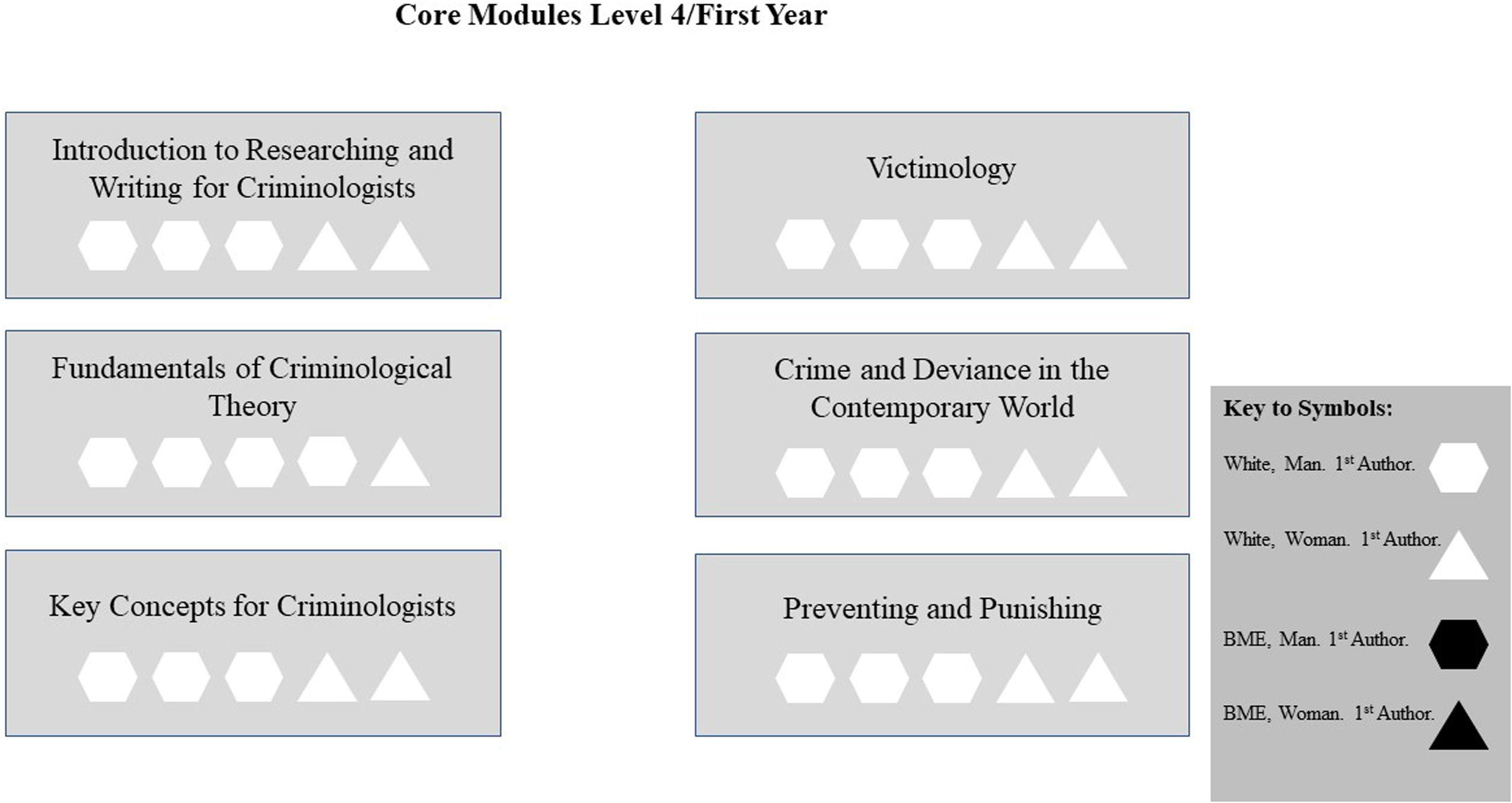
Level 4 modules indicating race and gender of first author.
In addition to the stark racial difference, it is also apparent that there is a gender difference, although this is less pronounced at Level 4 than at the higher levels of study. Figure 1 indicates that some reading will be by a (white) woman first author, although it is still an unequal division with 19 men to 11 women, and as will be discussed later (Figures 4 and 5) these indicative texts may not be included in final essential reading lists used by students.
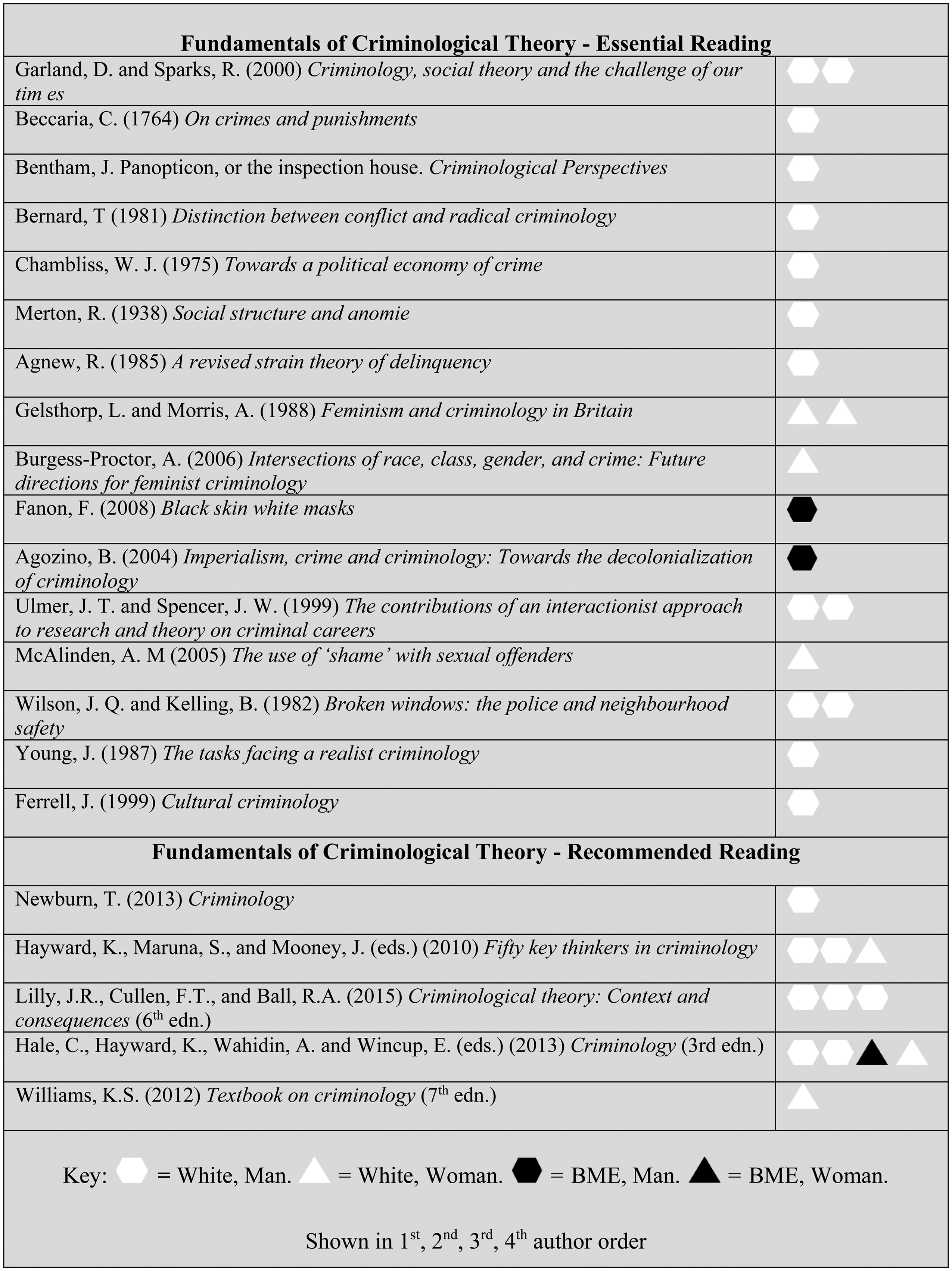
Fundamentals of criminological theory full reading list.
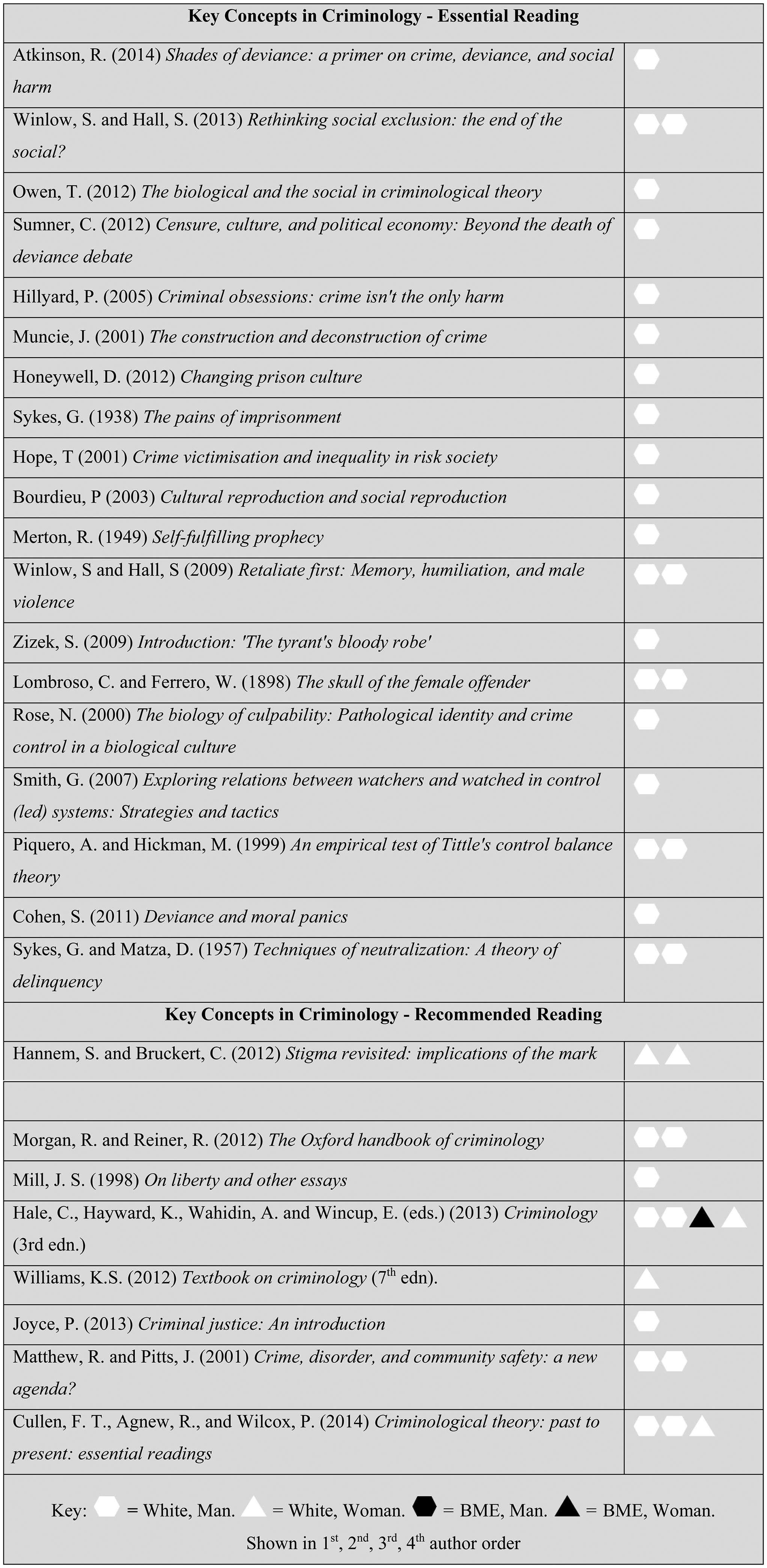
Key concepts in criminology full reading list.
Importantly, these disparities do not appear to be considered in the validation process, either at the internal review of the course, or the external validation of the criminology programme. What this potentially means for undergraduate criminology students is that their first year of study is predominantly from a white and male viewpoint.
The second year of study, at Level 5, is where students will be introduced to work written by BME academics, as Figure 2 shows – but note this is only in the discrete module on ‘Ethnicity, Crime and the Criminal Justice System’. Similarly, we see a module where women's voices are centred – but again this is predominately in the ‘Gender, Sexuality and Crime’ module. It is also important to note the issue of intersectionality whereby it is white women's voices that are centred when discussing gender and sexuality. The two Black women whose work features in the 105 readings put forward for validation are contained within the module on Ethnicity, Crime and the Criminal Justice System. Again, we can see how students’ experiences of criminology by the end of the second year of study will be that criminological knowledge is predominately male with stereotypical tropes playing out: white men write about statistics, and work, and the economy. Women write about gender. Academics of colour write about race.
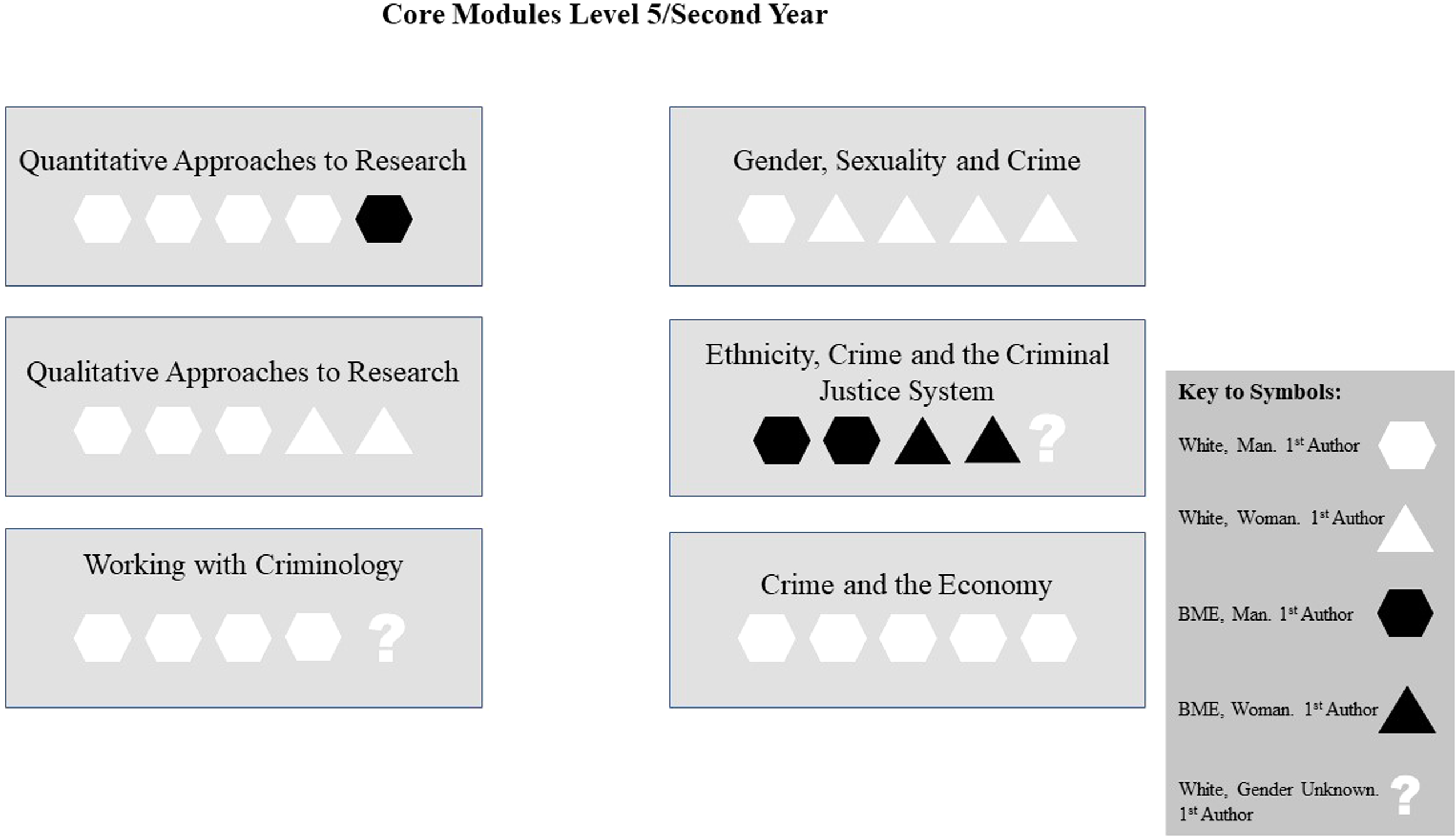
Level 5 modules indicating race and gender of first author.
Having explored the first two years of the Criminology Bachelor of Science degree programme, which consist of core modules every student must take, we move to consider the third, and final, year of study which allows students the opportunity to carry out independent study (either as primary or secondary research study, or as a literature-based dissertation) and select four out of the eight optional modules on offer. Here, in Figure 3, we see again an absence of work by academics of colour. With only one text of the 45 put forward has a BME (man) first author. There is also a striking gender divide whereby (white) women dominate in relation to sex work, and (white) men dominate in relation to philosophy, terrorism, and surveillance modules. These final year modules are meant to be ‘research-rich’ and be the pivotal point of the student's educational journey, where they graduate as criminologists. Yet again, the course content is heavily dominated by white and male work.
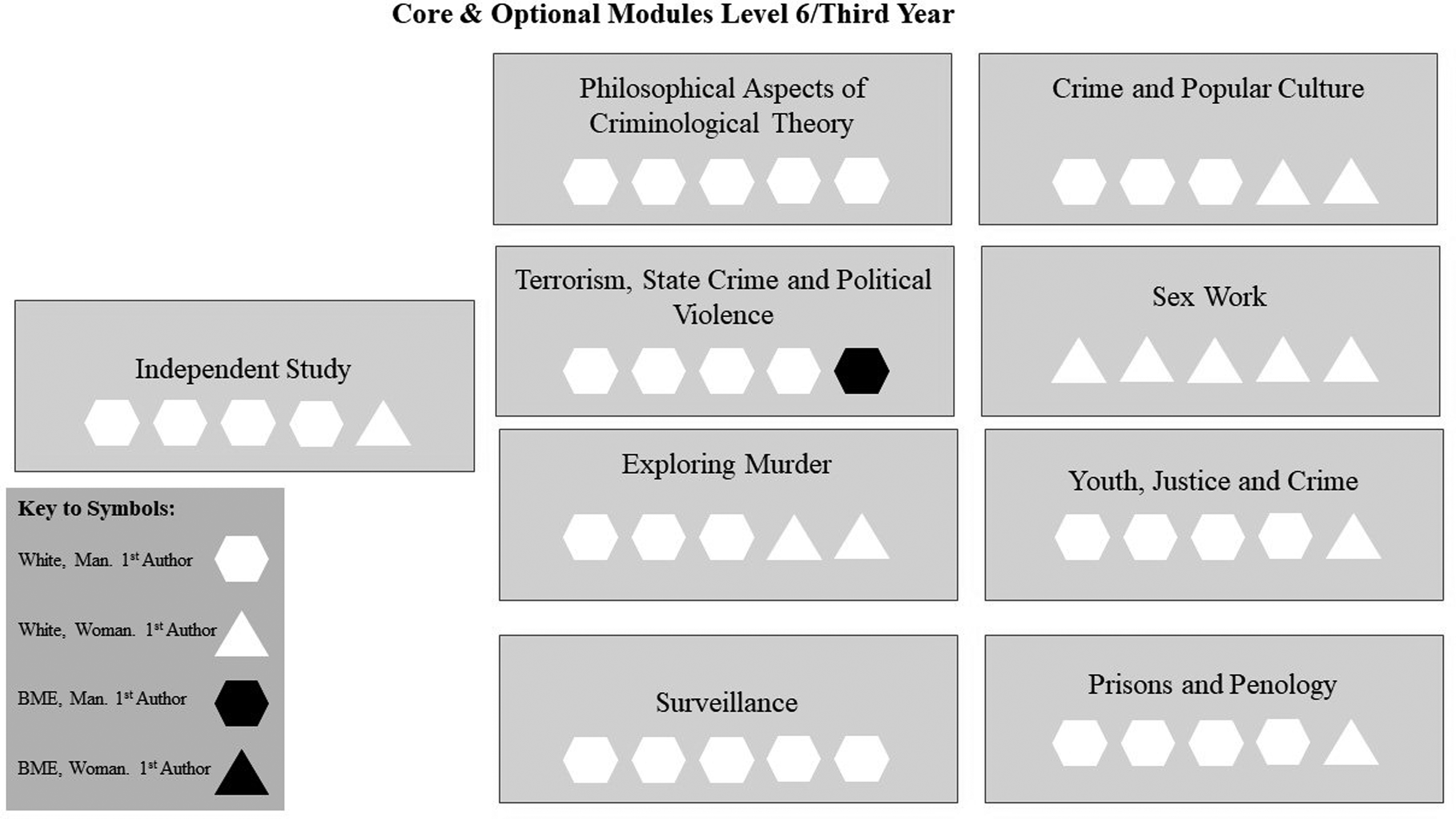
Level 6 modules indicating race and gender of first author.
Expanded Core Module Reading Lists
Moving from the validation documents which only list five indicative texts we then explored further the full reading lists that students used in their programme. Taking the two core first year (Level 4) reading lists for ‘Key Concepts for Criminologists’ and ‘Fundamentals of Criminological Theory’ we explored the essential and recommended reading suggested to students.
Analysis confirms the findings from the initial validation documents: the work provided to students is dominated by white men's voices and when authors of colour, or women's voices are included it is specifically in relation to content that is contained and is specific to issues around race and gender. Figure 4 shows this in relation to the essential reading for the ‘Fundamentals of Criminological Theory’ module. Expanding from the validation reading list, analysis icons show the perceived gender and race for each first, second, third, and fourth author in the selected reading. Across the semester students are reading white and male theorists, except the one week on feminism where women appear, and one week on race and colonial criminology where BME men are situated.
Issues raised by these authors in relation to the colonial and gendered nature of criminology have not been embedded. It could be argued, due to the focus of the module being the essential theories within criminology, that it is unavoidable that the reading list would include text from the discipline's, so called, white ‘founding fathers’. In criminology, as in most disciplines, it is important to study the earliest writings, theorists, and perspectives in order to understand the development of criminological ideas and theories. However, the prioritisation and dominance of white men within a fundamental criminological theory module suggests to students that such voices are those central to criminology and that those of BME and/or women are additional or alternative viewpoints. As Dennis (2018) argues foundational, traditional, theories should not necessarily be rejected, but equally they should not be positioned in the curriculum as the authoritative voices. Instead, suggesting such standardised perspectives should be taught critically by purposefully recognising the social, economic, historic, geographic, and political contexts in which they were developed (Dennis, 2018). However, the call to explore racial and gendered biases within criminal justice systems and processes, within society, and within our teaching has not been actualised in a meaningful way – it is discrete, it is a one-off. This was confirmed when we explored the module for ‘Key Concepts in Criminology’, as Figure 5 shows, where there are no authors of colour, and no works by women are listed as ‘essential reading’ across the entire semester-long module.
This is an important finding, suggesting that without the specific and direct content in relation to gender and race – even if this is presented in a deeply problematic way as ‘alternative viewpoints’ in the theory module, thereby marginalising these voices. Across other modules BME and women authors are excluded altogether: their work does not relate to ‘key concepts’ that students should explore, study, and learn.
Conclusion
Our research is important in highlighting the dominance of white and male voices in the criminology curriculum and the way in which academics of colour and women's academic voices are largely confined to discussions on race and gender. Furthermore, issues of race and gender are not embedded within criminological teaching, rather they continue to exist in the margins whilst dominant white and male ideology dominates ‘key concepts’ and ‘fundamental theories’ in the discipline. Our analysis is of one criminology programme in England, however, it is important to note that as a new programme it was developed without some of the restraints pre-existing courses may face, for example: books were not already purchased, journals had not already been subscribed to, materials were not already developed, and students were not already passing through the programme. With the rapid growth of criminology programmes in the UK (Stockdale & Sweeney, 2019) this paper highlights structural inequalities embedded within curriculum design and the resources provided to students. Whilst analysis of author's gender and race is in many ways reductionist, in that it uses categorisation based on perception of the author's gender and race, it is an important way to make visible the wider inequalities in reading list authorship at a module and programme level. By highlighting the criminological perspectives students are exposed to across their course this analysis shows there are deep embedded biases within the discipline which are exacerbated by issues related to the corporate structure of universities themselves and the process of reading list validation.
Where Do We Go from Here?
This research is a call for action, we suggest the following ways in which academics can address the issues raised:
Validation of new criminology courses – all courses must offer diverse reading with the Gray Test as a minimum standard, if you are an external validator do not validate the course until indicative reading reflects a wider range of voices meaningfully embedded across the programme. Internal review – as part of internal peer review, and general course review and planning that occurs across the academic year, staff should consider the programme as a whole and examine whose voices are dominant and whose are marginalised or excluded. Reading lists are an indicator of this, the overall aim of this work is to rethink course content. External examiner for ongoing degree programmes – external examiners should explore the ways in which race and gender (and intersections of these) are discussed and presented to students across their degree programmes. Are students studying whole modules which only consist of white and male readings? Are students given the opportunity to meaningfully engage with a range of work from diverse voices at each year of their degree programme? Are criminological issues related to race and gender embedded within the curriculum or are they discrete modules or topics? Consider the barriers to publication – if you are on an editorial board look to how to improve your submissions, and acceptance. When working with publishers – ask what they are doing to publish a wider range of voices. When conducting a peer review of academic books and journals consider if the work passes the Gray Test as part of the review process. Work with library staff to develop reading lists – there needs to be greater recognition (and discussion with students when teaching our subject) as to how ‘top’ journals reproduce existing global power imbalances. We should endeavour to use a range of journals and look to cite work from more diverse contexts (Mason & Merga, 2021). Reading list reviews involving staff and students are one way to view and acknowledge the ways in which knowledge has been produced and reproduced (and by whom), to embed critical information literacy skills, and to challenge the status quo. However, it is important to note ‘a reading list review should not be perceived as a myopic approach to improving body count through identity politics, but rather, as a catalyst for more sustainable institutional conversation and strategy to redress structural inequalities and realise transformational change’ (Thomas, 2020, N.P).
White academics need to recognise their positionality and approach to developing reading lists and course content; and the problematic notion that work written by academics from the global majority, or who identify as female, nonbinary, Lesbian Gay Bisexual Trans Queer (LGBTQ+) – and intersections of these – is regarded as unusual or less significant needs to be dissolved. Ultimately, this paper advocates that core criminology curricula in the UK must work to meaningfully include more work by women, people of colour, indigenous theorists, and authors, and those who have been historically marginalised, excluded, and erased, in order to prevent the re/production of harmful gendered and racialised narratives as well as support critical criminological thinking among students.
Footnotes
Declaration of Conflicting Interests
The author(s) declared no potential conflicts of interest with respect to the research, authorship, and/or publication of this article.
Funding
The author(s) received no financial support for the research, authorship, and/or publication of this article.
