



Abstract
Racially disaggregated incarceration data are an important indicator of population health and well-being, but are lacking in the Canadian context. We aimed to describe incarceration rates and proportions of Black people who experienced incarceration in Ontario, Canada during 2010 using population-based data. We used correctional administrative data for all 45,956 men and 6,357 women released from provincial correctional facilities in Ontario in 2010, including self-reported race data. Using 2006 Ontario Census data on the population size for race and age categories, we calculated and compared incarceration rates and proportions of the population experiencing incarceration by age, sex, and race groups using chi-square tests. In this first Canadian study presenting detailed incarceration rates by race, we found substantial over-representation of Black men in provincial correctional facilities in Ontario. We also found that a large proportion of Black men experience incarceration. In addition to further research, evidence-based action is needed to prevent exposure to criminogenic factors for Black people and to address the inequitable treatment of Black people within the criminal justice system.
With an official policy of multiculturalism, Canada is often praised as a tolerant nation that embraces immigration and diversity (Henry & Tator, 2010). In 2018, for example, more than 300,000 immigrants from countries around the world were admitted to Canada (Statistics Canada, 2020). As a result, Canadians report over 250 ethnic ancestries and speak more than 200 languages (Statistics Canada, 2017a, 2017b). This population diversity and a robust human rights framework, however, serve to mask the past and present injustices experienced by Black and other racialized groups in Canada. Indeed, the over-representation and experiences of Black people in Canada’s criminal justice system is increasingly acknowledged by scholars and policymakers as an important social issue and a legacy of Canada’s colonial past (Owusu-Bempah & Gabbidon, 2020).
However, because Canadian criminal justice agencies do not typically release statistics disaggregated by race, there is a dearth of quantitative data on the representation and involvement of Black people in Canadian correctional facilities (Kouyoumdjian & McIsaac, 2017). In addition to annual reports from Public Safety Canada (Public Safety Canada, 2020), Statistics Canada also produces annual reports on the number of people in federal prisons and provincial correctional facilities on an average day, but the only racial or ethnic data they provide are on the proportion of people who report Aboriginal identity (Reitano, 2017). Canada’s Correctional Investigator has highlighted the over-representation and increasing numbers of Black people in federal prisons (Office of the Correctional Investigator, 2013). While important, these reports lack population-based data on the race or ethnicity of people who are detained or incarcerated in provincial correctional facilities (where the majority of incarcerated people are held), and important characteristics such as length of stay in custody, age and sex distribution, and community of origin disaggregated by race and ethnic group. To address these knowledge gaps, we used provincial administrative data from Ontario for 2010 to describe the socio-demographic characteristics of people who experienced incarceration as well as incarceration rates and proportions for Black people using Census data.
To contextualize these data, we first describe the historical and contemporary social circumstances of Black people in Canada.
The Black Experience in Canada: Past and Present
In discussions of Black history in Canada, the Underground Railroad and North Star myth feature prominently. The North Star, of course, provided a beacon for enslaved Americans seeking freedom via the Underground Railroad (Walker, 1985). While the Underground Railroad is a positive feature of Canadian history, it has also served to foster an enduring fallacy; that the North Star led Black people not only out of slavery but also into freedom, equality and full participation in Canadian society (Walker, 1985). Indeed, Canadians have come to see themselves as morally superior to Americans when it comes to race relations, in part because of this myth. Common sentiment suggests that the violence, segregation and oppression experienced by Black people in America have not been a feature of the Canadian experience (Walker, 2010).
In contrast with this rosy view, slavery was practiced in the colonies that would become Canada for over 200 years (Maynard, 2017), and the subjugated status of Black people persisted long after its abolition. Canada’s first prime minister, John A. Macdonald, rationalized keeping the death penalty based on the supposed threat that Black men posed to White women (Walker, 2010). In 1911, prime minister Wilfred Laurier signed an Order in Council prohibiting Black immigration to Canada (Shepard, 1997). As successive Canadian governments sought to restrict Black immigration, the small population of Black people in Canada experienced discrimination, including segregation (both legal and de facto) in education, employment, and housing (Henry & Tator, 2010). This history has set the stage for the experience of more recent Black immigrants by creating a pervasive framework of anti-Black racism (Owusu-Bempah & Gabbidon, 2020).
Notwithstanding the downplaying by both politicians and the general public, several taskforces and a growing body of research have shed light on anti-Black racism in Canada (Commission on Systemic Racism in the Ontario Criminal Justice System, 1995; Ontario Human Rights Commission, 2018; Truth and Reconciliation Commission of Canada, 2015). Black people fare poorly in key areas pertinent to criminal justice, including child welfare, education and employment. Black Canadian children, for example, are greatly over-represented in Ontario’s child welfare system (Ontario Association of Children’s Aid Societies, 2016). Black students also face multiple challenges in the educational system—they are much more likely to be streamed into non-university-track programs, to be suspended or expelled, and to drop out (Collins & Magnan, 2018; George, 2020; James & Turner, 2017; James, 2012). The authors of an extensive report on the roots of youth violence in Ontario credit anti-Black racism and zero-tolerance policies in schools with the criminalization of Black youth (McMurtry & Curling, 2008).
Educational barriers and structural and institutional forms of discrimination converge to produce inequalities in Canada’s employment sector and poverty among Black Canadians. Data from Canada’s 2016 Census, for example, demonstrate that unemployment rates for Black people were approximately twice those for the rest of the population (Do, 2020). Black job seekers are excluded from the labour market in part due to discrimination by employers (Douthwright, 2017; Henry & Ginzberg, 1985). Even when employed, Black people earn less than their peers: Census data for Canada’s capital city of Ottawa show that in 2015, the median income for Black men was $40,762, compared with $63,384 for other men in the city (Do, 2020). This income gap trend is consistent across major Canadian cities and also at the national level ((Do, 2020). Lower employment rates combined with lower incomes have resulted in greater poverty among Black people. In 2016, Black people aged 25 to 59 were twice as likely to live in a low-income situation compared with the rest of the population (Do, 2020). Poverty is also spatially entrenched with the over-representation of Black people in disadvantaged neighbourhoods that are underserved by transit, libraries, schools, and hospitals (Hulchanski, 2010; Walks & Borne, 2006). These neighbourhoods experience higher levels of crime and victimization, and are thus subject to more concentrated, enforcement-oriented policing (Hulchanski, 2010; Meng, 2017).
As gatekeepers to the criminal justice system, police officers hold immense power over who is officially processed, and a growing body of research demonstrates that that Black people in Canada are over-represented in police stops and searches (Commission on Systemic Racism in the Ontario Criminal Justice System, 1995; Meng, 2017; Rankin, 2010; Wortley & Owusu-Bempah, 2011). Although arrest data disaggregated by race are rare in the Canadian context, available data show that Black people are also over-represented in arrests for minor offences that involve a high level of police discretion. A recent study of cannabis possession arrests, for example, found an over-representation of Black people in four of the five Canadian cities examined (Owusu-Bempah & Luscombe, 2020). These disparities exist even though empirical evidence shows that similar rates of cannabis use across racial groups (Owusu-Bempah & Luscombe, 2020). Without robust data, it is impossible to assess the influence of police bias versus differential offending patterns.
Unfortunately, data documenting the impact of race on court processes is almost wholly absent in the Canadian context (Owusu-Bempah & Wortley, 2014). One exception is data on pretrial detention. Kellough and Wortley (2002), for example, found that Black accused (35%) were more likely than accused from other racial backgrounds (23%) to be detained before trial and that these differences remained after accounting for relevant factors such as flight risk and danger to the public (Kellough & Wortley, 2002). Although less detailed, recent data indicate that Black accused also spend more time detained before trial than do White accused (Mehler-Paperny, 2017).
As mentioned, cross-sectional data on race and incarceration are available at the federal level in Canada and for certain provinces. Although inconsistent, some data are available dating back to the late 19th century. Mosher (1998), for example, provides racially disaggregated federal incarceration data for the period 1896–1938. Throughout this period, as they are now, Black people were over-represented in federal prisons (Mosher, 1998). The most recent data from Canada’s federal correctional agency indicate that Black people accounted for 7.2% of federal offenders in 2018/2019 while comprising 3.5% of Canada’s population (Maheux & Do, 2019; Public Safety Canada, 2020). Provincial data are even more scarce. The available data show that Black adults are over-represented in provincial corrections admissions in Nova Scotia and Ontario for 2010–2011 (Owusu-Bempah & Gabbidon, 2020).
As this brief account of the historical and contemporary experiences of Black people in Canada demonstrates, Black people continue to face inequities in child welfare, education, employment, criminal justice outcomes. Situated within this recognition of historical and contemporary experiences of Black people in Canada, along with the evidence that Black people are increasingly incarcerated, we turn to the methods used in our study of Black incarceration in Ontario, Canada.
Method
In Canada, provincial and territorial correctional facilities hold people awaiting trial and sentenced to less than 2 years in custody (Reitano, 2017). Ontario provincial correctional facilities are administered by the Ministry of the Solicitor General (MSG). In this paper, we use the term “incarceration” to represent time in custody, whether in remand or sentenced.
For a separate study (Kouyoumdjian et al., 2018) the MSG provided identifying data on all adults released from provincial correctional facilities in Ontario in 2010, including self-reported race and periods in custody from 2005 to 2015. As described previously (Kouyoumdjian et al., 2018), these data were linked with health administrative data for Ontario residents at ICES, an independent, non-profit organization funded by the Ministry of Health. We examined data for all people in the MSG dataset who were linked with ICES data, which was 97.4%.
For this population, we used self-reported data on race from the MSG. We categorized race into three categories: Black, White, and Other, based on our focus on the over-representation of Black people in correctional facilities.
We accessed data on the number of Black people in Ontario in each age- and sex-specific stratum from the long-form of the 2006 Census, which was a mandatory survey of 20% of the population. We selected the 2006 Census as the closest year in which data were collected on race by mandatory survey, given concerns regarding representativeness of voluntary data collection. As the Census does not enumerate the country’s “White” population, we calculated the White population by subtracting the number of people who reported Aboriginal identity from the “non-visible minority” population. In Canadian legislation, visible minority is defined as “persons, other than Aboriginal peoples, who are non-Caucasian in race or non-white in colour” (Government of Canada, 1995), and this category includes South Asian, Chinese, Black, Filipino, Latin American, Arab, Southeast Asian, West Asian, Korean, Japanese, and visible minority not included elsewhere. Our “Other” category includes people who reported Aboriginal identity and people who reported visible minority status, excluding those who self-identified as Black. “Black” includes individuals who reported Black as their race on the Census and on intake into the provincial correctional system.
We calculated annual incarceration rates for each age, race, and sex group. For the numerator, we used the number of people released from provincial correctional facilities in 2010. For the denominator, we used the number of people in the general population. We expressed these rates per 100,000 people and as a percentage. We used chi-square tests to compare between groups. We conducted analyses in SAS Version 9.4.
Results
We accessed data on 45,956 men and 6,357 women released from provincial correctional facilities in 2010. Among men, 12.8% self-identified as Black, 58.3% self-identified as White, and we categorized 28.9% as Other (Table 1). Among women, 7.1% self-identified as Black, 55.7% self-identified as White, and we categorized 37.3% as Other. A higher proportion of Black men and women lived in neighbourhoods with lower income quintiles compared to men and women in the other two race categories. Black men had a longer total time spent in provincial correctional facilities between 2005 and 2015 and a higher proportion of Black men were transferred to federal prison on the initial release in 2010 and between 2005 and 2015 compared with men in the other two race categories.
Sociodemographic Characteristics and Correctional Involvement of People Released From Provincial Facilities in Ontario in 2010, by Race, Sex, and Age.
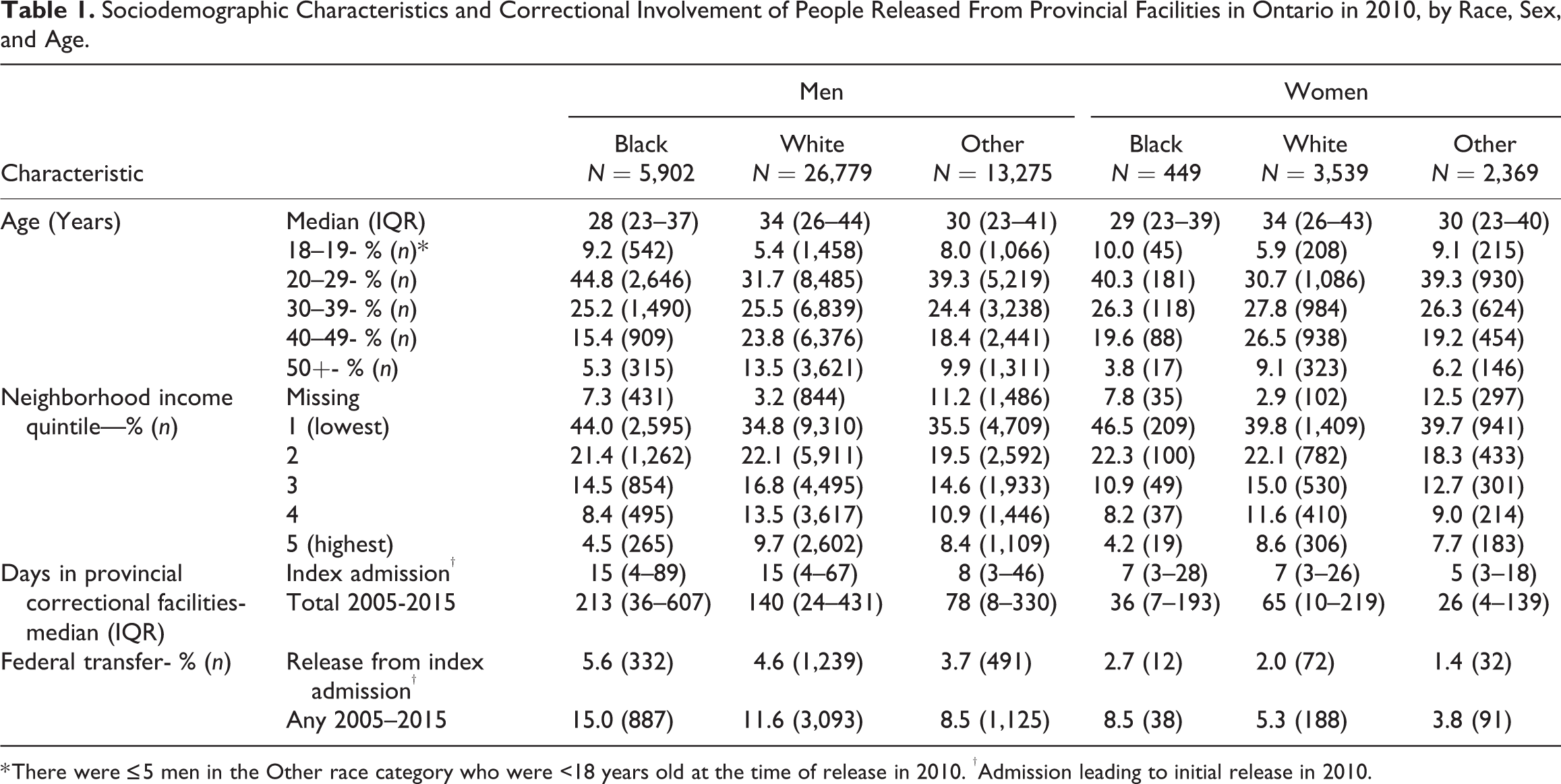
* There were ≤5 men in the Other race category who were <18 years old at the time of release in 2010. †Admission leading to initial release in 2010.
Compared with White men and men from Other racial backgrounds, incarceration rates for Black men were significantly higher overall and for all age groups except 65 and older (Table 2). Compared with White women, Black women had higher incarceration rates overall and in age groups 18-24, 25-34, 35-44, and 45-54, but not in age groups 55-64 or 65 and older. There was no difference between incarceration rates for Black women and women from Other racial backgrounds overall or in age-specific strata.
Rates of Incarceration in Provincial Facilities in Ontario in 2010, by Sex, Age-Group, and Race,* per 100,000.
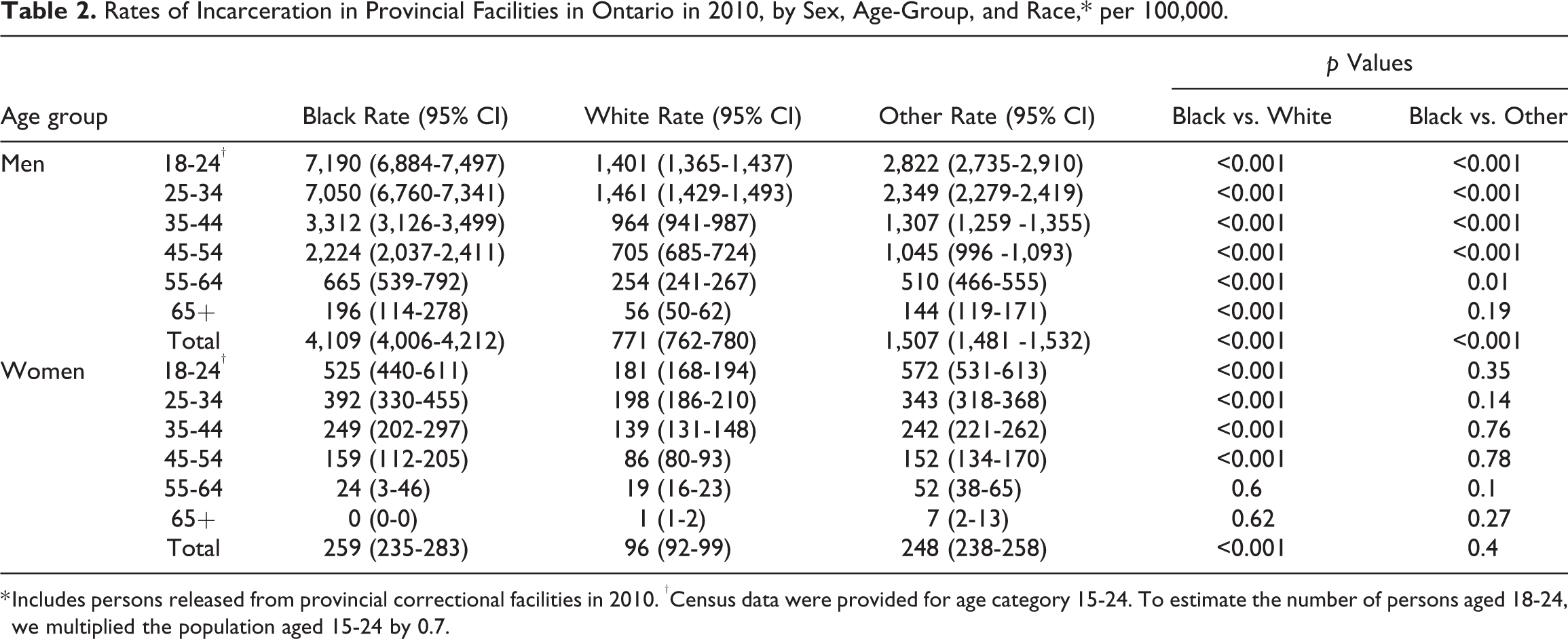
* Includes persons released from provincial correctional facilities in 2010. †Census data were provided for age category 15-24. To estimate the number of persons aged 18-24, we multiplied the population aged 15-24 by 0.7.
As shown in Figure 1, 7.2% of Black men aged 18 to 24 and 7.1% of Black men aged 25 to 34 were incarcerated in 2010. Figure 2 shows that the percentage of women who experienced incarceration in 2010 was 0.33% for Black women, 0.10% for White women, and 0.25% for women categorized as Other.
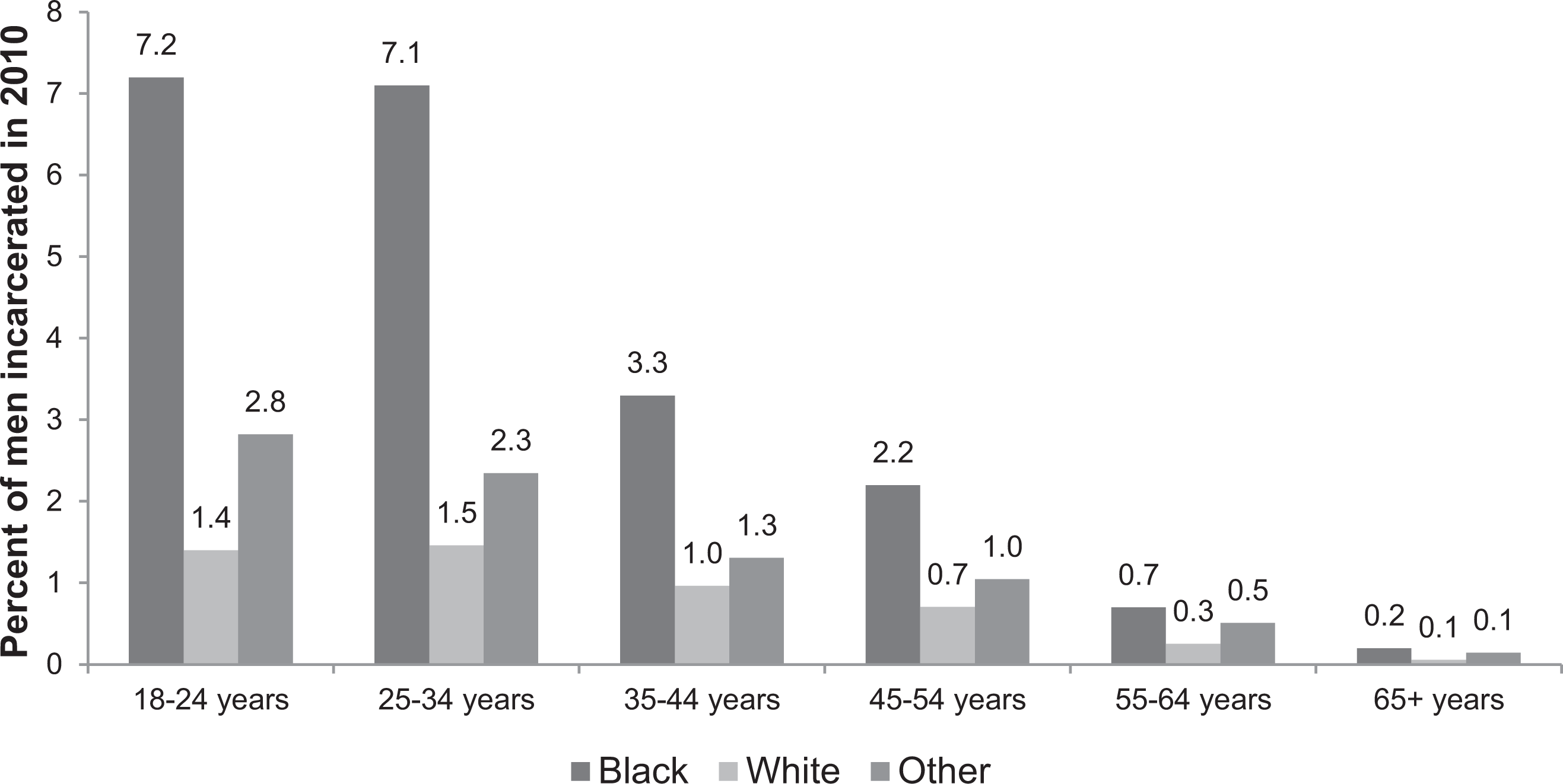
Percentage of men in Ontario who were incarcerated in provincial facilities in 2010, by race and age group.a
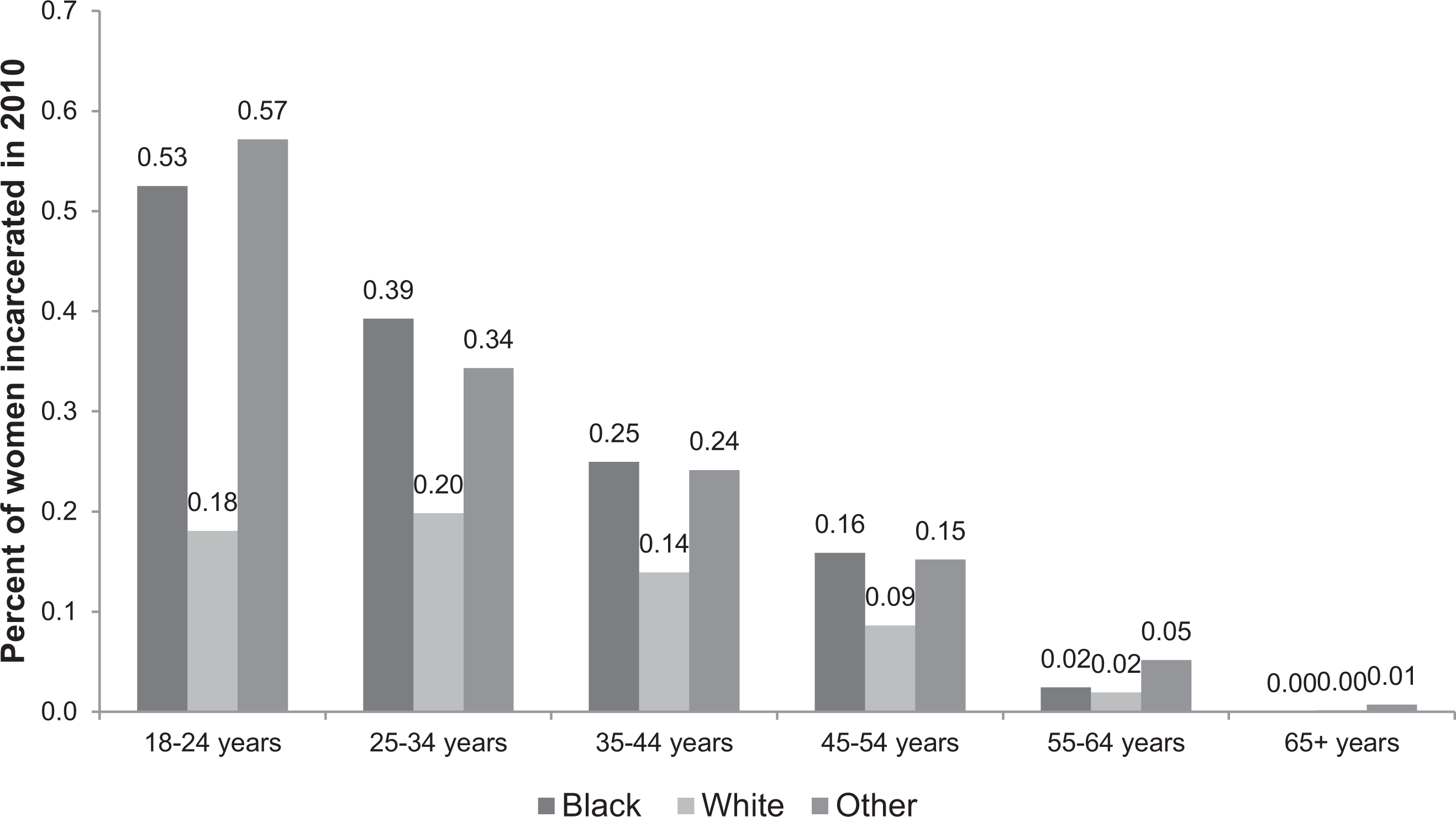
Percentage of women in Ontario who were incarcerated in provincial facilities in 2010, by race and age group.a
Discussion
Our study used novel data to examine Black peoples’ experiences with provincial incarceration in Ontario in 2010. Black men were five times more likely to be incarcerated than White men and Black women were almost three times more likely to be incarcerated than White women in 2010. We also found that at least one in 14 Black men aged 18-34 experienced incarceration in provincial correctional facilities in 2010. Furthermore, Black men spent longer in provincial correctional facilities and were more likely to be transferred to federal prison compared with other men. Finally, Black men and women incarcerated in Ontario’s provincial correctional facilities in 2010 were more likely to come from socially disadvantaged neighbourhoods.
Our findings are consistent with the limited available data on Black people in federal prisons in Canada. For example, Black people accounted for 7.2% of people under the supervision of the federal correctional system in 2016, while comprising just 3.5% of the overall Canadian population aged 15 and older (Public Safety Canada, 2017; Statistics Canada, 2019). Readily available data have also drawn attention to the over-representation of African Americans in US correctional systems (Petit & Gutierrez, 2018; Wildeman & Wang, 2017; Zeng, 2018). Data from the Bureau of Justice Statistics show that in 2016, Black men were incarcerated in state and federal institutions each day at a rate of 2,417 per 100,000 (Carson, 2018). As documented here, the annual rate of incarceration for Black men in Ontario in 2010 was 4,109 per 100,000. Although not directly comparable because the US incarceration rates are per day whereas our data are per year, this information helps to contextualize the extent of Black over-incarceration in Ontario.
This project is limited by available data. Since we had access to data only on people released from provincial correctional facilities in 2010, we would have missed people who were admitted to provincial correctional facilities in 2010 or prior to 2010 but not released in 2010. We expect this to be a very small number of people, given that very few people (<1% of those released in 2010) had lengths of stay greater than 1 year. As we did not include people in federal prisons, the incarceration rates are limited to provincial facilities, and would be lower than the total incarceration rates. We classified race in three categories, which has limitations. The Other category is heterogeneous, and includes people who self-reported Aboriginal identity, who are over-represented in correctional facilities (Statistics Canada, 2018). We did not look at Aboriginal identity separately based on respect for OCAP principles, which are a set of standards for how First Nations data should be collected, protected, used, and shared in Canada (First Nations Information Governance Centre, 2019), due to lack of appropriate engagement and the focus of this project on Black people. The Other category also included people for whom race data were missing or not reported. These data may not be missing randomly, as people in certain racial/ethnic groups may be more likely to report their race. As we did not have access to data on charges or convictions or whether people were remanded or sentenced, we do not know whether Black people are over-represented across charges, convictions, and status.
Our findings reaffirm the need for racially disaggregated criminal justice data in the Canadian context. The growth in the Black federal prison population over the past 2 decades in Canada has raised concern about the increasing concentration of incarceration among Black populations (Owusu-Bempah & Gabbidon, 2020). As most people in custody are supervised by provincial/territorial, rather than federal correctional systems, adequate data from the provinces and territories are required in order to develop an informed knowledge base.
Conclusions
This study demonstrates that incarceration is heavily concentrated among young Black men who come from economically marginalized neighbourhoods. The American experience shows us that concentrated incarceration has negative consequences at the individual, family and community levels, including social problems relating to poverty, mental health, education, employment and civic involvement (Kirk & Wakefield, 2018). Concentrated incarceration distorts social norms, leads to the breakdown of informal social control, and undermines the building blocks of social order which are essential for community safety (Clear, 2008). Identifying communities and population subgroups that are disproportionately impacted by incarceration will help inform targeted initiatives to prevent criminal justice system involvement and to mitigate the impacts of criminalization and the individual and community levels.
Footnotes
Acknowledgments
This study was supported by ICES, which is funded by an annual grant from the Ontario Ministry of Health (MOH). We acknowledge the Ontario Ministry of the Solicitor General, which provided data for the study. The analyses, opinions, results and conclusions reported in this paper are independent from the sources that provided data and funding. No endorsement by ICES, the MOH, or the Ministry of the Solicitor General is intended or should be inferred.
Declaration of Conflicting Interests
The author(s) declared no potential conflicts of interest with respect to the research, authorship, and/or publication of this article.
Funding
The author(s) disclosed receipt of the following financial support for the research, authorship, and/or publication of this article: Physicians’ Services Incorporated Foundation and University of Toronto.
