



Abstract
What impact do people think social media has on their well-being? To answer this question, we adopted a global perspective, analyzing 7.1 million observations from 191,672 users across 182 countries. Users believed social media had a small but negative impact on their well-being: Whenever respondents felt that social media affected their current well-being, their well-being in that moment was reduced by 2% compared with their average. The size of this perceived effect differed across users and countries. Whereas people in several northeastern regions, such as Russia and Kazakhstan, believed social media benefited their well-being, negative perceived effects appeared most prominently in the Anglosphere (United Kingdom, United States, New Zealand), Scandinavia, and parts of South America (Chile, Argentina). Other activities showed stronger effects on well-being, such as listening to music (plus 8%), relaxing (plus 6%), health issues (minus 8%), or studying (minus 7%), which suggests that the negative effects of social media use are comparatively small. Male participants reported significantly more negative effects compared with female and gender-diverse participants. Differences also emerged across age groups, with younger generations reporting more negative effects. In conclusion, according to users across the world, social media has a negative but small perceived impact on their well-being.
Introduction
With billions of users worldwide, and this number increasing rapidly, understanding the global impact of social media on well-being is crucial. 1 There is rising concern that social media might be negatively affecting users. 2 Different countries have varying public conversations about social media, different social media use habits, as well as different extents to which they utilize social media for public or private services. However, global evidence comparing effects across countries is missing as it is difficult to collect appropriate individual-level data at scale. 1
To start addressing this gap, we present the first large-scale global analyses of how users perceive that social media impacts their well-being. As our focus is on the immediate effects, we examine how social media use influences momentary mood, 3 which is a more dynamic measure of well-being as compared to, for example, life satisfaction. 4 Mood is a central component of well-being, capturing how people feel in a specific moment: Focusing on affect, it represents the hedonic dimension of well-being. 5 Well-being also entails eudaimonic aspects such as fulfillment or meaning, not addressed here.
Measuring the impacts of social media requires precise measures of its use and outcomes at appropriate time scales, and current research endeavors often fail to live up to these necessary high standards.5,6 There exist some high-quality studies in select Global North populations, but they have produced mixed findings. While some report positive effects, 7 others highlight neutral 8 or negative outcomes. 9 Literature reviews suggest either mixed 10 or negative, albeit minor effects.4,5,11 Studies have also found that social media impacts users differently, with some users showing positive and some showing negative effects. 11
This existing literature has, however, remained confined to select countries, failing to capture the full spectrum of cultural and societal nuances in social media usage and its consequences around the world.1,5 This is not just limiting our scientific understanding but also our ability to appropriately address pressing issues at a global scale. As the necessary high-quality and large-scale data (including tracking of social media use and related outcomes 6 ) is not available for worldwide populations at present, understanding how global users perceive social media’s effects on themselves and how this compares to existing results established in previous limited samples represents an important contribution to our understanding of social media and its impacts.
Materials and Methods
For this study, we collaborated with the smartphone app VOS Health. VOS Health allows users to monitor and manage their health by tracking metrics such as well-being, physical activity, sleep, nutrition, and stress levels at self-selected times throughout the day.
Users rated their well-being by responding to the question “How do you feel?” using a visual slider ranging from awful (0) to amazing (100). Afterward, they answered the question “What made you feel this way?” with options including education, exercise, family, finance, food, friends, gaming, health, hobbies, housework, medication, movies/TV, music, nature, partner, pet, relax, shopping, sleep, social media, traveling, weather, work. Users could tick all options that applied (for a screenshot, see Figure 1).
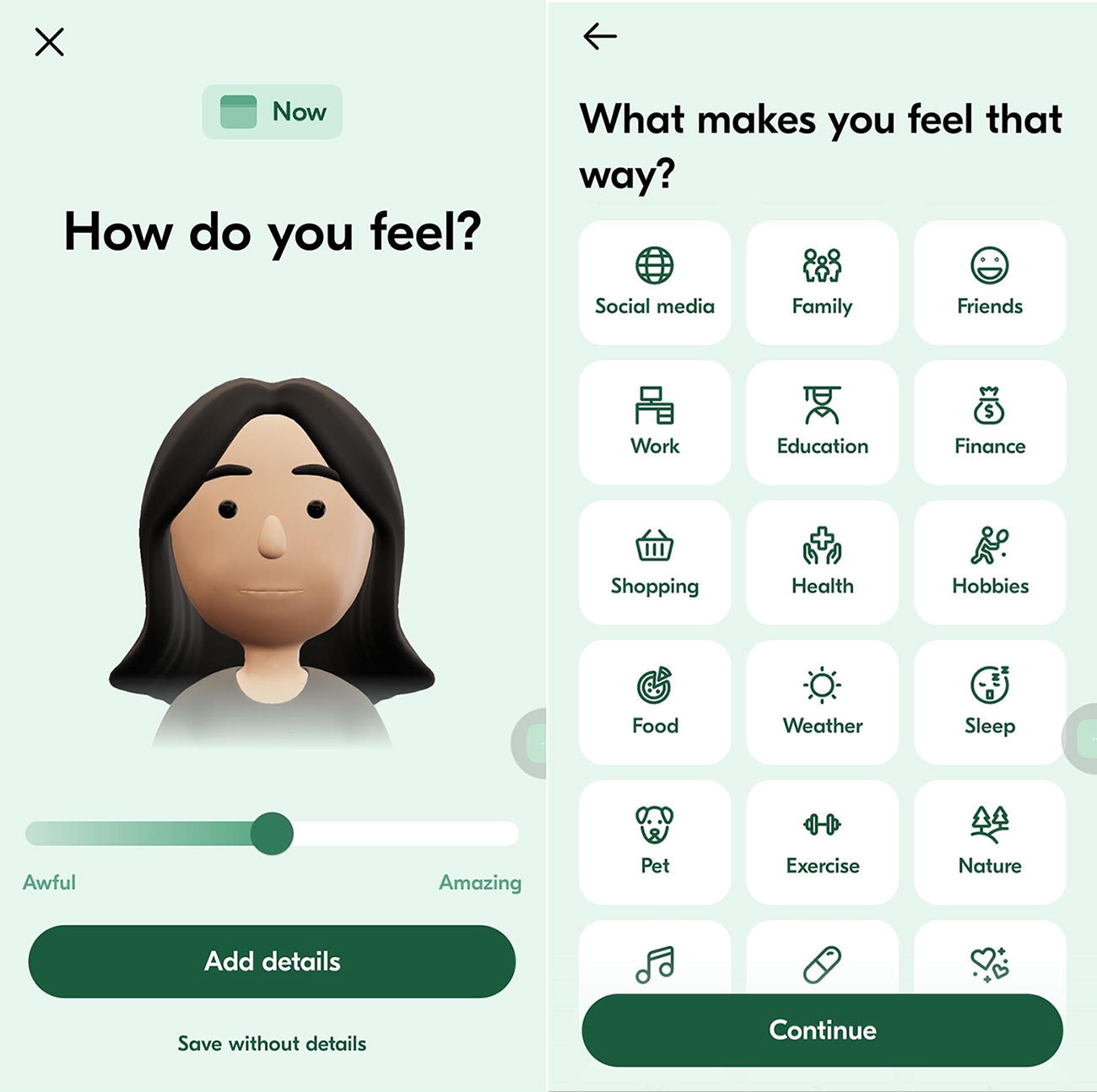
Overview of app and used questions.
Overall, 2,305,058 users provided data between October 2020 and August 2023, logging 12,188,412 observations of both their well-being and whether or not they believed their well-being was affected by social media use. To improve data quality, we only included participants who logged this information across at least 10 time points, thereby excluding participants who only briefly tested the app. The resulting sample size included 7,101,257 observations from 191,672 participants spanning 182 countries. The mean number of observations per participant was 36 (standard deviation [SD] = 57; maximum = 7,409), and the mean age was 21 years (SD = 7; minimum = 10; maximum = 98). Eighty-one percent of all users were female, 15% were male, and 4% were nonbinary/neutral.
We analyzed the data using random effects within–between model (REWB model), 12 in which we separated between-person relations from within-person effects. 13 In the REWB model, the dependent variable was current levels of well-being. We included random intercepts for participants nested in countries and random slopes for social media use for participants nested in countries. We controlled for several potential confounders varying by time point (i.e., all other activities that also could be selected as affecting current well-being; number of days people were using the app; and time of day). We included the person-centered values (within-person effects) for each varying predictor.
The within-person effects of social media use are the main result we report. They measure how much users believed a specific episode of social media use affected their current well-being, independent from how often they in general believed social media use affected their well-being, while controlling for a large number of varying predictors (listed above). To analyze heterogeneity in the effects across users and countries, we calculated 95% heterogeneity intervals 14 and compared models using the Akaike information criterion (AIC).
In the app’s terms and conditions, users consent for their data to be analyzed. The Institutional Review Board of the Department of Communication at the University of Vienna approved the analysis of the data (#1026). All analyses and detailed results can be found in the online supplementary material at https://osf.io/8m735/.
Results
Whenever users mentioned that their well-being was affected by social media use, their current level of well-being was slightly lower than their average well-being across the entire study (b = −2.21, 95% confidence interval or CI: [−2.61, −1.80]). In other words, this impact accounted for an average 2% decrease in their well-being. This effect varied substantially across users (95% HI: [−20.03, 15.62]), and a model with random slopes fitted better than one with fixed slopes (AICfixed = 62,901,312, AICrand = 62,875,282). Users, therefore, experienced the effects of social media differently.
The self-perceived effect of social media use on well-being varied substantially across countries (95% HI: [−5.16, 0.74]; see Figure 2). Again, a model with random slopes for countries fitted better than one with fixed slopes (AICfixed = 62,875,282, AICrand = 62,874,497). The most positive perceived effects were found in the northeastern sphere, with Russia, Kazakhstan, and Belarus reporting the most positive effects (M = 0.45%). Countries in Africa showed almost exclusively moderate negative perceived effects (b = −1.00% to −2.00%). The strongest negative perceived effects were found in Scandinavia (Sweden, Norway, Finland; M = −3.15%), the Anglosphere (United Kingdom, Australia, United States, New Zealand; M = −3.57%), and southern parts of South America (Argentina, Chile, Paraguay; M = −4.60%). See Table 1 for a list of effects for additional select countries, and see online materials for the results of all countries.
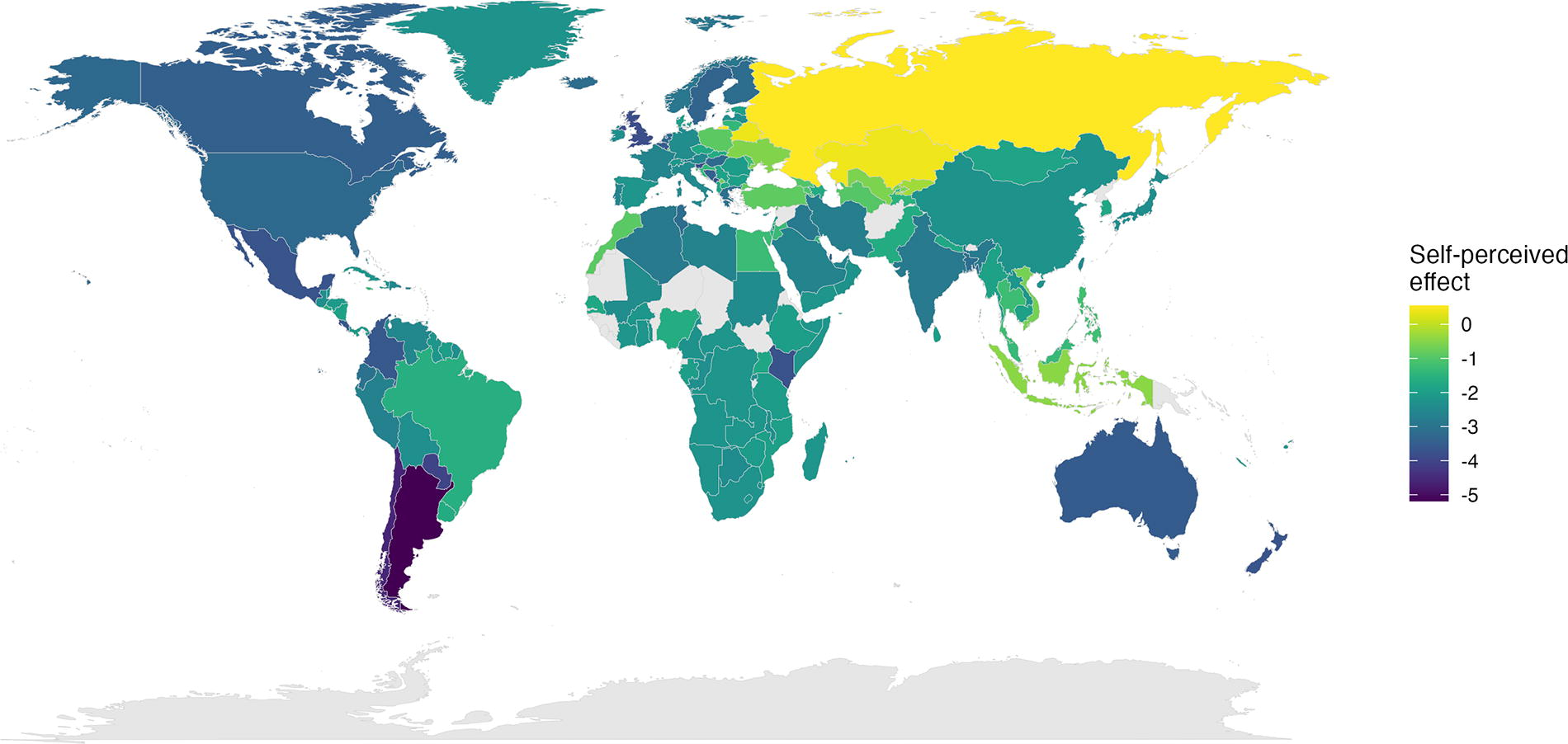
Overview of self-perceived social media effects on well-being. Numbers indicate that whenever respondents felt social media affected their current well-being, their well-being in that moment was, for example, reduced by 2% compared with their average. Countries with insufficient data are in gray.
List of Countries and Their Self-Perceived Media Effects
Numbers indicate that whenever respondents felt that social media affected their current well-being, their well-being in that moment was, for example, reduced by 2% compared with their average. We report the countries for which we found the strongest positive effects and the strongest negative effects. We also report the results of the 10 largest countries by population.
To contextualize the effect size, we compared this impact to the other activities users could select (see Figure 3). Results showed that the majority of the other activities had stronger net effects on well-being. For example, the most positive effects on well-being were listening to music (8% increase), relaxing (6% increase), and spending time with friends (5% increase). The most negative effects were health issues (8% decrease), studying (6% decrease), and finances (6% decrease). Effects comparable in size to social media use were activities with family (2% decrease), doing housework (2% decrease), (getting up from) sleeping (3% decrease), and working (3% decrease). Looking at other media-related activities, we found that watching movies was associated with increases in well-being (4% increase), as was playing video games (3% increase). We also found that days spent using the app were associated with increases in well-being (b = 0.69, standard error [SE] = 0.0075, p < 0.001; days of use standardized).
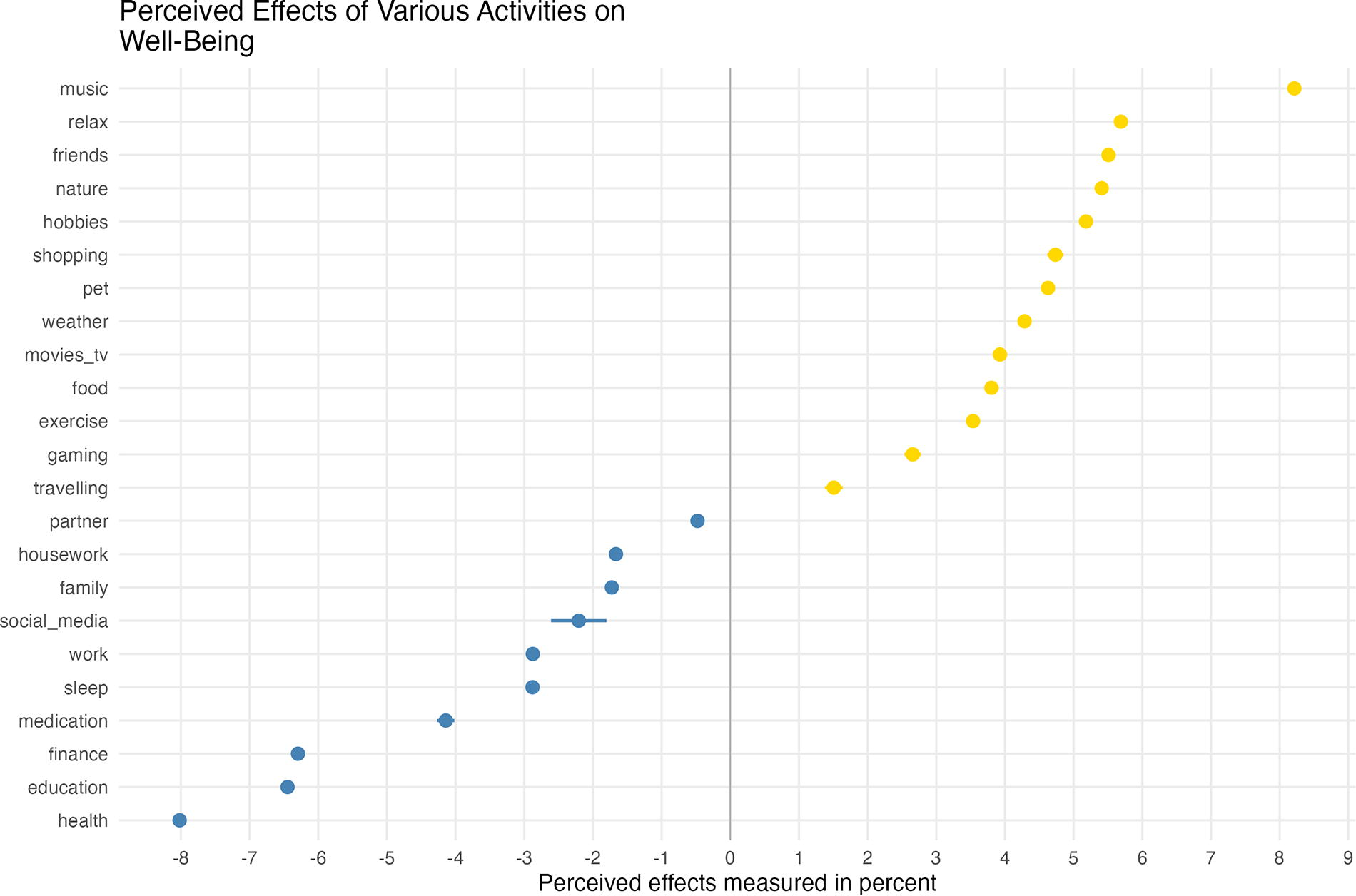
Average self-perceived effects of various activities on well-being, including their 95% confidence intervals. Social media use shows by far the largest confidence interval (only medication, traveling, gaming, and shopping also show some visible variance, although much smaller).
With a standard error of SE = 0.21, social media was also the activity with the by far largest CI (see Figure 2). This shows that there is much more variance in how social media affects well-being as compared with other activities, corresponding with our finding that effects vary strongly across users.
The estimated effect of social media use on mood interacted with gender (AICreg. = 62,874,497; AICint.gen = 62,872,829). Male participants showed the most negative effects (b = −3.37, 95% CI: [−3.85, −2.88]). For female participants, the effect was significantly less negative (b = −2.11, 95% CI: [−2.51, −1.71]), whereas it was least negative for participants identifying as nonbinary (b = −1.24, 95% CI: [−1.90, −0.57]) or gender-neutral (b = −1.27, 95% CI: [−2.04, −0.50]).
The effect also interacted with age (AICreg. = 62,874,497; AICint.age = 62,873,442). Millennial participants (aged 28–43) showed the most negative effect (b = −4.06, 95% CI: [−4.58, −3.54]). Next followed Generation X (aged 44–59; b = −2.20, 95% CI: [−3.43, −0.96]) and Generation Z (aged 12–27; b = −2.03, 95% CI: [−2.43, −1.63]). The Generation Baby Boomers (aged 60–78) reported a more positive and overall neutral effect (b = −0.64, 95% CI: [−4.61, 3.32]). The Silent Generation (aged 79 plus), the eldest group, showed a (non-significant) positive effect (b = 4.72, 95% CI: [−9.14, 18.58]).
Discussion
We found a negative self-perceived well-being effect of social media use. The effect was small, comparable with doing housework. This aligns with findings from previous analyses of media effects in more localized samples, which often report small negative average effects.4,5,11 However, our study reveals significant variation in these effects among users. While some experience pronounced negative impacts (up to a 20% decrease in well-being), others report substantial positive outcomes (up to a 15% increase), aligning with prior research highlighting the heterogeneity of social media effects.15,16 Our findings further demonstrate that the impact of social media on well-being shows far greater variability compared with other common activities. This wide range of effects may help explain the polarized debate surrounding social media, with some users and scholars asserting its harmful consequences, while others report beneficial outcomes.5,11
In addition, the results also revealed substantial variation of these effects across countries, something that has not yet been shown in research due to the lack of necessary large-scale individual-level data. Whereas the effects of social media use on well-being were positive in eastern countries (e.g., Russia), effects were mostly negative in Scandinavian countries (e.g., Sweden), the Anglosphere (e.g., United Kingdom), and select South American countries (e.g., Argentina). There are many potential explanations of such country-level variation, including different types of social media use, attitudes or affordances, media portrayals of social media effects, political systems, gross domestic product, population density, or cultural dimensions such as individualism versus collectivism.1,17,18 We encourage future research to analyze the factors that best explain the heterogeneity using principled, theory-driven, and preregistered approaches.
The results also put the perceived impact of social media on well-being into context. Other activities, such as listening to music, relaxing, or spending time with friends, had stronger positive effects on well-being, whereas health and finance issues or studying had more negative effects. These findings align with prior results from the literature, which emphasize that aspects of health, income, or social integration are among the most relevant factors for well-being.19–21
Exploratory results showed significant differences across gender and age groups. Contrary to prior research suggesting more negative effects for females 2 or gender-diverse users, 22 we found these groups reported less negative effects than males. Regarding age, older cohorts—such as the Silent Generation and the Baby Boomer Generation—reported more positive effects than Millennials and Generation Z, consistent with earlier findings. 2 Overall, the results indicate that self-perceived effects of social media use on well-being vary by sociodemographic factors, suggesting important directions for future research.
Users of VOS Health may not reflect typical social media users or national populations. The sample was comparatively young and female, and use of the app may indicate heightened self-awareness of well-being. Although our analyses controlled for age and gender and included 1,224 participants over 50 and 36,883 nonfemale users, this limitation remains and should be addressed in future research. Moreover, our narrow well-being measure—mood—does not capture dimensions such as life satisfaction, depression, or self-esteem, which can relate differently to social media use. 5 On the contrary, our broad predictor of social media use includes varied behaviors (e.g., reading, commenting, sharing), each with potentially distinct effects. 5 At the same time, understanding overall associations remains valuable, particularly for policy discussions that often rely on generalized measures (e.g., age restrictions, school bans).
Conclusions
While there has been a call for collective policy change to address potential social media harm, 2 this is often informed solely by evidence collected from select populations. 1 We show that the perceived impact of social media is small, negative, and varies across populations, gender, and age groups. To serve a global population, recommendations and regulations will need to be informed by local data, taking into account the highly individualized experiences of social media users.
Footnotes
Acknowledgments
The computational results presented have been achieved in part using the Vienna Scientific Cluster. We thank Philipp Masur and Niklas Johannes for providing valuable feedback.
Code and Data Availability

Authors’ Contributions
T.D.: Conceptualization, data curation, formal analysis, methodology, project administration, resources, software, validation, visualization, writing—original draft, and writing—review and editing. D.S.: Conceptualization, funding acquisition, methodology, validation, and writing—review and editing. A.O.: Conceptualization, methodology, validation, and writing—review and editing.
Author Disclosure Statement
The authors declare no competing interests.
Funding Information
This study acknowledges the support from the project “Research of Excellence on Digital Technologies and Wellbeing CZ.02.01.01/00/22_008/0004583” which is cofinanced by the European Union. A.O. was funded by the Medical Research Council (MC_UU_00030/13) and a UK Research and Innovation Future Leaders Fellowship (MR/X034925/1).