




Abstract
Objective:
To determine whether changing the consultant on-call schedule resulted in a reduction in time to theater for patients presenting with a hip fracture.
Summary Background Data:
Guidelines in the United Kingdom state that patients presenting with a neck of femur fracture should ideally be operated on the day of or the day after admission. However, there is a best practice tariff in the United Kingdom persuading trusts to operate on elderly patients with hip fracture within 36 hours of admission. Differing formats of daily trauma operating lists and varying consultant on-call schedules have the potential to affect a trusts ability to successfully meet such demands.
Methods:
This study retrospectively analyzed whether changing the on-call schedule from a system where the on-call consultant is changed on a daily basis to one which changes weekly resulted in a reduction in time to theater for such patients and an increase in best practice tariffs paid.
Results:
With the initial rotation system, the average time to theater for a fractured neck of femur was 44 hours 46 minutes, with 44.7% of patients having a time to surgery of less than 36 hours. Patients in the modified system underwent surgery with an average time to theater of 32 hours 19 minutes. In 71.7% of these patients, time to surgery was less than 36 hours.
Conclusion:
This study demonstrates that changing the schedule to permit a consultant to have a 7-day period of trauma on call at a time instead of only 1 day dramatically reduced the time to theater for patients with hip fracture. This significantly reduced the number of these cases done outside 36 hours and increased trust financial reward.
Introduction
Each year in the United Kingdom, there are between 70 000 and 75 000 hip fractures. 1 They are associated with a high mortality with 10% of patients dying within a month and a third within a year. 1 One of the key recommendations from the National Institute for Health and Clinical Excellence (NICE) guidelines in the United Kingdom is that patients should be operated on the day of or the day after admission to improve quality of care and clinical outcome. This allows a maximum 48-hour window of opportunity from the time of admission. Appropriate management of hip fractures according to NICE guidance is now attached to a best practice tariff encouraging clinicians to operate within 36 hours of admission in an attempt to further reduce mortality and morbidity associated with such injuries in elderly patients. 1 In 2010 to 2011, the average best practice attached to hip fracture was £445 2 but this has been increased and is now £890. 3 The other requirements that must be met in order to qualify for a best practice tariff payment are shown in Table 1.
Best Practice Tariff Requirements.

Abbreviation: ED, emergency department.
In order to meet these targets, numerous changes have been implemented in both emergency and trauma departments nationally. These include introducing clinical hip fracture pathways, improved availability to appropriate imaging, restructuring of staffing and their responsibilities, increased prioritization with regard to bed and theater space for such patients, and advancement of facilities. This study assesses 2 differing consultant on-call systems at a district general hospital in England to identify which, if any, provides a greater ability to safely manage proximal femur fractures in elderly patients more efficiently, according to the hip fracture best practice tariff.
Methods
This study was carried out in a district general hospital in a 7-consultant Trauma and Orthopaedic Department. The initial schedule consisted of consultants changing on-call duties on a daily basis, with shifts starting at 8
Admissions for hip fractures were identified by hospital coding using the hospital database to include intracapsular and extracapsular hip fractures following trauma. All patients who underwent operative management were included and those younger than 65 years of age were excluded from this study. The time of initial emergency department diagnostic anteroposterior pelvic and lateral hip radiographs and operation start time on theater records were used to calculate time to theater. The trust’s policy for management of patients with hip fracture pre- and postoperatively was in accordance with NICE guidelines during both limbs of the study.
Data were interpreted using Microsoft Excel 2007. Standard deviation from the mean was calculated and an unpaired 1-tailed t-test was used to determine the P value. A P value <.05 was considered to be statistically significant.
Results
In the first cohort assessed during a daily changing consultant on-call rotation (rota) system, we had a total of 47 patients who underwent operative management of their hip fracture. The average time to theater was 44 hours 46 minutes, with a range from 1 hour 07 minutes to 4 days 15 hours and 40 minutes. The standard deviation from the mean was 28 hours 10 minutes. In 26 (55.3%) of the 47 patients, the time to surgery was greater than 36 hours.
Following the change in the system where consultants were on call for a week at a time, 46 patients underwent surgery for hip fractures. The average time to theater was 32 hours 19 minutes, with a range of 13 hours 16 minutes to 6 days 1 hour and 38 minutes. The standard deviation from the mean was 24 hours 47 minutes. In 13 (28.3%) of the 46 patients, the time to surgery was greater than 36 hours. The P value was calculated as .0119 (Figure 1).

The difference in average time to theater for fractured neck of femur before and after the introduction of the consultant week on-take system. The black bars show the standard deviation from the mean.
Discussion
Hip fractures in the elderly patients have a high morbidity and mortality. Due to the burden of this condition, much has been done to research factors that affect outcome. A number of guidelines have been produced, based on research recommendations, with the aim of standardizing management of hip fractures to improve quality of care. Adhering to certain aspects of this guidance has been attached to a best practice tariff to incentivize evidence-based management.
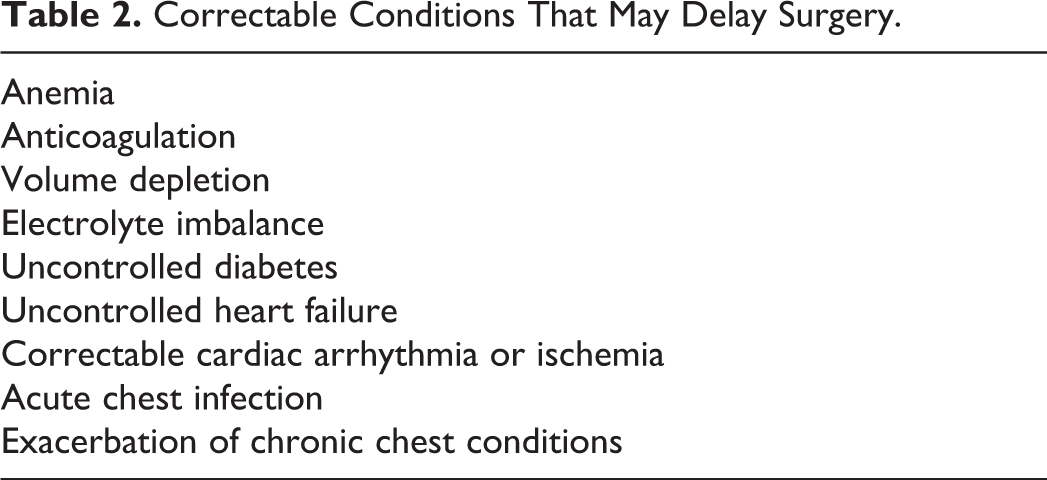
Patient factors that increase mortality from hip fracture include advanced age, male gender, coexistence of multiple comorbities, dementia, and high American Society of Anesthesiologists grading. 4 These risk factors are not modifiable at the time of admission, but research should be done on long-term preventative strategies to reduce rates of fracture in these patients. There are, however, some patient factors that increase morbidity and mortality that can be corrected at admission in order to improve outcome (Table 2) and have been taken from the most recent NICE guideline. 1
Correctable Conditions That May Delay Surgery.
Surgical delay in hip fracture is associated with an increased risk of death 5 and may increase the risk of venous thromboembolism. 6 The most common factors cited in surgical delay can be divided into administrative or medical. 7 Administrative reasons may include absence of theater space or a lack of available surgeon. Medical reasons may include comorbidities of the patient that require optimization or investigation; one such example could include echocardiography for patients presenting with murmur; however, the benefits of a spinal anesthetic may allow avoidance of such delays.
The benefit of operating within 36 hours is attached to a best practice tariff of £890. 3 There are a number of methods for reducing time to theater for fractured neck of femur. First, early recognition of patients with hip fracture in the emergency department with appropriate management; this may take the form of a checklist for hip fractures. Imaging should be performed quickly, and there should be rapid access to computed tomography or magnetic resonance imaging for patients clinically suspected of having a hip fracture without radiological evidence on plain radiographs. Following confirmation of the diagnosis, beds should be prioritized for these patients on dedicated trauma or orthopedic wards. Early involvement of anesthetic and orthogeriatric teams should occur with the aim of optimizing patients for surgery. There should be a dedicated team and, ideally, a 7-day-a-week all-day operating list for patients with trauma, uninterrupted by nonorthopedic emergencies.
Certain trauma units have introduced separate hip fracture operating lists or, as a minimum, regular theater time slots for these injuries. Some centers have appointed specialist hip fracture consultants to address the increasing workload and provide the appropriate experience required in such a fragile patient cohort. In the absence of dedicated hip fracture surgeons, the generic trauma consultant on-call changeover is a crucial time for ensuring avoidance of delays to patients awaiting hip operations. One suggestion would be that consultants could maintain care of these patients even after their on-call period had elapsed, ensuring a continued drive for prompt surgical management by the same clinician. Along with best practice tariffs to the department, additional payment per procedure for patients with hip fracture to orthopedic surgeons may also maintain the push to get patients to theater within the relevant time frame. However, continued “ownership” of patients following completion of an on call or pressures from financial incentives may cause disruption to nontrauma commitments and potentially runs the risk of patients being rushed to theater prior to appropriate medical optimization. All such measures need to be audited and assessed to ensure a combination of both cost and clinical effectiveness, which are vital to the successful running of any publicly funded health service.
An appropriate consultant on-call system, depending on the trust, staffing, and theater availability, is a potential factor that has not been previously discussed in any of the national hip fracture guidelines; we have identified the importance of this in our study. The results of this study show that changing the consultant schedule in a district general hospital from being on call for a day at a time to a week at a time reduced the time to theater for hip fractures. The average time to theater was reduced by 12 hours and 27 minutes. During the 3 months assessed at the hospital when the initial on-call rota was in situ, it missed out on 26 best practice payments that would have amounted to an extra £11 570 of revenue for the hospital at that time. In the 3 months assessed following the change in the rota, a total of £5785 extra was earned by the hospital. If the department had sustained a 100% record, changing the consultant on-call rota would therefore increase the amount of money earned for the hospital by a further £5785 for this 3-month period. With 2012 to 2013 tariffs in use, the hospital would have generated an extra £11 570 just by changing the consultant on-call rota. Extrapolation of these values to calculate what could potentially be earned in a year if a 100% success rate was achieved reflects a very substantial annual increase purely from tariffs.
Our study offers 1 option for improving time to theater for patients with hip fracture in a relatively small unit but our data are not representative of larger trauma centers. In a unit with a significantly higher influx and complexity of patients with trauma, the practicality and safety of patients with 1 consultant on call for a whole week would have to be questioned. Our time to surgery may further be improved by increasing daily theater time for trauma lists on weekdays and ensuring dedicated trauma list at weekends. This would require further staffing and restructuring to man other concurrent nontheater sessions, something that would be less financially viable, given the amount of trauma admitted to our unit compared to larger centers. In the study, it was unpractical to have the 2 limbs of the study running simultaneously to take on a prospective randomized format. Other limitations include both the sample sizes and the length of study period. Ideally, future studies should also include accurate recordings of administrative reasons for delays to theater.
Conclusions
Changing the consultant on-call rota from day on call to week on call in a district general hospital significantly reduces the time to theater for elderly patients presenting with hip fracture. With a weekly changing on-call system, more patients are operated on within 36 hours resulting in a substantial increase in best practice tariff payment.
Footnotes
Declaration of Conflicting Interests
The author(s) declared no potential conflicts of interest with respect to the research, authorship, and/or publication of this article.
Funding
The author(s) received no financial support for the research, authorship, and/or publication of this article.