




Abstract
The 8th World Congress of Pediatric Cardiology and Cardiac Surgery, held in Washington DC in August 2023, was a showcase of the current and future medical therapies and innovative procedures available for patients with congenital heart disease (CHD). Procedures included: multimodal imaging, bedside placement of transcatheter devices, unique combinations for hybrid procedures, cath and surgery for the low birthweight neonate, lymphatic imaging and interventions, leadless pacemakers, and the mitral clip in the univentricular heart, to name a few. The one element these procedures have in common is for them to be accomplished safely, effectively, and efficiently. To achieve a good outcome, most of these patients will need to be sedated or in the case of children, anesthetized. We are currently facing and project to be facing for several more years a health crisis, more profound in the United States than in other countries, where the demand for pediatric cardiac anesthesiologists exceeds the current and projected supply.
Pediatric cardiac anesthesiology is a young specialty. It began in the 1950s in concert with the beginnings of pediatric heart surgery. Over the next two decades, there were significant advances in both pediatric cardiology and pediatric cardiac surgery which enabled pediatric cardiac anesthesia to mature. At the end of the 1970s, pediatric cardiac anesthesia emerged as a distinct field requiring specialized training. Over the next 30 years, multiple training pathways were developed including apprenticeships, on-the-job training, and fellowship opportunities. These modes of training were of variable duration with variable curricula. In 2014, the Pediatric Anesthesia Leadership Council (PALC) in conjunction with the Congenital Cardiac Anesthesia Society (CCAS) recognized the need for a standardized training pathway. They recommended that pediatric cardiac anesthesiology training include another 12-month advanced fellowship following a 12-month pediatric anesthesia fellowship. This was reiterated in 2018 when the CCAS published competency-based milestones for the year fellowship. 1 Due to diverse curricula and evaluation processes, formalization of the training with accreditation through the Accreditation Council of Graduate Medical Education (ACGME) was the next step. The ACGME recognized pediatric cardiac anesthesiology as a subspecialty in early 2021. 2 Over the time it has taken to gain consensus that rigorous structured training is needed for a consultant to acquire the knowledge, skills, and experience to safely care for these complex heterogeneous patients undergoing an eclectic and expanding number of procedures, the demand for pediatric cardiac anesthesia continues to grow.
The etiology of the increase in demand is multifactorial. A major driver is the fact that in the current era, the majority of neonates born with CHD are projected to survive. Survival has improved across all age ranges which results in an increase in the number of both cardiac and noncardiac procedures requiring anesthesia. For the first time, the number of adult survivors with CHD exceeds the number of pediatric survivors. Pediatric cardiac anesthesiologists provide care for a variable percentage of these adults. The increased demand is not only reflected in just the number of cases but also in the case duration. More cases are taking longer due to the increasing percentage of patients undergoing cardiac surgery needing a redo sternotomy and more patients undergoing cardiac catheterization requiring one or more interventions. Anesthesia staffing shortages often result in concurrent needs for anesthesia care to be met by doing cases sequentially. Bed constraints in cardiac intensive care units can result in a delay in case starts from when the operating room is available to ensure bed availability on completion of the case. Longer cases, sequential procedures, and delayed starts result in more procedures continuing into or being started on nights and weekends stretching limited anesthesia resources. New procedures such as placement of a mitral clip for atrioventricular valve regurgitation in the univentricular heart and transcatheter ductal occlusion in the micro-premature neonate require anesthesia support as do new cardiac programs and expansion of existing programs.
A recent survey was conducted in the United States looking at the current pediatric cardiac anesthesia workforce. It was found to be inadequate for the current caseload as evidenced by the fact that nearly half of the programs are actively recruiting. The workforce is aging as 55% of the survey respondents were 55 years or older and 12.5% and 20% planned to retire in five and ten years, respectively. 3 In addition, there has been attrition unrelated to retirement or the COVID pandemic. The principal reasons for pediatric cardiac anesthesiologists choosing other career options or reducing their status to part time are: working in a practice where there is a chronic deficiency of providers for the expanding caseload with no relief in sight and moral injury. Moral injury describes the challenge of simultaneously knowing what care a patient needs and being unable to provide that care due to constraints that are beyond one's control.4,5 An example in pediatric cardiac anesthesia is when an attending is caring for patients in two cath labs with an experienced fellow or Certified Registered Nurse Anesthetist (CRNA) in each room and unexpectedly a patient in one of the rooms requires the attending's one-on-one care. The attending is not able to provide that care since there is not another attending available to cover the second venue, the reason the attending was covering two rooms to start. In addition to maternity leave, many practices are providing time off for new fathers. It is estimated that 25% of new hires just coming out of training will have three to six months of parental leave in their first five years of practice.
There are several factors which place the future of the subspecialty in jeopardy including disruption of the pipeline from pediatric anesthesia, financial implications of a second year of fellowship, and work–life imbalance. The majority of pediatric cardiac anesthesia fellows’ prior training is in pediatric anesthesia (Figure 1). Over the last five years, there has been a slow but steady decline in the number of pediatric anesthesia fellowship positions that are filled which is decreasing the applicant pool for pediatric cardiac anesthesia fellows (Figure 2).
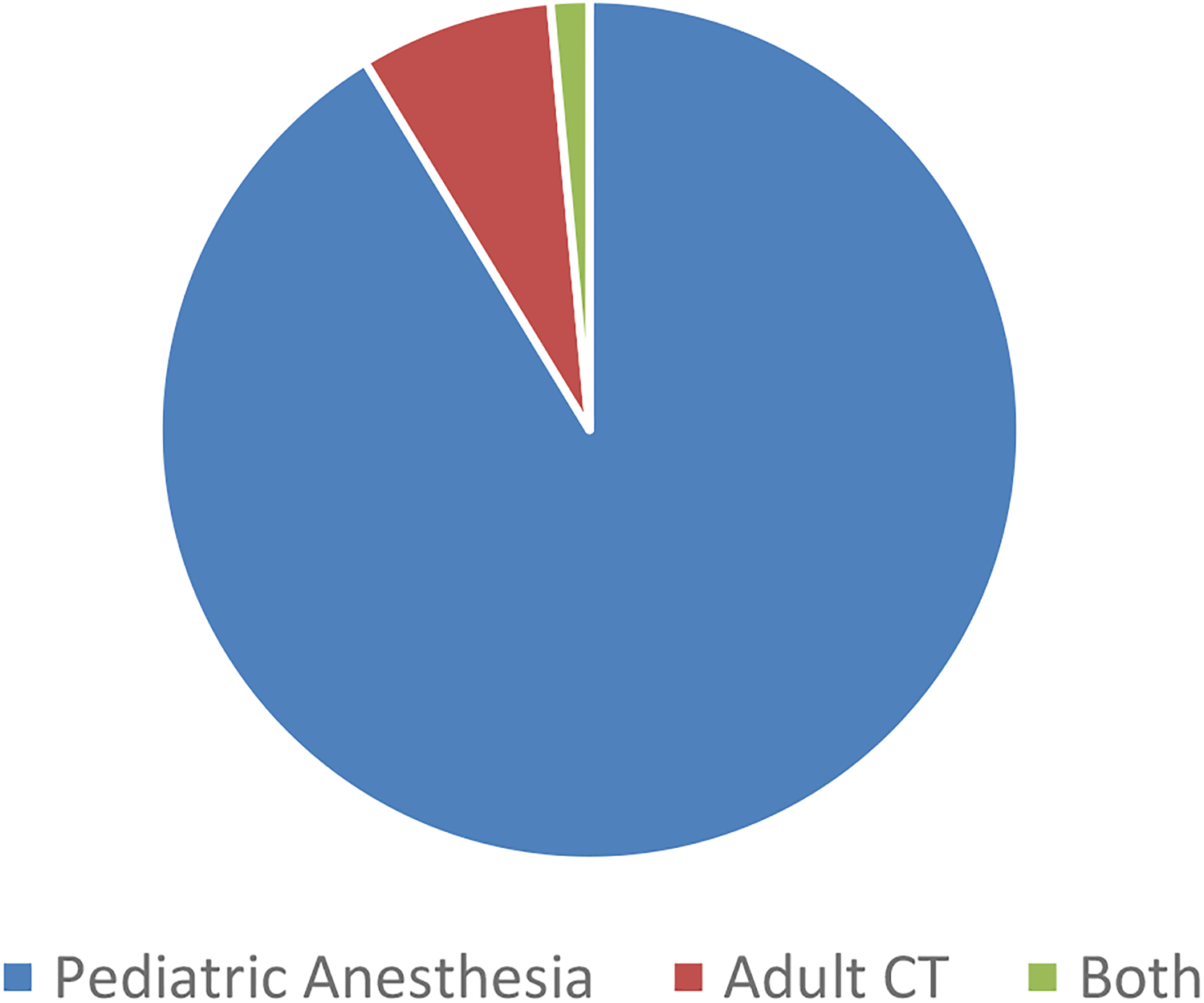
Anesthesia fellowship training prior to pediatric cardiac fellowship. CT, cardiothoracic.
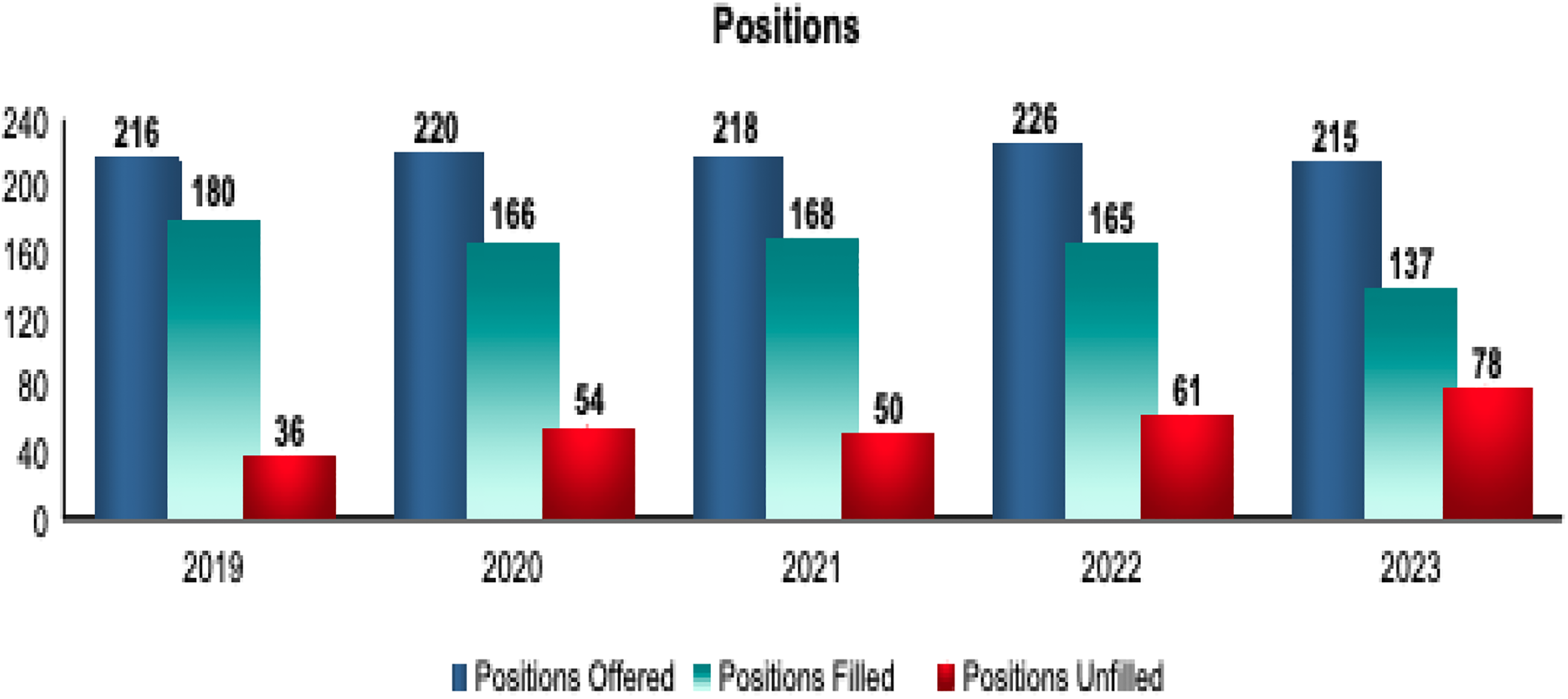
Pediatric cardiac anesthesia fellowship positions. CT, cardiothoracic.
In the United States, the average physician completing undergraduate and medical school has debt exceeding 150 thousand dollars. This is doubled in two career households, which are on the rise. Most fellowship programs pay a trainee's salary which precludes fellows from starting repayment of loans, that continue to accrue interest, increasing debt repayment costs. Given the current job market in anesthesia, trainees completing a standard anesthesia residency already command high starting salaries. There is not a significant increase, if any, in salary after completion of two years of fellowship (pediatric anesthesia, pediatric cardiac anesthesia).
The third factor influencing the future workforce is work–life harmony. There are a few undesirable givens in a pediatric cardiac anesthesia practice: length of days are unpredictable, often long and there is a higher call frequency due to a smaller number of anesthesiologists in a subspecialty practice compared with a general practice. A recent survey was conducted on pediatric anesthesia fellows who had interest in exploring training in pediatric cardiac anesthesia but decided against it. A reason that was cited frequently by these millennials was the “toxic” pediatric cardiac care environment characterized by unbalanced power dynamics, culture of blame, poor behaviors that were ignored or condoned, and lack of effective communication.
In 2022, the PALC and CCAS commissioned a task force to comprehensively examine the issues related to the staffing shortage in the United States and propose creative solutions to provide optimal care for this challenging and growing population of patients. Their report is due in late 2023, or early 2024. Not only is the problem now, but the problem has existed for the last three to five years.
One intervention that needs to be done immediately is to “detoxify” the congenital cardiac environment. Federal loan repayment programs and/or amnesty, similar to programs that exist for geographically underserved areas, will go some way to attract potential applicants. Payment of subspecialty fellows as junior faculty will minimize the financial burden of the additional time in training. In most markets, an imbalance between supply and demand can be resolved through raising prices. The reality of the anesthesia market is that the “price of anesthesia services” (principally provider compensation) is in part influenced by government policy. Medicaid reimbursement rates for anesthesia services have declined steadily for the last decade. Although commercial reimbursement is higher it has followed the same pattern of reductions. Hospital subsidization derived from revenues from the comprehensive cardiac program is the only option to make salaries competitive. Continuing to train and utilizing well-trained pediatric cardiac CRNAs will enable faculty to care for more patients that do not require 1:1 staffing.
Despite the current staffing shortage, there remains considerable satisfaction and rewards in caring for patients with CHD. The opportunity to anesthetize a patient for sequential procedures over a span of years is unique to pediatric cardiac anesthesia. Nothing is more rewarding than to see a child who was critically ill as a neonate later in life as a normal, thriving child for an anesthetic for a procedure unrelated to his congenital cardiac defect. Intellectual stimulation in an innovative environment enables participation in multidisciplinary clinical investigation. Longer term solutions include exposing medical students, interns, and first-year anesthesia residents to both the full spectrum of patients with CHD and to the rewards of a career in pediatric cardiac anesthesia early in their training. Creating an integrated pathway to train consultants in pediatric cardiac anesthesia, similar to what exists to train congenital heart surgeons, that would reduce training time needs to be explored. Subsets of patients with CHD who can be safely anesthetized by anesthesiologists other than pediatric cardiac anesthesiologists need to be identified. The curriculum for general, pediatric, and adult cardiac anesthesia training would need to be revised to enable those practitioners to acquire the fund of knowledge, skill sets, and clinical experience to safely care for these subsets of patients.
Optimal anesthesia care for children with CHD is in jeopardy. If pediatric cardiologists, congenital heart surgeons, and parents of children with CHD want an anesthesiologist they can trust to care for their patient or their child when they need to be anesthetized for a procedure, we as a congenital cardiac community need to enact creative solutions now.