




Abstract
Health degree programs provide opportunities to reduce disparities in care for LGBTQ patients by exposing students to LGBTQ communities and current health issues. However, LGBTQ content is mostly absent from medical school curricula. This mixed method assessment study, conducted during the 2018 to 2019 academic year, examined the feasibility of implementing a medical student journal club focused specifically on LGBTQ health issues as a complementary training tool to support efforts to create an inclusive educational environment. Compared to the pre-test, mean response scores increased for most of the parameters including familiarity with LGBTQ healthcare issues, confidence in the ability to identify harmful medical provider practices, and reading and assessing scientific literature. Qualitative data showed increased confidence, comfort and knowledge about LGBTQ health barriers. This study offers a framework for using a journal club to provide an effective platform for enhancing students’ LGBTQ cultural humility and research literacy.
Keywords
Introduction
Bias, discrimination,1-5 provider discomfort 6 and lack of knowledge7,8 contribute to disparities in care for LGBTQ patients. One recommendation to reduce disparities is to increase physician knowledge and exposure to LGBTQ communities.1,9-12 Undergraduate medical education provides opportunities to do that and build cultural humility. The Association of American Medical Colleges Advisory Committee on Sexual Orientation, Gender Identity, and Sex Development recommended 30 professional competencies to improve undergraduate medical education with the broader goal of reducing disparities and improving health outcomes for the LGBTQ population. 2 However, LGBTQ content is mostly absent from medical school curricula, with a median of 5 hours dedicated to such content in surveyed medical schools, and 33.3 percent of medical schools offering no content during clinical years. 13 A systematic review found that journal clubs were not one of the methods used to provide training to healthcare students on LGBTQ issues. 14
Journal clubs have supplemented training for physicians and other healthcare and public health professionals and have successfully enhanced knowledge, boosted analytical skills and helped individuals translate research into clinical practice.15,16 Journal club participation can also make physicians and medical students feel more comfortable and confident in their ability to evaluate study design, research methods, and results of peer-reviewed articles published in scientific journals, and stay current on medical developments.17-19
Several professional organizations and scientific journals have recommended structural frameworks for journal clubs and offer tools and assessments to gauge effectiveness.20-23 Following a systematic review of literature on medical journal clubs, a 15-item list of best practices for journal clubs was developed. The list included recommendations such as having a consistent schedule, location, and defined goals, reviewing fewer articles but going more in depth, and using experienced and skilled moderators. 24 When critically reading literature, some journal clubs use the MAARIE framework. 25 MAARIE is an acronym for Method, Assignment, Assessment, Results, Interpretation, and Extrapolation, which means that journal club members evaluate the methods, recruitment and assignment of study participants, measurement tools, results, conclusions drawn and the value of the findings to a broader population. The RADICAL framework is another that has been used. 26 RADICAL is an acronym for Read, Ask, Discuss, Inquire, Collaborate, Act and Learn. Using this structure, participants critically read the article assessing the study’s design, methods and findings. Participants then ask themselves the study’s questions and engage in a dialogue with others about the study. Journal club members are encouraged to search additional sources for more insight, collaborate with others, share their reflections and learn from others. To our knowledge, a journal club solely focused on LGBTQ health-related issues has not been implemented.
Methods
The initial concept of creating a journal club specifically focused on LGBTQ-identified and culturally responsive health literature was proposed by Ohio University Heritage College of Osteopathic Medicine (OUHCOM) students and operationalized by faculty and staff, who customized the structure and processes of the club after examining best practices and modifying available resources from other journal clubs.15,17-19,22
First- and second-year students on the main OUHCOM campus received recruitment emails and flyers, class Facebook announcements, and word of mouth notifications. Investigators held an information session in September 2018. Students received helpful resources, including questions to consider as they critically assessed study design, methods, findings, implications and next steps, to help them review articles. Students signed a letter of commitment requiring discussion participation, respectful treatment of journal club members, sharing articles of interest, providing honest feedback, and attending at least 75% of the journal club meetings.
Participants also submitted an electronic consent to take an anonymous, 22-item survey online survey administered through Qualtrics survey software (Provo, UT). The first section asked about familiarity with LGBTQ health issues and challenges faced by LGBTQ-identifying health professionals, and confidence and comfort related to providing culturally competent care, identifying barriers to care, communicating, and reading and assessing scientific literature. The second section asked for meeting logistic preferences and expectations. The third section contained demographic (school class, gender, first-generation student, hometown classification) questions.
Based on student feedback and investigators’ schedules, a one-hour monthly meeting time (early evening) and location (on campus) were established. Students critically read, reviewed, and prepared discussion points for each article provided 1 to 2 weeks prior to each meeting. Articles reviewed touched on the following topics: LGBTQ discrimination on campus, queer-friendly healthcare, health experiences of rural and urban lesbians, barriers to HIV pre-exposure prophylaxis among transgender women and men, and LGBTQ youth perception of primary care.
The project’s lead investigators served as co-facilitators at the first 2 meetings, initially choosing the articles to be discussed. Afterward, students volunteered to lead the discussions and investigators co-facilitated. We posted articles, a study guide, and other resources on Blackboard Learn, a Web-based learning environment, and students could engage in a dialogue or ask questions.
At the end of each meeting, 1 student volunteered to write a brief reflection summarizing the salient points of the session and post on Blackboard. We also emailed journal club members a survey asking about preferred topics for future meetings and evaluation of the sessions. In April 2019, after the final meeting, participants took an online post-survey asking about their confidence and comfort levels treating the LGBTQ population and whether the club met their expectations.
Most closed-ended questions on the survey used a 5-point Likert scale. Pre- and post-responses were not matched. We analyzed data using SAS version 9.4 (SAS Institute Inc., Cary, NC) to provide frequencies and descriptive statistics. Mean scores between pre- and post-surveys were examined using a Cochran-Mantel-Haenszel analysis. Responses to open-ended questions were examined using a qualitative method of analysis with open coding to identify themes and patterns. Two members of the research team coded distinct ideas, and discrepancies were resolved through consensus. The university Institutional Review Board approved the study.
Results
The study took place from September 2018 through April 2019. Participation in the meetings fluctuated slightly from month to month based on students’ schedules but never dropped to less than 4. Seven first- and second-year OUHCOM medical students participated in the study, 4 (57.1%) men and 2 (28.6%) women (1 student did not complete the demographic section). More than half (n = 4) were second-year students, and 1 was a first-generation student. Students did not have a strong preference for any particular time of day or a particular day of the week to hold the journal club, but most (n = 5, 83.3%) preferred monthly meetings to bimonthly or quarterly. Moreover, 4 (66.7%) preferred to meet at the medical school campus rather than elsewhere at the university, at someone’s home or a restaurant. Every student heard about the club from the faculty.
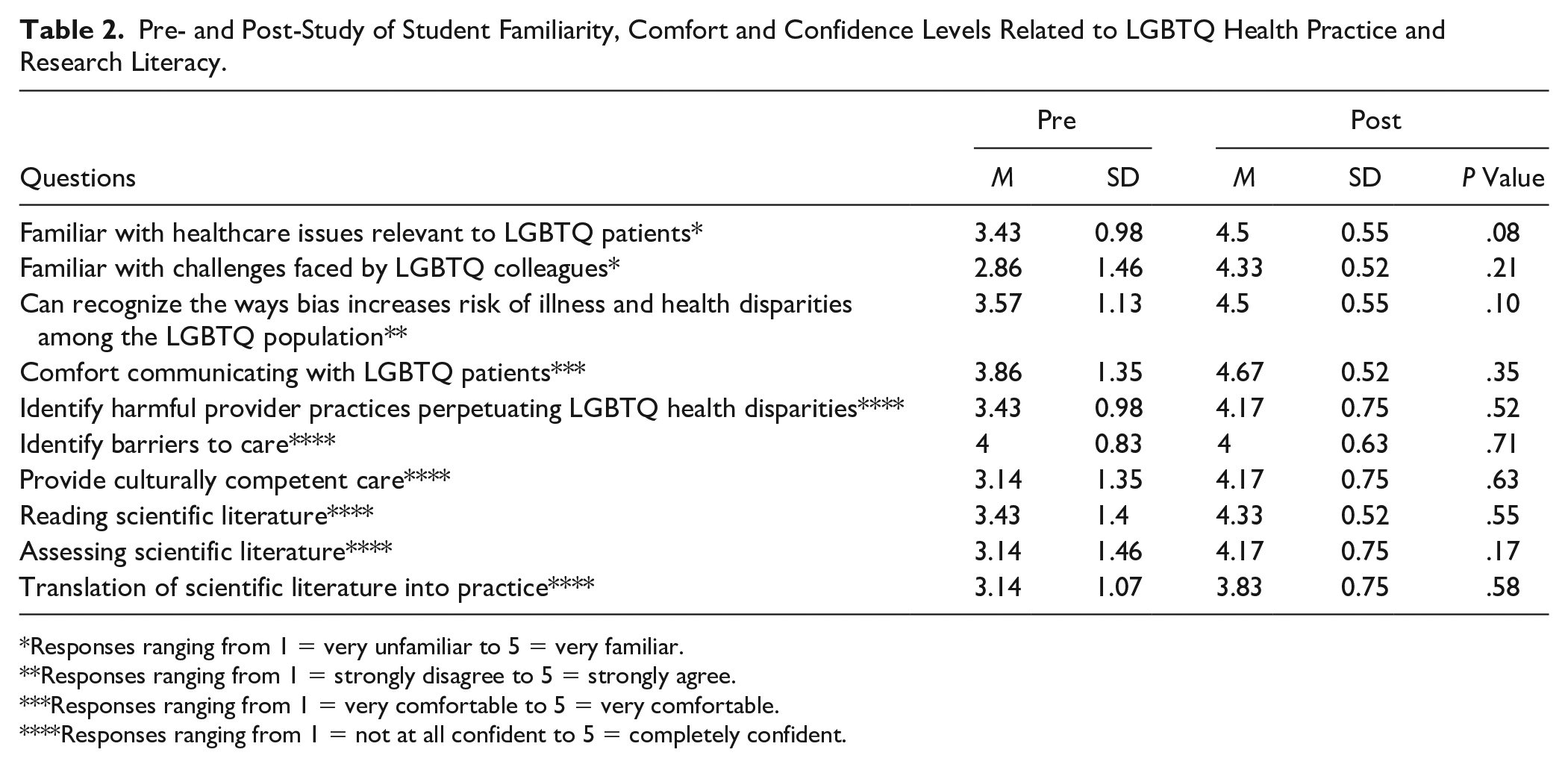
Open-ended questions about expectations and what they liked best provided data suggesting students believed their confidence, comfort, and knowledge about LGBTQ community health issues increased and they developed skills and tools to discuss scientific literature (See Table 1). The percentage of students saying they were familiar with LGBTQ healthcare issues changed from 71.4% (n = 5) to 100% (n = 7), familiarity with challenges faced by LGBTQ health professionals increased from 57.1% (n = 4) to 100% (n = 7). Students’ confidence in their ability to identify harmful medical provider practices and provide culturally competent care shifted from 42.7% (n = 3) on the pre-test to 83.3% (n = 5) on the post-test. During the pre-test, 2 students (28.5%) reported not being confident assessing scientific literature. On the post-test all students were either slightly (n = 3, 50%), completely (n = 2, 33.3%), or neither confident or unconfident assessing scientific literature (n = 1, 16.7%) (See Table 2). Students were less confident translating scientific literature than reading or assessing it.
Pre- and Post-Survey Themes of Open-Ended Questions.

Pre- and Post-Study of Student Familiarity, Comfort and Confidence Levels Related to LGBTQ Health Practice and Research Literacy.
Responses ranging from 1 = very unfamiliar to 5 = very familiar.
Responses ranging from 1 = strongly disagree to 5 = strongly agree.
Responses ranging from 1 = very comfortable to 5 = very comfortable.
Responses ranging from 1 = not at all confident to 5 = completely confident.
There were no statistically significant differences between pre- and post-responses, which we attribute plausibly to a small sample size. Compared to the pre-test, the mean response score post-test increased for most of the parameters that were being assessed. Though not statistically significant, this noteworthy finding can work as a framework for similar future studies targeting a larger student population.
Discussion
This study sought to determine the feasibility of holding a journal club examining LGBTQ health literature as a way to strengthen medical students’ competence when caring for the LGBTQ community and improve research literacy. To our knowledge, an LGBT-specific journal club for medical students has not been previously implemented, and its potential as a complementary training tool to support an inclusive health and/or medical education environment has not been previously examined.
The need to transform medical education to improve care for the LGBTQ population is well documented.1,2,12 Discrimination against LGBTQ communities has been reported throughout all facets of healthcare, with evidence of both implicit and explicit bias identified as early as medical school.1,9,27 One study found that bias was very common in heterosexual, first-year U.S. medical students with 82 percent demonstrating implicit bias and 47 percent showing explicit bias against LGBTQ individuals. 1 In addition to issues of bias, many physicians report being uncomfortable or inadequately prepared to treat LGBTQ patients.6,8 For example, residents and students reported feeling more uncomfortable talking about safe sexual practices with LGBTQ patients than with others. 6 Medical students and physicians have also been found to lack adequate knowledge of the unique medical issues of this population.7-9
Students in the journal club not only evaluated articles from their perspective as future medical providers but sometimes had intensely personal reactions based on experience. After reading the article by Hudak and Bates, 28 1 student who identified as a member of the LGBTQ community wrote on the Blackboard discussion board: “At that visit, the nurse gave me attitude for not using birth control and was scoffing at me during my intake. She didn’t bother to ask me about my sexuality and there was no identifier on the form to discuss it.” Once the student married their same-sex partner and received an insurance card with their spouse’s name on it, the student explained that the discrimination continued, “. . .so every time I go to a new doctor, a new pharmacy, a new dentist, etc. I have to relive the coming out process. . .I could have written that article and then some.”
A common recommendation to reduce bias and microaggressions against LGBTQ patients is to increase health professionals’ exposure to LGBTQ communities.1,9-12 Some evidence suggests that making medical students aware of LGBTQ issues can improve their knowledge, familiarity, and confidence when providing care. 29 The responses from students in our study appear to support previous findings. One student commented: “I joined the journal club in order to enhance my knowledge about the LGBTQIA+ community and their specific health needs/concerns. I wanted a safe space to learn about these topics as I do not have much health-related experience with members of this community. Being well-intentioned does not stop us from hurting/offending/alienating others; though I very much want to be an ally and advocate. . .”
Students demonstrated they could take information from articles and consider how that information could be applied in a clinical setting. In the online Blackboard discussion section, a student commented, “I find it frustrating that the majority (about 60% according to survey results) of providers are practicing in a heteronormative manner. Assumptions like this create barriers that contribute to medical disparities. Tying back to our previous article, 28 I think there is much we can do in this area to create a more welcoming environment, such as placing LGBT signs in office waiting and patient rooms and avoiding heteronormative intake forms.”
Because curricular options for learning about this population are limited in medical school, OUHCOM students and faculty hypothesized that a journal club might be a safe space to explore and discuss topics like LGBTQ terminology, sexual practices, and discrimination. Our students found value in the discussions and different perspectives that took place during journal club meetings: “I thought we had an excellent discussion and analyzed the article very thoroughly. It was great to hear anecdotal experiences to really drive home some of the key points.”
Recommendations
Have A Public Health/Healthcare Practitioner Participate
One of our lead investigators is a physician known for having an LGBTQ-friendly practice. Students said they liked having a physician help translate the literature into practical applications. The physician’s reputation also brought students to the club.
Routinely Assess Progress
After each meeting, we solicited feedback and topic preferences from students via a 5-point survey, which allowed us to make minor modifications immediately. For example, we received comments that students wanted more discussion on how study results affect future practice.
Make the Club an Elective Course
Students participated in the club voluntarily with no compensation. Several suggested the club become a course offering elective credit. We believe doing so might increase the number of participants. Those who attended the club identified as being part of the LGBTQ community or as allies and were interested in learning more. It could be argued that students most in need of developing cultural humility in this area did not participate, but elective credit might incentivize them to enroll. Another argument could be made that a club should be a complement to cultural humility education but should not be considered a substitute for more wholly integrating LGBTQ-relevant issues into all parts of the medical curriculum.
Ensure LGBTQ Participation in Planning, Implementation, and Evaluation
A community-based participatory research approach (CBPR) served as the model for the READ project so that members from the LGBTQ community had an equal voice in all aspects of the project.30,31 One of the co-investigators is a member of the LGBTQ community and provided feedback and guidance on current changing political and societal issues. Additional partners should include an academic LGBTQ center and community organizations that provide services and support. Inviting non-clinical LGBTQ members to share concerns and issues can assist in the selection of key topics for journal articles in the club. Additionally, having LGBTQ community members outside of the academic and clinical settings review selected journal articles with input can enhance the feedback and learning experience. While not 1 person or organization can serve as a representative for the entire LGBTQ community, inclusivity should be prioritized throughout the development and evaluation process so that the journal club is not about a group but rather part of one.
Challenges
Scheduling and time constraints were the main challenges. The club met at the end of the workday, a time agreed upon by most participants. Snacks were provided. However, the time occasionally conflicted with clubs, exams, and other student activities, making it difficult for all students to attend every session.
Conversations often ran over the 1 hour limit. The discussions were dynamic, and it was difficult to get through the content on time. Even though an online forum was offered to continue the conversation, it was infrequently used, which could be due to the small number of participants, preferences by the students to have oral conversations on the topics or other reasons.
Limitations
This study is limited in that it is not generalizable. It looked at 1 small cohort of students at 1 medical school. The responses were self-reported offering students’ perceptions of their confidence, comfort and knowledge but did not look at how the students would put their knowledge into practice.
Footnotes
Acknowledgements
The authors would like to acknowledge Lynn Petrik, RN, Research Nurse, Clinical and Translational Research Unit, for her editing support.
Declaration of Conflicting Interests
The author(s) declared no potential conflicts of interest with respect to the research, authorship, and/or publication of this article.
Funding
The author(s) received no financial support for the research, authorship, and/or publication of this article.
