




Abstract
Background
Increasing evidence suggests that lack of physical activity is more prevalent in older adults in industrialized countries. 1 Physical inactivity contributed to or caused complications in 10% of colon cancer cases, 10% of breast cancer cases, 7% of diabetes cases, and 6% of cardiovascular diseases. Cardiovascular disease has been noted as the fourth leading risk factor for mortality. 2 The leading causes of mobility disability is the lack of physical activity. 3 Engaging older adults in physical activity not only decreases the chance of mobility disability but also provides health benefits. These health benefits include a positive impact on cognitive flexibility, depression, sleep disturbance, Alzheimer’s disease, heart health, diabetes, and general health benefits. 4
The World Health Organization 5 defines physical activity in older adults as any movement that requires energy expenditure. 5 Global recommendations for older adults include leisure-time physical activity, transportation, household tasks, sports, games, and any family or community activity in the category of “physical activity.” Recommendation for physical activity and exercise in the older adults are at least 150 minutes of moderate-intensity aerobic exercise or at least 75 minutes of vigorous-intensity aerobic exercise per week, for a minimum of 10 minutes per session. Watson et al 6 evaluated inactivity in older adults and noted that the prevalence of chronic conditions increased with aging. More than 62% of adult aged 65 years and older were physically inactive. 6 Racial and ethnic minorities demonstrated lower levels of physical activity than whites. 7 Older adults are living longer; therefore, factors contributing to older adults engaging in physical activity and exercise has been discussed at the policy level. There is a plethora of studies on motivators and barriers of physical activity and exercise; however, one area of research under examination more recently reflects environmental factors that affect the ability to engage in physical activities and exercises.
Environmental Factors
Cities are observing an upward shift in the numbers of older adults living in cities, which has led many local government efforts to improve socialization and decrease isolation among older adult residents. The older adults in the current study live in Washington, DC, which has been listed as an age-friendly city. Washington, DC Age Friendly 2020 Strategic Plan 8 included essential features such as adding green spaces and outdoor settings that are well-maintained and safe, public transportation that is reliable, and frequent, traffic flow that is well regulated, affordable housing that is close to community services, and events held at times convenient for older adults. The District of Columbia local government has implemented many of the suggestions in Age Friendly 2020 Strategic Plan 8 making it a beacon of transformation for older adults. The suggestions are part of a checklist published by the World Health Organization that cities can adapt to provide positive experiences and decrease barriers for older adults. When implemented, many of these features increase opportunities for older adults in urban environments to be more active.
More recent research suggests that adding greenspace areas (parks) helps improve rates of physical activity in surrounding communities. Communities with a higher percentage of minority or low-income residents have less access to greenspace and are noted to be more inactive. 9 Environmental factors such as unsafe routes or unwalkable distances were associated with decreased physical activity. 10 Previous researchers have suggested that environmental factors inhibit physical activity and exercise in older adults and act as barriers. 11
Barriers to physical activity and exercises manifest for older adults in many ways leading to health, social, and economic complications. 12 Increase in physical activity, on the other hand, leads to a delay in age-related functional impairment. 12 The built environment may also pose a barrier to physical activity in older adults. Morgan et al 12 noted that external barriers are those such as access, facilities, cost, time limitation, weather, and support from family. Internal barriers include fear of injury, pain, safety, and health limitations. 12 Potential barriers to physical activities and exercise are those such as (1) not enough time; (2) no one to exercise with; (3) lack of facilities; (4) too tired; (5) already active; (6) do not know how to do it; (7) too lazy; and (8) lack of motivation.13(p583) In addition, environmental factors such as access to exercise facilities, neighborhood safety, and psychological issues are equally considered barriers. Depressive symptom diagnosed in Alzheimer’s disease patients is a less known and rarely discussed barrier in older adults that also causes physical inactivity. 14 To counteract these barriers are the things that motivate older adults to engage in physical activity and exercise.
Gillette and colleagues characterized motivators as self-motivational goals, personal goals, knowledge of exercise, and liking the exercise facility. 15 Resnick et al 16 found psychological benefits, such as improved mood and a sense of independence, while the physical benefits included a sense of feeling stronger. African American women reported to be less physically active than White women 17 ; however, they found that older African American women were motivated by an overall feeling of physical and mental health, wellness, and physical attractiveness. 17 Motivators in older African Americans rallied around health and well-being, social support, and enjoyment as key promoters to being physically active. 18 The current study aimed to fill a gap in the literature to understand the perceptions, opinions, beliefs and attitudes of this select group of urban-residing older adults on whether engaging in physical activities and exercise was beneficial. The goal of this study was to understand the perceptions, opinions, beliefs, and attitudes of urban-residing older adults on the benefits of physical activity and exercise. The question that guided this research is, What are the motivators to, barriers of, and benefits derived from engaging in physical activity and exercise?
Methods
Eight focus groups were held between July 17 and July 31, 2019 with 58 older adults who participated in Senior Companion and Respite Aid programs. This research was approved by the University Institutional Review Board at the University of the District of Columbia (IRB #138067-3).
Recruitment
Convenience sampling was employed to recruit older adults who attended a regular educational program at the university. This group attended educational sessions monthly and in the month of April 2019, the principal investigator (PI) was a guest speaker at the April educational session and made a public announcement of the need to understand older adults’ perceptions of physical activity and exercise. The PI asked by a show of hands how many would be interested in participating in the focus groups and those present agreed. Each older adult was made aware that participation was voluntary and would not result in any loss of benefits for non-participation. Furthermore, they were made aware that the focus groups would occur at their normal educational session, which allow their routine to remain the same. Each person was asked to sign a roster indicating a desire to participate. This roster was used to arrange participants in focus groups.
Data Collection
At the start of the focus group sessions, each participant listened as the consent form read aloud and given the opportunity to read the consent form silently. Participants who agreed to continue with the focus group were asked to sign the written consent form. Each participant instructed to complete a short survey to collect demographic information, current level of physical activity and exercise, and 2 questions on food intake. Each survey questionnaire was written at the prescribed reading level of literacy for the general population. The survey for Hispanic and Asian older adults were translated in the respective language allowing participants to read the questions in his or her native language.
Each group of participants reported to their respective focus group room where the trained moderator would guide the focus group discussions. The moderators used a semi-structured 5- to 8-question moderator script as a guide.
Example of focus group questions follow.
Focus Group Guide
Tell us about your adult experiences with physical activity?
What gets in the way or prevent you, your friends, or family member from being as active as you’d like to be?
What are the things that motivate you to engage in physical activities?
What type of physical activity do you enjoy the most?
In what way do you feel supported by your community
Some people like to have a leader or trainer when doing physical activity. What kind of leader or trainer do you like to have for physical activity?
What would be the ideal physical activity or exercise program?
Data Analysis
Focus groups were audio-recorded and video-recorded. The audio-recordings were transcribed verbatim by a transcribing service. Transcripts were analyzed individually by each of the moderators to ensure that transcripts reflected accurately. Each transcript reviewed by the entire research team manually. The PI and 2 other researchers coded the data from each of the transcripts. Research variables had been established and were the underpinning of the data analysis. The research team combed through each transcript and coded each research variable under each theme. As the coding continued, emergent themes appeared. The research team spent several weeks reviewing the themes, returning to the data until a point of saturation reached.
Results
Eight focus groups were conducted with 58 participants, 42 African Americans, 8 Latinos, and 8 Asians. Average age of participants was 72 years, with 9 male participants and 49 female participants. The presence of females outnumbers males. In these volunteer programs participants act in the capacity of caretakers and these are heavily influenced by female volunteers. These programs allow older adults to volunteer their time as companions for older home-bound seniors in Washington, DC. These senior volunteers represent every ward in the District of Columbia. (Wards are boundary lines that divide the District of Columbia into 8 sections. Each ward contains approximately 75,000 persons.) Racial and ethnic backgrounds included African Americans (42/58), Latinos (8/58), and Asians (8/58).
Most participants had completed high school, and were single, married, or divorced. See Table 1 for the list of participant’s characteristics. It is important to note that 66 members attended the educational session; however, this study reports on the 58 participants who agreed to participate in the focus groups. Each of the focus groups was videotaped using an Apple iPad and audiotaped using a Philips recording device. The six focus groups of African Americans were transcribed verbatim by A-Plus Transcription Company. The Hispanic and Asian focus groups were transcribed by the focus group moderator.
Summary of Participant Characteristics.

Four overarching themes were predetermined, and 4 themes were evident from the data and were congruent with the predetermined themes as seen across all focus groups (Table 2).
Thematic Analysis Across Focus Group Sessions Conducted July 17 and July 31, 2019, Which Consisted of 58 Participants That Included African Americans, Hispanics, and Asians. a
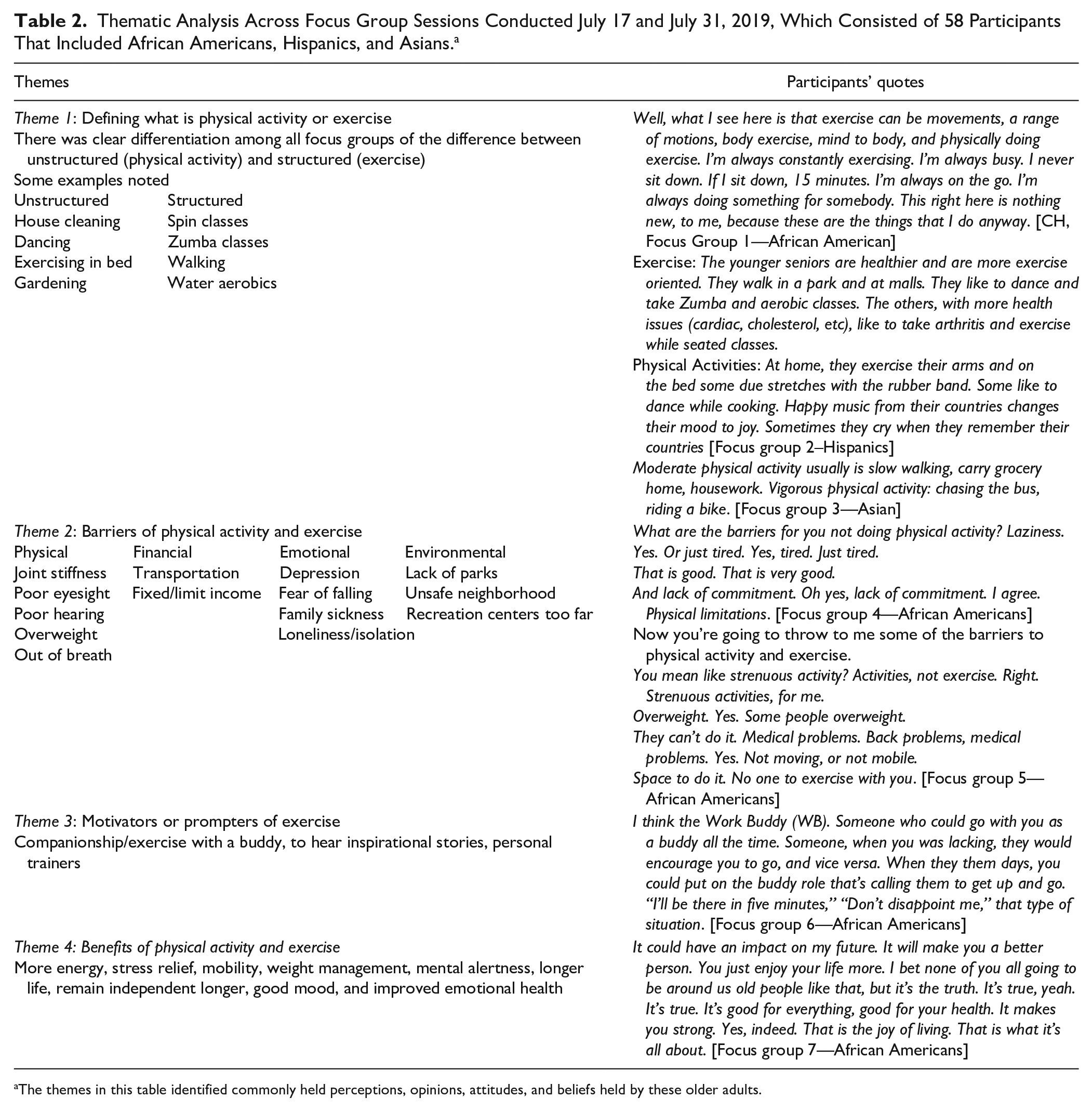
The themes in this table identified commonly held perceptions, opinions, attitudes, and beliefs held by these older adults.
Theme 1: Defining What Is Physical Activity or Exercise
Participants were asked to define what physical activity and exercise meant to them and overwhelmingly most could differentiate between physical activity and exercise. Most participants across all focus groups agreed that physical activity could include everyday activities, like doing household chores or running after grandchildren, while they indicated that exercise was more structure interpreting this as having attended an exercise class where there is an instructor. Majority of participants took pleasure in walking as a form of physical activities and dancing as a structured activity.
Theme 2: Barriers of Physical Activity and Exercise
Many participants agreed that poor physical health, illness, lack of interest, lack of companionship, fixed and/or limited income, weather conditions, and transportation were barriers. The term stress was used often across all focus groups and in particular the Hispanic focus groups where the women expressed how they felt compelled by adult children in their native home country to send money; while the Asian participants experience mood swings that affected the decision to engage in physical activity or exercise.
Theme 3: Motivators or Prompters of Exercise
Overwhelming many participants agreed that socializing with others, hearing inspiring stories of how older adults are living longer due to routine exercise regimen motivated them to exercise. Participants in the Asian group were motivated to exercise only if there was a change in health status that prompted the need to become more active. Hispanic participants on the other hand, were motivated to exercise as it kept them active and healthy, which allowed them to continue to work, with the goal of sending money home to their adult children. Participants in the African American group mentioned that the more you engage in physical activity or exercise the longer you live; longevity was a popular term these members used.
Theme 4: Benefits of Physical Activity and Exercise
Most participants agreed that a feeling of mental and physical well-being, weight loss, attractiveness, prolonged life, and a feeling of being fit and strong were benefits derived from physical activity and exercise. Finally, low-cost physical activity and exercise programs that were conveniently located at community centers dedicated to seniors were ideal for encouraging active and routine participation. Structured exercises, which included activities such as dancing and walking, top the list as a preferred activity.
Discussion
Participants in this study affirmed what has been reported in the literature regarding barriers and motivators to physical activity and exercise in older adults. This study focused exclusively on urban-community-residing adults who were volunteers in the Senior Companion and Respite Aid programs. These programs are managed by the Institute of Gerontology at the University of the District of Columbia. This research team conducted several sessions to evaluate themes that became apparent across all focus groups until a saturation point was reached where no new themes were evident.
The preferred activity noted across all focus groups was dance and the main barrier was fixed or limited income. Motivators, and benefits, included prolonged life, more energy, and a stronger body were the main benefits from physical activity and exercises. Finally, each focus group noted that an increase in community centers with a variety of classes especially dance and having a work buddy to exercise with would increase the likelihood of urban older adults engaging in more physical activity and exercise. The older adults further noted that community centers in safe neighborhoods would further increase their feeling of safety in neighborhoods.
The results of these focus groups identified three issues related to barriers: lack of time, injury, and lack of resources. However, social influence, lack of energy, lack of willpower, fear of injury, lack of skills, boredom, inconvenience, weather, lifestyle changes, travel, illness, and overtraining, made up the rest of the combined list of barriers to physical activity and exercise. Evaluating the individual perspective on barriers to physical activity and exercise through an ecological lens, Cerin et al 19 found that barriers such as lack of time and motivation were related to the level of leisure-time physical activity, while lack of motivation, poor health, and lack of facilities resulted in nonparticipation in leisure-time physical activity.
The investigators in this study draw similarities to that of Cerin et al 19 in that personal, social, and environmental influences can contribute to perceived barriers of leisure-time physical activity. Data from these focus groups support these findings. On the other hand, Crombie et al 20 noted in their study that older adult respondent’ perceived determinants of physical activity disbelieved that exercise could lengthen their life and meeting new people could prove beneficial. The participants in this current study disagreed and found exercise to be beneficial and attributed physical activity and exercise with longevity.
There is no shortage of current evidence of the barriers to and motivators for physical activity and exercise among older adults; however, there is a growing interest in understanding the barriers and motivators of older adults who live in cities. The investigators of this current study conclude that this research adds to the understanding of the perceptions, opinions, beliefs, and attitudes regarding physical activity and exercise in older adults in Washington, DC.
Limitations
As with any research involving human participants, there are limitations. We conclude that the main limitation of this study were the volunteers themselves. This group is an already active member of their community by providing volunteer services for other older homebound seniors in Washington, DC; these older adults may have more awareness of this topic. The current Senior Companion and Respite Aid programs require monthly participation in educational workshops that require participants to come to the university, which facilitates social cohesiveness among group members. Future research should involve seniors who are not members of a structured program to determine if there are similarities in responses to barriers and motivators for physical activity and exercise.
Conclusion
This research study examined the perceptions, opinions, beliefs, and attitudes regarding physical activity and exercise in older adults in Washington, DC, a strictly urban environment. We asked the question What are the motivators to, barriers of, and benefits derived from engaging in physical activity and exercise? We believe this study provided some base line data for what these urban-residing older adults discussed as reasons for participating in or not in physical activity and exercise. Because urban environments have different challenges than rural environments, it was important to understand older adults who were longtime residents.
The short survey given at the beginning of the focus groups asked the older adult to list their health conditions and as expected the top 5 health conditions included (1) arthritis 46%, (2) high blood pressure 71%, (3) high cholesterol 45%, and (4) diabetes 31%, and (5) knee issues 31%. These findings were similar to current research on older adults. The results of this current research will assist us in making recommendations to policymakers on the types of programs for older adults that will increase physical activity and exercise for local citizens with particular emphasis on environmental factors. These interventions are more likely to increase older adults’ ability to remain in their communities and to improve their overall health and well-being.
Footnotes
Declaration of Conflicting Interests
The author(s) declared no potential conflicts of interest with respect to the research, authorship, and/or publication of this article.
Funding
The author(s) disclosed receipt of the following financial support for the research, authorship, and/or publication of this article: This project is based on research that was partially supported by the University of the District of Columbia Agricultural Experiment Station with funding from the Hatch Multistate Research capacity funding program (NE1439) from the USDA National Institute of Food and Agriculture.
