




Abstract
Introduction
As a major public health concern, unipolar depression has been demonstrated to have estimated lifetime prevalence as high as 12%. 1 Depressive disorders are encountered often and observed very early in life worldwide 2 ; and are ranked the second foremost cause of disability across the world and projected to be the leading cause of disability by 2020. 3
Cigarette smoking practically affects every organ of the body and generally negatively affects the health of smokers.4,5 Tobacco use is the most significant cause of disease, disability, and death that are otherwise preventable in the United States and an estimated 40 million US adults smoke cigarettes. 6 Cigarette smoking is more common among adults known to have mental illness or substance use disorders compared with adults without these disorders.6,7 Adults with mental illness or substance use disorder are estimated to consume 40% of all cigarettes in the United States.7,8
Smoking and depression have a well-established and consistent link, often mirrored in a common notion that smoking helps relieve stress, can calm the smoker and make one feel better. In a number of epidemiological studies cigarette smoking is frequently comorbid with major depression9-11 with possible common underlying genetic and environmental (such as socioeconomic status) factors.11-14 Major depression has been demonstrated to trigger the commencement and continuation of smoking behavior.13,15,16 Also, smoking has been found to increase the risk of depression.12,17,18
The US Preventive Services Task Force recommends routine depression screening in the primary care setting. 19 Many or most depressed outpatients are treated by primary care clinicians (PCCs) rather than psychiatrists. 20 Traditionally, usual care (UC) of depression by a PCC follows the typical medical model approach, where the physician fulfills most health care delivery and patient treatment roles. Depressive disorders have largely been treated with pharmacotherapy alone, psychotherapy alone or a combination of pharmacotherapy (antidepressants) and psychotherapy, with the goal of achieving symptom remission and restoring baseline functioning.21,22 Typical clinical management within the primary care setting has been found to be associated with inconsistent improvements in the outcomes of depression.23-25
Alternatively, a more comprehensive strategy such as the collaborative care management (CCM) has shown to improve outcomes of patients with major depression.25-29 CCM involves collaboration among PCCs, patients, and mental health professionals and is an effective way of ensuring integrated care delivery with primary focus on the patient.
Our primary care clinics have utilized CCM since 2008.30,31 Prior studies have reviewed the enhanced effectiveness of treatment within CCM and the comparison of CCM with UC.32-36 We have also shown that comorbid psychiatric and medical conditions can have a negative impact on depression outcomes at 6 months.35,37-40 Recently, we reviewed the electronic records of 2826 depressed patients enrolled in CCM and found that current smokers had an associated decreased treatment adherence and worse clinical outcomes at 6 months compared with non-smokers. 41 Therefore, we sought to evaluate whether a current smoking history had a negative impact on depression treatment of adult primary care patients in the context of treatment with UC versus treatment with CCM. Given our recent data within CCM, we hypothesized that current smoking would also negatively affect 6-month depression outcome in patients treated with UC.
Methods
This retrospective study was conducted on 5515 patients who were diagnosed with major depression at a large primary care practice (>100 000 adult empaneled patients, >150 PCCs) from March 1, 2008 through June 30, 2015. Eligibility criteria for the study required that patients approve of a retrospective review of their electronic medical record (EMR), be 18 years of age or older, have a diagnosis of major depressive disorder or dysthymia, and an initial Patient Health Questionnaire–9 (PHQ-9) 42 score ≥10 at time of diagnosis (at least moderate depression). Exclusion criteria were a diagnosis of bipolar disorder and those patients who listed their smoking habits as “occasionally” or “quit,” since amount of smoking or duration of time since quitting was not obtained.
Once patients were diagnosed with depression and met the admission criteria of the PHQ-9 score, they were offered CCM. CCM was provided without cost to the patient and enabled adjustment of treatment plans by the CCM team, not just the PCC. The CCM team consisted of a registered nurse care manager, therapists, and psychiatrist who met weekly to review new and complex patients. While a majority of both UC and CCM patients were treated with medication therapy, this was not specifically tracked, as psychotherapy was also a viable option for some patients to consider. The goal of CCM was to provide increased evaluation of the patient with more frequent communication, treatment of goal to PHQ-9 score of 5 or less; hopefully with less clinician visits.
Baseline demographic data (age, gender, marital status, and race) and clinical data (initial PHQ-9 score and clinical diagnosis) with 6-month follow-up PHQ-9 scores were obtained from a depression registry and the EMR. Smoking status, but not number of cigarettes smoked per day, was a patient self-defined answer of yes or no. The 6-month outcome variables were defined as: remission of depression (PHQ-9 score of <5) and persistent depressive symptoms (PDS, PHQ-9 score of ≥10). 43 Depression treatment compliance was determined by whether there was a recorded PHQ-9 score at 6 months.
The study cohort was divided into 4 groups, based on treatment type (UC vs CCM) and smoking history (yes/no). Logistic regression modeling for the outcomes of remission and PDS, while retaining all the study variables, was performed with the group of patients who were smokers and treated with UC as the reference group.
This study was reviewed and approved by our Institutional Review Board. Statistical analysis was performed using MedCalc Software (www.medcalc.org, version 17.8.6). Intention-to-treat analysis was used and those who lacked a 6-month PHQ-9 score were assumed to not be in remission (thus having PDS). Chi-square testing was utilized for the categorical variables and, due to the nonnormal distributions; Mann-Whitney testing was used for the continuous variables. Multivariate logistic regression modeling examined the association between the combined variables smoking status and treatment type (UC vs CCM) and the outcome variables of remission or PDS, while controlling for all other study variables. Two tailed P values <.05 were considered statistically significant.
Results
When comparing those patients who self-identified themselves as smokers versus nonsmokers, smokers tended to be younger and were less likely to be female or married than the nonsmoking group (Table 1). Smokers also had a significantly increased baseline PHQ-9 score of 16 versus 14 for nonsmokers and were more likely to be diagnosed with recurrent major depression. There was no difference between these 2 groups for the variable of race, with both groups approximately 93% white. Smokers were less likely to engage into CCM and demonstrated worse compliance at 6 months than nonsmokers. Nonsmokers had improved outcomes at 6 months with 26.0% in remission versus 14.8% of the smokers. Smokers had PDS at the rate of 73.9% at 6 months, compared with 60.3% of the nonsmokers.
Comparison of Smoking and Nonsmoking Primary Care Patients With Depression (Intention-to-Treat Analysis), by Variable (N = 5155).

Abbreviations: PHQ-9, Patient Health Questionnaire–9; CCM, collaborative care management.
Regression modeling demonstrated that the independent variables age, race, clinical diagnosis and initial PHQ-9 all had statistically significant associations with remission at 6 months (Table 2). While controlling for these variables, smoking status did not have an association with remission for patients treated with UC. Patients enrolled in CCM had significantly better outcomes for remission than UC. However, nonsmokers in CCM were much more likely than smokers in CCM to achieve remission (adjusted odds ratio [AOR] 8.25 vs 4.60, respectively). In the smaller cohort of patients who were compliant with 6-month follow-up PHQ-9 scores (n = 2631), the outcomes were similar, with patients in CCM having better outcomes for remission, and nonsmokers treated with UC having similar outcomes to smokers treated with UC (data not shown).
Adjusted Odds Ratio of Clinical Remission (PHQ-9 <5) at 6 Months With an Intention-to-Treat Analysis, by Variable (N = 5155).
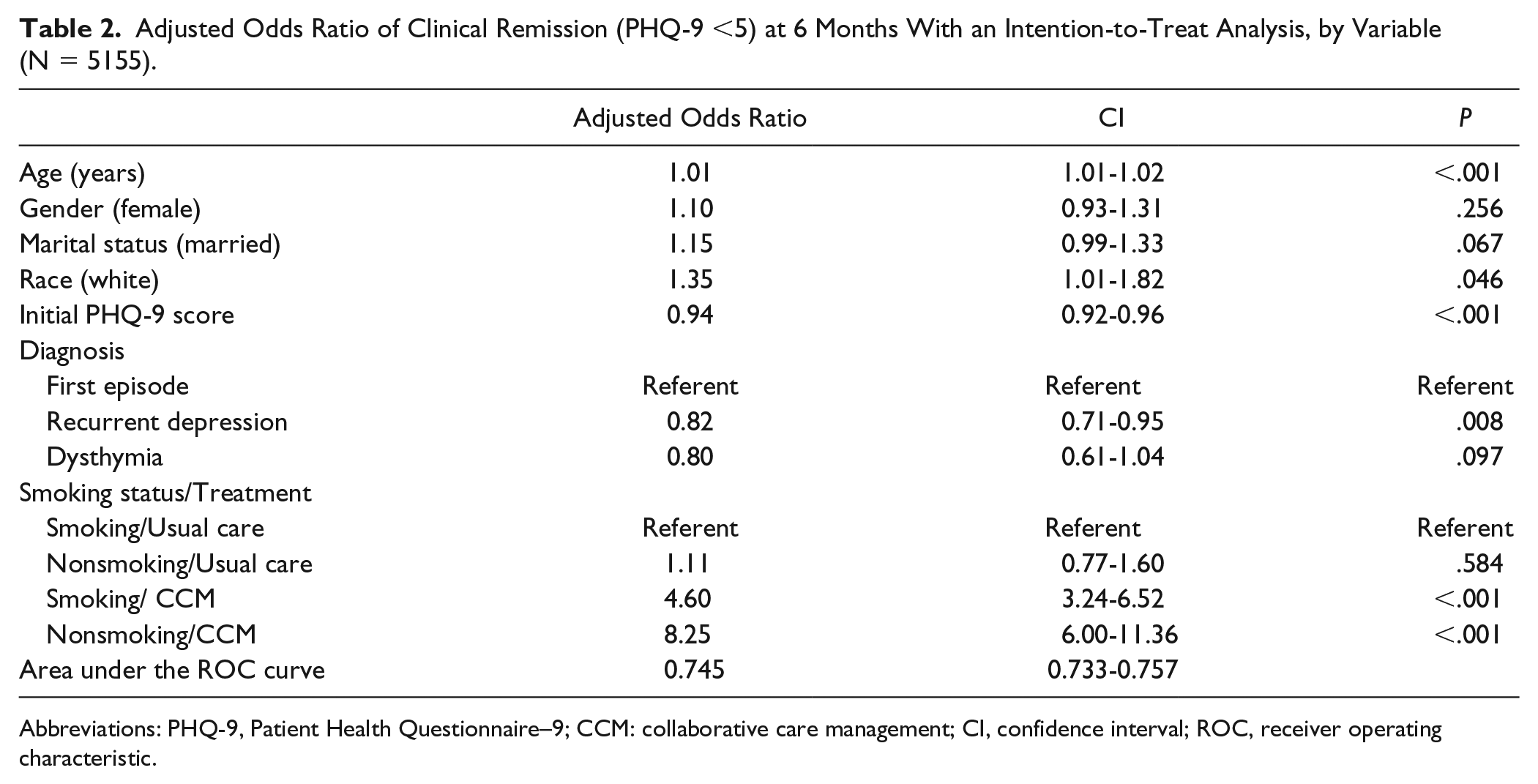
Abbreviations: PHQ-9, Patient Health Questionnaire–9; CCM: collaborative care management; CI, confidence interval; ROC, receiver operating characteristic.
Similarly, regression modeling demonstrated that age, race and initial PHQ-9 score were associated with PDS (Table 3). Within patients treated with UC, nonsmokers and smokers had similar odds of PDS. Patients treated with CCM were significantly less likely to have PDS, regardless of smoking status. Smokers treated with CCM had an AOR of 0.19 (95% CI 0.14-0.025, P < .001) for PDS compared with smokers treated with UC. Consistent with these results, in the smaller cohort of patients with 6-month PHQ-9 scores, outcomes were similar with patients in CCM having better outcomes for PDS, and nonsmokers treated with UC having similar outcomes to smokers treated with UC (data not shown).
Adjusted Odds Ratio of Persistent Depressive Symptoms (PHQ-9 ≥10) at 6 Months With an Intention-to-Treat Analysis, by Variable (N = 5155).

Abbreviations: PHQ-9, Patient Health Questionnaire–9; CCM, collaborative care management; CI, confidence interval; ROC, receiver operating characteristic.
Discussion
This study examined the 6-month outcomes of depression treatment for smokers and nonsmokers treated with UC or enrolled in CCM. Like many previous studies, CCM was universally beneficial, associated with increased odds of remission and lower odds of PDS at 6 months. 44 Similar to our previously published results within CCM, smoking was associated with worse depression outcomes than nonsmokers. 41
Contrary to our hypothesis, we did not observe a difference in depression outcomes between smokers and nonsmokers treated with UC. With less collaborative care and lack of consistent psychotherapy resources, UC has lower odds of remission than CCM irrespective of smoking status. It is possible the traditional pharmacotherapy alone, often offered by UC, does not have differential benefits for smokers and nonsmokers. Thus, a combination of overall lower odds of remission and a lack of differential treatment effects may fail to produce any observable difference in treatment effectiveness between smokers and nonsmokers treated with UC.
Additionally, many patients in the UC group lacked sufficient 6-month follow-up data. Our assumption that those lacking follow-up data remained in PDS is conservative and thus we may underestimate the overall effectiveness of UC and have less ability to detect small differences between smokers and nonsmokers in the UC group. However, a second analysis excluding patients who lacked follow-up data showed similar results.
There are several potential limitations to our study. One limitation of our study is that we looked at treatment of depression in its relationship to current smoking. Also, neither did our study did evaluate whether cessation occurred in the smokers during their depression treatment course nor was it able to disentangle whether smoking cessation may have played a role with improved depression outcomes. Furthermore, our study is a retrospective cohort study and thus we are only able to show associations.
This study was performed at a single large multisite institution using a unified CCM model, further study is needed to determine if similar results apply in heterogeneous practice environments. Patients were free to choose either UC or CCM, thus we cannot completely eliminate self-selection bias. We attempted to control for variables known to be associated with depression outcomes, but there may be unknown confounders affecting a patient’s choice between UC and CCM. 45
Since CCM model has been shown to improve overall depression outcomes regardless of smoking status, we believe that this study provides additional information to help guide those patients with depression who are currently smoking and would not otherwise have pursued CCM into enrolling into the CCM model. Hopefully, by encouraging increased CCM enrollment and thus improving depression outcomes. This study also provided reassurance that for those patients who decline CCM, outcomes in UC for smokers and nonsmokers have no significant difference.
Conclusions
CCM significantly improved depression outcomes for smokers, when compared with UC for depression, whether analyzing using intention to treat analysis or for those who were adherent with 6-month follow-up. However, in the UC group, smoking outcomes were not statistically different at 6 months for either remission or PDS. This is in contrast to prior studies within CCM and suggests that there is complex relationship between smoking and depression outcomes that needs further study.
Footnotes
Declaration of Conflicting Interests
The author(s) declared no potential conflicts of interest with respect to the research, authorship, and/or publication of this article.
Funding
The author(s) disclosed receipt of the following financial support for the research, authorship, and/or publication of this article: Departmental funds were utilized for this study. No outside funding was obtained.
