




Abstract
Background:
The dramatic increase in TikTok use over the past few years has generated a major challenge globally. Providing researchers with a valid, reliable, yet brief measure may stimulate large-scale epidemiological research that can help to clarify the mechanisms involved in susceptibility to TikTok addiction and guide the development of prevention strategies. The objective of our study was to design and validate a brief measure that we labelled the TikTok Addiction Test (TAT) using a multi-country sample, with a specific focus on measuring the 6 core features of addiction through 1 item each.
Method:
A multi-country survey with a cross-sectional design was conducted in February of 2025 among general population adults (N = 3362) from five Arab countries: Egypt, Jordan, Lebanon, Oman, and Palestine.
Results:
A single-factor solution was obtained in the Exploratory Factor Analysis and corroborated in the Confirmatory Factor Analysis, indicating an adequate goodness-of-fit indices, with all 6 items satisfactorily loading on the same latent variable. In addition, the internal consistency reliability indicators were excellent for the entire measure, with Cronbach’s alpha and McDonald’s omega values of 0.91. We found invariance in factor structure, factor loadings, and intercepts between sexes and for country groups. A total of 207 (6.2%) participants were identified as TikTok addicts. Females exhibited significantly higher mean TAT scores than males. Palestinian and Lebanese participants reported the highest TikTok addiction scores, followed by Egyptians, Jordanians, and Omani. Finally, significant positive associations were observed between TAT scores and smartphone addiction, depression, anxiety, and loneliness, supporting the concurrent validity of the scale.
Conclusion:
Results suggest that the TAT is a simple and useful instrument for measuring TikTok addiction of general population adults with only 6 items and 1 factor. As a brief self-report measure, the TAT can be highly valuable in time- and resource-pressured real-life settings, and offers a foundation for future research in this area.
Introduction
In the current era of digitalization, social networks have become an integral part of our everyday lives. In particular, the dramatic increase in TikTok use over the past few years has generated a major challenge globally, with the vast majority of users being adolescents and young adults. 1 TikTok is a short-form video focused social media app that allows users to watch, comment on, create, and share short videos, thus satisfying the various needs of information seeking, socialization, self-promotion, and entertainment.2,3 Besides, TikTok stands out from other platforms because it offers a space where the user can see random and new content from unknown individuals worldwide; it also provides tools that allow video generation and the possibility to become a content creator. Since the emergence of COVID-19 and lockdown, TikTok use has expanded rapidly throughout the world, serving as a boredom relief and mental health booster. 4 Indeed, in 2020, TikTok reached 689 million active users and was the most downloaded social media app globally. 5 Along with the positive effects it produces, TikTok can be potentially harmful for users, with negative impacts varying from physical and mental health issues to broader societal impacts. One of the potential negative outcomes of social media use is the development of addiction.
Users generally end up establishing strong emotional connections with TikTok, resulting in excessive use and a pressing desire to be permanently connected to the platform, 6 ultimately developing addiction.7 -9 Though not yet formally classified as a standalone condition in diagnostic manuals such as the DSM, TikTok addiction appears to meet criteria associated with behavioral addictions. Signs and manifestations that may occur in TikTok users with addiction tendencies include (1) “tolerance,” which refers to the tendency to increase the intensity and time of TikTok use to attain the same hedonic effects; (2) “salience,” that is, the permanent thoughts and expressed concerns about using TikTok; (3) “mood changes” as a result of TikTok use; (4) “withdrawal,” in which the individual experiences restlessness, nervousness, or suffering when prohibited from TikTok use; (5) “relapse,” which refers to loss of control over TikTok use despite attempts or desire to do so; and (6) “conflict” and functional impairment, which reflects the neglect of personal life because of the intensity of TikTok use. 10
TikTok flourishes on brief and easily usable videos that instantaneously capture viewers’ attention, amplifying immediate gratification and leading to patterns of compulsive use. 11 TikTok addiction can be harder to deal with relative to substance addiction, because the platform uses algorithms tapping into user’s interests and preferences without search efforts. The dynamic, highly personalized, and unpredictable content delivered by TikTok to users fosters a reward cycle that echoes mechanisms of addiction, 12 thus offering intermittent reinforcement to increase and maintain use. 13 This also leads to a distorted perception of time, disrupted daily routines, and high levels of subsequent psychological distress. 14 Besides, TikTok has interactive features (such as challenges, duets, live streaming) that can foster novelty-seeking and entertainment, ultimately reinforcing continuous user engagement. 15 Due to its unique algorithm and features, TikTok has a stronger negative impact on users than other social media platforms (such as Facebook and Instagram), including a greater experience of time distortion. 16 Research has shown that TikTok holds the risk of negatively influencing youth’s brain development, 17 and that TikTok addiction is correlated with an array of psychological, behavioral, and social concerns, including depression, anxiety, stress, 18 loneliness, 19 reduced self-esteem, 20 and poor school performance. 21 Despite the app being launched since 2016, it is only very recently that TikTok addiction and its potential risks has sparked an increasing gained interest among the scientific community. Due to the relative novelty of the subject, the limited comprehensive literature covering this phenomenon as a behavioral addiction, the current lack of a clear, consensual definition of the construct, and the absence of official diagnostic criteria, mental health professionals are confronted with significant challenges in capturing TikTok addiction. This emphasizes the strong need for standardized measurement instruments.
In this context, there have been some research efforts devoted to understanding and measuring problematic TikTok usage. For instance, a study investigated the TikTok addiction phenomenon via a qualitative methodological approach. 22 In this study, a TikTok addiction experience was defined as having had “an intense experience with the application,” such as attention difficulties, attachment feelings toward the application, preferring the use of the application over family/friends or over performing daily activities, bodily apperception, temporal apperception, and procrastination. 22 Another study referred to the phenomenon as “short video addiction,” which was described as a situation where users “are unable to control themselves” when watching short videos. 23 Other researchers used self-developed 4 items adapted from 2 previous studies. 24 In 2023, Günlü et al 14 developed and validated the Problematic TikTok Use Scale (PTTUS), which contains 16 items and 3 dimensions (i.e., obsession, escapism, lack of control). The PTTUS was adapted from an Instagram Addiction Scale, and was criticized later for mainly focusing on the behavioral aspects of addiction while neglecting the long-term psychological consequences of problematic use. 25 In 2024, Galanis et al 26 developed a new assessment tool, the TikTok Addiction Scale (TTAS). The TTAS is composed of 15 items and a 6-factor structure (i.e., salience, mood modification, tolerance, withdrawal symptoms, conflict, relapse), with good psychometric properties in terms of validity and reliability. 26 However, due to its length, the TTAS is rather time-consuming, and may have limited utility in some contexts, such as studies that adopt complex experimental paradigms or large-scale surveys that use multiple assessment tools.
Rationale and Objectives of the Study
Providing researchers with a valid, reliable, yet brief measure may stimulate large-scale epidemiological research that can help to clarify the mechanisms involved in susceptibility to TikTok addiction and guide the development of prevention strategies. The development of a brief scale enables the measurement of TikTok addiction with fewer items, while reducing redundancy and retaining the core features of the construct. 27 In addition, short scales are effective due to their ability to detect the most important information efficiently, while accounting for time constraints. 28 Such brief measures also minimize the boredom, fatigue and frustration associated with longer, more time-consuming measures, thereby increasing response rates and improving data quality. Following the precedent of validated brief measurement tools in the addiction field, such as the Bergen Facebook Addiction Scale (BFAS 29 ), the Bergen Social Media Addiction Scale (BSMAS 10 ), and the Bergen–Yale Sex Addiction Scale (BYSAS 30 ), a short TikTok addiction test may efficiently capture key components of the construct without sacrificing psychometric quality.
Therefore, the objective of our study was to design and validate a brief measure that we labelled the TikTok Addiction Test (TAT), with a specific focus on measuring the 6 core features of addiction through 1 item each. Samples from 4 Arab countries were used to increase the generalizability of our findings. The study intended to investigate whether the newly developed measure was valid and reliable. Additionally, the TAT was tested for invariance between groups of participants of different sexes and countries. The following hypotheses were proposed and tested: (1) the TAT will have a single-factor structure with high factor loading (>0.60) for all items and a high internal consistency (Cronbach’s alpha > 0.80), (2) the scale’s factor structure will be invariant across sex and country groups, (3) the TAT will correlate positively with a measure of smartphone addiction, and (4) the TAT will correlate positively with measures of depression, anxiety, and loneliness.
Methods
Sample, Design, and Procedure
A multi-country survey with a cross-sectional design was conducted in February of 2025 in 5 Arab countries: Egypt, Jordan, Lebanon, Oman, and Palestine. The target sample consisted of general population adults aged 18 years and over, who have been TikTok users for at least the past 12 months, who were able to read and understand Arabic, and had access to the internet. Potential participants who did not meet inclusion criteria at time of recruitment, those who did not agree to participate, and respondents who did not complete all questions were excluded. Participants who voluntarily agreed to participate in our study were asked to complete an online questionnaire under conditions of anonymity and privacy. The questionnaire was provided only in the Arabic language version. The survey link was created using Google Forms and was distributed to participants through social media platforms (e.g., Instagram, Facebook, WhatsApp). The first page of the questionnaire provided the necessary information about the study, including its purpose, its confidential and anonymous nature, as well as time required for completion (around 10 min). After reading the information, participants were asked to indicate their informed consent by ticking “Yes” to the question “Do you agree to participate in this study?” It was ensured that the multiple response inquiry was not possible by the same respondent, and each individual could participate only once. Participants could withdraw from the survey at any time while participating by simply closing the browser. The research protocol of this study was reviewed and approved by the Institutional Review Board of the Rayak University Hospital, Bekaa, Lebanon (ECO-R-401). A total of 72 individuals did not provide their agreement to participate in the study by ticking “no” to the consent question, resulting in 3362 valid responses received and included in the final analysis (Egypt: N = 1487; Jordan: N = 448; Lebanon: N = 805; Oman: N = 174; and Palestine: N = 550).
Minimum Sample Size
The minimum samples for the EFA and CFA were 60 and 120 participants respectively based on the recommendation of 10 31 and 20 items per scale’s item. 32
Measures
Demographics
Participants’ demographic information was gathered, including age, sex, country, and marital status.
The TikTok Addiction Test (TAT)
The TAT was developed in Arabic. We applied the same criteria and framework that were adopted for developing multiple commonly used and accepted psychometric scales in the behavioral addictions field, such as exercise addiction, 33 gaming addiction, 34 sex addiction, 30 or Facebook Addiction. 29 As such, the 6 defining symptoms of behavioral addictions, including Gambling Disorder, which is the only behavioral addiction officially recognized by the latest version of the DSM, 35 were utilized to design the TAT. These addiction criteria encompass the following: (1) salience, which refers to over-preoccupation with, and focused attention on, TikTok; (2) withdrawal, which reflects unpleasant physical or emotional sensations experienced when TikTok use is abruptly interrupted, (3) tolerance, which refers to major increase in TikTok use over time to achieve the same level of satisfaction, (4) mood change, which designates improves in mood in response to TikTok use, (5) conflict, which indicates worsening of interpersonal relationships as a result of excessive TikTok use, and (6) relapse/loss of control, which reflects failed attempts to limit TikTok use, uninstall or block the app. A single item was designed for each criterion, with response options varying from 0 (very rarely) to 4 (very often). The adoption of a 5-point Likert scale enables for clear assessment of risk levels, facilitating the identification of at-risk users. The time frame was defined as the 12 months prior to completing the measure. The specific wording of the items was inspired from the existing literature on TikTok addiction, 25 and from the wording used in measures evaluating other behavioral addictions.29,30,33 The 6 statements that make up the TAT are: (1) “Spent a lot of time thinking about, or planning to use TikTok?” (2) “Felt an urge to use TikTok more and more?” (3) “Used TikTok in order to forget about/escape from personal problems?” (4) “Tried to cut down on the use of TikTok, uninstall, and/or block the app without success?” (5) “Become restless, anxious, or depressed if you could not use TikTok?” and (6) “Used TikTok so much that it has had a negative impact on your relationships and/or work/studies?”
In line with previously reported and accepted cutoff criteria for other tools measuring behavioral addictions (e.g., Andreassen et al,29,30 Lemmens et al 34 ), those whose symptoms scored at least 3 (often) or 4 (very often) were operationally classed as a “TikTok addict.” Additionally, for a respondent to be categorized as having a TikTok addiction, at least 4 of the 6 TAT items (i.e., more than half of the symptoms 36 ) had to be endorsed at a frequency of often or very often. On the other hand, a total composite TAT score of 0 was defined as “no TikTok addiction.” Studies investigating behavioral addictions have generally adopted 2 approaches to categorize people with behavior problems and label a group as “addicts.” The first one is conservative, entailing the use of a monothetic scoring key (e.g., scoring at least 3 on all 6 items). The second one is liberal, based on the use of a polythetic scoring system (e.g., scoring at least 3 on at least 4 of the 6 items). 29 The latter scheme was chosen for our scale, because in the international classification systems (such as the Diagnostic and Statistical Manual of Mental Disorders, Fifth Edition, Text Revision, DSM-5-TR 35 ), a categorization (or tentative diagnosis) of addictions is normally made when the person with the behavior meets a given number of criteria. The risk for TikTok addiction was considered as “low” for TAT scores ranging from 1 to 6, where maximally 2 of the 6 items could be scored above cut-off, whereas the risk was considered as “moderate” for TAT scores of ≥7, where all 6 items scored above 1 and TikTok addiction criteria were not fulfilled.
The Smartphone Addiction Scale-Short Version (SAS-SV)
The SAS-SV is a self-report scale that contains ten items assessing the degree of smartphone addiction on a 6-point Likert-type scale ranging from 1 (Strongly disagree) to 6 (Strongly agree). 37 Total scores can be obtained by summing up all items’ scores. Greater total scores reflect more severe smartphone addiction. The Arabic validated version of the SAS-SV was used in this study 38 (Cronbach α = 0.90).
The Patient Health Questionnaire (PHQ-4)
The PHQ-4 is an ultra-brief measure composed of 4 items that assesses symptoms of anxiety and depression over the last 2 weeks through 2 items each. 39 Response options range from 0 (not at all) to 3 (almost every day). Higher scores indicate greater psychopathology. The Arabic validated version of the PHQ-4 was used in this study 40 (Cronbach α = 0.81).
The Jong-Gierveld Loneliness Scale (JGLS)
The JGLS is a self-administered brief scale which assesses subjective loneliness feelings via 5 yes/no statements (e.g., “I miss having people around,” “I experience a general sense of emptiness”). 41 A positive answer is scored 1, whereas a negative answer is scored 0. Higher scores reflect greater experience of loneliness. The Arabic validated version of the JGLS was used in this study 42 (Cronbach α = 0.69).
Analytic Strategy
There were no missing responses in the dataset. We divided the total sample into 2 subsamples using the SPSS random option; the first one consists of 33% of the total number was used for the exploratory factor analysis (EFA; n = 1097) and the second one for the confirmatory factor analysis (CFA; n = 2265). There were no significant differences between the 2 subsamples in terms of mean age, t(3360) = 0.48, P = 0.631, Cohen’s d = 0.018, and gender χ²(1) = 0.07, P = 0.792, Cohen’s d = 0.005.
Exploratory Factor Analysis on the First Subsample
The suitability of the data was evaluated using the KMO and Bartlett’s tests. The Measure of Sampling Adequacy (MSA) at the item level was examined to determine whether items with values below 0.50 should be excluded from the analysis. 43 The residual correlation between item pairs (doublets) was assessed using the Expected Residual correlation direct Change (EREC) index, which should be close to 0. Items that repeatedly appeared in multiple doublets were considered for removal. 44 Given the ordinal nature of the variables, EFA was conducted using a polychoric correlation matrix. 45 Unweighted Least Squares (ULS) was selected as the estimation method following international guidelines. 46 The number of factors to retain was determined through Parallel Analysis.47,48 Factors loadings of ≥0.40 were deemed acceptable. 49
Confirmatory Factor Analysis on the Second Subsample
CFA was conducted via SPSS AMOS v.29 software. We intended to test the factor structure we obtained in the EFA. Parameter estimates were obtained using the maximum likelihood method. The model adequacy was verified via several fit indices: the root mean square error of approximation (RMSEA) (≤.08), standardized root mean square residual (SRMR) (≤.05), the Tucker-Lewis Index (TLI), and the comparative fit index (CFI) (both ≥.90). 50 Multivariate normality was not verified; therefore, we performed non-parametric bootstrapping procedure.
Measurement invariance of TAT scores was done by sex and country using multi-group CFA 51 using the total sample at the configural, metric, and scalar levels. 52 We accepted ΔCFI ≤ .010 and ΔRMSEA ≤ .015 or ΔSRMR ≤ .010 as evidence of invariance. 53
The remaining analyses were conducted using SPSS software v.27. Composite reliability was evaluated using McDonald’s ω and Cronbach’s α, with values greater than 0.70 indicating acceptable reliability. The normality of the TAS score was confirmed, as skewness (=0.861) and kurtosis (=0.105) values fell within the range of −1 and +1. 54 Consequently, Pearson’s correlation was used to assess relationships 2 continuous variables, while the independent sample t test was performed to compare TAS scores between sexes. An ANOVA test was conducted to compare TAT scores across different countries, followed by a Bonferroni post hoc test for pairwise country comparisons. A significance level of P < .05 was applied.
Results
Characteristics of the Sample
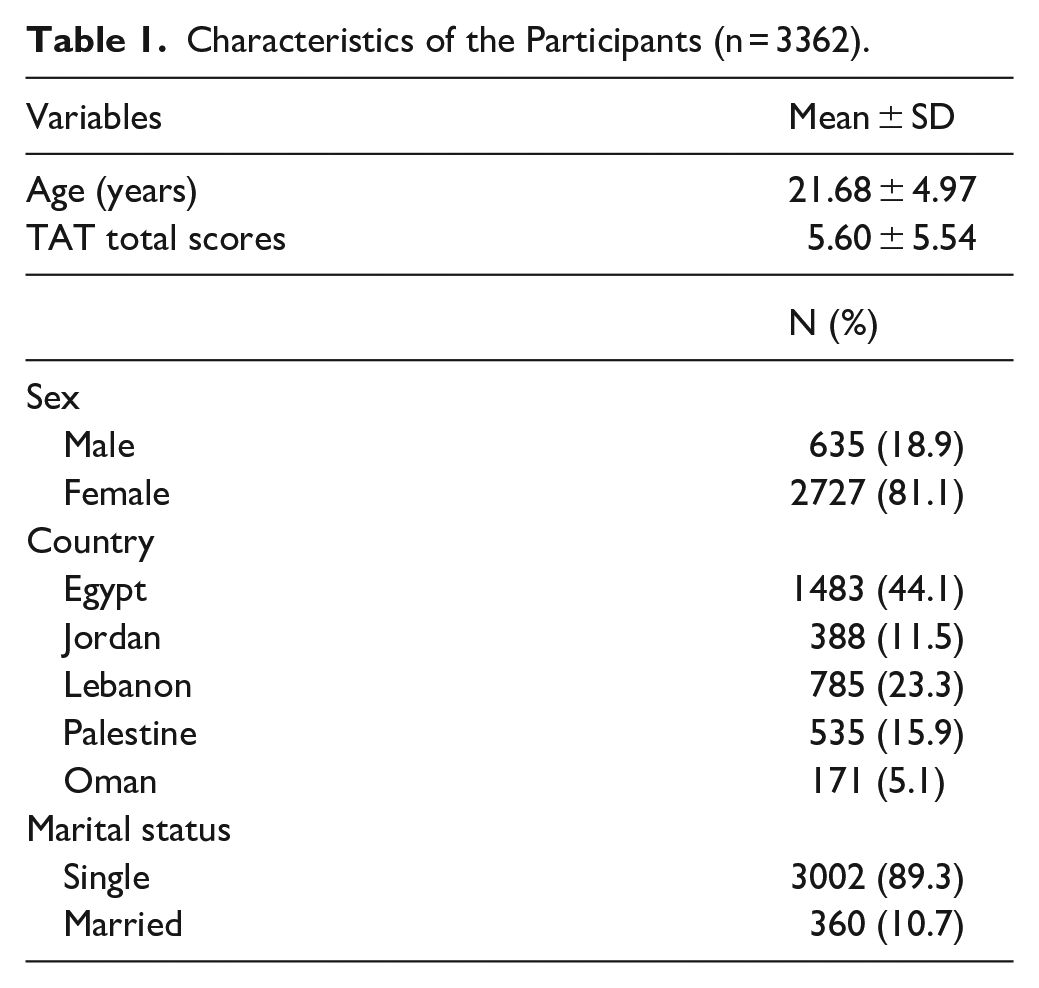
Participants’ characteristics are depicted in Table 1. The age range was 18 to 64 years. The majority of participants were females (81.1%) and single (89.3%) (Table 1). A total of 207 (6.2%) of the participants were identified as TikTok addicts, whereas 1020 (30.3%) had no TikTok addiction based on a TAT score of 0. As for the rest of participants, 1065 (31.68%) were categorized as having a “moderate risk” and 1070 (31.83%) a “low risk” for TikTok addiction.
Characteristics of the Participants (n = 3362).
Exploratory Factor Analysis (Subsample 1)
The KMO (=0.906) and Bartlett’s test (P ≤ .001) confirmed the adequacy of the data for EFA. None of the items was removed due to low MSA or appeared in multiple doublets. The parallel analysis indicated an adequate fit to 1 factor, which explained variance of 68.49%. Results indicated an adequate fit to a unidimensional structure supported by the GFI (GFI = .998) and CFI (=.999) being greater than 0.90, the UniCo (UniCo = 0.998) index greater than 0.95, the I-ECV (I-ECV = 0.951) greater than 0.85, and MIREAL (MIREAL = 0.164) lower than 0.30.
Confirmatory Factor Analysis (Subsample 2)
CFA results showed that the unidimensional structure of the scale was very good: RMSEA = 0.096 (90% CI 0.085-0.108), SRMR = 0.023, CFI = 0.978, and TLI = 0.963. The loading factors resulting from the EFA and CFA are summarized in Table 2. The Average Extracted Variance (AVE) value was 0.64 (>0.50), indicating convergent validity of the scale. The composite reliability was excellent in both subsamples and in the total sample (ω = 0.91/α = 0.91) (Table 2).
Loading Factors of the TAT Scale Deriving From the Exploratory Factor Analysis (EFA) and Standardized Loading Factors Deriving From the Confirmatory Factor Analysis (CFA).

Measurement Invariance
We were able to show the invariance across sex at the configural, metric, and scalar levels (Table 3). A significantly higher mean TAT score was found in females vs males (5.00 ± 5.14 vs 5.73 ± 5.62; t(3360) = −3.17; P = .002, Cohen’s d = 0.132). In terms of countries, Palestinians scored highest (6.03 ± 5.75), followed by Lebanese (5.68 ± 5.23), Egyptians (5.59 ± 5.48), Jordanians (5.28 ± 6.04), and Omani (4.54 ± 5.49), F(4, 3357) = 2.75, P = .027, Cohen’s d = 0.003. The post hoc analysis showed a significant difference between Palestine and Oman (P = .022).
Measurement Invariance of the TAT Scale Across Sex and Countries in the Total Sample.

Abbreviations: CFI, comparative fit index; RMSEA, root mean square error of approximation; SRMR, standardized root mean square residual.
Concurrent Validity
Higher TATS scores were significantly associated with higher smartphone addiction (r = 0.36; P < .001), loneliness (r = 0.20; P < .001), anxiety (r = 0.26; P < .001), and depression (r = 0.25; P < .001).
Discriminant Validity
Discriminant validity was supported, as the square root of the AVE (=0.80) exceeded all correlations between the construct and other scales, in line with the Fornell-Larcker criterion.
Discussion
In light of growing interest and research in TikTok addiction, both empirically and conceptually, the need for the development of psychometric tools becomes a necessity. For the measure to be applicable and practical for use, a key criterion that should be satisfied is brevity, 55 especially in young TikTok users who may tend to prefer and see as less demanding activities that are quick and short-lasting. This study was designed to examine the psychometric properties of a newly developed brief instrument of TikTok addiction, the TAT, which consists of 6 items created based on elements that theoretically mirror central behavioral addiction criteria, 35 in order to ensure content validity. The validation process was performed using a large multi-national sample of university students from 5 Arab countries of the Middle East and North Africa (MENA) region. The region offers a fertile environment to investigate and address this research question because many Arab countries have the highest TikTok reach globally, with TikTok use having more than doubled over the past few years in the region. 56 Findings indicate that the TAT has good psychometric characteristics in terms of factor structure, validity, and reliability.
As anticipated, a single-factor solution was obtained in the EFA and corroborated in the CFA indicating an adequate goodness-of-fit indices, with all 6 items satisfactorily loading on the same latent variable. In addition, the internal consistency reliability indicators were excellent for the entire measure, with Cronbach’s alpha and McDonald’s omega values of 0.91, indicating a high level of homogeneity among items. Our results justify the summation of scores to a total score as reflecting a single construct, and lend support to the fact that a total TAT score is a meaningful entity that can be used by researchers and clinicians as a first indication of TikTok addiction severity.
We found invariance in factor structure, factor loadings, and intercepts between sexes and for country groups. This finding is crucial for future research on sex comparisons, to ensure that the observed group effects reflect true, authentic differences between groups rather than differential item functioning and statistical artifacts. This suggests that when sex or country groups are compared, the scale’s items operated similarly for male and female respondents and for those from various Arab nations. Our findings indicated that females exhibited significantly higher mean TAT scores than males. Male users have an increased tendency to refer to TikTok, as to Internet more generally, for recreational and entertainment purposes, 57 whereas female users might be more appealed by the social connection features of TikTok and the desire to fulfil self-presentation needs. 58 Differences in the reasons why males and females engage with TikTok might influence sex differences in the prevalence of TikTok addiction. 25 Despite these indications, there remains a significant knowledge gap regarding sex-related differences in TikTok addiction, as no studies exist to date on the how males and females may experience distinct patterns of TikTok use. 25 Furthermore, Palestinian and Lebanese participants reported the highest TikTok addiction scores, followed by Egyptians, Jordanians, and Omani. A meta-analysis showed that the prevalence estimates of social media addiction the Middle East and Africa tended to be higher than those in other parts of the world. 59 In line with our findings, previous estimates indicated that more than three-quarters of the adult population in Lebanon (76.3%) and more than 6 in 10 in Jordan (62.9%) use TikTok. 56 These patterns may be influenced by cultural and contextual factors, including widespread internet access, high smartphone use, and the popularity of social media as a primary outlet for entertainment and self-expression in the region. Additionally, limited recreational opportunities and socio-political instability in some of these countries may contribute to greater reliance on online platforms like TikTok. Differences in social norms, particularly regarding gender roles and media engagement, may also shape usage patterns across countries. Countries vary in terms of the openness of public discourse, societal attitudes toward gender roles and regulation of digital content, all of which can influence how individuals engage with platforms like TikTok. In more conservative societies, public self-expression, especially among women, may be more restricted, leading to lower reported usage or more private consumption of content. Conversely, in more liberal countries, social media may serve as a door for creativity, identity expression, and communication, contributing to higher usage rates.
Significant positive associations were observed between TAT scores and smartphone addiction, depression, anxiety, and loneliness scores. These patterns of correlations were as expected, and support the concurrent validity of the TAT. These results concur with those of previous studies highlighting that as the time spent on TikTok increases and users’ addiction to the app intensifies, so do depression, anxiety, and loneliness.18,19 Overall, this study’s results provide further empirical evidence that heavy TikTok involvement could have detrimental mental health consequences on users. 25 In this regard, the TAT could be useful to evaluate the specific influence of TikTok addiction on users’ mental health.
Study Limitations
This study has limitations. First, the target population was university students, with the majority of the sample being female, which is not representative of the broader general population, and may limit the generalizability of results. To strengthen the psychometric robustness of the TAT, there is still a need for further validation on larger and demographically diverse samples of general population adults, such as non-students and higher age groups, who may have different experiences with TikTok. Second, the study was conducted in a single language and cultural context (Arabic). Future studies should aim to broaden the geographic scope of psychometric research on the TAT, in order to enhance the applicability of the new measure to culturally distinct countries such as Western and Asian contexts. Third, the study only relied on self-reported data, which could affect the accuracy of the findings. Moreover, the self-reported nature of TikTok usage could introduce recall or social desirability bias, despite the emphasis on anonymity. To complement subjective data, future studies should consider adopting an experimental approach and incorporating objective measures of TikTok use, such as eye-tracking analysis of user experiences. Finally, test-retest reliability of the TAT could not be verified due to the cross-sectional design, underlying the need for longitudinal analyses that document changes over time.
Practical Implications and Future Research Directions
The present findings showed that the TAT is a simple and useful instrument for measuring TikTok addiction of general population adults with only 6 items and 1 factor. As a brief self-report measure, the TAT has many advantages, such as reducing administration time, respondent burden, and attrition. Therefore, the TAT can be highly valuable in time- and resource-pressured real-life settings, especially when included in longitudinal research and/or large test batteries alongside multiple other constructs. The TAT offers a foundation for future research in this area. Its use may provide more reliable prevalence estimates and better knowledge about patterns of TikTok addiction. Moreover, it is hoped that the new scale will encourage research that opens the possibility to a deeper understanding of the unique mechanisms underlying the TikTok addiction, as well as its different effects on users’ mental health. Elucidating the mechanisms behind addictive use of TikTok can help inform the development of specific preventive and treatment interventions, and improve the effectiveness of public health efforts tailored to address the excessive TikTok consumption and promote healthy technology use. Further research is essential to validate the TAT across broader and more diverse populations to ensure its cross-cultural applicability and generalizability.
Conclusion
This study fills a gap in the literature by creating a brief, simple, and practically useful measure of TikTok addiction that could be suitable for use in time-limited situations, and could operate across varying individual characteristics. The EFA and CFA presented a unidimensional factor structure for the TAT, which means that all 6 items are loaded on a single factor with good fit indices and good reliability indicators. Hence, the calculation of sum scores provides useful information for clinicians and researchers that reflects the overall degree of addiction that TikTok users receive. Future studies are required to confirm the psychometric properties of the TAT and improve the generalizability of the results.
Footnotes
Acknowledgements
Author KJ would like to acknowledge support through the ICTP-Arab Fund Associates Programme (2024-2026).

Ethical Considerations
The research protocol of this study was reviewed and approved by the Institutional Review Board of the Rayak University Hospital, Bekaa, Lebanon (ECO-R-401). All methods were performed in accordance with the relevant guidelines and regulations.
Consent to Participate
Written informed consent was obtained from all subjects; the online submission of the soft copy was considered equivalent to receiving a written informed consent.
Consent for Publication
Not applicable.
Author Contributions
FFR and SH designed the study; FFR drafted the manuscript; SH carried out the analysis and interpreted the results; HAMS, MH, KJ, AYN, SEK, TS, ER, IN, and MF collected the data; AMA and SO reviewed the paper for intellectual content; all authors reviewed the final manuscript and gave their consent.
Funding
The author(s) received no financial support for the research, authorship, and/or publication of this article.
Declaration of Conflicting Interests
The author(s) declared no potential conflicts of interest with respect to the research, authorship, and/or publication of this article.
Data Availability Statement
All data generated or analyzed during this study are not publicly available due the restrictions from the ethics committee but are available upon a reasonable request from the corresponding author.
Clinical Trail Number
Not applicable.