




Abstract
This study examines the association between state laws limiting local control (preemption laws) and local smoke-free policies. We utilized policy data from the American Nonsmokers’ Rights Foundation. The primary outcome variable is the presence of a “100% smoke-free policy,” across any of 4 indoor settings: workplaces, restaurants, bars, and gaming venues. We employed generalized structural equation modeling to investigate the relationship between state laws pre-empting smoke-free indoor air regulation and local adoption of policies requiring smoke-free air in any public venues, or for specific venues, adjusting for sociodemographic characteristics. Our findings reveal a significant association between state preemption laws and the presence of a local 100% smoke-free indoor policy as of 2023. In states with preemption laws, cities were less likely to have a 100% smoke-free indoor policy at any venue than cities in states without preemption laws (OR = 0.07, 95% CI = 0.05-0.10). When considering specific smoke-free venues, cities in states with preemption laws were less likely to have a 100% smoke-free indoor policy covering workplaces (OR = 0.05, 95% CI = 0.03-0.09), restaurants (OR = 0.04, 95% CI = 0.02-0.07), bars (OR = 0.04, 95% CI = 0.03-0.08), and gaming venues (OR = 0.03, 95% CI = 0.01-0.09) compared to cities in states without preemption laws. Our study suggests that state preemption laws limit local decision-making and the implementation of public health policies focused on tobacco harms.
Keywords
Introduction
Over the past decade, state laws preempting local government authority regarding a wide range of public health issues have significantly increased, covering areas such as firearm safety, food and nutrition, minimum wage, sick leave, environmental concerns, civil rights, and substance control.1 -16 There are different types of preemption laws with varying ramifications. Floor preemption, for instance, is enacted when a state imposes minimum local standards concerning a specific issue but allows local authorities to set higher standards. An example of this would be a state mandate requiring public schools to serve at least 1 helping of fruits and vegetables with every school lunch. In this case, local government restrictions cannot be less stringent than this nutritional requirement. Conversely, ceiling preemption is implemented when a state curtails or restricts local government authority to regulate a particular issue, thereby effectively establishing a regulatory “ceiling.” Prohibiting local governments from regulating certain aspects of hydraulic fracturing within their jurisdictions, thereby limiting local action, would be a case of ceiling preemption.
Although preemption was traditionally aimed at harmonizing the efforts of various levels of government, new forms of ceiling preemption have emerged that appear to inhibit any regulation at state, county, and city levels. 17 The proliferation of these new public health-related ceiling preemption laws has raised concerns among researchers and practitioners, as they pose a threat to public health policy and local government action, potentially leading to adverse health outcomes.18 -20 Many states now have ceiling preemption laws that prevent local communities from implementing tobacco control policies that are more stringent than, or diverge from, the state’s laws. 21 Historically, these ceiling preemption laws have been backed by the tobacco industry, as they can invalidate existing local tobacco control policies and prevent future enactment.21,22 The passage of state ceiling preemption laws was a major objective for the tobacco industry in the mid-1990s, and they achieved considerable success. 23 Despite calls from public health advocates to eliminate state ceiling preemption laws that prevent the adoption of stronger tobacco control regulation at the local level, 24 numerous states continued to preempt some forms of tobacco regulation as of September 2022. 1 Although the presence of these laws has been documented, they vary significantly in content, scope, and important dimensions, which have not been well-studied.
Numerous state policies, such as smoke-free preemption laws, preempt local smoking restrictions in specific environments.25,26 Regardless of the level of government, smoke-free legal policies (via statutes, regulations, or ordinances) play a crucial role in public health as they prohibit indoor smoking in restaurants, bars, and workplaces. A substantial body of literature has demonstrated that smoke-free policies can enhance the health of workers and the general population. 27 Furthermore, smoke-free policies safeguard children from harm. Research has indicated that the implementation of smoke-free policies correlates with a decrease in perinatal deaths, preterm births, and hospital visits related to asthma and respiratory infections in children. 28 Therefore, the more widespread the coverage of smoke-free policies across the population, the more significant the positive impact on public health.
While the potential adverse effects of ceiling preemption laws have been extensively debated in public discourse, our understanding of how state preemption laws influence local policymaking remains limited, with scant empirical analysis available in the existing literature. 29 One study, drawing on data from 2001 to 2002, found that state preemption laws were associated with fewer local ordinances restricting smoking. 29 However, this study utilizes recent data to examine the association between state ceiling preemption laws and the likelihood of a city having 100% smoke-free policy coverage. It also considers venue-specific coverage and adjusts for a range of county characteristics. We hypothesize that cities in states with preemption laws are less likely to have 100% smoke-free policy coverage and are less likely to regulate a variety of specific venues.
Methods
To identify local smoke-free policies as of 2023, this study utilized the U.S. Tobacco Control Laws Database compiled by the Americans for Nonsmokers’ Rights (ANR) Foundation. The ANR Foundation, a nonprofit organization, offers resources to researchers and the public to address the detrimental effects of smoking and secondhand smoke among youth and young adults and to mitigate the impact of the tobacco industry on public health. The Foundation’s Tobacco Control Laws Database is a nationwide repository that records state and local tobacco-related legal policies.
State laws preempting local regulation of smoke-free indoor air were identified using the CDC’s States System, which the authors selectively verified and supplemented. The CDC States System is a comprehensive platform that monitors and evaluates various state-level tobacco-related activities and policies. We included several covariates to control for potential confounding variables. Data on county-level socioeconomic characteristics, including the percentage of the white, black, and Hispanic population, poverty level, unemployment rate, and per capita income (expressed in 2019 dollars), were collected from the Bureau of Labor Statistics, Census Bureau, and American Community Survey.
Measures
Dependent Variables
The outcome of interest in this study is the presence of a “100% smoke-free policy” across any of 4 indoor venues, including workplaces, restaurants, bars, and gaming venues, irrespective of ventilation. We operationalized these variables into 2 categories: (i) the presence of a 100% smoke-free policy in any of the venues, and (ii) a 100% smoke-free policy for each specific venue. The binary variable indicates whether a jurisdiction has a smoke-free policy (coded as 1) or lacks such a policy (coded as 0) at the city level.
Independent Variables
State laws preempting local regulation of smoke-free indoor air were the primary independent variable. This binary variable represents whether a city is in a state with an applicable preemption law (coded as 1) or not (coded as 0). County-level characteristics, including the percentage of a county’s white, black, and Hispanic population, poverty level, unemployment rate, and per capita income, were used as potential covariates in the analysis.
Statistical Analysis
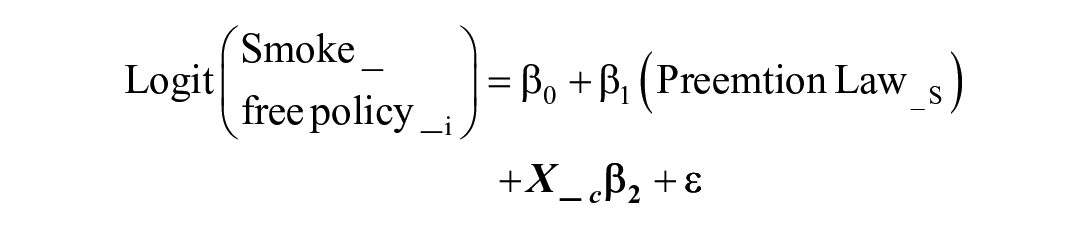
In our study, we used a generalized structural equation modeling (GSEM) to examine the relationship between state smoke-free indoor air preemption laws and the adoption of local smoke-free policies in various settings across the U.S (Figure 1). The analysis, specifically the logistic regression model, enabled us to estimate the odds of a city adopting smoke-free policies in the presence or absence of state preemption laws. Unlike structural equation modeling, the GSEM model is particularly advantageous as it can handle non-normal distributions and it incorporates a range of generalized linear models, including logit and probit models. 30 The functional form of our analysis is a logit model, which is expressed as follows:

Relationship between preemption laws and city smoke-free policy.
In this model, the dependent variable is whether a city has 100% smoke-free policy coverage. This is represented by the binary variable “Smoke_free policy_i,” where “i” denotes a specific city. The independent variables include a binary variable, “Preemption Law_S,” that captures whether a city is located in a state with smoke-free preemption laws. “S” denotes a specific state. We also consider a vector of county characteristics, denoted by “X_c,” which includes demographic and economic factors. These factors are the county’s racial composition (the percentage of white, black, and Hispanic), the poverty level, the unemployment rate, and the per capita income.
Results
Table 1 presents the descriptive statistics of our study sample. It reveals that just over one-third of cities in the U.S. have adopted at least 1 policy for a 100% smoke-free indoor environment as of 2023. Approximately one-third of these cities had at least 1 smoke-free indoor policy in workplaces, restaurants, or bars. However, 100% smoke-free indoor policies were observed less often in gaming settings.
Socioeconomic Demographic Characteristics of the Study Sample (N = 5359).

Abbreviation: SD, standard deviation.
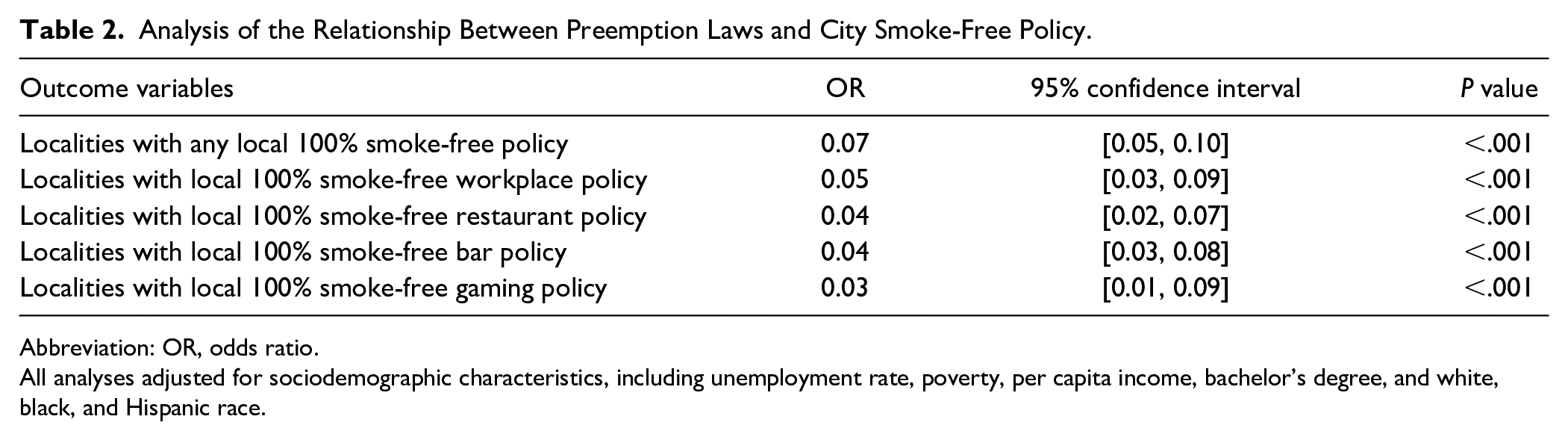
The GSEM regression results, which explore the relationship between state preemption laws and the existence of 100% smoke-free indoor policies in cities, are presented in Table 2. The first key finding is the significant association between state preemption laws and the presence of a 100% smoke-free indoor policy across any of the 4 venues—workplaces, restaurants, bars, or gaming venues. Our analysis reveals that cities in states with preemption laws were less likely to have a 100% smoke-free indoor policy across any of the venues. Specifically, the odds were lower than those cities in states without preemptive laws, after adjusting for county sociodemographic characteristics (OR = 0.07, CI = 0.05-0.10).
Analysis of the Relationship Between Preemption Laws and City Smoke-Free Policy.
Abbreviation: OR, odds ratio.
All analyses adjusted for sociodemographic characteristics, including unemployment rate, poverty, per capita income, bachelor’s degree, and white, black, and Hispanic race.
Further examination of the association between state preemption laws and 100% smoke-free indoor coverage for each venue is reported in Table 2. The findings indicate that the presence of a state law preempting smoke-free local policies was significantly associated with the likelihood of a city having 100% smoke-free coverage. In detail, the odds of having smoke-free polices for workplaces were significantly lower in cities with state preemption laws than those without (OR = 0.05, CI = 0.03-0.09). Similarly, for restaurants, the odds were significantly lower in cities with state preemption laws (OR = 0.04, CI = 0.02-0.07). The odds for bars followed the same trend, being lower in cities with state preemption laws (OR = 0.04, CI = 0.03-0.08). A strong association was also found for gaming venues, showing lower odds in cities with state preemption laws (OR = 0.03, CI = 0.01-0.09).
Discussion
The impact of state preemption laws on local policymaking is not well understood. This study contributes to the limited empirical literature by examining the relationship between state preemption laws and local governments’ adoption of smoke-free indoor policies. Our findings indicate that states with smoke-free preemption laws are significantly less likely to have cities adopt smoke-free policies than states without such laws. Local governments in states without preemption laws appear to be able to implement smoke-free policies that protect individuals within their jurisdictions from the harms of smoke. This protection extends to workplaces, bars, restaurants, and gaming venues. Conversely, local governments in states with preemption laws are restricted from adopting these policies, resulting in less protective coverage for individuals in these venues. This suggests that if states continue to preempt local governments from adopting restrictive indoor smoking policies, individuals in these communities will have less protective smoke-free coverage. These findings have significant public health implications for 3 primary reasons.
Firstly, local government is a vital source of public health policy. Public health advocates have increasingly recognized the importance of local communities in advancing public health. 31 Local communities often serve as catalysts for policy changes at the state and federal levels. Policymakers at the city and county levels are typically more responsive to public opinion, as they are part of the communities they represent. This proximity often leads to the enactment of laws based on grassroots movements. 15 As a result, local communities have historically been more likely to implement innovative policies. The success of these local policies often inspires the adoption of similar policies in other communities and at state and federal levels. The field of tobacco control serves as a prime example of how municipalities have historically spearheaded policy innovation and continue to adopt progressive public health policies. 32 However, the preemption of local authority can stifle local innovation and hinder responses to public health concerns, 33 such as indoor smoking.
Secondly, smoke-free legal policies are crucial in reducing exposure to secondhand smoke. Substantial evidence indicates that the toxins present in secondhand smoke adversely affect the cardiovascular system in several ways, including oxidative stress, inflammation, arterial stiffness, and increased infarct size. 34 Exposure to secondhand smoke can also trigger acute cardiovascular diseases. 35 A study conducted by Lightwood and Glantz found a significant decline in the rate of hospital admissions due to acute myocardial infarction associated with smoke-free policies. 36 Despite significant progress in reducing secondhand smoke exposure among nonsmokers in the U.S., an estimated 23.1 million children and adolescents are still exposed to it each year. 37 Systematic reviews have found a significant association between secondhand smoke exposure in children and increased asthma morbidity, 38 and it may also be linked to adverse growth outcomes. 39 In the absence of smoke-free policies at all levels of government, jurisdictions may be exposing both adults and youth to unnecessary risks associated with secondhand smoke.
Thirdly, smoke-free legal policies serve as a deterrent to smoking. It appears that such policies decrease the average smoking rate among adults who smoke. 40 A longitudinal study by Apollonio and colleagues found a correlation between a reduction in the number of days smoked per month, except among adults who occasionally smoke, and smoke-free policies. 41 Smoke-free legal policies also redefine previously socially acceptable smoking behaviors as unacceptable, thereby de-normalizing smoking in the public’s view.42,43 Another study found that this denormalization significantly mediates the relationship between smoke-free policies and habitual smoking among people who smoke more heavily. 44 Furthermore, a longitudinal study of young adults and adolescents found that smoke-free bar policies were associated with lower odds of current smoking and fewer days of smoking. 45 Local jurisdictions should be allowed to discourage smoking through smoke-free indoor air policies.
Overall, smoke-free legal policies at all levels of government can contribute to healthier environments by reducing exposure to secondhand smoke and discouraging smoking to the greatest extent possible. County-level smoke-free policies have significantly contributed to the reduction in smoking prevalence in the U.S. and the reduction in the number of cigarettes smoked among adults. 46 A study also found that the implementation of county-level smoke-free policies resulted in a significant reduction in asthma discharges. 47 Smoke-free legal policies at both state and local levels ensure that adults and youth are not exposed to the risks and dangers of smoking. However, state preemption continues to threaten local innovation and the development of local solutions to public health problems. As highlighted in our study, state-level ceiling preemption laws appear to significantly limit local action related to indoor smoking bans.
This study has some limitations that are worth noting. The analysis design precludes us from making a causal claim. Also, despite the effort to collect information about city smoke-free indoor air policies, there may be instances where some policies were not fully represented in our database. Coding preemption laws, given their complexity, poses a significant challenge, and there is a possibility that certain aspects of these laws may not have been fully captured in our analysis. Nevertheless, the data sources used appear adequate to address the primary objectives of this study.
Conclusions
This study highlights the significant association between state preemption laws and local efforts to promote healthier environments and communities through smoke-free policies. The findings reveal a considerable association between state laws that preempt local authorities from enacting smoke-free policies and a reduced likelihood of having venue-specific smoke-free coverage at the city level. This suggests that state preemption laws can hamper public health progress. Local governments have been associated with pioneering innovative public health policies, including those related to tobacco control. However, state preemption laws pose challenges to this local autonomy, potentially restraining the progress of grassroots public health initiatives.
Empowering local jurisdictions to enact smoke-free indoor air policies could lead to the development of tailored solutions to public health issues and promote healthier communities. The ongoing public health challenge posed by smoking necessitates a collaborative approach between state and local governments to ensure the broadest possible implementation of widespread smoke-free legal policies. This would ensure the benefits of these policies, including reduced smoking prevalence and improved health outcomes, are realized across all communities. States need to reevaluate existing preemption laws to better support local innovation and public health advancement. States should consider repealing smoke-free ceiling preemption laws that restrain local communities from ensuring they are protected from the potential dangers of indoor smoking.
Footnotes
Declaration of Conflicting Interests
The author(s) declared no potential conflicts of interest with respect to the research, authorship, and/or publication of this article.
Funding
The author(s) disclosed receipt of the following financial support for the research, authorship, and/or publication of this article: The research reported in this publication was supported by grant number R01CA249052 (SA). The content is solely the responsibility of the authors and does not necessarily represent the official views of the NIH.
Ethical Approval
This study did not require ethical approval as it utilized deidentified data that is publicly accessible.
