




Abstract
Purpose:
The purpose of this research was to study the effectiveness of the IMB Educational Health Promotion (IMBEHP) video for improving quality of life, health risk awareness, and health promotion among Chiang Mai University (CMU) personnel.
Methods:
This research was a quasi-experimental study with a 1-group pre-posttest design. The sample group included 528 CMU personnel who worked at the university between June 2020 and December 2021. Data collection was conducted before and after participants watched the IMB health promotion video.
Results:
After watching the video, the participants’ quality of life scores were at a medium level. Moreover, physical health, mental health, social relations, and total quality of life score measures showed statistically significant differences between before and after viewing, at P < .05. The mean total for quality of life increased from the prior intervention implementation. Understanding of health risks also increased after watching the video, and the levels of health risk increased as follows: low level of health risk increased to 343 (64.96%), followed by medium and high health risk, at 21.78% (n = 115) and 10.04% (n = 53), respectively. Lastly, awareness about nutrition was statistically significant at .05.
Conclusions:
The results of this study demonstrate the efficacy of video in educating, motivating, and developing health-promoting skills among this population. After watching the video, CMU personnel increased their awareness of chronic disease risk factors, health promotion practice, illnesses prevention, healthy behaviors, and improvement of quality of life.
Introduction
In 2020, the World Health Organization (WHO) 1 announced that the coronavirus (COVID-19) was highly infectious and was spreading to many countries. The first COVID-19 case found in Thailand was in January 2020 2 and involved a Chinese tourist who had traveled to Thailand. 3 Subsequently, there were widespread cases among clusters where people gathered in large groups. There was an extreme sense of urgency in many provinces in an attempt to control the spread of COVID-19 in high-risk areas. Some new cases were found in persons with a history of traveling to crowded places, for example to pubs and bars in Chiang Mai province. 4 The WHO suggested teleworking to prevent the spread of COVID-19. 1 All higher education institutions in Thailand followed this suggestion by implementing work-from-home policies and instituting online teaching.
Due to the COVID-19 pandemic, changes in lifestyle affected university personnel’s health behaviors. People’s lifestyles began to include unhealthy and risky behaviors, including increased alcohol consumption, cigarette smoking, lack of exercise, and unhealthy eating.5,6 Moreover, people’s stress levels increased during the pandemic. All of these behaviors are considered risk factors for chronic illnesses such as diabetes, hypertension, and cardiovascular disease.4,7
The results of previous study have confirmed that media and health literacy should be promoted among Thai people to enable them to receive information via social media which also leads to appropriate health behavior changes. 8 With current media and technology, there are many accessible platforms in terms of people’s health and behavior. Educational video is another type of media that can be used for learning new information because of the convenience of self-pacing, self-learning, observation, discussion, predictions based on presented information, and application. 9 These qualities make learning via video effective for the development of skills from direct learning experiences. 5
The existence of previous informational video can have beneficial effects on patients’ motivation for dose reduction of hypnotics’ medication use which was significantly strengthened after watching the video. 10
The objective of this research was to develop and test the IMBEHP video to motivate Chiang Mai University (CMU) personnel to embrace health promotion, to be aware of health risk factors for chronic illnesses, and to be aware of self-care for illness prevention and a healthy lifestyle during the COVID-19 pandemic.
Methods
This research was a quasi-experimental study using a 1-group, pre-posttest design. The research consisted of the IMBEHP video creation and involved broadcasting the educational video prototype via the CMU website. This IMBEHP video also included information on health, medication, follow-up doctor’s appointments for chronic illnesses, and the effect of chronic illnesses on mental health and society while taking medications; motivation for remaining in treatment for chronic illnesses and continuation of treatment to the person’s capacity; and behavioral skills for one’s healthcare and chronic illness prevention, self-care ability, medication, relation between lifestyles and healthcare, and society’s needs and support regarding healthcare and chronic illness prevention. The details were shown in Figure 1.

Process of the IMB Educational Health Promotion video intervention.
The IMBEHP video was published and subsequently updated bimonthly. Before each episode was released, a teaser video was released approximately 1 week before, via www.HealthyCMU.com and online channels, such as Facebook and Healthy CMU Line group as shown in Figure 2.
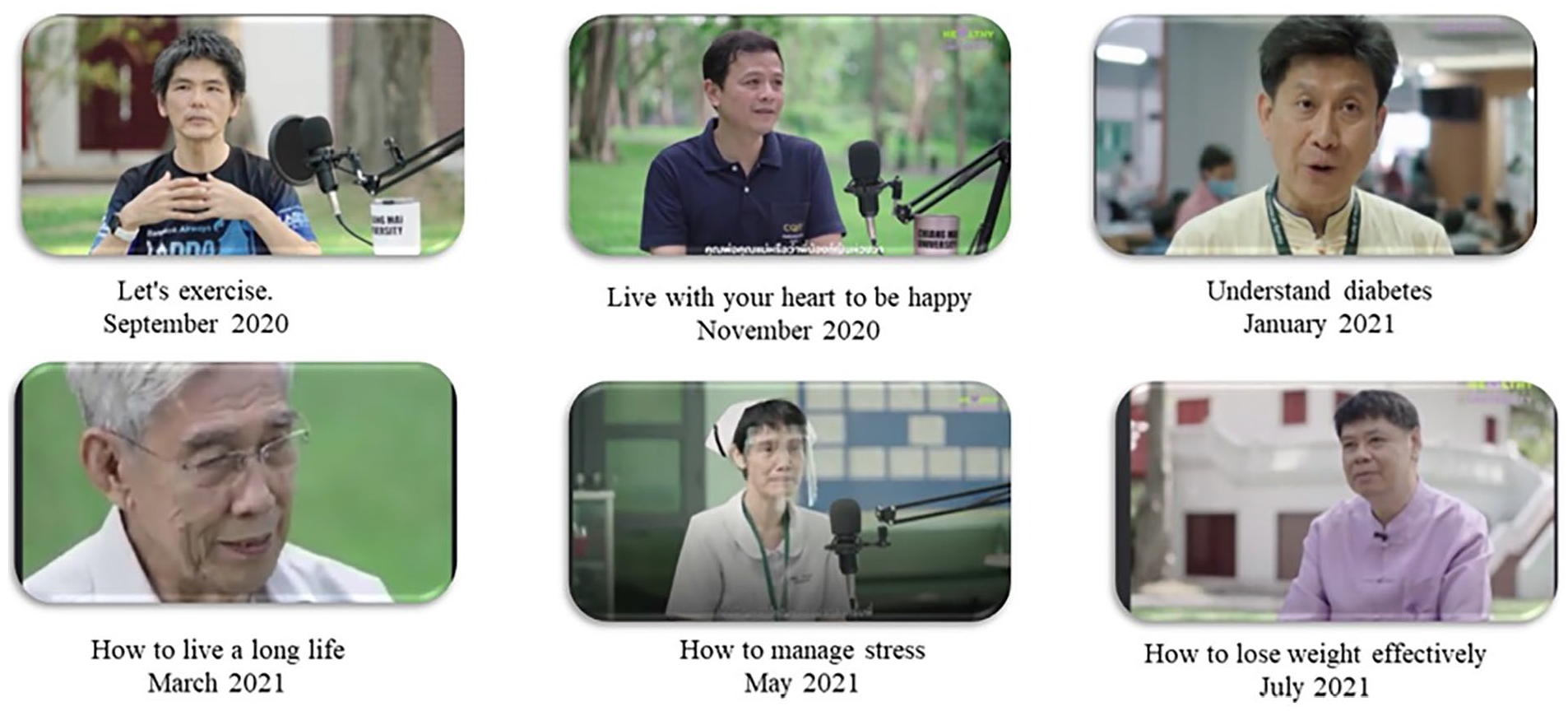
The IMB Educational Health Promotion video (IMBEHP video).
The video content and the expected effects consisted of non-communicable disease knowledge regarding hypertension, diabetes mellitus, obesity, and stoke; reframing beliefs by using healthy models and increasing positive attitudes of clients toward non-communicable disease prevention; and raising awareness about risk behaviors, medication management in daily life activities, and types of exercise. The video content was checked for accuracy by experts and was also evaluated regarding its interestingness and enticement for the audience, as well as ensuring that it had been carefully selected so as not to discriminate against any race, ethnicity, gender, religion, or culture. In addition, the content did not include inappropriate material about tradition, culture, or age, nor did it constitute any violation of human rights.
After developing the IMBEHP video, the researcher consulted 5 external experts who work in related health fields for feedback. After that, the suggestions were used to improve the content of the video again.
Data Collection
After research approval from the Research Ethical Review Committee of the Faculty of Nursing, Chiang Mai University, permission to conduct this study was also obtained from the CMU administrators. All participants were informed in advance about the purpose and research process of this study. They were informed that participation in this study is voluntary. All data were treated as group information, with no personal identifiers. Individuals who agreed to participate were asked to sign a consent form.
An online questionnaire was given to participants at baseline prior to the beginning of the intervention activities and at 12 months following the intervention. Participants viewed the educational video prototype and afterwards, they provided their answers to an online survey. The researchers collected data and checked for data completion before performing statistical analysis.
The sample size consisted of a total of 528 CMU personnel who were working at the university at the time of the study and included administrators, instructors, and officers. The study was approved by the Institutional Review Board of Chiang Mai University. (Approval no. 2021-EXP048). All participants were informed in advance about the purpose and research process of this study, as well as being told that participation in the study was voluntary. Individuals who agreed to participate were asked to sign a consent form.
There were 3 research instruments, which are explained as follows: (1) The WHO Quality of Life assessment, Thai brief version (WHOQoL-BREF-THAI), is a self-administered questionnaire used to assess participants’ QoL. The instrument is comprised of 26 items with each item being scored on a Likert scale ranging from 1 to 5. Each domain is scored with values from 0 to 100, with higher scores indicating better QoL; (2) The Health Screening Survey by the National Health Promotion Organization is a health risk assessment 11 and contains 13 items used to screen the general public’s health risk for cardiovascular disease. The scores of this health screening survey are organized into 1 of 3 groups according to the amount of risk that occurs for various items. These groups included a low, medium, or high health risk group; (3) The Health Promotion Lifestyle Survey 12 contains 50 questions using a 4-level Likert scale from 1 (never) to 4 (always) with the purpose of measuring health-promotion behaviors of participants in 6 areas. The criteria for interpreting scores are high, moderate, and low levels. The Cronbach’s alpha coefficient of the 3 instruments were .791 to .927, higher than or equal to .70. 13 All instruments also had a high reliability measure (.78-.83).
Data were analyzed using SPSS software for the demographic data. Descriptive statistics included frequency, percentage, mean, and standard deviation. The average score for the survey, before and after watching the educational video prototype, was obtained by using a dependent sample t-test.
Results
According to the results of the demographic data (Table 1), there were 528 subjects, of which 357 (67.6%) were females. The participants had a mean age of 42.37 years, with an age range from 18 to 65 years. Regarding job responsibilities, 239 (45.3%) subjects’ jobs required little or limited movement. The most common chronic illnesses were hypertension, diabetes, and cardiovascular disease (41.0%, 12.0%, and 12.0%, respectively). In addition, 31.2% of the subjects did not exercise (n = 68), and 153 participants (29.0%) drank alcohol while Q36 (7.2%) smoked cigarettes. There were 101 subjects (19.1%) with a BMI between 25.00 to 29.99, and 35 subjects (6.6%) with a BMI of more than 30.
Demographic Characteristics of Chiang Mai University Personnel.

As seen in Table 2, before and after watching the IMBEHP video, CMU personnel’s quality of life scores were at a medium level but showed a difference at a statistically significant level of 0.05 (t = −5.840, P < .001). In addition, physical health (t = −2.928, P < .01), mental health (t = −3.931, P < .001), and social relation measures (t = −2.856, P < .01) showed increases and statistically significant differences between before and after watching the video at .05. While environment was statistically insignificant when compared before and after, the total quality of life score was statistically significantly different at .05.
Quality of Life of CMU Personnel Before and After Watching the IMB Educational Health Promotion Video.

Abbreviation: SD, standard deviation.
P < .05.
According to Table 3, there were 171 subjects who were at a medium level of health risk (32.3%); 161 subjects were at a high level of health risk (30.4%); and 105 subjects (19.8%) were at a low level. The risk factors were consumption of extremely spicy food, jobs that require sitting in an office for a long period of time, and a history of chronic illnesses like hypertension or diabetes. After watching the IMBEHP video, the number of participants demonstrating a low level of health risk increased to 343 (64.9%), while decreases were observed for the medium and high health risk groups (21.7%; n = 115 and 10.0%; n = 53, respectively).
Comparison Between Health Risk of CMU Personnel Before and After Watching the IMB Educational Health Promotion Video.

As seen in Table 4, regarding the differences before and after watching the IMBEHP video, CMU personnel showed statistical insignificance at .05 in terms of interpersonal relationship (t = −0.655, P = .513), body movement (t = 1.767, P = .078), spiritual improvement (t = −0.611, P = .541), health responsibility (t = −0.752, P = .452), and stress management (t = .583, P = .114). However, nutrition was statistically significant at 0.05.
Comparison of the Health Promotion Lifestyles Before and After Watching the IMB Educational Health Promotion Video.

Abbreviation: SD, standard deviation.
P < .05.
Discussion
The COVID-19 pandemic affected people worldwide, and many changes happened as a result. CMU personnel had to change their lifestyles and work habits which could have affected their health status as well as their quality of life. The results of this research found that the majority of CMU personnel who participated were female with minimal body movement while at work. Other health risks among participants included alcohol consumption, cigarette smoking, and obesity. Minimal body movement, poor dietary intake, and long working hours result in poor quality of life. 14 The findings of this study can be explained through the current conditions which meant that participants did not take positive action toward health promoting behaviors because they ranked it as low priority in their busy life and thought that they were still strong. Social and economic changes meant that products and services which were previously affordable increased in cost. Therefore, participants needed to work to help earn money for their household expenses. They worked an overload of hours, having poor exercise behavior, while eating poorly and drinking coffee, and accessing health information via televisions and online media.
Regarding the IMBEHP video, 1 aspect of online learning that resulted in higher effectiveness was that it could be accessed anywhere, 15 and aimed to improve knowledge, attitudes, and behavioral skills. According to other research results, this type of learning also tends to lead to positive results that are oriented toward improving the audience’s ability and learning outcomes. 16 Besides, qualitative feedback from 5 experts supported the idea that videos engage adults with diverse beliefs and literacy skills, and are attractive, educational, clear, and communicative, with content that can be easily understood by the audience.
Another study found that people, especially women, had increased stress levels during the pandemic, as women were expected to take care of families and work outside. 17 IMBEHP video not only increased participants’ knowledge, but also improved health promotion behavior after 12 months. This supports the idea that a video can communicate a complicated and multi-dimensional message and facilitate decision-making. An additional study has shown that animated videos increase knowledge about COVID-19 prevention and reduce the level of anxiety. 18 Consistent evidence has also been found for social correlates of physical activity in adults, including social support, interpersonal influences, parent/family influences, and information support.
The results of this study found that CMU personnel with medium to high health risks reduced these risks after watching the IMBEHP video, as it covered health promotion practice and chronic illness prevention, which can be directly observed in the video. Similar to the IMB-model, using online education showed positive effects on health knowledge, motivation, and perceived objective skills, 19 enhanced self-care ability, and improved quality of life. 20 This is similar to other studies on health-promoting behaviors which significantly predicted higher quality of life for all participants. 21 Thus, this media can help the participants to increase physical activity and healthy eating behavior, and to decrease their sedentary behavior resulting in weight loss. It is useful for healthcare providers to promote healthy behaviors. When a person has knowledge and a good attitude in practice, this will result in people being able to perform correctly which, subsequently, results in an improved quality of life. 22
Therefore, health-promoting behaviors significantly predicted higher quality of life for all participants. 19
Conclusion
The information-motivation-behavior skills health promotion (IMBEHP) video for CMU personnel during the COVID-19 pandemic was developed based on the information-motivation-behavioral skills (IMB) model. After watching the IMBEHP video, CMU personnel showed health risk awareness, and health promotion skills in physical, mental, and social relationships, and regarding the environment. Additionally, those with high and medium health risks showed improved, healthier dietary behavior.
This research has 2 limitations. First, there are other factors that contribute to participants’ quality of life scores, including income differences, and the variety of work types in each faculty. Second, the study lacked a control or comparison group which could introduce bias into the data. Suggestions for further studies include conducting a randomized control trial and controlling other contributing factors that may affect personnel’s quality of life.
Research Data
sj-docx-1-jpc-10.1177_21501319241246396 – for The Effectiveness of an Information-Motivation Behavioral Skill Health Promotion Video on Health Status Among Chiang Mai University Personnel During the COVID-19 Pandemic
sj-docx-1-jpc-10.1177_21501319241246396 for The Effectiveness of an Information-Motivation Behavioral Skill Health Promotion Video on Health Status Among Chiang Mai University Personnel During the COVID-19 Pandemic by Warawan Udomkhwamsuk, Patcharin Chaisurin, Wanicha Pungchompoo and Tanutporn Junsiri in Journal of Primary Care & Community Health
Footnotes
Declaration of Conflicting Interests
The author(s) declared no potential conflicts of interest with respect to the research, authorship, and/or publication of this article.
Funding
The author(s) received no financial support for the research, authorship, and/or publication of this article.

References
Supplementary Material
Please find the following supplemental material available below.
For Open Access articles published under a Creative Commons License, all supplemental material carries the same license as the article it is associated with.
For non-Open Access articles published, all supplemental material carries a non-exclusive license, and permission requests for re-use of supplemental material or any part of supplemental material shall be sent directly to the copyright owner as specified in the copyright notice associated with the article.
