




Abstract
Introduction:
Self-efficacy in individuals optimizes their hypertension management. Electronic patient portals are being increasingly used to support chronic disease management, as they raise the health literacy of patients and enable them in self-management. However, the association between the use of patient portals and self-efficacy in hypertension management remains unclear. The study aimed to determine the association between self-efficacy among patients with hypertension who are managed in primary care and their demographic characteristics and usage patterns of patient portals.
Method:
A cross-sectional survey was conducted at a public primary care clinic in urban Singapore. Multi-ethnic adult patients with hypertension were invited to participate in a self-administered electronic questionnaire. Chi-square test was performed for bivariate analysis; adjusted logistic regression models were used for factors with P value <.1.
Results:
A total of 310 patients (66.8% Chinese, 55.5% males, mean age of 63.1 years) completed the survey. Patient portal users had higher self-efficacy scores than non-users (mean score=63 vs 60, maximum = 80, P = .011). The factors associated with increased patient portal access included younger age <65 years (absolute odds ratio [AOR] = 2.634, 95%CI = 1.432-4.847; P = .002), monthly income >$5000 (AOR = 2.324, 95%CI = 1.104-4.892; P = .026), and post-secondary education level (AOR = 3.128, 95%CI = 1.675-5.839; P < .001). Most patients (93.1%) used the portal to check medical appointments but only1.3% of them used it to record home blood pressure measurements (HBPM).
Conclusions:
Patient portal usage was associated with higher self-efficacy scores in patients with hypertension. These users were younger, more educated, and earned more than the non-users, but only 1.3% of them used it for HBPM documentation.
Introduction
Hypertension is an important risk factor for vascular diseases and related complications. 1 The prevalence of hypertension is as high as 35.5% in the multi-ethnic adult population, which is categorized into 4 main racial groups: 74.3% Chinese, 13.5% Malay. 9% Indian, and 3.2% Others in the highly urbanized island state of Singapore. 2 This is in comparison to about 30% of adults in England, 3 48% of adults in the US, 4 and 1.28 billion adults worldwide. 5 It is one of the top 3 chronic conditions managed in the local public primary care clinics (polyclinics).6,7
Self-efficacy, defined as the confidence to adopt the necessary behaviors to reach a desired goal, is a cornerstone of management of patients with hypertension.8 -11 In between clinical consultation, patients need to adhere to healthy lifestyle behaviors and prescribed therapeutics to attain their target blood pressure control. Assessing self-efficacy is vital for healthcare providers to identify patients with poor self-care behaviors and presents opportunities for modification to enhance their adherence to lifestyle changes and therapeutic treatment. Self-efficacy assessment can be performed as part of a clinical consultation, or it can be determined systematically using a validated scale or questionnaire. The “Hypertension Self-Care Profile” (HTN-SCP) is one such scale which has been validated in patients with hypertension in Singapore.12,13
Patient portals are electronic channels to provide healthcare information to the public, including those related to specific diseases such as hypertension and healthcare services for their treatment. Certain patient portals which are linked to the electronic health records, are usually created by healthcare institutions to offer patients a secure access to their own medical data and information of health services. Patient portals often incorporate various functions, including appointment scheduling, bill payments, medication refills, laboratory results, health parameter recording, and evidence-based health and wellness information. Some portals are also designed to document personal clinical data from home blood pressure and/or glucose monitoring. These embedded functionalities enable patients to be cognizant of their health status and can prompt them to take pre-emptive measures to address their health risks.13,14
Literature has alluded to the use of patient portals in raising the self-efficacy and self-management of people. Evidence generally supports the use of patient portal interventions in improving health knowledge and other psychological outcomes, such as decision-making and self-efficacy, as well as behavioral outcomes, such as medication adherence and cancer screening.14 -16 Nonetheless, little is known about frequency of their patient portal access and usage behavior among patients with hypertension as surrogate indicator of their self-efficacy. Furthermore, prior studies have identified social disparities in the use of patient portals, with higher usage among those who are better educated and have access to broadband internet.17 -19 Hence, the use of patient portal is postulated to be associated with personal demographic characteristics, health literacy, self-efficacy, and self-care behavior in patients with hypertension.
This study primarily aimed to determine the association between self-efficacy among patients with hypertension who are managed in primary care and their patient portal usage. The secondary aims of this study were to compare the demographic characteristics and factors associated with portal users with non-users. Identifying these factors allows developers and content designers to enhance the portal features and functionalities, thereby mitigating the barriers for non-users. Understanding patient portal utilization may potentially allow the healthcare professionals to leverage on this tool to raise the health literacy, self-efficacy, and self-care among the patients with hypertension and to scale its implementation in primary care.
Methods
Study Design and Setting
This cross-sectional study was conducted over 6 months at a public primary care clinic (polyclinic) located in eastern Singapore. It serves an estate with an estimated population of 289 000 residents and manages an estimated number of a 1000 patients daily.
Study Population
The study population included multi-ethnic Asian patients aged 21 to 80 years who visited the clinic with a clinical diagnosis of hypertension and were able to communicate in English. The exclusion criteria were underlying auditory, visual, or cognitive impairment, which prevented them from providing written informed consent to participate in the study.
A list of patients with upcoming appointments in the clinic was generated every week in chronological order based on room numbers assigned to patients and appointment times. Patients on the list were numbered in chronological order. Random sampling using computer-generalized numbers was used to identify potential patients to be invited to participate in the study.
A briefing about the study, including the eligibility criteria, was given to the doctors involved in running the appointment room prior to study initiation. The attending doctors were updated on the potential participants in the screening list who would consult them in their rooms. This approach prepared the doctors to recruit the participants when the latter actualized their appointment. A study team member provided a more detailed explanation to the patient in a separate room prior to obtaining written informed consent, followed by the completion of the questionnaire. The participants who completed the questionnaire received a $10 (about US$7.40) grocery voucher as a token of appreciation for the time spent with the research team.
Sample Size
The study population was computed using the sample size for proportion formula, n = z2 (1-p)/d. 20 Based on a study by Peacock et al, 28% of the respondents accessed patient portals and personal health information online in the previous year. 21 The minimum required sample size was 310, with 5% precision and a 95% confidence level (CI).
Questionnaire
The questionnaire was digitalized for self-administration using the FormSG electronic platform. FormSG is a digital form builder used by the Singapore Government and public healthcare institutions to collect data securely. The questionnaire consisted of 52 items divided into 4 sections dealing with demographics, self-efficacy, patient portal usage and a system usability scale. The questionnaire was piloted before the study and minor amendments were made to improve its clarity. Demographic data of the participants, such as age, gender, race, ethnicity, marital status, occupational status, educational level, current housing status, and household monthly income were collected.
Hypertension self-care Profile (HTN-SCP) tool (English version)
The HTN-SCP tool was previously developed based on Orem’s self-care model and has been validated in Singapore.12,13,22 In this study, the self-efficacy domain of the HTN-SCP was selected to measure the level of self-efficacy using a set of 20 questions with opening instructions: “How confident are you that you could do the following?” The questions sought information on the patients’ physical activity, dietary intake, habits of reading nutritional facts and labels, restriction of alcohol consumption, smoking habits, home blood pressure monitoring, compliance with medication and follow-up, and weight reduction. The Cronbach’s alpha coefficient for self-efficacy was .931. This instrument also has a high reliability for the self-efficacy measure (0.40-0.74).12,22 The 20 self-efficacy questions were scored between 1 and 4, and the total score ranged from a minimum of 20 to a maximum of 80. The 20 self-efficacy questions were scored between 1 and 4, 4-indicating “Very confident,” 3-“Confident,” 2-“Somewhat confident,” and 1-“Not confident.” The total score ranged from a minimum of 20 to a maximum of 80, the higher the score the better the self-efficacy is. We have added in the methods section.
Electronic patient portals
Singapore is divided into 3 healthcare districts or regional health systems, each comprising a cluster of hospitals and polyclinics and their respective patient portals. In addition, the Health Promotion Board leverages on the HealthHub as the national patient portal, which allow local residents to navigate their healthcare needs across the 3 regional health systems. The National University Health System (NUHS) in west Singapore is supported by the OneNUHS portal; the National Healthcare Group (NHG) in the central region by the NHG Cares portal; the Singapore Health Services (SingHealth) in the east by the HealthBuddy portal. These portals require the utilization of SingPass for access. SingPass is an online account management system for secure access to the Singapore Government and private sector e-services.
Usage patterns of patient portal
The section on patient portal usage collected data on (1) awareness of internet access; (2) use of SingPass to access the patient portal; (3) ownership of a device with internet access; and (4) participants’ concerns about the cybersecurity of personal information in the portal.
The next section of the questionnaire aimed to find out the portal usage behavior of the participants based on (1) the portal they accessed, (2) how they discovered the portal, (3) frequency of portal access in the previous 12 months, and (4) portal features accessed, including appointments, medication refills, laboratory results, payments, health articles, and recording of home blood pressure readings. The perceived importance of having access to a portal as part of hypertension management was also assessed using a 5-point Likert-type scale (1 = very important; 5 = unimportant).
For non-users, potential consideration of using the patient portal in the future was evaluated using a 5-point Likert-type scale (1 = definitely yes; 5 = definitely not).
Data Analysis
Variables were summarized based on whether patients had accessed their portal. Continuous and categorical variables were described as mean (standard deviation, SD) and frequency (percentages), respectively. Independent t-tests were used to assess the differences between access to portal and continuous self-efficacy score. Chi-square test was used to assess the difference in the categorical demographics variables and access to portal. Potential factors with a P-value of less than .1 in the bivariate analysis were entered into the adjusted logistic regression to obtain the adjusted odds ratios. One-way ANOVA test was used to assess the differences in self-efficacy scores and the reasons for not accessing the patient portal, as well as consideration of accessing patient portal in future. A P-value of less than .05 was considered statistically significant. All statistical analyses were performed using the IBM SPSS version 27.0.
Results
Figure 1: Out of a total of 626 patients who were approached after the random sampling, 331 of them were eligible for the study and 310 completed the questionnaire, with a response rate of 93.6%. 51.6% (160/310) of the study population had previously accessed at least one patient portal.

Recruitment of the study population.
Table 1 shows the demographic characteristics of the patients. Over half (52.9%) of patients were aged <65 years; 55.5% were men and 66.8% were Chinese, 24.8% Malays and 5.8% Indians. Approximately two-thirds (65.2%) of patients had primary or secondary level of education, 77.7% were married and 38.4% of them were from a lower socioeconomic class with a monthly household income <S$2000. (estimated US$1500).
Patients Socio-Demographics and Self-Efficacy Score According to Patient Portal Usage.

Data are presented as mean (SD) or absolute odds ratio (95% confidence interval).
Participants Characteristics and Portal Usage
Multivariate logistic regression analysis revealed that age, income, and education level were significantly associated with having accessed the patient portal. Age <65 years (AOR: 2.634, 95% CI:1.432-4.847; P = .002), income >$5000 (AOR: 2.324, 95% CI:1.104-4.892; P = .026), and post-secondary educational background (AOR:3.128; 95% CI:1.675-5.839; P < .001) were associated with increased odds of accessing the portal.
Self-Efficacy Level and Patient Portal Access
Chart 1 shows that portal users had a significantly higher mean self-efficacy score of 63 (interquartile range 56-69), compared to 61 for non-users (interquartile range 57-65) P-value of .011.
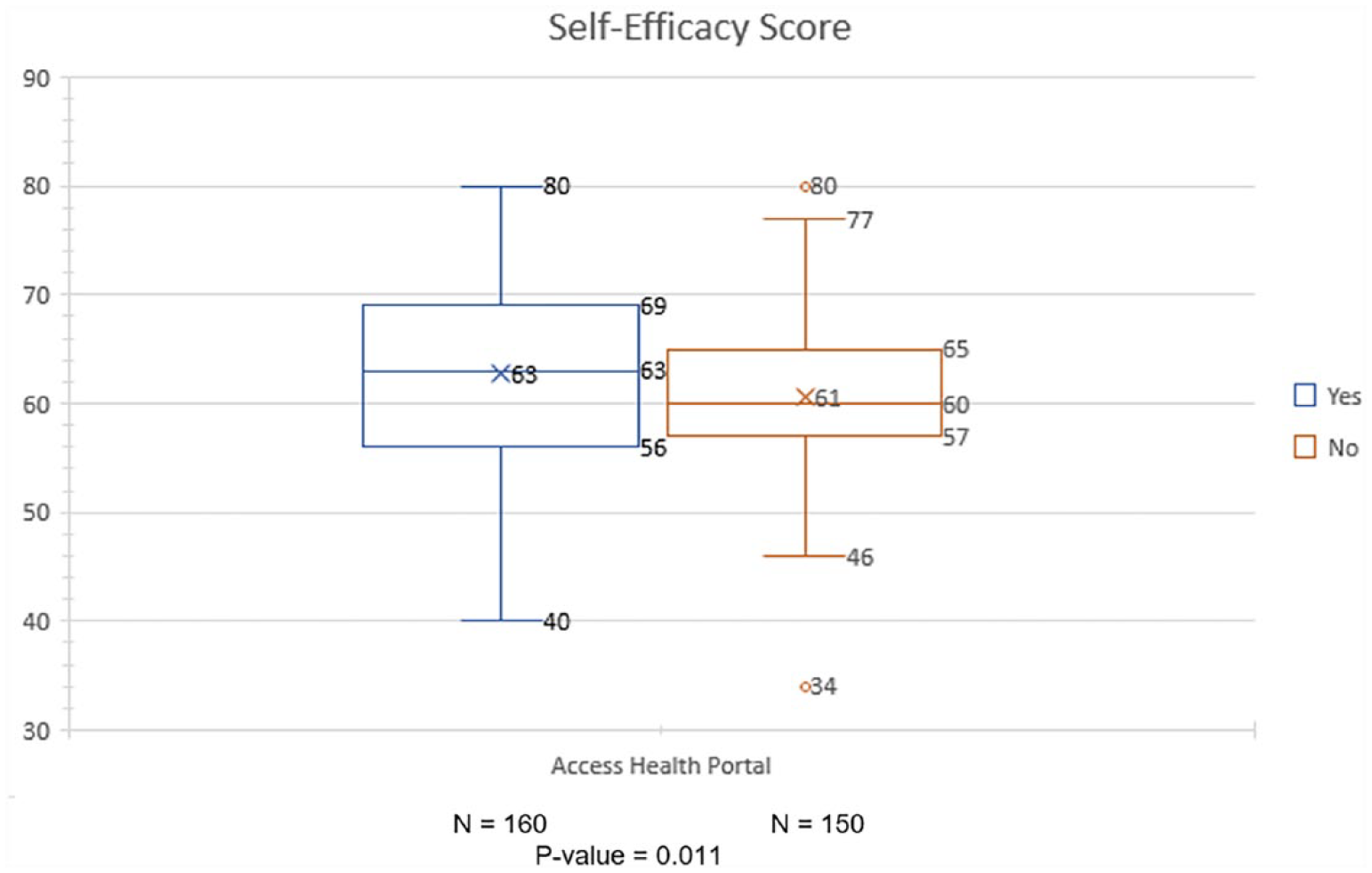
Self-efficacy score for patients with and without access to the patient portal.
Patient Portal Usage Behavior
Chart 2 shows the patient portal usage patterns among users and the barriers to portal access among non-users. Most users were recommended by their friends, relatives, healthcare providers, and websites to use the patient portal. The patient portal was mostly used to view appointments (93.1%); 63.8%, 30.0%, and 28.8% of patients respectively used it for scheduling appointments, payments, and viewing laboratory results. Only 1.3% of them used the patient portal to record their home blood pressure readings. Its use for other self-care related activities, such as accessing health articles, viewing medication lists, and requesting medication refill services, were infrequent. On average, portal users had accessed the patient portal approximately 8 times in the previous 12 months.

Patient portal usage.
In Table 2, most non-users were unaware of the existence of the portal nor had been introduced to its usage. Non-portal users (78%) who had expressed interest in accessing the patient portal in the future had higher self-efficacy score than those without any interest (P < .001).
Patients Who Did Not Access the Patient Portal.

Abbreviation: SD, standard deviation.
Discussion
Patient portals play a crucial role in hypertension management by providing valuable health information about hypertension, educating patients on their target blood pressure, offering dietary guidelines for hypertension, and providing lifestyle modification advice for hypertension control. The portals also feature a medication extension service, allowing patients who are running out of their anti-hypertensive medications before their doctor appointments to request a refill, ensuring compliance. Patients can use the portal to schedule appointments, promoting follow-up compliance. Additionally, the blood pressure recording feature enables patients to track and monitor their blood pressure, fostering high self-efficacy in managing their hypertension.
In this study, slightly over half (51.6%) of the participants reported having accessed patient portals in the previous year. Overall, patient portal users had higher self-efficacy scores than non-users. Patient portal access was associated with younger age, higher income, and higher education levels. The local younger adults are better educated and receive higher incomes, which raise their digital health literacy. Such factors are compatible with findings from previous studies.17 -19,23
In contrast, the lack of awareness of the patient portal and the procedure to access it were the main barriers to its utility. Nonetheless, most non-users expressed interest in using the portal in the future. Few portal users highlighted that healthcare professionals recommended the use of patient portals, which have a positive impact on its portal usage. 16 However, the increasing prevalence of complex chronic diseases in an aging population in Singapore and the constraints of short consultation time in polyclinics, healthcare providers might be too busy and overwhelmed to prioritize the promotion of patient portal usage. Different approaches need to be adopted to promote portal usage. The recent scaling up of team-based care in the polyclinics which allow other healthcare professionals such as the care managers to induct the patients with hypertension or other chronic diseases may be a potential solution to mitigate the bottleneck during the physician consultation. 24 In addition, the SG-Digital Office in Singapore has also focused on increasing the digital health literacy and promoting its adoption, especially among seniors and less internet savvy individuals. 25 The latter can learn the use of patient portals through personalized, one-on-one guided sessions at the nearest SG Digital Community Hub, whose localities are spread throughout the island state. 26
Portal users mostly used it to check (93.1%) and schedule (63.8 %) medical appointments. Such portal use by patients reduces the appointment default rate27,28 and promote adherence to medical treatment, such as those targeting hypertension. 8
HBPM allows the patients to reflect on their vascular health status and to take appropriate and timely actions to attain blood pressure control. 8 Physicians often encourage HBPM among the patients due to high prevalence of white coat hypertension but the latter often forget to bring their paper records during their medical reviews. 29 However, the use of patient portal for self-monitoring of hypertension is dismal in this study. Recording of home blood pressure in the patient portal was reported by only a tiny number of users (1.3%). The lack of familiarity of such a function in the patient portal is probably the main reason, which may be mitigated if the public and patients are inducted and directed to its functions in the portal.
Despite the statistically significant higher self-efficacy scores for patient portal users compared to non-portal users, the difference is very small. The patients included in this study were those who had and attended existing appointments. This group of patients is compliant with follow-up for their chronic conditions, indicating they are likely more proactive in monitoring their health than those who default on their appointments. The small differences in the self-efficacy scores between portal users and non-portal users could be attributed to the high baseline self-efficacy scores of those compliant to doctor appointments, unlike defaulters who are not included in the study.
This study has its limitations. Recall bias may under or over report the outcomes by the participants. Consequently, actual portal usage was not quantified as an outcome. A new national healthcare program known as Healthier-SG was launched in July 2023 to encourage local adults aged 50 years and older to partner a regular family physician to manage their chronic diseases. 30 Healthier-SG enrolment by eligible adults require their use of HealthHub and various regional patient portals. In this way, the use of patient portal is expected to escalate and their portal usage and purpose can be objectively assessed. It is an excellent opportunity to leverage on the patient portal to further raise their self-efficacy, ranging from better health literacy to self-monitoring of vital clinical parameters and self-care.
The study is also restricted to one polyclinic site at Bedok, although it is the one of the estates with the largest population of elderly residents aged 65 years and above. 31 The study population comprised of patients with hypertension and those who were proficient in English, which limits the generalizability of the results to the broader population.
Nevertheless, the study has several strengths. The response rate was high at 93.6%. This is one of the few studies globally to examine patient portal use and its association with the self-efficacy levels among patients with hypertension. The identified barriers toward the access and utility patient portals present opportunities for intervention to bridge the gaps, targeting those who are older, less educated, lower socioeconomic status, and low self-efficacy.
Conclusion
The study reported higher self-efficacy scores in patients with hypertension who had accessed the patient portal. Portal users were younger and had higher income and educational levels than non-users. The significant difference in self-efficacy levels between users and non-users could nudge the multidisciplinary healthcare team, aside from physicians, to induct and promote the use of patient portals among the latter, focusing on those who were older and less enabled in digital health.
Footnotes
Declaration of Conflicting Interests
The author(s) declared no potential conflicts of interest with respect to the research, authorship, and/or publication of this article.
Funding
The author(s) disclosed receipt of the following financial support for the research, authorship, and/or publication of this article: This project was funded by a grant from SingHealth Polyclinics (Seed Funding Grant Number: P9SEED602104).
Ethics Approval
The study protocol was approved by the SingHealth Centralized Institutional Review Board (CIRB 2021/2260), and all patients provided informed consent before participating.
