



Abstract
Objective:
To determine the association between sociodemographic factors, stress, depression and anxiety, emotional eating, and concern about COVID-19 contagion in first and second-line Peruvian nurses.
Methodology:
The study was cross-sectional and conducted with 500 Peruvian nurses of both sexes, over 18 years of age. Validated questionnaires were used to measure sociodemographic aspects, concern about COVID-19, generalized anxiety, depression, self-perceived stress, and emotional eating. Multiple linear regression analysis was performed to analyze the factors affecting concern about COVID-19 contagion.
Results:
The multiple linear regression analysis showed that stress, being between the ages of 18 and 29 years, being male, being from the coastal region or the jungle region, having a bachelor’s degree, severe anxiety, and severe depression were associated with higher concern about COVID-19. On the other hand, having more than 5 to 10 years of experience and more than 10 years of experience, low emotional eating, and non-emotional eating were negatively associated with concern. This model explained 44.05% of the variability among the participating nurses.
Conclusion:
These findings provide resources for future research on the comprehensive well-being of nursing staff by exploring various sociodemographic aspects and mental conditions associated with greater concern about COVID-19. Meanwhile, years of experience and emotional eating behavior were associated with lower concern about COVID-19. Future studies could incorporate this information to preserve the mental and physical health of nurses in the face of potential occupational threats.
Introduction
The World Health Organization (WHO) reported that the first cases of Coronavirus (COVID-19) were detected in Wuhan, Hubei Province, China, at the end of 2019, triggering a global pandemic in 2020. 1 In Peru, as in many other countries in Latin America, the COVID-19 pandemic caused havoc in the healthcare system 2 and represented an occupational risk for healthcare professionals working in the frontlines, 3 especially for nurses who faced challenging situations in their workplaces. 4
The International Council of Nurses (2021) mentioned that COVID-19 infection has resulted in the death of 2262 nursing professionals, and currently, the number of confirmed cases among these professionals stands at 1.6 million. 5 Nurses constitute the primary healthcare workforce, making their psychological well-being a matter of considerable concern. 6
Concern is an emotional state that refers to a state of unease or restlessness resulting from an event or situation that threatens overall well-being. 7 Concern is also a predictor of various psychological aspects such as anxiety and fear . 8 The COVID-19 health emergency has had a profound impact on the mental health of nurses, who have experienced moderate to high levels of stress, depression, and anxiety. 9 Although the emergency situation has been subsiding, mental concern persists. 10 Furthermore, the country’s political and economic situation has heightened anxiety, especially regarding the increasing morbidity and mortality associated with the pandemic.11 -13 It has been found that concern about the COVID-19 pandemic is directly related to secondary traumatic stress syndrome in frontline nurses, and nurses’ level of concern about the COVID-19 pandemic fully mediates the effects of nurses’ occupational stress on their secondary traumatic stress. 14
Nurses with higher levels of stress, anxiety, and depression are more concerned about COVID-19 contagion.15,16 Anxiety, stress, and depression have indirect negative effects on the patient, as they affect the mental condition of the nurse responsible for their healthcare. The conditions affecting this integral part of the nurse stem from caring for both high and low-risk COVID-19 patients, lack of adequate personal protective equipment, unsafe environments, and nurses’ emotional instability,17,18 long working hours, 19 and prolonged exposure to caring for patients in different healthcare settings. 20
In this context, nurses attending to patients with COVID-19, suspected COVID-19 cases, and non-COVID-19 cases have experienced moderate levels of stress, anxiety, and depression directly associated with their long working hours. 21 Likewise, it has been demonstrated that moderate to high levels of depression, anxiety, and stress are prevalent among first and second-line nurses working in various healthcare settings. 22
The mental health of nurses has been greatly affected by COVID-19. 23 In this regard, mental conditions can lead to changes in eating habits, turning individuals into emotional eaters or overeaters, as they start consuming calorie-dense and high-saturated-fat foods more frequently, which can lead to weight gain and non-communicable diseases. 24 Emotional eating refers to the propensity to eat in response to various positive and negative moods. Anxiety, stress, and depression often lead to a loss of appetite. However, individuals with emotional eating disorders may exhibit excessive appetite in similar situations. 25 Given the increased concern about COVID-19 and the mental conditions of nursing staff, it is possible that they are associated with emotional eating.
Mental health issues have significantly impacted nurses’ sleep hours due to the extensive working hours these professionals undertake. 19 It is worth mentioning that sleep is vital for regulating psychological and physical processes, and a lack of sleep can lead to sleep quality impairment and other related disorders. 26 In this context, it is important to note that sociodemographic factors can influence how nurses face and are affected by the pandemic. Younger or less experienced nurses may have more difficulties in managing stress, anxiety, and depression related to COVID-19. 27 Furthermore, nurses working in rural areas or with fewer resources may face additional challenges such as a lack of access to appropriate protective equipment or psychological support. 28 On the other hand, the level of education and continuous training can also play a crucial role in nurses’ preparedness and adaptation to the pandemic. Nurses with a higher level of education may be better equipped to handle stress and anxiety and may have more access to resources and tools to manage emotional eating and concern about contagion. 29
Therefore, the objective of this study is to determine the association between sociodemographic factors, stress, depression and anxiety, emotional eating, and concern about COVID-19 contagion in Peruvian nurses.
Materials and Methods
Design and Sample
A descriptive and cross-sectional study was conducted to examine the relationship between sociodemographic factors, mental health, and emotional eating in relation to concern about COVID-19 contagion among Peruvian first and second-line nurses. The study participants were nurses working in various hospital services in the southeastern region of Peru. The inclusion criteria included: (a) frontline nursing professionals (direct care for COVID patients), (b) second-line nursing professionals (no direct care for COVID-19 patients), and (c) nursing professionals who voluntarily agreed to participate in the study.
The G*Power 3.1.9.7 program 30 was used to calculate the sample size. With 15 explanatory variables in a multiple linear regression, an effect size of 0.10, a statistical power of (1 − ß) 0.95, and a significance level (α) of 0.05, it was determined that the minimum required sample size was 249 participants. Convenience sampling was used, considering possible dropouts or refusals to participate.
Procedure
Questionnaires were administered through a Google form between May and September 2022. The forms were shared via the WhatsApp social network among nursing staff in the study region, following an internet-based methodology. 31 Before participating, professionals were informed about the purpose, process, and use of the research results. All questionnaires were anonymous and confidential, and participants could withdraw at any time. The study protocol was reviewed and approved by a Peruvian university (code 2022-CE-EPG-0000134), following the principles set forth in the Helsinki Declaration.
Instruments
Sociodemographic variables. The survey asked participants about their total hours of sleep each night. Sleep duration was classified into 3 groups: Short sleep <7 h/day, Medium sleep 7 to 9 h/day, and Prolonged sleep >9 h/day. This classification was based on 3 studies that investigated the same variable32 -34
COVID-19 Concern Scale. The Spanish version of the COVID-19 Concern Scale 7 was used, which consists of 6 questions that measure the frequency of people’s concerns about acquiring COVID-19, its impact on mood and daily activities, and concerns about future infection. Each item has 4 possible responses: Not at all = 0, Several days = 1, More than half the days = 2, and Nearly every day = 3. The scale has adequate internal consistency with a Cronbach’s alpha of .70, indicating sufficient reliability.
Generalized Anxiety. To measure the level of anxiety, the Spanish version of the Generalized Anxiety Disorder Scale GAD-2 35 was used, which is adapted and abbreviated from the GAD-7. The scale consists of 2 items and has a Likert-type response scale (Never = 0, Several days = 1, More than half the days = 2, and Nearly every day = 3). Anxiety level was classified as minimal (0-2) and severe anxiety (3-6). This scale had a Cronbach’s alpha of .78, indicating adequate reliability.
Depression. The PHQ-2 Depression Scale Patient Health Questionnaire-2 36 was used to measure depression. It is composed of 2 items with a 4-point Likert-type response scale (Not at all=0, Several days = 1, More than half the days = 2, and Nearly every day = 3). It had a Cronbach’s alpha of .72, indicating high reliability.
Perceived Stress. The Spanish version of the PSS-4 Perceived Stress Scale, 37 adapted and abbreviated from the PSS-14 and PSS-10, was used to measure stress levels. It consists of 4 items with a Likert response scale classified as (Never = 0, Almost never = 1, Sometimes = 2, Often = 3, Very often = 4). It demonstrated adequate reliability with a Cronbach’s alpha of .75.
Emotional Eating. The Spanish version of the Emotional Eating Questionnaire (CCE) consisting of 10 items was used to assess the extent to which emotions affect eating behavior. 38 Each item has 4 possible responses (never = 0, sometimes = 1, generally = 2, and always = 3). Total scores are then classified into 4 groups: non-emotional eater (0-5), low emotional eater (6-10), emotional eater (11-20), and very emotional eater (21-30). The scale had a Cronbach’s alpha of .70, indicating adequate reliability.
Statistical Analysis
Descriptive statistics were employed to summarize the characteristics of the participants. To assess gender differences in the study variables, the t-test was used, comparing mean scores. Bivariate analysis was conducted to examine correlations between study variables. Multiple linear regression analysis was performed to identify the explanatory power and factors influencing concern about COVID-19 contagion among nurses. Anxiety, depression, stress, and emotional eating were included in the model, adjusting for participants’ demographic characteristics. Categorical variables such as age, residence, and marital status were introduced into the linear regression using dummy coding, which allows for the representation of qualitative variables in the analysis. 39 Data were analyzed using R software version 4.1.1.
Results
Sociodemographic Characteristics
Table 1 presents the sociodemographic characteristics of the study participants. The majority of the nurses were aged between 30 and 59 years (58.8%), resided in the highlands (40.8%), and were single (57.4%). All participants had received the COVID-19 vaccine (100%), and 99.6% had received the third booster dose. Additionally, 84.0% showed high confidence in the vaccine. Regarding the professional profile, 80.2% of the nurses held a bachelor’s degree, 68.4% had more than 10 years of experience, and 52.0% worked on the front line of care. Of the participants, 41.6% worked more hours per month than recommended, and 58.4% slept less than 7 h daily.
Sociodemographic Characteristics.

Preliminary Analysis
Table 2 presents the scores for COVID-19 concern, anxiety, depression, stress, and emotional eating, according to gender. The t-test results indicate that nurses experience greater concern for COVID-19 (P < .05). However, no significant differences were found in the variables of anxiety, depression, stress, and emotional eating between genders (P > .05).
Comparison of COVID-19 Concern, Mental Health Factors, and Emotional Eating by Gender.

Statistically significant, P < .05.
Mean Scores of COVID-19 Concern, Mental Health Factors, and Emotional Eating
Table 3 presents the descriptive results and bivariate analysis. It is observed that the concern for COVID-19 is significantly and positively correlated with anxiety (r = .42, P < .01), depression (r = .47, P < .01), and stress (r = .41, P < .01). Additionally, anxiety is significantly and positively correlated with depression (r = .43, P < .01) and stress (r = .41, P < .01). A positive correlation is also observed between depression and stress (r = .67, P < .01).
Mean, SD, and Correlations Between COVID-19 Concern, Mental Health Factors, and Emotional Eating.

Abbreviations: M, mean; SD, standard deviation.
P < .05. **P < .01.
Influence of Sociodemographic Factors, Mental Health, and Emotional Eating on COVID-19 Concern
The multiple linear regression analysis revealed that stress (β = .500, P < .001), being between 18 and 29 years old (β = .720, P < .05), being male (β = .790, P < .05), residing in the coastal region (β = .930, P < .05) or jungle region (β = 1.020, P < .05), having a bachelor’s degree (β = .900, P < .05), suffering from severe anxiety (β = 2.140, P < .001), and severe depression (β = 2.280, P < .05) positively influenced greater concern for COVID-19. On the other hand, work experience of 5 to 10 years (β = −1.910, P < .05) and more than 10 years (β = −1.950, P < .05), as well as low emotional eating (β = −5.310, P < .05) and emotional eating (β = −3.480, P < .05), negatively influenced concern. This model explained 44.05% of the variability in COVID-19 concern among participating nurses (Table 4).
Multiple Linear Regression Analysis.
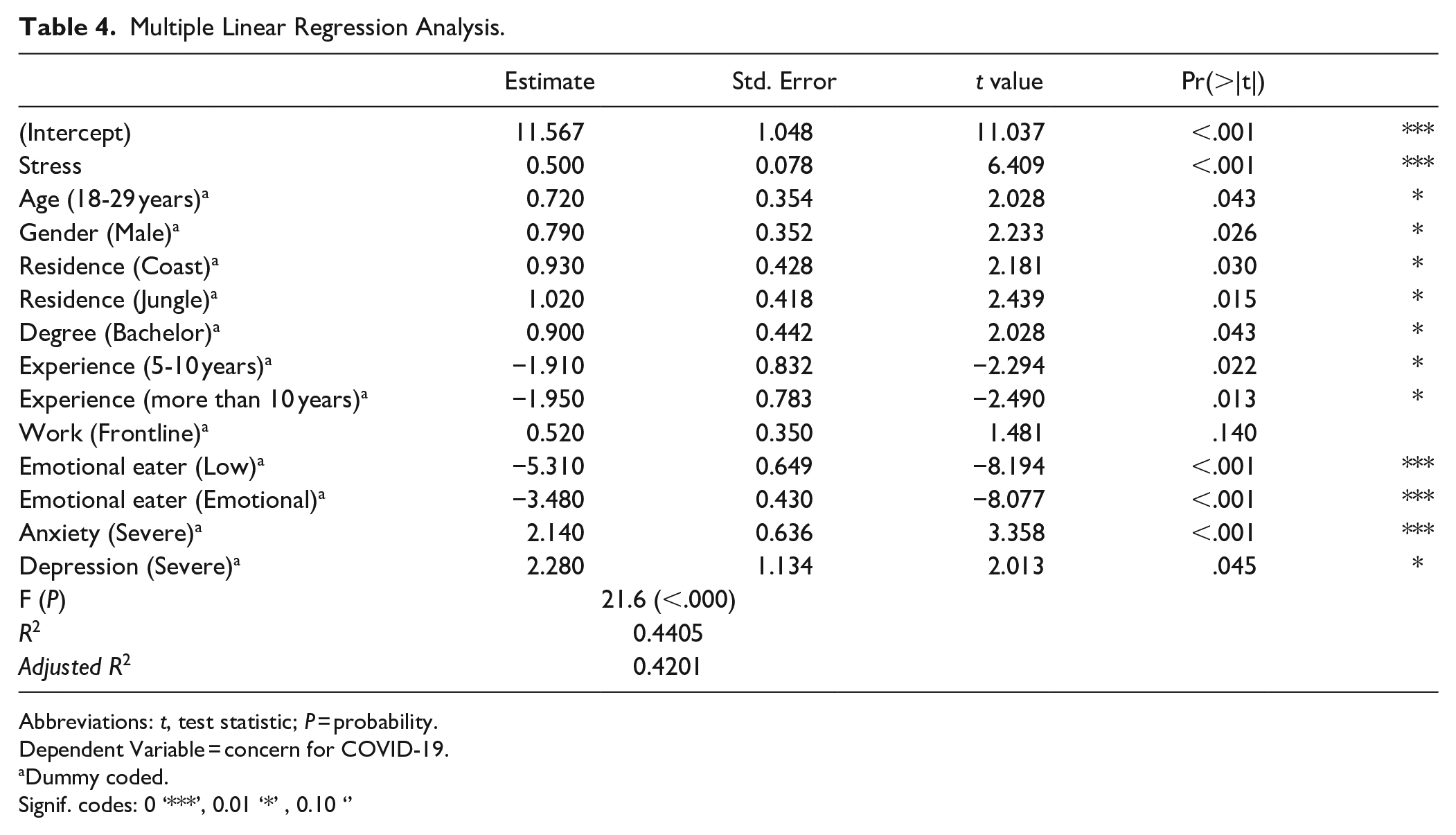
Abbreviations: t, test statistic; P = probability.
Dependent Variable = concern for COVID-19.
Dummy coded.
Signif. codes: 0 ‘***’, 0.01 ‘*’, 0.10 ‘’
Discussion
COVID-19 can be portrayed as a traumatic, unique, and highly intricate phenomenon, with the potential to have devastating effects on nursing personnel. This perspective sheds direct light on the experiences of nurses who, during the pandemic, have expressed various concerns related to the risk of contracting the virus and the possibility of becoming disease vectors for their loved ones. This study examined the perception of this danger and how different sociodemographic and mental aspects influenced its intensity. Age (18-29 years), gender (males), geographical location (coastal and jungle regions), and education level (bachelor’s degree) were found to be variables that favored an increase in concern about COVID-19. Similarly, psychological conditions such as stress, severe anxiety, and major depression also showed a positive correlation with concern generated by the disease. On the other hand, emotions related to eating behavior (emotional eating) demonstrated a negative link with concern about COVID-19.
Previous research has shown that younger or less experienced nurses tend to express acute concern about the dangers associated with their profession, both for themselves and their families, during the COVID-19 pandemic period. 40 A range of emotions including fear, physical and emotional exhaustion, isolation, and distress have been revealed in this group of nurses, along with a widespread sense of not having been adequately prepared to face such a challenge. 41 The present research supports these findings, demonstrating that concern about COVID-19 was particularly pronounced in younger nurses. This data is alarming, as a higher than anticipated number of nurses under the age of 35 have left the profession due to the pandemic.42,43
Throughout various studies, a consistently greater concern about COVID-19 contagion among nurses has been illustrated. 44 However, the results of the present study appear to contradict this commonly accepted perception. Instead, it has been observed that male nurses exhibit a greater worry regarding coronavirus contagion. This discrepancy could find its explanation in the sociodemographic and health reality of Latin America, and specifically in Peru. Various statistical reports have illustrated that in this region, there has been disproportionately higher mortality among men than women due to the COVID-19 pandemic.45,46 This fact could be rooted in multiple factors, including gender disparities in access to healthcare, differences in health behaviors, or even biological variations between men and women in response to the virus.47,48 It is possible that this higher risk scenario for men is reflected in the population of male nurses, leading to an increase in concern levels regarding the possibility of contracting the disease. This data underscores the need to pay attention to gender realities in the fight against the pandemic, not only in terms of public health policies but also in providing psychosocial support to frontline healthcare workers.
This study demonstrates that nurses residing in coastal and jungle regions expressed greater concern about COVID-19 contagion compared to their colleagues in the highland region. These findings appear to reflect the geographical and demographic specificities of these regions in Peru. Previous research has indicated that residing in coastal and jungle regions is associated with a higher risk of contracting COVID-19. 46 In fact, regions with lower altitudes have been found to experience a high mortality rate due to the virus.49,50 This context can increase apprehension levels among nursing professionals working in these areas. Additionally, factors such as high incidence of COVID-19 patients, a significant number of deaths, and insufficient preparedness to cope with such a magnitude pandemic can contribute to the fear of acquiring the disease among nurses. 51
The findings of this study reveal that nursing professionals with a bachelor’s degree showed a high level of concern during the COVID-19 pandemic. This is in line with recent research identifying nursing staff as a particularly vulnerable group in terms of emotional well-being during the current epidemiological situation.52,53 These professionals, given their proximity and constant contact with infected patients, experience greater concern about contagion compared to other healthcare groups. 54 This phenomenon is exacerbated by their frontline position in hospital and healthcare settings, increasing their exposure to the virus. In contrast, nurses with more work experience seem to handle the crisis more effectively and exhibit less concern about the pandemic. 55 Our results also support this observation, as we found that nurses with 5 or more years of work experience expressed less concern about COVID-19. Therefore, it is essential to consider the implementation of support measures and ongoing training, especially targeted at younger and less experienced staff. Evidence suggests that better-trained nursing staff can handle crises more effectively and experience less concern about contagion. 56
Furthermore, mental health during a pandemic is a topic that has gained critical importance, and this study supports the notion that nurses have experienced significant deterioration in this aspect during the COVID-19 crisis. Consequently, nurses have been found to have the highest rates of clinical depression among healthcare personnel, indicating a serious challenge to their well-being. 57 This study supports the view that the increased concern about contagion during the COVID-19 pandemic has led to increased stress levels among nurses, as suggested by previous research. 58 Similarly, other studies have reported high levels of stress, anxiety, and depression among nurses concerned about contracting the virus.15,16 Additionally, qualitative studies have identified 4 main themes of psychological distress in nurses, with fear, worry, and intense anxiety being the most prominent. 59 Our findings are in line with these and add a quantitative perspective to this knowledge. We have verified that severe stress, anxiety, and depression are factors that increase concern about COVID-19 among nurses. This pattern reflects the results obtained in previous studies using structural equation modeling, which found that fear and stress are predictors of depression. 60 Notably, younger nurses exhibited higher levels of stress, which in turn increased their level of concern, in contrast to their older counterparts. This may be linked to evidence that factors associated with concern, such as depression, anxiety, and stress, tend to decrease with age. 15 Thus, it is possible that older nurses have more effective coping mechanisms, stemming from accumulated experience, to deal with stressful situations.
Finally, our findings reveal that emotional eating behavior, including both low and moderate levels of emotional eating, had a notable impact on concern about COVID-19. More specifically, the emotional effects influencing eating behavior correlated negatively with the degree of concern regarding COVID-19. This finding is intriguing, especially when considering that during the pandemic, a significant percentage of the population increased their consumption of unhealthy food, particularly during periods of strict confinement. 61 Previous studies have identified various psychological aspects, including anxiety, fear, and stress, contributing to increased food consumption in the general population. 62 This phenomenon was not limited to the general population; in fact, it was found that anxiety levels also negatively influenced eating behavior among healthcare personnel during the COVID-19 pandemic. 63 This analysis underscores the importance of considering emotional states and eating behavior in the nutritional care process. Eating in response to negative emotions, emotional eating behavior, has been shown to be linked to obesity and, in this study, it has also been associated with greater concern about COVID-19. 64
Implications
The results of our research emphasize the need to address concern about COVID-19 comprehensively, considering the emotional, sociodemographic, and nutritional aspects of nurses. It highlights the urgency of implementing support strategies that mitigate the impacts of this pandemic on the mental health of nursing personnel. In practical terms, we suggest the establishment of stress management programs and psychological support, both at an individual and group level. Such interventions should take into account specific demographic factors, such as youth and inexperience, which appear to increase vulnerability to pandemic-related concern and stress. Additionally, our findings underscore the need for increased investment in training and preparedness of nursing staff to face pandemic situations and other public health challenges. This approach can not only reduce stress and anxiety levels among nursing personnel but also improve the quality of care provided to patients. From a theoretical perspective, our study contributes to the growing literature examining the impact of the COVID-19 pandemic on the mental health of nursing staff. However, it also suggests that other factors, such as eating behaviors, may play a role in this complex phenomenon. Therefore, future research should examine these interactions in more detail and consider other potential factors that may influence pandemic-related concern and stress. Lastly, given the negative link found between emotions affecting eating behavior and concern about COVID-19, we recommend incorporating nutritional support strategies into any intervention aimed at improving the mental health of nursing personnel. This nutritional support could include access to healthy meals in the workplace, nutritional education, and guidance on managing emotions through healthy eating.
Limitations
The results presented here should be considered within the limitations of the current study. Among these limitations is the cross-sectional nature of the study, which does not allow for establishing causal relationships between the analyzed variables. It would be useful to conduct longitudinal research to examine how concern about COVID-19 and its associated factors evolve over time. Additionally, the questionnaires were administered after healthcare personnel received booster vaccine doses, which may lead to a decrease in concern about COVID-19 due to the confidence generated by vaccination. Another limitation is the lack of a pre-pandemic baseline for levels of concern, mental health, and other studied factors, making it difficult to determine if the observed changes are solely attributable to the COVID-19 pandemic. Furthermore, the focus on a specific population (nurses) limits the generalizability of the results to other healthcare professionals. Additionally, the instruments were self-reported, which may introduce variation in symptom assessment compared to clinical interviews or evaluations by specialists, as self-reported measures do not necessarily translate into clinical symptoms. Moreover, the possible presence of unmeasured confounding factors, such as cultural differences, access to resources and social support, and academic and professional training, could affect the observed relationships between the studied variables. The Neyman bias, also known as survivor bias, is another limitation that could impact the results. This is because nurses who were most affected by concern, stress, and other pandemic-related mental health issues may have left the profession before the study was conducted. This could have led to an underestimation of the prevalence and severity of mental health problems and concern about COVID-19 in the population of nurses. Lastly, the lack of longitudinal follow-up of the nurses hinders the assessment of the evolution of concern, mental health, and other factors over time and how they may change with the progression of the pandemic and societal and policy responses to it. All of these limitations should be taken into account when interpreting the study’s results.
Conclusion
This study sheds light on the multiple and interconnected dimensions of the nursing staff’s response to the COVID-19 pandemic. The obtained data reveal the correlation between various sociodemographic characteristics, mental health conditions, and levels of concern about COVID-19. It demonstrates that factors such as age, gender, geographical location, and years of professional experience play a significant role in the perception of risk and concern about the disease. On the other hand, the analysis has shown an inverse correlation between emotional eating and the level of concern about COVID-19, a phenomenon that offers an unexpected clue for exploration at the intersection of mental health, nutrition, and stress management in healthcare professionals. It is hoped that these findings can contribute to the development of policies and programs that help mitigate the psychological and emotional impact of the challenges faced by nurses in their daily work.
Footnotes
Declaration of Conflicting Interests
The author(s) declared no potential conflicts of interest with respect to the research, authorship, and/or publication of this article.
Funding
The author(s) received no financial support for the research, authorship, and/or publication of this article.
