



Abstract
Objective:
Adolescents experience the critical period for physical and psychological growth. Few studies focus on the influence of sleep hygiene on the psychological health of adolescence aging from high school to freshmen year. Also, the influence from the COVID-19 pandemic has a public health significance.
Methods:
A total of 698 students from high schools and colleges were included in the manuscript, and a cross-sectional procedure was conducted, objective to make an epidemiological comparison of the social phobia/depression prevalence, and discuss the effects of potential determinants.
Results:
Psychological problems including social phobia and depression were prevalent especially among the high school students, with the female gender showing higher possibilities. Current results also indicated that the association between sleep status and the occurrence of social phobia is most obvious among high school students, while relatively higher MMR risks was found both for high school students showing symptoms of social phobia and college freshmen with depressive symptoms. Moreover, the interaction between social phobia and depression was obvious for both populations.
Conclusions:
Psychological problems including social phobia symptoms and depression are more prevalent among the high school females when compared with their male and freshemen peers. Sgnificant influencial factors for the risk of psychological problems among 2 populations are different, but media multitasking status should be paid attention to for both.
Introduction
Among youth, anxiety and depression occupy a high proportion of psychological problems. As a kind of social anxiety disorder, social phobia is a widespread, impairing yet treatable condition, which could be controlled by early detection and intervention. Thus, exploring and confirming the potential determinants will benefit public health.1,2
Adolescents experience a critical period which is essential to sexual maturity and cognition development,3,4 during which psychological health, social behavior, and academic performance interact with each other and the resulting conditions will follow them into adulthood.5,6 High school youth and college freshmen share the similar age and physical determinants but differ in social influence because of a difference in education levels and systems. Being put into consideration the rapid socioeconomic development, educational transition aiming diversity, the increasing demand of media multitasking, and the prolonged duration of the COVID-19 pandemic in China; a growth have been detected in the prevalence of social phobia and depression among youth, and therefore social attention have been increasingly attracted to the corresponding situation.7 -9 Among various determinants that are associated with psychological health, sleep status is one of the known factors and sleep hygiene is reported to interact with academic performance both directly or indirectly.10 -12 Apart from sleep status, reports also show that among the population of youth which are characterized by terms of long time on social media per day, high frequency of site visits per week, multiple platform usage, problematic social media use, high social media intensity, are highly associated with the risk of obtaining depression and anxiety. However at the same time other researchers emphasize the potential benefits from high media usage.13 -15
The current manuscript aims on making a baseline comparison of the prevalence of social phobia/depression symptoms, and discuss the relative potential determinants among high school youth and college freshmen. This research is also expected to provide interesting propositions for correlating follow-up research in the future.
Methods
Participants
A total of 365 students from high schools from Tianjin, China were included in the study, while 333 freshmen from universities (colleges) in the same city were selected as subjects of comparison. A cross-sectional survey was conducted from January to December in 2022. All participants signed their written informed consent. Ethical approval was obtained from the Ethics Committee of Tianjin Medical University.
Study Design
Students were invited to complete self-report questionnaires which took each respondent approximately 15 min. The key variables in this manuscript included age, gender, nationality, school, and grade, also including objectively measured scales such as BMI, etc. Apart from above, self-reported variables include (1) exercise frequency, (2) stay-up-late frequency, (3) academic scores in 4 levels (first 25%, 26%-50%, 51%-75%, and 76%-100%), and (4) self-reported questionnaires: 2 of the self-reported questionnaires were related with psychological health, another 2 were about sleep status, and the last was about the status of media multitasking. In the current analysis, general features prevalent were discussed through descriptive analysis. Also, the association between potential influence factors and independent variables was analyzed.
Statistical Analyses
Double entry was used to ensure the accuracy of the data, and SPSS 19.0 statistical software and R4.2.1 were used to process the data. ANOVA was used to compare the quantitative data, while chi square or Fisher’s exact test was used to compare categorical data. Logistic regression model was performed to investigate the association between dependent variables and independent variables, in order to exam the association between determinants and psychological health/academic outcomes, P < .05 was considered to be statistical significant.
Results
The Prevalence of Psychological Problems of the Study Population
The prevalence of social phobia symptoms and depression in high school youth were 36.44% and 27.12%, respectively. And the prevalence of social phobia symptoms was higher for girls among high school youth (female: 36.44%; male: 27.78%), P < .05. On the other hand, the prevalence of social phobia symptoms and depression symptoms among college freshmen were 4.50% and 10.51%, respectively. Features of the studied populations could be found in Table 1.
General Features Distribution of the Study Sample.

Determinants Related to Social Phobia Symptoms
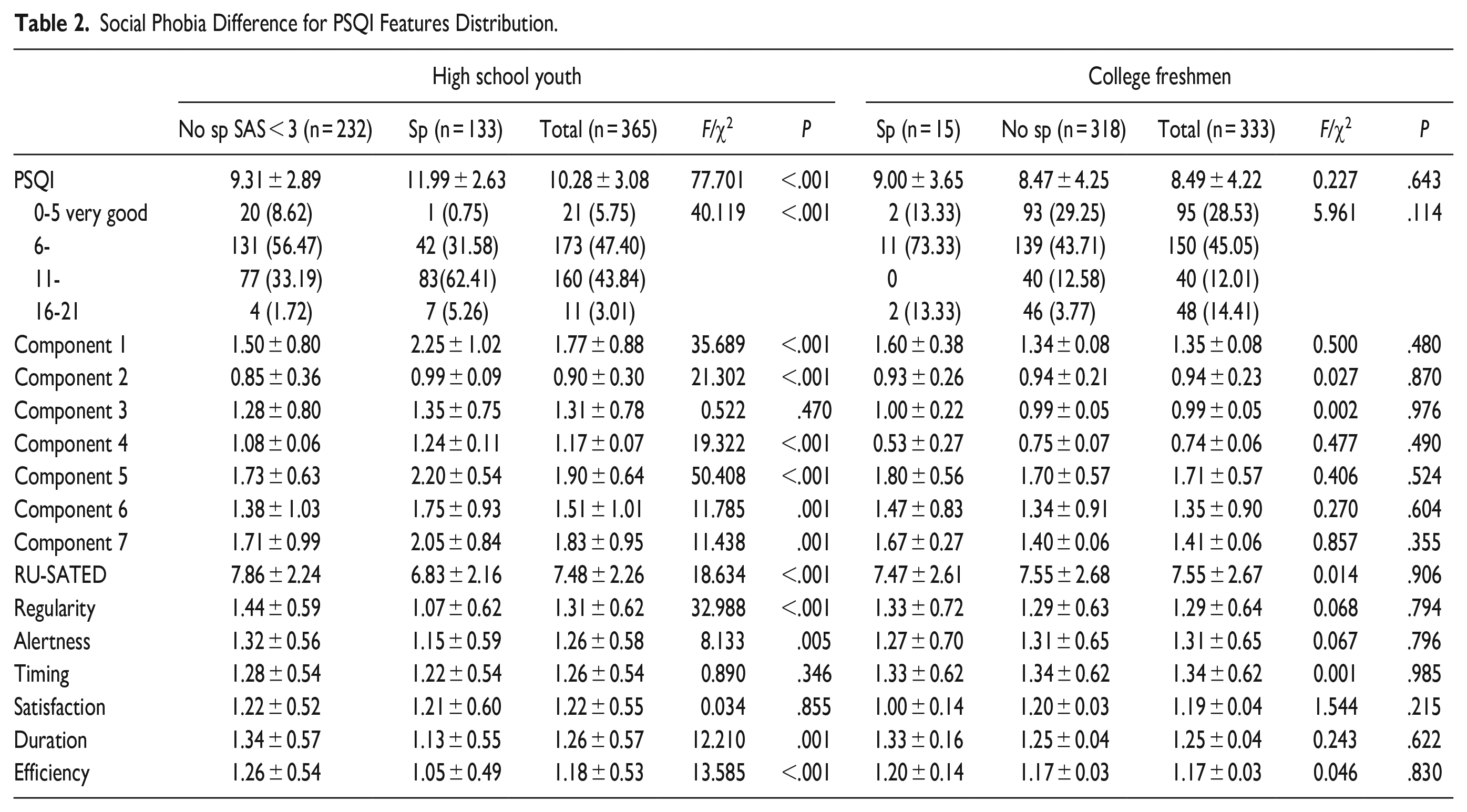
As an epidemiological survey, although criteria for distinguishing social phobia/depression statuses were different for the high school youth and freshmen (by different scales because of age), the scales perfectly screen out individuals with symptoms and the others. In this manuscript, a comparison between 232 individuals with no social phobia symptoms (no SP group) and 133 individuals with social phobia symptoms (SP group) among the high school youth indicated that the social phobia ones experienced worse PSQI evaluation results. The total and separate individual scores for its 7 component scores (Sleep quality; Sleep onset latency; Sleep duration; Sleep efficiency; Sleep disturbance; Use of sleep medications; and Daytime dysfunction.) were higher in SP group, P < .05. The majority of the PSQI scores in the SP group were between 11 and 15 (average of 11.99 ± 2.63), while the scores for the no SP group youth were concentrated between 6 and 10 (average of 9.31 ± 2.89). The RU-SATED was also used to evaluate sleep hygiene, and a similar trend as PSQI was found. The total score of RU-SATED of youth in this study was (7.48 ± 2.26). Comparing the no SP group and the SP group, total score and 4 individual item scores were all showed to be lower in the SP group, suggesting a worse sleep hygiene status, P < .05. The timing and satisfactory items showed no difference. As for the college freshmen, no overall statistical association was found between PSQI (and its items)/RU-SATED (and its items) and symptoms of social phobia. All are shown in Table 2.
Social Phobia Difference for PSQI Features Distribution.
However, in discussing the potential determinants associated with social phobia risk, multivariate logistic regression analysis among high school youth showed the statistical influenced factors as the following: a higher PSQI score and lower RU-SATED scores, the female gender, obtainment of depression, and higher MMR, P < .05.
No univariate regression analysis result suggested any one-to-one association between positive social phobia statuses and potential influence factors (including sleep related factors, media use related factors, etc.) for college freshmen. But when given full consideration of all potential factors and their interactions, the multivariate regression analysis shows: among the college freshmen in this study, the factor of academic performance was positive with social phobia, (OR: 2.337, 1.147-4.760, P = .019).
All was shown by Table 3 and Figure 1.
Associations Between Potential Determinants and Social Phobia.


Comparison of main determinants toward social phobia between populations by multivariate regression model.
Determinants Related to Depression Symptoms
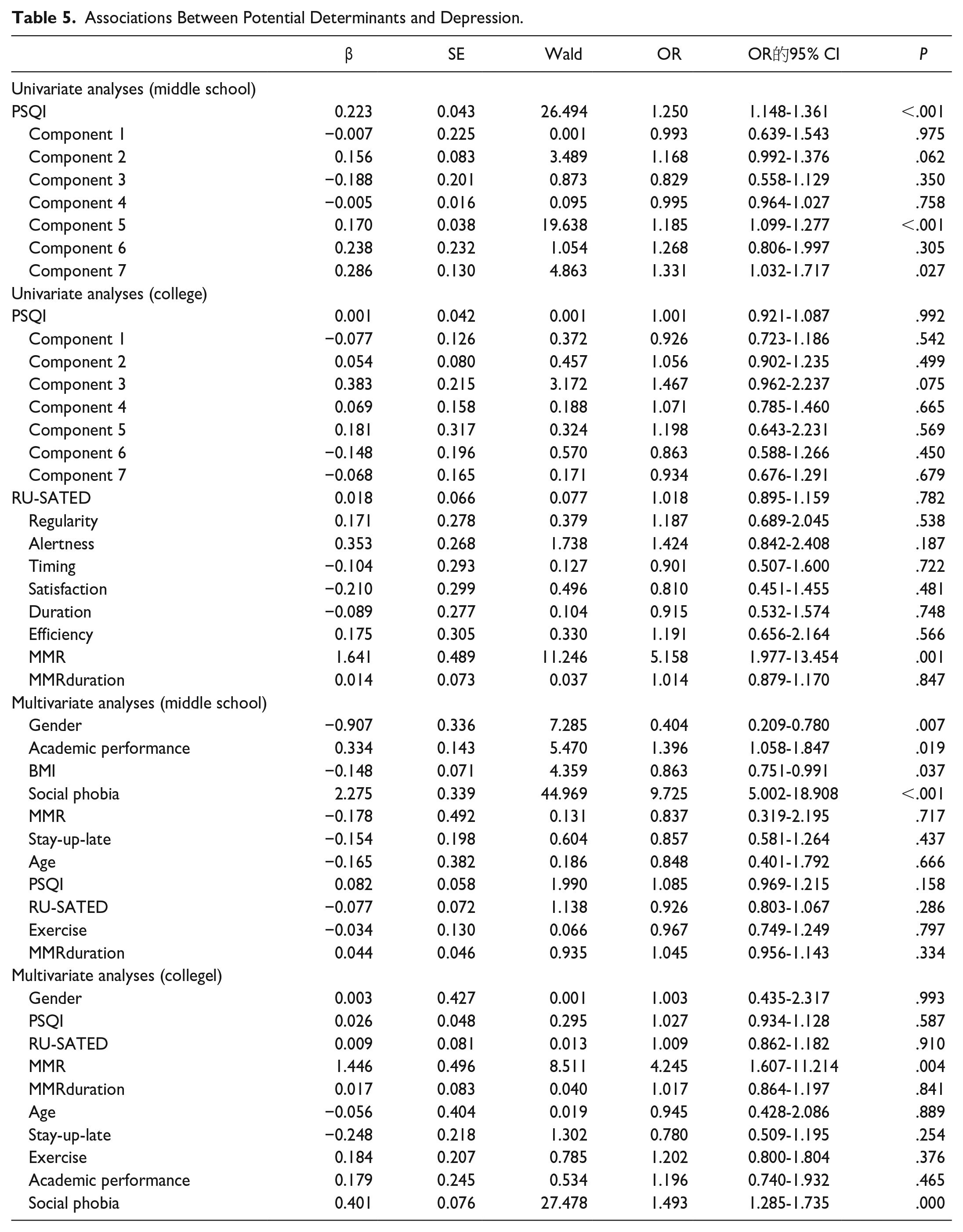
Among the high school youth the PSQI comparison between 236 individuals with no depression symptoms (no depression group) and 99 individuals with depression symptoms (depression group) suggested that the youth with depression symptoms experienced worse status of PSQI and RU-SATED. Influence factors to depression among high school youth from multivariate regression model showed that male gender, worse academic performance, lower BMI level, and obtaining social phobia symptoms were statistically risk factors, P < .05.
As for the college freshmen, similar as social phobia status, totally no statistical association were found between PSQI (and its items)/RU-SATED(and its items) scores for the univariate comparison. However, with an OR of 5.158 (P < .001), the univariate regression analysis results suggested the factor of MMR increased the risk of participants showing depressive symptoms. And the multivariate regression analysis further proved a positive influence of MMR.
As shown in Tables 4 and 5 and Figure 2.
Depression Difference for PSQI Features Distribution.

Associations Between Potential Determinants and Depression.

Comparison of main determinants toward depression between populations by multivariate regression model.
Discussion
Psychological Problems Prevalent Status
The prevalence of social phobia and depression symptoms in high school youth was 36.44% and 27.12% in this survey. While the prevalence of college freshmen was 4.50% and 10.51% respectively.
The pressure youth are experiencing, physically and psychologically, are influenced by economic transformation, urbanization, and education systems, along with the affects from the COVID-19 pandemic. Social phobia is an anxiety disorder found to be highly prevalent among high school and university students.16,17 Reports suggest that young age, the female gender and diminished socio-economic background are important determinants to the risk of social phobia. In the current study, female gender was found to obtain a higher prevalence and also be positively associated with social phobia symptoms, even with the full consideration of other factors.
Moreover, depression is predicted to be the second leading cause of disease burden worldwide by 2030.18,19 In China, the situation is urgent also; therefore the current manuscript showed us that psychological problems including social phobia and depression are prevalent among high school students, especially for females.
The features of the studied populations show, essential elements such as body gesture (BMI), stay up late frequency and exercise frequency are distributed differently among high school youth and college freshmen; the causation of which is mostly social (environmental) factors, including different educational focuses, the educational hierarchy, and academic burdens, etc. Furthermore, college freshmen showed a significantly higher level of MMR than the high school youth; and among the high school students, the level of girls are slightly higher than the boys
Potential Risk Factors to Psychological Problems
It is reported that up to 50% of children will experience a sleep problem, and about 4% have a formal sleep disorder diagnosis.
Early identification of sleep problems may prevent negative consequences. 20 Most of the previous reports maintain the idea of using psychological interventions as a cure to sleep problems in all age groups, significantly decreasing the risk of its negative impact on mental health. As for the student population, psychological intervention helps improve their academic performance. Among the potential interactive factors, sleep hygiene is usually viewed to play a crucial role in sleep development and sleep problems. To note, 1 important issue related to sleep hygiene is the access to electronic media devices, which is just another focus in this research.21 -26
When assessing the sleep status, various sleep measurements have been developed, the most widely employed is the Pittsburgh Sleep Quality Index (PSQI). 27 And sleep hygiene status assessed by RU-SATED could make a valid complement. 28 Both scales were conducted in the current manuscript. Sleep is surely associated with psychological status directly or indirectly, and interacts with many other school related determinants. 29 Poor sleep quality is usually prevalent among individuals with social anxiety disorder and may impair memory consolidation of in-session extinction learning: thus, not only fluctuating the risk and status of anxiety, but also indirectly affecting individuals’ academic outcomes. Moreover, sleep problems and anxiety symptoms are bidirectional, the associations vary by subtypes of sleep problems and anxiety symptoms.30,31 In the current manuscript, potential risk factors for social phobia among high school youth include a higher PSQI score, lower RU-SATED scores, together with female gender, obtaining depression and higher MMR. As for the college freshmen, the factors are less outstanding academic performances and the obtainment of social phobia. No univariate regression analysis results suggested any one-to-one association between positive social phobia status and the potential influenced factors (including sleep related factors, media use related factors, etc) among the college freshmen in this manuscript. The result might be limited by sample size, but when all the potential factors and their interactions are put into consideration, the multivariate regression analysis showed us among the college freshmen the academic performance factor was positive with social phobia. This might be related to the shift of study (education) model from middle school to college and/or college study burden for medical students. On the other hand, potential factors associated to the risk of depression were: the male gender, less outstanding academic performance, lower BMI level and among high school youth, the obtainment of social phobia symptoms; as for college freshmen, a higher MMR, and the obtainment of social phobia. The causation f which might be the shift in studying environments, the change in social environment from middle school to college, the pandemic’s influence. Social phobia, depression, and media multitasking status seems to exasperate one another among college freshmen.
Another principal factor which is interactive with psychological status and academic performance of youth is media multitasking, which was also found to be associated with psychological problems for both high school youth and college freshmen. Previous statistical reports shows a 97% of all adolescents use at least one of the platforms including YouTube, Instagram, Snapchat, Facebook, Twitter, etc; and a number of studies show that the rise in youth psychological problems is the factor related to media use, which is generally but not always reveals reduced performance on cognitive tasks and well-beings.32,33 In the current manuscript, the association between sleep status and social is obviously among high school students. Important influenced factors for the risk of psychological problems among youth of high school and freshmen year were different, but media multitasking status should be paid attention to for both. Interaction between social phobia and depression was also obviously for both high school youth and college freshmen. These were in line with the previous reports.
The findings from the current manuscript are expected to lead to wider relevant public health discussions, and call for proper improvement or correction from according fields.
Strengths and Limitations
Accurate causality between potential factors and social phobia/depression/academic performance can not be determined because of the cross sectional design in the current study. Comparison by 2 separate populations might be less strengthful than cohort follow up. However, the current analysis still could offer the essential epidemiological information.
Secondly, most of the information were based on self-reported data, which might not avoid potential reporting bias.
Furthemore, the criteria for distinguishing social phobia/depression status were different for the high school youth and freshmen (by different scales for the sake of the age), but fortunately the different scales could perfectly separate individuals with the focused symptoms and the other ones, and therefore make the results of the comparison in risk factors’ effects maintain its significance and reliability.
Also, it should be noted that we did not take into account all the possible factors, such as peer relationship, family background, etc. The future study is needed to clarify these.
Conclusion
The current manuscript showed us that psychological problems including social phobia and depression symptoms are prevalent among the high school students, especially for females. Moreover, important risk factors for the psychological problems among high school youth and freshmen youth are different, but media multitasking status should be paid attention to for both.
Footnotes
Acknowledgements
Thanks for the support of all the participants and their teachers of the international school included in the study. And thanks for the sharing data information from National Natural Science Foundation of China (81502828).
Author Contributions
Ziyu Zhang, Yue Gao, and Xinyue Zhi substantially contribute to conception and design of the manuscript. Ziyu Zhang, Xuanyu Ren, Rongli Nie, Qiqi Chen, and Xinyue Zhi contribute to acquisition of data, analysis, and interpretation of data. Ziyu Zhang, Xuanyu Ren and Xinyue Zhi contribute to draft the article and revising it critically. Yue Gao and Xinyue Zhi contribute to the final approval of the version to be published.
Declaration of Conflicting Interests
The author(s) declared no potential conflicts of interest with respect to the research, authorship, and/or publication of this article.
Funding
The author(s) received no financial support for the research, authorship, and/or publication of this article.
Ethical Statement
We confirm that we have read the issues involved in ethical publication and declare that this manuscript is consistent with the guidelines.
