



Abstract
Introduction:
This study reports the prevalence of the 5 most common cancers and their geographical distribution based on the last update of cancer statistics in Iran (2019).
Materials and methods:
The data used in this study were extracted from the Global Burden of Disease (GBD) studies. It was prepared regarding sex in different provinces. Moran’s I test was used to check geographical correlation and identify hot spots and cold spots. A significance level of 5% was considered in all tests.
Results:
The most prevalent cancers among Iranian women reported Breast (312 per 100 000; 95% UI: 281-345), Thyroid (43 per 100 000; 95% UI: 26-51), Colon and Rectum (43 per 100 000; 95% UI: 39-47), Leukemia (33 per 100 000; 95% UI: 21 -41), and Uterine (29 per 100 000; 95% UI: 14-35) respectively; further, the most prevalent cancers among Iranian men reported Prostate (219 per 100 000; 95% UI: 158-258), Colon and Rectum (80; 72-88), Bladder (65 per 100 000; 95% UI: 58-71), Leukemia (40 per 100 000; 95% UI: 20-51), and Testicular (33 per 100 000; 95% UI: 20-48) respectively.
Conclusion:
exclusive of any type of skin cancer, Breast, prostate, colon and rectum, bladder, thyroid, testicular, uterine, and leukemia are most prevalent cancers in Iranian population.
Introduction
Cancers are a major non-communicable disease that causes of millions death around the world, 1 and it is one of the top 3 causes of death in Iran as well. 2 The prevalence of cancers differs from one country to another, but some cancers are most prevalent in all countries. An updated study in 2014 showed that the most incidence was Breast, Colorectal, stomach, Thyroid, and Leukemia in Iranian women. Stomach, Prostate, Colorectal, Bladder, and lung were reported with the highest incidence risk in Iranian men. 3
The prevalence of cancers is an index that shows the current situation of cancers in a community without regard to the fatality of that, this index calculates all current cases (new and old cases) as a numerator divided by all populations who potentially could get cancers; all of this data could extract from the cancer registry of Iran, this program is conducted the Ministry of Health and Medical Education gathering all cancers cases according to International Classification of Diseases-Oncology (ICD-O) from most cities. 4
The trend of cancer occurrence has been rising in these recent years; Aging, low quality of life, smoking, and changing lifestyle are some significant risk factors that have been named in many studies as causes of this event. 1
Given all these topics, the prevalence of cancers could be changed every few years; finding the prevalence and geographical distribution of common cancers could help health policymakers to manage and control cancers regard the cancer status of every region. The results of this study are reported based on the last update of cancer statistics in Iran (2019), these results include the prevalence of the 5 most common cancers and their geographical distribution.
Materials and Methods
Study Area
Iran is located in the west of Asia with 31 provinces. According to the last estimation, the population is about 84 000 000 and the percent of men and women are 50.5 and 49.5, respectively. 5
Data Source and Processing
The Global Burden of Disease (GBD) study is a regional and global research community program that examines the burden of disease, risk factors, and various health outcomes. In this study, the updated data (2019) of the 5 most common cancers (Breast, Prostate, colon and rectum, Bladder, Leukemia, Thyroid, Testicular) by sex and age-standardized were used, which were extracted and analyzed separately for each province. All data were from vital registration, cancer registry, and verbal autopsy report in which malignant neoplasm or cancer defined by international classification of diseases (ICD).
Descriptive Analysis
To describe the data, the prevalence was reported based on 100 000 people and with a 95% confidence interval. Arc map GIS version 10.1 was also used to demonstrate the geographical distribution of the prevalence of cancers in different provinces based on quartiles (Q1-Q4).
Spatial Autocorrelation
Geographical distribution of a variable can create some nonrandom clusters by regions; these clusters could have low(cold spot) and high (hot spot) values that are evaluated by spatial autocorrelation. 6 Moran’s I test was used to check the correlation between different provinces regard to their Cancers prevalence and whether there is a cluster for these types of cancers among other provinces. If it is significant, the hot and cold clusters of will be identified. A significance level of 5% was considered in this test.
Results Descriptive Results
Descriptive Results
The most prevalent cancers among Iranian women reported Breast (312 per 100 000; 95% UI: 281-345), Thyroid (43 per 100 000; 95% UI: 26-51), Colon and Rectum (43 per 100 000; 95% UI: 39-47), Leukemia (33 per 100 000; 95% UI: 21 -41), and Uterine (29 per 100 000; 95% UI: 14-35) respectively; further, the most prevalent cancers among Iranian men reported Prostate (219; 158-258), Colon and Rectum (80 per 100 000; 95% UI: 72-88), Bladder (65 per 100 000; 95% UI: 58-71), Leukemia (40 per 100 000; 95% UI: 20-51), and Testicular (33 per 100 000; 95% UI: 20-48) respectively.
In women, Alborz was the province that reported the most rate of breast cancer (384 per 100 000; 95% UI: 311-470); Bushehr, East Azerbaijan, Yazd, and Alborz were provinces that reported the most rate of Thyroid (62 per 100 000; 95% UI: 28-83), Colon and Rectum (61 per 100 000; 95% UI: 50-76), Leukemia (49 per 100 000; 95% UI: 24-68), and Uterine (48 per 100 000; 95% UI: 15-67) respectively (Figure 1).
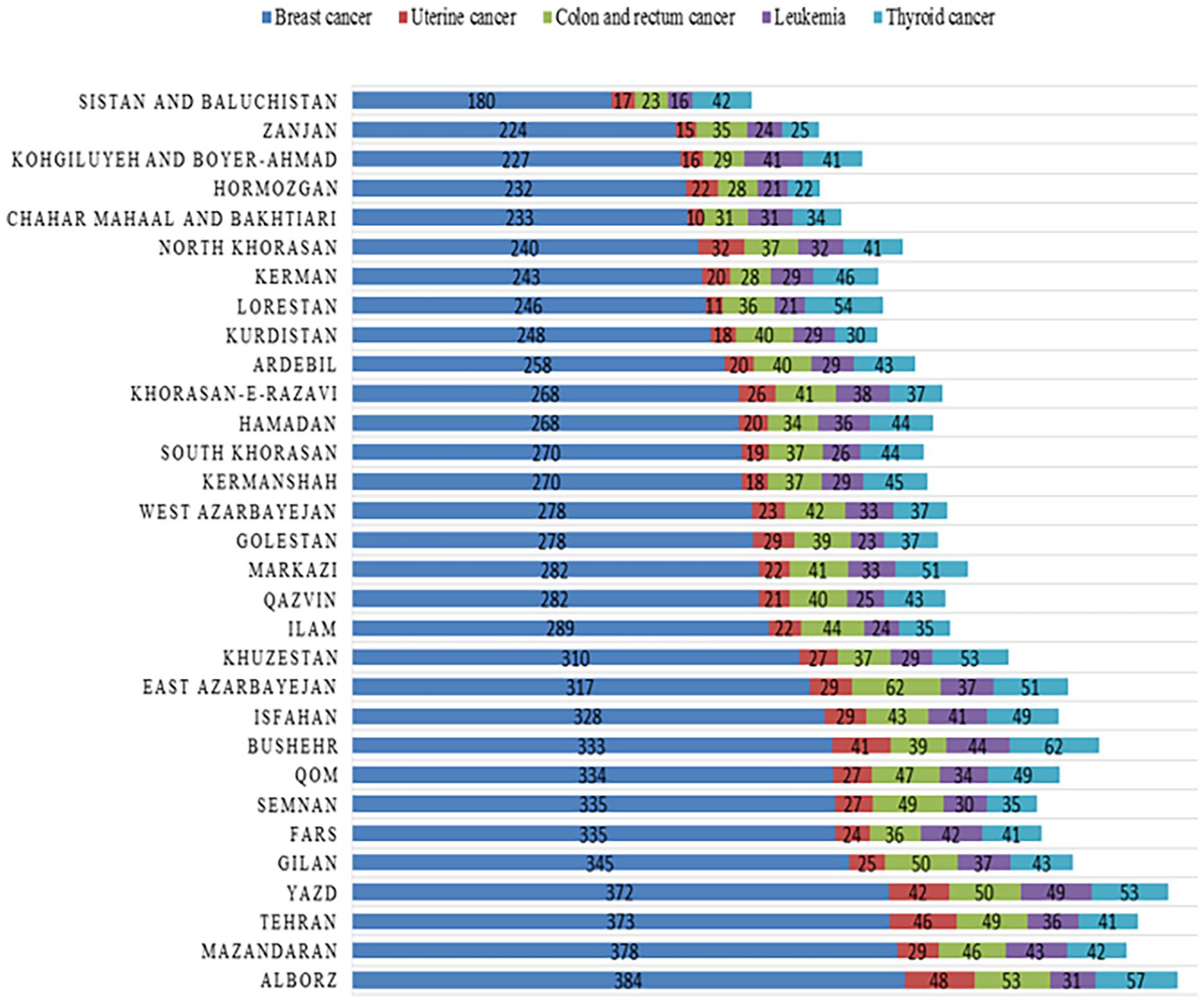
Five prevalent cancers in Iranian women in 2019, by Provinces (per 100 000).
In men, Mazandaran, East Azerbaijan, Bushehr, Fars, and Qom were provinces that reported the most rate of Prostate (299 per 100 000; 95% UI: 189-408), Colon and Rectum (114 per 100 000; 95% UI: 91-141), Bladder (122 per 100 000; 95% UI: 97-150), Leukemia (54 per 100 000; 95% UI: 25-78), and Testicular (53 per 100 000; 95% UI: 21-101) cancers respectively (Figure 2).

Five prevalent cancers in Iranian men in 2019, by Provinces (per 100 000).
Spatial Analysis Results
Analyses showed 3 significant clusters among women cancers in provinces of Iran, Breast (z-score:3.37, P < .001), Colon and Rectum (z-score:3.12, P < .01), and Uterine (z-score:2.38, P:.02); but Thyroid (z-score: −0.28, P:.8) and Leukemia (z-score:1.2, P:.23) were not significant (Figure 3).

Hot and cold spots of 5 prevalent cancers in Iranian women in 2019: (A) uterine, (B) breast, (C) colon & rectum, (D) leukemia, and (E) thyroid.
In men, just the Colon and Rectum (3.32, P < .001) and Testicular (2.35, P < .01) were composed of a significant cluster; Prostate (z-score: 0.85, P: .39), Bladder (z-score: 0.72, P:.47), Leukemia (z-score:1.22, P:.22) were not significant (Figure 4).
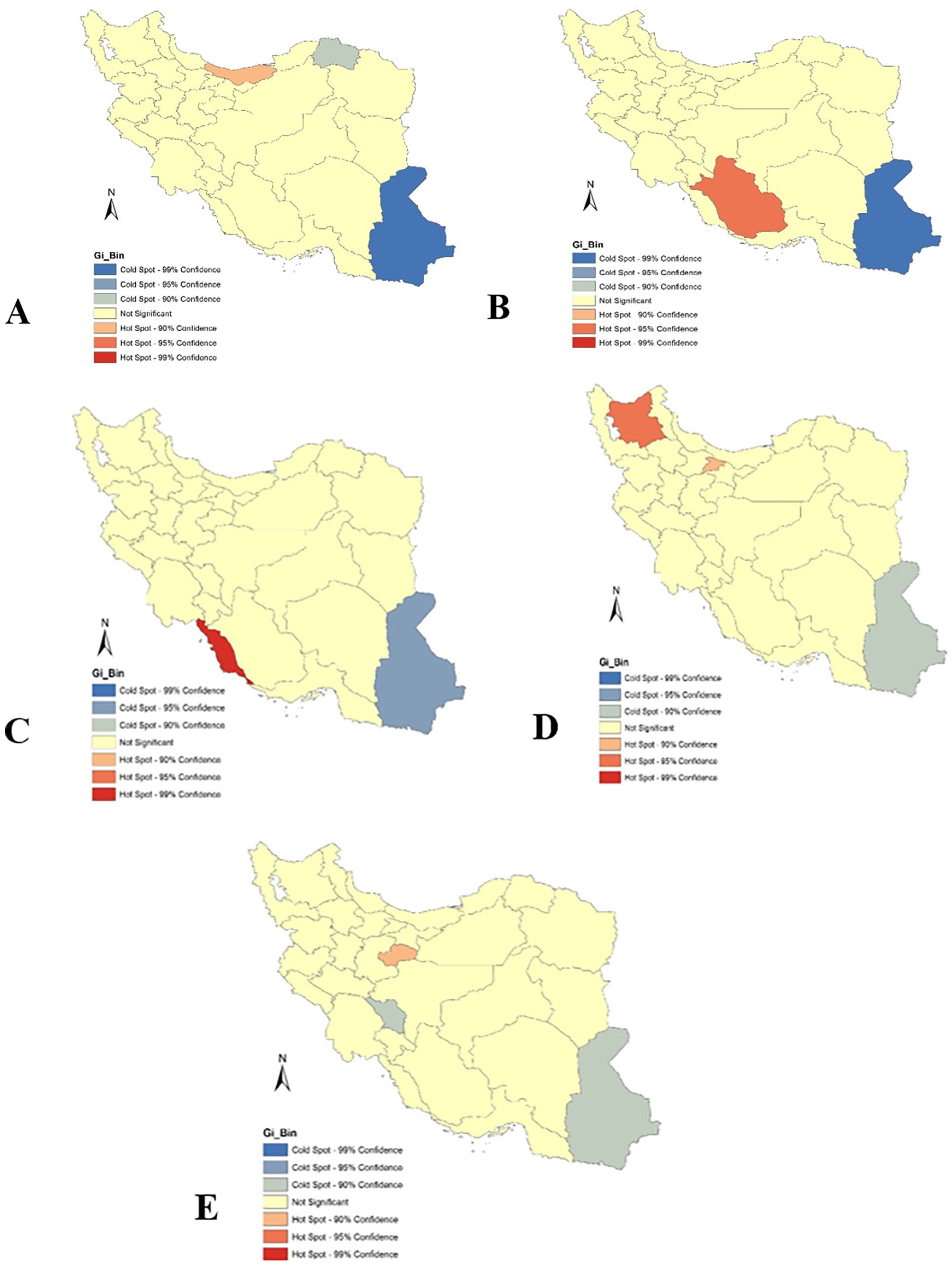
Hot and cold spots of 5 prevalent cancers in Iranian men in 2019: (A) prostate, (B) leukemia, (C) bladder, (D) colon & rectum, and (E) testicular.
Discussion
Overall, risk factors of cancer could be stratified in 2 major groups, life style (diet, physical activity. . .) and environmental exposures (physical, social, emotional); Iran is multi-cultural country in which diversity life style and habits. In this study we try to clarify the causes of high prevalent of common cancers in Iran and its provinces.
Breast Cancer
Breast cancer (BRC) is most common cancer in Iranian women, many studies have been published that reported life style, obesity, decrease in childbearing, oral contraceptive pills, employed, and inadequate breast feeding are main risk factor to incident BRC,3,7 in other hand early age at first pregnancy and duration of breast feeding are a main protective factor that prevent to get this cancer. 8 Geographical distribution of BRC showed Sistan and Baluchestan as a province with highest fertility rate is province with lowest BRC prevalent rate(108 per 100 000), in spite of Mazandaran(384 per 100 000) that have low fertility rate and high prevalence of obesity. In addition to these causes, increasing in life expectancy, Adult literacy, and physician availability 9 could be increased the prevalence of BRC in Iran.
Thyroid Cancer
Thyroid Cancer (THC) is the another cancer with high prevalence in Iranian women, Risk factors of this cancer are almost diet and unhealthy water; Nitrate contaminate of drinking water is a major factor that induce from factory wastewater, this factor could be found in the Persian Gulf neighboring province (Busher ). Sea food such as fish is a factor with differently affect, this situation could be seen in 2 south provinces (Bushehr with high: 62 per 100 000; and Bandar Abbas with low prevalence: 22 per 100 000). 10
Colon and Rectum Cancer
Dietary habits such as salt intake is a major risk factor to get Colon and Rectum Cancer (CRC), East Azarbayejan (114 per 100 000) is a province with traditional diet that have so many salted foot and meet, 11 in other hand the population transition, Cohort Effect, and race are a factors could be increased the prevalence of this cancers.12,13
Uterine Cancer
Uterine Cancer (UC) is a cancer that have been increased these decades, religious beliefs is named as a barrier that could be increased the prevalence of this cancer specially in religious regions 3 ; result of this study showed the low prevalence of UC was reported in Qom as a religious province (22 per 100 000) but the lowest prevalence of this cancer was reported in Charmahal and Bakhtiari(10 per 100 000), in addition to HPV infection, the prevalence of some risk factors such as older age, obesity, and polycystic ovarian syndrome could justify these results. 14
Prostate Cancer
Prostate cancer (PC) has increased in Iranian men these decades; some factors such as Physical activity, opium use, and Aging have played an important role in this increase. 15 Sistan and Baluchistan (103 per 100 000) is the province with the youngest population in Iran, physical activity rate in this region is higher than in other regions as well, in another hand, the prevalence of obesity in Mazandaran province (299 per 100 000) is higher than in other regions, it seems these 2 factors have created a high-risk and low-risk point in these provinces.
Bladder Cancer
Opium use, tobacco smoking, diabetes, fluid intake, drug, and high consumption of alcohol are the major risk factors for Bladder Cancer (BC).7,13,16,17 The geographical distribution showed Bushehr province is a high–risk province, it seems tobacco use and low quality of water are 2 major factors for this situation; Schistosoma mansoni as a water-borne parasite could be another reason for the high prevalence of BC in Bushehr province(122 per 100 000).
Leukemia
Although obesity, smoking, environmental factors, and genetic disorders are known risk factor for this cancer but the unknown factors have a main effect to induced it.18,19 In some city of iran, diagnosis and treatment clinic has been launched, one of this city is Yazd(49 per 100 000) that many patients refer to this city for diagnosis and treatment, it could be increase the cases in this city.
Testicular Cancer
Testicular cancer (TSC) is a cancer that had not high prevalence decades ago, but todays have been rising significantly, the risk factors of TSC are the same other cancers. In addition, occupational exposure such as high temperature (heat) is a major risk factor for it. It seems people who work in the high temperature situation could be high risk to get TSC. 20
Conclusion
The result of this study showed exclusive of any type of skin cancer, Breast, prostate, colon and rectum, bladder, thyroid, testicular, uterine, and leukemia are most prevalent cancers in Iranian population. Life style, improving the health services access, and Aging could be the main factor to prevalent of these cancers. Given all these topics, we should try to detect and control risk factors by region, some risk factors just exist in north of Iran that we couldn’t detect in South or east. For example obesity is a major risk factor in north of Iran that increase the prevalence of BRC and PC; dietary habits (Iranian Kebab or roast meat) could cause the high prevalence of CRC in this location. Industry provinces could have a special risk factor to some cancers such as TSC.
Footnotes
Acknowledgements
I would like to thank Institute for Health Metrics and Evaluation (IHME) to available the data for research.
Author Contributions
All work was managed by MTS.
Declaration of Conflicting Interests
The author declared no potential conflicts of interest with respect to the research, authorship, and/or publication of this article.
Funding
The author received no financial support for the research, authorship, and/or publication of this article.
Ethical Approval
This work is considered non-human subjects research and just used available aggregated data.
Study Limitation
In despite of several advantages of secondary data, poor quality, outdated and underreporting could affect ton the result of a study.
