



Abstract
Purpose:
Effective communication is a key component to managing an event such as a global pandemic. In Canada, federal/provincial reports indicated that effective communication was a challenge in the early days of the COVID-19 pandemic. The purpose of this study was to examine the communication strategies used within long term care facilities in the Canadian province of New Brunswick.
Methods:
Online surveys were used to collect data from administrators, staff, and individuals with family members living in long-term care facilities.
Results:
The findings show an overall satisfaction with the information received by staff and families, however the frequency and format in which information was communicated were inconsistent. All participants indicated that too much information and poor quality information was a challenge. The importance of digital platforms to provide COVID-19 information was consistently identified as a successful communication strategy.
Conclusion:
The findings of this study reveal that the quantity and quality of information provided during the pandemic created challenges for administrators, staff, and families. This is in line with reports from Canadian provincial/federal reports on COVID-19 and long-term care. Recommendations have been made that would benefit the long-term care sector, not only for pandemics, but for communication in general.
Introduction
Communication is a key component to managing any type of extreme event. Effective communication throughout a global pandemic, not only transmits Public Health guidance, but can also play a role in reducing negative social, psychological and health impacts. 1 The COVID-19 pandemic has provided an opportunity to examine communication strategies used, especially in a digital information age. Of particular interest, has been the impact of this pandemic on those who live, work, and have family in long-term care facilities [LTCF]. A post-mortem analysis of the communication strategies used by these individuals can inform best practices used by institutions and community-based programs when planning for emergency preparedness or future pandemics.
Globally, the COVID-19 pandemic has resulted in an alarmingly high rate of deaths in long term care facilities (LTCF).2-4 Canada has reported significantly higher rates of COVID-19 deaths in LTCF particularly during the First and Second waves of the pandemic.5-7 Long Term Care Facility residents accounted for 3% of all COVID-19 cases and 43% of COVID-19 deaths. 8
The trajectory of COVID-19 related deaths in New Brunswick LTCF did not follow the national trend. Although in the First wave of the pandemic death rates were considerably lower (n = 1), by August 2021 (Third wave), 59% of all COIVD-19 related deaths in the province were in LTCF. 9 Beginning in August 2021, the province no longer reported LTCF COVID-19 related deaths and to date this number is not readily accessible.
The general guidance on how to communicate during a public health crisis is to educate and to reduce negative outcomes, such as psychological distress. 1 To ensure that communication is effective, it is imperative to establish an environment of trust.10-12 Once that trust is established, the information provided must be “accurate, timely, consistent, clear, and simple to understand material.” 1 Failure to do this can hinder efforts to manage a pandemic. 13 Furthermore, the information must be accessible to the intended audience. This includes taking into consideration factors such as literacy rates, access to a computer, tablet or smartphone, access to high-speed internet, social and cultural characteristics, and language barriers.11,12
In Canada, early federal and provincial reports on the impact of the COVID-19 pandemic on the long term care [LTC] sector acknowledged that communication was becoming a challenge.
13
These reports (see Table 1) identified 2 central themes related to the effectiveness of communication efforts. First, there were challenges with
Reports Relating to Communication in Canadian LTC During the COVID-19 Pandemic.

In the Canadian context, the LTC sector was deluged with information related to COVID-19. This became a great burden for many LTCF operators who were ill prepared to relay this information to residents, family, and staff13,26 and added to an already stressful situation. 21 The Ontario Long Term Care COVID-19 Commission Report 21 noted that, “The volume and complexity of communications about the pandemic response to long-term care exacerbated the challenges the homes faced” (p. 151). Fancey et al 27 explain that effective communication was difficult because of frequent changes to guidance on visitation to LTCF.
Early reports from the Canadian LTC sector clearly identified that poor communication with residents, families, and staff was an area of concern. The reports (see Table 1) noted that staff, residents, and families reported feeling increased levels of distress and anxiety due to the lack of communication. 20
The dissemination of large volumes of information through a variety of mediums created challenges for the LTC sector. The ideal would be for LTCF to implement a single method of communication, supported with current contact information, to be used consistently for information updates. 10 This could encompass a wide range of platforms including signage, telephone, email, conference calling, webinars, hotlines, or recorded messages.10,22
Table 1 demonstrates that most federal/provincial reports on LTC and COVID-19 identified that a high priority needed to be given in the development of communication plans, particularly for staff and families. Although it is not evident if new policies have been implemented, recommendations from a variety of jurisdictions have identified that clear and consistent messaging is key (see Table 1). A survey of communication strategies, used during the early months of the pandemic in various LTCF across Canada, acknowledged efforts that were made to increase effective communication. 27 It was highly recommended that information be accessible to all, by using a variety of platforms; digital and non-digital. 27
The purpose of this research project was to assess the communication strategies used to communicate COVID-19 related information in LTCF located in the Canadian province of New Brunswick. The study focused specifically on the experiences of administrators, residents, staff, and families engaging with LTCF in New Brunswick.
Methods
Data Collection
A total of 4 online surveys, in Canada’s both official languages (English and French) were conducted during the First and Second waves of the COVID-19 pandemic (August 2020-March 2021). The 4 surveys were housed on the secure online survey platform Hosted in Canada (www.hostedincanada.com) and were approved by the St. Thomas University Research Ethics Board (#2020-26). Participants could not proceed with the survey until written informed consent was given (this appeared on the first screen of the survey).
LTCF administrator survey
In August 2020, a survey of 25 closed and 2 open ended questions about how communication of COVID-19 information was exchanged with provincial government departments, residents, staff, and families was completed by LTCF administrators. The participants (n = 27) responded to an email request which contained a link to the survey. The majority (70%) of administrators were managing LTCF of 75 beds or less.
LTCF staff survey
Between August-September 2020, LTCF staff (n = 74) completed a survey of 10 closed and 3 open ended questions about communication strategies. The participants responded to recruitment material posted on Facebook which directed them to the online survey. Most staff were employed in Nursing Homes (65%), 26% were employed in Special Care Homes and 9% did not identify their place of employment.
LTCF family survey I
Between August-September 2020, families of those living in LTCF (n = 101) completed a survey of 9 closed and 3 open ended questions about communication strategies. The family members responded to recruitment material posted on Facebook which directed them to the online survey. Most participants (67%) indicated that their family member lived in a nursing home, 17% in a special care home, and 16% did not indicate type of facility.
LTCF family survey II
In February 2021 families of those living in LTCF (n = 110) completed a survey of 2 closed and 2 open ended questions about levels of satisfaction with the information about visitation rules and regulations. The participants responded to recruitment material posted on Facebook which directed them to the online survey. In this sample, most participants (64%) indicated that their family member lived in a special care home and 36% in a nursing home.
Data Analysis
All surveys contained closed and open-ended questions which were analyzed using SPSS v 27 and NVivo 12 (QSR International, Burlington MA, USA). A thematic analysis was conducted to develop a coding frame of the content. 28 The coding frame was reviewed to determine emerging themes. For this paper, only the responses related to questions on frequency and format of information, satisfaction with information, and successes and challenges with information exchange will be the presented.
Results
LTCF Administrator Survey
The results of the LTCF administrator survey showed no consistency in the frequency with which residents, staff, and families were provided information. Table 2 shows that residents were updated daily (19%) or weekly (19%). Staff were updated daily (19%), as needed (15%) or when there were updates (15%). Families were given information as there were updates (22%) or as needed (22%). Notably, 7% reported no need to provide families with COVID-19 related information.
Administrator Survey Frequency of Updates to Staff, Residents, & Families [n = 27].

Table 3 shows that LTCF administrators provided information to residents most often in a face-to-face format (44%), followed by postings on bulletin boards (30%) and telephone (22%). The administrators reported that staff were most frequently given information in a face-to-face format (59%), emails (33%), and in a central location (30%), such as a communication book. Families were most frequently contacted by telephone (85%), email (59%), and social media (37%).
Administrator Survey Format of Communication [n = 27].
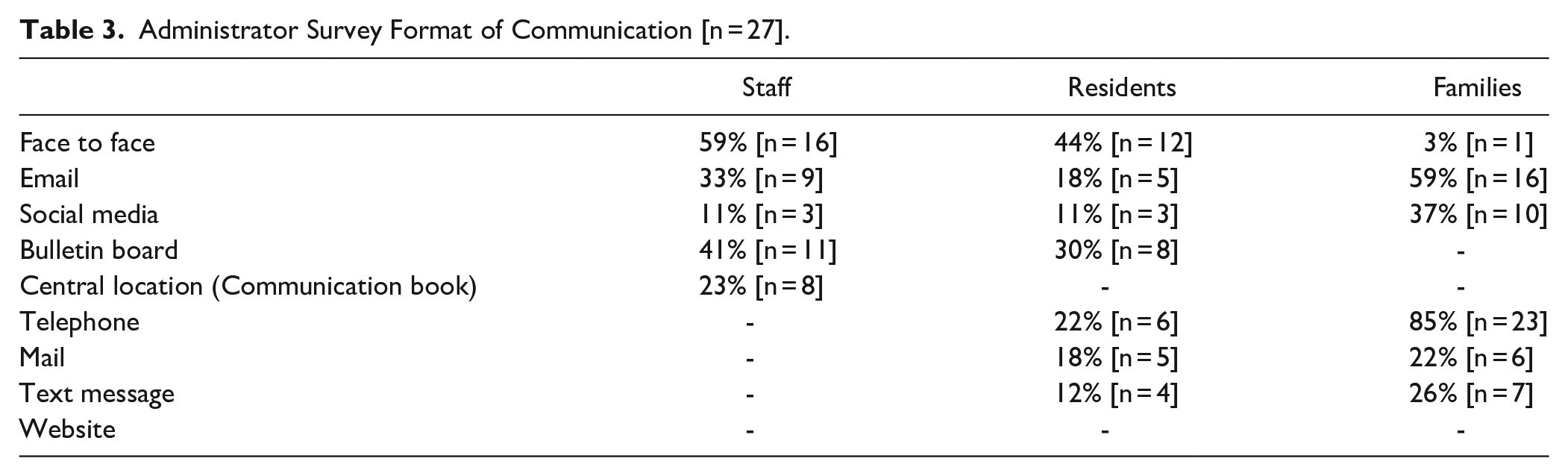
Administrators were asked to indicate successful and challenging communication strategies. An analysis of reported successful strategies indicated 1 dominant theme (n = 7): the importance of digital platforms such as email and Facebook which allowed for more effective communication. For example, 1 administrator noted, “Email communication and Facebook have been god sends.” Alternatively, the administrators identified 2 challenges to communication, first, too much COVID-19 information (n = 8) and the non-compliance of staff and families to the constantly changing information (n = 9). One participant wrote, “Hard to stay on top of the operationalization of directives and everyone’s understanding of them. Constant education is exhausting.” Regarding the non-compliance of staff and families to information about COVID-19 rules and regulations it was noted by 1 participant that, “Having to follow through with disciplinary actions with staff who do not consistently wear masks”. Another wrote, “I have had to evict residents who were not practicing social distancing and/or left the property without checking in with the supervisor on duty”
LTCF Staff Survey
When staff were asked how satisfied they were with the information provided by their employer (1 = unsatisfied; 5 = very satisfied), they indicated a high level of satisfaction (M = 4.5; SD = 1.48). The staff reported that most information was provided by email (53%) and was received daily (41%). When asked how satisfied (1 = unsatisfied; 5 = very satisfied) they were with the frequency of updates, staff indicated a high level of satisfaction (M = 4.8; SD = 1.6).
The LTCF staff were also asked about communication successes and challenges. An analysis of the responses indicated 3 dominant themes: the importance of digital platforms for communication (n = 17), too much information (n = 12) and poor quality information (n = 14). The use of digital platforms to communicate was identified as a key to successful communication. One staff member noted that, “Facebook allowed us opportunity to connect with loved ones, sharing that we were all alright and doing well despite the restrictions.” Another stated, “Our Facebook private group was a very reliable source to get the info to staff quickly. As reported in the Administrator survey, staff identified too much information as a challenge to successful communication. One staff member wrote, “The sheer volume of information to read was mind boggling. Our administrator dissected it all and highlighted changes. This information should have already been provided in a way we would KNOW the changes made from the last update.” Poor quality information was identified as the second challenge. For example, 1 staff member noted that, “the communication from my employer was spotty and often not with all details.”
LTCF Family Survey I
Overall, the findings from the Family Survey I showed an inconsistent delivery pattern of COVID-19 related information. 42% of participants reported information was provided with regularity and 19% reported they had never received any information. Slightly more than half, 55% of participants reported that they had received an email from the LTCF with information regarding COVID-19 and only 37% reported feeling the information was clearly explained.
Participants in Family Survey I were also asked about communication successes and challenges. An analysis of the responses about communication successes revealed 2 themes: the importance of LTCF staff (n = 10) and the use of digital platforms/technology (n = 6) for communication. The participants acknowledged LTCF staff as one important form of successful communication. It was noted that staff were key to navigating communication between families and residents. One respondent stated, “Everyone has the best interest of their residents. Staff are exceptional, they are working hard to keep residents from being too isolated.” In particular, the use of digital platforms/technology, such as tablets used to FaceTime with family members, was deemed a communication success. For example, 1 participant noted that, “I like having the option of the nursing home having a tablet/iPad so that I can Facetime with my dad.” Conversely, participants were asked to indicate challenges to communication. From the analysis of these responses, 2 themes emerged: lack of staff (n = 5) and poor quality information (n = 16). Regarding lack of staff, one participant stated, “the staff do not have time to answer the phone, if they are providing care to the residents that live there. Another said, “Communication is NOT their priority and it’s hard as a family member to ask them to make it a priority. We know they’re busy. We don’t want to pull them away from caring for the residents. We NEED someone dedicated and focused on ONLY communication.”
As also reported in the LTCF Staff survey, poor quality communication was a challenge. One participant stated, “Inconsistent information, staff members not really being informed leads to confusion among residents.”
LTCF Family Survey II
In Family Survey II, participants were asked to rate their level of satisfaction (1 = unsatisfied; 5 = very satisfied) regarding the information provided about the constantly changing visitation rules/regulations. The participants were satisfied with these updates (M = 3.86, SD = 1.14). Participants were asked to identify challenges to accessing information. From the analysis of the responses, 2 themes emerged: poor quality information and accessing information. Like the findings in Family Survey I, participants assessed information to be of poor quality. One participant stated, “The rules are not consistent” and another reported that “The nurses don’t seem to know what’s going on.” Accessing information was also identified as a challenge with 1 participant stating that, “The biggest challenge in getting accurate information is there has been no clear line as to whom I’m supposed to speak with.”
Family Recommendations
Family Survey I & II participants were asked for recommendations that could improve communication between families and LTCF. The responses to both surveys were consistent. There was a clear indication for the need of regular, clear, and consistent updates. One participant stated, “Regular updates and information sharing. Although I understand this can be time consuming. Other facilities provide updates without being prompted to do so.” Another participant stated, “Just be absolutely clear about what is being done and what the visitation policies are. Clear, honest, pertinent information is reassuring and helpful during these times.”
The recommendations from families consistently suggested that there should be better utilization of digital platforms to provide access to information and the use of platforms such as FaceTime to interact with family members. One participant stated, “Make public any situation that can be made, via social media, radio or other public means to get a message or announcement out right away.”
Discussion
The findings show an overall satisfaction with information communicated to staff and families of LTCF during the COVID-19 pandemic. There were, however, inconsistencies with the frequency and format in which it was delivered. From all 4 surveys, 3 consistent themes emerged: (1) poor quality communication—the need for a regular and consistent flow of quality information to families, residents, and staff; (2) there was too much information, and (3) digital platforms—digital platforms, such as email and social media were viewed as critical to communication. The findings regarding poor quality communication and too much information confirm those challenges identified in Canadian federal/provincial reports highlighted in Table 1.
Poor Quality Communication
Administrators indicated that the high volume of COVID-19 information resulted in a break down of the communication flow to residents, staff, and families. Table 3 shows that updates were not consistently provided. 19% of administrators updated residents daily, 15% provided COVID-19 updates to staff when they were received, and families were informed when there were updates (22%) or as needed (22%). Overall, there were no consistent patterns in the delivery of information by administrators to residents, staff, and families. Although participants in Family Survey I & II indicated high levels of satisfaction with information, they expressed concerns over the quality of information and the ability to access it.
The Quebec Ombudsman and the Ontario Patient Ombudsman identified that inconsistent and inadequate information was problematic for residents, staff, and families.16,20 These reports highlighted that poor quality information being communicated to residents, staff and families can result in feelings of distress, anxiety, isolation, and loneliness.20,21 Furthermore, consistent information provided in a timely fashion is essential to alleviating negative psychological outcomes for families.1,10
Too much Information
The results from the Administrator and staff surveys indicated that the sheer volume of information was overwhelming. Administrators indicated that managing high volumes of information was demanding. Staff indicated that it was a challenge to discern the necessary information. These results reflect the findings in several federal/provincial reports which indicated that Canadian LTCF were ill prepared to manage the high volume of COVID-19 information being transmitted.13,21,26 Fancey et al 22 noted that too much information was identified by LTCF operators as a barrier to effective communication. Furthermore, responses to Family Survey II indicated that inaccurate and inconsistent information about the constant changes to visitation guidelines and regulations were a challenge to understand.
Digital Platforms
Overall, responses to all surveys indicated the importance of digital platforms, in particular email and social media, as being essential to enhancing communication. The administrators identified email and Facebook as effective communication tools. Staff identified social media as a communication tool, that not only benefited them, but was also a way to connect families who were restricted from in person visitation. Families also noted the importance of digital technology/platforms in supporting communication during this time.
Conclusion
The purpose of this study was to assess the communication strategies used in the LTC sector during the First and Second waves of the COVID-19 pandemic outbreak in the Canadian province of New Brunswick. The findings from 4 surveys conducted during the First and Second waves of the pandemic, are unique in that they provide perspectives from administrators, staff and families into the effectiveness of the communication strategies used during that time. Overall, it was determined that digital platforms were used in a variety of ways by administrators, staff and families and found to be useful in supporting effective communication. However, administrators, staff and families did not report any consistencies in the frequency or format of information being exchanged. This could contribute to negative psychological impacts. Consistently, all participants identified that too much information and poor quality information were challenges to effective communication.
The findings of this study can inform policy in relation to communicating during a pandemic, but also for the everyday operations of LTCF. Three recommendations can be made based on the review of literature and the findings of the study.
Recommendation #1: Assess Fixed Assets Related to Computer Technology
The COVID-19 pandemic has escalated the use of digital platforms as a method of communication; therefore, it is important that the LTC sector be able to effectively communicate using this medium. Accordingly, it is essential that LTCF have hardware and high speed internet access to use this as a tool for communication.
Recommendation #2: Consistent Messaging
The sheer volume of information related to COVID-19 was overwhelming for the LTC sector to manage; particularly to staff, residents and families. Providing clear, consistent and accessible information or support to individual LTCF can be a solution to effective communication.
LTC services are delivered to communities ranging from urban to rural. Each of these locations have variances in language, age groups, internet access and levels of literacy. Developing education and assessment tools to assess communication needs will allow for the development of communication plans that will ensure the clear and consistent delivery of information to residents, staff and families. Education modules and assessments tools should be developed that will enable the LTC sector to implement effective communication plans, not only for pandemic planning, but for general use.
Recommendation #3: Develop Policies Related to the Right to Privacy, Particularly Around Social Media
The results of the surveys, for this study, indicated that social media was used as a platform to communicate COVID-19 information. Those developing communication plans and policies need to be aware of right to privacy legislations. Education modules and specific guidance on how to develop policies in this area will ensure this is done effectively.
Limitations
The pandemic dictated that delivery of surveys in an online format was the most effective method to collect data. The choice to recruit staff and families via social media must be considered when contemplating the applicability of the findings. Most notably, the low response rate from the LTCF administrators was understandably low, considering the significant demands of managing a pandemic.
Footnotes
Declaration of Conflicting Interests
The author declared no potential conflicts of interest with respect to the research, authorship, and/or publication of this article.
Funding
The author disclosed receipt of the following financial support for the research, authorship, and/or publication of this article: Funding for this study was provided by the New Brunswick Innovation Fund, Covid-19 Research Grant. #
Ethical approval
St. Thomas University, Research Ethics board, #2020-26
