




Abstract
Introduction:
Commonly, burnout in nurses has influenced their performance. The contribution of this study allows to broaden the knowledge of the performance-burnout relationship and identifies the work performance in nurses as a precursor of burnout.
Objective:
The study aimed to examine the factors of work performance of nursing staff that influence burnout.
Methods:
A descriptive cross-sectional design was used and a total of 340 nurses from the department of Puno in Peru participated. Demographic, job performance, and burnout data were collected.
Results:
Job performance factors, such as counterproductive behavior, positively influenced burnout, while task and context performance negatively influenced burnout. These variables explained 28.54% of the variance of burnout among nurses.
Conclusion:
Job performance factors have a significant impact on burnout. To reduce burnout, workforce resources that motivate, engage, and monitor nurse performance must be identified individually or organizationally. There is a need to develop training that promotes the improvement of emotional skills for better performance and the reduction of professional burnout.
Introduction
Burnout is a concern of health organizations because it affects physical and mental health and has repercussions on problems related to employability, work absenteeism, and the provision of safe, and better quality care.1,2 Burnout is a prolonged response to chronic work stress and is present in various occupations, with nurses being the group with the highest risk of developing it.3,4 In recent years, nurses have high levels of burnout, due to the characteristics of their work.5,6 Burnout has a harmful impact on nurses and is characterized by a loss of enthusiasm for work7,8 through feelings of emotional fatigue as a manifestation of the extreme workload or personal tensions at work that occur among nurses.9,10 Exposure to long periods of work due to lack of resources represents a harmful component and becomes a threat to the well-being of nurses and their practice environments.11-13 Nurses who experience burnout present greater negligent behavior, lower quality, and greater medication errors toward patients 14 and report greater intention to absenteeism from work. 15 Likewise, burnout is the result of the imbalance between work and family roles in nurses. 16 Previous studies also suggest that nurses with burnout are more likely to be dissatisfied with work.17,18
Performance refers to a behavior that supports a social environment based on behaviors that help the hospital function. 19 Performance depends on 3 basic psychological needs: authentic volitional behavior, the need to feel efficient, and to connect with co-workers. 20 Burnout has been negatively related to job performance in nursing staff in several studies.21-23 Shortage of nurses and workload in Peru can affect job performance. 24 High workload, long shifts, time pressure, high work, and psychological demands are associated with burnout in nursing. Therefore, the negative relationship of burnout in the job performance of nurses has been widely reported.21-23,25-28 Thus, the negative impact of burnout on nurses is manifested in poor performance and professional failure. 29 Meanwhile, poor work performance tends to be a negative antecedent of burnout. 30 While labor resources are factors: (1) internal, such as skills, personal characteristics, and effort; or (2) external, such as work conditions or challenges, help employees deal with various threatening or negative conditions and enable goal achievement and personal development. Since, according to the resource conservation theory, employees try to obtain and conserve economic resources, job security, and empowerment.31-33 When personnel resources are unable to meet labor demands due to internal or external factors, burnout occurs. 34 Consequently, depersonalization or lack of accomplishment of the nurses indicates greater exhaustion. 35 Likewise, organizations that have ways in which they provide rewards, such as financial incentives to employees during difficult times, positively affect performance. 36
Motivating health workers allows for greater communication and organizational feedback that affects real and perceived capacity, which, in turn, stimulates worker adoption of organizational goals. 37 Consequently, burnout is likely to be reduced due to emotional rewards (eg, recognition, increased opportunities, and empowerment) and material rewards (eg, incentives, promotion, certificates, and special licenses) that enable higher performance. 38 High-performing nurses cope with high-stress situations, make better decisions, improve well-being, develop skills, and reduce pressure for better quality care. 39 Nurses whose coping strategies are effective for problem-focused and emotion-focused coping have developed coping-enhancement skills.
To our knowledge, few studies have addressed the relationship between job performance in nurses and professional burnout, 30 and do not provide information on which sources of job performance, such as task performance, counterproductive behaviors, and performance in context, are affected by burnout. The proposal of Hobfall’s, 40 was followed, which indicates that the conservation of resources refers to individual efforts to obtain resources such as opportunities, empowerment, fair burden, demands, etc., since their lack causes burnout. 41 The identification of the factors that influence burnout makes it possible to contribute to a better understanding of work performance and burnout in nurses and of nurses’ discomfort.
Since employees who are most concerned about their work and career advancement seek the means to manage stressors and negative effects. Employees strive for higher performance and secure their job and promotion. Therefore, this study aimed to examine job performance factors that influence burnout.
Materials and Methods
Study Design
This study employed a descriptive, cross-sectional design to identify the influence of job performance on burnout.
Participants, Sample, and Sample Size Calculation
The study participants were care nurses, that is, nurses who care for patients in the different hospital services located in the Puno region of Peru: (a) registered care nurses in occupational groups such as contracted, employed, temporary (fixed term) or by third parties; (b) nurses under contract for a minimum of 3 to 6 months. Some exclusion criteria were considered, such as: (a) part-time nurses; and (b) nurses, such as chief nursing officers or managers not directly involved in patient care. The sample size was calculated using the program G* Power 3.1.9.7. 42 The number of explanatory variables in the multiple linear regression is 6; for an effect size of 0.10, a statistical power of (1 − ß) 0.95, and a significance level (α) of .05 for a multiple regression analysis, the minimum sample size required was 215. Possible dropouts were taken into account, the surveys were sent through a Google form and were shared through social networks such as WhatsApp, following the Internet-based methodology. 43
Procedure
We contacted the heads of the nursing departments of each hospital in the Puno region of Peru to explain the purpose of the study and obtained the corresponding permission. The questionnaires were sent to the nursing departments, from where they were distributed to the staff via WhatsApp application, following the Internet-based methodology. 43 Data were collected during February to March 2022. Participants were informed about the purpose, process, and results to be used in this research, all questionnaires would be anonymous and confidential, and could be withdrawn at any time. The study protocol was reviewed by a Peruvian university with code 2022-CEUPeU-009 and following the principles established in the Declaration of Helsinki.
Instruments
Demographic questionnaire
The demographic characteristics were gender, age, and employment status as hired, which have a start date, but not an end date; appointment is the incorporation of a nurse to the service of state entities; fixed-term contract that considers a contract for a specific time and third party that perform a service in favor of a third party.
Job performance
The IWPQ is a 13-item self-report instrument used to assess individual work performance on the task, in context and counterproductive behaviors. 44 Each item is scored on a Likert scale ranging from 1 (never) to 5 (always). In the original study, adequate internal consistency values of α = .76 for task performance, α = .76 for counterproductive behaviors, and α = .72 for performance in context were reported. In this research, reliability using Cronbach’s Alpha was >.80 for task performance (α = .87), counterproductive behaviors (α = .86) and context performance (α = .84).
Burnout
The Burnout Unique Item (IUB) was used to measure burnout. 45 It is a 1-item self-report instrument with 5 descriptive categories that are ordered according to the magnitude of the experience associated with burnout. The scoring is done by obtaining the median scores, and a 1 is assigned to the minimum intensity and a 5 to the maximum intensity.
Statistical Analysis
Descriptive statistics were used to summarize the characteristics of the participants. To identify differences between job performance factors: task performance, counterproductive behaviors, contextual performance, and burnout according to demographic variables, analysis of variance or t-test was used. Pearson’s correlation coefficient was used to examine the relationships between job performance factors and burnout. A multiple linear regression analysis was performed to identify the explanatory power and work performance factors that affect burnout in nurses, entering the work performance factors, after adjusting for the demographic characteristics of the participants. Categorical variables such as job performance and age were entered as dummy coding. The data were analyzed using the free software R 4.1.1.
Results
On-task Performance, Counterproductive Behaviors, and Performance in Context According to Sociodemographic Characteristics
The mean age (±SD) of the care nurses was 40.49 (±10.21) years, and the majority were women (71.8%) and aged between 41 and 64 years (44.4%) and 63.5% of the nurses had a contract labor condition. Table 1 shows that the variables performance with the tasks (F = 0.016, P > .05), counterproductive behaviors (F = 0.627, P > .05), performance in the context (F = 0.045, P > .05) and burnout (F = 2.632, P > .05) do not present significant differences between the age groups. Similarly, no differences were found between men and women in all the variables analyzed (P > .05). Significant differences were also found in the variable performance with the task (P < .05) and in the context (P < .05) between the groups of nurses according to their employment status, except in the behavior variables (P > .05) counterproductive and burnout (P > .05).
On-task Performance, Counterproductive Behaviors, and Performance in Context According to Sociodemographic Characteristics (N = 340).

Mean Scores of Job Performance Factors and Burnout and the Correlation Between Variables
In Table 2, the descriptive analysis shows that the variables burnout and counterproductive behavior present adequate variability, except for the variables performance in the task and performance with the context.
Correlation Coefficient, Mean Scores and Standard Deviation.

Abbreviations: Burn, burnout; TaPer, task performance; CoBe, counterproductive behaviors; PeCo, performance in the context; M, mean; SD, standard deviation.
P < .01.
Correlation analysis (Table 2) showed that burnout is positively correlated with self-defeating behavior (r = .28, P < .01) and negatively correlated with task performance (r = −.43, P < .01) and performance in context (r = −.45, P < .01). Likewise, performance on the task had a positive correlation with performance in the context (r = .73, P < .01) and a negative correlation with counterproductive behavior (r = −.25, P < .01), while the self-destructive behavior was negatively correlated with performance with context (−0.30, P < .01).
Influence Between Work Performance Factors on Burnout
Multiple linear regression analysis showed that counterproductive behavior (β = .032, P < .05) and age from 20 to 30 years (β = .218, P < .05) had a positive influence on burnout; and task performance (β = −.049, P < .01), context performance (β = −.078, P < .001), fixed-term work (β = .416, P < .01) had a negative influence with burnout. This model explained 28.54% of the variability of burnout in the participating nurses (Table 3).
Multiple Linear Regression Predicting Job Performance Affecting Burnout.
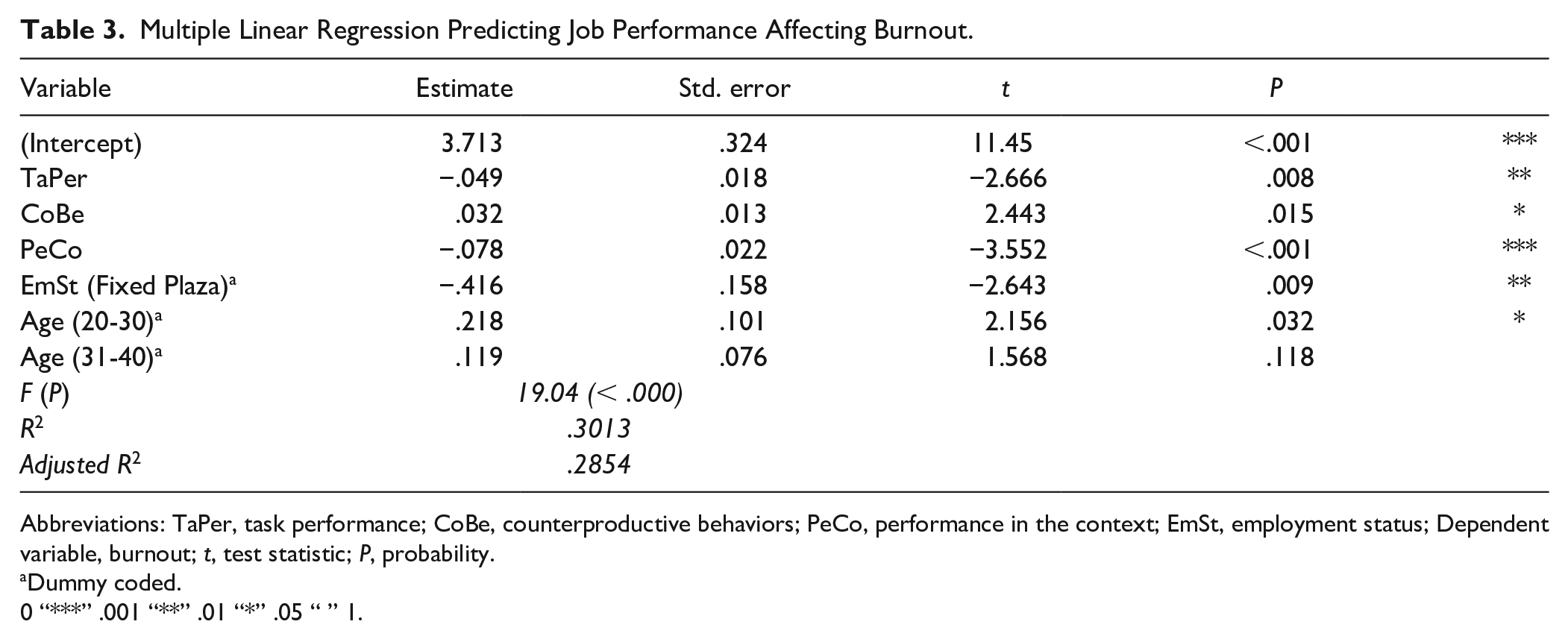
Abbreviations: TaPer, task performance; CoBe, counterproductive behaviors; PeCo, performance in the context; EmSt, employment status; Dependent variable, burnout; t, test statistic; P, probability.
Dummy coded.
“***” .001 “**” .01 “*” .05 “ ” 1.
Discussion
Burnout has been widely associated with reduced results in job performance,21-23,25,46 given this, various resources have been proposed that allow burnout to be minimized. This study approached this topic from the resource conservation theory, in which the influence of job performance on burnout was further examined.30,40 In particular, this study showed that all factors of nurses’ job performance significantly influenced burnout.
Notably, task performance, context performance, and burnout differed significantly from work status. Previous findings indicate that the type of contract and the length of stay in the work area differ in important aspects. Professionals perform the same work within the institution, but are excluded from various benefits and compensation of the company, despite the fact that the treatment of various groups of employees is the same.47,48 Similarly, work status contributes to higher job performance, due to experience and remunerative status, as well as may include higher burnout due to relatively longer working hours.47,49
Because this study provided a more complete understanding of the 3 subfactors of job performance. Multiple regression analysis found that counterproductive behavior had a positive impact on burnout. This finding indicates that counterproductive behavior expressing employees’ inefficiency in handling tasks or duties may be the result of individual deficiencies, lack of certain skills, or knowledge. These counterproductive actions positively impact burnout, causing self-destructive behaviors, irrational beliefs and non-constructive thinking pattern errors that become detrimental to organizational health.50,51 In addition, nurses who exhibit deviant behavioral problems with their peers, in the face of demanding situations with patients develop retaliatory behavior where they have shown frustration or hostility as examples of workplace sabotage and lead to increased burnout. 52 The organization’s identification of these behaviors will allow for better management of emotional encounters and employees will show less burnout.
Likewise, the results show that task performance has a negative influence on burnout, that is, a high level of individual work indicates that the staff performs their task competently, therefore, the causal link of high task performance has a higher probability of not developing burnout. 53 This is because a set of interrelated cognitive mechanisms allow people to regulate their motor, attentional, and representational processes in a volitional way, adaptively coping with complex, novel or changing tasks. 54 Meanwhile, depersonalization, professional inefficiency, the feeling of not adequately fulfilling tasks, and being incompetent at work cause serious professional problems, since the negative behavioral, emotional, social, and organizational consequences reveal a lower performance in employees’ tasks and an increase in burnout. 55 Therefore, the depletion of cognitive abilities and reduced competencies of nurses propose a chronic deterioration. Moreover, the lack of task performance is the result of a lack of career advancement and negative self-evaluation.56,57 Identifying high performance in nurses is important for a high level of personal performance of patients. Additionally, involving nurses inappropriately in the performance of tasks leads to burnout.
In addition, the findings indicate that performance in this context had a negative impact on burnout. Performance in context is a valuable resource, as personal skills, cohesion, group collaboration, self-fulfillment or self-confidence are an effective way to reduce burnout.58,59 This is because employees may often choose to perform activities that are not prescribed in their role profile, demonstrating contextual performance by feeling engaged in work. 60 Strategies that include support in work tasks and interpersonal support, which allow the development of appropriate behaviors in social environments, will help the hospital to function properly. 61 Empowering staff through praise, recognition to establish a shared vision and goals in the organization’s employees will allow them to suffer less burnout.
The results have a practical meaning for nursing professionals in organizations, because better management of labor resources can motivate employees and reduce burnout. The increase in an individual’s overall strengths, skills, and group collaboration contrasts with burnout. In this sense, this study enriches the theory of resource conservation by considering task performance and context as resources that reduce burnout by extending their application in the organizational environment. Organizations can also introduce practices that help employees identify positive tools to reduce unreasonable work demands such as excessive workloads, lack of support, etc., as well as seek and create opportunities. Because performance contributes to greater employee engagement, personalized interventions to assist efforts to achieve personal and organizational goals and accomplishments should be made to reduce burnout caused by the work environment. Furthermore, organizations through psychologists or supervisors could identify job stressors or counterproductive behavior and provide individual support that allows for positive encouragement by making the workload manageable, providing timely feedback, celebrating their successes and rewards, and empowering them by strengthening their weaknesses. Managers in organizations can monitor the identification of the most suitable candidates through positive performance appraisal, considering the negative effect this has on burnout. Selections of candidates with positive outlooks would have consequences for organizations, as employees who develop burnout may reduce productivity. Management policies should also be developed for various working conditions. In response to this, organizations could provide training to help improve skills that enhance job performance and employees can be counseled and trained for better competence and minimize negative consequences.
Limitations
This is a cross-sectional data set, which limits the scope of causal relationships. However, based on the literature review and grounded theories, they were substantially supported. Therefore, it is recommended that longitudinal studies be conducted in the future. There may be other factors that affect burnout in nurses, however, this study could not include all confounding variables. The research had greater participation of women, which provides difficulty in generalizing the results to both groups. On the other hand, the research provides data from a specific region of Peru, and other regions or samples were not considered; therefore, generalizations to other countries should be made with caution.
Conclusion
Among the task performance factors, counterproductive behaviors and contextual performance were associated with burnout in Peruvian nurses. These variables explained 28.54% of the variance in nurses’ burnout. Our findings follow that each of the job performance factors affected nurses’ burnout. Above all, the study findings highlight that nurses’ job resources promote job performance and reduce burnout.
Footnotes
Declaration of Conflicting Interests
The author(s) declared no potential conflicts of interest with respect to the research, authorship, and/or publication of this article.
Funding
The author(s) received no financial support for the research, authorship, and/or publication of this article.
