




Abstract
Keywords
Introduction
A considerable proportion of the Western population is worried about health risks of electromagnetic fields (EMFs). For example, 27% of a representative German study population expressed concern about EMF, and in an Austrian study, 70% of a representative sample believed that EMF can, at least to some extent, cause health complaints.1,2 Furthermore, figures ranging from 1.5% to 9.5% have been reported to estimate the proportion of subjects who attribute own health complaints to EMF.1-4 As many of these subjects ask physicians for help, general practitioners (GPs) play a key role in consulting people who believe that health complaints could be due to EMF. Therefore, it is important to know how doctors perceive the risks of EMF. In several studies from Western European countries it was shown that a remarkable proportion of GPs consider everyday exposures to EMF as possible health risks. In Switzerland, this proportion was 61.4% 5 ; in Germany, the corresponding figures ranged from 29.0% to 57.5% depending on the methods used 6 ; in Austria, up to 96% of GPs believed that “electromagnetic pollution can cause health problems together with other environmental factors.” 7 In a recently published French study, 79% of GPs believed that living near an electric power line, living near a mobile phone base station, or using mobile phones increase the risk of developing a disease. 8 Actual knowledge about health risks from exposure to EMF is not yet conclusive. On one hand, there is little evidence that EMF emitted by mobile phones and mobile phone base stations cause nonspecific health symptoms.9,10 On the other hand, the International Agency for Research on Cancer (IARC) stated that there is limited evidence for the carcinogenicity of radiofrequency radiation in humans and classified radiofrequency EMF as “possibly carcinogenic to humans.” 11
General practitioners cannot be considered as a homogenous group. In 2 studies, GPs using complementary and alternative medicine (CAM-GPs) were shown to be more inclined to consider EMF as a health risk than GPs using conventional medicine (COM-GPs). In Switzerland, 95% of CAM-GPs, but only 55% of COM-GPs believed that EMF could cause health symptoms. 5 In France, GPs applying homeopathy regarded EMF devices as more risky than GPs not engaged in homeopathy. 8
The aim of the present study is to investigate in detail how German CAM-GPs differ from COM-GPs with regard to the way they perceive EMF health risks. Furthermore, we investigate whether the kind of alternative medicine (homeopathy, acupuncture, naturopathic medicine) has an influence on the results. As there is a wide range of EMF sources, we confined our analyses to radio/TV, electric devices, power lines, mobile phone base stations, mobile phones, and cordless phones.
Methods
Sample
The sampling procedure was described earlier in detail. 6 In brief: Lists of GPs published by the 17 Regional Associations of Statutory Health Insurance Physicians include the names and addresses of almost all German GPs. From each of these 17 lists, 7% random samples were drawn in March to May 2008, leading to a total of 2795 GPs. Two thirds of the selected GPs (n = 1867) received a long self-administered postal questionnaire of 4 pages, and one third (n = 928) received a short questionnaire. The short questionnaire was used to have a larger response rate for some crucial items. Physicians who had not responded were sent the questionnaires again after 4 weeks.
Questionnaires
Beside some questions on personal data (age, sex, site of doctor’s practice, education in complementary and alternative medicine), the items of the long questionnaire covered 4 topics:
Knowledge about EMF: For a list of 7 statements on EMF, GPs were asked to decide whether the statements were correct or not. Moreover, GPs were asked to assess their general knowledge about EMF on a 6-grade rating scale.
Perception of health risks: This included 13 items on how strongly GPs were concerned about various health and behavioral risks, and 4 items on whether GPs attributed health problems to EMF.
Trust in organizations: GPs were asked to what degree they had confidence in organizations like the Federal Office for Radiation Protection, the World Health Organization (WHO), citizens’ initiatives, etc.
Experience with EMF-related consultations: This included items on the frequency of EMF consultations, as well as questions about the last EMF consultation (kind of health problems told by the patient; recommendations given to the patients, etc).
The short questionnaire included some selected questions from the long questionnaire: Beside sociodemographic questions, participants were asked whether EMF could cause harm under everyday conditions, how often they were involved in EMF consultations, and how trustworthy organizations like the WHO and the Federal Office for Radiation Protection were in their view.
Statistical Analyses
Characteristics of GPs with and without an education in complementary medicine were compared using t tests for continuous variables and χ2 tests for proportions.
Using logistic regression models, odds ratios (ORs) were calculated to assess whether CAM-GPs differed from COM-GPs with regard to several dependent variables:
Assessment of 2 statements on health effects of EMF (“agree,” “not agree”)
Concern about each of 13 different health and behavior risks (“strongly”/“rather” worried vs “hardly”/“not” worried)
Attribution of health complaints to EMF
Trust in organizations (little/medium trust vs strong trust)
Having ever had at least 1 EMF consultation
For GPs who ever had at least 1 EMF consultation: In the last EMF consultation, the assumption that the health problems of the patients could be due to EMF was made either by the GP alone or by the GP and the patient together (but not by the patient alone)
For each outcome, 2 different models were fitted: One with adjustment for age, sex, and geographical region, and one with additional adjustment for potential mediators. These mediators were trust in the WHO, general concern about environmental and health risks, attribution of health complaints to EMF, and dramatizing the effects of EMF on health (except one of these variables was the dependent variable). General concern about environmental and health risks was calculated by adding up the ratings for the various environmental and health risks except for EMF sources, and by building three categories of high, medium and low general concern according to the tertiles of the sum of the ratings. The assessment on the statement “Mobile phone use can lead to head warming of more than 1°C” was used as an indicator whether GPs dramatized the health effects of EMF.
Some of the previous analyses were repeated by stratifying for the type of complementary medicine. GPs who practiced acupuncture (regardless of whether they used any other type of complementary and alternative medicine) were compared with GPs without any certificate in complementary medicine. The same was done for GPs who practiced naturopathic treatment, or homeopathy, respectively.
Statistical analyses were carried out with SAS 9.2. The level of significance was set at 5%.
Results
Response rates were 49.0% for the short and 23.3% for the long questionnaire. A total of 435 GPs responded to the long questionnaire, and 183 GPs (42.1 %) reported using complementary and alternative medicine. As shown in Table 1, CAM-GPs were younger, and more often female. Moreover, for CAM-GPs, the site of doctor’s practice was more often urban or suburban than rural. 456 participants responded to the short questionnaire, and characteristics of participants are shown in Table 2. Differences in sex and site of doctor’s practice were less pronounced in respondents to the short questionnaire than in respondents to the long questionnaire.
Characteristics of General Practitioners (GPs) by Education in Alternative Medicine: Long Questionnaire.

Five participants did not report whether they had an education in alternative medicine.
t test.
Chi-square test.
Characteristics of General Practitioners (GPs) by Education in Alternative Medicine: Short Questionnaire.

One participant did not report whether he had an education in alternative medicine.
t test.
Chi-square test.
CAM-GPs were more inclined to dramatize the effects of EMF risks than COM-GPs (Table 3). Thus, GPs applying complementary medicine more often falsely believed that mobile phone use can lead to head warming of more than 1°C (OR = 2.2, 95% confidence interval [CI] = 1.5-3.3), and CAM-GPs were more likely to disagree that the average EMF exposure of the whole population was far below average (OR = 2.1, 95% CI = 0.9-5.1).
Associations Between Education in Alternative Medicine and Assessment of Health Effects of Electromagnetic Fields: Results From Logistic Regression Analyses.
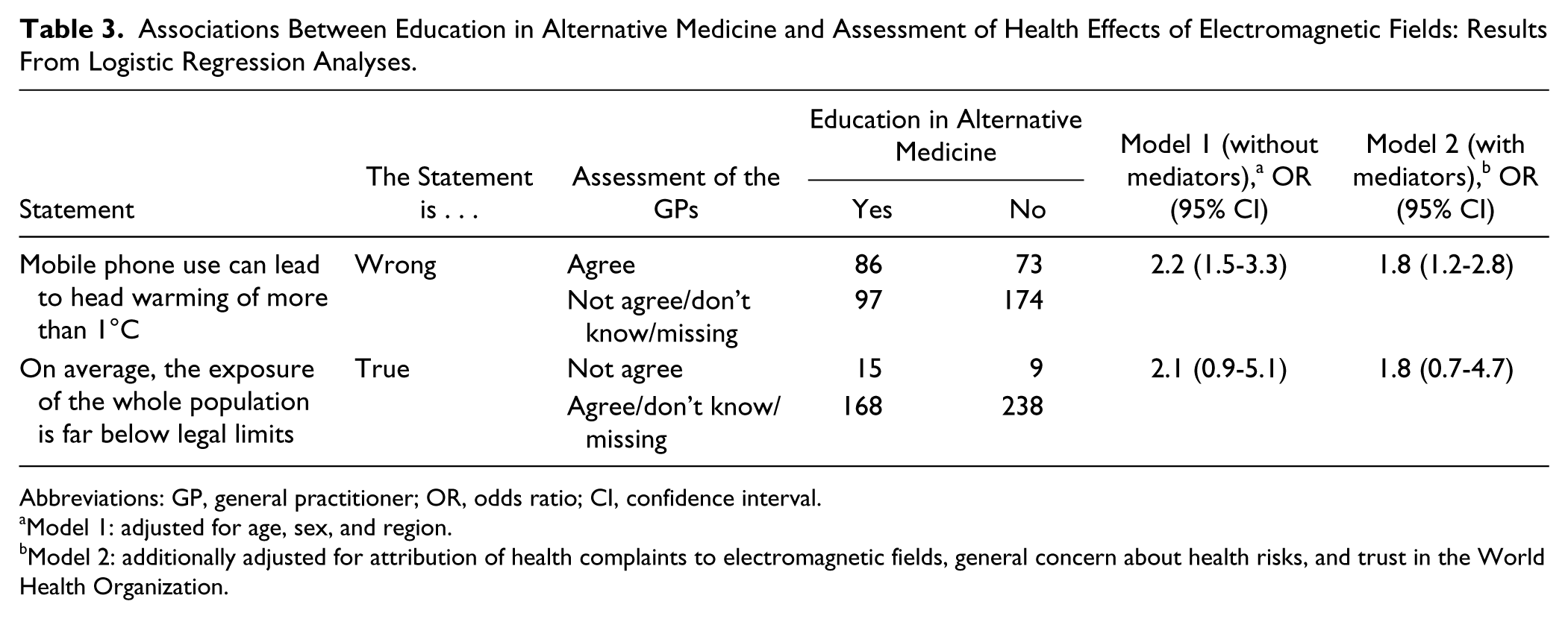
Abbreviations: GP, general practitioner; OR, odds ratio; CI, confidence interval.
Model 1: adjusted for age, sex, and region.
Model 2: additionally adjusted for attribution of health complaints to electromagnetic fields, general concern about health risks, and trust in the World Health Organization.
CAM-GPS are not more worried about risks like smoking, excessive alcohol consumption, and air pollution than COM-GPs (Table 4). However, CAM-GPs are significantly more concerned about EMF sources like electric power lines, mobile phone base stations, transmitters for radio and TV and mobile phone use. Moreover, CAM-GPs were more concerned about risks from road traffic. CAM-GPs more often attributed health complaints to EMF, and this effect was particularly strong with regard to own health complaints (OR = 3.2, 95% CI = 1.8-5.6; Table 4).
Associations Between Education in Alternative Medicine and Various Aspects of Perceiving and Dealing With EMF Risks: Results From Logistic Regression Analyses.

Abbreviations: EMF, electromagnetic field; GP, general practitioner; OR, odds ratio; CI, confidence interval.
Model 1: adjusted for age, sex, and region.
Model 2: additionally adjusted for dramatizing effects of EMF, attribution of health complaints to EMF, general concern about health risks, and trust in the World Health Organization (except one of these variables is the dependent variable).
Furthermore, CAM-GPs were more likely to have ever had at least 1 EMF consultation (OR = 2.5, 95% CI = 1.6-3.9; Table 4). CAM-GPs were more likely to have only little or medium trust in the Federal Office for Radiation Protection (OR = 2.2, 95% CI = 1.4-3.6), but less likely to have little or medium trust in citizens’ initiatives (OR = 0.4, 95% CI = 0.3-0.6).
In Tables 3 and 4, most associations between an education in complementary and alternative medicine and the various outcomes were attenuated when potential mediators were included into the regression models. However, the mediators added to the models explained only a part of the effects seen in the models with adjustment for age, sex, and region.
General practitioners applying homeopathy had a stronger tendency to attribute health complaints to EMF, to address EMF in consultations, and to be concerned about EMF sources than GPs applying acupuncture or naturopathic treatment (Table 5). To give an example, GPs applying homeopathy were more likely to believe that EMF can cause health complaints under everyday conditions than COM-GPs (OR = 6.7, 95% CI = 1.9-23.1). This association was less strong when GPs applying acupuncture or naturopathic treatment, respectively, were compared with COM-GPs (OR = 1.9, 95% CI = 1.01-3.5, and OR = 2.7, 95% CI = 1.4-5.0, respectively).
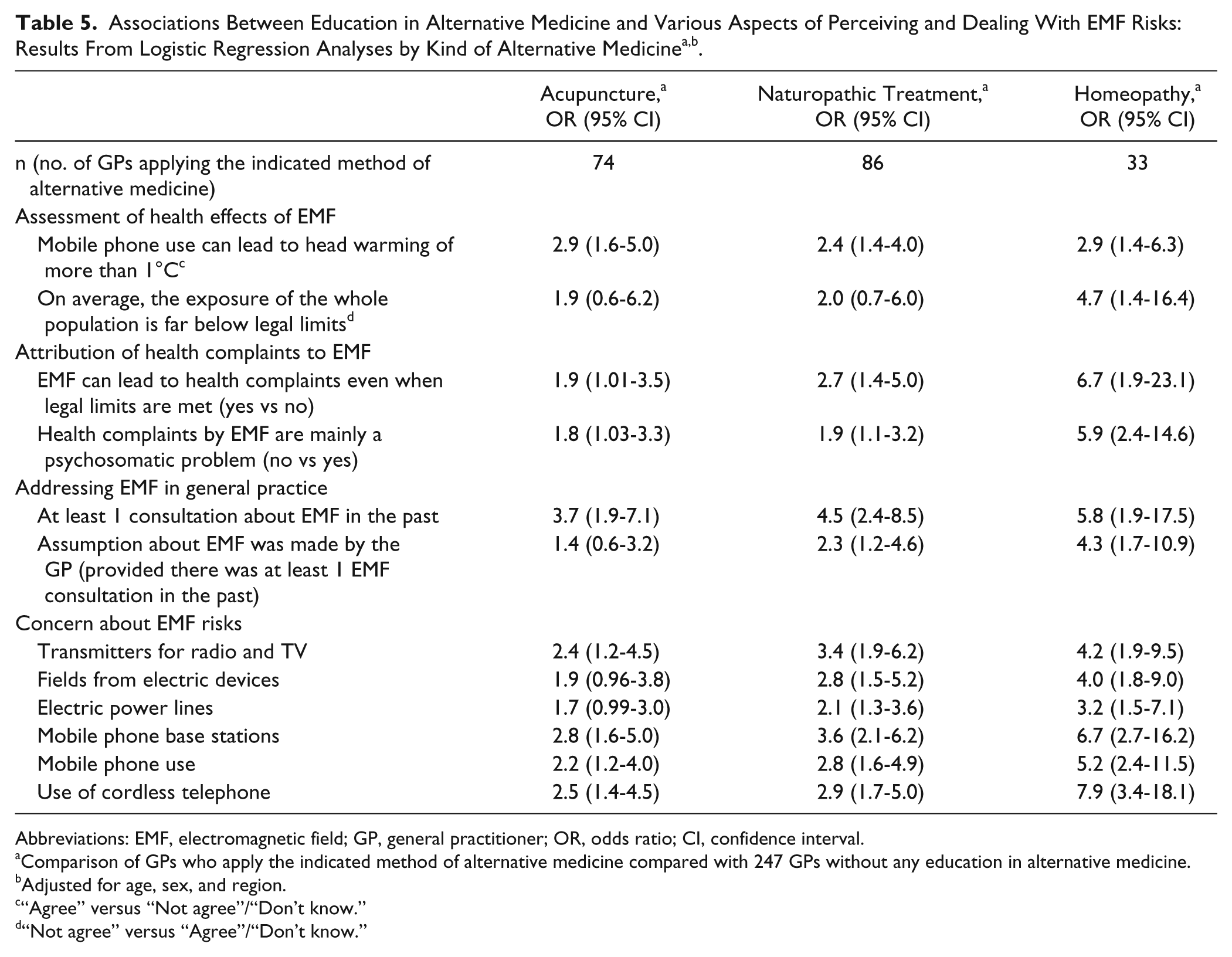
Abbreviations: EMF, electromagnetic field; GP, general practitioner; OR, odds ratio; CI, confidence interval.
Comparison of GPs who apply the indicated method of alternative medicine compared with 247 GPs without any education in alternative medicine.
Adjusted for age, sex, and region.
“Agree” versus “Not agree”/“Don’t know.”
“Not agree” versus “Agree”/“Don’t know.”
Using data of the short questionnaire, the following results were obtained from logistic regression models adjusted for age, sex, and region: CAM-GPs more often stated that EMF can lead to health complaints when legal limits are met (OR = 2.4, 95% CI = 1.6-3.6), they reported more EMF consultations (OR = 1.8, 95% CI = 1.2-2.7), and they stated more often to have little or medium trust in the WHO and the Federal Office for Radiation Protection (OR = 1.8, 95% CI = 1.2-2.7 and OR = 1.7, 95% CI = 1.1-2.5, respectively).
Discussion and Conclusion
This study showed that CAM-GPs perceive EMF as more risky than COM-GPs. Furthermore, there was an indication that perception of EMF risks differs within the group of CAM-GPs: GPs using homeopathy perceive exposure to EMF as more risky than GPs using acupuncture or naturopathic treatment, and they address EMF issues more often in routine practice.
Assessment of Health Effects of EMF
CAM-GPs more often believed that daily life exposure to EMF has dramatic consequences. The statement that using mobile phones can lead to head warming of more than 1°C is not correct, and it overdramatizes the consequences of exposure to EMF. Alternative medicine doctors more often agreed to this statement than traditional medicine doctors. The statement that average exposure of the whole population to EMF is far below legal limits is correct, and denying it means a dramatic view of EMF risks. In our survey, alternative medicine doctors more often denied it than did traditional medicine doctors.
Concern About EMF Risks and Attribution of Health Problems to EMF
It depended on the kind of risk whether CAM-GPs were more worried about health and behavior risks. With respect to established risks like smoking, excessive alcohol consumption, air pollution, and consumption of meat of unknown origin, no differences were seen between GPs with and without an education in complementary and alternative medicine. However, CAM-GPs were significantly more concerned about EMF risks than COM-GPs. In earlier studies, it was shown that GPs applying alternative medicine are more likely to attribute health symptoms to EMF,5,8 and in the present study, this was confirmed. In this study, CAM-GPs were particularly strongly inclined to associate own health complaints with EMF.
Generally, concern about modern health risks, attribution of health complaints to modern health risks, and belief in the efficacy of alternative medicine have been suggested to form a pattern of cognitions in patients. Thus, it was shown that subjects who were strongly worried about modern health problems had a stronger tendency to attribute symptoms to pesticide spray. 12 Moreover, patients who think that alternative medicine is effective were shown to be more worried about modern health risks. 13 Our findings that GPs applying alternative medicine are more concerned about EMF and more often attribute health problems to EMF exposure, could be a hint that the pattern of cognitions that was found in patients exists in GPs as well.
Trust in Scientific and Health Organizations
Patients using alternative medicine were shown to be more skeptical about traditional medicine, 14 and one might assume that GPs applying alternative medicine have more skeptical attitudes toward science. Our results are in line with this assumption: CAM-GPs show less trust in the Federal Office for Radiation Protection and in the WHO than GPs without CAM education. Citizens’ initiatives are often more skeptical about the mainstream of scientific risk assessment, and, accordingly, CAM-GPs have more trust in these initiatives than COM-GPs. The 2 types of GPs do not differ in trust in non-scientific organizations, as can be seen from the example of the Chamber of Physicians.
Addressing EMF in General Practice
Our study confirmed earlier findings that CAM-GPs have more EMF consultations. 5 This could have two reasons. Patients who attribute health problems to EMF might expect to find more support by GPs applying alternative medicine, and, as shown also by our results, CAM-GPs more often suggest that the patients’ symptoms are caused by EMF.
Kinds of Alternative Medicine
Dramatizing effects of EMF, attribution of health complaints to EMF, concern about EMF, and addressing EMF in routine practice, were stronger in GPs applying homeopathy than in GPs applying acupuncture or naturopathic treatment. This might be explained by the idea that the distance to traditional medicine is not the same for all kinds of alternative medicine, and it might be largest for homeopathy.
Risks perception of doctors may have serious consequences. As shown by earlier results from this study, in almost 1 in 2 EMF-related consultations doctors had suggested protection measures or therapies, most often removal of electric devices, but also change of sleeping-places and moving into another apartment. 15 In the 2 studies from Austria and Switzerland, a similar spectrum of recommended measures had been reported.5,7 Recommending far-reaching protection measures should be evidence based and, therefore, it is essential that GPs have an appropriate view of the risks of EMF. However, in our study, for example, 37% of all participants falsely believed that mobile phones lead to head warming of more than 1°C, and 43% were concerned about mobile phone base stations—which contrasts with results from a review by the WHO showing that there is hardly any evidence that mobile phone base stations cause health complaints. 16 These results strongly indicate that there is a need for further education of GPs regarding health risks of EMF. In CAM doctors, changing attitudes toward risks of EMF may not be easy. As mentioned above, belief in the efficacy of alternative medicine is correlated with further cognitions like skepticism about science and worry about modern health risks. In a study on Italian GPs, doctors practicing alternative medicine were shown to differ in lifestyle and, for example, vegetarian or macrobiotic diet was associated with recommending or using alternative medicine. 17 Obviously, applying alternative medicine is embedded in a larger pattern of behaviors and world views. From this, it cannot be taken for granted that better information on scientific results might bring CAM-GPs easily to have a less dramatic view on possible health effects of EMF and to be less concerned about risks of daily used EMF devices.
Limitations and Strengths
This study has some limitations. First, the response rate from the long questionnaire was only 23%, and, thus, quite poor, which is, however, not unusual for surveys among GPs, especially when a quite long questionnaire is used. In the short questionnaire, the response rate was 49% and, thus, considerably higher. With both questionnaires, it could be demonstrated that alternative medicine doctors see EMF as more risky than do doctors practicing conventional medicine. Therefore, bias from low response in the short questionnaire might not be too strong. Second, knowledge about health effects of EMF was not assessed by using open questions but by presenting statements about EMF to doctors and asking them to tell whether these statements were right or wrong. Open questions would give a more valid idea of the knowledge, but we were afraid that open questions would evoke a test situation for the participants and prevent them from filling in the questionnaire. The strength of our study is that we not only confirmed earlier results on how GPs with and without education in alternative medicine perceive EMF risks and how they address EMF issues in their practice. We rather gave a more detailed view of how GPs perceive EMF including knowledge about health effects of EMF, concern about various risks including EMF, and trust in organizations. Moreover, this is the first study to investigate whether the kind of alternative medicine has an influence on perception of EMF risks.
Conclusion
This study confirmed that GPs using alternative medicine more often attribute health complaints to EMF and have more EMF consultations. We extended these results by showing that GPs applying alternative medicine are more inclined to dramatize health effects of EMF, are more concerned about everyday exposure to EMF, and have less trust in scientific organizations which publish recommendations about EMF. Furthermore, we found that these effects depend on the kind of alternative medicine and are strongest in GPs applying homeopathy. The perception of EMF risks by GPs—in particular by GPs using alternative medicine—may result in EMF consultations which are not justified by the current state of knowledge. Therefore, information should be provided for patients and all doctors that according to current knowledge, EMF does not cause health complaints under everyday conditions.
Footnotes
Authors’ Note
The study sponsor had no involvement in study design; in the collection, analysis, and interpretation of data; in the writing of the report; and in the decision to submit the article for publication.
Declaration of Conflicting Interests
The author(s) declared no potential conflicts of interest with respect to the research, authorship, and/or publication of this article.
Funding
The author(s) disclosed receipt of the following financial support for the research, authorship, and/or publication of this article: The study received funding entirely from the German Federal Ministry for the Environment, Nuclear Safety, and Nature Protection (Project number: St.Sch. 4545).