




Abstract
Keywords
Introduction
Enrollment in online university programs is on the rise. 1 However, online university students have not been extensively studied. One recent study 2 tested the importance of behavioral risk factors for self-rated health (SRH) among online university students and found cigarette smoking was associated with lower odds of good SRH.
The Centers for Disease Control and Prevention (CDC) promotes the health and quality of life of US residents and has supported population surveillance of health-related quality of life (HRQOL) since 1993. 3 HRQOL is measured by an integrated set of questions regarding perceived health status and activity limitations. 3 The HRQOL data are useful in the identification of disparities amongst demographic and socioeconomic subpopulations, characterizing the symptom burden of disabilities and chronic disease, and tracking population patterns and trends. 3
The wide array of research studies in the literature shows the versatility of the HRQOL measures.4-9 The HRQOL measures are useful in detecting the impact of major population-based policies or interventions. 10 Currey et al 11 discussed how HRQOL is arguably the best indicator of the impact of disease on an individual’s life. In addition, the HRQOL index enables public health researchers to translate the effects of different diseases into a common language. This makes for an easy and effective comparison. The purpose of this study was to identify risk factors for poor health status among online university students using the CDC’s HRQOL core module.
Methods
Eligibility criteria for this study included online students and the age of 18 years or older. The study was approved by the Walden University Institutional Review Board. Participants were recruited through Walden University’s participant pool and LinkedIn. LinkedIn is an online business-oriented and professional networking site that provided access to online university students through specific groups geared toward this population. This study yielded 301 responses. In addition to the Walden University participant pool and LinkedIn, recruiting the sample was done through a snowball sampling procedure. Each participant was encouraged to forward the survey to anyone who was qualified and interested in taking the survey. This sample does not represent all online university students.
For this study, the HRQOL core questions formed the 3 dependent variables, which were poor SRH, frequent unhealthy days, and frequent activity limitations. The Healthy Days measures and activity limitations are commonly used measures of health status. The Healthy Days measures were developed and validated by the CDC. 12 The core set of these measures is referred to as the CDC HRQOL-4. 10 Independent variables included demographics, socioeconomic status, health risk behaviors, and lifestyle behaviors.
Participants were asked to rate their own health by answering, “In general would you say your overall health is excellent, very good, good, fair, or poor?” Excellent, very good, and good responses were combined to form a category called “good SRH,” whereas fair and poor composed a category called “poor SRH.” 13 The CDC 3 recommended calculating the summary index of unhealthy days by adding responses to question 2, “Now thinking about your physical health, which includes physical illness and injury, how many days during the past 30 days was your physical health not good?” and question 3, “Now thinking about your mental health, which includes stress, depression, and problems with emotions, how many days during the past 30 days was your mental health not good?” with a logical maximum of 30 unhealthy days. Responses were dichotomized as frequent (14-30 days) and infrequent (0-13 days).4,7,8,14,15 Recent activity limitation was measured by asking, “During the past 30 days, approximately how many days did poor physical or mental health keep you from doing your usual activities, such as self-care, work, or recreation?” Chen et al 4 suggested using the 14-day minimum period because the majority of the HRQOL indicators use the same time period.
Descriptive statistics summarized the independent variables (Table 1). In addition, univariate analysis was performed to test the association between the dependent variables and independent variables. Multiple logistic regression analysis with reverse elimination tested the independent associations between poor HRQOL and the independent variables.
Characteristics of Online University Students (N = 301).

Results
In this sample of online university students, 87.3% of the respondents reported good SRH compared to 12.7% who reported poor SRH. Less than 10% reported days their physical health was not good and only 8.4% reported having days when their mental health was not good. Among those who responded, less than 5% reported days when poor physical or mental health kept them from doing usual activities. Furthermore, according to the unhealthy days index, only 15.1% of the respondents experienced frequent unhealthy days in the past 30 days.
Data was downloaded into Epi Info 3.5.4 for analysis. Univariate analysis (Table 2) revealed that poor SRH was associated with higher body mass index (P = .03), lower income (P = .04), smoking (P = .01), and fewer exercise minutes (P = .04; Figure 1). Frequent unhealthy days was correlated with being female (P < .05), lower income (P = .02), fewer exercise times (P = .02), and fewer exercise minutes (P < .05; Figure 2). With regard to frequent activity limitations, “other” race (P = .00) and lower income (P = .02) showed statistical significance (Figure 3). Most of these associations were confirmed with multiple logistic regression analysis. Because of an extremely low number of cases, respondents who reported binge drinking (0.7%) and being Hispanic (8.7%) were not included in the univariate analysis.
Univariate Analysis.

Abbreviation: SRH, self-rated health.

Percentage with the characteristics who also have poor self-rated health (SRH; n = 300).
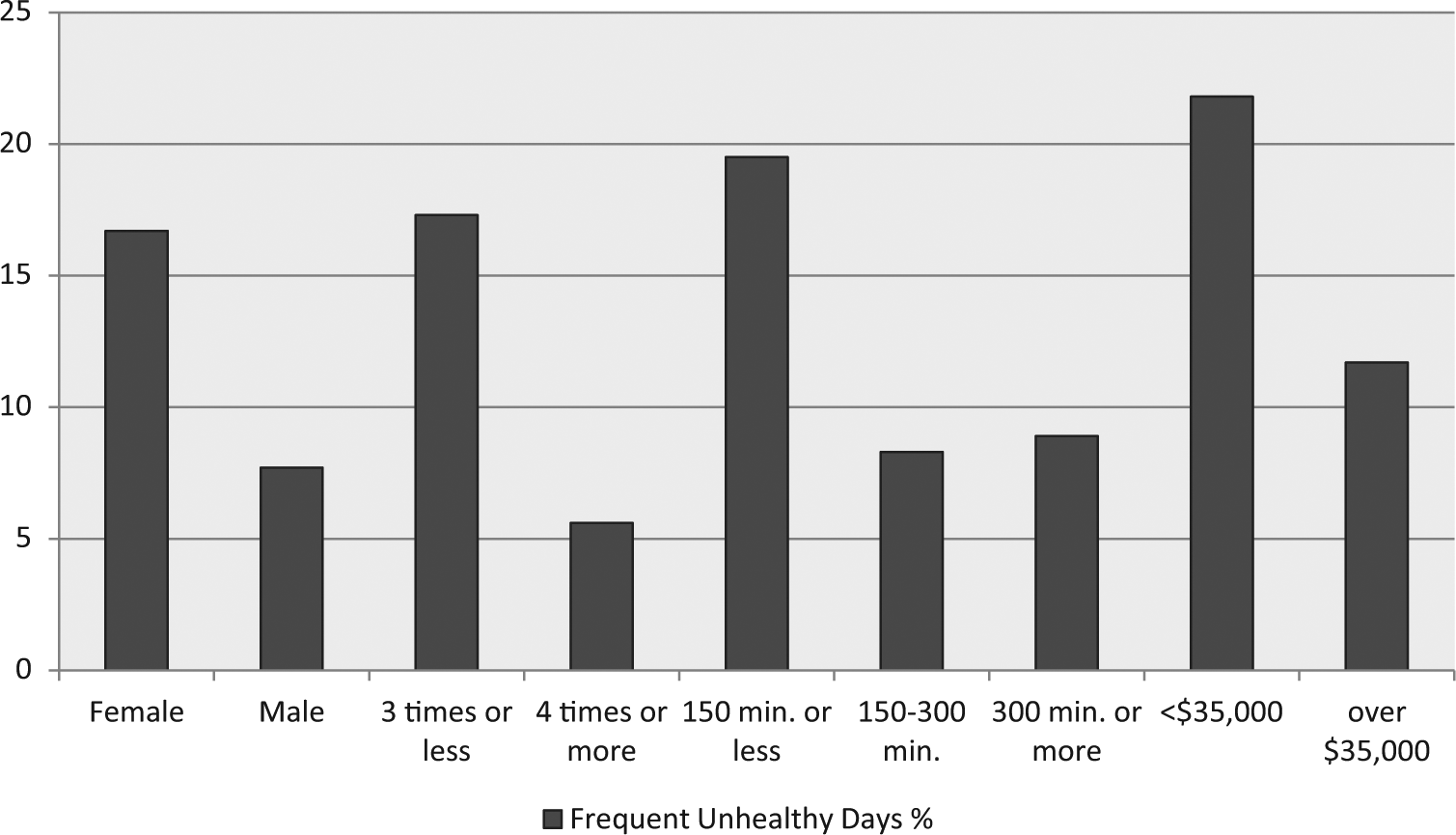
Percentage with the characteristics who also have frequent unhealthy days (n = 285).

Percentage with the characteristics who also have frequent activity limitations (n = 298).
Multiple logistic regression analysis (results not shown) revealed that poor SRH was related to people who reported being overweight and/or obese compared with those who reported a body mass index in the normal to underweight range (odds ratio [OR] = 2.99, P < .05). Poor SRH was also found significant among smokers (OR = 2.53, P = .03). Income and exercise times were associated with frequent unhealthy days. The odds of frequent unhealthy days were lower for those who made more than $35 000 compared with those who reported making less than $35 000 (OR = 0.46, P = .03). The odds of frequent unhealthy days were lower for those who exercised 4 or more times a week compared with those who exercised 3 times or less a week (OR = 0.28, P < .05). Frequent activity limitations were significantly associated with race and income. The odds of frequent activity limitations for those who reported an income of more than $35 000 was lower than those in the less than $35 000 category (OR = 0.29, P = .04). The odds of frequent activity limitations were significantly higher for persons who reported belonging to “other” race (OR = 14.75, P = .00). The confidence interval is extremely wide for “other” race and should be interpreted with caution.
Discussion and Conclusions
Health disparities for vulnerable populations have been defined by race/ethnicity, socioeconomic status, gender, age, geography, disability status, and risk status related to sex and gender. 10 This exploratory study revealed that being an online student may not be a risk factor for poor health. However, some subgroups are at greater risk for poor health.
We found that online university students were healthier compared with the online university student population analyzed by Rohrer et al, 2 who reported that 35% of the respondents had poor SRH. In addition, Rohrer et al 2 reported that 24% of the respondents were smokers versus only 15% in this study. Multiple logistic regression models revealed that overweight/obese, smoking, low income, “other” race, and less exercise were independent risk factors for poor health in this sample of online students. Future research should explore the “other” race category in an effort to explain its impact on health status. Smoking status proved to be significant in the univariate analysis and in the multivariate tests in relation to poor SRH.
These results should be used cautiously. Cross-sectional surveys cannot be used to demonstrate direct causal relationships. This sample, which was not random, is not representative of all online students. The results are true for this study’s sample, but are not true for all online students.
Despite these limitations, our results provide an important contribution to our understanding of the risk factors that may affect general health status among online university students. The findings from this study are important because few researchers have examined HRQOL among a sample of online university students using the CDC HRQOL-4 questions. Online university programs may be interested in these findings for targeting health promotion policies and/or interventions. Further studies of this population are needed to ascertain the underlying causes of poor HRQOL.
Footnotes
Declaration of Conflicting Interests
The author(s) declared no potential conflicts of interest with respect to the research, authorship, and/or publication of this article.
Funding
The author(s) received no financial support for the research, authorship, and/or publication of this article.