




Abstract
The popularity of traditional healing practices on social media during the COVID-19 pandemic challenged the discourse diffused by the Ministry of Health in Morocco. This created a struggle in the public sphere between a scientific discourse on health care constructed by the Ministry of Health and a culturally conservative discourse propagated by practitioners of traditional healing. This paper explores how both discourses were competing to shape public opinion about the best health-care practices to end the COVID-19 pandemic in Morocco. The data was collected from Facebook and YouTube based on criteria of social-media functionalities. The data was analysed using multimodal critical discourse analysis followed by a process of coding and category development. The results of the study reveal that shaping public opinion about ways to deal with the COVID-19 pandemic in Morocco was characterized by the success of traditional health-care discourse in a counter-hegemonic struggle with the discourse of the Ministry of Health. This discourse was conservative, as it cherished an online Muslim identity of social-media users by relying on ideologically constructed argumentation and discursive strategies in representing prophetic medicine as the best health-care practice to end the pandemic.
Introduction
Shaping public opinion on health care was not limited to the Moroccan state during the COVID-19 pandemic. From the beginning of the crisis, individuals as well as social-media influencers took part in sharing new information about the best practices to deal with the dangers of the novel virus. As more cases were recorded, the Moroccan government imposed a lockdown for three months, from 20 March to 20 June 2020. During this period, social-media platforms were an important space where information and updates on the pandemic were widely shared and discussed. Since the public sphere is ‘a realm of our social life in which something approaching public opinion can be formed’ (Habermas, 1964: 116), Facebook and YouTube platforms were a new space that allowed the population to voice their opinions and concerns during the lockdown. The government attempted to control such communication by issuing decrees that contained sanctions ranging from paying fines to being jailed for propagating disinformation that goes against the instructions of the sovereign power.
This article examines competing discourses on traditional health care in Morocco on social media during the pandemic by investigating the construction and propagation of texts in the public sphere. Traditional healing discourse was conservative, as it ideologically reconstructed an online Muslim identity, cherishing prophetic medicine as the solution to end the health crisis. It challenged the discourse of the Ministry of Health, which was aimed at keeping the health situation under control. This paper admits that the recourse to traditional healing practices was generally related to variables including education, age, sex and social class (a question beyond the scope of our research); however, new forms of traditional healing in Morocco, including ruqya (exorcism), hijama (cupping) and the use of herbs, have not yet been given much attention by researchers, and particularly the popularity of these forms on social media. COVID-19-related fear, anxieties, uncertainty and mistrust in governments’ measures intensified such practices among the population and triggered a heated and unprecedented debate between divergent discourses on social media. This paper aims at understanding the success of traditional health-care practitioners in gaining popularity and support among social-media users by analysing the semiotic choices and discursive strategies in their texts as they competed with the hegemonic discourse of the Ministry of Health in Morocco. Thus, the main research questions that this paper strives to answer are: Q1: How was traditional healing discourse reconstructed and propagated on social-media platforms in a way that challenged the discourse of the Ministry of Health and gained support and popularity among social-media users during the pandemic in Morocco? Q2: In what ways did traditional healing discourses on health care during the pandemic differ from the discourses of the Ministry of Health?
Literature review
Communicating health-care information during the pandemic
The situation in Morocco was not an exception in comparison to what happened in other countries throughout the world. Issues of the disintegration of health systems, lack of preparedness, socio-economic inequalities, stigmatization and exclusion, unequal burdens, critiques of state power and the spread of conspiracy theories (Manderson et al., 2021) were global phenomena. In the Maghreb, COVID-19 pandemic was an opportunity for broad increases in restrictions on the media sector in an attempt by the Tunisian, Algerian and Moroccan governments to control communication on health issues (Farmanfarmaian, 2020). In a critical moment of health crisis, communicating scientific uncertainty with an enforcement-based approach by legacy media in Morocco ‘contributed to the polarization of opinions, further increased resistance to the official decision-making orientations, and obscured opportunities for resolving the complexities involved in communicating scientific uncertainty and corresponding public decisions’ (Zag and Mifdal, 2024). In a comparison of the public's reaction to the COVID-19 pandemic on Twitter among the countries of Middle East and North Africa, Jafarian et al. (2021) illustrated that the only common theme among all the analysed data from different languages was ‘government responsibilities’ during the pandemic.
Such communicative responses of governments to the crisis competed with people's increased interest in social-media platforms as sources of information to deal with the health crisis. Suarez-Lledo and Alvarez-Galvez (2021), in a systematic review of previous studies on health misinformation on social media, found that the main topics of misinformation were vaccines, diets and eating disorders, drugs and new tobacco products, pandemics and communicable diseases, non-communicable diseases, and medical treatments and health interventions. In the United States, social-media users sought more information on how to prevent infection, and the misinformation that circulated on Reddit, for example, was that vitamin C, sodium ascorbate and zinc were cures or preventatives for COVID-19 (Chipidza et al., 2022).
The need for protection from the deadly effects of the virus among Moroccans was nourished by identity politics, resulting in a return to local culture, including religion, and past experiences with pandemics. Among respondents to their study, El Bouazzi et al. (2023) found that 72.75% opted for self-medication for COVID-19 in Morocco, using vitamin C (81.10%), zinc (74.91%), acetaminophen (72.51%), herbal products (69.41%), antibiotics (47.77%), cough medicines (26.46%) and anti-inflammatories (21.99%). The high use of herbal products shows the extent to which Moroccans opted for the use of herbs. In this way, new types of religious influencers and pseudo-scientists proposed ways to counteract the effects of COVID-19 on social media by claiming that traditional healing practices and recipes can heal patients and prevent the spread of the virus. A good case in point is a Moroccan traditional nutritionist who claimed to have a model cure using herbs that could heal patients infected by the virus and who gained wide support among social-media users, as he ideologically constructed his discourse on the claim that bringing back Islamic traditions of healing would end the pandemic in Morocco (Raqui, 2022).
The pluralism of traditional healing and modern medicine
Traditional healing discourse, along with biomedicine, has for decades shaped Moroccans’ experiences with sickness. In popular culture, saints are viewed as holders of baraka—‘a mysterious wonder-working force which is looked upon as a blessing from God’ (Westermarck, 1968: 35). It is a spiritual force that can heal any ailments. In parallel, such sicknesses are believed to be enacted by spiritual beings called djinns that can harm the soul as well as the body of a person. Djinn eviction, which is a kind of exorcism practised in maraboutic (Muslim mystical) institutions, is based on the reproduction of a cultural schemata of dominance–submission that governs power dynamics between the healer and the patient in the ritual (Maarouf, 2009). The merging of the human body with the divine and the material world entails that, when the body is sick, ‘healing involved interventions at different levels of the body’ (Amster, 2013: 44). These interventions may include seeking help from the saints, who can ‘localize the God's baraka in the patient's body’, capturing a ‘divine form in [a] physical substance’, such as water in which Koranic verses are dissolved or the saliva of a talib or sherif (traditional healers), and healing the human body by the exorcism of jinn or wearing amulets written according to Ilm Al-harf (science of the letter) (Amster, 2013: 45). Although traditional healing practices from Moroccan popular culture have long been widespread among people, modern medicine found its way into the public-health sphere. The Moroccan state has been keen on the development of the public health-care sector but, as MacPhee (2012: 26) notes, there is a ‘well established healing tradition’ in addition to ‘biomedical models as well as Arab Galenic (humoral) and Islamic-prophetic text-based traditions’.
The adherence of individuals to Islam can go beyond spiritual practices and shape their health-care practices. Bangladeshi families in the UK have used both Islamic and biomedical resources in coping with genetic disorders (Rozario, 2009), and, in Sweden, ruqya (an Islamic form of exorcism) is practised by Muslims coming from different countries with possible local adjustments in the European context (Marlow, 2022). Ruqya involves the recitation of Koranic verses and special words in the presence of a sick person, with the aim of curing his/her illness. Ruqya, hijama and the use of herbs to treat illnesses are now gaining more space in traditional healing practices in Morocco compared to the ritual of djinn eviction in popular Moroccan culture discussed above. For instance, most people no longer go to saints to participate in exorcism rituals, but they can order private sessions or visit local sites established by ruqya practitioners, who can be found almost in every city. The discourses of these new forms of what we would call prophetic medicine, whose proponents claim that it was practised by the Prophet Muhammad, are now widely reconstructed, recontextualized and distributed on social-media platforms.
Methods
Since this study investigates the ways in which competing discourses on traditional health care were constructed on social media, it was important to specify data sources based on this purpose. The choice of social-media platforms as places where public issues of national concern were debated is due to rising internet penetration and mobile internet adoption among Moroccans (a population of 36 million). In 2017, the number of social-media users was 14 million, increasing to 18 million in 2020 and 22 million in 2022. Moroccans use Facebook as their favoured site for communication (58.65%), followed by Instagram (20.7%), YouTube (16.01%) and Twitter (X) (2.62%). As of 2020, Moroccans spent the average of 2 hours and 30 minutes per day on social media (Statista, 2024).
Following purposive sampling, the data was collected from Facebook and YouTube as two platforms on which health-care discourses competed and social-media users participated in public debate. The data contained 82 videos that were shared by participants on both YouTube and Facebook in addition to five images that were posted on Facebook pages. In addition, comments on the videos and posts were observed and categorized to assess viewers’ responses. Data collection was undertaken by evaluating the relevant Facebook pages and YouTube channels according to the functional building blocks of social media as outlined by Kietzmann et al. (2011). Four functionalities were identified in the target social-media sources: 1) identity: making sure that the owners of the social-media platform reveal their identity; 2) sharing: the platform allows for receiving and exchanging content; 3) conversations: the platform allows for communication with others; 4) reputation: higher number of followers or subscribers (Kietzmann et al., 2011). The functional building blocks were used to track and evaluate Facebook pages and YouTube channels from which the data was collected. The social actors that were chosen in line with the purpose of this study were categorized as in Table 1 (they are anonymized in this paper and referred to by their function). They represent herbalists, ruqya and hijama practitioners as the three main types of prophetic medicine practitioners in addition to the Ministry of Health in Morocco, which represents scientific discourse on health care.
Categories and data from social-media platforms.
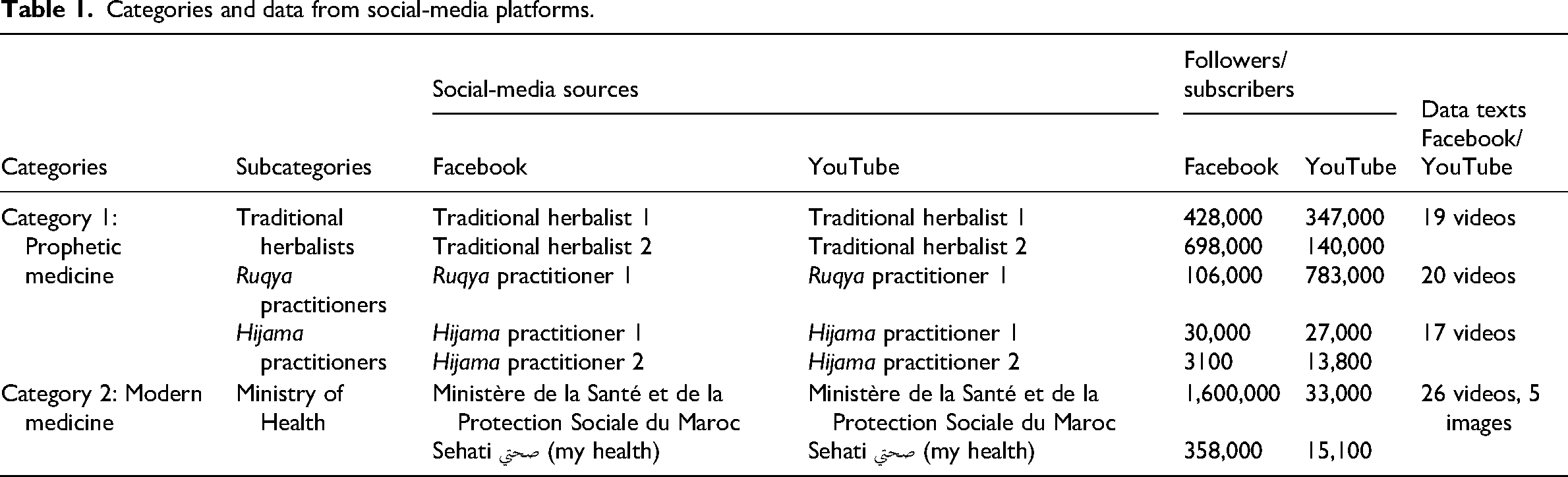
Categories and data from social-media platforms.
This study was based on qualitative data analysis. The amount of data collected was analytically manageable as far as multimodal critical discourse analysis (MCDA) is concerned, and it allowed for manual coding processes and category development. MCDA was used to analyse the genres of communication and the discursive strategies employed in discourse propagation. The analysis was done on texts that contain lexical, visual and metalinguistic components. The critical study of discourse adopted here is based on works that emerged in close relationship with systemic functional linguistics theory. According to Halliday (1978, 1985), individuals produce texts by representing aspects of the world, enacting social relations as well as the attitudes, values and desires of participants and connecting parts of texts together along with their situational contexts. These are the ideational, representational and textual functions of language, respectively. Fairclough (2003) builds on this view of text as a multifunctional entity. He views texts as having three main meanings: the representational meaning, the action meaning and the identification meaning. The representational meaning corresponds to the ideational function. The action meaning corresponds to the interpersonal function, although the focus is on text as a way of interacting, which also includes the textual function. And the identification meaning encompasses the ways in which participants construct their own attitudes, values and desires, as in the interpersonal function. ‘Focusing analysis of texts on the interplay of Action, Representation and Identification brings a social perspective into the heart and fine detail of the text’ (Fairclough, 2003: 27). These three levels of meaning in texts correspond to genres, discourses and styles, respectively.
Along with textual analysis, MCDA is used to approach other modes of communication as tools of meaning-making and, more generally, of social construction. This makes visual communication, including images, an important way of producing meanings that are worthy of analysis. Kress and Van Leeuwen (2020) refer to the ‘semiotic landscape’ in their approach to visual communication based on Halliday's meta-functions. An image as a text makes sense in its whole composition, which may include various elements; and its meaning is socially and culturally constructed. In the light of this view, a semiotic mode serves the same purpose as the meta-functions found in speech and writing. Thus, there are choices for visual sign makers in representing participants and processes, embedding such representations in mediated social interaction that involves social relations, and forming a textual composition of signs interrelated with each other and with their context (Kress and Van Leeuwen, 2020). Moreover, metalinguistic features such as intonation and pauses convey additional meanings to the receivers of texts that contain auditory elements (Gee, 2008). In this way, texts are ‘the result of the semiotic work of design, and of processes of composition and production. They result in ensembles composed of different modes, resting on the agentive semiotic work of the maker of such texts’ (Kress, 2012: 36). Given the critical dimension of this approach to discourse analysis, the ideological aspects of the analysed discourses are highlighted in this study. Simultaneously, advanced stages of coding of indicators led to the categorization of the three types of healing under one inclusive category of prophetic medicine as a cure for any kind of illness, including the COVID-19. In the second category, we find modern medicine represented by the Ministry of Health, which drew on scientific discourses on how to deal with the pandemic and aimed at combating the use of traditional health-care practices among the population.
The analysis of the intrinsic features of the texts that were constructed during the pandemic in Morocco revealed similarities as well as differences between different genres, discourses and styles that were constructed together by various social actors in ideologically motivated ways to shape public opinion. These features and strategies can be formalized in terms of argumentation, distance and social relations, generic features, and discursive and semiotic markers of identity.
Information versus argumentation
The genre of communication in texts could be analysed, as Fairclough (2003) suggested, in terms of three main aspects: activity, social relations and communication technologies. The texts constructed by the Ministry of Health and the practitioners of prophetic medicine differed in terms of the activity in each genre. The ministry propagated texts in the form of spoken speeches, written communiqués and images. It relied heavily on one-way mediated communication. From the beginning of the pandemic in Morocco, the ministry issued reports in the form of speeches by the minister or a spokesperson, mostly in state-run-media press conferences. On a daily basis, the Ministry of Health mainly shared statistics about the situation of the pandemic in the country, providing the numbers of cases recorded each day, as in Figure 1.
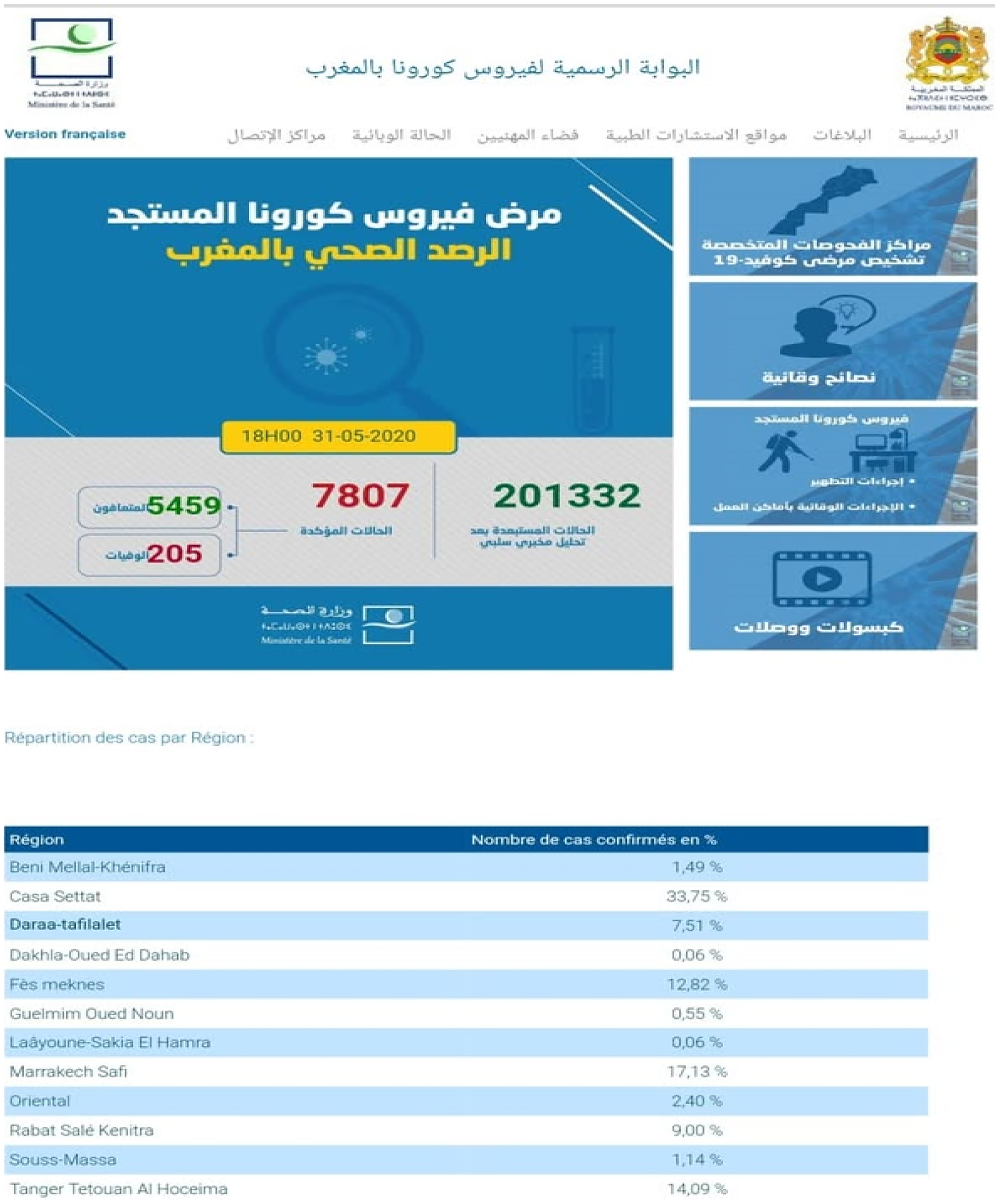
A chart containing numerical and statistical information about the COVID-19 pandemic in Morocco shared by the Ministry of Health in Morocco on its Facebook page, 2020.
Such images were shared daily on the Ministry of Health's Facebook page, informing the public about the number of new cases recorded, the number of patients who were cured, the deaths, the number of patients who were excluded after being tested negative, and statistics about regions with higher numbers of infections. The same type of information was also shared with the public in the form of press releases. The speeches by the ministry's spokesperson shared the same data with the audience in a spoken form on state-run media. They were also posted on the ministry's official Facebook page in order to reach social-media users. When traditional healing texts were being widely shared and public opinion was being shaped accordingly, the Ministry of Health started issuing texts to control the situation and limit the popularity of traditional healing practices among the population. The text in Figure 2 warned against the use of herbs as a form of cure when traditional healing practices were being strongly endorsed and supported by some people. The following is an English translation of the text from Modern Standard Arabic. Beware of using herbs to cure Corona (COVID-19) The need to strengthen immunity against coronavirus and to reduce the effects of infection made most citizens use herbal medicine, such as using some mixtures that are composed of some herbs such as Artemisia Herba-Alba, Syzygium aromaticum and Eucalyptus. But these herbs can cause bad effects on human health due to their side effects or by being poisonous, such as renal insufficiency, liver damage, respiratory suffocation and other side effects. Any attempt to prevent or cure COVID-19 sickness by using herbs is a wrongdoing, and it has dangerous effects on the health of the sick person. And this is what the World Health Organization has confirmed. Therefore, the Moroccan Centre for Fighting Poisoning and Medicine Vigilance warns against the excessive use of herbs, even those that are used in eating; and it also warns against being carried away by the advice and recipes that are shared via the internet to prevent or cure Corona sickness. So, Moroccan families must follow the instructions of the authorities by commitment to the lockdown at home as an application of the medical emergency state, in order to avoid the spreading of the virus, and the guidance of the Ministry of Health concerning everything related to their health. For anyone feeling the symptoms of this sickness, it is obligatory to call the specialized authorities (Allo Epidemic Vigilance 080 100 47 47 or Alo 141 for emergency medical assistance or Allo 300) in order to follow the necessary procedures and confirm whether the case in question is positive or negative and to take care of it.
Example 1
1. I have a herb … 2. It strengthens immunity … 3. It kills all viruses that exist in the human body.
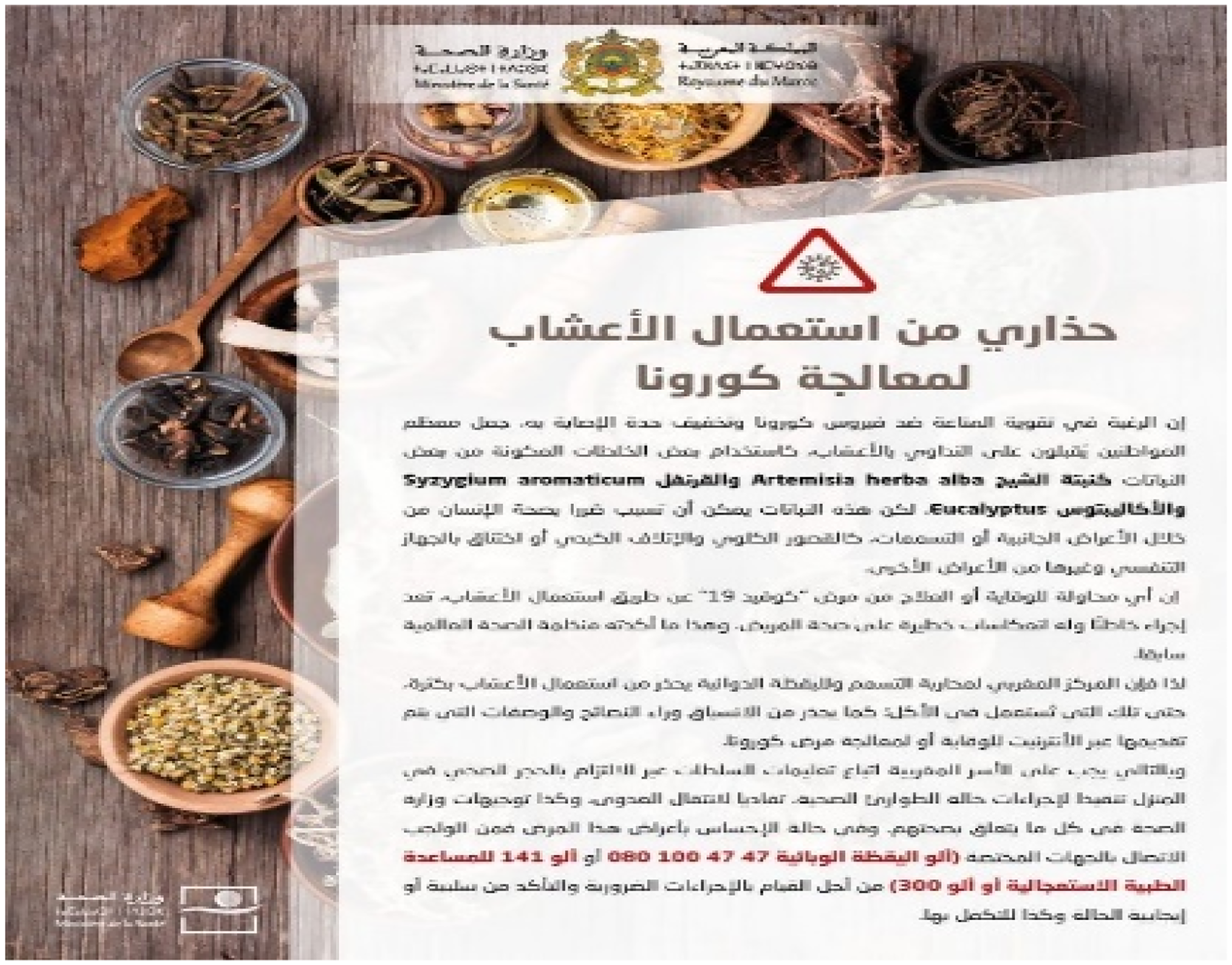
A communiqué posted by the Ministry of Health on its Facebook page warning against the use of herbs to cure COVID-19, 2020.
Similarly, ruqya and hijama practitioners presented ruqya and hijama as cures for all illnesses, including COVID-19. The main claim behind such a warrant is that traditional healing practices from prophetic medicine are the solution to deal with the health crisis of the pandemic. In order to convince the audience of such a claim, the advocates of hijama and ruqya used backing strategies by referring heavily to the Hadith and the Koran. In one example of this backing strategy, Ruqya practitioner 1 recounted the story of the Prophet Muhammad, who recited verses from the Koran and was cured when he was affected by a scorpion sting. Also, Hijama practitioner 1, in his videos about hijama, told the story of Isra’ and Mi’raj, when the Prophet Muhammad travelled on a night journey and ascended to heaven, where he communicated with Abrahamic prophets and Allah. A translation from Classical Arabic to English of Verse 1 in Sura 15 of the Koran is as follows: Glory to the One who took His servant in a travel by night from the sacred mosque to the furthest mosque that we blessed its surroundings to make him see some of our signs. He alone is the All-hearing, the All-seeing.
The reliance on particular modes of communication and the activities involved in each one established different social relations with the audience in terms of social hierarchy and social distance. The communication of the Ministry of Health during the pandemic was high in social hierarchy, as it exercised power over individuals by issuing top-down informative speeches and communiqués. Example 2 is from a press release that was issued by the ministry and shared on its Facebook page (translated from Modern Standard Arabic to English).
Example 2
The national laboratories involved in the laboratory diagnosis of this disease confirmed 164 new cases, to make a total of 4569 cases recorded since the beginning of the pandemic in our country. One hundred and eight of the new cases (74%) were discovered among those who were in contact with cases previously reported. That means we find out about the new cases early and often without people having symptoms … There is a positive index that we want to inform you about, which is the index of the spreading of the virus among the population. It is close to 1%. We are now between 1.4% and 1.7% at the national level. We hope it continues to drop down thanks to more vigilance and compliance with the rules until we defeat this pandemic and make our country overcome this crisis.

A comment on a video by Hijama practitioner 2 on YouTube, 2021.
The new communication technologies that the practitioners of traditional healing relied on and the argumentative activity in their texts established an emotional proximity with social-media users and created an inclusive online community as a compensation for the doubt, fear and anxiety associated with the lockdown and social distancing forced by the state. In this way, the communication was far from being national and produced by one formal institution, given the variety of producers of such content on social media. It is worth noting that doing hijama (cupping) was a common practice after the vaccination stage in Morocco. The practitioners of hijama claimed that it could heal the body or take away the presumed side effects of the vaccines. These kinds of texts employed argumentation and an emotional appeal to shared beliefs (cures from religious culture) as a strategy and were, therefore, perceived by social-media users as culturally and emotionally close to them, which is different from the texts of the Ministry of Health, which were mainly informative and aimed at achieving compliance with the lockdown and the procedures associated with it.
Because the traditional healing practitioners gained powerful voices and were very influential among their followers, they could practise emotional coercion through ‘proximization strategies’ by creating a ‘deictic centre’, which brings danger closer to the audience (Oddo, 2018). That makes it easier to involve the audience emotionally and make people accept their culturally constructed arguments for remedies. In contrast, the formal language of the Ministry of Health officials and the frightening statistics that they provided widened the gap between them and the audience, who needed a reassuring ideology deeply rooted in local traditional practices.
The genre indicators in traditional healing texts established in-group ties with social-media users and supported the symbolic power of the practitioners. The texts were constructed with a mixture of formal and informal lexicons. All the producers of those texts used Darija, a Moroccan dialectical Arabic, and Modern Standard Arabic interchangeably in their texts. As far as ruqya and hijama practitioners were concerned, they mainly used Modern Standard Arabic, with recourse to Moroccan dialect at fewer times. Their greater reliance on Modern Standard Arabic was due to their recurring references to the Koran and the Hadith (the sayings of Muhammad), which are written in Classical Arabic. The use of Modern Standard Arabic went hand in hand with an aura of sacredness associated with the religious texts that they referred to. For traditional herbalists, Darija was often used with notable references to traditional herbs and practices well known among Moroccans. In Example 3, from a video on YouTube by Traditional herbalist 2, the text is in Darija except for the words in bold, which are in Modern Standard Arabic.
Example 3
1. If you inhale the wormwood 2. you inhaled it … 3. you kill the virus, 4.
The mixture of Darija and Modern Standard Arabic served the communicative purposes of traditional healers. The dialect reduced the social distance between the creators of the texts and their audience. The informal terms from traditional healing and Darija, such as the word ‘wormwood’ that traditional herbalists mentioned recurrently in their speeches, created an aura of what Fairclough (1989) calls ‘simulated equalization’. In this way, such lexical choices made the traditional healers of the in-group whom they addressed. This was not the case with the texts on the pandemic situation that the Ministry of Health issued or the ones that aimed at undermining the popularity of the traditional healing discourse. As is the case with Figure 2 and Example 2 above, the Ministry of Health shared the picture in Figure 4 to warn against the use of herbs, using Modern Standard Arabic. The English translation of the text is as follows. The safe use of disinfectants Avoid fumigating the house with herbs or drinking herbal recipes that may be poisonous with the appearance of turbulence at the level of the nervous, respiratory and digestive systems and also at the level of the liver and kidneys.
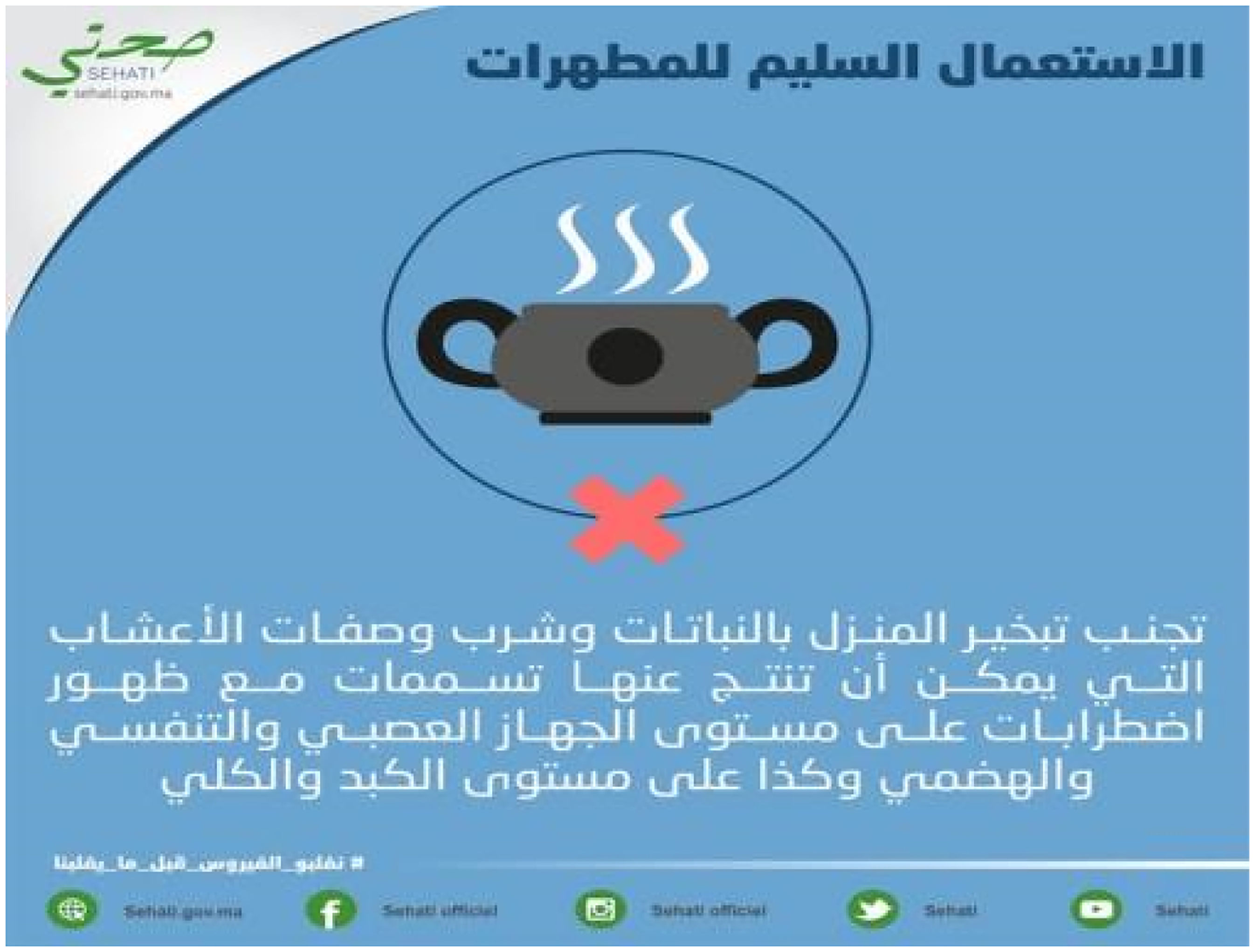
A picture posted by ‘Sehati’, a Facebook page owned by the Ministry of Health, warning against using herbs to fumigate houses or drinking herbal liquids to cure COVID-19, 2020.
The analysed texts from traditional healers contained lexical choices that constructed a discursive polarization in public debate. The ‘Us vs Them’ (Van Dijk, 1998) discursive construction in the analysed texts varied between the use of overt and implicit structural oppositions to construct the texts by describing participants with opposing classes of concepts. As Example 4 shows, Ruqya practitioner 1 used implicit structural oppositions in online ruqya during the lockdown by doing live cure sessions. He described Muslims as being different from Westerners by having ‘faith in COVID-19’, which implies a believer/unbeliever binary opposition concerning the origin of the virus.
Example 4 (from YouTube)
My beloved ones, Virus Corona that all humanity was infected with and fear now, came as destiny. Listen to me, believer. I am not talking to an atheist, a Jew or Christian. I am talking with the one who believes in God and the day of judgement. This virus came as destiny.
Semiotic markers and social-media users’ responses
The lexical choices opted for by the practitioners of traditional healing to convey their claims were supported by visual choices as well. The choice of clothes varied from one mode of healing to another. Ruqya practitioners often appeared wearing religious clothes, as their practice is mainly an ‘Islamic’ form of djinn eviction; hijama practitioners similarly opted for religious clothing, although they used biomedical outfits when showing their practice of cupping on their patients; whereas traditional herbalists’ choice was mostly formal clothes, given the style of an ‘expert in medical herbs’ that they strove to convey. The physical appearance of hijama and ruqya practitioners with religious clothes and an ‘Islamic’ way of beard-shaving surrounded their self-presentation with an aura of piousness. Such signs of religiosity implied that the speakers were knowledgeable about prophetic medicine and that the models of cure they presented to end the pandemic were grounded in the sacredness of the Koran and the Hadith, particularly the stories they refer to in their argumentation discussed above. It is no surprise that Ruqya practitioner 1 considered COVID-19 virus as being ‘similar to djinns, as long as they are both invisible to humans’, implying that Moroccans would better deal with the virus using ruqya as a cure by reciting verses from the Koran and making douaa (prayer) to Allah to stop the pandemic.
The gaze of the speakers in the analysed videos from the prophetic medicine category reduced the social distance between traditional healing practitioners and their viewers. They all appeared in sitting positions, looking at the viewer in a direct gaze, given the use of smartphones to record videos, live streaming and stories on social-media platforms. Furthermore, videos are moving images and, as long as they create symbolic relations with viewers, as images do, they allow for various forms of visual address, in contrast to images (Kress and Van Leeuwen, 2020). The dynamic aspect of the video can make depicted participants move closer to the camera, as in a ‘medium shot’, to establish a close social distance. The angle of the camera at the horizontal level is frontal, implying involvement, and, at the vertical level, the angle of power is eye-level, implying equal power and intimacy. In this respect, the practitioners of traditional healing never appeared standing and looking down on the audience, as the spokesperson of the Ministry of Health often did in press conferences during the pandemic, where the distance is public and impersonal. Conversely, traditional healing practitioners relied on videos that were non-stop speeches with sustained eye contact and head movements towards the camera, which created a closer visual address and acknowledged the audience. This kind of gaze implies recognition and constructs a ‘demand image’, urging people to act accordingly (Kress and Van Leeuwen, 2020); it required positive reactions from the viewers, which took various forms such as commenting on, sharing and even redistributing such content in other YouTube channels and personal and group pages on Facebook. Figures 5 and 6 are sample comments of the proponents and opponents of traditional healing commenting on the Ministry of Health's communiqué, as shown in Figure 2.

A comment on Facebook about the Ministry of Health's communiqué warning against the use of herbs, 2020.

A comment on Facebook about the Ministry of Health's communiqué warning against the use of herbs, 2020.
Supportive comments on the videos on YouTube and Facebook by the practitioners of traditional healing were dominant in the propagated texts that cherished prophetic medicine. The comments section on both platforms was a space where social-media users could interact with the practitioners whom they follow by asking for more information, praying for the practitioners or simply expressing ideas that are in line with the claims in the videos. More interestingly, social-media users reproduced the discourses that they were exposed to on traditional healing practices on the Ministry of Health's posts. As in Figure 5, herbs are considered the best choice to deal with the pandemic, as they originate from God, while medicines originate from humans. These kinds of comment on the communiqué were dominant, and they reproduced similar narratives that valued practices from prophetic medicine while downgrading modern medicine. On the other hand, there were also other comments, as in Figure 6, that supported the discourses of the Ministry of Health against the popularity of traditional healing practices by pointing to the importance of medicine and science to deal with the pandemic. This polarization created more uncertainty and had a negative effect on people's responsiveness to the state's policy, especially to the call for vaccination. The polarization was both politically and culturally motivated, reproducing the conflict between modernist and traditionalist views in cultural terms, and between political agents in opposition and in government in political terms.
The Ministry of Health relied on images and written communiqués, as shown above, to construct new narratives on traditional healing practices that were becoming more popular during the pandemic. There was an overreliance on the writing mode as opposed to speech. The ministry never issued videos on traditional healing practices that would create a visual address with the audience. Even when texts combined images and writing, more importance was given to the writing. Take as an example the communiqué in Figure 2 warning against the use of herbs. The composition of the image is based on a right/left and given/new structure (Kress and Van Leeuwen, 2020). Information that is considered to be known by the audience is the given, and it is often presented first to the audience on the left as an initiation for the important message (the new). Due to the reverse order of writing in Arabic (from right to left), the given is to be on the right and the new on the left. Yet, the image constructed by the ministry did not follow this structure. The important message of warning against the use of herbs to cure COVID-19 is presented first as a given and an assumption (excluding any dialogicality), as if the audience already knew about it; then the image appears on the left as the new, with more salience to reinforce the meaning of the verbal text. The foregrounded image is without any clear message to convey on its own for the audience on whether to use herbs or not. The relationship between the image and the text here is merely that of ‘illustration’ (Barthes, 1977), where the text is the focus and the image is an illustration of its meanings. Yet the structure of given/new serves the opposite by giving more importance to the image rather than the text. In Figure 4, the importance is given to the image by putting it in the centre, and this time with a cross on it signifying a warning against using herbs, and the written texts are on the margins above and below the image. The relationship here is based on a centre/margin, top/down structure and gives more importance to the image, too, although it is the text that contains practical information on the side effects on the health of individuals from using herbal medicine. Such compositional meanings by the Ministry of Health were based on assumption and presupposition on a controversial issue, and they were thus not influential in fighting misinformation and orienting public opinion not to follow traditional healing practices during the pandemic. In this respect, the visual choices of the practitioners of traditional healing acknowledged social-media users and their needs for reassurance, empowering them to deal with uncertainty and fears associated with the health crisis. Both lexical and visual choices worked together simultaneously to legitimize the claim that prophetic medicine was the solution to cure patients infected with the virus and bring an end to the health crisis.
Shaping public opinion during the COVID-19 pandemic in Morocco was undertaken within a struggle of different discourses. The Ministry of Health established a consensus about the lockdown and all the procedures associated with it in the beginning of the pandemic. Yet, a counter-hegemonic discourse of traditional healing succeeded in gaining popularity and support on social media. Such success pushed the Ministry of Health to issue communiqués and posters warning against the use of traditional healing methods to deal with the spread of the virus. However, as this analysis has shown, those texts were mainly informative, like the numeric and statistical data in the form of images and speeches by the ministry spokesperson that were shared on a daily basis with a formal touch that failed against the informal and inclusive character of traditional healers’ discourses and their argumentative moves and strategies. To deal with this situation, two Moroccan public TV channels modified and adapted their broadcasting with an exceptional increase in specialized programmes on the health crisis, a proximity content using Darija and more interactivity with the audience (Kabbadj and Bendahan, 2021). In this way, the Moroccan state aimed at keeping the health situation under control, but ‘the hegemony it built did not generate continually consent among the population, as it was built mostly on “take” but not “give”’ (Mifdal, 2023: 11). What traditional healing discourse provided instead was an imagined online Muslim identity that empowered the belief among social-media users that prophetic medicine could heal any illness, including the COVID-19, and at the same time it belittled the efficacy of modern medicine.
The argumentation moves and the lexical as well as the visual choices reactivated existing mental models of traditional healing in Moroccan popular culture and thus achieved a cultural resonance that the official discourse did not manage to construct. Even if not all Moroccans make regular recourse to traditional healing, the mental models are there and can easily be activated during times of crisis and doubt. As Van Dijk (2001: 114) points out, ‘it is through mental models of everyday discourse such as conversations, news reports and textbooks that we acquire our knowledge of the world, our socially shared attitudes and finally our ideologies and fundamental norms and values’. Given the deeply rooted belief in traditional healing in Moroccan society, public opinion was ready to endorse conservative discourses that draw heavily on popular culture and beliefs of popular Islam. This return to popular traditions and norms is in line with a dominant conservative Islamic culture, which is, according to Altemeyer and Hunsberger (2005), characterized by an in-group/out-group divide and the perceived superiority of one's moral world view. Such a divide in the Moroccan society takes the form of a struggle between ‘preachers’ and ‘modernists’ as two competing social fronts (Hammoudi, 2015).
The COVID-19 pandemic in Morocco was not only a health crisis for modern health-care systems but also an identity crisis for traditional healing proponents. Before the pandemic, practitioners of traditional healing claimed that prophetic medicine could be used to cure any illness. The sudden outbreak of COVID-19 put such claims into question. Not being able to find a cure for COVID-19 contradicted the belief in the baraka (blessing, grace) of traditional healers and the sacredness associated with prophetic medicine. This could be overcome only by ideologically constructing conservative discourses with motivated lexical and visual choices to convince the adherents of traditional healing of its limitless healing efficacy. Those choices belonged mainly to a Muslim religious register, cherishing a collective identity based on a bygone past when Muslim civilization was leading development at many levels. As Wilce (2009: 205) puts it, ‘we perform work-related social identities using one register and other identities with other registers elsewhere’. In a time of identity crisis for the proponents of traditional healing, a religious register was opted for, as it was reassuring and helpful in overcoming fears, doubts and uncertainty during the pandemic. Even among Muslim immigrants, ‘turning to Islam and the Qur’an is the cure, and adhering to Islamic practices in the diaspora is the vaccine needed to prevent future health problems’ (Marlow, 2022: 10).
Traditional healing practitioners succeeded at the discursive level, thanks to the cultural resonance of their discourse, instead of being able to provide a cure for the virus. When social-media users endorsed such discourse and supported it, they did so as if they were defending their own Muslim identity, without necessarily using such models of cures or checking their efficacy. That was the case with a Moroccan traditional nutritionist whose discourse was supported by social-media users signing a petition when his opponent doctors launched another petition as a call to stop him from threatening the health of Moroccans with his model of cure using herbs (Raqui, 2022). Even if social-media platforms allowed for the rapid consumption and redistribution of the traditional healing discourse, they allowed other social-media users to criticize it. In this way, comments on the analysed data ranged between supportive and critical stances towards the propagated discourses. Although not many social-media users would engage with correcting misinformation, ‘there is potential for users to be an effective force against misinformation if they are equipped with accurate information and the motivation to engage’ (Tully et al., 2020: 9). Thus, traditional healing practitioners were successful in shaping public opinion in a moment of crisis by counter-hegemonic discourses that downgraded the scientific discourses of the Ministry of Health and foregrounded the healing power of prophetic medicine. Yet, such success was limited in its scope among social-media users, as it was challenged by other critics who participated in the struggle by commenting and posting on their own Facebook accounts to correct misinformation and uncover the ideological work in such discourse.
Conclusion
This study explored the interplay between different discourses constructed and distributed on social media by various social actors during the pandemic in Morocco. Traditional healing discourse gained much popularity and support among social-media users. It challenged the hegemonic health-care discourse of the state by claiming to be able to cure COVID-19 with prophetic medicine healing practices of using herbs, ruqya and hijama. The aim of this paper was to explain the temporary success of such conservative discourse in gaining popularity by critically analysing its semiotic aspects. The analysis showed that the proponents of traditional healing made lexical and visual choices in their construction of ideological texts in their attempt to deal with an identity crisis, while at the same time exploiting social media to construct new discourses, as the whole argumentative base of prophetic medicine was threatened by the novel virus. Traditional healers established their reputations among social-media users by claiming the status of credibility and presenting themselves as specialists capable of curing any illness. Their ideological work was carried out by argumentative/emotive moves with a culturally resonating religious register that marked the lexical and visual aspects of the propagated texts.
The discourse of the Ministry of Health warning against the use of traditional methods to deal with the virus failed to keep the health-care situation under control, especially at the discursive level. The means of communication that the ministry relied on and the discursive aspects of its texts could not stop traditional healers’ discourse from becoming more popular. It is high time for the ministry to be mindful of cultural perspectives in its attempts to fight misinformation and raise health awareness among the population. In any future pandemic, instead of relying on traditional modes of communication, the ministry should be more prominent on social-media platforms, using professionals capable of communicating effectively with social-media users, and ‘academics and practitioners must work together to translate new understanding into practice to plan and evaluate programs that use narratives to purposely and effectively shift social norms across global health topics’ (Riley et al., 2021: 103).
This paper uncovered the ideological work in traditional healing texts whose producers claimed that they were able to cure COVID-19, but it did not investigate how they construct texts concerning sicknesses other than COVID-19, such as cancer and other diseases. Future research might explore the characteristics of such discursive practice, as it is constructed every day on social-media platforms in a way that threatens the health of individuals.
Footnotes
Declaration of conflicting interests
The authors declared no potential conflicts of interest with respect to the research, authorship, and/or publication of this article.
Funding
The authors received no financial support for the research, authorship, and/or publication of this article.

Author biographies
Oussama Raqui is a PhD candidate at Chouaib Doukkali University in El Jadida, Morocco. His research interests are discourse, media and cultural studies.
Mohamed Mifdal is a full professor of English studies at Chouaib Doukkali University in El Jadida, Morocco. He got his PhD from Bordeaux 3, France in 2009. His research interests include literary studies, cultural studies, media studies and critical discourse analysis. He has published peer-reviewed articles, book chapters and books on literary satire, humour, ESP, social movements, new media and digital culture.