



Abstract
Action and reflection are fundamental to the advancement of public communication of science and technology (PCST). Effective professional training in this field must integrate both theoretical knowledge and practical application, tailored to the local context. This study arose from an initiative to establish a professionalizing master's programme in PCST at the Autonomous University of Zacatecas, Mexico. Through a survey of 210 PCST practitioners across 28 Mexican states, this study identified pressing educational needs within the community. The findings revealed a strong demand for training in practical competencies, including science recreation activities, digital media and project development, alongside theoretical foundations such as science–society relations and narrative framing. These findings offer a basis for the creation of a specialized curriculum aimed at addressing gaps in PCST professionalization in Mexico, providing the opportunity for the master's PCST programme to become a crucial step towards formalizing the discipline in the region.
Keywords
Introduction
Communication is an essential pillar of scientific and technological advancement (Ziman, 1980), facilitating the dissemination of knowledge among peers for validation and development (Estrada, 2002). However, the communication of science to non-specialist audiences introduces significant complexities. Engaging the lay public in scientific discourse requires not just translation of technical knowledge but a thoughtful recontextualization of this knowledge to align with the audience's needs and interests (Alcíbar Cuello, 2004; Burns et al., 2003). Public communication of science and technology (PCST) professionals, therefore, act as interpreters, mediating between scientific knowledge and public understanding (Stocklmayer and Rennie, 2017).
There is a great diversity of media and platforms that can be used to communicate science to the lay public (Estrada, 2002; García-Guerrero, 2022; Kim and Dopico, 2016; McCallie et al., 2009), including printed media (such as books, magazines and newspaper sections), electronic media (such as radio, television, social networks and podcasts), museums (through exhibits and interactive devices, for example) and group settings (such as lectures, talks, forums, plays, demonstrations and workshops). To achieve effective communication, each form of media demands a specific set of knowledge and skills, combining theoretical foundations with skills that are gradually developed through deliberate practice. Alongside the development of these different specialties, an academic discipline dedicated to the analysis of PCST work has developed over recent decades (Lewenstein, 2003; Mulder et al., 2008; Stocklmayer and Rennie, 2017). In broad terms, it studies the conditions necessary to establish effective communication with non-specialized audiences. This involves the development of concepts and categories that help to understand how science communication processes occur, as well as the creation of evaluation strategies to identify the strengths and weaknesses of the work being carried out.
The professionalization of PCST has become an evolving global trend, with many regions developing formalized training programmes aimed at preparing communicators for this critical role. However, in Mexico, this remains an ongoing challenge. Existing postgraduate pathways in science communication are limited, often having a theoretical focus and lacking the practical emphasis required for effective public engagement. This study, building on the theoretical underpinnings of PCST and empirical data from a national survey, aims to establish a foundation for the creation of a professionalizing postgraduate programme that meets the specific needs of the Mexican PCST community.
This study seeks to answer the following research question: What are the key areas of knowledge and skills that PCST practitioners in Mexico require to enhance their professional practice? To answer this question, we build our study on the theoretical underpinnings of PCST, complementing this with empirical data. We conducted a survey among 210 PCST practitioners across Mexico, exploring their perceived training needs and priorities. Our findings offer valuable insights into the current state of PCST training in Mexico, providing a foundation for the development of a professionalizing postgraduate programme.
Theoretical framework
The development of PCST work has not occurred homogeneously at either the international level or within local contexts, with individuals having different levels of participation. Based on the communities of practice approach (Wenger, 1999), Lewenstein and Baram-Tsabari (2022) put forward three basic categories to classify science communication practitioners:
Occasional. People who are newcomers to PCST or who make sporadic contributions. They may be students who collaborate as volunteers, researchers who want to make their work known or those who are required to participate in institutional events. This category fits the case of thousands of researchers in Mexico who became involved in PCST activities, most of the time without proper training, only to fulfil the requirements of the National System of Researchers [Sistema Nacional de Investigadoras e Investigadores] (Diario Oficial de la Federación, 2023). Active. People who have built a practical identity, although they are mainly committed to other work. This category includes students who are more experienced in and committed to the development of PCST initiatives, as well as researchers for whom science communication is an important part of their scientific work. Professionals. Practitioners who have built an important part of their professional identity in PCST. They may engage in other roles, such as research or management, but they dedicate a large part of their working time to PCST and expect remuneration for their outreach work.
The above reflects a trajectory in which PCST has undergone a process of professionalization, recognized in the fact that some people go beyond the development of PCST activities only as amateurs, getting employed specifically to fulfil this function and have the preparation to perform it competently (Trench, 2017). However, the fact that someone performs a role professionally or that their work includes professional elements does not mean that the activity qualifies fully as a profession (Trench, 2017).
The professionalization of PCST is an ongoing process that reflects broader trends in the institutionalization of scientific outreach. As Trench (2017) argues, the development of any profession requires a clear delineation of competencies, career paths and formalized educational structures. However, PCST faces unique challenges in this regard, particularly due to its interdisciplinary nature and the diversity of its audiences. Unlike professions such as law or engineering, which have well-established competencies and career trajectories, PCST operates across multiple domains—ranging from education and media to policy and community engagement—each demanding a distinct set of skills (Longnecker and Gondwe, 2014).
In many regions, including Mexico, PCST is still perceived as an ancillary activity, often voluntary, rather than a core professional function. This perception hinders the creation of structured career paths and the allocation of necessary resources for its professional growth (Lewenstein and Baram-Tsabari, 2022). Furthermore, the absence of standardized training programmes means that many practitioners learn through informal means, such as trial and error, or by working under more experienced communicators (Reynoso, 2008). This highlights the need for formal educational programmes that impart theoretical knowledge and also provide hands-on experience in real-world settings.
Among the fundamental characteristics that define science communicators and that should be taken into account in their training, Longnecker and Gondwe (2014) highlight the understanding of how people communicate and learn, what knowledge is, how to determine the credibility of different sources of information, what influences the way people see the world, how to change people's position on an issue, and the context in which certain media can be used to reach specific audiences. On top of all that, science communicators must know their audience and respect their needs.
Engaging in PCST is not a simple task, and in Mexico there is a high degree of improvisation among researchers who decide to promote their own work, personnel who perform outreach functions in science and technology councils, and in vocational initiatives developed by universities. There are exceptional cases where people, even without the appropriate training, manage to perform successfully in PCST; however, in most cases, initiatives carried out by people without the appropriate training show clear deficiencies. This highlights the need for professional training paths for PCST.
The importance of PCST training programmes
An essential part of the development of any profession is having a body of knowledge that serves as a foundation for its work. This core component consists of paradigms, in the sense proposed by Kuhn (1971), which in turn are defined by the community of experts in the field and serve to train new generations of professionals.
PCST has the peculiarity of requiring different areas of knowledge for the successful development of its initiatives, each of which has its own practical and theoretical dimensions. For example, communication components involve understanding how to relate to the public (Durant, 1999; Lewenstein, 2003; Stocklmayer and Rennie, 2017), how to build arguments by combining paradigmatic and narrative discourse (Bruner, 2009; Davies et al., 2019; Negrete, 2012), and how to manage processes in different media. PCST also involves mastery of a scientific aspect, which incorporates elements of epistemology, history, reliable sources of information and, of course, the topics to be discussed.
In a more structured way, Mulder et al. (2008) identify four major areas of preparation necessary for professional performance in PCST:
Science. This area involves the elements needed to have an overview of scientific issues relevant to the communication processes carried out with the public. It includes topics from the natural sciences, life sciences, mathematics and engineering, although it can (and should) also be extended to the insights offered by social disciplines to understand the world. Educational studies. This involves knowledge of the way in which people learn, both individually and in terms of group dynamics. Contributions from areas such as psychology, didactics and sociology should be considered. Science and technology studies. This involves addressing the way in which these disciplines are constructed, as well as the different social dimensions surrounding them. In this area, philosophy, sociology, policy studies, law and ethics come into play. Communication studies. This covers the way of working in specific media to build PCST processes. It includes a wide range of disciplines such as journalism, writing, radio and TV broadcasting, communication design, museology and audience studies.
It is difficult for a single person to have exhaustive training in all the above-mentioned elements. However, it is necessary to have foundational knowledge in all of these areas, which is why there is a need for PCST educational programmes. As Estrada (2002) highlights, at the beginning of the twenty-first century in Mexico, there were practically no specific programmes to train PCST practitioners, or even university courses (science or communication) to provide relevant knowledge.
PCST training was mostly conducted in practice, which continues to occur in a variety of contexts. Such training can be developed by trial and error or through an artisanal workshop system by collaborating with more experienced communicators. This is what Reynoso (2008) identifies as happening with the first generation of science communicators. The second generation consists of those who, in the absence of specific PCST training programmes, complemented their training with a postgraduate degree in related areas: pedagogy, literature, film, journalism or science, technology and society studies. Finally, in the last 20 years, the third generation has appeared thanks to the collaboration of the first two generations with specialists in related fields to develop professional training projects. Thus, courses, diplomas and some postgraduate degrees related to PCST have appeared.
In this context, and as part of the initiative to create a master's degree in PCST at the Autonomous University of Zacatecas, it is worth reflecting on the elements that should be considered when structuring a programme of this nature. Normally, training courses are created with a very specific vision, reflecting the objectives of the institutions that offer them (Baram-Tsabari and Lewenstein, 2017); in this sense, they are guided by the need that gave rise to them. When designing a postgraduate programme that aspires to attract a greater diversity of student profiles and serve their different needs, a more complex reality is faced. The following is a discussion of the central elements to consider when structuring a postgraduate programme in PCST.
Academic contributions to PCST training
Many research studies have addressed the importance and needs of PCST training (Daoust-Boisvert, 2022; Hong and Wehrmann, 2010; Trench, 2017; Turney, 1994) and analysed particular postgraduate programmes in the field (De Semir, 2009; Greco, 2009; Massarani et al., 2016; Mulder et al., 2008; Ramani, 2009; Trench, 2009; Vogt et al., 2009). However, there are fewer studies that provide an explicit reference for structuring new programmes or making adjustments to existing ones.
An initial reference in this regard can be found in the work of Longnecker and Gondwe (2014). Their research addresses several of the points discussed so far, and they put forward six principles to consider when developing a university science communication programme:
Identify priorities that may respond to local PCST needs, as well as using local knowledge to establish the programme's focus. The content should reflect the best practices of science communicators. Students should have access to real-world, hands-on experience of interacting with PCST professionals. In general, assignments are a better choice for assessment than exams as they provide learning experiences and allow a more accurate evaluation of the acquired learning. A free choice of topics for assignments allows students to apply what they are learning in a way that is most relevant and useful to them. Effective assessment processes motivate students and serve to integrate theory and practice.
The above principles provide a general vision of the route to create a PCST programme, as well as aspects to consider when structuring the different courses. However, the approach needs to be complemented by specific elements to define the content to be included. The construction of a master's programme requires a clear conceptual basis as the central axis of the curricular structure, which guarantees coherence between the different courses. The challenge here is that due to the interdisciplinary nature of the work, there is no obvious essential structure for PCST training in terms of content and skills needed for its development. Hence, the conceptual core serves to identify the components to be included in a PCST programme (Baram-Tsabari and Lewenstein, 2017).
Effective PCST enables people to identify a topic, enjoy engaging with it, develop an interest in it, become able to take a position on it and ultimately relate the information to their particular reality (Burns et al., 2003). That is what a practitioner intends to accomplish. Baram-Tsabari and Lewenstein (2017), drawing on the six essential branches of science learning in non-formal environments (Bell et al., 2009), offer a coherent framework for someone who has learned from PCST:
Experiences excitement, interest and motivation regarding PCST activities while developing attitudes that support effective PCST (affective goal). Succeeds in generating, understanding, remembering and using concepts, explanations, arguments, models and facts related to PCST (content goal). Uses PCST methods, which include written, oral and visual communication skills and tools, to foster fruitful dialogues with diverse audiences (method goal). Is able to reflect on the role of PCST in society, including processes, concepts and institutions related to this work. In addition, this includes reflection on their own PCST learning and practice processes (reflective goal). Participates in PCST activities in authentic settings through written, oral or visual messages, suitable for different sectors of the non-specialized public; manages to build fruitful dialogues with the participants (participatory goal). Thinks of self as a science communicator and develops an identity as someone capable of contributing to the work of PCST (identity goal).
The contribution of Baram-Tsabari and Lewenstein (2017) is fundamental insofar as their six points outline the competencies that a master's degree in PCST will seek to develop. The emphasis on certain areas will shape the profile of the programme: it will be oriented towards a theoretical approach if the syllabus focuses more on content and reflective goals, or it will have a more pragmatic profile if it prioritizes affective and participatory goals. In any case, the design of courses for the master's degree programme must keep in mind which goal (or goals) will determine the central content and approach.
PCST postgraduate programme profiles
Internationally, the literature on PCST training programmes and their evolution is very limited (Daoust-Boisvert, 2022), but a basic overview can be developed from existing documents. In the first instance, we will address existing initiatives in Latin America, and this will be complemented by examining significant examples of PCST postgraduate programmes in the international context.
Massarani et al. (2016) conducted a study within the scope of action of the Network for the Popularization of Science and Technology in Latin America and the Caribbean (RedPOP). They identified and analysed Latin American postgraduate courses in PCST, considering only diplomas, specializations, master's degrees and doctoral degrees with a duration of more than 120 hours and where the teaching and learning is carried out on a regular basis.
According to Massarani et al. (2016), numerous diploma programmes have been created specifically to offer training in PCST, but this is not the case for master's degrees, where most programmes are not focused on science communication but include it as one of several terminal options. Examples include the Master's in Biological Chemistry at the Federal University of Rio de Janeiro (Brazil), with a specialization in ‘Education, Outreach and Management in Biosciences’; the Master's in Biological and Health Sciences Teaching at the Oswaldo Cruz Institute (Brazil), with a specialization in science communication; the Master's in Philosophy at the Federal University of Rio de Janeiro (Brazil), with a specialization in science communication; the Master in Philosophy of Science at the National Autonomous University of Mexico (Mexico), which includes science communication among the six areas in which its students can conduct research; and finally, the Master in Science, Technology and Innovation at the National University of Rio Negro (Argentina), which includes a course on the popularization of science.
In most cases, the objective of such programmes is not to train professionals with expertise in PCST, but to prepare researchers in this field (Massarani et al., 2016). To achieve this, elements of disciplines such as philosophy, communication and social science are offered. For example, the Master's Degree in Science and Culture Communication at the Western Superior Studies Institute (Mexico) offers an approach closer to practice but with an emphasis on research, design, planning and management for intervention in science outreach projects. Massarani et al. (2016) highlight the diversity of disciplines that shape the different master's degree programmes—some with a focus on education and others on history, philosophy or sociology—but note the absence of professionalizing programmes for the effective practice of PCST.
There is not a single comprehensive study in the international context that addresses the situation of master's degree programmes in PCST, and such an analysis is beyond the scope of this paper. As a basic reference, we will outline the main characteristics of programmes with recognized prestige in different countries.
A pioneering programme at the international level was established in Australia in response to the needs of a science communication project. In the 1980s, the Science Circus toured rural regions, organizing recreational science events. An important component of these events was interaction with the public, carried out by young students who soon realized that the preparation they had been given was very limited, and so they pushed for more adequate training (McKinnon and Bryant, 2017). Gradually, with the collaboration of the Australian National University, courses were integrated on topics such as public speaking, plain language writing and performance development, and in 1992 this led to the creation of the Master of Science Communication (Gascoigne and Metcalfe, 2017; McKinnon and Bryant, 2017). Since then, the programme has deepened its focus on elements of science and society, scholarly analysis of PCST and evaluation of initiatives in the field while maintaining the professionalizing base that gave rise to it.
In line with this practical essence, the Master's Degree in Scientific, Medical and Environmental Communication was established at Pompeu Fabra University in Spain in 1994. Its emphasis is on training professionals who understand the main aspects of the transmission of knowledge to society through multiple channels such as mass media, publications, institutional relations and museums (De Semir, 2009). The teaching staff have partnered with an important team of national and international experts who serve as a bridge for PCST work. The content of the programme includes sources of scientific information, forms of transmission of scientific knowledge, relationships between experts, industry and society, the social impact of discoveries, ethical issues and public perception of science (De Semir, 2009). The master's degree underpins its active vision through collaborations that allow students to gain practical work experience in different PCST centres, tailored to their interests.
The first school of science communication in Italy was established in 1993. The Master in Science Communication is part of the Interdisciplinary Laboratory of the International School of Advanced Studies in Trieste. One of the distinctive features of this master's degree is that its teaching staff includes scientists and journalists. Although the academic offer has a general profile, the programme is oriented to people interested in a career in science journalism (Greco, 2009). Those in charge of the programme emphasize that their goal is not to train ‘technicians’ of science communication. Instead, they have the more ambitious vision of preparing intellectuals capable of exploring the many intersections between science and society, with the ability to highlight these issues in public discussion (Greco, 2009). Thus, this case exemplifies the search for a deeper social analysis with respect to PCST.
The Master in Science Communication at the University of the West of England in Bristol coincides with the case of Trieste with regard to its interdisciplinary teaching staff that combine research interests in the natural sciences and social sciences. In a similar way to Pompeu Fabra, academic contributions and professional practice are integrated to provide education with an emphasis on practice (Ramani, 2009). There are important links with institutions such as the British Science Association, the Royal Society, Ecsite-UK and the BBC, so that students have access to real experiences in the world of PCST. The courses of this programme enable its graduates to become active, reflective and responsible science communicators. The programme has theoretical foundations, such as modules focused on the relationship between science and society, as well as practical components that address the new opportunities of PCST, focusing on topics such as the science–art relationship, podcast development and grassroots journalism. Everything is rounded off with a final project in which students bring to life an initiative related to their particular interests (Ramani, 2009).
At the more analytical-reflexive end of the spectrum of PCST programmes is the Master of Science Communication programme at Dublin City University. This programme promotes discussion between academics and students with diverse profiles, based on contributions from the humanities, social sciences and natural sciences. The objective is to transcend perspectives that create an opposition or distance between these disciplines in order to find ways in which they can enrich each other (Trench, 2009). Thus, the essence of this programme in the Republic of Ireland is based on courses such as ‘Science and Society’, ‘Science in the Media’, ‘Problems of Contemporary Science’ and ‘Philosophical Perspectives on Science’. The academics are active and recognized researchers who contribute to cutting-edge academic work in the field. This approach achieves a vision with a significant theoretical, critical and analytical weight, oriented more towards the formation of researchers than practitioners of PCST. This is reflected in the final degree work, a thesis, where students apply the knowledge and skills acquired to analyse a relevant topic in PCST or the social studies of science (Trench, 2009).
An overview
The different master's degree programmes provide an interesting spectrum of PCST education, ranging from programmes that were established with a mission intrinsically linked to practice, such as at the Australian National University, to those that are almost entirely devoted to research on PCST (Dublin). As noted above, the place that a specific programme takes within this spectrum is defined by the institutional vision and the needs of its prospective students.
It is noteworthy that, in other regions of the world, there are programmes with an emphasis on both PCST theory and practice, while in Latin America, there is a perspective more focused on research and management in the field. Although the professionalizing work is left, at least in part, to short courses and diploma courses, there is a latent need in Mexico and throughout the region for the creation of postgraduate programmes with a focus on professionalization.
In this regard, as a guideline for the creation of a new master's programme, Hong and Wehrmann (2010) make a valuable contribution based on the analysis of 20 university PCST programmes. Based on the findings of their study, the authors propose that the curriculum should reflect the profiles of professional science communicators. Thus, with strong links to real practice in terms of both teachers and content, students can gain the competencies and tools for their own professional activities.
The importance of the students’ entry profiles should not be overlooked here. Normally, a professionalizing master's programme attracts people who have a background in PCST practice, with an emphasis on a specific medium. As highlighted by Longnecker and Gondwe (2014), almost every entering student will be more accomplished than any of their teachers (individually) in a specific aspect of PCST. Some students will have outstanding design skills, others will be talented writers or speakers, while others will have in-depth knowledge in a particular area of science, to name a few examples.
It is key to have a flexible framework to take advantage of the students’ experience and skills so that they enrich each other. This involves building an environment that actively involves them in PCST work and in the advancement of the master's programme itself; it is about building a community of practice (Wenger, 1999). Thus, students will start with legitimate peripheral participation, which will gradually allow them to become more involved as they gain knowledge and skills until they reach more active positions with central roles in the community (Lave and Wenger, 1991; Lewenstein and Baram-Tsabari, 2022).
It is essential to understand the profiles and needs of the individuals who will join this community as students. Only by doing so will we be able to structure a programme that is relevant to its intended audience. Therefore, a fundamental step is to carry out a study focused on the Mexican PCST practitioners who could join the programme.
Methodology
This study employed a cross-sectional survey design to collect data on the training needs and preferences of PCST practitioners in Mexico. Using the Google Forms platform, a survey instrument was developed to gather information on participant demographics, experience levels, training needs and interest in a postgraduate programme.
A purposive sampling method was used to recruit participants from various PCST organizations, networks and social media groups. The survey was distributed electronically to participants through various channels, including email, social media and direct contact. Follow-up reminders were sent to increase response rates. This approach ensured that the sample was representative of the diverse PCST community in Mexico. A total of 210 PCST practitioners from 28 of Mexico's 32 states participated in the survey.
The cross-sectional survey design was chosen for its efficiency in collecting data from a large and diverse population. The purposive sampling method ensured that the sample was representative of the target population, allowing for the generalization of findings. Moreover, the survey instrument was designed to capture a wide range of information relevant to the research question.
There are three main limitations in our study: non-random sampling, which limits the generalization of the findings to the entire population of PCST practitioners in Mexico; self-report bias, with participants’ responses being influenced by social desirability bias or other factors; and limited follow-up, as we did not conduct follow-up studies to identify the long-term impact of training needs.
The survey instrument consisted of 31 questions divided into six sections: general data, experience, training, interest in training, elements of interest, and importance of a postgraduate degree. Both closed-ended and open-ended questions were used to gather a variety of data. The content validity of the survey was established through expert review by PCST professionals and academics. The survey was available for completion between November 4 and 15, 2021.
Results: PCST training needs in Mexico
The survey collected responses from 210 PCST practitioners across Mexico, representing 28 of the country's 32 states. Zacatecas had the highest representation (39), followed by Mexico City (33), San Luis Potosí (21), Estado de México (20), Puebla (13) and Veracruz (11). Five states had between 5 and 9 responses, while the remaining 17 states had between 1 and 4 responses.
Distribution of study participants by age and gender.
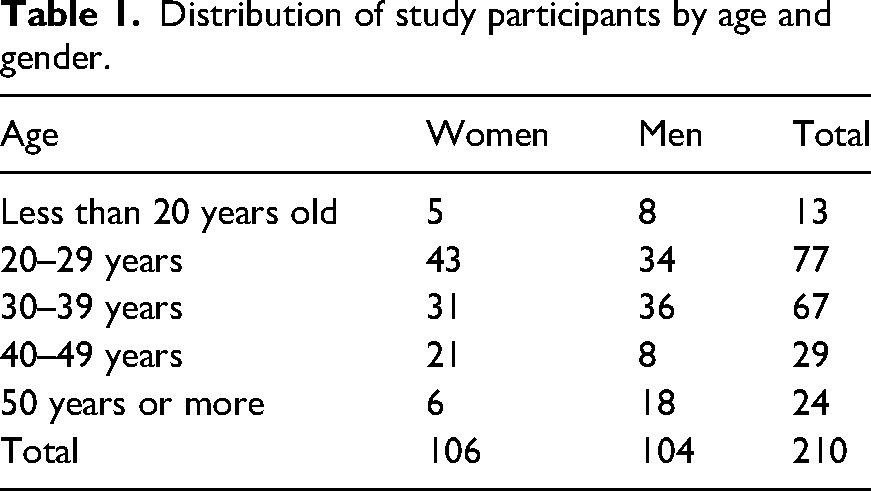
Distribution of study participants by age and gender.
A total of 106 women and 104 men participated in the survey. Table 1 shows an interesting distribution in terms of the ages of the practitioners who contributed information. In general, this was a young population, with 157 people aged 39 years or younger, which shows the growth of the field in Mexico in recent years.
We will now turn our attention to the level of experience of the survey participants. Figure 1 shows that 120 of the participants had worked for three years or more in PCST. In contrast, the category with the lowest range of experience (less than one year) was represented by the lowest number of participants (14).
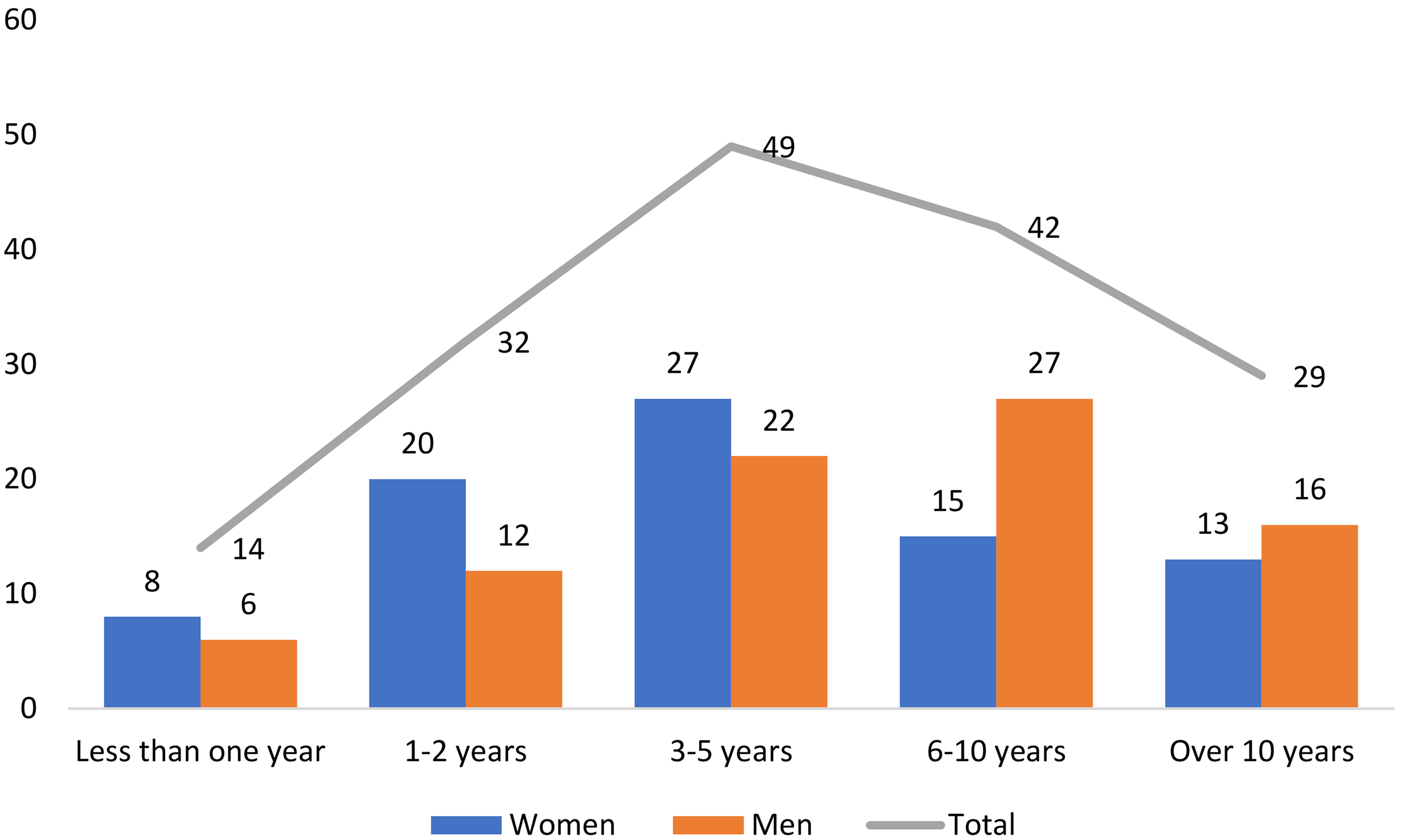
Distribution of participants by PCST experience.
To complete the characterization of the participants in the study, we sought to identify their level of education, training profile and degree of participation in PCST activities. There were 44 university students, 77 individuals with a bachelor's degree, 59 with a master's degree and 30 with a doctorate. Regarding the area of training, 85 people were trained in basic sciences, 52 in engineering, 29 in health sciences, 21 in humanities, 16 in social sciences, 5 in education and 2 in other fields.
Regarding the amount of time that participants dedicated to PCST activities, the highest number of participants worked on PCST activities from 0 to 5 hours per week (91 participants), followed by 6 to 10 hours (35 participants), 11 to 20 hours (16 participants), and 21 to 30 hours (6 participants). Those for whom PCST was their main work, accounting for between 31 and 40 hours of their work per week, totalled 18 people. Following the classification provided by Lewenstein and Baram-Tsabari (2022), we can categorize the 91 people in the first group as occasional practitioners, the following 35 respondents as active practitioners, 16 intermediate cases (between active and professional), and the remaining 24 people (working on PCST for 21 to 40 hours) can be fully identified as professionals.
A total of 79.05% of the participants indicated that they are or have been part of an organization dedicated to PCST, while 120 respondents (57.14%) stated that they had received some type of training to collaborate in PCST practice. Of the latter, 99 participants (82.5%) indicated that the process adequately prepared them to begin their work. Among the most relevant elements included in the training were key concepts for PCST, development of experimental activities, sources of information, pedagogical elements, group management and voice management.
The duration of the participants’ training programmes provides a reference for their depth of preparation in PCST. At the simplest level, 26 participants had between 1 and 10 hours of preparation; 25 participants had between 11 and 20 hours; 18 participants had between 21 and 40 hours; and 51 participants had a preparation of more than 40 hours. This indicates that 141 participants (67.1%) had very limited PCST training (less than 20 hours) or nothing at all. This highlights the need to provide a greater supply of training programmes for those who wish to engage in this work or, at the very least, collaborate in this field.
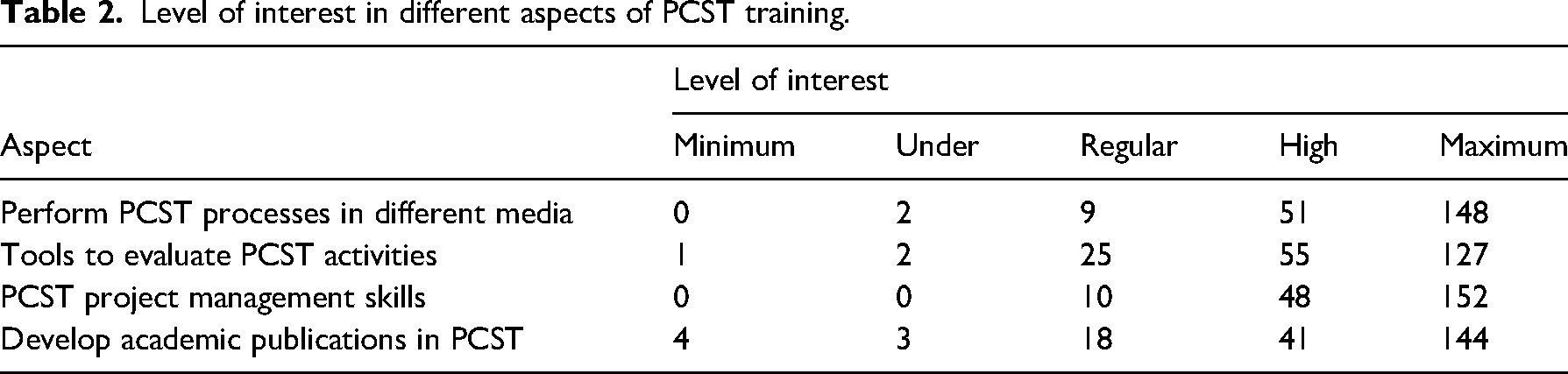
On this basis, participants were consulted on which aspects they would like further training in (Table 2). There was a maximum level of interest in all aspects, with the highest level of interest (72.38%) in PCST project management and the lowest level in evaluation tools (60.48%). It is thus possible to establish a comprehensive training programme aimed at full professional development.
Level of interest in different aspects of PCST training.
Participants were asked to indicate the theoretical and practical aspects in which they would like to be prepared as part of a professionalizing programme. Figure 2 shows these aspects, which can serve as a guideline for the theoretical training required by Mexican PCST practitioners.
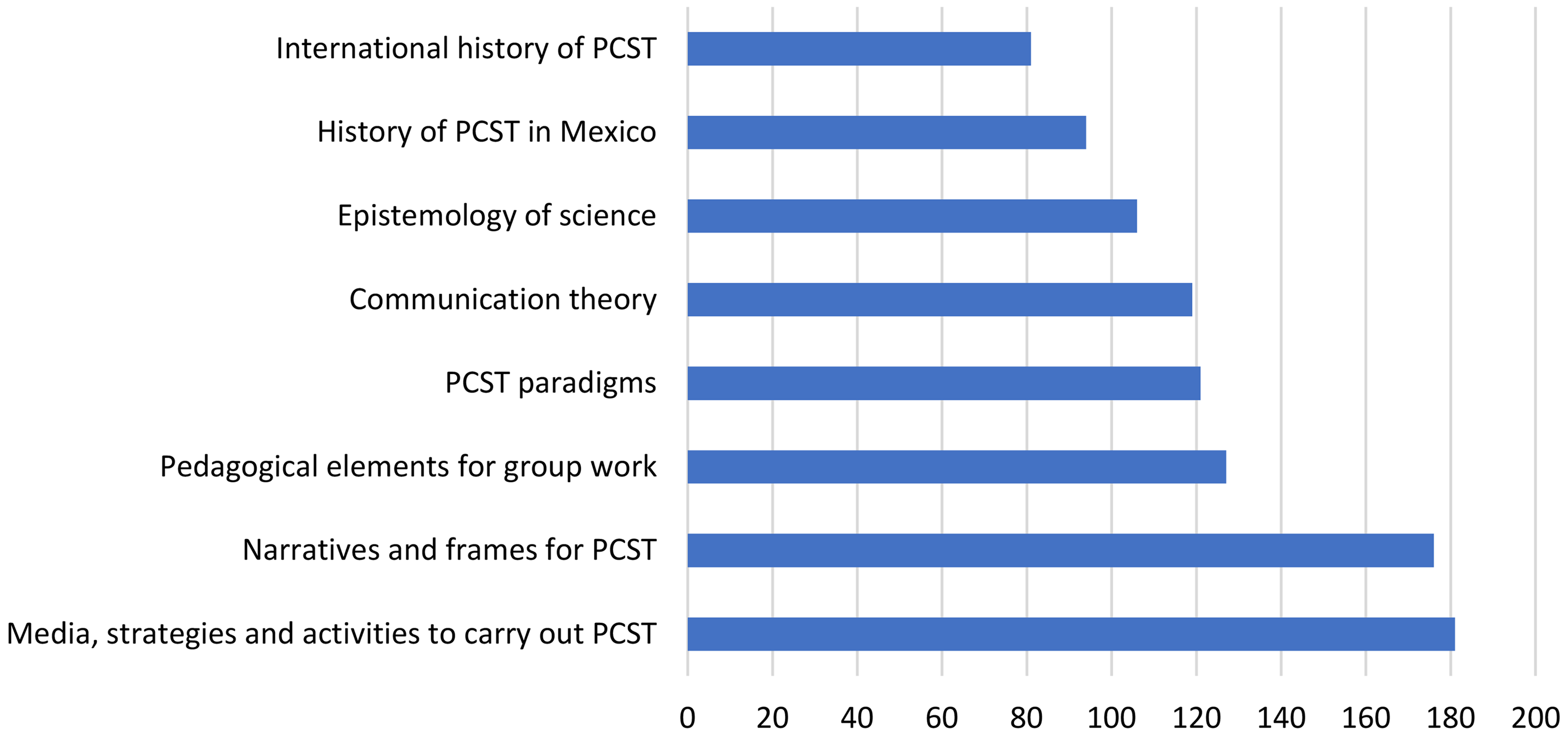
Theoretical aspects in which the participants wish to prepare themselves.
Participants expressed the highest preference for training in ‘Media, strategies and activities to carry out PCST’ (86.20%), followed by ‘Narratives and frames for PCST’ (83.8%), ‘Pedagogical elements for group work’ (60.5%), ‘PCST paradigms’ (57.6%), ‘Communication theory’ (56.7%) and ‘Epistemology of science’ (50.5%). Only two aspects had a response lower than 50%: ‘History of PCST in Mexico’ (44.8%) and ‘International history of PCST’ (38.6%).
More importantly for a programme that will seek a professionalizing approach is the review of the practical aspects the PCST practitioners perceived as necessary for their preparation. Figure 3 shows the results obtained from the survey. Eighty-one percent of the responses expressed an interest in ‘Design, management and development of PCST projects’, followed by ‘Writing for PCST’ (73.3%), ‘Development of science recreation activities’ (69.5%), ‘Practical tools: voice management, body expression, group work’ (68.1%), ‘Graphical resources for PCST’ (65.7%), ‘Digital platforms for PCST’ (62.4%), ‘Science journalism’ (57.1%), ‘Evaluation tools for PCST’ (53.3%) and ‘Creation of systematic PCST programmes’ (51%). Regarding this practical dimension, there were only two aspects with less than 50% support from the participants: ‘Reliable sources of information’ (44.3%) and ‘Success stories in PCST in Mexico’ (32.4%).
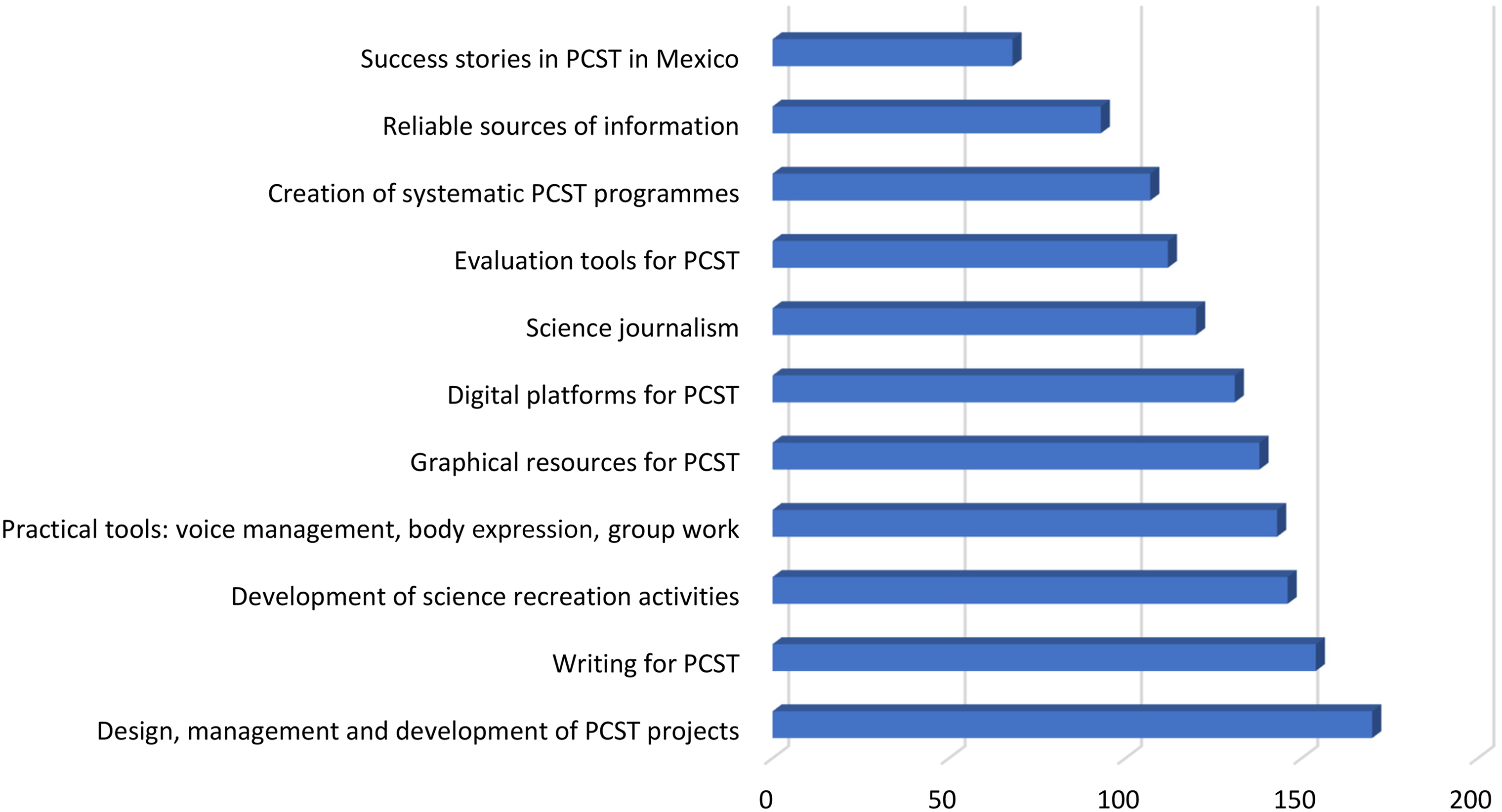
Practical aspects in which the participants wish to receive preparation.
To conclude the analysis of PCST training needs in Mexico, it is necessary to discuss participants’ perspectives regarding possible participation in a postgraduate programme. The survey results showed that 79.5% of the participants believed that studying a postgraduate programme in PCST will help improve their professional performance, 17.6% said they were not sure and only 2.9% rejected the idea that it would allow them to improve. Regarding the possibility of facilitating successful entry into the labour market, 53.3% stated that a postgraduate degree would help them, 37.2% were not sure and 9.5% said there would be no benefit.
When asked for their preferred option for a postgraduate degree in PCST, 31.4% chose a diploma course, 27.6% preferred a specialty and the most favoured option was a master's degree, selected by 41.0% of participants. Regarding the most appropriate modality for studying a programme of this nature, the face-to-face option was selected by 17.6% of participants, followed by the online modality (35.2%) and a mixed option (46.2%) (1% of participants indicated that they were not interested in any of them).
The last question asked about participants’ interest in becoming a student in a master's degree programme in PCST if it were to be created in the next few years. A total of 121 participants (57.6%) expressed interest in studying such a postgraduate programme, while 12 participants (5.7%) indicated that they would not participate and 77 participants (36.7%) indicated that they were not sure.
The findings of this study underscore the urgent need for specialized training programmes in PCST, particularly those that emphasize practical competencies. The survey revealed high demand for practical training, particularly in project management (81%), writing (73.3%) and science recreation activities (69.5%). Science communicators must be adept at using various media to reach non-specialist audiences, a need that is mirrored in the Mexican context. This reflects a global trend where project-based initiatives have become essential for engaging diverse audiences (McKinnon and Bryant, 2017).
Interestingly, while the survey showed significant interest in media strategies and activities (86.2%) as well as in narrative management and framing (83.8%), there was less enthusiasm for theoretical aspects such as the epistemology of science (50.5%) and the history of PCST (38.6%). This suggests that practitioners prioritize tools and strategies that can be immediately applied to their work over abstract theoretical knowledge. This finding aligns with observations from other countries where PCST practitioners often emphasize the importance of developing practical, hands-on skills (Daoust-Boisvert, 2022). However, it also points to a potential gap in the Mexican PCST community's engagement with critical reflection on the role of science communication in society, which is crucial for the field's long-term development.
The preference for hands-on training also reflects the current state of PCST in Mexico, where many practitioners enter the field without formal training and must rely on informal learning opportunities. As Reynoso (2008) notes, this ‘artisanal’ approach to science communication can be effective in the short term but often leads to inconsistent quality in public engagement initiatives. A structured educational programme that integrates theory and practice would not only address this gap but also help standardize the field, providing practitioners with a shared set of competencies and professional norms.
Theoretical needs point to four fundamental areas, all of which point towards the reflective goal in Baram-Tsabari and Lewenstein's (2017) characterization: science and society, educational foundations, narratives and frames, and PCST studies. In terms of practical skills, there is demand for training in a wide range of areas that combine PCST methods with participation goals: general tools for PCST, writing and handling of written media, recreational science, digital resources, science journalism, project writing and project management. At the bottom line, with a project-based and active approach, students should achieve their affective and identity goals.
Regarding the implications of the master's programme design, the findings suggest three main lines of work that should be prioritized: reflective courses, practical skills courses and elective courses.
Reflective courses. An initial course of this type must address the science, technology and society relationship, how PCST is relevant in this context, as well as fundamental PCST models and theories. A second course should discuss science communication, public engagement with science and public understanding of science in the context of informal science education, considering pedagogical elements. Also, as a bedrock to any PCST initiative, there must be a course focusing on the use of narratives, storytelling techniques and framing to effectively communicate science. Practical skills courses. Writing is a fundamental skill for science communication, whether for communicating directly with the public or for preparing an exhibit, workshop or video. Thus, a series of courses on developing writing skills is indispensable. Given the relevance of social media today, there must also be a course on utilizing digital platforms and tools for science communication. A science recreation course will be key to providing students with tools to interact with different audiences. Evaluation is an essential requirement for any PCST professional, so it is essential to have a course on measuring the impact and effectiveness of programmes and activities. Finally, to integrate all aspects of PCST, there will be a project design and management course focusing on planning, developing and evaluating PCST projects, including topics such as budgeting, timelines and stakeholder engagement. Elective courses. It is important for a master's programme not to be rigid but to instead have the flexibility to adapt to the needs and interests of students. In this sense, the programme should provide options such as ‘epistemology and history of science’, ‘ethics in science communication’, ‘science journalism’, ‘artificial intelligence and PCST’ and ‘research in science communication’.
By incorporating these core and elective courses, a master's programme can effectively address the identified training needs of PCST practitioners in Mexico and equip them with the necessary skills to contribute to the field.
Conclusions
The professionalization of PCST in Mexico has made significant progress, yet critical gaps remain, particularly in the availability of formal training programmes that balance theory with practical skill development. This study has provided a useful overview of the training needs within the Mexican PCST community, proposing a framework for the creation of a professionalizing master's programme at the Autonomous University of Zacatecas. The findings indicate a strong preference for training in practical skills, such as project management and digital media, alongside a need for theoretical foundations in science–society relations and narrative framing.
The emergence of courses within scientific careers and diplomas in science popularization has offered valuable routes to prepare new generations of practitioners. However, to approach professional maturity, the PCST community in Mexico requires programmes with a more in-depth approach, such as those offered by a master's degree. So far only two institutions, the National Autonomous University of Mexico and the Western Superior Studies Institute, offer master's degrees related to PCST, and in both cases the emphasis is on theoretical analysis and management rather than practice. In this sense, there is a need for the emergence of professionalizing programmes that respond to the needs of the Mexican community.
Addressing these needs through a professionalizing master's degree, tailored to the needs identified in this study, would not only enhance the professional identity of Mexican PCST practitioners but also contribute to the formalization of the field as a recognized profession. Moving forward, it is essential to engage stakeholders from academia, government and the private sector to create employment opportunities for trained professionals and to raise awareness of the value of PCST within society. The proposed programme represents a crucial step in this direction, offering a model that could be replicated in other regions to support the global growth of science communication as a profession.
Footnotes
Declaration of conflicting interests
The authors declared no potential conflicts of interest with respect to the research, authorship, and/or publication of this article.
Funding
The authors received no financial support for the research, authorship, and/or publication of this article.

Author biographies
Miguel García-Guerrero has a career spanning more than 29 years in PCST. Since 2001 he has worked at the Museum of Sciences of the Autonomous University of Zacatecas and coordinates the Quark Group. He is the author of 5 books and coordinator of 11 others, all on science outreach. He belongs to level 1 of the National System of Researchers in Mexico. He was the founding president of Recreación en Cadena, the Mexican Network of Science Recreation Groups, and he is the Science Outreach Coordinator of the Mexican Society of Physics and the Executive Director of the Network for the Popularization of Science in Latin America and the Caribbean (RedPOP).
Ilse Magdalena García-Nava has a degree in secondary education with a specialization in chemistry from the Zacatecas Teacher Training Center (CAM). She completed her master's studies in Humanities and Educational Processes at the Academic Unit of Higher Teaching of the Autonomous University of Zacatecas. She has ten years of work experience in different secondary education institutions in the state of Zacatecas, during which she has worked as a chemistry teacher and has participated in the Experiential and Inquiry Teaching Collectives of the Sciences (CEVIC). She has been a member of the Quark Group since 2019, where she has participated in PCST activities at the Science Museum of the Autonomous University of Zacatecas.