



Abstract
This paper provides an account of my perception as a woman doing science, and examines the general situation and evolution of women's participation in science in Portugal. I will start with a slightly broader perspective, emphasizing a few global trends in women's participation in science and alluding to one persistent obstacle: gender discrimination. These trends also define the Portuguese context. Despite significant progress in opening the door to women's participation in science, it remains challenging for women to pursue a viable career path in research and ascend the hierarchy. Beyond the glass ceiling, top positions are still reserved for a predominantly male old guard. Yet pioneering women have shown that changes can happen and have opened the door for us to collectively continue this important work—something that I am proud to be part of.
‘You already have a doctorate, what more do you want?’
—Max Planck to Lise Meitner 1
Introduction
When talking about gender discrimination in science, it becomes impossible not to allude to historic episodes of pioneering women who were discriminated against based on gender premises and to their fight to pursue careers in science—for what they meant at the time and for what they represent for women's participation today. The struggles and successes of those women against gender discrimination are important to keep alive, to remind us that the path for women in science has not always been easy, but, most importantly, that gender inequalities are possible to overcome if women unite to fight for their rights.
I will start with some stories about the experiences of prominent women scientists in the twentieth century, illustrating the challenging realities they faced at the top of the profession despite their outstanding contributions scientists. I come back to this point in the second part of this paper, when describing the context in Portugal where women faced similar realities, and where a strong domestic ideology continued until almost the end of the twentieth century. These accounts, and the numbers from national and international reports that I will show here, speak to the discriminatory environment for women in achieving recognition of their merits that continues today, and the low status that women, compared to men, have long faced in science.
Limited access and lack of recognition
On 5 July 1934, The Guardian announced the death of Marie Curie, a major figure in science. 2 She died at the age of 66 from pernicious anaemia, after years of working with radiation. Madame Curie was the first woman in France to receive a doctorate and the first woman to be employed as a professor of general physics at Sorbonne University in Paris after the death of her husband in 1906. She was also the first woman to be awarded a Nobel Prize—the highest recognition in science. In fact, she won two Nobel Prizes in distinct fields, one in physics in 1903 and another in chemistry in 1911, and remains the only person to have received this accolade in two sciences. This astonishing accomplishment seems scarcely possible in the lifetime of any scientist; even more remarkably, it came at a time when science was a place for men, and great scientific achievements were uncommon for women. In the then male-dominated environment, Marie Curie and many other remarkable female scientists who have made important contributions to science had to overcome major social obstacles related to the condition of having been born female. Social stigma, sexism, biased judgements and gender-based prejudices against the value of their work did not, however, stop them fighting for their place in science and recognition of their work.
Gender discrimination in science has historical, cultural and social roots. Only rarely have women scientists been truly recognized for their contributions, wisdom and brilliance. Of the 954 individuals who received Nobel Prizes over 120 years, only 53 have been women—just 5.6%. As Santos et al. (1991) discuss, certain circumstances illustrate well that this gender discrimination cannot be considered ‘accidental’. Whether in getting an education, competing for positions, or achieving recognition through awards, being female downgraded women's standing and visibility in science. Perhaps the best known example is the failure to elect Marie Curie to the French Academy of Sciences in 1911: although she already held two Nobel Prizes, she was overlooked in favour of the less-deserving Edouard Branly. Owing to sexism in academia, she had already been denied a place at Kraków University on her return to Warsaw in 1894, despite holding two degrees from Sorbonne University (see Goldsmith, 2005). Another well-known case is that of Rosalind Franklin (1920–1958), who earned a PhD at the University of Cambridge in 1945. In her short lifetime, she produced research that was helpful in the discovery of the structure of DNA, which led to Watson and Crick winning a Nobel Prize. However, her contributions to this discovery were not recognized, leaving her in the shadow of the discovery (see Maddox, 2002). Similarly, Jocelyn Bell-Burnell (1943–) discovered the first pulsars in 1967 as a graduate student but did not receive the Nobel Prize in physics awarded for this discovery in 1974 (Hewish et al., 1968). Her story is portrayed in a recent video (see Proudfoot, 2021).
These stories illustrate the hostile environment for women in science over the years at the highest level. Yet perhaps the most important lesson from these stories is what these women represent: they represent a mark in science and in the history of women in science. They break with the idea of science made by men and for men, of the ‘gentlemen of science’ (Cohen, 1998), and of competitive, aggressive environments in which only men can triumph. They represent pioneering steps towards gender equality in science, and their legends go far beyond their extraordinary scientific achievements. They symbolize perseverance and the courage needed to bear environments closed to women, to stand their ground and fight for the rights of generations to come. These strengths have certainly affected the role of women in science today, which is evidenced in the growing number of female scientists who have had opportunities and have made science their careers.
A ‘turn’ in the numbers in the twenty-first century
I will now briefly review global and European trends of women in science to evidence the progress achieved in opening the door of science to women, but also point to some details in the numbers of women researchers to show that, behind this opening, challenges for women remain.
High increase in female researchers worldwide
Global indicators over recent decades undeniably point to the increase of women's level of education and participation in science, in all areas of research. In the early twentieth century, women were barely represented among scientists holding PhD degrees. Today, however, women account for 44% of doctorate holders (OECD, 2022) and 33% of researchers 3 worldwide (UNESCO, 2020a). According to data from the UNESCO Institute for Statistics 4 for 107 countries covering the years from 2015 to 2018, this proportion of researchers is higher than five years ago (28.4%). However, this representation is not equal across global regions. The regional averages for the share of female researchers are higher for Central Asia (48.5%), Latin America and the Caribbean (45.8%), Arab states (40.9%), Central and Eastern Europe (39.0%), North America and Western Europe (32.9%), contrasting with sub-Saharan Africa (31.1%), East Asia and the Pacific (25.0%), or South and West Asia (23.1%), where the share of women in research is lower (UNESCO, 2020a). Despite some limitations (for example, some countries do not collect relevant data regularly), 5 the available data from various sources confirms a trend towards achieving gender parity in research. However, the data also shows differences in the areas in which women show higher representation: physics, mathematics and engineering are less popular among women, whereas health and welfare, social sciences and journalism, and arts and humanities are more popular, with female representation reaching about 80% in some disciplines and countries (UNESCO, 2020a).
In Europe, the share of female researchers in higher education is relatively high. Countries such as Lithuania (50.7%), Latvia (52.4%), Bulgaria (52.8%) and Portugal (51.3%) have the highest shares of women in science, whereas Italy (40.4%), Denmark (44%), Malta (35.8%) and Hungary (37%) have lower shares. The numbers are even higher for the share of women in science and technology positions overall (including other sectors than higher education).
Low representation of female scientists in top positions
Looking at the aggregate numbers, gender parity appears to have been largely achieved. However, this masks the underlying issue of women being poorly represented in senior positions and in top management roles.
In 2000, the European Commission commissioned an important report on women and science to an independent Expert Working Group (European Technology Assessment Network for Women and Science, ETAN). 6 The study, the first of such type, aimed to assess the position of women in science in Europe. The report showed that women were very poorly represented in senior positions in countries such as the Netherlands (5.0%), Belgium (5.1%), Switzerland (5.7%), Germany (5.9%) and Austria (6.0%). Even in countries with higher percentages of females in senior positions, women's representation was still low: Finland (18.4%), Portugal (17%), Australia (14%), the United States (13.8%) and France (13.8%) (European Commission, 2000). Twenty years later, the numbers have changed little. According to UNESCO data for 2018, women made up 43% of teachers in universities but held only 18% of top management roles. The male–female divide is even wider in school governance and education policymaking (UNESCO, 2020a). For example, in 2020, only 15% of rectors in the European University Association (EUA) were female, compared to 85% males, and this represented an increase of 38% from the proportion of female rectors in 2014 (EUA, 2020).
Also, these numbers tell us little about the conditions in which scientific researchers, including women, work, are integrated and are promoted. A study by the Organisation for Economic Co-operation and Development (OECD, 2022) showed that around 90% of the researchers in OECD countries were in precarious, short-term contracts and fellowships. Most do not enter academic careers, and those that do have difficulty progressing (OECD, 2022). The numbers clearly indicate that women in science still contend with inferior standing compared to men. I will come back to these points later in this paper, as this also reflects the context in Portugal.
I will now turn to focus on these issues in the Portuguese context by briefly talking about the evolution of women in the scientific profession, presenting short historical accounts and reporting national statistics.
Women's participation in science in Portugal
In Portugal, the participation of women in science has followed the general trends outlined above: a period of strictly no access and recognition followed by growth in the numbers of women doing science but with a persisting problem of low status in the profession. Yet, compared to women in many other countries, those in Portugal were late in entering all professions (Ferreira, 1986), and science was no exception. This is largely attributable to the New State (Estado Novo) dictatorship that governed the country from 1933 to 1974. 7 During this period, the practice of science was scarce, conducted by men, and mostly restricted to state laboratories, while women were principally limited to the roles of housewife and mother based on a strictly domestic ideology and vision (Cova and Pinto, 2002). This authoritative, conservative and anti-feminist regime did not recognize the principle of gender equality in the constitution and did not provide equal rights for women, including political, legal, economic and educational rights (Ferreira, 2005; Monteiro and Ferreira, 2016); the university was an elitist space for the education of a few intellectuals. This does not mean, however, that women did not work; it was not uncommon for day labourers to work in the fields, farming, harvesting or olive picking, or in more specialized jobs (Fonseca, 2020).
The first female admission to a Portuguese university and the first award of a higher academic degree to a woman took place very late. The University of Coimbra (established in 1290 and among the oldest in Portugal) did not admit a female student until 1891, when Domitila de Carvalho was permitted to enrol in mathematics (Carvalho, 2004; Gomes, 1991), and did not award a PhD to a woman until as late as 1965, when Seomara Da Costa Primo of the Faculty of Sciences became the first female recipient. In the University of Lisbon, the first woman to earn a PhD was Maria Manuela da Gama Figueiredo Assalino in 1939 (Santos et al., 1991).
Perhaps ironically, in the early years of Estado Novo, the National Board for Education (Junta de Educação Nacional, JEN) was created to plan and fund science and to internationalize Portuguese science between 1929 and 1936 (Lopes, 2017). Several scientists went abroad to get PhDs and bring knowledge back to the country under the JEN programme of individual fellowships. One of the few women scientists to participate in the JEN programme was Branca Marques (1899–1986). In 1931, after obtaining her degree in physical–chemical sciences from the Faculty of Sciences of the University of Lisbon, Marques went to Paris to do her PhD research in nuclear physics at the Curie Laboratory of the Radium Institute under the supervision of Marie Curie; she received her doctorate in 1935 (Heliodoro, 2012). After returning to Lisbon to the Faculty of Sciences, Marques founded the first radiochemistry laboratory in 1938, and she also became the first female full professor in a faculty of sciences in Portugal after many years as a research assistant. As a member of the Portuguese Society for Chemistry and Physics (since 1931), she was a constant presence at society meetings, yet was almost always the only woman in attendance (Heliodoro, 2012).
Although these were not good times for women, they were not silent. Many Portuguese women manifested concern over female emancipation. One notable figure was Carolina Beatriz Ângelo (1878–1911). She was a medical doctor and the first female surgeon in Portugal, which was against the strongly sexist preponderance of male surgeons at the time. She became the first woman to vote in Portugal in 1911 by invoking her status as head of the household after being widowed (prompting a change in electoral legislation to block women from voting). 8 Ângelo was a feminist involved in many initiatives, including the Republican League of Portuguese Women (Liga Republicana das Mulheres Portuguesas) (1909–1919). Created by a group of educated and intellectual women, this feminist political association focused on advocating female emancipation, particularly women's education, the right to vote, the fight against poverty, and, above all, gender equality. Ângelo was also involved in the creation of the Association of Feminist Propaganda (Associação de Propaganda Feminista), which planned the creation of a school for nurses. These associations ended amid political instability in the First Republic (1919–1926) (Esteves, 2001). There were other women's groups and organizations throughout the Estado Novo to represent women and fight for women's rights, but they had little support and visibility and did not flourish or grow as lasting groups (Cova and Pinto, 2002). The first important state mechanism for equality was created in 1970 by the Working Group for the Definition of a Global National Policy on Women (Monteiro and Ferreira, 2016); its work is continued by the current Commission for Citizenship and Gender Equality, pursuant to Decree–Law No. 164/2007 of May 3. It is around this commission that some networks of women's associations have formed in various sectors, including science.
Despite the dark years for women under the Estado Novo regime, Portugal quickly caught up following the revolution of 25 April 1974 and the fall of the authoritarian regime. During the past almost 50 years of democracy, Portugal has eliminated gender discrimination from its legislation (Monteiro, 2011). Moreover, it has expanded its infrastructure for science in parallel with the growth of the workforce, where women had a fiery entry. Many political developments occurred in the years that came, including Portugal joining the European Union (in 1986), creation of the Ministry for Science (in 1995) and the Foundation for Science and Technology national funding agency (in 1997), and increasing budgets for science (Entradas et al., 2020).
The precipitous rise of women into science since the 1990s
In 1950, around 42% of the Portuguese population was illiterate (the percentage among women was even higher), and only 0.04% of the Portuguese population had completed university degrees (Gonçalves, 2003). This picture changed quickly after 1975, and more so over more recent decades. In 2021, less than 2% of Portuguese citizens were analphabetic, with women accounting for 68% of these individuals (Instituto Nacional de Estatística, INE, 2022). Moreover, in 2020, 33% of women in Portugal had higher education degrees, compared to 28% of men. This reflects significant increases on the respective percentages of 20% and 14% recorded in 2011 (INE, 2022) but also indicates a ‘turn’ in which the percentage of women with degrees surpassed that of men. Nevertheless, researchers made up about 1% of the active population in 2020, up from 0.8% in 2012.
In terms of women's participation in science, Portugal has become an international exemplar of gender balance. As noted above, the percentage of women employed in science is higher in Portugal than in many other countries. Portugal also stands out for the representation of women among science students, which has been quite stable at over 50% during the past decade (UNESCO, 2020b). National data (Figure 1) shows that female students have consistently accounted for over half of all students in higher education institutions, including both universities and polytechnics, since 1990 (DGEEC, 2022a).
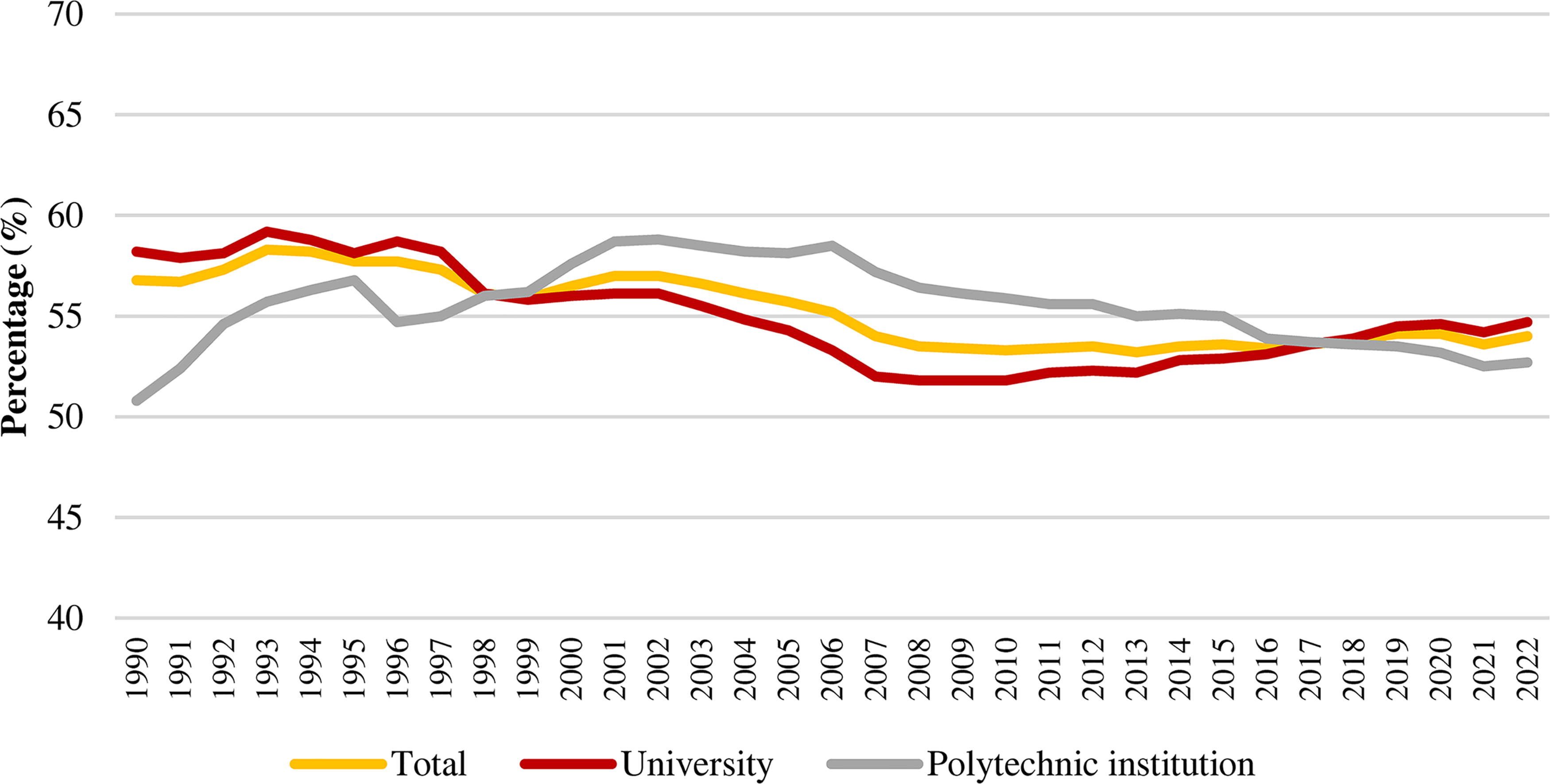
Percentage of female students in Portuguese higher education institutions between 1990 and 2022. Source: DGEEC (2022a).
The number of women scientists has also significantly increased over recent decades, moving close to parity with male scientists. According to national statistics, the number of researchers in public universities rose from 24,296 in 2001–2002 to 30,372 in 2021–2022, when the female proportion was around 46% (Table 1, INE, 2022). However, it is important to note that many researchers have temporary contracts, and only a small percentage are integrated into academic careers or hired as ‘academic staff’ in universities (with permanent contracts). Between 2017 and 2021, 64% of researchers (not ‘academic staff’) in Portugal were employed under temporary contracts; this refers to all those who are not ‘academic staff’ (DGEEC, 2021). Although this issue affects both men and women, the impact on women is greater as they are more concentrated in postdoctoral and lower-level positions.
Number of personnel employed in the fields of research and development (R&D) in public universities in Portugal.
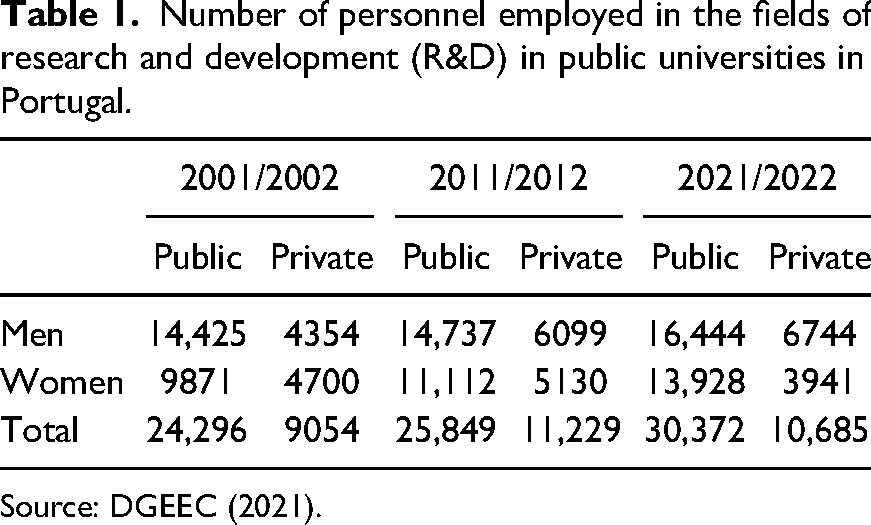
Source: DGEEC (2021).
The research community in Portugal seems to be fragmented, with two parallel career paths: academics in universities (academic staff who also conduct research) and ‘entrepreneur’ researchers working in universities and other scientific institutions on temporary contracts. A few institutions have created a separate career track for researchers in universities, but this development is very recent and the outcomes are unknown.
Despite very positive trends in the total number of women in science education and research, Portugal is similar to other countries in lacking gender equality in top-level positions, particularly full professorships and in management and decision-making roles in higher education. Jesuíno et al. (1995) showed that, in the late 1990s, only 17% of full professors in Portuguese universities were women. More recent data shows that after 20 years there has been little change.
Figure 2 illustrates the overall underrepresentation of women in all three levels of professorship, and the gap widens as we ascend the hierarchy. Even the low-ranking positions are still dominated by men, although there has been progress towards parity at this lower level in recent years. In 2001, 39.2% of assistant professors were women, and in 2012 that proportion was 46%. In 2022, only 37% of associate professors and just 25% of full professors were women (DGEEC, 2022b). Figure 3 also shows the very limited representation of women in Portuguese university rectorates: only in 2000 was the first woman appointed to a rectorate, and the total number of women in rectorates did not exceed two until 2018 (INE, 2022).
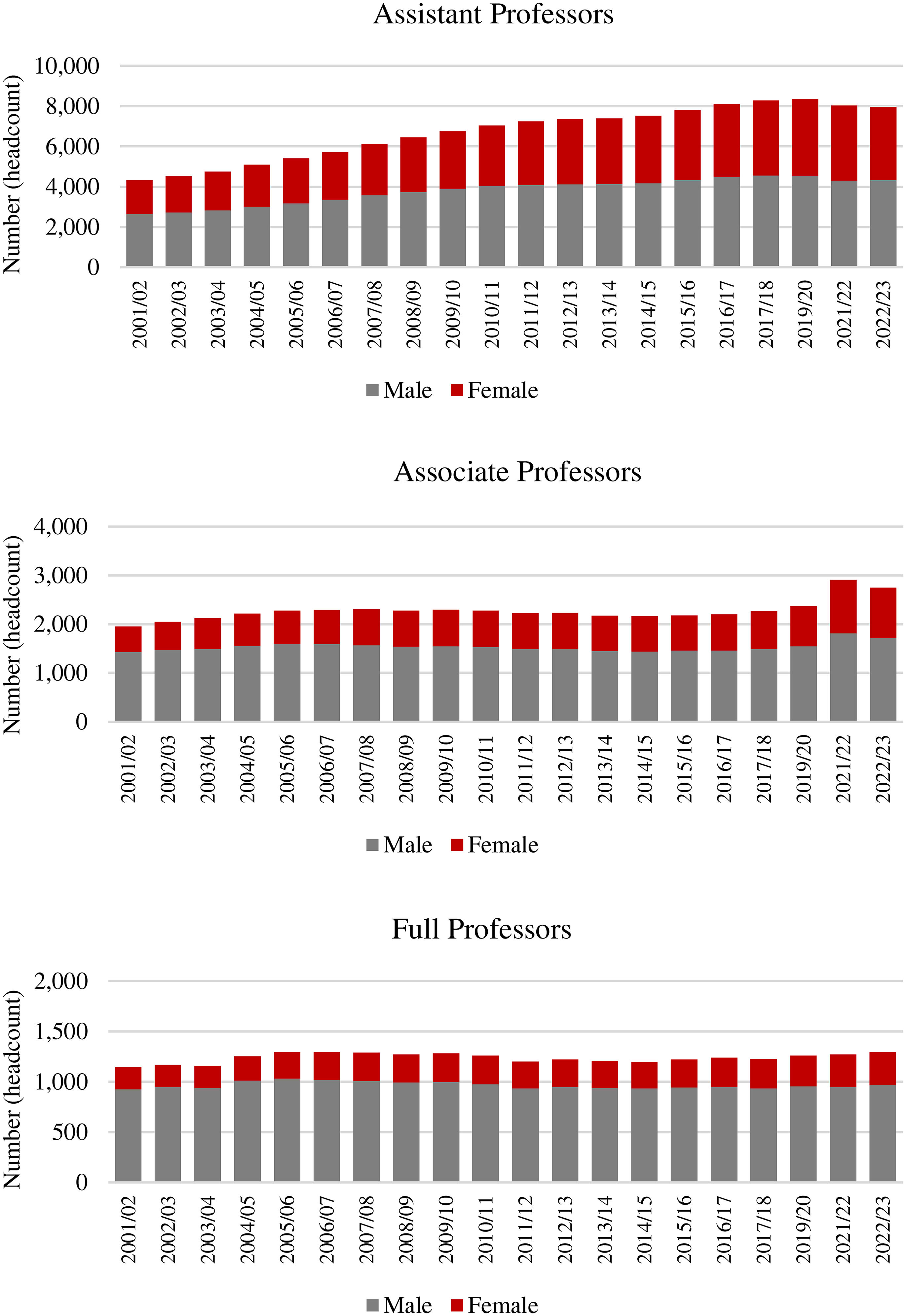
Numbers of female and male for assistant professors, associate professors and full professors at Portuguese universities from 2001–2002 to 2022–2023. Source: DGEEC (2022b).
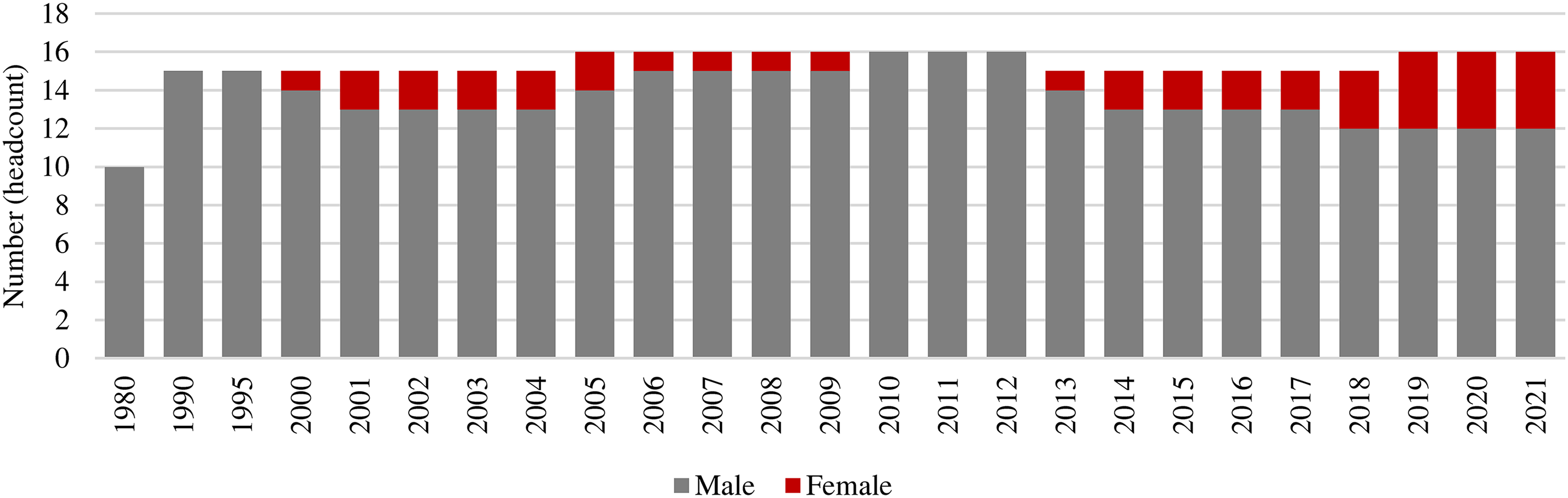
Numbers of men and women in Portuguese university rectorates from 1980 to 2021. Source: DGEEC (2022b).
The stories of women presented here and the national and international numbers show the astonishing progress made in tackling gender discrimination worldwide. Gender equality has become part of European and national policies and organizations that aim to promote equal participation and opportunities for women and men, especially in access to education, science and scientific decision-making. But they also show that gender discrimination in science has been present since women have been doing science. The old problem in recognizing women's achievements and merits persists today, even in societies and in fields of research where women are in the majority.
Disfavour of women in access to science or failure to recognize their achievements based on gender premises did not promote women as scientists in society and has affected women's status for generations. Women are seen as less brilliant in science by the public—the ‘gender brilliance’ stereotype (Storage et al., 2020), which is common across the world, even in countries that are more gender-equal (Miller et al., 2015). And women are also underrepresented in careers in which success is perceived to depend on high levels of intellectual aptitude (such as brilliance or genius).
This is recognizably not a question of scientific capacity, as shown by the many examples of brilliant women who have made important contributions to the advancement of science, and no convincing evidence that women are intellectually less capable than men exists (Miller et al., 2015). Why is it that women continue to have a lower status in the profession, if not for the segregation of the fields by those who want to preserve their power and keep it as it has always been?
This gender discrimination is seen at two main levels, at career entry and in top positions, as shown here and points to two main problems: job insecurity and a lack of access to top positions.
The push at European and national levels to increase these numbers through schemes that involve opportunities for PhDs and postdoctoral research has been enormous, yet these initiatives seem to be detached from institutional policies to integrate young researchers into academic careers. This raises important questions about the place of PhDs in society and their role in the national scientific system and universities, and in other sectors. In Portugal, attempts to address the precarious conditions faced by scientists working in universities (the large majority) have been short-term measures, not comprehensive solutions. This represents a failure of academic and political institutions to define and implement policies to encourage recruitment of researchers in the sectors they are needed.
Women are particularly affected by the lack of recognition and the resulting limitation of their promotion prospects. This is an old problem, and confirms the persistence of a glass ceiling, under which women are generally restricted to lower-level professor positions and poorly represented at the senior management level, which continues to be dominated by men. This glass ceiling might be a more serious problem for women working in more conservative institutional cultures such as Portugal's, where institutions are characterized by conservatism and ‘academic inbreeding’ is a prominent feature (Horta, 2022). Research on gender topics continues to show that university cultures are hard to change, and in many cases are ruled by the old modus operandi of introspective reasoning, gender values that deviate from equality, and progression that disvalues merits (Amâncio and Santos, 2021). This extends the problem of elevating the status of women. As Amâncio and Santos (2021) argue, this lack of recognition of women's achievements and merits in Portugal is rooted in the gender values and ideology of the Estado Novo regime, which seem ‘particularly difficult to break in the absence of women's voices that raise awareness on gender equality’. In this respect, it is interesting to note the creation of the Portuguese Association of Women in Science (Associação Portuguesa de Mulheres Cientistas) in 2003 by 10 senior female professors, aiming to promote gender equality in science and fight for increased representation of women in governance and top positions. Associations such as this one are needed to elevate women's status in science.
The absence of women from senior positions reflects lost potential to maximize their capacities and talents. It is also problematic from a social justice and institutional perspective in terms of scientific growth, as well as an impediment to promoting deserving women. Equality in science is not yet fully achieved at many levels, but there is a path for further progress.
Finally, this story and its struggles are also mine. I am part of a generation of female scientists benefiting from the progress initiated by pioneers; I have enjoyed (competitive) opportunities to go abroad to pursue a PhD and to build a career internationally. I see how these opportunities have helped me become the researcher I am today, driving my passion for research. Yet I also see the ongoing challenges in the academic system, particularly the need to better integrate women. I am confident that these challenges can be overcome through all women speaking with one voice to government and institutions. Being recognized is a right, not a privilege. In the spirit of Lise Meitner: We do not just want a PhD degree; we also want to fulfil our full role as scientists in institutions and society.
Footnotes
Declaration of conflicting interests
The author declared no potential conflicts of interest with respect to the research, authorship and/or publication of this article.
Funding
The author received no financial support for the research, authorship and/or publication of this article.