




Abstract
A variety of knowledge-related disputes emerged during the formulation of China's fertility policy. As the core epistemological element of policy decision-making, the reliability of data proof was gradually confirmed in this process. In this study, we find that data proof became a crucial consideration when the Chinese government initiated a one-child policy in the 1980s. The government used Song Jian's population cybernetics and the centennial projection of Chinese population growth as decisive support for the promulgation of this policy. The government subsequently planned to introduce a two-child policy in 2011. During this process, fierce competition arose between the knowledge claims advanced by Zhai Zhenwu and Wang Guangzhou, who differed significantly on the measurement of the fertility rate and the willingness of women to bear children. The accuracy of data proof came to be gradually realized by both the government and the public. By drawing on a co-productionist analysis of the interactions among the stakeholders, epistemology and China's agenda in this process, we conclude that a new civic epistemology of data proof for public policymaking was created in the formulation of the two public policies on fertility. This has transformed knowledge production as well as political institutions, identities and representations.
Keywords
Introduction
As the main administrator of public affairs, the government regulates economic production and social life by formulating and implementing public policies. Because science and technology are applied to almost all aspects of economic production and social life in the contemporary world, public policies inevitably rely on them as the basis for factual judgements. Choosing the appropriate scientific and technological knowledge thus becomes a critical part of public policymaking. The choice of knowledge claims requires the approval of all policy participants, including government officials, science and technology experts and the target population. Otherwise, controversies and disputes can arise. The epistemologies shared by the members of a given society act as the basis for knowledge selection in policymaking. Knowledge selection based on a common epistemological basis can yield the maximum consensus.
According to Sheila Jasanoff, we use civic epistemology to represent this common epistemology. ‘Civic epistemology refers to the institutionalized practices by which members of a given society test and deploy knowledge claims used as a basis for making collective choices’ (Jasanoff, 2005: 255). Civic epistemology serves as a conception of world, and, once it has been formed, changes only slowly. It is the basis on which members of the society understand a variety of things. In the knowledge society, ‘knowledge is comprised not of simple statements of truth or fact, but rather of complex judgments regarding how to identify multiple forms of evidence, assess their credibility and meaning, and integrate them together, based on appropriate evidentiary standards and weighting’ (Miller, 2008). By analysing knowledge disputes that arose in the formulation of China's fertility policy, this paper examines the Chinese civic epistemology based on the framework of Jasanoff's co-production theory, with an emphasis on the introduction of data proof and its demands for accuracy.
By drawing on the framework of co-production, we first examine the decision-making process and the knowledge disputes related to the formulation of the one-child policy in the 1980s. The government subsequently considered changing this policy in the 2010s. A new round of knowledge disputes and claims arose in the formulation of the two-child policy. We mainly analyse (1) the particular knowledge disputes and the corresponding knowledge claims in the formulation of the one-child policy and the two-child policy, (2) how these policies were created and the bases for them, and (3) how the knowledge disputes were settled while generating a new civic epistemology of data proof in the formulation of these policies.
Knowledge disputes in the formulation of the one-child policy in the 1980s
The People's Republic of China was founded in October 1949, ending nearly a century of division and war and ushering in a period of peaceful development. In the 1950s, such leaders as Mao Zedong advocated more children in the family, and the national population underwent a rapid rise. By the beginning of the reform and opening-up policy in 1978, China had a population of 960 million that imposed a significant burden on its natural resources, land resources and material production. The Chinese government then faced the historic task of controlling population growth (Chen, 1979).
Different knowledge claims and the core dispute
How does a country control the rapid growth of its population? Three knowledge claims and policy-related suggestions were advanced at the time in response to this question: Liu Zheng and his colleagues used a statistical analysis of the population versus material production and suggested ‘encouraging the family to have one child, and to forbid the birth of a third child’ (Liu et al., 1980). Song Jian and his team predicted the scale of population growth in China for the next 100 years by using a model of population cybernetics and advocated that one family should have only one child (Song et al., 1980). Liang Zhongtang examined China's rural social practices and proposed that a family should have two children over a long period (Liang, 2014). The specific knowledge claims and policy-related suggestions in this regard are listed in Table 1.
Three knowledge claims and policy suggestions.
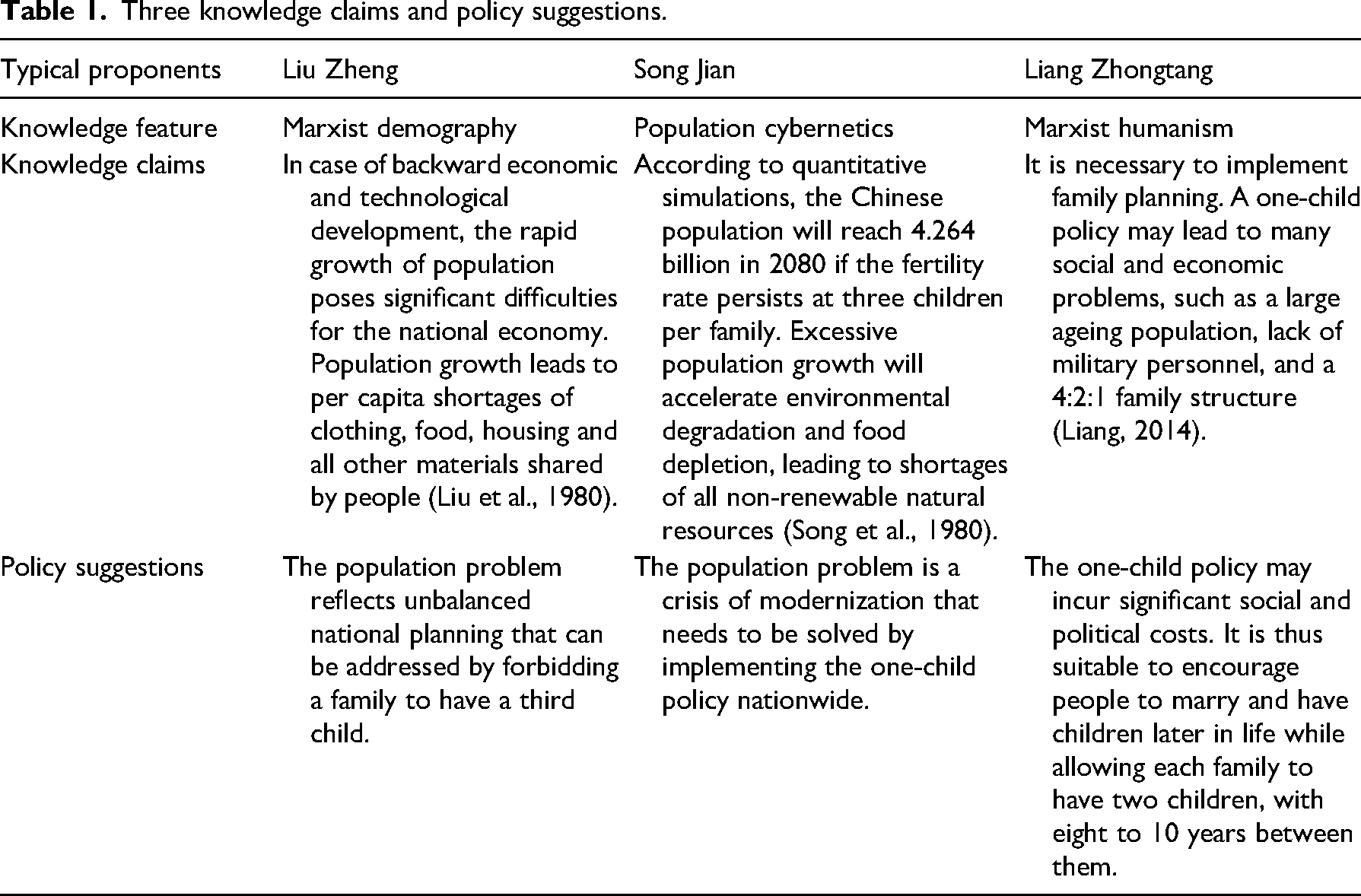
Three knowledge claims and policy suggestions.
The core dispute among the above three claims is as follows: Which policy should the state adopt to better control population growth: the one-child policy, the two-child policy with a long period between births, or forbidding a family from having a third child? There is considerable disagreement among demographers, scholars, political leaders and citizens on this question.
China eventually chose the one-child policy to control rapid population growth. However, back in 1957, Ma Yinchu, the president of Peking University, proposed the ‘new population theory’ and advocated population control. His opinion was criticized as ‘Malthusianism’ by Chinese leaders, such as Mao Zedong, at that time, such that academic research on population-related issues was implicitly forbidden. Faced with the task of controlling population growth in 1978, the government first needed to address the legitimacy of this enterprise. Because the Communist Party of China (CPC) governed the country based on Marxist theory, Professor Liu Zheng of Renmin University of China took the lead in developing the ‘two productions theory’ based on classic works of Marxism to provide the ground for the legitimacy of controlling population growth. ‘Two productions theory’ claims that population growth should be adapted to material production, and it became the theoretical basis for controlling population growth and enforcing family planning in China.
By studying the experience of population management in developing countries, Liu et al. (1979) found that Singapore had incorporated population control into its economic plans with considerable success. They laid the foundation of incorporating the population into national planning from theoretical and practical perspectives. They suggested that every effort be made to forbid a family to have three or more children while encouraging it to have only one child. This would gradually reduce population growth and increase the ratio of one-child families. They also suggested that the government give people the choice of having two children if they wanted to.
However, Liu and his team mainly used qualitative analysis to verify their claims about knowledge of the population and supplemented this with some basic statistics and comparisons of indicators of the growth of the population and the economy. When Song subsequently made his 100-year prediction regarding the population and persuasively proposed the one-child policy, Liu publicly supported it, while some members of his team chose strategic silence (Greenhalgh, 2008). From the perspective of co-production, Liu and his team had institutional advantages in consultations on population-related policies because the Population Development Studies Center at Renmin University of China was traditionally preferred by the government for consultations on population. By comparison, Song was a natural scientist instead of a demographer. However, his predictive model of the population and policy suggestions were finally adopted by the government in decision-making. This reflects the importance of data proof of population cybernetics.
Trained as an aerospace engineer, Song adapted his research to demography according to the requirements of the ‘four modernizations’(the modernization of agriculture, industry, science and technology, and national defence) proposed by Deng Xiaoping, and the policy advocating a transfer of scientific research focus from military affairs to civilian affairs in the early period of the reform and opening-up. In June 1978, Song, who was then deputy director of the Second Ministry of Machine Building, which was in charge of missiles, attended the 7th Conference of the International Federation of Automatic Control (IFAC) in Helsinki. There, he was impressed by the scientific model of population cybernetics proposed by two Dutch experts, GJ Olsder and RCW Strijbos. He also learned about new population theory, the relevant mathematical tools, perspectives on the population crisis, and population cybernetics to solve the population crisis in China (Greenhalgh, 2008). After returning home, Song cooperated with Yu Jingyuan and Li Guangyuan to study population-related issues. In late 1978, they used a computer to simulate the country's population growth over the next 100 years. This was rare in China at the time. Their precise quantitative predictions were beyond the expertise of national demographers at that time.
Song's 100-year population projections showed that China's population would surpass 4 billion people in 2080 if at the fertility rate persisted at three. The forecast shocked and worried national leaders and reinforced the need to quickly control population growth. Song and his team subsequently detailed the economic and ecological crises brought about by such population growth. According to their calculations, China's natural resources could not support each couple having two children. Thus, Song proposed allowing each family to have only one child.
As the central government was formulating a one-child policy in 1979, Liang Zhongtang and some other scholars were researching Marxist theories of human nature and examining the impact of the policy on the rural population, which accounted for 80% of the country's population at the time (Liang, 2014). Agriculture in China had not yet been mechanized and required a large labour force. Therefore, boys were preferred to girls in rural areas. A family with at least one boy could guarantee the basic agricultural labour that was needed.
As the one-child policy was promoted across China in mid-1979, Liang publicly opposed it. In December 1979, the Second National Symposium on Population Theory was held in Chengdu, Sichuan Province. At the meeting, he shared his ‘Several opinions on China's population development strategy for the next decade’, which concluded that population control in the next decade should focus on reducing birth rates, and recommended that families be allowed to have two children while encouraging people to marry late and ensure a gap of eight to 10 years between children. However, his report was simply considered as representing opposition to the one-child policy and was not published at that time.
In September 1979, Liang spoke with Liu Zheng and pointed out that the goals of the one-child policy and controlling population to within 1.2 billion by the end of the century were absolutely impossible to achieve. Liu, who agreed with and participated in Song's proposal for the one-child policy, noted that this was a feasible goal and would lead to no harm even if the enterprise failed. This led to the political approval of a seemingly demographically impossible goal.
In early 1980, Song's group began a multifaceted search for alliances and recruited three key actors in the policymaking process: political leaders, the literate public, and scientists and elite engineers. In February 1980, the People's Daily published an editorial proposing to limit the population to less than 1.2 billion by 2000. On 25 September 1980, it published an ‘Open letter from the Central Committee to all Communist Party and Communist Youth League members on the issue of controlling China's population growth’. The letter explicitly advocated allowing families to have only one child. This indicates that Song's data-based model of population cybernetics and its forecasts were widely accepted by political leaders, scientific and technological experts, and the public. The open letter announced the one-child policy to the public, and the policy was adopted based on Song's knowledge claims and policy proposals.
The co-production of knowledge and policy
Song's data proof for the population was recognized as a new civic epistemology. At that time, the data provided by Song is unparalleled. His precise centennial projections seem to be more scientific than data provided by other researchers. The co-production of knowledge and policy was achieved mainly because he had successfully acquired the position as an expert in demography and had formed institutional alliances. At the Chengdu conference, Song noted that demographic data at the time was primarily treated based on the ‘statistical method’ and the ‘age shift algorithm’ to predict population growth. They were relatively simple and rough, while his own model was more accurate as it used functional relations to examine various quantitative dependencies (Song and Li, 1980). He argued for the superiority of the scientific method over sociological research and extended the quantitative method of scientific research to demography. Song's contribution is mainly reflected in the introduction of quantitative research to demography and other sociological fields as well as in the use of charts, formulae and complex computer operations to establish the objectivity and accuracy of his predictive representations. In the ensuing competition for credibility, the scientific community sought to expand the cognitive authority of science based on Song's political resources, the social networks of defence research institutions and the cultural credibility of natural scientists.
From the perspective of co-production, Liang had certain advantages in terms of his identity as an expert but not in terms of institution, discourse and representation. Liang worked in the Communist Party School of Shaanxi Province and mainly studied the theory and practice of the CPC. He researched in rural areas for many years and knew a great deal about the living conditions of farmers. However, his workplace was far from the centre of bureaucracy in Beijing, which made it difficult for him to easily access influential figures in policymaking. His proposed fertility policy had a prominent political character, but his method to calculate population projections was rudimentary compared with the precise calculations of scientists such as Song. He predicted population growth based on rough estimates instead of predictions that were accurate to within single digits. Consequently, his knowledge claims and policy suggestions were not so persuasive as those of Song.
Unlike other Chinese demographers at the time, Song and his team were researchers at national defence research institutions, had access to high-performing computers that were then rare in China and were among the first to have the opportunity to exchange ideas with foreign researchers and access the frontiers of international academia. Song obtained the latest demographic data from the Public Security Department earlier than other researchers. He also gained political influence and cultural authority due to his engagement and achievements in national defence science and technology. Song's research used complex and precise mathematical models to predict the population. These scientific methods impressed political leaders and intellectuals who did not fully understand them. He published his views in important national newspapers, such as the People's Daily and the Guangming Daily, informing people of the scientificity of his population projections. Song's proposed one-child policy was eventually announced as the national policy.
From March to May in 1980, the General Office of the CPC Central Committee held five seminars involving scholars from various disciplines as well as public representatives to discuss demographic knowledge and the fertility policy. Members of the conference finally agreed on adopting the one-child policy. The final decision was based mainly on Song's proposal of allowing only one child for each family, but also incorporated suggestions based on other knowledge claims. Song's population cybernetics model dominated policymaking, while social scientists such as Liu provided a Marxist discourse on material production and population production to lend ideological legitimacy to the national fertility policy. Liang also warned of the social consequences of the one-child policy, and this prompted the government to consider the need for an appropriate time to terminate it. Their respective intellectual contributions are explained in the 1980 open letter.
The announcement of the policy recommended that a couple have only one child in order to control the national population to under 1.2 billion by 2000 (CPC Central Committee, 1997). However, the target of 1.2 billion corresponded to 1.75 children per woman of childbearing age in Song's centennial forecast. This discrepancy can be explained because the policy was the result of political and scientific considerations, as well as the integration of the above three knowledge claims (Song's one-child proposal, Liu's proposal of the free choice of a second child, and Liang's two-child proposal).
In the political context, Chinese leaders worried that, if a fertility rate of 1.5–1.75 were set, people would not comply, while a strict one-child policy would have a better effect in controlling the birth rate and would make it easier for local governments to implement it. From the scientific perspective, Song was convinced of the accuracy of population cybernetics, and few people in China had the competence to question him. Once the one-child policy had been endorsed by national leaders, Song continued to provide quantitative evidence for it based on population growth as well as the limits of environmental and natural resources. He argued that overpopulation could lead to an ecological disaster and noted that China was rich in resources but was already overpopulated. With a high rate of population growth, its population would soon exceed the limits of its supply of resources.
The stability of the population ecology is related to the survival and prosperity of China. Song's population predictions and the proposal of the one-child policy evolved rhetorically from ‘the most effective means of population control’ to ‘the only solution’. According to his calculations, China's natural resources could afford only 700–800 million people over 100 years, and he called on people to bear responsibility for the next generation and for the CPC to save China from the impending demographic disaster. In addition, he cited the population plans of the UK and the Netherlands, which aimed to reduce their populations by 45%–63%, and argued that China should seek to reduce its own population by a third. He claimed that this was feasible if the one-child policy were adopted for 30 to 40 years (Song, 1982).
Following extensive consultations with scholars from various disciplines and negotiations on the three knowledge claims detailed above, the CPC Central Committee decided to implement the one-child policy for 30 years; that is, until 2010. The disputes regarding demographic knowledge and the formulation of the fertility policy in the 1978–1980 period highlight the accuracy of data proof of the population cybernetics. It transformed China's conception and understanding of population growth, was accepted by all sectors of Chinese society (the government, the scientific community and the general public), and was integrated into the modern Chinese civic epistemology.
Knowledge disputes in the formulation of the two-child policy in the 2010s
Different knowledge claims and the core dispute
Since 2008, the National Population and Family Planning Commission (now the National Health Commission) has been conducting research to adjust and improve China's fertility policy. Four opposing demographic knowledge claims and policy suggestions have emerged in this time, as shown in Table 2.
Four knowledge claims and policy suggestions.
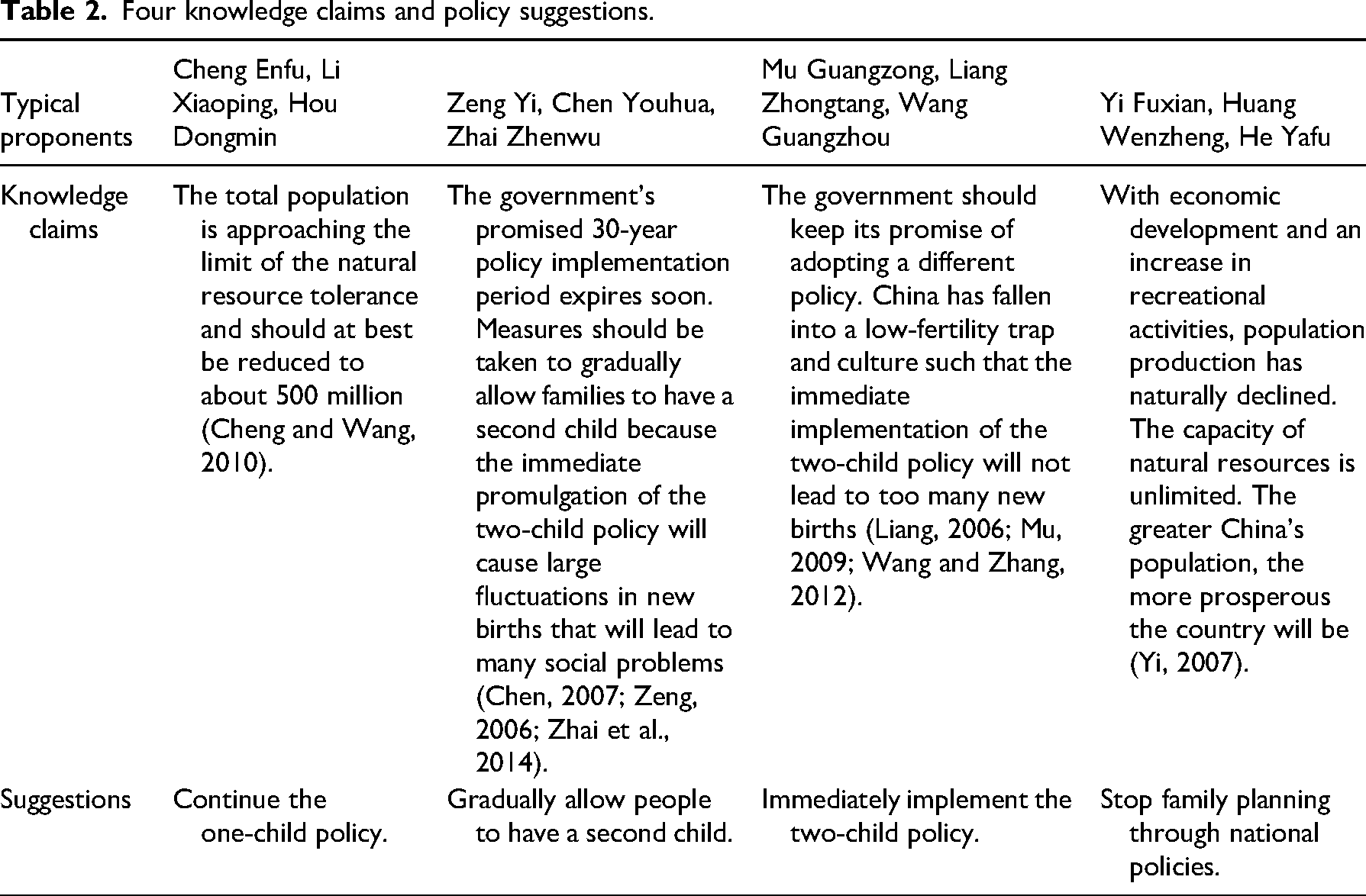
Four knowledge claims and policy suggestions.
The first and the fourth claims and suggestions were quickly excluded from consideration, while the second and the third competed for a while.
The first suggestion of continuing the one-child policy violated the government's commitment to the ‘30-year covenant’ and might undermine its credibility. Further, demographers now agree that it is not feasible to focus only on the population while ignoring its appropriate structuring. Thus, reducing China's population to 500 million was not supported by demographers and political officials.
The fourth suggestion was rejected because it ignored the limits of China's natural resources, which can support only 1.5–1.6 billion people, and failed to consider the impact of the cumulative effects of population growth. This claim and the corresponding suggested policy are not in line with the basic political principles of ‘peaceful coexistence and non-aggression’ traditionally pursued by the Chinese government, and thus are not conducive to social stability. They have been widely criticized as neo-Malthusian by many scholars. The continuation of the one-child policy and the proposal to completely eliminate family planning are thus clearly weak claims. A substantive dispute arose only between the second and third propositions, that is, whether to initiate a two-child policy immediately or gradually, and when to do so.
The knowledge disputes and the decision-making process of the two-child policy can be broadly divided into two stages. The first consisted of authoritative knowledge-based public decision-making from May 2010 to May 2013, and the second consisted of resorting to parallel research and democratic decision-making from May 2013 to December 2015.
From May 2010 to May 2013, the available demographic knowledge made clear the need for policy adjustments, and researchers weighed in with their plans and justifications. The Family Planning Commission formed a research team led by Professor Zhai Zhenwu from Renmin University of China to investigate the relevant issues and used its reports as the main basis for policymaking. The basic data obtained from the large-scale surveys organized by Zhai's team showed that about 60% of the Chinese people were desirous of having two children. This was similar to the results of web surveys at the time, such as a Sina online poll of more than 20,000 people that showed that 64.5% of the respondents wanted two children (Sina, 2009).
Zhai's team investigated the feasibility of immediately implementing the two-child policy in 2012. However, their research suggested that urban and rural areas should coordinate to gradually allow people to have a second child. They proposed that the government first permit the ‘Dandu Erhai’ policy (a selective two-child policy that allows couples to have a second child only if either parent is an only child), and then gradually implement a two-child policy throughout the country. They opposed the immediate implementation of the two-child policy nationwide because their projections showed that this would lead to 150 million target population of childbearing age, with at least 30 million births per year and an annual peak of 49.95 million births (Zhai et al., 2014). Such a large number of births would impose a significant burden on China's medical, educational and other public resources, which were designed for only 16 million births per annum. This demographic data was accepted by the Family Planning Commission, which rejected the possibility of directly implementing the two-child policy. The data was presented to the public as the basis to justify the ‘Dandu Erhai’ policy at a press conference of the Family Planning Commission on July 2014.
Other scholars expressed different views. Liang (2014) noted that the two-child policy could better help achieve the goal of controlling the population and optimizing its structure. Zeng (2012) called for the initiation of the two-child policy in 2012 or 2013, and recommended that women's willingness to have a second child and the capacity of primary schools in a given region should be investigated. Thus, families who wanted two children should be queued by age in a given region if it is short of primary schools, while a second child should be generally allowed in regions free of such pressures. Zeng's suggestion was complicated to implement and thus was not accepted by decision-makers. Mu (2014) analysed the consequences of the one-child policy and suggested that ‘the trend of rapid population growth has ended, and the best opportunity for adjusting the fertility policy has been lost’. He claimed that a two-child policy should be implemented as soon as possible. Wang and Zhang (2012), researchers from the Chinese Academy of Social Sciences, forecast that the implementation of a two-child policy was feasible in 2015, and that it would increase new births to about 21 million. However, these claims and arguments for the two-child policy were not officially endorsed by the Family Planning Commission.
Policymakers sided with Zhai as the representative of knowledge of demography in their decision-making. Zhai was the vice president of the Chinese Demography Society. Owing to his extensive investigations and large-scale demographic surveys, his predictions of the demographic consequences of the two-child policy carried significant weight compared with the opinions of the other researchers.
In October 2012, the China Development Research Foundation published The Chinese Development Report 2011/2012: Changes in the Population Situation and Adjustments in Fertility Policy. It provided a demographic forecast whereby the fertility rate was expected to exceed 4.4 if the two-child policy were implemented in 2012. This was significantly higher than the generational replacement fertility rate of 2.1 and the ideal fertility rate of 1.8 set according to the national agenda and would bring large fluctuations in the population and burden social resources. The report also concluded that even the implementation of the ‘Dandu Erhai’ policy would lead to as many as 26 million births in peak years, 10 million more than the 16 million births per year in the previous decade (CDRF, 2012). Such a rebound in the rate of population growth would also have a significant impact on social resources. At the time, the report not only pressured the government to act but also nullified the possibility of immediately implementing the ‘Dandu Erhai’ policy. The Family Planning Commission subsequently announced a three-step plan to implement the ‘Dandu Erhai’ policy. However, the projections in the report turned out to be significantly incorrect and led to this agenda being shelved.
In March 2013, the National Population and Family Planning Commission was merged with the Ministry of Health to form the National Health Commission, and the responsibility for formulating a population development strategy and policy was transferred from the Family Planning Commission to the National Development and Reform Commission. This separation of policymaking bodies and functional executive institutions was conducive to balancing different knowledge claims and policy proposals used for decision-making.
In May 2013, the National Health Commission formed two teams, led by Zhai Zhenwu and Wang Guangzhou, to study the implementation of the ‘Dandu Erhai’ policy. They were asked to conduct parallel research while keeping it confidential. At the same time, the China Population and Development Research Center conducted a large survey to confirm the predictions of the two teams.
Zhai's team forecast that, within five years of the implementation of the ‘Dandu Erhai’ policy, about 2 million more babies would be born each year, with an overall fertility rate of 1.9 and a population peak of no higher than 1.42 billion. This was within the range of population that could be supported by natural and social resources (Zhai and Li, 2014). Wang (2015) noted that, if the ‘Dandu Erhai’ policy were implemented gradually in three steps, the number of annual births would range from 0.5 million to 1.1 million, and would be about 1 million if the policy were immediately implemented. Therefore, gradually executing the ‘Dandu Erhai’ policy was not necessary.
In August 2013, the China Population and Development Research Center surveyed more than 63,000 married people in 29 provinces and concluded that 11 million families would be targeted by the two-child policy, and that 1 million to 2 million new births would be expected each year. This would have no significant impact on basic public services, such as education, healthcare and employment (Zhai et al., 2015). This survey data converged with findings by Wang and Zhai and was the crucial knowledge basis for the implementation of the ‘Dandu Erhai’ policy. On 30 December 2013, the CPC Central Committee and the State Council issued the ‘Opinions on readjusting and improving the fertility policy’ to officially announce the promulgation of the ‘Dandu Erhai’ policy.
In 2014, Zhai's and Wang's teams were again commissioned by the National Health Commission to conduct independent parallel studies on the many problems that might arise from the implementation of the two-child policy. Based on a large-scale survey using the 2014 national sample of population statistics, Zhai's team noted that the target population for the two-child policy for 2016 was about 91.01 million, with a maximum annual number of births no greater than 23 million (Zhai et al., 2016).
Wang (2016) assumed that, if the two-child policy were implemented in 2016 and all women of childbearing age had children as expected, the total number of births per year would not exceed 19 million and the cumulative effect of new births in the 2016–2020 period would not be excessive. In light of the gap between intentions regarding fertility rates and birth plans, and actual fertility-related behaviours (for example, Japan's intended fertility rate is 2.1 but its actual birth rate is only 1.3), the number of births per year might be smaller than 19 million. Jiang Weiping from the China Population and Development Research Center arrived at a similar finding and argued that the maximum number of births per year would be no more than 20.866 million (cited in Wang et al., 2016). Demographers agreed that the cumulative effect of new births would be minor and recommended the immediate implementation of the two-child policy in 2016.
New data on population collected in 2015 confirmed once again that the Chinese were not particularly willing to have more children. By May 2015, only 1.45 million couples in China had applied to have a second child, representing only 13.2% of the number expected by the policy. Under the ‘Dandu Erhai’ policy, the number of new births did not increase but decreased by 320,000 in 2015. In light of the refined knowledge claims, communication among government departments and practical evidence of a culture of low fertility, the CPC Central Committee and the State Council decided to implement the two-child policy throughout the country.
The Fifth Plenary Session of the 18th CPC Central Committee announced the two-child policy on 29 October 2015. To better cope with the ageing population and improving the structure of the population on the whole, the General Office of the National Health Commission issued the ‘Decision of the CPC Central Committee and the State Council on optimizing the fertility policy to promote the long-term balanced development of the population’ on 30 July 2021. It called for implementing a three-child policy along with supporting measures.
The co-production of knowledge and policy
Zhai's research was used as the basis for the ‘Dandu Erhai’ policy in 2013, while a variety of knowledge claims based on parallel research were used to justify the two-child policy in 2015. This change in the choice of knowledge basis was a promising one because state decision-making has a massive impact on society, and the use of reliable knowledge provides a basic guarantee of the scientificity and rationality of the relevant policies.
Making policies based on parallel research and various knowledge claims also reflects a positive response to the questioning of authoritative knowledge claims. Qiao (2015), a researcher from Peking University, compared and questioned the data published by the Family Planning Commission before and after the introduction of the ‘Dandu Erhai’ policy and the two-child policy. He pointed out that the commission had adopted a prudent policy by referring to an increase of 10 million births per year, predicted in The Chinese Development Report 2011/2012, but had also used forecasts made by Zhai when initiating the ‘Dandu Erhai’ policy; that is, an increase of 1.5–2 million new births per year. The basis for policymaking and the bases for public statements by the government were thus inconsistent and constantly changing. Moreover, there were some mistakes in the knowledge claims used to negate the possibility of immediate implementation of the two-child policy in 2012, and the claims used to support the ‘Dandu Erhai’ policy.
Qiao's questioning reflected the problems in the basic data on the Chinese population at that time, such that the fertility ratio became an inexplicable ‘data Rashomon’. The proposals to adjust the policy based on varying assessments of the status quo of fertility were also significantly different, and knowledge disputes consequently arose. Against this backdrop, the Family Planning Commission settled the knowledge basis for its policy from 2010 to 2013 by selecting authoritative demographers and knowledge claims for high population accumulation.
The above processes of policymaking and knowledge selection involve the co-production of identities, representations, civic epistemologies, political institutions and national goals. Starting from the period of the one-child policy, the Population Development Studies Center of Renmin University of China has been the official advisory body for national family planning. Professor Zhai, as dean of the research centre, is also the academic leader in population science. With incomparable reputational advantages over those of other scholars in the field, he has the luxury to directly communicate his views to officials of the family planning departments. In addition, he is the executive vice president of the China Population Society. Zhai's team can thus communicate and exchange views easily with the family planning system through formal and informal channels. From the perspective of co-production, Zhai has traditional identity-related and institutional advantages such that advocates of opposing views cannot challenge his authority and claims. Their acquisition of data is also a step behind that supported by official institutions.
In terms of objectivity and credibility, the knowledge advocates of fertility accumulation theory and the two-child policy have used different rhetorical and scientific representations in different stages of debates on the issue.
Compared with the objectivity of advocates of continuing the one-child policy and fertility accumulation theory, expositions of proponents of the two-child policy exhibited prominent appeals to emotion in the early stage—for example, ‘let a couple have two children; the sky will not fall’ (Chen, 2009). There were many similar emotional statements, which often expressed a strong subjective view and lacked accurate data as support. For example, the proponents of a two-child policy believe that excess birth rates in some regions have become ‘reasonably excessive’ for some people overtime (Li, 2008). They further note that it is tantamount to a ‘storm in a teacup’ to oppose the two-child policy based on the phenomenon of an excessive number of births. However, in light of the scientific atmosphere and civic epistemologies of data proof, such stances have little chance of prevailing in knowledge disputes.
In the second stage, when Zhai's data was found to be erroneous, the opposition had the opportunity to participate equally in knowledge production for official decision-making. Wang Guangzhou was then a researcher at the Chinese Academy of Social Sciences in Beijing. As the Chinese Academy of Social Sciences is among the research institutions in China that are considered authoritative, Wang had identity-related and institutional privileges to participate in consultations for decision-making. Data provided by Wang and his team showed that the demographic consequences of implementing a two-child policy were within the range of tolerance of the resources available, and they abandoned the resort to evocative arguments that was characteristic of the first stage. In this process, the civic epistemology of data proof is more mature than the 1980s. Compared with the fact that few people can understand Song's formula of population projections or challenge his results, this period is filled with data checks and challenges. Data proof was first given by Zhai's team, and later was challenged by other demographers. Through a recalculation, new data was given and convinced the government and the public to adopt a different policy.
Political institutional preference plays an important role in the co-production of knowledge and policy. In the first stage of the formulation of the two-child policy, the Family Planning Commission made decisions on population-related issues and was in charge of reporting forecasts on the long-term development of the population. Given that it had its own vested interests, the institution did not want a change in policy and tended to choose scientific knowledge that was favourable to its own interests as the basis for policy. Thus, among various claims in academic circles, the policymakers selected the prediction of high numbers of new births based on fertility accumulation theory to delay the initiation of the two-child policy.
In March 2013, responsibilities of formulating strategies and policies for population development were transferred to the National Development and Reform Commission. This separation between institutions for policy formulation and policy implementation was conducive to reducing the influence of vested interests and to facilitating the consideration of different knowledge claims and policy-related suggestions. Due to such important changes in political institutions, advocates of the two-child policy got an equal opportunity to compete with other knowledge claims. That is also why the ‘Dandu Erhai’ policy was quickly launched at the end of 2013 and was soon followed by a nationwide two-child policy in two years.
The national agenda played a guiding role in the co-production of knowledge and the two-child policy. As Li (2013), director of the former National Health and Family Planning Commission, stated on 23 December 2013, ‘China's food security and basic public service resource settings are based on a total population tolerance of 1.43 billion in 2020 and a peak population of 1.5 billion around 2033.’ It is precisely based on such a specific measure of the population and their responsibility for controlling fluctuations in population in an orderly and stable manner that family planning agencies are most concerned with the demographic consequences of changes in policy. Only when robust analyses predicted that the policy would not lead to unsustainable pressures on food security, education, healthcare and employment was the ‘Dandu Erhai’ policy implemented. Similarly, a basic premise for implementing a nationwide two-child policy is that the peak population will not exceed the safety line of 1.5 billion people set in the state agenda.
Data proof and the demand for accuracy in knowledge disputes
A reflection on the two processes of policymaking on birth rates in China in the 1980s and 2010s shows that the knowledge debate over population-related issues focuses on the accuracy of the demography method, typically on the models used and the basic survey data marshalled. Moreover, the final policy is based on the credibility of the data used for forecasting. ‘Credibility’ here is based on the trustworthiness of the basic channels used for data acquisition, the variable factors considered in the predictive model, and high conformity with the sampled data. Thus, a new civic epistemology of data proof has been formed in the co-production of knowledge and policies.
In March 1979, Liu Zheng and his team proposed the fertility planning proposal and reported basic statistics on many socio-economic aspects, including the GNI (gross national income), grain output, amount of cultivated land, per capita arable land, cotton yield, per capita housing area, number of primary and secondary school students, number of college students per 10,000 people, population, rate of population growth and nursing expenses. For example, in discussing the burden imposed by a rapid growth in population on the country since 1950, the report stated: It is calculated that raising a baby to the age of 16 as part of the labour force, including the primary and secondary school expenses, cost 1600 yuan in rural areas, 4800 yuan in towns, and 6900 yuan in cities. Counting by the ratio of new births in rural and urban areas (87.2% in rural areas, 4.2% in town areas, and 8.6% in cities), the total cost of raising the new children is more than 1 trillion, accounting for about 30% of the GNI accumulated since 1950. For this cost, the state and the local government shoulder almost 30% of the burden, while the family bears a little more than 70%. On this basis, the state and the local government will spend 396 billion yuan to raise 600 million people, which is equivalent to about one-third of the total financial accumulation of the country in 28 years since 1950, and family expense would be doubled. This expense is based on a minimum standard of living and does not include the cost of production materials and other technical equipment required by the new labour when it participates in production; nor does it include the cost of attending university and training for technical education. (Liu et al., 1980: 1)
In the context of population growth, Liu's team made linear forecasts of growth based on the rate of increase in the population. The report said: If only two children per couple were to be born, the natural rate of population growth could fall to below 1% by 1980, but, by 1985, the population would still exceed 1 billion (1.03 billion). It could be controlled to 1.2 billion by the end of the twentieth century, but the population would continue to grow at the beginning of the twenty-first century and would not increase or decrease until 2026, with a population of 1.32 billion. This means that it will be 48 years from now before the population becomes static (no increase or decrease). (Liu et al., 1980: 3)
This statistical method of data analysis and the age shift algorithm of population prediction cannot accurately predict population development. In 1979, Song Jian proposed population cybernetics to establish a model of population growth according to a functional relationship. Song and his team systematically expounded models of population development. Their discrete model can be formulated as: x(t + 1)=H(t)x(t)+β(t)B(t)x(t)+f(t). The x(t) is the population in t year. The H(t) is a state-transfer matrix and B(t) is a fertility matrix. The β(t) represents the relative birth rate and f(t) represents the population disturbance caused by migration, war and natural disasters. This model ‘was tested with demographic data for China from 1975 to 1978 and found to be consistent with the results of national censuses, with a percentage error of a 1,000th in the five-year forecast’ (Song et al., 1980: 920).
Song and his team used the above model to predict 11 population indices, including the total population N(t) (t represents a particular year), the total deaths D(t), the mortality function μ(t), the average age A(t), the relative birth rate u(t), the natural growth rate g(t), the labour force index λ(t), the social support index ρ(t), the ratio of the old to the young ν(t), and the population ageing index ω(t). Song used his population cybernetics model to project the population for 1980–2080 with six relative birth rates every five years, as shown in Table 3. It is clear from it that these demographic indicators adequately describe the development in the population. However, this model treats women of childbearing age as fertility machines and babies as products, without taking into account the strong influence of subjective factors, especially the influence of reproductive culture on intentions to bear children. Violations of the one-child policy continued to occur from 1980 to 2010, producing an actual birth rate of 1.75. This illustrates shortcomings of the population cybernetics model.
Projections of the populations of China for 1980–2080.
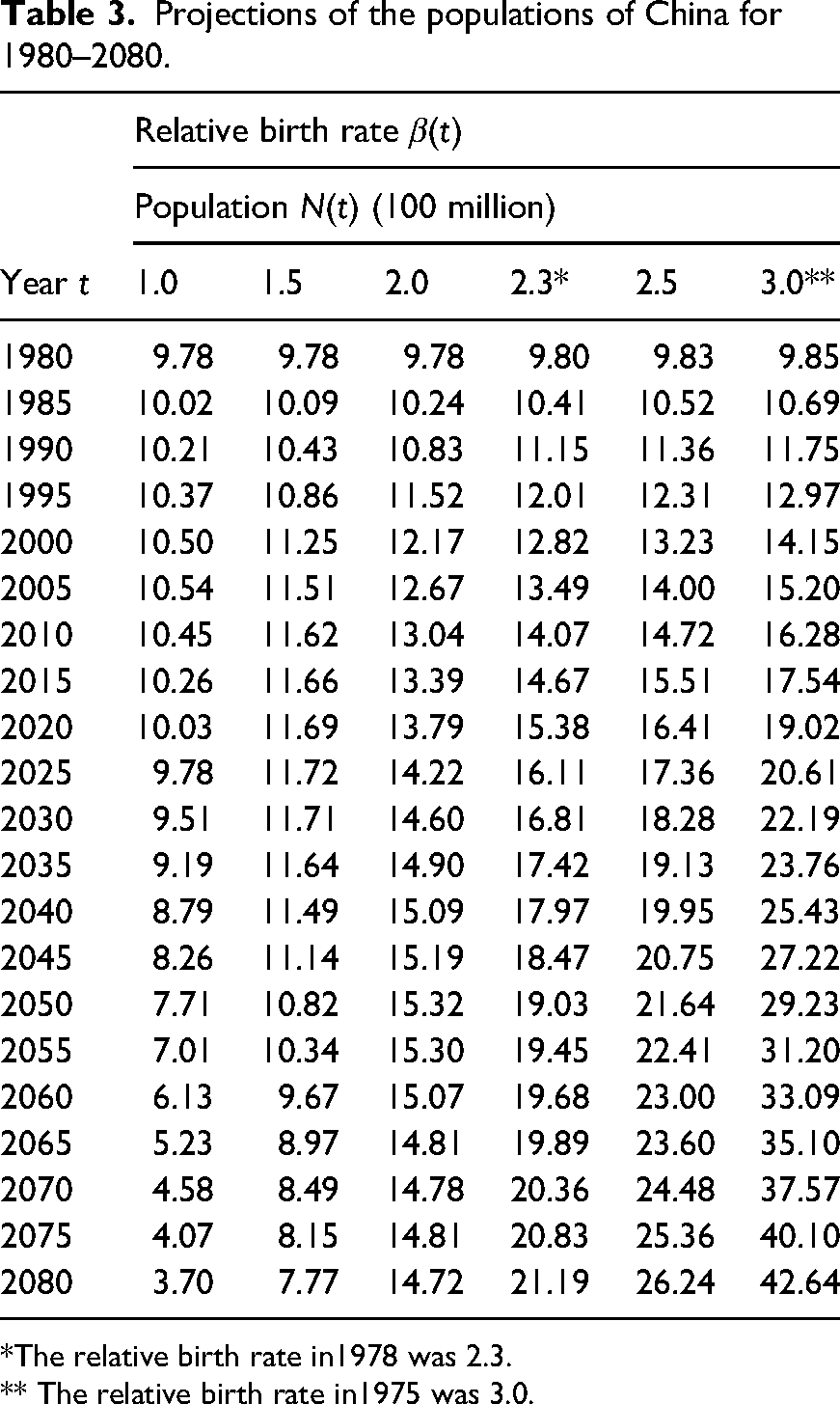
Projections of the populations of China for 1980–2080.
*The relative birth rate in1978 was 2.3.
** The relative birth rate in1975 was 3.0.
Wang Guangzhou, who had hitherto claimed the inadequacy of prevalent models of population forecasting, reported new projections in 2015 for the implementation of the ‘Dandu Erhai’ policy and the two-child policy. He noted: For specific issues in the study of fertility policy adjustment, both the sum fertility method and the macro-model of progressive fertility rate will face the problem of marriage distribution among people. The marriage model is a difficult problem not only for the macro-model, but also for the micro-model. It is difficult to build a multistate marriage model by using the current basic data, such that divorce and remarriage can be estimated only by approximation. If the forecast period is short, the error is relatively small, but, if the period is long, the error must be large. (Wang, 2015: 14)
Wang also claimed that the quality of the basic data was seriously flawed. Since then, Wang and a number of researchers have innovated their models of population development. The China Population and Development Research Center has also conducted surveys to achieve better results.
This study shows that fierce intellectual controversies have characterized the formulation of fertility policies in China since 1980, with a focus on the application of predictive models and the quality of the basic data used. Model selection appears to have developed from simple linear predictions of the rate of population growth to multivariate function models and complex function models that consider such factors as the structure of the population and patterns of marriage. The demand for data refinement is mainly reflected in the following aspects: the descriptions of variables are more specific and detailed than before, the relationships between variables have become complex, and the basic data obtained through a sampling-based survey has become accurate. The formulation of fertility policies is a typical case of the co-production of scientific knowledge and social order in China. The analysis of this case here is ground for concluding that data proof and requirements related to accuracy are now recognized as the basis for knowledge selection and policymaking and have become part of China's new civic epistemology.
Footnotes
Declaration of conflicting interests
The authors declared no potential conflicts of interest with respect to the research, authorship and/or publication of this article.
Funding
The authors disclosed receipt of the following financial support for the research, authorship and/or publication of this article: This work was supported by the Beijing Social Science Fund under grant no. 21ZXA002 and the Fundamental Research Funds for the Central Universities under grant no. E2E40903X2.
Author biographies
Zhicong Shang is a professor of philosophy and the sociology of science at the School of Humanities of the University of Chinese Academy of Sciences. He has a PhD from Peking University and has done much research on civic epistemology in the development of science in China.
Xiteng Tian is an assistant professor at the School of Marxism of Xinxiang Medical University. She has a PhD from the University of Chinese Academy of Sciences. Her research interest is civic epistemology in China.
Wenyu Yan is a PhD candidate at the School of Humanities of the University of Chinese Academy of Sciences. Her research interest is civic epistemology in China.