



Abstract
The ways in which researchers present the results of their research and make claims about them are determined by the conventions of academic writing held by the scientific community. This article examines the use of hedges and boosters in the published articles of PhD students in a Moroccan university, and to what extent these students are conscious of their semantic and pragmatic meanings and use them adequately following established conventions. Textual analysis was implemented to study the use of these discourse markers in the published articles. We additionally carried out qualitative and quantitative research in the form of questionnaires and semi-structured interviews to gain a better understanding of hedge and booster use. While the students may use hedges in contexts in which the results are deemed uncertain and unsatisfactory, expressing conviction through boosters is a common practice. These results indicate a lack of appropriate adherence to academic conventions and that cultural influences and other contextual variables are in play. Thus, revising textbooks and methodologies in Moroccan universities based on scientific data and conventions is required.
Overview
The present paper examines the use of hedges and boosters in the published articles of some Moroccan PhD students. It uses textual analysis to explore how these students understand hedges and boosters and use them in their articles. The aim is to assess their adherence to academic writing conventions of the scientific community. The use of hedges has been reported by researchers as a safe way to present claims and have them ratified by this community, while the use of boosters, which may reflect conviction, confidence and certainty, is viewed as not welcome and may contradict the conventional understanding of science as tentative and presenting claims with extreme caution.
Sutherland (2016: 114) defines hedging as using ‘linguistic devices that reduce the force of what we say’. Hedging is often mentioned in relation to spoken language. However, as a review of the literature will show, it is also used in writing, including academic writing. Holmes (1992) refers to the 1972 work of Lakoff who, again, discusses its place in spoken English, particularly women's utterances. Christiansen (2011) mentions that hedging devices such as ‘I suppose’, ‘probably’ and others are often used in conjunction with the word ‘well’ in spoken English. Other writers also give examples of hedging in conversations.
However, hedging in written English has also received some attention. De Chazal (2014: 141) mentions it in the context of academic English, referring to it as ‘the academic practice and language of “softening” statements, [which, he says,] is closely connected to critical thinking’. He points out that the ‘concept of hedging in academic discourse has been discussed since at least 1972’ when Lakoff wrote about it, as cited in Swales (1990). De Chazal mentions one interesting slant on the use of hedging that is relevant to our study, namely its cultural implications. According to him, some cultures prefer a ‘robust style’, which can lead to ‘a possible reluctance to use appropriate hedging language in English’ (De Chazal, 2014: 141). He then gives the example of native Russian speakers, whose hedging use is below average.
This is of particular interest to our study, as the language use of writers in Morocco has several influences, including French, Arabic and Berber. De Chazal adds some reasons for hedging in academic English. Among them are a desire to be precise and the wish to signal that a statement is a personal view or one for which there is insufficient evidence. Whether related to spoken or written language, the use of hedging seems to be closely linked with cultural influences. Boosters are also used in scientific research articles to show certainty and express conviction. The present article compares students’ use of hedges and boosters, examining their motivations, context and cultural background.
This paper varies its research tools for triangulation effects and to obtain an insider perspective so that the results can explain how the PhD students use hedges and boosters and how they provide explanations for their use in terms of different determinants and factors, ranging from established scientific conventions to the effects of cultural predispositions and other sociocultural factors involving distance, power relations and resistance to these conventions.
The aim then is to give a detailed description and interpretation of the ways in which claims and results are presented by Moroccan students and maintain that this use could be equally influenced by local sociocultural factors. Therefore, the research question asks how Moroccan PhD students use hedges and boosters in their research articles and whether local sociocultural factors influence their use of these linguistic units and discursive markers.
Review of the literature
Lakoff (1972) was the first scholar to highlight this linguistic phenomenon from the perspective of logic by pointing out the ability of certain words (such as ‘rather’, ‘sort of’ and ‘largely’) to make things fuzzier or less fuzzy. He was more concerned about the degrees of truth in sentences that are neither true nor false, nor nonsensical, but rather true or false to a certain extent or in certain respects. For Lakoff, these fuzzy words, which he called hedges, modify the membership of a predicate or a noun phrase, assigning values to predicates that they modify. Although Lakoff acknowledged the role of connotative meaning in defining the membership function of certain words, he did not elaborate more on the pragmatic role of hedges.
Prince et al. (1982) elaborated the concept of hedges by distinguishing between shields that hedge the speaker and approximators that hedge the propositional content. Skelton (1988: 38) argues that this distinction ‘looks more like a description of a property of text sentences than of language use’. Instead, Skelton distinguishes between propositions and comments that play the role of hedges by modulating the proposition and making the language more flexible. According to him, ‘the language user distinguishes between what s/he says and what s/he thinks about what s/he says’ (Skelton, 1988: 38). The language user's commentative language is evaluative of the propositional and factual content in terms of the degrees of precision and certainty and in terms of the distance he/she chooses to take towards that content; that is, the relation of the language user to the propositional content by the presentation or effacement of his/her personality.
Other studies on hedges moved from the semantic logician approach to a more pragmatic view of hedges as a communicative, interactional strategy whereby speakers use linguistic means of expressions, including hedges, to sound more polite and minimize the threat to ‘face’ (Brown and Levinson, 1987). These authors define ‘face’ as the public self-image and distinguish between ‘negative face wants’ and ‘positive face wants’. Every rational speaker would try to avoid what they call face-threatening acts (FTAs) or use certain strategies to minimize the threat. The positive face's basic want is to be liked and admired (the speaker considers the addressee as a member of the in-group, for example), and the negative face's basic want (of the addressee) is to be recognized and unimpeded.
According to Brown and Levinson, hedges are thus used to soften ‘assumptions about cooperation, informativeness, truthfulness, relevance and clarity’ (1987: 146) for reasons of face. Normally, hedges ‘are a feature of negative politeness’, but some hedges may have a positive politeness function (to hedge extremes and make one's opinion safely vague, through expressions such as ‘sort of’ or ‘in a way’) (1987: 116). In negative politeness, the speaker will try not to interfere with the addressee's freedom of action, and, therefore, negative politeness is characterized by ‘self-effacement, formality and restraint’ (1987: 70). Brown and Levinson argue that the assessment of the seriousness of an FTA involves some sociological variables that exist in all cultures, namely the social distance between the speaker and the addressee, the relative power of each of them, and the absolute ranking of imposition in the culture. It can be argued at this stage that the assessment of the speaker of his/her use of FTAs is partly culture-specific, but it can also be the result of convention in the subculture of a certain knowledge community, as can be showcased by this study.
Myers (1989) notices, to his surprise, that no studies deal with hedges in written texts. Though Brown and Levinson's study of the use of hedges to mitigate FTAs in oral communication is insightful, the people involved in interactions in written texts, Myers argues, are not present to each other. Myers uses Brown and Levinson's analytical model to understand the interactions between writers of scientific written texts and their readers. He classifies the audience of a scientific text into two categories: the exoteric audience (researchers interested in the ongoing research) and the esoteric audience (researchers interested in some of the results of the research); and the author into two personas: the voice speaking in the text and the researcher whose work is described. In the subculture of science, the sociocultural factors described by Brown and Levinson (1987) were revised by Myers, indicating that the social distance in this culture is great, but the differences in power are supposed to be small, and that the scientific community is to be viewed as more powerful than any individual. This should explain why the researcher must humble themself to the community to have their claims ratified and accepted and to avoid being rejected. Since certain FTAs are unavoidable, the researcher must redress them with politeness strategies.
Positive politeness devices such as the use of the collective pronoun ‘we’ or using shared knowledge or identification with established paradigms or with the view being criticized emphasize solidarity between the writer and the reader (the scientific community). Negative politeness strategies are associated more with hedges assuring the readers ‘that the writers do not intend to infringe on their wants, their freedom to act’ (Myers, 1989: 12). The writer is supposed to present his claims as provisional pending acceptance from the community, using epistemic modality, impersonal or passive constructions, or hedged personal attributions. Myers (1989: 30) concludes that the use of politeness theory serves to shift attention from ‘static rules, norms, and systems to the dynamics of interactions’.
Nevertheless, while other researchers (Hyland, 1994, 1996a, 1996b, 1998a, 1998b, 2000, 2005; Crompton, 1997; Salager-Meyer, 1994; Bonyadi, 2012; Anh, 2018; Hassan, 2020) acknowledge the role of hedges in mitigating claims in search of acceptance and ratification by the readers and the scientific community, some of them (Hyland, 1998; Anh, 2018) are heedful of the use of both hedges and boosters in scientific writing. Boosters such as ‘clearly’, ‘of course’ and ‘obviously’ allow writers to express conviction and strong claims and may seem to ‘contradict the conciliatory and defensive tactics’ (Hyland, 1998: 353). Hyland (1998: 350) assumes that ‘affectively they also mark involvement and solidarity with an audience, stressing shared information, group membership, and direct engagement with readers’. While boosters stress shared wants and concerns, they are found to be used more in philosophy and marketing papers than in hard-science papers as the former are more interpretative and less abstract.
Another significant interpretation of hedges that needs to be more specified and refined is the function of hedges themselves. Most researchers explain the use of hedges by assigning them the role of expressing doubt and uncertainty. However, some researchers found that this is not always the case. Salager-Meyer (1994: 151) claims that ‘the association of hedging with vagueness or fuzziness can obscure some important functions of hedging’. She contends that one could alternatively consider them as ways of being more precise in reporting the results; in other words, stating the true state of the writer's understanding. This implies that writers use hedges to achieve greater precision, and not to be vague and fuzzy or as a cover-up technique.
Taxonomies of hedges
The literature on hedges in research articles is varied and may seem confusing in its classification of the linguistic means of hedging. However, most of these classifications consider the semantic and pragmatic dimensions of the use of hedges. Three elements must be included in any analytical model of hedges: the writer, the propositional content and the reader. The classification of hedges is mostly conducted in terms of these three elements, and most scholars tend to organize hedges in terms of the participants, their semantic and pragmatic functions, or a mix of both. Salager-Meyer (1994) adopts a taxonomy that consists of five categories of hedges:
Shields include modal verbs, lexical modal verbs such as ‘seem’ and ‘appear’, epistemic verbs such as ‘suggest’ and ‘speculate’, and derivative modal adjectives, adverbs and nouns. All of them express the writer's assessment of the possibility or the probability of the propositional content and are called plausibility shields. Salager-Meyer does not seemingly include attribution shields (which attribute responsibility to someone other than the writer) in this category unless it is implicit in expressions such as ‘author X suggests that’ or ‘according to X, it is suggested that’. Approximators include adapters and rounders that are used when exact figures or membership properties are not available or clear enough or when the state of knowledge does not allow scientists to be more precise. Expressions of the authors’ doubt and personal involvement. Emotionally charged expressions, such as ‘extremely difficult’ and ‘particularly encouraging’. Compound hedges, such as ‘it seems reasonable to assume’. Content-motivated hedges involve ‘either a concern with the need to present claims as accurately as possible or to anticipate what may be harmful to the writer’ (Hyland, 1996a: 7). They are subdivided into two categories: Accuracy-based hedges allow the writer to express propositions with greater precision and caution (such as ‘generally’, ‘almost’ and ‘might’), and readers are expected, according to Hyland, to understand that the propositions are true as far as can be determined. Writer-based hedges diminish the author's presence in the text rather than increase the precision of the claims (such as ‘it seems that’ and ‘these data indicate’). Reader-motivated hedges contribute to developing a relationship with the reader ‘by addressing the need for deference and cooperation in gaining the ratification of claims’ (Hyland, 1996a: 9). In expressions such as ‘I believe’ and ‘I suggest’, the writer marks a statement as an opinion rather than a definitive statement of truth. Lexical means of hedging include:
modal auxiliary verbs (used epistemically), such as ‘might’ and ‘could’; epistemic lexical verbs, such as ‘seem’, ‘appear’ and ‘assume’; epistemic adjectives, such as ‘likely’ and ‘possible’; epistemic nouns, such as ‘possibility’ and ‘assumption’; epistemic adverbs, which include adverbs of indefinite degree such as ‘rather’, indefinite frequency such as ‘often’, doubt or certainty such as ‘presumably’, approximation such as ‘almost’, and evidence such as ‘apparently’; indefinite quantifiers, such as ‘some’ and ‘a bit’. Non-lexical means of hedging include:
personal attribution, such as ‘we believe’; abstract rhetors, such as ‘the results show’. General and unnamed rhetors, such as ‘Some people may think’. Attribution to literature, such as ‘According to author X’. Conditional clauses. Reference to limited knowledge, such as ‘It is not at all clear how’. Questions. Others (compound hedges), such as ‘One possible answer might lie in’.
Though Salager-Meyer does not refer to the politeness theory in her analytical model, it can be inferred that her categories involve the three components of the communicative process, namely writer, text and reader. Other researchers use another model based on those three elements to focus more on the relationship of the writer to the content and reader and the accuracy of the propositional content. Hyland (1996a, 1996b) divides the content of scientific articles into factive and non-factive statements and then divides hedges into two categories (content-oriented and reader-oriented):
The classification of hedges into different categories according to their semantic or pragmatic functions does not change much the nature of hedges and their recurrence, but only reflects the interpretations of their functions. They are summarized by Hassan (2020) as follows:
The two models (of Salager-Meyer and Hyland) were developed from earlier research and were adopted and modified (slightly) by others. They reflect the researchers’ concern with both the semantic dimension of hedges (accuracy, reliability of the propositions) and their pragmatic dimension, interpreting hedges as a regulator of the distance the writers adopt towards their factive statements and the relation they choose to build with the reader (recognition, deference, intimacy), avoiding or redressing any FTAs they find themselves forced to take when presenting their claims.
Hedges and discursivity
Myers (1989: 38) maintains that ‘language without hedging is language without life’. In science, it is not welcome to be categorical in one's claims, and, even when the writing is impersonal and highly propositional, the decision to efface the author from the text is itself a discourse marker of an attitude towards the propositional content. The decision to use hedges is not just personal, as it is dependent on the conventions of the scientific community regarding scientific writing and the local culture of the author.
The discursive position of the author of scientific texts precedes the act of writing itself and frames the way the author writes the text. The author is supposed to use hedges when making claims, to build a relationship with the reader based on recognition, respect and cooperation, and to avoid impeding the reader from interpreting the text or the results in a different, alternative way. The author occupies such a discursive position after supposedly being trained to use these conventions at the university, throughout his life as a student and his practice of research as a professor. However, when writing from that position, the author might not fully adhere to the inherent strategies implied by that position because of different reasons, such as lack of experience, lack of clear instructions and poor training (as showcased by the writing of PhD students being studied in this paper).
The author is, at the same time, subject to the influence of the local culture and its values in terms of distance, power and ranking, as explained by Brown and Levinson (1987) in their study of sociocultural variables informing the use of politeness. If the authors of scientific articles are not trained in the use of the conventions of the subculture of the scientific community, they may choose to use hedges according to the cultural predispositions that shape their subjectivities (the notion of habitus proposed by Pierre Bourdieu). In Moroccan culture, for example, the identity of a scientist or an intellectual or a university professor is already interpreted and fixed as assertive, authoritative and having great power. When the authors fail to consciously use hedges according to the conventions because of the reasons mentioned above, their cultural predispositions shape their relationship to the content of their writing and the addressee.
The formation of the discourse of the author is subject to different variables and thus overdetermined. These variables include the conventions of the scientific community, the universal principles of human interactions, the local culture, the predispositions that the author has been socialized into and the situated personal mood of the author at the time of writing. The study of the texts selected for this paper shows the contribution of these different variables and how this has different configurations in different articles.
One final point to make in this section is the discursive presence of the author and the use of hedging in a different academic field. Hyland (2005) studies disciplinary variations in the use of hedges, and the results of his study show that humanities and social science papers use more hedges than hard science papers do. This is due, according to Hyland (2005: 106–107), to the fact that hard science papers ‘tend to be highly specialized’, whereas the soft-knowledge areas are ‘typically more interpretative and less abstract’. Within the articles themselves, the distribution of hedges among the different rhetorical sections of the articles shows, according to Salager-Meyer (1994), that authors use more hedges in the introduction and discussion sections, when they try to build a niche in the former and make claims about the results in the latter. Therefore, these two factors can be added to the other above-mentioned variables informing the use of hedges in scientific research articles.
Data collection and method
The researchers examined 28 articles from different disciplines, but all of them belong to hard-knowledge areas, namely chemistry, physics, computer science, biology, geology and mathematics. The methodology used is textual analysis in search of hedges and boosters (for comparison) as they are used in these articles, using the analytical framework devised by Hyland (1996a, 1996b) mentioned above.
The articles collected are published in indexed journals by Moroccan PhD students who belong to research laboratories at the Faculty of Sciences, Chouaib Doukkali University in Morocco. These articles were submitted to one of our authors, who teach English for specific purposes at this faculty, before being submitted for defence. This paper uses non-probability convenience sampling due to some constraints and in accordance with the objectives of the research, which was based on maintaining the continuity of the observation of many PhD students and their writing before and during the lectures. The chosen articles represent the major tendencies in writing scientific research articles in this faculty and probably in all Moroccan universities.
This paper is the outcome of more than 10 years of observation and participation by one of the authors, who has been teaching PhD students at the faculty and discussing with them their use of different rhetorical functions and discursive markers of stances. This author has also proofread more than a hundred PhD research articles before publication. He has collected a vast amount of information on how PhD students write and how they use hedges and boosters, and has made some hypotheses about their actual use of these discourse markers and how they conceptualize and understand their use. One of the hypotheses that motivate this paper is that these students do not fully adhere to the conventions of scientific research writing due to certain cultural influences.
The results obtained from the textual analysis of the 28 research articles indicate that such influences are in play. Therefore, it was required to countercheck these results by collecting more data from the PhD students about how they understand the use of hedges and boosters, by using a mixed quantitative and qualitative data-collection methodology, first in the form of a questionnaire that was devised to collect more information from the PhD students who attended the lectures in June and July 2022. The questionnaire was given to those who attended the first lecture (44 students) before they were instructed on how to use hedges. Then, hedging was one of the components of the second lecture. The students were asked to answer the questionnaire again at the end of the fourth and last lecture. During this last lecture, the 44 students who answered the questionnaire for a second time were asked to signal this information on their answer sheet, while those who answered the questionnaire for the first time (15 students) were also instructed to signal this information (whether they were answering the questionnaire for the first or second time).
We also used a qualitative method in the form of semi-structured interviews, which were conducted with 10 students who attended all the lectures and volunteered to take the interview on the use of hedges in general and in their published articles submitted to one of our researchers. This researcher explained the purpose of the semi-structured interviews to all the students who attended the fourth lecture before asking them to volunteer for the interviews.
Data analysis
Textual analysis of articles
The textual analysis of the selected articles is discourse analytic in two ways: discourse as language use, and discourse as social practice. The former focuses on the linguistic description of hedges and boosters as linguistic features that are used to express a range of meanings, such as doubt, uncertainty, fuzziness, certainty or conviction. The latter highlights the sociocultural dimension of the use of hedges and boosters as discourse markers to understand why the authors of the selected articles used them and the underlying discursive effects these authors wanted to communicate to the readers and the larger scientific community. Our study of hedges (and their discursive effects) as expressions of doubt, uncertainty and lack of commitment (and boosters demonstrating conviction, by contrast) was conducted using the linguistic model devised by Hyland (1996a, 1996b). It is as follows:
Content-oriented hedges:
Accuracy-oriented:
– precision of content: downtoners, approximators and style disjuncts – reliability hedges: epistemic modals, adjectives, nouns, adverbs and content disjuncts (plausibility shields and approximators) Writer-oriented: impersonal subjects, epistemic lexical verbs, and these verbs in the passive voice Reader-oriented hedges (interpersonal strategy): personal attribution and epistemic verbs, if-clauses, questions, and limited knowledge.
The only difference between our model and Hyland's model is the displacement of limited knowledge from the category of accuracy to the category of reader-oriented hedges, as we believe that the use of such hedges serves more a pragmatic function than a semantic one; namely, promoting a self-image of honesty and humility, and avoiding any negative reactions from the reader.
This linguistic model was used to analyse the presence of linguistic features and discourse markers that are used as hedges or boosters in the selected research articles in their immediate context and the larger communicative context. The analytical approach proceeds with a top-town analysis of the use of hedges and boosters as chosen linguistic units and discourse markers in these articles, which are organized into linguistic and discursive categories as outlined in Hyland's linguistic model (content-oriented or reader-oriented categories). The linguistic features that are deemed to express doubt or certainty are classified and analysed in their immediate textual context as linguistic units that have the two mentioned textual functions (doubt or certainty) and as discourse markers that highlight the way the authors communicate their presence and responsibility for the claims to the readers of their articles. The classification is followed by a description and evaluation of the use of hedges and boosters in each category of articles (according to their field of research, as shown in Table 1).
Number of hedges and boosters in the articles by discipline.
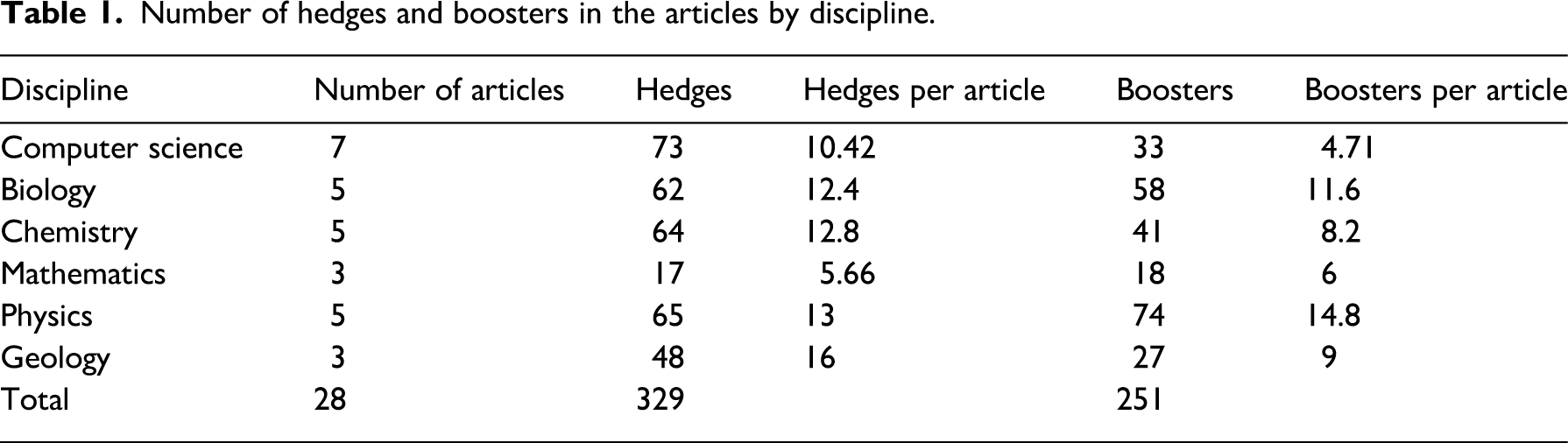
We compared the results of the textual analysis of hedges and boosters and used the inter-coder reliability to test the agreement between our results. The comparison showed a substantial agreement (0.8). We disagreed on the use of two particular linguistic items, namely the verbs ‘show’ and ‘indicate’, particularly in sentences in which both verbs are interchangeable, such as when showing a clear tendency in a graph or table but not making any claims about that tendency. One of our authors who is a native English speaker did not see a clear distinction between the two verbs in particular contexts of occurrence. Thus, these cases were discarded. We agreed on the data collected from the textual analysis in terms of Hyland's linguistic framework.
The analysis of the 28 articles has shown that the PhD students use hedges and boosters almost equally in biology articles; in computer science, geology and chemistry articles, the difference is substantial in favour of hedges; whereas, in physics and mathematics articles, boosters are used more than hedges. However, the total number of hedges largely exceeds the total number of boosters.
When we analysed the use of hedges and boosters in their immediate textual context, many variations emerged. In biology articles, hedges were used according to the needs of the author and the context of use. Epistemic modals, adjectives, adverbs and nouns, content disjuncts and impersonal subjects followed by epistemic verbs such as ‘seem’, ‘appear’, ‘indicate’ and ‘suggest’ were used to interpret results and present claims about them but rarely to present results. However, when introducing results, using tables and graphs, the authors showed also no commitment and let the results speak for themselves, using boosters such as ‘show’, ‘demonstrate’ and ‘confirm’. Personal involvement and commitment were almost absent in these articles, and only a few expressions of reservation and limited knowledge were introduced when the authors seemingly felt that they could not generalize their claims. Downtoners and approximators were rarely used, as the authors tended to give exact figures as shown in tables.
In chemistry, geology and computer science articles, hedges were used more than boosters. Another difference with biology articles is the use of style disjuncts and approximators, frequency adverbs, if-clauses and personal attribution (such as ‘we confirmed’, ‘we have shown’) with boosters and solidarity markers. This difference should not mean that the authors of these articles were categorical, but they seemingly describe what they have presented before with strong commitment and confidence. Their more extensive use of hedges indicates that they were tentative in presenting claims and were more inclined to express their reservations and limited knowledge when needed. This tendency to use strong verbs such as ‘show’, ‘confirm’ and ‘prove’ will be clarified when we present our analysis of the questionnaire results and the semi-structured interviews.
In mathematics and physics articles, the authors tend to use more boosters than hedges with personal attribution (such as ‘we found’, ‘we showed’, ‘we conclude’, ‘we confirmed’) or with impersonal subjects (such as ‘it is clear that’, ‘clearly’, ‘obviously’, ‘it is obvious’). In mathematics articles, the style is more impersonal, and the results are allowed to speak for themselves, leaving no room for other interpretations (if the calculation is correct). The same tendency is noticed in physics research articles, but with the use of more hedges than in the mathematics articles. The use of tentative language seems to happen when the authors make controversial claims, from their perspective. The use of personal attribution with epistemic verbs such as ‘assume’ is more frequent, and the authors acknowledge limitations in their knowledge and difficulty in interpreting results or referring to other claims from other research papers.
The overall assessment of the use of hedges and boosters seems to suggest that the authors of these articles use hedges when they sincerely feel that their claims cannot be generalized as facts, and they need to be ratified first by reviewers and later by readers (both esoteric and exoteric). Additionally, authors try to avoid FTAs. The use of boosters is more manifest in disciplines in which calculations and numerical results are used as a main procedure in research, or when the authors want to protect themselves by letting the results speak for themselves. The presence of the authors’ involvement is more pronounced when the authors want to show that they are confident and find in the expression of commitment a sign of this confidence and an appeal to the readers’ solidarity.
Analysis of the students’ responses to the questionnaire
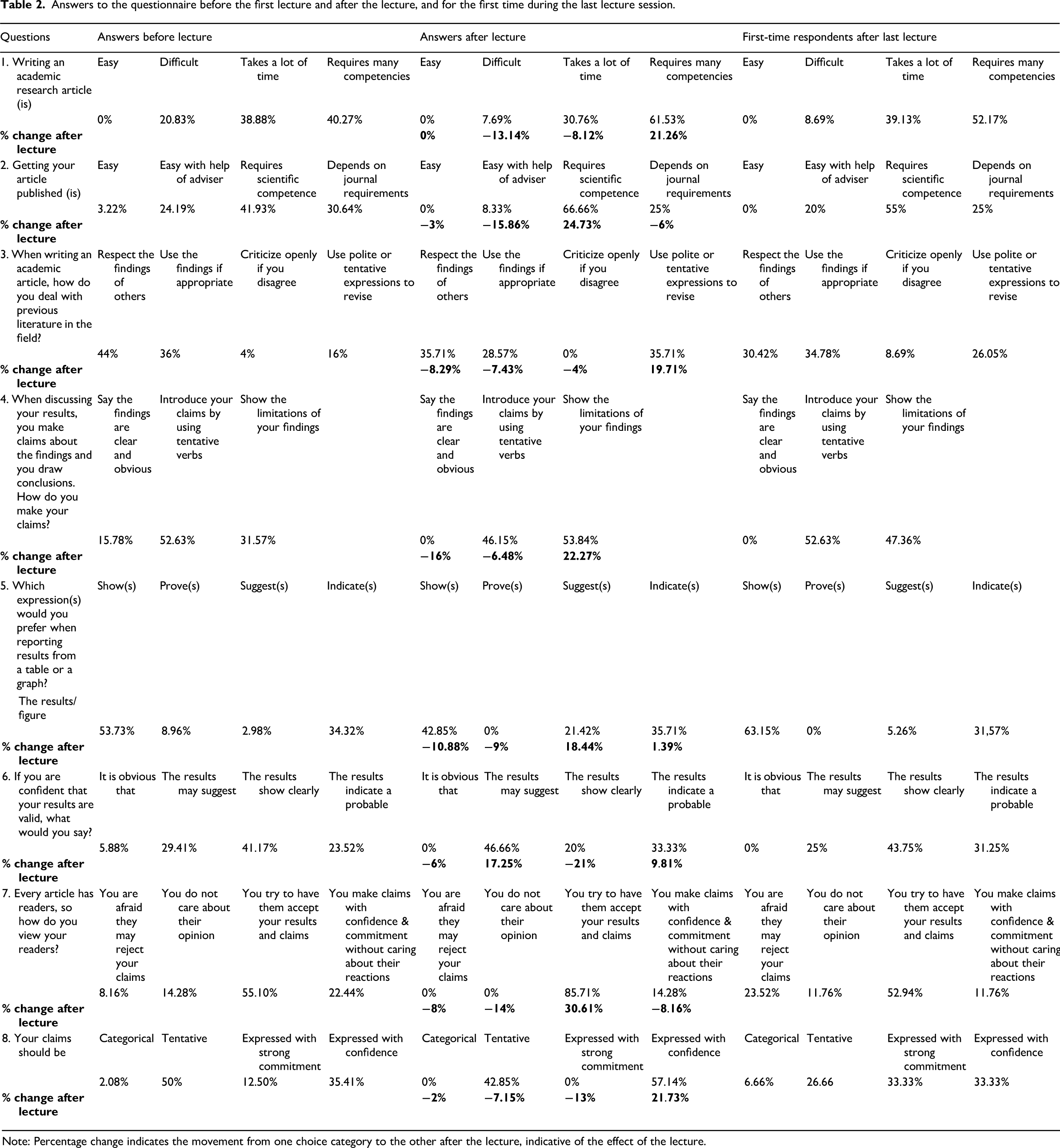
The above-mentioned preliminary results need further clarification through the analysis of how such authors perceive the notions of hedging, politeness, confidence and commitment. Therefore, a questionnaire (see Appendix 1) was given to 44 PhD students: those who had already published one or two research articles (n = 22) and those who had not published any articles yet (n = 22). They were asked to answer the questionnaire during the first lecture, before they were instructed on how to use hedges and boosters. The questionnaire consisted of eight questions about different issues relating to the publication of a research article, attitudes towards previous research, the content of their articles, the readers and their use of hedges. They were allowed to choose more than one answer. The results are shown in Table 2.
Answers to the questionnaire before the first lecture and after the lecture, and for the first time during the last lecture session.
Note: Percentage change indicates the movement from one choice category to the other after the lecture, indicative of the effect of the lecture.
The respondents acknowledge the difficult task of publishing a research article (Q1), the role of advisers in helping them choose the most suitable journal for their publications and the requirements and competencies needed for that task (Q2). When answering the question about their attitudes to previous research, they show their respect for previous studies and say they will use them if appropriate, but very few show a tendency to criticize previous findings openly (Q3). In the same vein, when asked to describe the way they discuss the results of their research, few of them choose to say that their findings are clear and obvious, and they opt for a more tentative way of doing this (Q4). However, they cannot distinguish between the verbs ‘show’ (53.73%) and ‘indicate’ (34.32%) (Q5) and they give more prominence to the verb ‘show’ in reporting results.
When asked to clarify their understanding of the notions of confidence and commitment and their attitudes towards their readers, the respondents’ answers show that, although they tend to favour tentative hedging expressions (52.93%) slightly more than strong boosting expressions (47.05%; ‘It is obvious that’ and ‘The results show clearly’) (Q6), the tendency to use boosters to show conviction remains strong—compared to Hyland (1998a), where the use of hedges (85.5 per paper) far exceeds the use of boosters (34.5 per paper) in academic writing. This may be due to the association of showing confidence with credibility in their minds. Those who choose hedging expressions seemingly view hedging as a convention that needs to be respected, even if one is confident. When specifying their attitudes towards their readers, more than half of the respondents say they try to have the readers accept their claims. Nevertheless, 22.44% say they make their claims with confidence and commitment without caring too much about the readers’ reactions (Q7). When tentativeness is opposed to commitment and confidence, the results are almost equal (Q8).
These results are indicative of two tendencies in the answers of the respondents: tentative attitudes and attitudes of confidence and commitment. We thought that the lack of clear difference between these two tendencies was probably due to the lack of clear instructions about the use and aims of hedges given to the students in previous teaching. Therefore, we decided to give the PhD students clear instructions and explanations about the use of hedges and boosters in the second lecture, in which these students were given extensive practice in their use. The same questionnaire was given a second time to the students at the end of the fourth and last lecture. There were 15 students who answered the questionnaire for the first time and 44 students who answered it for the second time.
Table 2 also shows the answers of the students who answered the questionnaire for a second time after being instructed on how to use hedges and boosters. Their answers indicate a considerable rise in the use of epistemic verbs such as the verb ‘suggest’ (from 2.98% to 21.42%), a slight rise in the use of the verb ‘indicate’ and a slight decrease in the use of the verb ‘show’ (Q5). Thus, we noted that, while the respondents understand the verbs ‘suggest’ and ‘indicate’ as expressions of uncertainty or politeness (being humble), their use of the verb ‘show’ is consistent and has very little change. Another major feature is the total omission of commitment as a suitable description of their attitudes in presenting claims. The respondents classified their attitudes as either tentative (42.85%) or confident (57.14%) (Q8). This shows that, although the respondents were given clear explanations about the use of hedges and boosters, they still value confidence highly. They seem to hold the view that when one is confident, one does not need to use hedges.
As Table 2 also shows, the responses of the students who answered the questionnaire for the first time during the last session (15 students joined tardily to attend the fourth lecture) do not differ much from the responses of those who answered the questionnaire for the first time in the first session: the two groups had the same attitudes regarding commitment and the use of the verb ‘show’. This may indicate a constant attitude and understanding that seems to be derived from common factors or determinants that could be determined by the local culture and social understanding of authority and hierarchy, the conventions of scientific writing as practised by the local scientific community, other factors that may include the interactions of the reviewers or the kind of teaching they received at university, or individual personality factors.
Semi-structured interviews: Analysis and conclusions
Another attempt at obtaining more clarification from the students about this issue was conducted by devising semi-structured interviews, which contained standard questions (see Appendix 2) about hedging and personal questions about the students’ articles. One of our researchers interviewed the students and asked them, in the end, to write their answers and submit them to the researcher. The answers were different; however, certain regularities suggested tendencies among these PhD students.
A computer science PhD student whose English is quite good declared that, when she was writing her article, she watched videos on YouTube to obtain instructionson how to write the discussion section. Her answers were quite informative about how she understood hedging:
Hedging is a For me, it is all about finding the
Choosing ‘the right middle’ and flexibility in presenting claims are explained by her tendency to be polite and maintain a cautious stance. In the same vein, when asked about how she would present claims about which she was not certain, she said:
Be
Being honest in revealing uncertainty and explaining the reasons for such reservation would suggest that she is tentative in presenting her claims. However, when asked about how she would make the readers accept her claims, she gave more prominence to logical argumentation, persuasion and credibility. In answering another question about hedging expressions such as epistemic modals and verbs, she said that these expressions ‘help take certainty down a notch’. However, what she said about hedging seemed to express her desire to conform to what is conventionally accepted in the scientific community. Her real stances emerged when she was asked about her personal involvement in presenting claims: I try to avoid using ‘I think’, ‘I believe’. Instead, I attempt
She voiced a common tendency among Moroccan PhD students involved in this study, namely letting the results speak for themselves. This would reflect a tendency to distance oneself from involving oneself in presenting results and claims. However, this use of impersonal style and basing one's claims on results are coupled more with boosting expressions than with hedging. When given examples of boosters from her articles, she gave a practical explanation:
Examples:
Based on the results of this study, k-NN has
Our results, on the other hand,
Her answers:
I wrote this article in 2019, and to be real I watched a YouTube video on how to write [the] discussion and conclusion in academic writing. If I remember correctly, they said you should try to
As already mentioned, I was trying to
Her answers show that she is now more explicit about the tendency to show confidence, conviction and certainty about the results and the claims she has made. She seemingly views the expression of conviction and certainty based on algorithms and mathematical equations as allowed when one's results and claims are based on exact and correct calculations. This tendency is equally indicated by the responses that other students gave when answering the questionnaire and in interviews. Conviction should be given strong expression, for it marks the researcher's authority and credibility.
Another interviewee (a researcher in physics) chose strong expressions to present claims that seemed valid to him, and hedges to show his uncertainty when presenting uncertain claims. He also repeated constantly that he tried to be objective, polite and humble in presenting his claims to the readers. Expressing certainty about valid claims (to his eyes) is a necessity, and expressing uncertainty is required only when claims are not ‘universal’.
Another interviewee (also a researcher in physics) defined hedging correctly as the expression of hesitation and uncertainty but maintained that he would use argumentative strategies to convince the readers when he thought his claims were valid. When asked about the use of hedges and personal attribution, he said he would use verbs of cognition to express an opinion (such as ‘I think’ and ‘in my opinion’) and epistemic modals when his claims are ‘not supported’. To our surprise, he denied any form of interaction with readers, or the use of politeness strategies to make them ratify his claims. This may indicate that the students are more concerned with reinforcing the validity and credibility of the propositional content using logical argumentation and calculations while shielding themselves from any possible criticism by using plausible reasoning and strong logical argumentation. They seem less concerned with politeness. What is of importance to them, as suggested by most interviewees, is to promote the positive self-image of an authoritative researcher who presents his/her research objectively, basing the results on correct calculations and necessary derivative claims, but using boosters more often. When uncertainty is strong, they tactically shield themselves from criticism by projecting their image of a humble researcher.
Results and discussion
The textual analysis of the articles, the responses to the questionnaire and the semi-structured interviews have indicated that the PhD students tend to use hedges and boosters for different reasons in different contexts. The use of hedges is quantitatively more visible in four types of research articles, namely biology, computer science, geology and chemistry, but boosters are used more in physics and mathematics articles. However, the overall assessment of the use of hedges and boosters shows that the students favour hedges when making claims about which they are uncertain, and boosters when reporting results and claims that are deemed valid and strong. Personal involvement in presenting results and claims is very low, as these students seem to prefer letting results speak for themselves and expressing claims based on logical reasoning, argumentations and calculations with strong confidence. These results can be classified as follows.
Conviction versus caution
When reporting results that are based on tangible calculations, most of the students do not see any reason for being cautious, and they probably think the results presented as such shield them from any criticism. Readers are supposed to share the conviction that, if the calculations are correct, the results should be presented with confidence and certainty (using boosters).
Hedging claims and politeness strategies
Making claims is not always conducted by using hedges. The students use hedges when they want to show real uncertainty, or when the degree of precision needs to be specified. The notion of politeness in a written scientific text is new to most students, and this was clear in the brainstorming discussion in the lecture about hedges. Though they may use hedging expressions in presenting such claims, they are more inclined to shield themselves (from the criticism of the reviewers) than to seek ratification by being polite to the readers. They may seek and try to achieve ratification from readers in an indirect and unconscious way.
Persuasion through correct reasoning
Most students associate confidence with the perceived effect of the potential persuasive power of their results. The more confident they are about the validity of their results, the more they are inclined to show more confidence than caution, as they take for granted that the readers would agree with them, and they thus seek solidarity and share knowledge with the scientific community.
Humility and politeness as conventions
The students’ responses to the questionnaire and interview questions suggest that they view humility and politeness as conventions that are used to shield them from criticism (negative politeness strategy). These strategies are used unconsciously for protection when their claims about the results do not seem convincing to them. However, the conscious impulse to show the strength of their results and claims about them is a constant practice in their writing.
These results indicate differences from the conventions as implemented by the wider scientific community. Hyland (1998b: 3) maintains that hedging ‘indicates an unwillingness to make an explicit and complete commitment to the truth of propositions’. This cautious stance of the authors of research articles is visible in their use of epistemic modality and expressions. However, as shown in our study, this is a common practice only when the interpretation of results is faced with overdetermination and probability. Conversely, when the reasoning and argumentation allow the authors to perceive their results and claims about them as robust, they tend to show this conviction with confidence, using solidarity markers and boosters. We have noticed the constant use of the verb ‘show’ by the students even after being instructed about the use of hedges and boosters. During the interviews, the interviewer asked some interviewees to translate the verbs ‘show’ and ‘indicate’ into French, as they had received most of their science education in French. The answers were ‘montrer’ and ‘indiquer’, and they declared that their instructors used them interchangeably. Even the dictionary entries for these verbs do not show the difference that the scientific writing conventions prescribe. The origin of this confusion between the two verbs may be due not only to a lack of instructions (as these students were told how to use them in the second lecture), but mostly to the fact that they prefer the verb ‘show’ to express conviction about the validity of the results presented in logical reasoning and based on algorithms and calculations.
Another explanation may be related to the local culture, which expects any researcher or intellectual or preacher to show authority over the knowledge he presents to others. Credibility is associated with assertiveness, mastery and showing strong conviction. The power involved in the transmission of knowledge should be high, and the transmitters of this knowledge should present themselves as confident and reliable and as authoritative sources of this kind of knowledge if they want their audience or readers to be convinced and persuaded. The audience or the readers assess the truth value of the knowledge they receive in terms of the credibility of the holder of the knowledge first, and then the assessment of the content follows as a result of their first judgement. This power relation is also maintained in the university between professors and students, where the former present themselves as sources of credible knowledge and the latter as (passive, to some extent) recipients.
The apparent change in the use of epistemic verbs (such as ‘indicate’ and ‘suggest’) in the responses of the students who answered the questionnaire for a second time should not hide the resistance of the students to the clear instructions given to them about hedges and boosters in which the verb ‘show’ was classified as a booster. This may indicate a rooted disposition among these students to promote their self-image as confident and assertive when their claims are supported by numerical results. Doubt and uncertainty emerge only when too much certainty may affect how their credibility is perceived by the addressees.
Another form of resistance comes from the fact that these students do not view the written text as involving communication in the way oral communication operates, in which the immediate presence of the addressee obliges the speaker to avoid FTAs, as explained by Brown and Levinson (1987), and any negative reactions. One of the interviewees denied any intentional interaction with the readers of his article. Another interviewee showed that she was concerned only with the reactions of the reviewers and that, if the latter let the boosters ‘slide’, she would confidently use them. Their first assessment of the articles was what counted most of the time.
Implications and limitations
The results presented and discussed above imply that the role of local sociocultural factors is greater than the actual conventions prescribed by the wider scientific community. This may be due to the lack of experience of these students in the field of research, and that the impact of local culture is still rooted in their predispositions as researchers and authors of scientific articles. More emphasis should be laid on the teaching of these conventions in Moroccan universities, and both the advisers and reviewers should bold the importance of adherence to the conventions for the students to have their results and claims ratified by the wider scientific community. Textbooks and handouts used in the teaching of different scientific disciplines do not stress the importance of the use of hedges and present results in a way that highlights certainty for teaching purposes. They need, as Hyland (1994) argues, revision based on an analysis of authentic data.
The lack of sufficient competence in using hedges in English may also be due to the fact that the teaching of this competence is not extensive, and students find it difficult to improve it and use hedges appropriately. The results of this study are in line with those obtained by Hyland (2000) in his study of Cantonese undergraduates, in which it is suggested that, while the students generally attended to boosters, hedges did seem to be more invisible. Explaining this phenomenon by lack of language proficiency implies that PhD students should obtain more practice in using hedges in English as a second foreign language in Morocco.
This study did not have the opportunity to include PhD students from other universities in Morocco, but presents these results as specific to the students included in this study and reflecting their own understanding and use of hedges and boosters in academic writing.
Conclusion
This paper has investigated the understanding and the actual use of hedges and boosters in research articles by PhD students in the Faculty of Sciences at Chouaib Doukkali University. A total of 28 research articles published by these students were studied to extract linguistic units used as hedges and boosters and understand their semantic and pragmatic meanings in the immediate context of their occurrence and their larger communicative context. After the data was collected and classified into two categories, the use of hedges and boosters was evaluated quantitatively. The overall assessment of the use of hedges and boosters seems to suggest that the authors of these articles use hedges when they sincerely feel that their claims cannot be generalized as facts and need to be ratified first by reviewers and later by readers, and that the authors try to avoid any FTAs. The use of boosters is more manifest in disciplines in which calculations and numerical results are used as a main procedure in research (such as mathematics and physics), or when the authors want to protect themselves by letting the results speak for themselves. The authors’ involvement is more pronounced when the authors want to show that they are confident and find in the expression of commitment a sign of this confidence and an appeal to the readers’ solidarity.
In order (for the authors of this article) to have a deeper insider understanding of this use of hedges and boosters in research articles, these students were asked to answer a questionnaire before being instructed on how to use hedges and boosters and another time after being instructed on how to use them. The comparison of their answers indicates that, although the respondents were given clear explanations about the use of hedges and boosters, they still value confidence highly. We also conducted semi-structured interviews. Ten students volunteered to be interviewed by one of our authors about their published articles and their understanding of the use of hedges and boosters. The results may indicate that the PhD students are more concerned with reinforcing the validity and credibility of their propositional content by using logical argumentation and calculations while shielding themselves from any possible criticism by engaging in plausible reasoning, strong logical argumentation and letting the results speak for themselves. They seem less concerned with politeness.
The results of this study indicate a certain tendency among these students to use hedges when their claims are perceived as uncertain, but they tend to use boosters to report results and make claims when they feel they are confident about them. They tend to promote a self-image of a confident, authoritative and assertive researcher. This stance draws largely on cultural determinants that need further research. While acknowledging the necessity of adherence by these students to the conventions of the wider scientific community, we think that the collaboration of advisers, professors and reviewers is needed to overcome these shortcomings in the academic writing of the PhD students in Morocco.
Footnotes
Acknowledgements
The authors would like to thank the editors of this journal and the reviewers for their help and insightful comments.
Declaration of conflicting interests
The authors declared no potential conflicts of interest with respect to the research, authorship and/or publication of this article.
Funding
The authors received no financial support for the research, authorship and/or publication of this article.

Author biographies
Mohamed Mifdal is a Full Professor of English studies at Chouaib Doukkali University in El Jadida, Morocco. He received his PhD from Bordeaux 3, France, in 2009. His research interests include literature, translation studies, media studies and ESP methodology. He has published many peer-reviewed articles, book chapters and books on literary satire, humour, ESP, new media and digital culture.
Marilyn Lewis is an Honorary Research Assistant at the University of Auckland, where she taught courses in TESOL and in English for Academic Writing. She now co-writes books and articles on language learning and teaching, and has published extensively in the field, including a recent title with Hayo Reinders on facilitating workshops. This title reflects her ongoing interest in running workshops in her home country of New Zealand and in other parts of the world.
Appendix 1
Department:
Year:
Publication: a. yes b. not yet
1. Writing an academic research article (is)
a. easy b. difficult c. takes a lot of time d. requires many competencies (in discipline, language, communication)
2. Getting your article published (is)
a. easy b. easy with the help of my adviser c. requires good scientific competence d. depends on the requirements of the journal (indexed or not/ rejection rate high/low)
3. When writing an academic article, how do you deal with previous literature in the field?
a. respect the findings of others b. use the findings if appropriate c. criticize them openly if you do not agree with them d. use polite or tentative expressions to revise them
4. When discussing your results, you make claims about the findings and you draw conclusions. How do you make your claims?
a. say the findings are clear and obvious b. introduce your claims by using tentative verbs like suggest, indicate or imply c. show the limitations of your findings
5. Which expression(s) would you prefer when reporting results from a table or a graph?
The results/figure
a. show(s) b. prove(s) c. suggest(s) d. indicate(s)
6. If you are confident that your results are valid, what would you say?
a. It is obvious that b. The results may suggest c. The results show clearly d. The results indicate a probable
7. Every article has readers, so how do you view your readers?
a. you are afraid they may reject your claims b. you do not care about their opinion c. you try to have them accept your results and claims d. you make your claims with confidence and commitment without caring too much about the readers’ reactions
8. Your claims should be
a. categorical b. tentative c. expressed with strong commitment d. expressed with confidence
Appendix 2
What does hedging mean to you? How do you present your results or your claims when you think they are valid and correct? How do you present your claims when you are not certain they are valid and correct? Do you interact with readers when presenting claims? If so, how do you try to make them accept your claims? What do you mean when you use modals like may, can and could and epistemic verbs like suggest, seem and appear? Do you use personal pronouns with verbs like (I/we) think, believe? When do you use them and why?
Personal questions varied and adapted to the use of hedges and boosters in each article.