




Abstract

The general understanding of ‘common sense’ in Chinese
The English expression ‘common sense’ is usually translated as ‘常识’ (Changshi) in Chinese. However, there are two English translations of Changshi:
Common sense: Changshi refers more to facts, while ‘common sense’ refers to the principles inherent in the facts (Chen and Zhou, 2007). General (elementary) knowledge: Standards and rules in a society that have long been observed and believed and are still valid (Chen, 2007).
There is not only an overlap between the two meanings (Figure 1) but also an inner logic in the historical shaping of ‘sense’ or ‘knowledge’. For example, the variety of Chinese characters during the period of their creation showed the process of transformation from people's perceptions to their generalization of the objective world.
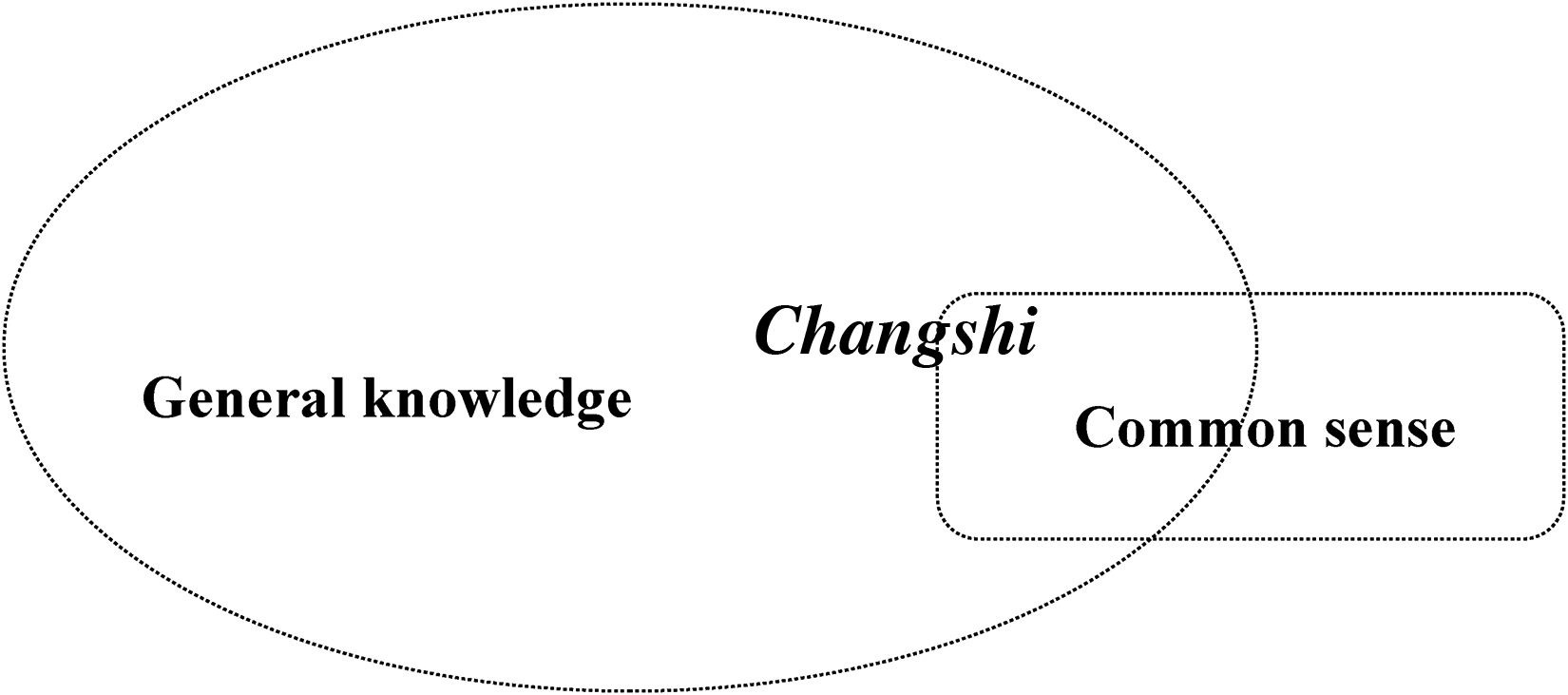
The two meanings of Changshi in Chinese.
In the classical theory of ancient Chinese character creation, all Chinese characters are classified into six categories: pictographs, self-explanatory characters, associative compounds, mutually explanatory characters, phonetic loan characters and pictophonetic characters (Xu, 1981).
The construction of Chinese characters started from ancient people's observation and depiction of the natural world, which shaped many pictographs. As direct depiction can represent only visualized things, self-explanatory characters were created to represent abstract things or concepts. Both pictographs and self-explanatory characters are single characters. This means that each character is a brand-new creation. As a result of the increasing demand for new characters to express people's cognition of the objective world, character synthesis and other ways of character creation were invented, including associative compounds, mutually explanatory characters, phonetic loan characters and pictophonetic characters.
According to archaeologists, the earliest Chinese characters can be traced back to oracle bone scripts in the Shang Dynasty (from about 1600 BC to about 1046 BC). Before the Qin Dynasty (from 221 BC to 207 BC), the creation of Chinese characters was continuously evolving, and a set of rules (the six ways to create characters) was observed across the states that developed their own character systems. Collectively referred to as ‘Large Seal script’, these characters differed greatly from modern Chinese characters. In the Qin Dynasty, the various character patterns from the seven states were unified as ‘Small Seal script’, along with weights and measures. Subsequently, script fonts gradually stabilized, and new characters were mostly derived from slight adjustments to or new interpretations of existing characters.
Pictographs
A pictograph is the oldest way to create a character. It uses the most direct description of objective things and, on that basis, is gradually simplified until a character is formed. Take the following characters in Small Seal script, the style of calligraphy adopted in the Qin Dynasty for the purpose of standardizing the script, as an example (Xu, 2006):
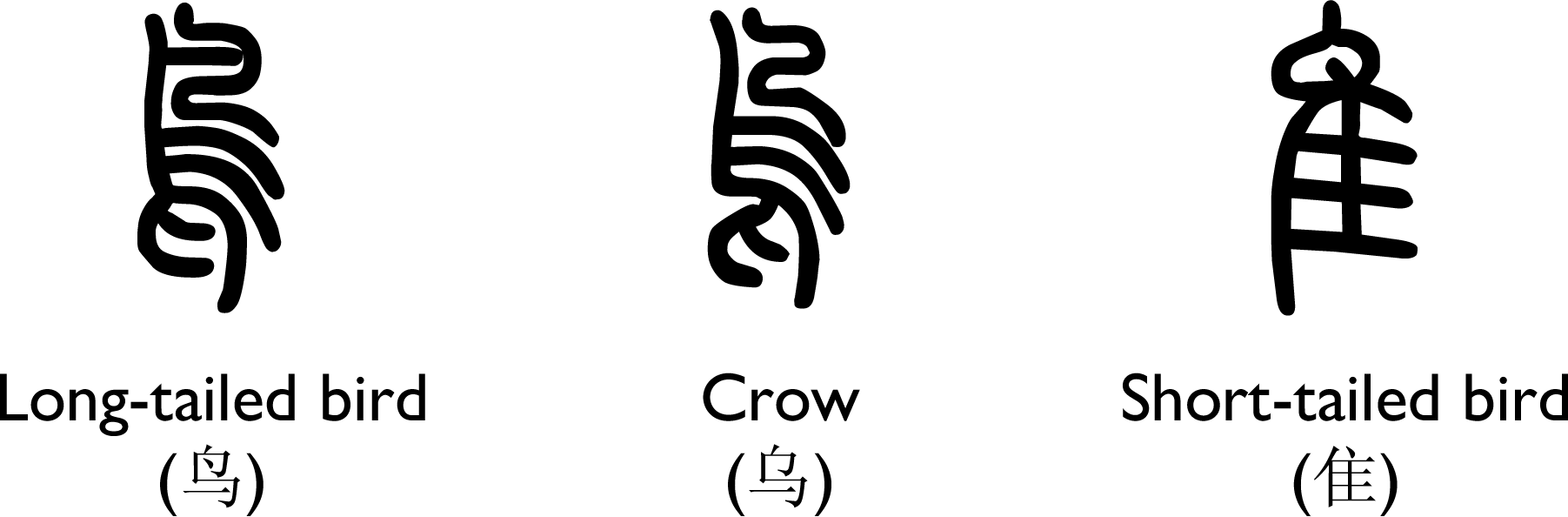
The first character shows the feather and body structure of a bird. This pictogram gradually evolved into the character ‘鸟’ (niǎo, meaning bird), used in Chinese characters today. The second character, ‘乌’ (wū, meaning dark colour), refers to the crow because the whole body of a crow is black, and the eyes cannot be identified easily. Therefore, one horizontal line, which embodies the eyes, is omitted compared with the first character for ‘bird’. The third character, ‘隹’ (zhuī), originally referred to a short-tailed bird. Its ‘feather’ shape is clearly different from that of the first character (Lindqvist, 2008).
Self-explanatory characters
Although pictographs can be used to vividly depict concrete objective things, it is difficult to indicate abstract meanings. Self-explanatory characters, however, are endowed with obvious abstract symbolic meanings, making them a good supplement to pictographs. For example, see the following characters in Jinwen, a style of Chinese calligraphy used for inscriptions on ancient bronze objects:
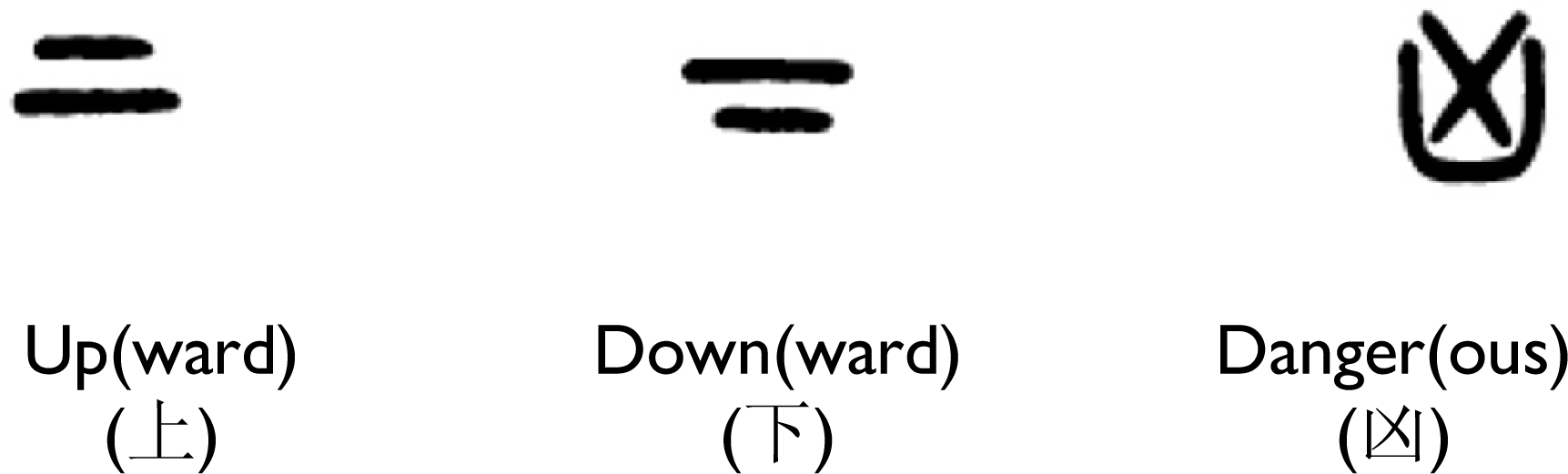
In the first two characters, which are on a horizontal datum line, a small horizontal line above is added to indicate ‘upper’ and a small horizontal line below indicates ‘lower’. In the third character, two crossed arrows are placed in a pit, meaning ‘hazard’ and ‘danger’.
Associative compounds
The character-making method of pictographs is not only limited in its expression of abstract meanings but also, as the understanding of objective things deepens, in expressing more and more new things in a single glyph structure. Therefore, the ancients combined two or more unibody characters to form plural associative compounds, as in the following:
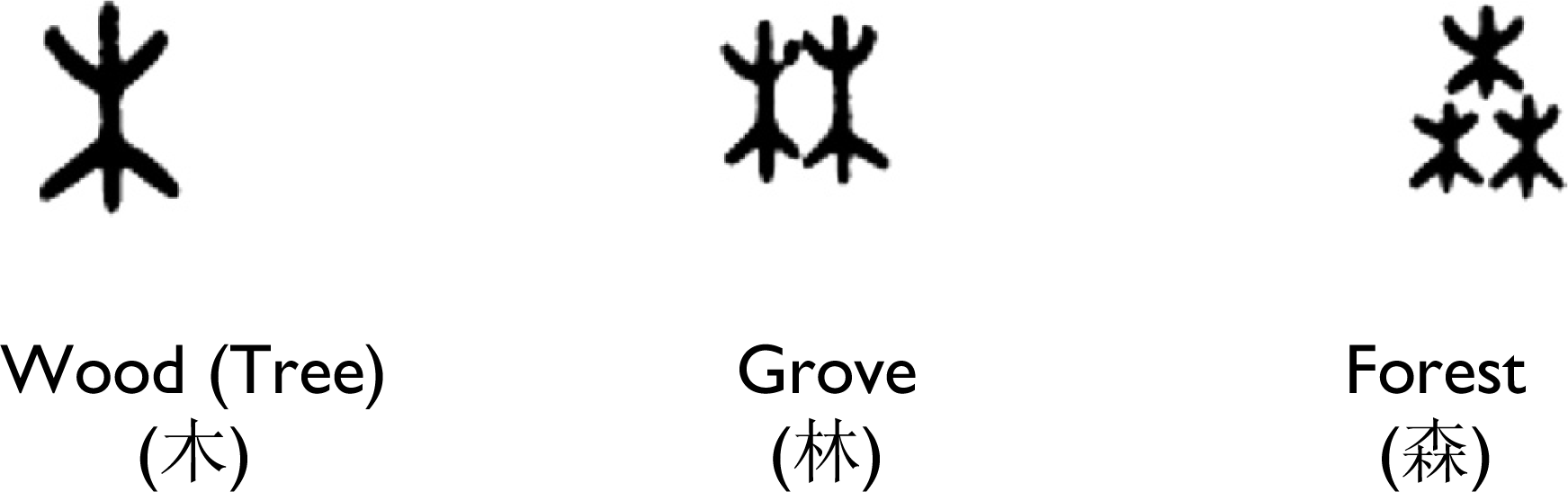
The first character ‘木’ (mù, meaning wood) is an image of a tree and a typical pictograph, whereas two trees standing together form the character ‘林’ (lín, meaning grove), and more trees form ‘森’ (sēn, meaning forest). These characters are relatively simple and clear combinations. However, the creation of some associative compounds can be very imaginative, as in the following group of words with the forms of ‘鸟’:
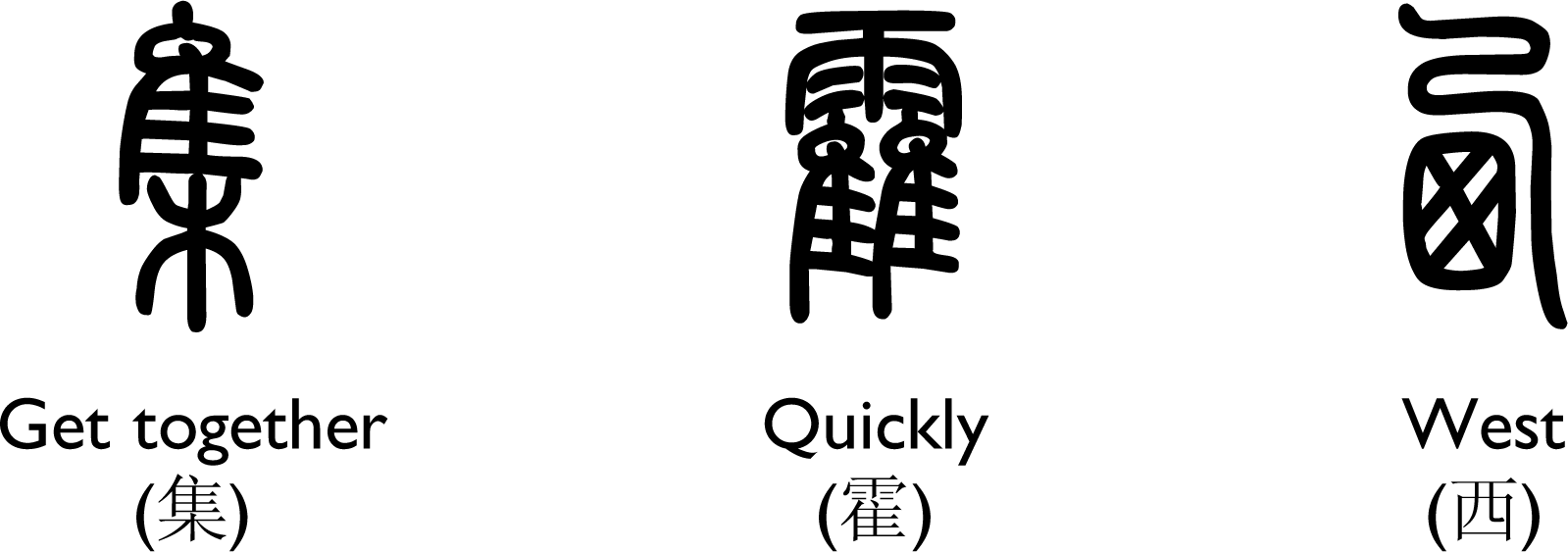
The first character, ‘集’ (jí, meaning gathering), shows a bird standing on a tree. This draws on ancient people's observation that many birds perch in trees when they assemble. The second character, ‘霍’ (huò, meaning swift), indicates that birds fly faster when it rains. The character is also an onomatopoeia imitating the sound of such birds. Earlier forms of the character had used two or three ‘鸟’ in the lower half, but that was then simplified to only one ‘鸟’, as in today's form of the character. The last character, ‘西’ (xī, meaning west), shows that birds usually return to their nests to rest at sunset, and the upper part that represents ‘鸟’ is simplified.
Mutually explanatory characters and phonetic loan characters
With the increasing variety of characters and the gradually increasing complexity of ideographic expressions, both mutually explanatory characters and phonetic loans became character-making methods. For mutually explanatory characters, existing homophones or near-homophones are used to express new meanings. In phonetic loans, when there are two or more words with similar meanings, just one of them is used to express a specific meaning; the others are used to express other meanings.
Pictophonetic characters
As the most common way to construct Chinese characters, pictophonetic characters are one of the most scientific and highly efficient word-making methodologies. They are compounds in which half represents phonetic meaning and the other half represents semantic meaning, so they are usually formed by rearranging or combining pictographs, self-explanatory characters and associative characters. For example:
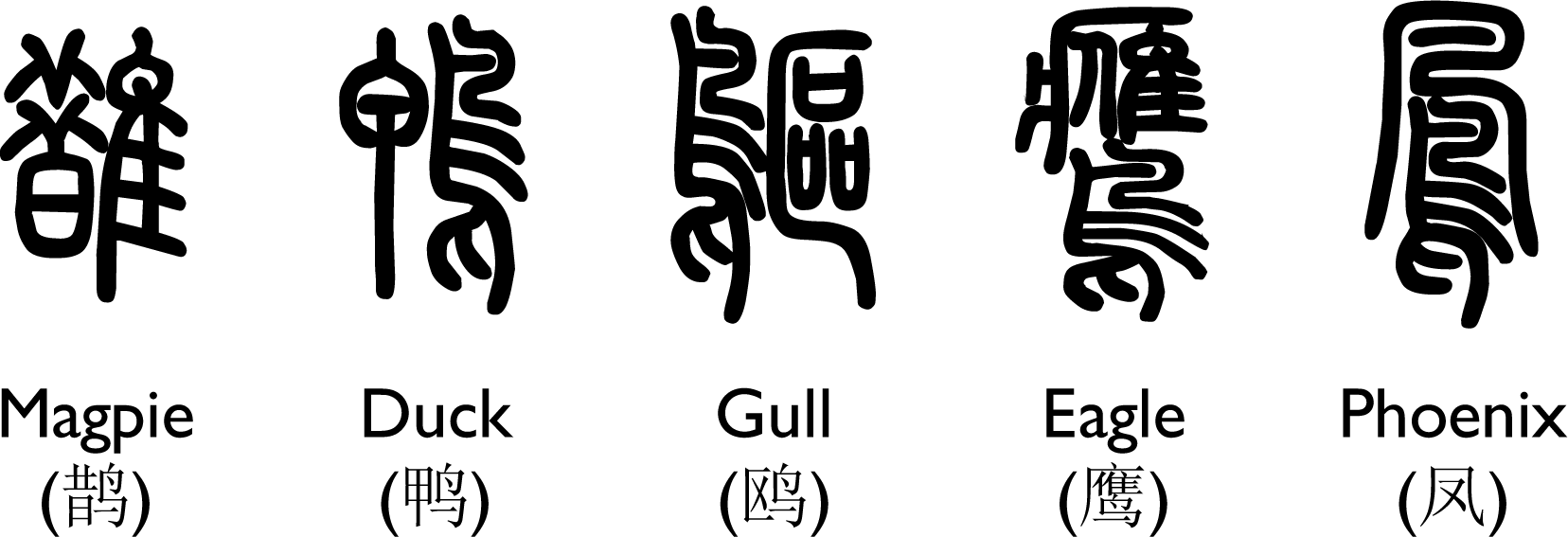
Whether the character ‘鸟’ (long-tailed bird) or ‘隹’ (short-tailed bird) appears on the left, right or top of the compound character, it forms the ideographic part of such characters. The other part is responsible for expressing sounds and determining the pronunciation of the character. The ideographic part of the first character ‘鹊’ (què, meaning magpie) is ‘隹’, which has evolved into ‘鸟’ in today's form of the character (鹊). The current form is obviously more in line with the image of the magpie, and it shows that the way of describing objective things gradually moves towards accuracy in the process of character making.
Common sense comes from a general understanding of life. The character constructors found principles from general facts, and then they exercised judgement. For example, by observation in daily life, we know that a magpie is a kind of bird, a duck is a kind of bird, and a gull is a kind of bird. Therefore, we know the ‘rules for being a bird’. When we see a type of bird that we have not seen before—perhaps a swan—we know that it is another kind of bird. According to this, we can say that knowing the birds easily seen in daily life is a kind of common sense, but knowing the typology of birds is a kind of general knowledge, which can help us understand unfamiliar species, such as swans.
The ancients created pictophonetic characters for convenience, and gradually developed a classification of objective things. Considering that a large number of characters were formed thousands of years ago, they were naturally used to depict natural things and phenomena based on people's simple and direct observation, experience and description. For example:
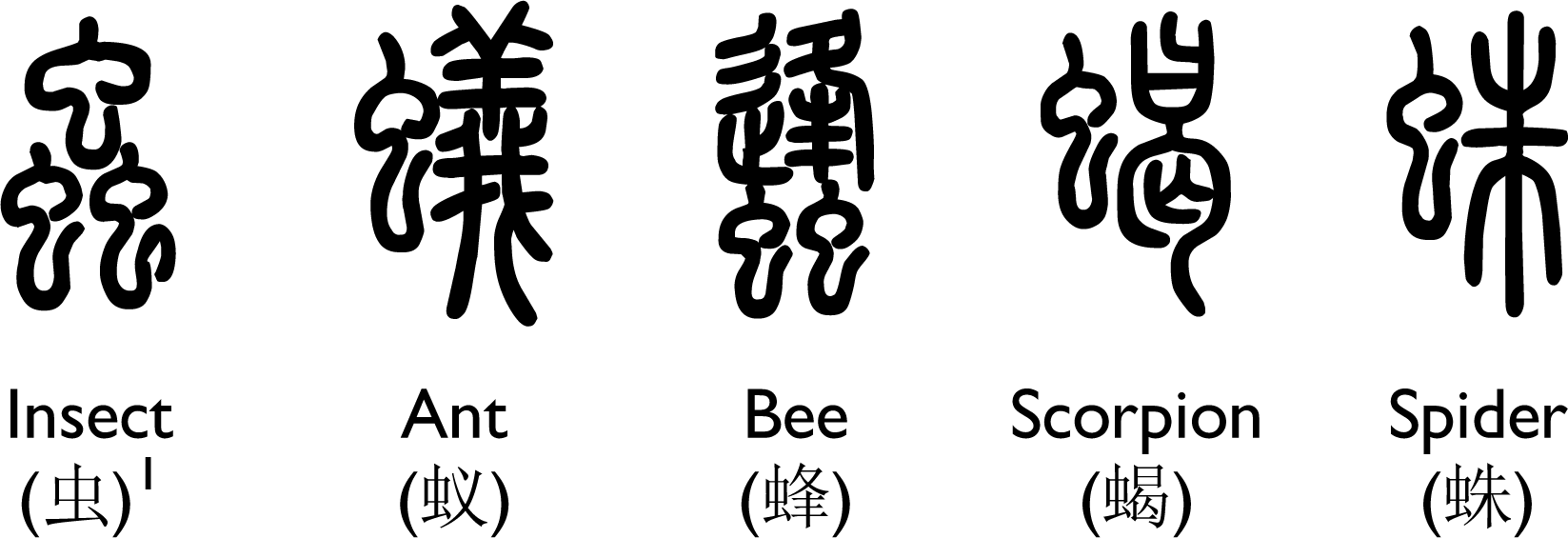
In the above, the first pictograph, ‘虫’ (chóng, meaning worm), is a direct depiction. Based on this, the following two characters, ‘蚁’ (yǐ, meaning ant) and ‘蜂’ (fēng, meaning bee), are insects, composed of the ideographic part for a worm (虫) and the other part indicating the pronunciation. Although, in today's biological classification, scorpions and spiders are arachnids, not insects, they are classified as insects in the character-creation process because they look like insects. We can see that the ancients’ character making indicated their typology of natural objects by direct observation; it was also a process of trial and error, reflecting their knowledge of the natural world.
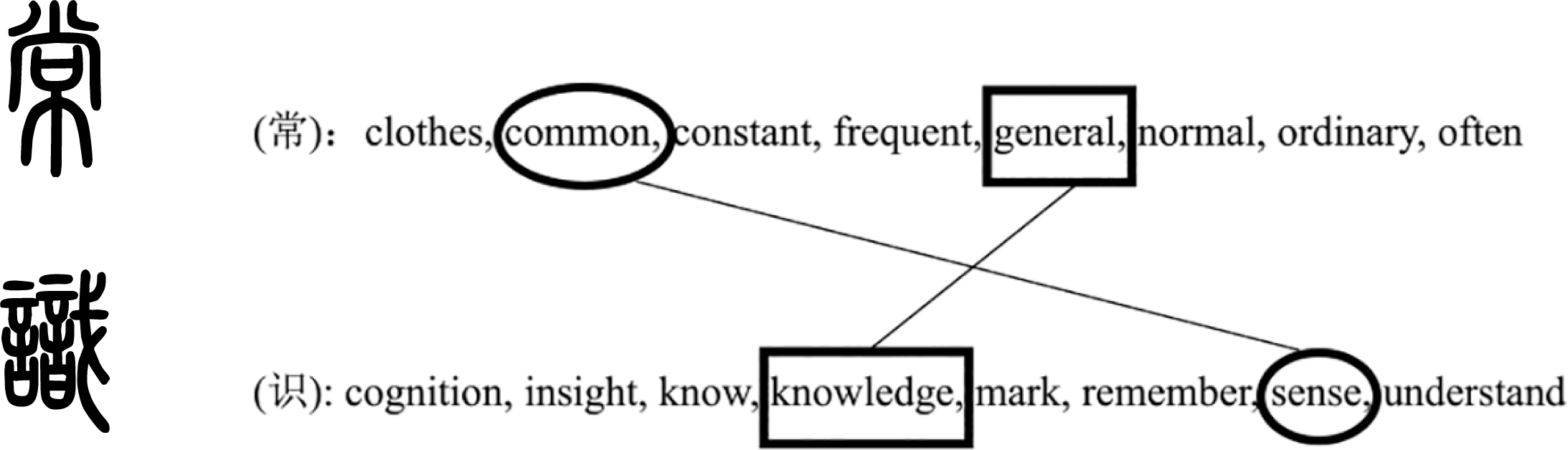
The final example is the core concept of ‘常识’ (Changshi). ‘常’ is a pictophonetic character. The upper part (‘尚’) provides its pronunciation, and the lower part (‘巾’) provides its meaning (clothes). ‘识’ is also a pictophonetic character. The right part (‘戠’) provides its pronunciation, and the left part (‘言’) provides its meaning (speak/talk/word). As shown above, each character has a group of meanings during the evolution of characters; both ‘常’ and ‘识’ are possible combinations of the two characters’ original meanings.
Tracing the creation of characters: A long process from common sense to general knowledge
The creation of Chinese characters, especially when we consider the transformation of their meanings and evolution over a thousand years, reveals a process in which the ancients observed and perceived natural things, and then promoted perception to build common sense through communication, and finally formed general knowledge. With the gradual formation of human society, the objective content indicated by characters has expanded from the earliest natural objects to the unique products of humans. The reason that some ancient characters were lost in the long span of history is that the objects they represented no longer existed. Therefore, those characters were buried in various ancient books and records.
As general knowledge, traces of knowledge formation can still be seen in the Chinese characters used today. For example, when describing natural objects, apart from the example mentioned in this paper that spiders (蛛) are not exactly insects (虫), we often see similar ‘wrong’ characters in children's books and popular science works, such as ‘鲸’ (jīng, meaning whale), which has a ‘鱼’ (yú, meaning fish) but is not a fish, and ‘蜈蚣’ (wú gōng, meaning centipede), which has a ‘虫’ but is not an insect. Although new objects are constantly emerging in contemporary society, there is no need to express them with new characters. Once a sense that it is not necessary to judge whether the statement is right or wrong becomes common in a certain group and spreads outward, the words formed by the combination of existing characters will continue the transformation to reach the stage of general knowledge.
Footnotes
Declaration of conflicting interests
The author declared no potential conflicts of interest with respect to the research, authorship and/or publication of this article.
Funding
The author received no financial support for the research, authorship and/or publication of this article
Notes
Author biography
Xiang Li is an associate researcher at the National Academy of Innovation Strategy, CAST. His research interests are science museums, science culture, and art and science.