




Abstract
Ancient Chinese civilization was agricultural. To grasp the essence of science and civilization in China, Dr Joseph Needham drew attention to its agricultural development. He maintained close academic relations with Chinese historians of agriculture and obtained their help from time to time for the compilation of his Science and Civilisation in China. Needham also had a far-reaching influence on research on the agricultural history of China, both on its institutionalization and on transitions in the directions of research. The so-called ‘Needham puzzle’ was first proposed systematically in his address titled ‘Science and agriculture in China and the West’ at the annual conference of the China Agronomic Association in Chongqing in 1943. He believed that science is not isolated from society but is an indivisible part of civilization and that civilization has evolved as the result of the interactions of science, society and the environment.
Research on China’s agricultural history began as early as the 1920s. In 1920, in cooperation with the US Department of Agriculture and the Library of Congress, the University of Nanking (now Nanjing University), which was established by American missionaries, set up the Research Department of Agricultural Books. Ms Catherine Howes Wead of the Library of Congress was sent to Nanjing to systematically gather and collect ancient Chinese books on agriculture, which had been handed down to the Institution of Chinese Agricultural Civilization of Nanjing Agricultural University. In 1932, the Research Group on Agricultural History was set up within the Department of Agricultural Economics of the university, and a course on agricultural history was established for undergraduates. In general, however, research on agricultural history remained sparse and was sporadic during most of the Republican era (1911–1949). Circumstances changed from the 1940s onward, and one of the major instigators of that transformation was Dr Joseph Needham.
1. Falling in love with the history of science and technology in China
Dr Joseph Needham (1900–1995) was a well-known biochemist and founder of chemical embryology, for which he was elected as a Fellow of the British Royal Society in 1941. He became interested in the history of science and technology in the late 1920s. In 1931, he attended the second International Conference on the History of Science held in London and was deeply impressed by Marxist perspectives on the history of science. In 1936, he began delivering a series of lectures on the history of science at the University of Cambridge. He had no idea of Chinese attainments in science and technology until he became familiar with them in 1937 through Shen Shizhang, Wang Yinglai and Lu Guizhen (Lu Gwei-Djen, 1904–1991), who were pursuing their PhDs at Cambridge. He was amazed by the advanced accomplishments in science and technology in ancient Chinese times and devoted himself to the study of Chinese history.
In 1939, Needham published his first paper on the history of science in China in cooperation with Lu Guizhen, 1 who was the daughter of Lu Shiguo (Figure 1), a well-known physician of traditional Chinese medicine in Nanjing.
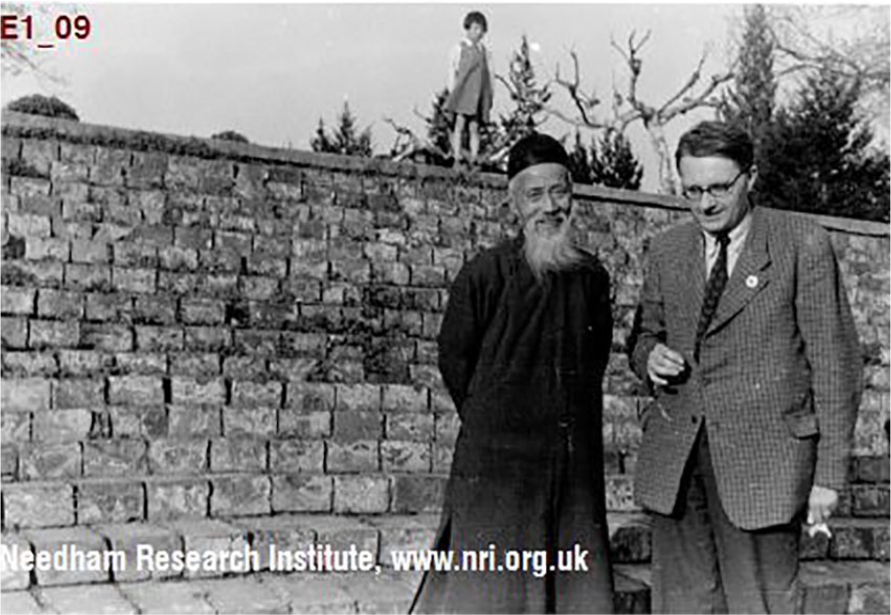
Dr Joseph Needham and Mr Lu Shiguo in Nanjing (April 1946).
In February 1943, Needham was sent to China by the British Government. He later established the Sino-British Science Cooperation Office in Chongqing. During his 3-year stay in China, he had a number of opportunities to share ideas and knowledge with scholars from various institutions and universities and learned more about Chinese history and ancient China’s accomplishments in science and technology. He had the idea of writing a book to introduce those remarkable achievements to the West.
In 1948, when he returned to Cambridge from Paris, Needham started a book project titled Science and Civilisation in China (SCC). Its first volume was published in 1954. By 1995, when Needham passed away, 16 volumes of SCC had been published and had earned him a worldwide reputation. SCC was awarded the First Prize for Natural Science in China, and Needham was elected as a member of the Chinese Academy of Sciences. For his accomplishments, Needham also won the George Sarton Medal in 1968.
2. Needham’s circle of agricultural historians
Needham realized that ancient China was an agricultural society, and hence focused on its history of agricultural development and how that affected Chinese society and civilization. In February 1943, he delivered a famous speech titled ‘Science and agriculture in China and the West’ at the annual conference of the China Agronomic Association in Chongqing, proposing for the first time the well-known ‘Needham puzzle’: China had led the world in science and technology for two millennia, but why did it fail to do so in modern times? That question aroused worldwide interest and sparked heated debates for decades.
During his work on science and civilization in ancient China, Needham became acquainted with numerous scholars and established cooperative relationships with them that lasted decades. Among them there were a number of historians of agriculture, such as Professor Shi Shenghan (1907–1971) 2 of National Northwest College of Agriculture (now the Northwest Agriculture and Forestry University), Professor Wan Guoding of the University of Nanking, Mr Hu Daojing (1913–2003) of the China Press in Shanghai, Professor Wang Yuhu (1907–1980) of the Beijing Agricultural College (now China Agricultural University) and Professor Liang Jiamian (1908–1992) of the College of Agriculture of Zhongshan University (now South China Agricultural University).
Professor Shi Shenghan received his PhD in plant physiology from the University of London under the supervision of Professor F.F. Blackman. He served as a professor of biology at Tongji University, Wuhan University and National Northwest College of Agriculture. From the 1950s on, he devoted all his efforts to studying Chinese agricultural history.
Needham first met Shi at Sichuan University in Leshan. As Needham was a biochemist and Shi was a biologist who spoke excellent English, Shi soon became an ideal companion for Needham’s academic investigations and they became good friends.
Shi was erudite in both Chinese and Western scholarship and gave Needham considerable assistance. Needham benefitted a great deal from Shi’s work, especially his Annotations of Qi Min Yao Shu (Shi, 1957) and many other works. While initiating the SCC project, Needham had hoped initially to have Shi as his collaborator for the volume on biology and agriculture. He wrote to the Chinese Government about it but failed owing to Shi’s politically precarious situation in China at the time. Needham did not forget their friendship and the enlightening help he had received from Shi. He dedicated the SCC volume on botany to Shi (Needham, 1986).
Needham also wished to help Shi in any way Shi needed. In the late 1950s, when the Science Press prepared for the publication of English translations of Shi’s books A Preliminary Survey of the Book Chi Min Yao Shu (Shi, 1958) and On Fan Sheng-chih Shu (Shi, 1959), Needham offered his help on collation and annotation. Shi expressed his gratitude to Needham in the prefaces of the books.
Needham also had contact and academic exchanges with Professor Chou Io (Zhou Yao) of the National Northwest College of Agriculture. 3 Chou was a distinguished entomologist who had graduated from the Universita degli studi di Napoli Federico II in Italy under the supervision of world-renowned entomologist Filippo Silvestri. Chou (1957) published the first treatise of A History of Chinese Entomology in Early Times, and was a pioneer in the history of biology in China. Needham attached importance to Chou’s research and cited a number of his results in SCC.
Mr Hu Daojing was a well-known editor and bibliographer (Figure 2). 4 He graduated from Chizhi University in Shanghai (now the Shanghai International Studies University) and wrote numerous articles and books on ancient Chinese classics; the most famous ones are Annotations of Shen Kuo’s Meng Xi Bi Tan (Hu, 1956) and Ancient Agronomic Books and Essays on Agricultural History (Hu, 1985). Because of his experience in collection and publication, he became an important source for Needham’s research materials for SCC. They corresponded frequently (there are 14 folders of their correspondence in the Needham Research Institute (NRI) archives). In 1964 alone, Hu sent Needham more than 30 books on science and technology in ancient China.
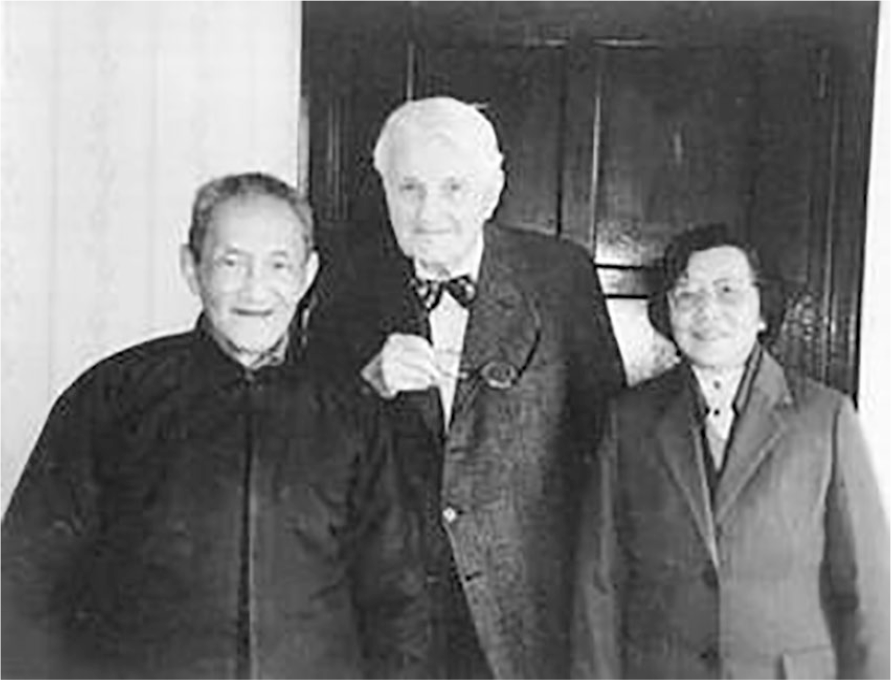
Needham and Hu Daojing in Shanghai.
In 1980, Hu gathered Chinese scholars distinguished in the history of science and edited a book titled Explorations in the History of Science and Technology in China (Hu, 1981) as a gift to celebrate Needham’s 80th birthday. It was published by Shanghai Classics publishing house. Needham appreciated Hu’s contribution to the bibliography of ancient science and technology and agricultural history, and wrote a dedication to Hu in his book Meng Xi Bi Tan Bu Zheng. Needham was also an important advocate for Hu’s membership of the International Academy of the History of Science in 1981.
Professor Wang Yuhu was a distinguished scholar in agricultural history and ancient agricultural bibliography. 5 He studied economics at the Technische Universität München (Germany) and the Université de Paris (France) and initiated world agricultural history and comparative agricultural history studies in China. He returned to China in 1933 to serve as curator of the university library of the Beijing College of Agriculture for nearly 30 years. His best known work is A Collection of Agronomic Books in Ancient China (Wang, 1957). Needham drew attention to his works and had them listed as important reference works for SCC. When the SCC biology volume was published, Needham wrote on the title page in memory of Wang Yuhu, Shi Shenghan and Amano Motonosuke and stated that, without their pioneering work in agricultural history, the volume on agriculture could not have been completed (Needham, 1984).
Professor Liang Jiamian studied at the College of Agriculture of Zhongshan University and became interested in agricultural history under the influence of Professor Ding Ying, the dean of the college. 6 In 1941, he was engaged to work in the university library and made agricultural history studies as his lifelong career. Needham first met Liang in May 1944 in the company of Dr Huang Xingzong. Because of the war with Japan, Zhongshan University moved to Zhangyi in Hunan Province. As Liang was in charge of the university library and had accumulated much knowledge of the history of agriculture, Needham spoke to him twice in detail regarding Chinese agricultural history (Figure 3). From then on, they maintained a close academic relationship. Because Liang acted as director of the university library for decades and was familiar with ancient sources, he offered Needham considerable assistance by sending books or providing valuable duplicates of ancient Chinese texts on farming and biology.
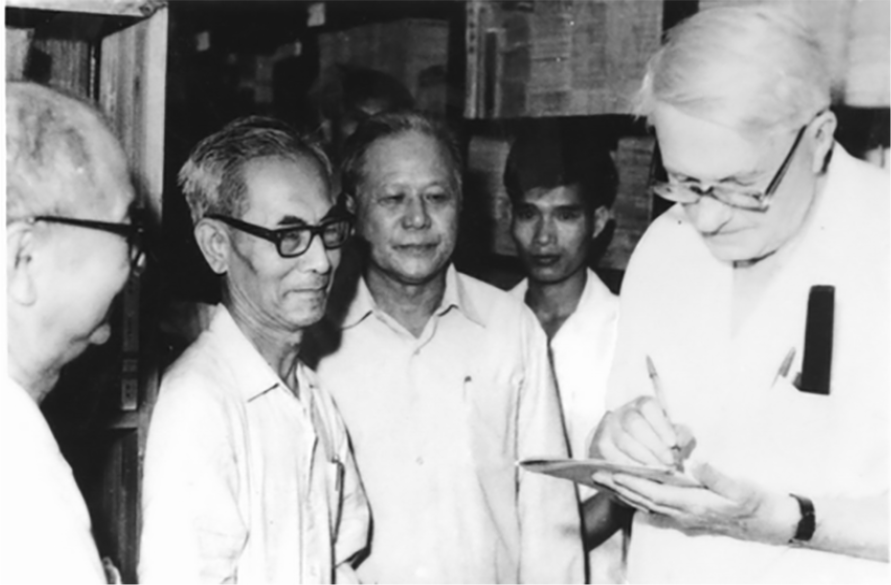
Needham and Liang Jiamian at South China Agricultural College.
Professor Wan Guoding was the first scholar to research the agricultural history of China. 7 He was born in Wujin (Jiangsu Province) in 1897 and graduated from the University of Nanking in 1920. Wan fell in love with agricultural history in the early years of his university education and wrote his first paper on the history of sericulture in ancient China. In 1924, he was appointed director of the Research Department on Agricultural Books and, in 1932, head of the Agricultural History Research Office of the Department of Agricultural Economics in the university. In 1955, he was appointed as the first director of the National Institute of Chinese Agricultural Heritage under the dual leadership of the Chinese Academy of Agricultural Sciences and Nanjing Agricultural College (now Nanjing Agricultural University).
Needham made three visits to Professor Wan and his research team, in 1943, 1958 and 1964. When Needham first visited the University of Nanking in 1943, he became acquainted with Wan through Zhang Zhiwen (1900–1982). 8 Zhang graduated from Cornell University and was a well-known agronomist specializing in cotton. He was dean of the College of Agriculture at the University of Nanking from 1931 to 1948. During the war with Japan, along with other universities, the University of Nanking was moved to Chengdu. In June 1943, Needham was told that Wan and his colleagues had been involved in a major project called A Complete Collection of Ancient Agricultural Works since 1920, and Needham hoped that Wan could provide him with the academic materials he needed. Before long, Needham received a piece on the outline of the project and Professor Zhang Zhiwen’s treatise, Plan of Post-war Agricultural Construction in China.
On 17 October 1948, Needham wrote again to Zhang, requesting more academic resources for the compilation of SCC and expressed hope that he would get two copies of A Complete Collection of Ancient Agricultural Works. In 1951, Needham also tried to communicate with Wan Guoding through their old friend Zhu Kezhen (1890–1974), a former president of Zhejiang University and then vice president of the Chinese Academy of Sciences. In a letter, he told Wan about his grand project and enclosed ‘an advance schedule of the various chapter-headings’ (Figure 4).
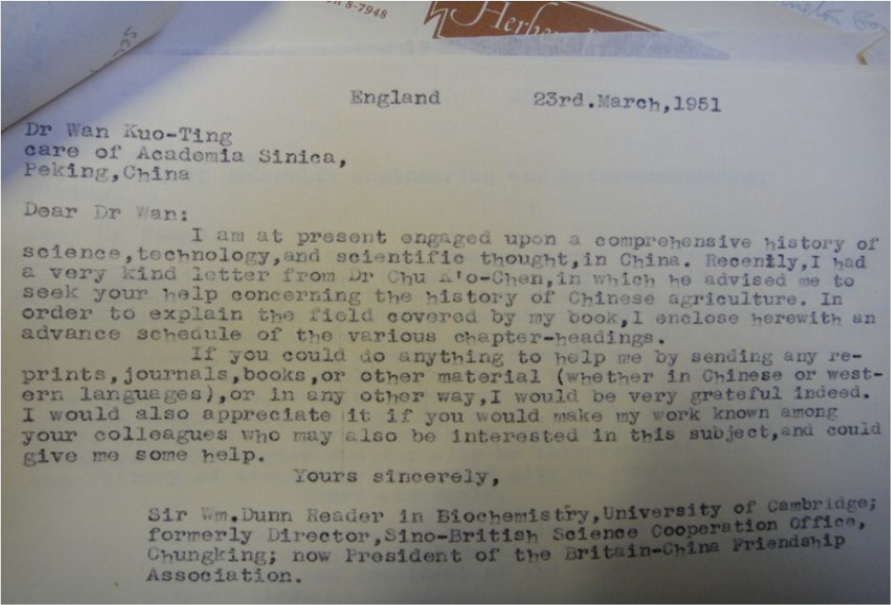
Needham’s letter to Wan Guoding, 23 March 1951.
The archives show that Needham not only received a lot of academic resources from Chinese scholars but also arrived at important findings through discussions with his Chinese colleagues. For instance, on 25 June 1958, Needham and Lu Guizhen visited the Institute of Chinese Agricultural Heritage and had a long discussion with professors Wan Guoding, Chen Hengli, Zou Shuwen, Hu Xiwen, Song Zhanqing and Li Changnian and other researchers at the institute. Needham’s diary contains a detailed description of the event (Figure 5). The topics they dealt with were extensive: the origin of the soybean and its use; comparisons of economic and political institutions in China and the West; the reasons why farming practices in ancient China had been more advanced than those in Western countries; and special histories of various crops, pest control and hydraulic engineering. Some of those discussions are reflected in SCC. During his visit to the institute on 27 August 1964, Needham discussed with Professor Hu Xiwen the use of green manure in ancient China. He believed that Chinese civilization could have developed over thousands of years because of this perfect combination of the use and nurturing of farmland. 9
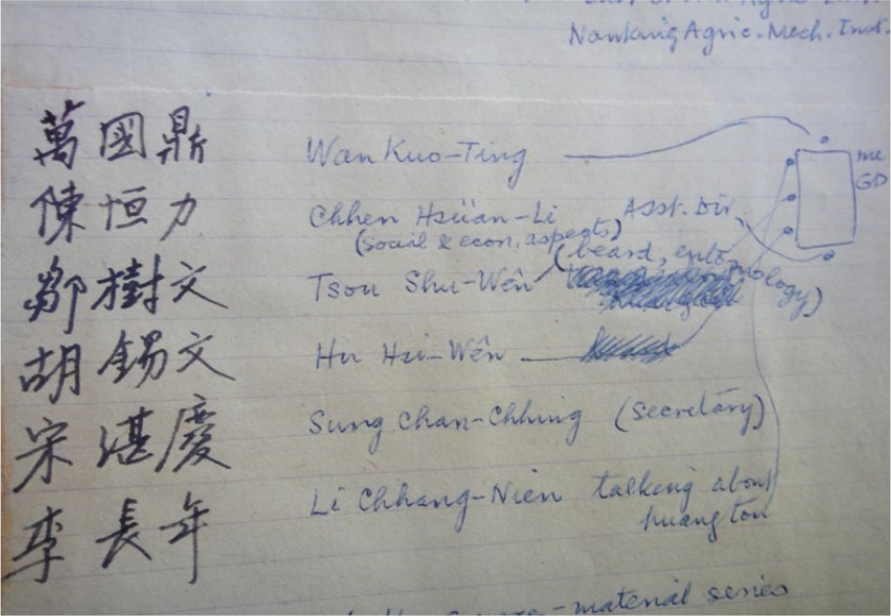
Needham’s diary entry on his visit to the Institute of Chinese Agricultural Heritage in 1958.
Later in the same year, Needham had another long exchange in Beijing with Professor Zou Shuwen, who visited the Science Press to prepare his book The History of Chinese Entomology (Zou, 1981) for publication. 10 They discussed in detail ways of using beneficial insects, such as silkworms, honeybees, white wax insects and the like, as well as ways of controlling various pests in ancient China. Some of their discussions are recorded in the volume on agriculture in SCC (Needham, 1984).
3. Needham and the institutionalization of the history of science in China
Although China had a long history of achievements in science and technology, no effort had been made to study them before the 20th century. Needham’s SCC inspired and stimulated work on the history of science and technology as an independent discipline in China.
After the publication of the first volume of SCC in 1954, systematic research on the history of science in China flourished. One of the leading figures in the field was Zhu Kezhen, who was a distinguished meteorologist. Zhu was born in Shaoxing (Zhejiang Province) in 1890. He obtained his PhD from Harvard University in 1918 and became the first chairman of the Department of Geography of Southeast University in 1921. He became the founding figure of modern geography and meteorology in China. In 1934, together with Weng Wenhao and others, he set up the China Geography Association. From 1936, Zhu served as president of Zhejiang University for 13 years. In 1948, he was elected as a member of the Chinese Academy of Sciences and, in 1949, he was appointed vice president of the academy.
Zhu was not only an outstanding meteorologist and leader in scientific activities but also a historian of science. He conducted pioneering work in a number of fields, such as historical meteorology, historical phenology and historical seismology. His magnum opus is ‘A preliminary survey of climate change in China for five thousand years’ (Zhu, 1972). Needham became acquainted with Zhu as early as March 1943, when he met him at a welcoming banquet held by Zhu Jiahua, the Minister of Education, in Chongqing. In April and October 1944, Needham visited Zhejiang University at Zunyi (Guizhou Province) and established a lifelong friendship with Zhu.
Zhu was also a constant supporter of Needham’s research. He sent dozens of boxes of ancient Chinese academic materials to Needham, including a set of the Gu Jin Tu Shu Ji Cheng (Complete Collection of Illustrations and Writings from Past to Present). From their correspondence, one notes that Zhu even drew up a list of leading Chinese scholars in different fields of the history of science and technology for Needham’s reference, including Li Yan and Qian Baocong for the history of mathematics, Liu Zhaoyang for the history of astronomy, Liu Xianzhou for mechanical history, Wan Guoding for agricultural history, Li Tao for the history of traditional Chinese medicine, Liu Dunzhen for the history of architecture, Zhang Hanying for the history of hydraulic engineering and others. 11 Because there was no stable funding for Needham’s SCC project early on, Zhu even persuaded the Chinese Government to give Needham some financial support for 3 years and entrusted Wang Ling to assist Needham with the compilation of SCC. Needham expressed his gratitude to Zhu in the preface of the first volume of SCC, describing him as the most generous and persistent donor and supporter of Needham’s huge, lengthy project.
Needham’s ideas and his SCC have had a far-reaching impact on the institutionalization of the history of science in China. Inspired by the first volume of SCC, Zhu published an article in the People’s Daily on 26 July 1954 titled ‘Why should we study the history of science and technology in ancient China?’ drawing people’s attention to Needham’s work and stressing the importance of the history of science. In 1956, with Needham’s help, Zhu led a group of historians of science to Italy to take part for the first time in the International Conference on the History of Science (Figure 6).
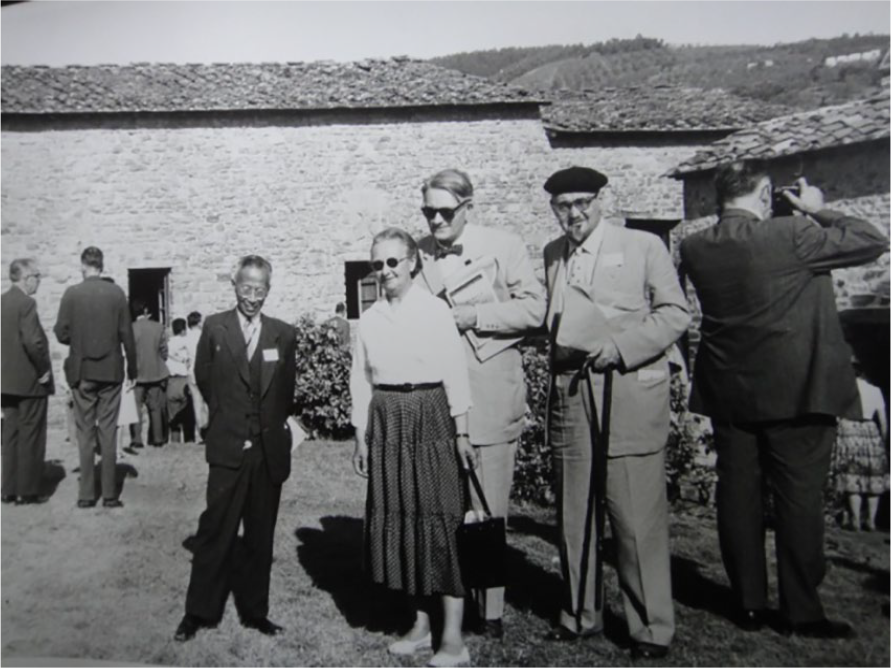
Zhu Kezhen and Needham in Italy at the 8th International Conference on the History of Science.
After returning home, Zhu and some other well-known scholars asked the Chinese Government to set up a special institute for the history of science. In 1957, the Chinese Academy of Sciences established the Institute for the History of Natural Science and started the publication of The Collection for the History of Science, with Qian Baocong as chief editor. Before long, a number of universities and institutions in other parts of China established special institutes or research offices in this field, including the Institute for the History of Science at the University of Science and Technology of China in Hefei (Anhui Province).
In 1954, the Ministry of Agriculture held a symposium on investigating the agricultural heritage of ancient China. In 1955, with the support of Jin Shanbao, 12 the president of Nanjing Agricultural College, the national Institute of Chinese Agricultural Heritage was formally established in Nanjing, with Professor Wan Guoding as its first director.
In 1957, the institute was reorganized and affiliated under the dual leadership of the newly established Chinese Academy of Agricultural Sciences in Beijing and Nanjing Agricultural College (where the institute was located). Similar research units were later set up in other agricultural universities, such as the Research Office on Ancient Agronomy of the National Northwest College of Agriculture at Wugong (Shaanxi Province), led by Professor Shi Shenghan; the Research Office on Agricultural History of Beijing Agricultural College, led by Professor Wang Yuhu; and the Special Collection of Ancient Agricultural Classics of South China Agricultural College in Guangzhou, led by Professor Liang Jiamian. Although there was no special unit for agricultural history, similar research was conducted by scholars at Zhejiang Agricultural College (now Zhejiang University), the Chinese Academy of Forestry Sciences and the Chinese Academy of Hydraulic Science and Technology.
In the early decades of the People’s Republic of China, the nation was isolated, but Needham was one of a few scholars to maintain a friendly relationship with the country. He was the founder and first chairman of the Sino-British Friendship Association. As early as in 1943, Needham met with Zhou Enlai, one of the leaders of the Communist Party of China, in Chongqing. In 1964, on the 15th anniversary of the People’s Republic of China, Needham met Chairman Mao Zedong. Mao praised Needham’s wonderful work on the history of science and technology in China and sought his suggestions on the development of modern industry.
With the encouragement of China’s leaders, Needham gained some privileges in China. Not only did he have opportunities to visit many academic institutions, but he also made series of rural field trips throughout China and collected much firsthand material on rural areas and traditional Chinese farming practices.
4. Needham’s influence on research into the agricultural history of China
In the late 19th century, China was invaded by a succession of imperialist powers. To survive, the country was forced to learn from the West. During the Westernization Movement and later periods, a number of talented people were sent to Western Europe and the United States to study advanced science and technology. Under the influence of a Eurocentric ideology, it was widely believed that science was derived from the West and that there had been no natural science in ancient China. Ren Hongjun (1915), the founder of the China Science Society, wrote a paper titled ‘Why was there no science in ancient China?’ for the first issue of Science. Needham and Zhu Kezhen disagreed with Ren and claimed that a clear distinction should be made between traditional science and modern experimental science.
Many thought that Needham first raised the Needham puzzle in the first volume of SCC in 1954, but he had already posed the question at the annual conference of the China Agronomic Association in Chongqing in February 1944 in his lecture on ‘Science and Agriculture in China and the West’.
In that lecture, Needham refuted the argument that there had been no science in ancient China and claimed that a large number of inventions and advances in science and technology had been made in that period, including the compass, gunpowder, paper-making and printing. 13 In agriculture, the ancient Chinese began raising silkworms and using their cocoons as early as thousands of years ago. China was the motherland of tea planting and tea making, which later spread throughout the world. The ancient Chinese were also the first to invent biological controls of pests in fruit production.
Western scholars had focused on contributions made by the Egyptians, Babylonians and Arabs, ignoring achievements by China and India. In Needham’s view, China had been far superior to the West in science and technology, at least until the 15th century. Chinese civilization was rooted in agriculture, and Chinese farming technology had been a model for European countries, exerting a deep influence on the agricultural revolution in Western Europe in the 17th and 18th centuries. Yet, a stunning reversion had occurred in the past 100 years.
Chinese farmers began using the iron plough extensively as early as 2000 years ago, while European farmers used wooden ones. However, by the time Europeans started using steel ploughs, Chinese farmers were still using iron ones. Hence, Needham raised the question, ‘Why did these great beginnings of agricultural science not arise in China, one of the greatest agricultural countries in the world?’ (Needham, 1948).
It is not an easy question, and Needham tried to give a brief answer from geographical, environmental, economic and social perspectives. He was deeply influenced by Karl Marx’s philosophy and Karl Wittfogel’s (1957) Oriental Despotism. 14 Their different natural environments and cultural traditions meant that China and European countries had followed different paths of development. The ancient Chinese had invented gunpowder but failed to make advances in gun-making and military technology.
Modern agriculture was based on the engineering and chemical industries, so, to improve Chinese agriculture, China would have to accelerate the development of modern science and technology. The Needham puzzle stimulated generations of Chinese scholars to examine traditional China’s culture, its national strategy and shortcomings, and encouraged people to carry out social and cultural reforms.
What is most important is not whether Needham’s argument is correct, but rather his broader vision of exploration and the ways he suggested engaging with the history of science and technology. His intellectual heritage had a profound influence on the direction and content of agricultural history in China. According to Hu Daojing’s recollection, Needham sent an outline of the SCC volume on agriculture to Chinese historians of agriculture for comments and suggestions in 1979. Inspired by Needham and his SCC, Chinese historians of agriculture discussed the possibility of compiling what became A History of Agricultural Science and Technology in China (Liang, 1989) at a conference in Zhengzhou (Henan Province). With financial support from the Ministry of Agriculture and the joint efforts of scholars from dozens of institutions, the work was published in 1986 and won the National Prize for the Advancement of Science and Technology.
The true intellectual legacy of Needham and his SCC is not only the series of books and records he brought together on the history of science and technology in ancient China (Chinese scholars may well be more familiar with the academic resources). The real value of his work lies in his ideas, his theoretical analysis, his comparative view of cultural development and his probing of interactions among civilizations. I suspect that is why he gave his book the name ‘Science and Civilisation in China’, placing technology in a certain historical context, and exploring the interactions between technology and civilization.
At the beginning of the compilation of A History of Agricultural Science and Technology in China, Chinese agronomists and historians of agriculture had planned to deal exclusively with the historical development of agricultural science and technology, without considering other factors related to agriculture. However, inspired by Needham’s SCC, they realized that farming is a complex socio-economic activity involving not only tools and technology but also productive activities such as land ownership, marketing and distribution. They had previously limited the scope of the research to a narrative concept of the history of planting, but they realized that ancient Chinese agriculture had been an organic combination of cropping, forestry, husbandry, fishing and sideline production; hence, the concept of ‘comprehensive agriculture’ was adopted to guide the compilation. The effort proved to be a great success.
From the 1920s to the 1980s, nearly all efforts by historians of agriculture in China were focused on collating and annotating ancient agronomic works and the history of agricultural technology, especially in the fields of crop breeding, fruit, vegetables, pest control, farming implements and husbandry. Needham’s vision of comparative history encouraged Chinese scholars to explore the broader background of agricultural development and the social and economic settings for the transformation from the traditional to the modern. Inspired by Needham and SCC, they came to recognize that technology never develops in isolation, and that technology alone cannot explain the development of Chinese agriculture; every technique has its own historical and cultural background. From the 1980s onward, Chinese historians of agriculture began to pay more attention to comprehensive research on Chinese agricultural developments and the interactions among civilizations.
Civilizations are interconnected, and Needham drew attention to the spread and interactions of the world’s civilizations. He listed 26 important Chinese inventions and probed their far-reaching influence. In recent decades, increasing attention has been devoted to research on agricultural diffusion and communication between China and other parts of the world. Examples include the National Social Science Foundation’s ‘Agricultural Communications between China and Abroad through the Silk Road’ and ‘The Introduction and Extension of American-originated Crops and Their Long-term Impacts in China’ projects. In October 2012, the first International Conference on Agricultural Origination and Diffusion in the World, sponsored by Nanjing Agricultural University and the University of Reading in the United Kingdom, was held in Nanjing. In addition, the Series on Crop Introduction and Localization in China has been in progress at the Institute of Chinese Agricultural Civilization of Nanjing Agricultural University, and dozens of books have been published.
Needham shifted to study the history of science, but he was not pedantic about history. He believed that people could learn from historical enlightenment and was thus concerned about ongoing developments, showing his passion for economic and rural development. As early as in the 1940s, he made rural field trips to different parts of China, especially Sichuan, Guizhou, Shaanxi, Gansu and Jiangxi, to investigate agricultural production, the daily lives of farmers and irrigation systems. After the founding of the People’s Republic of China, when he returned to China, he also chose to visit Nanyuan People’s Commune in Beijing; Jiajiazhuang People’s Commune in Taiyuan; and the national model in agriculture, Dazhai in Xiyang County (Shanxi Province).
Needham paid great attention to traditional Chinese farming and its achievements. He collected a set of documents and pictures of the National Exhibition of Agricultural Implements in 1956. Based on those materials, he wrote a paper on the development of steel technology in modern China and had it published in a special issue of Newcomen Society. In his position as chairman of the Sino-British Friendship Association, he wrote to the leaders of China, helped the London Science Museum duplicate some agricultural implements from the China National History Museum and held a special exhibition in London. 15
When he visited the South China Institute of Tropical Crops in Hainan, he revealed a great interest in rubber technology and production. During his visit to the Chongqing Institute of Citrus and Tangerines of the Chinese Academy of Agricultural Sciences, he held detailed discussions with researchers there and took 18 pages of notes about citrus varieties and related technologies.
Chinese historians of agriculture also recognize the importance of historical studies on agricultural and rural development. Several studies have been published in recent decades. The inaugural rotating workshop of the Joint Conference of Purdue and Nanjing for China Studies was held at Nanjing Agricultural University in October 2015. Scholars from China and the United States got together to explore economic and social transformations in modern times.
Needham valued the traditions of Chinese agriculture and thought they could play an important role in sustainable development in the future. In line with that view, there have been two core areas of research on the agriculture of China since the 1990s.
The first is research on the interactions between agricultural development and environmental change. The second is ways of preserving the excellent Chinese agricultural heritage and making it better serve rural development.
In 2014, the Expert Committee on Globally Important Agricultural Heritage was set up in Beijing under the Ministry of Agriculture to steer the conservation of Chinese agricultural heritage. At present, 11 sites in China have been selected and nominated by the Food and Agriculture Organization of the United Nations as ‘globally important agricultural heritage system’ sites, and more than 100 have been selected as ‘nationally important agricultural heritage system’ sites. In cooperation with the Institution of Chinese Agricultural Civilization of Nanjing Agricultural University, the China Agricultural Science and Technology Press has published a series on Chinese agricultural heritage studies. Dozens of books have been published as part of the series, including A Directory of Agricultural Heritage in China (two volumes), On Agricultural Heritage, On the Conservation of Agricultural Heritage in China, and Memories of Traditional Villages in China. The first Forum on Chinese Agricultural Heritage Conservation and the Symposium on the Protection of Traditional Villages were held in Nanjing in 2010 and 2012, respectively.
To summarize, Joseph Needham was an outstanding scholar with a profound vision of the world. His wide-ranging knowledge of science and history, in both the West and China, helped him create his great work, SCC, which brought him world renown. Because of his peculiar status as an ‘old friend of the Chinese people’ and a famous scholar, he and his SCC became an important impetus for the institutionalization of the history of science and agriculture. Given that Chinese civilization was agricultural, Needham paid attention to its agricultural development. In his compilation of SCC, he received a lot of assistance from Chinese historians of agriculture and established close relationships with them.
Needham and SCC had a far-reaching influence on the institutionalization of research into agricultural history in China and on transitions in the direction of that research. Chinese historians of agriculture have drawn on comprehensive and comparative studies in their academic research to learn about history and better serve rural and agricultural development.
Needham taught us that science is not isolated from society and other parts of the world, but is an indivisible part of civilization, and that civilization evolves as a result of the interactions of science, society and the environment.
He probably posed the Needham puzzle not as a real question with a real answer, but as a way to inspire us to think of world civilization and humankind’s future from a more balanced and sustainable perspective.
Footnotes
Declaration of conflicting interests
The author(s) declared no potential conflicts of interest with respect to the research, authorship and/or publication of this article.
Funding
The author(s) received no financial support for the research, authorship and/or publication of this article.