




Abstract
Science competitions are an important part of science education. Research on students participating in science competitions is helpful for strengthening the role of the competitions in selecting and cultivating science and technology talent. The International Science and Engineering Fair (ISEF) is the world's largest pre-college science competition. This paper is a follow-up study of 70 contestants in the ISEF from the Chinese mainland (2003 to 2013). My research team emailed each of them a questionnaire to collect information on their subsequent learning and careers. The results reveal that most contestants were male; they were good at engineering, computer science and environmental science; they performed well in subsequent academic learning (70% of them won awards during their academic study, and 85% selected a major study field related to science, technology, engineering or mathematics); and the high school years is the best period in which to encourage students to pursue science-related study and careers. Based on my analysis, I offer some suggestions for cultivating young scientists.
Research background
A review of how developed countries achieve that status clearly shows the primary importance of talent for building an innovative nation. Young people constitute an important force in a country's development, so the cultivation and selection of young talent is a national foundational endeavour. Science competitions are an important part of youth science and technology education. They provide a major channel outside the classroom to stimulate students' interest in science and cultivate and select science and technology talent. Therefore, encouraging students to participate in science competitions and giving full scope to the role of competitions in training and selecting talent is the basis for thoroughly implementing an innovation-driven development strategy.
China holds a wide variety of youth science competitions each year and also sends students to many international competitions, including the International Science and Engineering Fair (ISEF), to which China has sent nearly 400 students since 2000. Founded in 1950, the ISEF is the world's largest international pre-college science competition for students in grades 9–12. Each May, approximately 1,800 high school students from more than 75 countries and regions compete in the fair, which involves completing independent research projects in different subject categories in the course of one week. The event has strong support from the scientific community, and more than 1,000 doctoral-level scientists volunteer as judges each year.
Research on the development of participants of science competitions is a hot topic of science competition research. The Science Talent Search (STS), in its 60th anniversary report, found that 95% of former STS winners pursued science-related careers; 70% earned PhDs or MDs; 50% engaged in college teaching or research work; and seven were awarded Nobel Prizes. 1 According to Mann (1984), many educators agree that the ISEF can help students discover subjects that interest them, design experiments for scientific investigation and lay a solid foundation for success. Barron (1997) identified evidence that students who undertake ISEF projects will continue to pursue science-related careers. These studies indicate that the ISEF plays a positive role in selecting science talent.
To expand the literature, this study attempts to answer the following questions:
What are the common characteristics of Chinese students participating in international science competitions?
How does the experience change their academic aspirations?
What positive effects does the experience have on their academic performance and career development?
With these questions in mind, I used a survey of Chinese students participating in the ISEF (from 2003 to 2013) to analyse the characteristics of those students, what factors contribute to winning the competition, and the influence of the ISEF on their academic development. The study aims to provide support for the development of China's young science and technology talent.
The study used the questionnaire survey method and interviews, and achieved a sample size of 70.
Methodology
The questionnaire survey was the main research method used. The research team designed a questionnaire to collect former ISEF contestants' personal information and details of their academic development, training environment and assessment of the ISEF. The survey was completed over three months from November 2015 to January 2016.
The sample encompassed all Chinese mainland contestants in the ISEF from 2003 to 2013, totalling more than 300, of whom the research team was able to get in touch with 280. My team members emailed the questionnaire to each of them and asked them to email their responses within a week. Questionnaires that were not returned within two months were discarded.
To gain deeper insights into the influence of the ISEF experience on the students' academic performance and career development, the research team also conducted semi-structured interviews with three former ISEF contestants. Those interviews were conducted via email correspondence and telephone conversations.
Sample
Of the 280 questionnaires distributed, 70 valid responses were returned, representing a response rate of 25%. Although students from the Chinese mainland began to participate in the ISEF in 2001 (in 2000, some participated as observers), information about the first two years was mostly missing. Therefore, the sample started from 2003.
The distribution of projects undertaken by the study's respondents—35% team projects and 65% individual projects—was roughly comparable to the 30% team / 70% individual distribution of projects in the Chinese mainland, according to the publicly available ISEF project database. The projects covered almost all ISEF subjects, but the largest proportion were engineering projects, which was also generally consistent with the Chinese mainland data in the ISEF project database. However, the yearly data on this study's respondents was not consistent with the database, primarily because the contact information of contestants in the first several years was unavailable. Overall, the study's sample was broadly representative of all Chinese mainland contestants in the ISEF from 2003 to 2013.
In this study, statistical analysis was conducted by using Microsoft Excel 2010 and data was analysed by using SPSS 16.0.
The three interviewees have all started their professional careers. They participated in the ISEF in 2004 and 2008.
Results and analysis
This section analyses the characteristics of Chinese mainland ISEF contestants, their ISEF projects, their academic development, and the influence of the ISEF on their academic aspirations.
Characteristics of Chinese mainland ISEF contestants
First, most ISEF contestants were male. The male:female ratio of the 70 respondents was 71%:29%. The oldest was aged 31 years, and the majority were aged 19–20.
Second, more than half were college students, including 17% who were master's and doctoral candidates, while 19% had embarked on professional careers.
It can be concluded from the data on all Chinese mainland contestants in the ISEF database and the data from this study that male students were the absolute majority among the contestants in science competitions featuring high school students' research projects.
Characteristics of the projects of Chinese mainland ISEF contestants
First, as noted above, the ratio of individual projects to team projects in this study was 65%:35%, which is largely consistent with the data on all Chinese mainland contestants.
Second, as shown in Figure 1, the largest number of ISEF projects of Chinese mainland contestants were engineering projects (26%), followed by computer science and environmental science projects. Projects in other subjects were at lower levels.
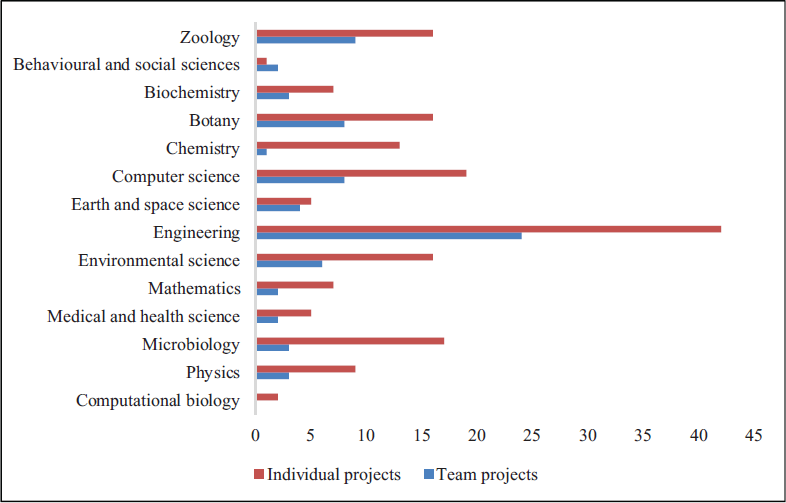
Number of respondents' ISEF projects, by subject, 2003 to 2013
Third, the award rate was approximately 50%, and 70% of award winners received only one award. Of the awards received by the respondents, 89% were category awards (granted by the ISEF Committee) and 11% were special awards (granted by sponsors such as enterprises, governments and other institutions).
This section examines the academic development of Chinese mainland ISEF contestants in five aspects: their educational background, their specialties, the universities where they pursued their academic study, the awards received during their study and their professions.
Educational background
One of the primary goals of science competitions is to encourage more young people to pursue further study in science, technology, engineering and mathematics (STEM). This study makes a detailed analysis of the academic development of Chinese mainland ISEF contestants. Of the 64 respondents who provided this information, 81% were in a bachelor's program, 8% in a master's program, and 11% were either currently pursuing or had completed a doctoral program. Evidently, students with ISEF experience tended to have good academic development. Respondents to this study were going to achieve or had achieved at least a bachelor's degree.
Specialties
As Figure 2 shows, 85% of respondents continued their study in a STEM field, while the remaining 15% pursued a humanities specialty.
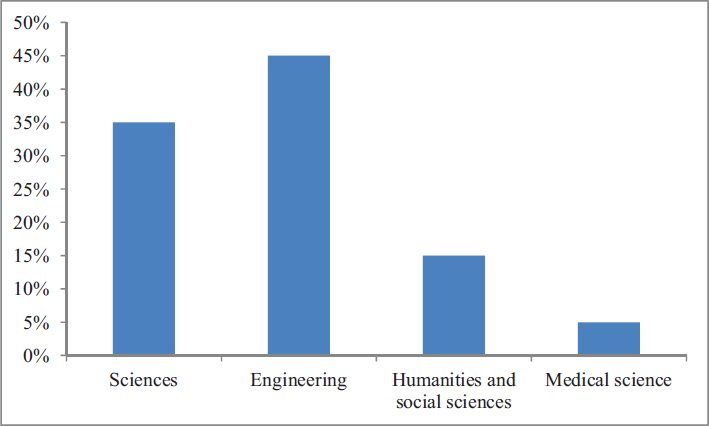
Percentages of respondents pursuing different higher education specialties
Only 13% of respondents pursued higher education in Chinese universities, while 87% pursued higher education overseas. Those who were studying domestically were enrolled into prestigious universities such as Peking University, Tsinghua University, Fudan University and Zhejiang University. Those universities are referred to as ‘985/211’ institutions, after the government schemes that funded their development from 1995 onwards.
Awards
As Figure 3 shows, 72% of respondents had received awards during their bachelor's, master's or doctoral programs; most awards were issued by universities. Overall, former ISEF contestants tended to perform well in their academic study, and a high percentage received awards during their study.
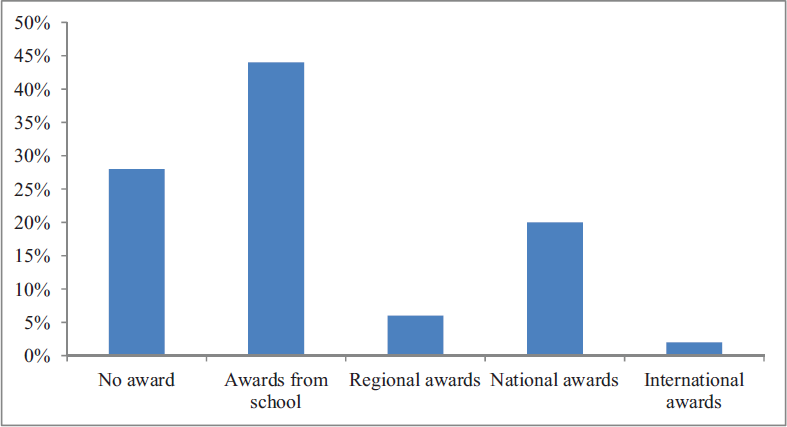
Percentages of respondents receiving awards during their academic study
Among the 70 respondents, 19 had started their professional careers. Of those, 93% were engaged in science-related work and 7% in administrative work. To gain a better understanding of how the ISEF experience influences participants' professional development, the research team interviewed three former ISEF contestants (referred to as L, ZH and W) who had started their professional lives.
L currently works as an assistant professor and is engaged in cell science research at Florida State University. He remains very enthusiastic about youth science competitions and serves as a judge at multiple events. He was a contestant in the 2004 ISEF, in which his project studied the anti-ageing effect of purslane. He deeply cherishes both the ISEF and the China Adolescents Science and Technology Innovation Contest. The two competitions have taken him on an exciting journey that perfectly integrates his personal interests and career development. In his view, participating in youth science competitions can greatly increase students' scientific literacy, which will have lifetime benefits.
The story of L shows that the ISEF provides a high-level platform for students interested in science and research. The ISEF experience will also serve them well when they apply to prestigious universities and lays a strong foundation for their future research activity.
ZH currently works at a biopharmaceutical company in Hong Kong. She participated in the 2004 ISEF, in which her project examined whether brachydactyly type D (‘club’ or ‘stub’ thumb) is hereditary. Despite her busy work schedule, ZH has remained active in youth science competitions and serves as a judge in several events in China. She said that her ISEF experience generated a strong interest in biology and inspired her to pursue a four-year bachelor's program in biology, followed by further biology study at the University of Hong Kong, where she ultimately earned doctorate. She recalled having overcome many hardships in undertaking her ISEF project, and was unable to participate in the 2003 ISEF, for which she had registered, due to the SARS outbreak at that time. 2 She has a deep conviction that perseverance is the foundation of success, whether in research or in any other pursuit. She considers that participating in the ISEF was an influential, life-changing experience for her.
ZH was a college student when she participated in the ISEF, and her ISEF experience helped her to secure admission to a bachelor's and later a doctoral program. Her story shows that science competitions can play a huge role in developing students' research skills and other qualities that will not only give them an edge in future employment opportunities but also have long-term positive effects on their lives.
W was a contestant in the 2008 ISEF, in which his project studied moss control for tea trees in Yunnan. He is currently a commercial airline pilot. Although he is not engaged in botanical research, he still cherishes fond memories of his ISEF experience, and his interest in botany remains strong. He said that the ISEF trained his skills in scientific exploration and kindled his potential interests.
W represents a small group of former ISEF contestants who eventually chose careers unrelated to scientific research. However, according to W, the ISEF experience was among his best memories and helped him to find his interests. His research experience has also served him well in his subsequent work and life.
Analysis of how the ISEF experience influences academic aspirations
This study analysed the influence of the ISEF experience on respondents' academic aspirations from middle school onwards. As Figure 4 shows, most respondents aspired to study science during middle school, while fewer went in for fields such as engineering, computer science, business and law, and even fewer for mathematics, sociology and languages.
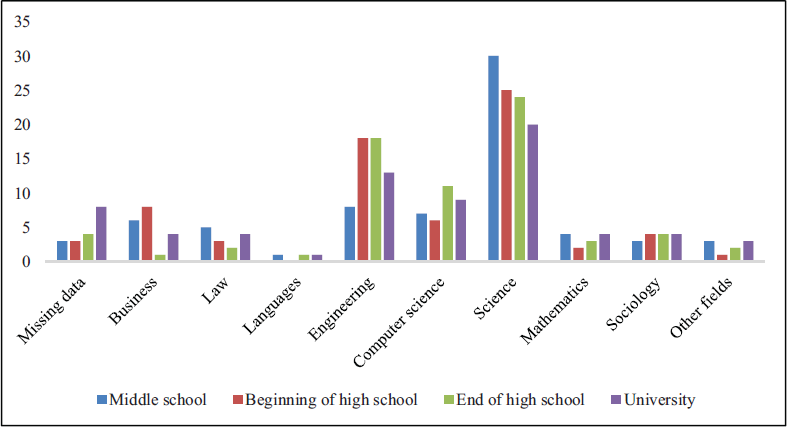
Numbers of respondents holding various academic aspirations from middle school through to university
On students beginning high school, most still preferred science, although engineering became more favoured (18 respondents took an interest in it at this stage). There was also a slight increase in the number of respondents interested in business.
At the end of high school, science remained the most favoured subject among respondents, although their interest had declined compared to the middle school stage. It was followed by engineering and computer science, which were both favoured by more respondents than at the beginning of high school. This stage saw a significant drop in the number of respondents showing an interest in business.
At the university stage, science remained most favoured, again followed by engineering and computer science.
In all four stages, science remained the most popular and languages remained the least popular among respondents. Engineering reached its prime during the high school stage, and computer science was more popular at the end of high school and at university than during middle school and at the beginning of high school. The popularity of science reflects the characteristics of the study's sample and demonstrates that ISEF contestants do have greater interest in science.
As Figure 5 shows, 14 of the 70 respondents (20%) remained committed to their academic aspirations throughout these four stages of education, while approximately 16% shifted their academic aspirations in every stage. As they advanced through the grades, there was linearly increasing consistency in their academic aspirations. This indicates that academic aspirations established in high school are less likely to subsequently change, making this period the best time to encourage students to study science and pursue a scientific career.
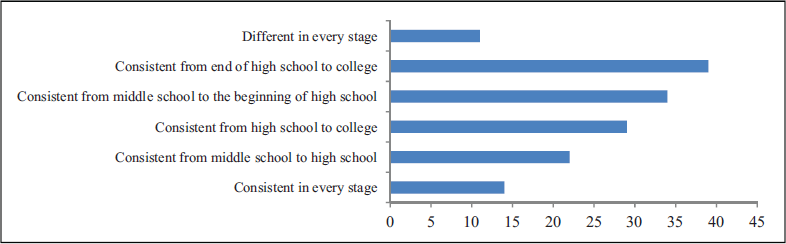
Numbers of respondents holding consistent academic aspirations in different stages of their education
This section discusses the gender difference in science competitions; questions related to the ages and current identities of the respondents; characteristics of Chinese mainland students' participation in the ISEF; the academic development of former ISEF contestants; and the ideal time for students to establish academic aspirations.
Gender difference in contestants in science competitions
Based on a student survey, Joyce and Farenga (1999) identified a gender imbalance in participants of out-of-school science activities. Reinforcing their findings, this study attributes this gender difference to the different degree of interest shown by male and female students in science. Existing literature shows that, among high school students, male students tend to have a significantly greater interest in science than do female students (Li, 2014). Participation in science competitions is driven by strong interest in science. As male students have greater interest in science than female students have, it is natural that there are more male contestants in science competitions.
Ages and current identities of respondents
Judging from the ages of the respondents, most of them had participated in the ISEF over the previous five years. Accordingly, for a retrospective study of this type, it appears easier to build a large sample by focusing on that recent period. In addition, the process of reaching potential respondents proved to be very difficult, as many had changed their phone numbers or email addresses (in some cases, previously provided company email addresses no longer worked because the companies had been dissolved). Tencent QQ emails or QQ accounts were found to be the most reliable contact information.
Characteristics of Chinese mainland students' participation in the ISEF
As outlined above, the ratio of individual to team projects among Chinese mainland participants in the ISEF is around 2:1, which explains the outnumbering of team projects by individual projects in this study. Their high winning rate indicates that Chinese contestants and their projects perform above the international average. Meanwhile, the concentration of awards and projects in specific categories shows that science competitions in China concentrate on some research fields and are yet to expand to other fields.
A smooth academic journey for former ISEF contestants
As the world's largest pre-college science competition, the ISEF has been recognized and held in high esteem by many prestigious universities. This survey shows that in China ISEF contestants before 2014 were given the chance to enter high-quality domestic universities without taking an entrance examination. Such favourable factors have greatly smoothed the academic development of former contestants. Their ISEF projects give them additional leverage in seeking admission to both domestic and overseas universities, and there tends to be high consistency between their project fields and later university specialties.
The ideal time for students to establish their academic aspirations
According to this study's findings, science was the most favoured field among ISEF contestants. This shows that they had strong interest in science. Consistency of academic aspirations was found to be highest in the high school stage and university stage, indicating that high school students aged 15–18 years understand themselves better than do middle school students. Therefore, high school is a key stage for the training and selection of science and technology talent.
Conclusions and suggestions
I have come to four main conclusions and make some suggestions for further development.
First, male students are more interested in science competitions and have significant advantages in those competitions.
Suggestion: China's science competitions should encourage participation by female students by designing relevant activities or establishing special awards for female students, aiming to increase the number of women who proceed to study science and engage in scientific careers.
Second, former contestants in the ISEF in the most recent five years are more willing to respond to a follow-up survey.
Suggestion: China's science competitions should establish a comprehensive database and, if possible, a full-featured sample tracking system to enable better tracking of the development of China's young science and technology talent. WeChat and QQ IDs are the most reliable contact information and so should be included in any such database.
Third, Chinese mainland ISEF contestants have an above-international-average performance and a high winning rate, although awards tend to be concentrated in a few fields.
Suggestion: China should strengthen its weak areas in science competitions by strengthening talent training and project development in fields such as physics, medicine and health science, while continuing to develop its existing strengths.
Fourth, science competitions, including the ISEF, are important platforms for selecting young science and technology talent.
Suggestion: Science competition organizers should engage more young people, especially high school students, in their competitions, for instance by increasing the media publicity for winners. High schools should also create favourable conditions for their students to undertake independent research projects.
Footnotes
1

2
SARS: severe acute respiratory syndrome.
Author biography
Xiuju Li is an associate researcher at China Research Institute for Science Popularization. Her research interest is in science education.