



Abstract
Purpose
With this article, we aim to open up and further develop the conceptualization of educational practices associated with ocean literacy (OL) by enquiring into age-appropriate practices and conceptualization. Furthermore, we aim to make ocean knowledge relevant to early childhood education.
Design/Approach/Method
Drawing on practices developing research inspired by utopian action research, this study enquires into children's, teachers’, artists’, and researchers’ co-exploration of local ocean landscapes and their connection to oceans through stories and world maps. The article investigates ocean literacies by researching how younger children sense, co-explore, and express their experiences in local landscapes connected to the ocean.
Findings
Based on the existing ocean literacy concept and literature, this study, with its detailed narrative descriptions, gives ground to propose the concept of emergent ocean literacy (EOL) to better define the youngest children's first conceptualizing of oceans and ocean landscapes and the pedagogical practices to develop a “glocal” mindset.
Originality/Value
While most educational OL studies reference higher education and university studies, this study fills a gap in ocean literacy knowledge. The study reveals that young children understand and take part in collective memories of critical events concerning the welfare of the ocean.
Keywords
The Local and Global Are Connected Through Our Common Ocean
In 2017, a sick goose-beaked whale found its way to a shore on the west coast of Norway and died there. Its stomach was filled with more than 30 plastic bags and many smaller pieces of plastic. The scientists investigating the whale supposed that it was emaciated because the huge amount of plastic collected in its stomach had created a plug, stopping the whale's digestive process. Later, we learned that this local news had become international news (Moore, 2017). The “plastic whale” story became a critical event narrative (Mertova & Webster, 2020; Woods, 1993) used in art exhibitions worldwide to communicate human damage to ocean life. The “plastic whale” seems to have been incorporated into a new global collective memory (Skårdal & Norberg-Schultz, 2019). This memory inspired the researchers to approach kindergartens 1 on the island of the critical event to collaborate on a project related to the UN Decade of Ocean Science for Sustainable Development, highlighting the role of the “plastic whale” story in inspiring the research.

Exploring the Biotope Between the Land and Sea. Note. All figures (photos) were taken by Elin Eriksen Ødegaard. All images involving children in this article have been used with parental authorization and consent. Signed consent forms confirm that the photographers/authors may use the images to promote childcare services, either in print or online.
Starting with this story, this article aims to open and further develop the conceptualization of educational practices associated with ocean literacy (OL). Ocean literacy is today a multidimensional concept, often defined as the understanding of the ocean: How the ocean influences life and how humans influence the ocean. The OL concept has evolved over the years and is continuously refined to capture the complexity of ocean literacy (Brennan et al., 2019; Chang et al., 2021; McKinley et al., 2023).
While most educational studies on OL reference higher education and university studies, there is a need to pay more attention to earlier education on ocean literacy (Santoro et al., 2017). We engage in this debate with the aim of making ocean knowledge relevant to Early Childhood Education and Care (ECEC) and making societies at large more aware of the power of ECEC in advancing sustainability topics, such as making the children more visible in the communication and actions of the One Ocean Decade. To achieve our aim, we investigated how ocean literacy is performed and brought to life in early childhood settings. Drawing on practices developing research (Wallerstedt et al., 2023), the study focuses on children's, teachers’, artists’, and researchers’ co-exploration of local ocean landscapes. More particularly, the research investigates ocean literacies by examining how younger children sense, co-explore, and express their experiences in local landscapes connected to the ocean.
The research connects to the project One Ocean Exploration, an arts and natural science project in three kindergartens in two municipalities in Western Norway, which is located on the coastline facing the North Sea. Central to the study is giving rich descriptions of how collaborative explorations of the biotope, where land and sea meet, unfold, and how children develop knowledge through sensing, exploring, experiencing, and expressing oceans and coastal landscapes (Figure 1; Ødegaard et al., 2024).
We anticipated that children would develop emergent ocean literacies by affording the youngest children opportunities to sense, explore, experience, and express ocean-related landscapes (Galafassi et al., 2018). Children depend on a clean ocean for their future lives and are fascinated by water and the living biotopes where the sea and land meet (Rooney et al., 2021). On this basis, we created the hypothesis that practices characterized by collaborative exploration would increase the awareness of sustainability among children and staff in early childhood education, specifically through exploring together with a response to the sea landscapes and children's meaning-making.
Sensing the landscapes is pivotal for children's meaning-making as they are embodied and relational on both micro and macro levels. Local cultures are “thick with the meaning” on a day-to-day basis; at the same time, micro-events can suddenly have the momentum of becoming political, as we have described in the introduction.
The Need for Enquiring Ocean Literacy for the Youngest Children—Situating the Research Question
Water represents an urgent and severe case of major resource scarcity, making it the most critical ecological and human rights issue of our time (Santoro et al., 2017). All living beings, plants, animals, insects, fish, and humans require water to survive. Despite this essential need, much of societal and educational research has neglected the importance of water. The Earth has one big ocean with many features. The ocean and life in the ocean shape the Earth's features and significantly influence the weather and climate, thereby affecting children's lives. The ocean supports a great diversity of life and ecosystems and makes the Earth habitable. This also includes humans, who are inextricably interconnected with the unexplored ocean. These are the essential principles of the ocean that every ocean-literate person should understand (Fauville et al., 2019; Schoedinger et al., 2005).
Historian and geographer Terje Tvedt notes that few studies on social and historical development begin with the recognition that our planet is fundamentally a Water Planet and that evolution, development, and social life are intricately tied to water (Tvedt, 2021, p. 204). In addition, philosophers and researchers focusing on climate change and geography have emphasized the need for nature literacy, arguing that fostering a connection with nature should start with young children (Jickling, 2000). However, early childhood education and care (ECEC) have received little attention in this regard.
Sacha Kagan (2019) writes about the importance of the imaginary in sustainability education and argues that it must be understood as a deep symbolic matrix that enables our access to the world: “Imaginaries are not just made up and imposed on the world by the humans, but the result of an imaginative encounter with the human and other-than-human world” (Kagan, 2019, p. 157). This makes sense as we look at the connection between human history, myths, and stories of the sea, which come from living in a sea and ocean environment. When allowing imagination to be relevant for sustainability, we also let children's voices be relevant for OL. To add to this current knowledge and to actualize OL in the early years of education, it will be important to consider child development and how young children experience the world in which they live, the emergence of knowledge and literacy through the senses, and the educational opportunity to explore and experience. OL must realize understanding the young person in certain causal (time) and spatial (place) relations to landscapes, life and bodies, sensing materials there, playing, exploring and expressing with tools in landscapes (e.g., Harwood & Collier, 2017; Ødegaard, 2020). Furthermore, it is about emotions, values, beliefs, motives, imagination, and memories (Ødegaard, 2020).
Tim Ingold's anthropology supports this argument and his idea of “dwelling.” The idea of dwelling requires us to understand that how we approach the world is not so much about making views “of the world but of taking up a view in it” (Ingold, 2000, p. 43). He argues against a long-lasting idea of logocentrism in our search for knowledge, which has led to a “disembodied intellect moving in a subjective space in which are represented the problems it seeks to solve” (Ingold, 2000, p. 186). Opening up the scope of theory to spatial ontologies, as Ingold does, is productive for understanding the youngest children's embodied and place-related meaning-making (Hawley & Potter, 2022; Myrstad et al., 2022). Ingold's landscape anthropology, dwelling, and livelihood (Ingold, 2010, 2011) do not distinguish between nature and humans. Humans dwell in landscapes when walking, hunting, fishing, picking, and building shelters for survival. Therefore, the concept of a landscape is not only the perceptual vision of the landscape, but rather being there and experiencing how the weather impacts the landscape; these things are best learnt by walking and living with the landscape.
Against the background of relational ontology, previous research, policy discussions, and evolving definitions of OL, we designed the interdisciplinary, practices-developing study. The article explores a research question that focuses on children's meaning-making and collaborative explorative practices: How can an arts and landscape-based approach to early childhood education broaden the concept of ocean literacy? This question concerns applied practical relevance in early childhood education, especially for conducting research on developing practices, meaning developing the didaktik 2 of early education systematically (Wallerstedt et al., 2023).
Drivers of Engagement in Education for Ocean Life
When developing knowledge about how children make meaning of the ocean and life in the ocean, the dwelling idea is relevant, but for education for sustainability, we also need to understand the psychological drivers of engagement. Sensations, emotions, experiences, stories, and language are such carriers of engagement and start early (Ødegaard, 2007, 2021). Sensing a place is a universal genre of experience (Caine et al., 2022; Mark et al., 2011; Ødegaard et al., 2023). Personal experience from teaching and living with children, as well as decades-long research among children, brings to mind stories of children's exceptional ability to make meaning and taxonomy from lived life and where the landscape itself affords conditions for what to sense, explore, and learn (Adolph et al., 1993; Ødegaard & Marandon, 2019).
According to Wu (2018), there is a strong relation between environmental sensitivity imparted to children through everyday life experiences and education, and the emotional basis for developing an ecological worldview, knowledge, and personal norms for pro-environmental actions. Wu's findings are of major importance from the perspective of early childhood education for sustainability. We can now see efforts to change the model for teachers concerning early childhood development, where sustainability rhetoric and policy are brought to the forefront of national curricula (Li et al., 2019; Ødegaard, 2015).
OL is often connected to marine education, among a range of multidisciplinary topics, which includes learning about the global seas’ relationship with all world systems and society's influence on the sea (Chang et al., 2021). OL implies the transmission of knowledge about the ocean, its importance, and our common responsibility towards the seas, oceans, and resources, which has been identified as one of the essential predictors of environmental behavior and education. In addition to this, OL is often aligned with the objectives of environmental education as defined by UNESCO in 1975: awareness of and sensitivity to the global environment and its allied problems; attitudes, values, and feelings of concern for the environment, and the motivation to actively participate in environmental improvement and protection; and skills for identifying and solving environmental problems and participation to be actively involved at all levels in working towards the resolution of environmental problems (Fauville et al., 2019, p. 2).
The Decade of Ocean Science for Sustainable Development (2021–2030) is an UN initiative promoting a common framework for supporting stakeholders in studying and assessing the health of the world's oceans (UN, 2020). This initiative is boosting Sustainable Development Goal (SDG) 14: Conserve and sustainably use the oceans, seas, and marine resources for sustainable development. The Ocean Decade intends to promote an increased understanding of the need to take urgent actions to maintain a life-supporting ocean and ensure adequate protection and adaptive management of the marine environment. These intentions shall enhance understanding and create a new level of awareness among the public. The goal is also that this understanding should trigger and forecast future capabilities, change, and articulation of relevant new knowledge (UN, 2018).
This global UN initiative presents a vital opportunity to transfer ocean literacy to the next generation, the very young children. The role of education, in particular, is not mentioned in the document; nevertheless, it has sparked local initiatives worldwide (e.g., the United Nations Ocean Decade Children Oceanic Pottery Project, UNESCO, 2022). Climate change and ocean pollution significantly affect children who live by the sea. Childhood is often seen as a sheltered world in itself. However, the realities of a diverse society, an increasing awareness of the impact of climate change, and health concerns due to pandemics have given rise to an entirely new range of childhood experiences (Pramling Samuelsson et al., 2020), which early childhood research must consider in order to be up to date and relevant for the everyday lives of children, families, and communities.
Ocean education should have a long-term perspective; time and place are as fundamental to narrative meaning-making as life itself (Ødegaard, 2007). Education about oceans must include the embodied experiences of today's young children as well as the intergenerational aspects and those of children's spaces. An often-forgotten dimension is childhood and the experience of being a child in a local landscape (Kjørholt & Bunting, 2023; Ødegaard & Marandon, 2019; Spyrou et al., 2021). Through an intergenerational lens, we learn how growing up in coastal landscapes becomes embodied, where children over time make meaning of sea landscapes as “home” (Kjørholt & Bunting, 2023). Attachment to a place over generations is also seen in more studies (e.g., Spyros et al., 2021).
These studies pinpoint the generational and cultural aspects of living and developing a sense of belonging to the sea, the coastal landscapes, and the activities there, whereas Ødegaard and Marandon (2019) show, through a pedagogical lens, how experiencing landscapes is intertwined with pedagogical practices. Children's landscapes in educational practices habituate their bodies to cope with the landscape. When teachers walk alongside children, the children learn to handle danger when it occurs and to value species when they are observed and encountered.
Practices-Developing Research
The present study, positioned in a relational ontological perspective (Spyrou, 2022), has significant practical implications. The design of the study was co-created by an interdisciplinary team of artists and anthropologically inspired educational researchers. The staff was involved in tailoring the pedagogical approach to the local environment and the children, in integrating the project into everyday activities, and in long-term planning for change. The study followed a practices-developing research design approach (Pramling & Wallerstedt, 2022) to sustain pedagogical cultures of exploration, learn aspects of age-appropriate pedagogical approaches, and identify tensions and obstacles to enrich children's EOL. This design more clearly addresses what counts as knowledge and analysis, motivated by value goals of sustainable futures. It draws on a rich enquiry-based educational research tradition where the methodology is understood as developing research practices in collaboration with early childhood educational institutional personnel. By using the plural form—“practices”—rather than the more commonly used singular form of practice, we indicate that we are using the word in its theoretical sense rather than its everyday sense to avoid reconstituting a common dichotomy between practice (preschool) and theory (research) (Wallerstedt et al., 2023, p. 179). Following this methodological design, valuing, reflecting, and acting upon life experiences and everyday practices is central. This research approach is often best expressed in a narrative language. Therefore, as researchers, we wrote narrative field notes following some of the principles of Narrative Inquiry (Caine et al., 2022), noticing (a) time, how the explorative practices unfolded in events; (b) place, the esthetics and substance (biotopes) of the waterscapes; and (c) relation, describing the human action, expressions, and dialogues. Narrative knowledge, whether it is called tacit knowledge, embodied knowledge, everyday knowledge, or narrative knowledge, has received attention in the philosophy of knowledge and experience to make certain points, insights, and connections visible. In contrast, empirical knowledge makes connections based on factual and strictly observable knowledge (Wallerstedt et al., 2023). Our approach includes the perspectives of children as well as those of educators and artists. This is achieved when researchers go alongside children and adult participants throughout the whole project. We collaborated with the kindergarten owners and staff to make sure that staff would include the project in their current and future practices. Eco-social transformations are increasingly driven by individuals and communities, striving to find other ways of practicing human–nature relations based on ecological knowledge (Ingold, 2011). A practices-developing methodological approach could imply the possibility of creating cases of exemplary practices to inspire future-oriented practices (Egmose et al., 2022).
Theoretical perspectives informing the analysis conceptualize the sea and coastal environment as entwined with culture and nature. By studying children and adults within and entwined with their local landscapes, as they co-explore, we reveal that places are not just physical entities. They are also embodied, relational, and “thick with meaning” (Ingold, 2011; Nieuwenhuys, 2003). This understanding of places as rich with meaning emerges when humans sense and interact with nature and culture as both material and symbolic (Ødegaard, 2007). Theorization from the field of Children's Geographies, which focuses on children's lives situated in places, offers new and insightful perspectives into early education. To support our analysis, we bridge cultural-historical perspectives with sensory ecological philosophy (Hedegaard & Ødegaard, 2020) and pay attention to children's local ocean landscapes, inspired by their placemaking practices (e.g., Kjørholt & Bunting, 2023). The cultural-historical aspect is relevant in the study as children will always be related to the habits, work-life, and traditions, as well as current and historical beliefs and practices of a society (Hedegaard & Ødegaard, 2020; Ødegaard, 2025).
The intersection between culture and nature is not new, nor is the intersection between arts, play, imagination, storytelling, and learning (Kagan, 2011). For some time now, the leverage of “the Anthropocene” has mapped a pathway towards integrating ecological and cultural ontological and epistemological systems to move beyond the modernist separation of nature and culture (Pretty et al., 2009). In kinship with these ideas is deep ecology, as proposed by the Norwegian philosopher Arne Næss. He was an essential agent for ecological thinking in Norwegian society and beyond. Næss urged holistic thinking, play, and imagination to understand the world (Næss, 1989, 2005). Næss had clear visions and ideas about high-quality early childhood education, creating a link between researchers and teachers. He recommended that all children get access to “patches of free nature” and that teachers, as researchers, should identify themselves as being “seekers” (Jickling, 2000, p. 57).
With these epistemological inspirations, we enquire and narrate how these visions and ideas can contribute to educational approaches to sustainability, as well as open and broaden our understanding of OL so that it is relevant for the education of very young children.
The study draws on fieldwork that lasted three 6-week sessions over autumn 2021 and spring 2022. Over 18 weeks, we worked with three kindergartens on an Ocean Portraits arts project. The project involved 36 three-, four-, and five-year-olds, 12 children from each kindergarten, six kindergarten staff members, two artists, two filmmakers, and two researchers.
To access the kindergartens, we contacted two municipal authorities at the coast. We had a premise that the kindergartens needed to be close to the coastline, so walking distances to the shore would be easy and safe to organize for the staff in the kindergarten. After being invited by the authorities of the kindergarten owners to an information meeting for the interested kindergartens, one urban and two rural kindergartens volunteered to plan further and adapt the art project to the landscapes and the group of children. As researchers, we learned about their local knowledge of the place and the group of children we were to meet and go alongside. We got to know the children by orchestrating the first meeting as a playful and open-ended event outdoors and by observing and pitching in (Paradise & Rogoff, 2009) when appropriate and convenient.
Ethical Considerations, Data Creation and Analysis
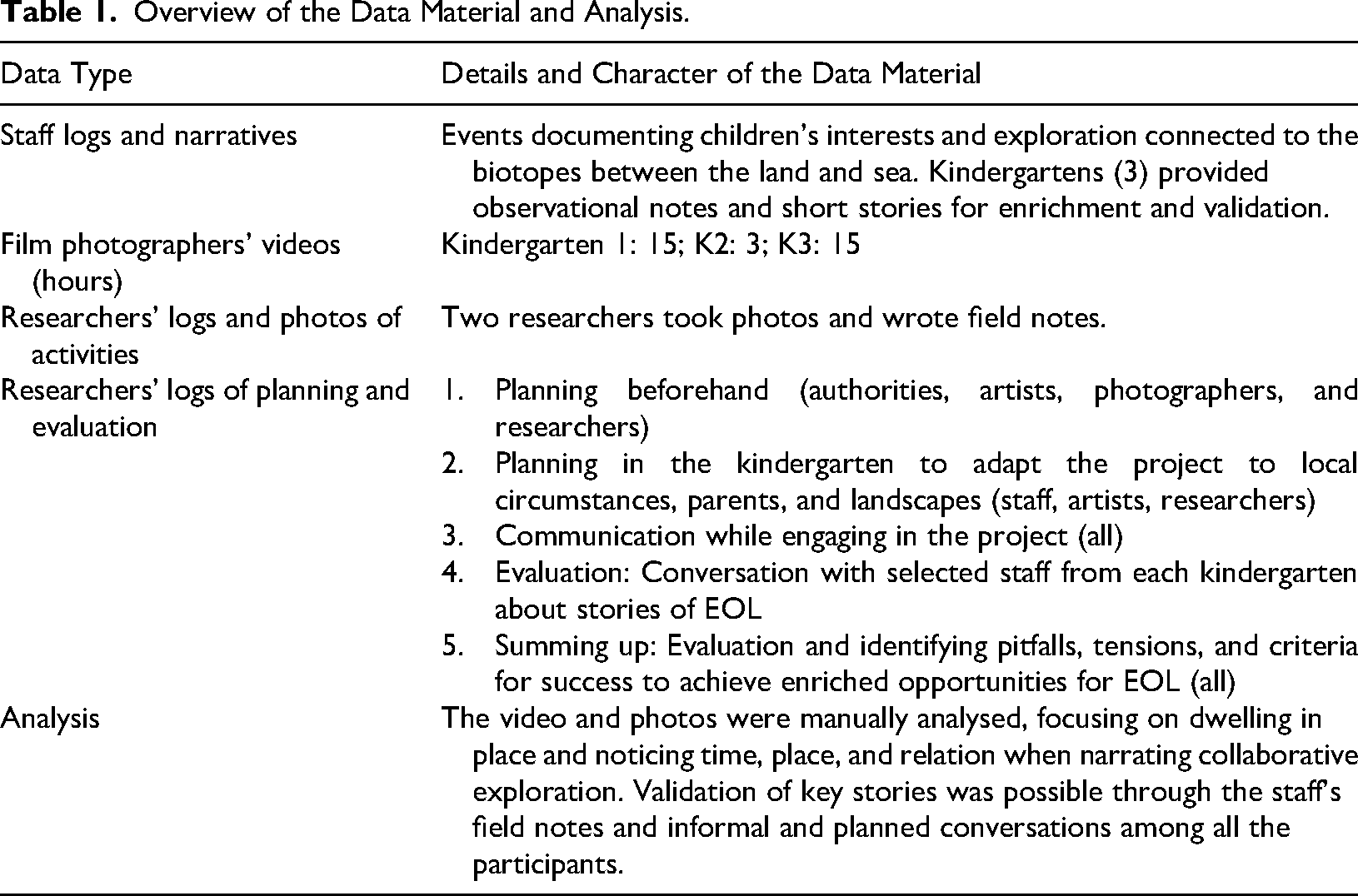
The project followed participatory procedures for data creation, as illustrated below in Table 1. The research design was approved by SIKT—Norwegian Agency for Shared Services in Education and Research—Exploration and Cultural Formation. The researchers, artists, and staff contributed notes, photos, films, and stories. The staff engaged in participatory observations and were attuned whenever ocean landscapes came up in everyday conversation. They deepened the One Ocean project by reading books on ecological and marine topics and telling stories about real life or fantasy relating to the sea. They took the children on additional excursions to explore the local ocean landscapes. We distributed roles among the adults. The kindergarten teachers were responsible for safety issues, following authority regulations and guidelines for bringing children outside of kindergartens on excursions.
Overview of the Data Material and Analysis.
The researchers obtained ethical approval from the parents and discussed ethical considerations with the staff. Before the activity, we agreed to respect the children's verbal and non-verbal cues regarding their desire to participate. Instead of reluctance, we found that the children were quite enthusiastic about joining in, and they did not seem to notice the camera. Moreover, key considerations included who would take the photos, when and how to use the camera, and how to disseminate and publish the images. However, tensions occurred between the filmmaker and the artist about exploring the space with children when the camera became annoying. Short negotiations between the researchers and the artist dealt with this problem. The children, their families, and all staff were invited to a celebratory event where the children's ocean portraits were on display, and the children participated in decision-making processes.
As summed up in Table 1, the data material encompasses a rich tapestry of qualitative inputs that illuminate the dynamics of children's interests and explorations within the biotopes connecting land and sea. The researchers and artists wrote extensive field notes over 18 weeks. The inclusion of staff logs and narratives served as an additional layer, where observations and stories crafted by staff yield insights into the lived experiences of children in these unique environments, between the planned events, and from the staff's perspectives. The three participating kindergartens each contributed observational notes and narratives that enhanced our understanding of children's inquiries, fostering a broader appreciation of how these biotopes inspire wonder, exploration, and learning.
The multi-modal approach was further enriched by the video recordings captured by film photographers across the three kindergartens, totalling 33 hr of footage. These video materials were invaluable for capturing the nuances of child-led exploration and interaction within their surroundings, providing visual context that complements the written data.
The researchers’ logs, which comprised both photographic documentation and detailed field notes, played a crucial role in the ongoing evaluation of the project. These logs offered a dual perspective on both planning and reflection processes, fostering a collaborative ethos among the varied stakeholders—including authorities, artists, and researchers. This holistic approach not only contextualized the project within local circumstances and the unique landscapes of each kindergarten but also encouraged an iterative dialogue about the engagement strategies employed.
Additionally, the meticulous planning and evaluation processes detailed in the researchers’ logs indicate a commitment to reflective practice and adaptive learning at the same time as data were created for research and documentation (Wallerstedt et al., 2023). From initial planning sessions to post-project evaluations, the data collected enabled meaningful conversations with staff about the essence of enriching opportunities for EOL. Emergent learning of ocean literacy is understood as closely linked to personal and collaborative exploration, through practice, meta-dialogues, imagination, inquiries, new actions, and new discoveries. The collaborative nature of the analysis, where validation of key stories occurs through cross-referencing materials such as staff field notes and participant dialogues, ensured a robust framework for understanding the complexities of child engagement and how ocean literacy can emerge and be documented.
Storying Emergent Ocean Literacies
As a response to the enquiry on how early childhood education can broaden the concept of ocean literacy, we present three narrative excerpts to describe how EOL practices unfolded through collaborative exploration in an arts- and landscape-based project.
What Can We Imagine With Stones and Maps?
All the selected kindergartens were situated within a 5–10-min walk from a coastal area. One day, with Kindergarten 2, we passed some boathouses, small boats, and a supply boat for the oil rigs to come down to an area of about one acre of land. A green field of grass sloped down towards a stony shore. The April spring had brought cuckoo flowers on the field and in front of a rocky area; sheltered from the wind, there was a small area of birch, willow, and hazel bushes with fresh green leaves (Figure 2). We went with a group of 12 four-year-olds and two staff to the bay, but the kindergarten had been there with the group the day before to remove the plastic on the beach. This was a regular spring activity for this kindergarten. The artists were already there on the field from the early morning to put up a field tent so we could get some shelter from the rain during the day. It was one of many cold rainy days with wind, so we dressed in rainwear, rubber boots, and mittens. The field was appealing to the children, and some of the children immediately started to run, jump, and roll down the slope. The first common task for the day was to find a small stone, our favourite stone to explore. This stone should also help us to discover colours and shapes. How the stone looked when dry and how it changed when lying under water. The sea was dark that day, and when we went wading at the water's edge, we could see through the water. We could see stones that had different colours and shapes. We could feel the water—it was cold—and we could feel the movements of the waves through our rubber boots. We also discovered groups of small fish that disappeared as soon as they were discovered. The beach also had sea anemones and shore snails. The children were acquainted with the marine life and respected the creatures enough to let them be. Each one of us carefully chose a tiny stone, and we cared for it, looked at it, put it in the water again, and, at the end of the day, the artists collected them for us all in a box, a collection of small stones for later use. (Researchers’ story)
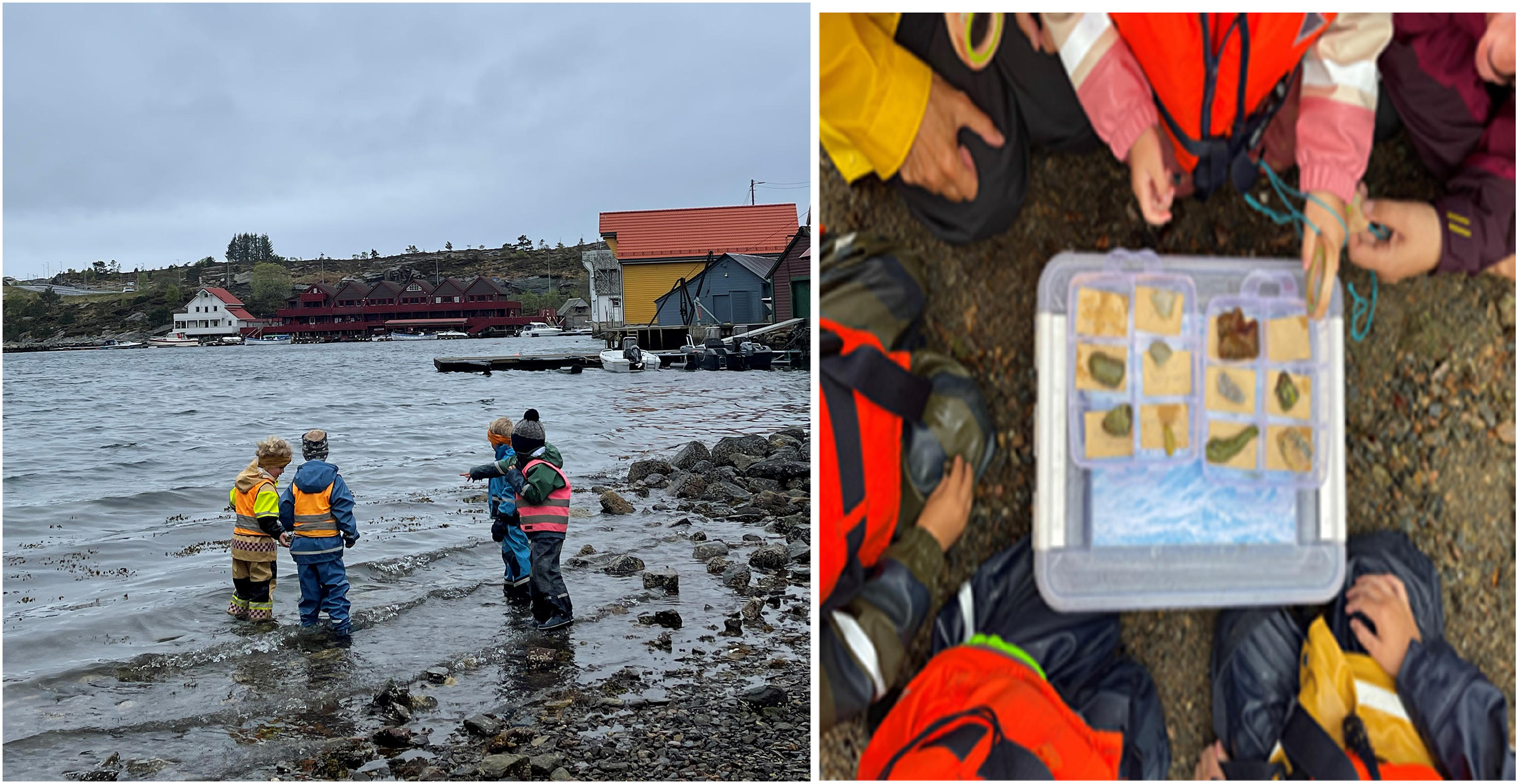
Sensing and Imagining the Ocean.
Finding a beach stone of our own choice was appealing to us all; we became connected and noticed many esthetic and sensory details, like the cold and wet feeling when reaching out to pick a stone, the shape, color, taste, and smell. It also gave the children a new repertoire of the esthetic qualities of a stone and what it could represent. Throwing stones in the water, which is often the main repertoire of children on a stone beach, was not a dominant activity here. In the next kindergarten, the task was the same (Figure 3).

Collaborative Exploration with the World Map.
Working with the world map, we staged metaphorically that “the ocean is what binds us together and what keeps us apart.” The artist encouraged a keen awareness of the senses, shapes, textures, and colors in nature when exploring the map through playful imagination with the stones we had previously searched for and carefully chosen: I could feel the mild wind across my cheeks when sitting down by the world maps. I asked a boy who came to sit close to me: “Where does your stone belong?” He put his stone on the Sahara Desert in Africa. His stone has a yellow tone, and I can understand his choice. “The same colour as the Sahara Desert,” I said. “It could blend in with the sand there,” I added. He told me that the stone could lie in the sand and moved it a bit, but it was still placed within the borders of the Sahara. He pushed the stone hard into the paper. I am thinking that he needs to be sure that it stays deep in the sand where it belongs. The boys gave me a smile of confidence. More and more children took part in the activity; they came with their tiny stones, drew their shape, and told stories. (Story from the artist) “This shark swims like this,” a girl said while drawing a line across the North Pacific Ocean. “But here it stops,” she said. She was close to land by the Philippines when she stopped her shark line. “Let us see,” I said. “Look a bit closer, the sea seems to have a light-blue colour there.” She confirmed, “Yes, the colour is light blue.” “This means that it is not a very deep sea there,” I said. She moved her shark stripe gently towards the south, between Indonesia, Papua New Guinea, and Australia, and let the shark go when entering the Indian Ocean. “Look at the treasure!” The boy, who had previously placed his stone within the Sahara Desert, reached out to me again. “It was not so easy to see,” I said. He smiled mysteriously. “It's almost in the middle of the playground,” he explained, and pointed to what he had drawn on the map. “It's a monster and the monster kids,” commented another. He was adding some lines to where the treasure was found. “There, there, and there,” he said, pointing his finger to the northern parts of Africa. “No one must come there,” he said with horror in his voice. “What happens then?” I asked. “Then you’ll be eaten,” he explained. “That's just rubbish!” It was one of the girls commenting on her own drawing. She had a disappointing tone and expression. “Nah,” I said slowly and looked at her drawing. “It looks like seaweed to me. Maybe there is something hiding in the seaweed?” I suggested. “Yes,” she said and drew a fish with careful strokes so that you could hardly see it. “There is a lot in the sea,” she said. “Plants, animals, and rocks,” I confirmed. “And seaweed,” she added. Another boy discovered the seaweed just in front of us; it was a belt of dry seaweed just in front of him. He pointed, and I picked up a small piece of the weed and put it on the map. “Yes,” he said, and started to draw around the weed. “The seaweed must also have a place,” he said. The seaweed really set the imagination on fire. Several children started to draw imaginary sea animals in the ocean. Soon, the ocean had sea crocodiles and plant crocodiles. I also drew some animals from the inspiration of the weed. The boy continued to draw, further and further south on the (…) “It reaches all the way down here,” he says. “To the South Pole,” he continued. “It's cold there,” I say. “Yes, and everything turns to ice,” he confirmed. (Excerpt from the artist's notes)
What Happened to the Birds?
Some days later, we went to the beach and were again reminded of the changeable world on this permanent beach. The artists had prepared shelters for us on the field close to the beach this day. It was a rainy and windy day, and the task for the day was to study a world map by playing with our stones. Nevertheless, something else turned up on the beach: Heaps of dead sea birds were lying on the beach and the grass (Figure 4). The children noticed the dead sea birds with curiosity and concern: What had happened to them? The adults all started to worry: What had happened here? Why were there so many dead sea birds today? One of the teachers told us that she had noticed dead sea birds some days ago and had already alerted the Norwegian food authority, but they did not have any explanations on the matter or any clear recommendations. All the adults became worried: What was this? Was it safe for us to continue in the area? Was it the bird flu? Could it be contagious to humans? Or was it something else? We decided to stay and continue with our plans, but told the children not to touch the birds, to be on the safe side regarding the risk of an infection. One of the children picked a flower and put it on top of one of the birds, but then we paid attention to the world maps we had laid out beneath the shelters. Suddenly, all the children sat and lay down around the maps, and we forgot about the birds. After more than 90 minutes, with telling, drawing, and imaginative dialogues, we were cold, wet, and hungry. The teacher had a key to one of the boat houses so that we could eat in a dry facility. As we sat on the floor in the boat house and ate our lunch, the dialogue about the birds continued. The children brought it up again, maybe from the association of us all eating our bread lunch. One four-year-old child said, “Maybe the birds did not have any bread?” One of the teachers said she believed it might be bird flu and that it might be contagious among the birds. Then, another four-year-old child had another explanation, “The birds might have eaten plastic, just like the whale.” (Researcher's story
3
)

A Dead Sea Bird.
What Is a Tide?
We were at the beach in the local bay. The tide was high that day, and some of the children noticed the change in the tide and asked, “Why is there so much water on the beach today?” One of the artists tried to explain, “The water level changes on a regular basis along the coasts of every ocean on Earth. We call it the tide. Today, it is high tide, and later tonight, it will be low tide; we can see more of the beach. The water moves, you see.” “But why so?” the child asked, and the artist continued to explain, “The move of water between the rise and the fall of tides takes a long time; it is, in a way, dragged by the moon and sun. We cannot see the moon and the sun now because it is cloudy. Tides cycle as the moon rotates around the Earth. We cannot feel it, but the Earth constantly moves as the sun's position changes.” The child did not respond to his explanation, and the teacher jumped in to explain more, “Yes, when we were here to clean the beach for plastic, it was low tide, I remember, then we could easily walk here, and now the tide is high, and the beach looks smaller.” (Researcher's story)
Emergent Ocean Literacy Pedagogy for Early Childhood
In summary, the combination of diverse data types, including observational narratives, photo and video documentation, and co-creative design and dialogues with three kindergartens in 18 weeks, altogether, facilitates a comprehensive exploration of how children navigate the biotopes between land and sea, and how the staff and artist co-explore and make meaning in and with the natural coastal landscape. This study not only captures the essence of their co-explorations (Ødegaard, 2021) but also lays the groundwork for future inquiries into the impact of ocean and coastal environments on early childhood education. We were particularly interested in understanding how an arts and landscape-based approach to early childhood education could broaden the concept of ocean literacy.
Based on existing ocean literacy concept and literature, this study, with its detailed narrative descriptions, gives ground to propose the concept of emergent ocean literacy (EOL) to better define the youngest children's first conceptualizing of oceans and ocean landscapes. It is similar to recent ocean literacy concept in most regards (Chang et al., 2021; Fauville et al., 2019; Santoro et al., 2017); nevertheless, emergent ocean literacy allows us to highlight age-appropriate pedagogy to reach sustainability goals. The answer to the research question lies in the narrative knowledge conveyed through the excerpts of field notes, analysis, and reflection.
The concept of EOL is a transformative approach that resonates with the intrinsic curiosity of young children. EOL focuses on the organic development of children's understanding through sensuous, experiential, and expressive dialogue-driven explorations of ocean landscapes. We can see from the excerpts that children are driven by curiosity and responses to their place explorations, also asking for content knowledge, for example, about the discovery of variations in the tide. Understanding tides and the facts about gravity on Earth is highly abstract for a child, but dialogues between child and adult elicit an emergent understanding, and the concept of tides is open to inquiry. Narratives of children's emergent understanding of oceans, life, and science could support teachers in their pedagogical practices. We see in all three excerpts that collaborative explorations and extended dialogues in sensuous experiences give rich pedagogical opportunities. They all align with SDG 14 and cultivate foundational values of stewardship and connection to the marine environment, fostering a sense of agency in young children as they begin to engage with and shape their world. By emphasizing narrative knowledge from field observations and collaborative pedagogical practices, we can show how EOL encourages ocean literacy. The study contributes practical relevance to current knowledge and discussions on ocean education by weaving in various narrative accounts of how the teachers, researchers, and artists planned the children's ocean explorations, and how the activities, local ocean landscape, and collaborative pedagogical engagement afforded dynamic opportunities for action and the nurturing and unfolding of emergent ocean literacies.
The ocean portraits were unique because they had sensory qualities like color, tone, texture, and brush strokes, illustrated in Figure 5.

Children's Ocean Portraits.
The children's artwork was done as a collaborative exploration, where the semantic and symbolic qualities of the expressions mattered as well as the dialogic engagement involving artists, staff, and researchers with the ocean topic in a sea landscape. We found that this approach appealed to children. As a pedagogy, it seemed to enrich the children's opportunities to move, sense, explore, imagine, and feel the sea landscape, meaningfully expressing the biotope between the land and sea with esthetic expressions through dialogues.
Based on previous research on what practices have proved vital for developing emergent literacy, we found that an increasing body of educational research explores more forms of knowing and is often based on a criticism of “teaching for tests” approaches (Cooper, 2005; Kagan, 2011). Thus, we can expand the knowledge by going beyond criticism to offer descriptive examples of conducting early years pedagogy. Our place-based enquiry brings children's multiple meaning-making and collaborative exploration to the forefront. Based on narrative knowing and telling, we propose that the concept of emergent ocean literacy should consider that children move, sense, co-explore, and imagine, giving attention to their whole bodies and local ocean landscapes. We propose that EOL incorporate: Sensory and imaginary experiences in local ocean landscapes; cultural, geographical, and bodily understandings of landscapes; emergent knowledge of the biotopes and ecologies where land and sea meet; stories of the coastal land and lives of the ocean; and human expression and agency connected to these literacies.
EOL is better suited to grasping, understanding, and responding to children's way of sensing and exploring in their early years. EOL embraces the interconnections between humans, how they sense, explore, and name the more-than-human world, and how the human and non-human worlds, such as water landscapes, weather systems, and human practices, are connected (Ingold, 2010, 2011). As emergent literacy can be observed by paying attention to how children engage with meaning through their senses in play (Heppner, 2016), EOL can be observed by experiencing, sensing, exploring, and, on this basis, starting to imagine the concepts, practices, skills, and capabilities of the sea and ocean landscapes.
The ocean landscapes were central to this project because we walked through, sensed, explored, experienced, and expressed the landscape. All the participants, both adults and children, engaged in dialogues about the landscape's esthetic, biotope, weather, details of the handicraft process of making the paper, and the artistic expression of the ocean landscapes. Therefore, we needed theoretical underpinnings to support these movements and processes. Our research design followed a practices-developing approach (Wallerstedt et al., 2023) where the staff, researchers, and artists could expand their experience and knowledge.
Children's meaning-making is a multifaceted, complex experience where thought, body, and emotion merge. It comes to life through dialogues with adults who name the world for the child. This naming is never neutral; the showing, sensing, naming, and telling come in a cultural context with connotations of emotions and values. The naming of the world is relational and becomes children's language expressions through their interpretation of “signs,” which stand for or represent something real (Ødegaard, 2007; Ødegaard & Pramling, 2013).
While transmission shuts out life, paying attention to life involves listening to meaning, being present, and getting along with others by caring for people, things, and non-human conditions. Early childhood education should not be a matter of transmission in rapid shifts; instead, it should focus on and dwell more deeply in our world and what we bring to life.
Based on this background, we recommend that further research consider EOL as an age-appropriate concept for ECEC research targeting SDG 14. To contribute to age-appropriate sustainability, research is of relevance for the children involved and early childhood education, in general. Furthermore, we recommend that future research build upon our work on practice-developing research (Wallerstedt et al., 2023). It is also recommended that future research pay more attention to the emotional aspects of education for sustainability, more specifically, take a closer look at the impact of how the teachers teach and to what extent an emotional engagement for EOL matters. We believe that the psychological dimension of caring for the earth, the soil, water, ocean, human, and non-human species is necessary to achieve sustainability (Ødegaard, 2025). More research is also needed to support teachers in their mandate to educate children for sustainable futures.
Footnotes
Acknowledgments
We thank all the children who participated with great engagement in this study and the families of the children who gave their consent. We offer a huge thanks to the staff, who met us with positivity and created possibilities and field notes under challenging circumstances during the pandemic. Likewise, we thank the Authorities of the Municipality of Øygarden, who opened doors and celebrated the project. We acknowledge the Research Council of Norway, which financed the project through Kindergarten Knowledge Centre for Systemic Research on Diversity and Sustainable Futures—KINDknow (Number 275575, 2018-2028). We greatly thank Anette Marandon and André Steenbuch Marandon for their collaboration on the art project Ocean Portrait. The art project was founded by the Arts Council of Norway, the City of Bergen, the County of Vestland, and the KINDknow Research Centre.

Ethical Considerations
The research design was approved by SIKT—Norwegian Agency for Shared Services in Education and Research (SIKT Norway, f. 655592)—Exploration and Cultural Formation.
Author Contributions
Elin Eriksen Ødegaard was responsible for writing the abstract and the bulk of the main body, finalizing the manuscript, and responding to reviewers’ comments. She designed the research project and the pedagogical parts of the project. Åsta Birkeland contributed to the text development of the first draft. Both Elin Eriksen Ødegaard and Åsta Birkeland participated in the fieldwork, and Åsta Birkeland followed up with communication with the kindergartens. Both kept a field log, and the two researchers validated the notes through reflexive dialogues during the development of the first draft.
Funding
The authors disclosed receipt of the following financial support for the research, authorship, and/or publication of this article: This work was supported by the Research Council Norway (grant number 275575).
Declaration of Conflicting Interests
The authors declared no potential conflicts of interest with respect to the research, authorship, and/or publication of this article.