




Abstract
Purpose
This study investigates the motivations, contributions, and challenges faced by international researchers employed at Japanese companies. It utilizes Tomlinson's Graduate Capital Model to gain insight into their experiences.
Design/Approach/Methods
This study employs Tomlinson's Graduate Capital Model as an analytical framework to analyze data from semi-structured interviews with 15 international researchers, focusing on their experiences and perspectives.
Findings
The study indicates that international researchers' motivations to work in Japanese companies include professional advancement, the research environment, academic opportunities, economic factors, and cultural elements. Language proficiency in Japanese and English significantly influences career choice and mobility. The post-COVID era impacts their mobility, with funding availability, institutional support, and policy changes playing critical roles. In addition, this study highlights the need for holistic support, multilingualism, and multicultural integration among Japanese companies to enhance their competitiveness in the global talent market.
Originality/Value
This study fills a significant gap by offering a deeper understanding of the experiences of international researchers in Japanese companies, and by delivering insight and practical implications for policy considerations and talent management strategies in a rapidly evolving and increasingly globalized labor market.
Keywords
Introduction
The international mobility of human resources in science and technology has become a key aspect of globalization, and talent migration plays an important role in shaping the skilled labor force throughout the Organisation for Economic Co-operation and Development (OECD) area (OECD, 2008). To develop a global pool of human resources and enhance the international competitiveness of Japanese industries and businesses, companies in Japan have made an effort to attract highly skilled foreign professionals and expect them to actively contribute to their workplaces.
The flow of global human resources is influenced by various factors, including academic or professional reasons, such as career advancement, access to improved research funding, higher-quality research infrastructure, opportunities to collaborate with outstanding scientists, and greater freedom for intellectual debates (Orazbayev, 2017; Verginer & Riccaboni, 2021). Economic incentives, such as higher remuneration, family or personal considerations, political factors, and cultural elements, also contribute to the mobility of highly skilled professionals (Huang, 2018; OECD, 2008). The research landscape has recently begun to address the presence of highly skilled foreign professionals in Japanese universities and research institutions (cf. Chen, 2022; Huang et al., 2019). However, there is a significant gap in the understanding of the experiences of international researchers employed by Japanese companies. Gaining insight into the motivations, contributions, and challenges faced by these researchers is crucial for formulating effective policies to attract global talent to Japanese companies. Therefore, this study aims to address this gap by providing a comprehensive overview of international researchers’ experiences.
The participants in this study were international researchers employed by Japanese companies who held foreign passports or citizenship. They were not born in Japan and had not obtained their first degree, such as a bachelor's degree, from a Japanese university. They possessed master's or doctoral degrees or had postdoctoral experience and were employed by Japanese companies in research positions or research and development (R&D) roles.
This paper begins with an overview of Japan's background and policies for attracting highly skilled foreign professionals. Subsequently, it analyzes data from semi-structured interviews with international researchers and discusses their motivations, contributions, and challenges in Japan. Finally, the potential shifts that international researchers may have experienced in Japanese companies during the post-pandemic era are explored. This study offers pertinent insight and implications for future policy considerations.
Research background
With declining birth rates leading to labor shortages in advanced countries, competition to acquire highly skilled foreign professionals is intensifying worldwide, and public policies are being increasingly sought (Ewers et al., 2022; Heitor et al., 2014). Recognizing the importance of addressing this issue, Japan implemented several strategies to expand international student acceptance and attract highly skilled professionals.
In the Japanese context of an aging society, the combination of a declining birth rate, a decrease in the college student population, and mounting pressure on higher education institutions to contribute to economic revitalization through the cultivation of talented graduates has fueled a nationwide drive for internationalization (Ota, 2018; Yonezawa, 2014). In response, the government has introduced a series of funding programs to support universities in their efforts to “internationalize” their campuses and establish overseas networks, primarily with the objective of attracting global talent.
In 2008, Japan introduced the “300,000 International Students Plan” with the ambitious target of accepting 300,000 international students by 2020. Government policies to increase the number of international students resulted in an increase in inbound students in Japan, which had hosted 312,214 international students in 2019, 93.6% of whom were from Asia. However, in 2021, the number of international students decreased to 242,444 because of travel restrictions (Japan Student Services Organization [JASSO], 2019, 2021). As a countermeasure, the Japanese government decided to restore the number of international students to the pre-COVID pandemic level by 2027. Building on this initiative, the government launched the “400,000 International Students Plan” in March 2023, further expanding the scope of international student admissions (Japan-Mobility and Internationalisation [J-MIRAI], April 27, 2023). These policies have been integral to Japan's economic growth strategy, as they not only promote the diversification of its student population but also facilitate the entry of highly skilled foreign professionals (Yonezawa, 2023).
The Japanese government has implemented policies to attract global talent to compete in the global economy and accommodating a specialized domestic industrial structure (Murakami, 2009). Japan's policies for foreign workers originated in the Revised Immigration Control and Refugee Recognition Law in 1990, which primarily targeted unskilled labor (Fukushima, 2018). Since the early 2000s, legislation has been introduced to attract knowledge workers, such as the mutual recognition of national qualifications as part of the 2001 IT talent acquisition policy (Akashi, 2009). The number of foreign workers in Japan in 2022 reached 1.82 million, which is 2.5 times higher than that a decade ago (Ministry of Health, Labour and Welfare [MHLW], 2023). Furthermore, in 2012, Japan established the “Points-Based Preferential Immigration Treatment for Highly Skilled Foreign Professionals” system to actively encourage the acceptance of talented foreign professionals. In this system, points are calculated based on factors such as academic background, work experience, and income. Individuals who meet these criteria as highly skilled foreign professionals are granted preferential treatment in terms of immigration and residency management. This measure aims to incentivize exceptional global talent to contribute to the Japanese economy and society. The total number of certified cases reached 38,014 by December 2022 (Immigration Services Agency [ISA], 2023).
In February 2023, the government announced new expansion measures for foreign workers to bolster international competitiveness in talent acquisition. These measures prioritize the recruitment of highly skilled foreign professionals, emphasizing their role in enhancing Japan's workforce and driving economic growth (Mainichi, February 17, 2023).
The long-term vision behind these policies is to ensure the stability and prosperity of Japan's economy and society in the face of an aging population and shrinking workforce. By embracing talent from around the world, Japan seeks to stimulate economic dynamism, foster innovation, and enhance its competitiveness on the global stage (Ministry of Economy, Trade and Industry [METI], 2016).
Literature review
Studies on global talent attraction and retention policies have provided insight into the strategies employed by different countries to attract and retain highly skilled professionals (Heitor et al., 2014). The OECD has conducted extensive research on this topic, exploring policies and practices in both member and non-member countries (OECD, 2008). Their findings highlight various factors influencing the mobility of skilled workers, including economic incentives, career advancement opportunities, research funding, and the quality of research infrastructure. OECD Science, Technology, and Industry Working Papers have provided insight into the career paths and labor market dynamics of individuals with doctoral degrees with the objective of informing policies and practices that support the effective utilization of highly educated talent and promote research and innovation (Auriol et al., 2013). Altbach and Yudkevich (2017) offered a fresh perspective on this, discussing the myriad challenges and opportunities arising from the globalization of higher education and the recruitment of international researchers. They emphasized the importance of creating inclusive and supportive environments for international researchers to maximize their contributions to research and academic institutions.
Baruffaldi and Landoni (2016) clarified the mobility patterns of international researchers, particularly in Europe. They found that researchers frequently moved among countries, often temporarily, because of the internationalization of the scientific sector. This study highlighted the global nature of researcher mobility and its impact on knowledge exchange and collaboration. In different regions, such as Eastern Europe, the United States, and China, the roles, contributions, and challenges of international researchers can vary significantly (Libaers, 2007; Luczaj, 2022; Pan, 2010; Walsh, 2015).
The Japanese context is unique. Although there is a dearth of early studies on this subject, some findings suggest that larger Japanese corporations are more inclined to employ international researchers (Fujisue, 1999). More specifically, Murakami's studies (2007, 2009) provided an in-depth exploration of the roles and contributions of foreign scientists and engineers (S&Es) in Japan. Foreign S&E professionals perform on par with their Japanese counterparts. The key motivations for these talents to move to Japan include the nation's cutting-edge science and technology sectors, compelling economic factors, and rich cultural and social tapestry.
However, Japan is facing challenges. The demand for skilled professionals has surged, driven by factors such as an aging population and technological advancements (Oishi, 2012). However, attracting and retaining global talent remains challenging. Challenges unique to Japan, such as the traditional employment system that emphasizes long-term company loyalty and promotions based on seniority, can restrict opportunities available to highly skilled foreign professionals (Hashimoto, 2017). Studies have also focused on policies related to highly skilled foreign professionals and Japan's immigration management (Akashi, 2010; Fukushima, 2018). These studies examined corporate human resource strategies and motivations for hiring practices (Akashi, 2009; Li, 2019; Li & Huang, 2022).
Professionals who have studied in Japan, owing to their advanced education and language proficiency, are in high demand from employers. Given that they represent potential highly skilled foreign professionals, understanding their motivations, experiences, and challenges is of paramount importance. There is a pressing need to bridge the existing research gap, especially for professionals who fit the points-based system for highly skilled foreign professionals.
The COVID-19 pandemic has added a new dimension to this scenario by altering international students' mobility patterns (Shimmi et al., 2021). Therefore, it is necessary to re-evaluate their academic and professional choices, and understanding their current realities, especially in the post-pandemic world, is even more crucial.
In conclusion, a holistic understanding of the dynamics of international students and highly skilled foreign professionals is vital. Such insight can guide policymakers, academic institutions, and employers to help Japan formulates effective strategies to attract and retain global talent in an increasingly interconnected world.
Research methodology
Analytical framework
This study used Tomlinson's (2017) Graduate Capital Model as an analytical framework to comprehensively examine the motivations, contributions, and challenges faced by international researchers in Japanese companies. The Graduate Capital Model offers a structured lens through which the multidimensional aspects of these researchers' experiences can be understood. This allows us to explore how their accumulated human, identity, cultural, and psychological capital intersect and influence their decisions, actions, and outcomes within Japanese corporate settings. Using this framework, we gained valuable insight into the interplay among these capital elements, providing a holistic perspective on the dynamics of international researchers in the labor market and their potential contributions to Japanese companies and society.
Research questions and research method
This study focuses on the following three key questions:
What are the primary motivations for international researchers to work for Japanese companies, and how do these motivations vary across individuals? What contributions do international researchers make to Japanese companies in terms of innovation and research output? What challenges do international researchers face in Japan, especially during the pandemic?
To gain insight into the motivations of international researchers to move to Japan and work for Japanese companies, a qualitative study involving interviews with researchers from various fields and scales was conducted. Interviewees were selected based on theoretical sampling, considering factors such as country of origin, gender, age, research field, and company size (Tracy, 2019). The recruitment process employed a snowball sampling method through private and public organizations as well as alumni associations. Owing to the impact of the COVID-19 pandemic, the authors conducted all interviews using platforms such as Zoom and WeChat.
Prior to conducting the interviews, the authors obtained consent from the participants and approval from the relevant ethical committee. Semi-structured, open-ended interviews were conducted between September 2020 and January 2022 with 15 international researchers from 13 companies (see Table 1). They were engaged in R&D departments at Japanese companies at the time of the interviews. The participants had experience studying at Japanese universities, held a master's or doctoral degree, and had obtained a Highly Skilled Foreign Professional visa or met the criteria for obtaining this visa. The participants originated from Chinese mainland, Mongolia, the Philippines, Nepal, and Chinese Taiwan, and their ages ranged from 20–40 years old. The interviews were conducted primarily in English, Chinese, or Japanese, depending on the participants and their primary language of communication. The interview sessions followed a consistent set of questions and typically lasted for approximately one hour. The participants were asked about their personal and family situations, their educational backgrounds, their motivations for working for Japanese companies, contributions to their work, challenges they faced in both work and life, the impact of the COVID-19 pandemic on them, and their future outlook. The key questions included the following: “What are the merits and demerits for you to work in Japan?”; “What role are you expected to play in your current company?”; “What contribution(s) can an international researcher make to Japanese society, especially to their workplace?”; and “Please specify any troubles or difficulties you have faced while working here.”
Profiles of international interviewees.
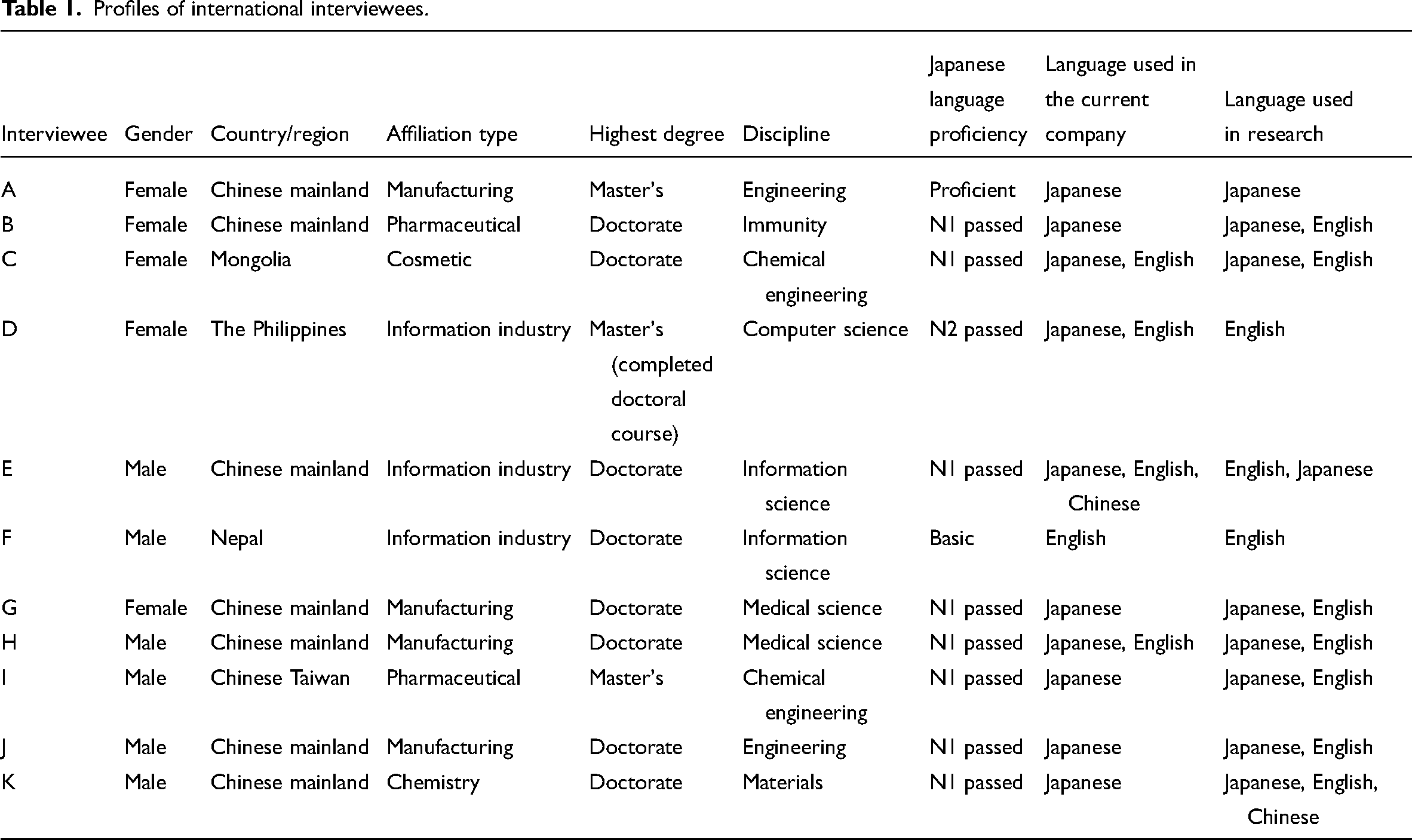
As shown in Table 1, the participants included seven men and eight women representing various sectors, such as manufacturing, pharmaceuticals, cosmetics, and information. In terms of nationality, all participants hailed from Asian countries/regions, predominantly from Chinese mainland, which aligned with the 2022 data, indicating that 63.9% of highly skilled foreign professionals came from Chinese mainland (Immigration Services Agency [ISA], 2023). Concerning their field of expertise, because they are employed in companies focusing on R&D, all the participants were specialists in the sciences, engineering, or other “hard science” disciplines. Regarding their educational backgrounds, many moved to Japan after completing their bachelor's degree and pursued further studies at Japanese universities, with a significant proportion attaining doctoral degrees. Most participants demonstrated commendable proficiency in Japanese and mainly used either Japanese or English for work and research purposes. Moreover, three participants noted that they also used their mother tongue, Chinese, at work.
To compare the interviewees’ responses, we also interviewed three managers. Two of them were Japanese, and one was Chinese. The key questions for them were as follows: “What do you expect from international researchers?”, “What are your current efforts, and what do you need to do in the future to make the most of the international researchers in your administrative department?”
Research findings
Motivations for working for Japanese companies
By analyzing the interview data, we identified several key motivations for international researchers who decided to work for Japanese companies. These motivations were related to factors such as professional growth opportunities and a favorable research environment, which aligns with the findings of previous studies (Huang, 2018; Murakami, 2009). According to the interviewees, Japanese companies are often well-equipped with state-of-the-art research facilities, funding opportunities, and resources that can support their researchers, including international researchers, in their work. Notably, interviewees consistently mentioned that having these resources could significantly enhance their research capabilities and productivity. They viewed these factors as crucial drivers in their decision to work at their current companies. For example, a participant from Nepal employed by an information science company articulated the following: I chose this particular company because it presented a significant chance for me to acquire new technological knowledge. Moreover, the work environment, salary, and bonus structure are highly appealing. (F)
Similarly, a female researcher from the Philippines highlighted the following: What captivates me the most is the international atmosphere within the company. The attractive salary, the conducive research environment, and the company's genuine concern for its employees further contribute to its allure. (D)
A Chinese researcher made a similar comment as the two interviewees above: I am able to continue my doctoral research while working here. Unlike in venture capital firms, where my responsibilities would be spread across various areas, working in this Japanese company affords me the opportunity to broaden my skill set. (E)
Echoing these comments, another participant expressed her desire to work in Osaka and highlighted the stability associated with a reputable Japanese company: My aspiration is to work in Osaka, and being employed by a prominent Japanese company would offer relatively stable employment. Moreover, during the interview process, I was able to perceive a positive and encouraging atmosphere. (A)
As demonstrated by these statements, a favorable working environment, opportunities to pursue advanced research, and economic considerations were significant motivations for international researchers to decide to work for Japanese companies. It is worth noting that the participants from countries with a lower GDP per capita than Japan tend to attach greater importance to economic factors. For example, the same participant from the Philippines emphasized the following: My earnings here surpass what I would typically earn in my home country. Working in Japan provides me with greater financial security compared to returning home. (D)
However, it appears that economic incentives shifted as the gap between researchers' home countries and Japan narrowed. A Chinese participant employed by an information science company explained as follows: A similar technical job in China or the US would pay several times more than what I earn at this company. Japanese companies' salary packages are not as competitive as those in regions such as Shanghai and Shenzhen in China. (E) My current company prioritizes the well-being of its employees and provides ample support, particularly for women or female employees who become mothers. It is relatively easy for me to take leave when my child falls ill. (B) There are two primary reasons that have influenced my choice to remain in Japan. First, I possess personal curiosity and prefer not to reside in China, a country I am already quite familiar with. In contrast, Japan continues to offer novel experiences even after my ten-year stay. Second, I hope to leverage my international background to engage in work or business ventures related to Sino-Japanese exchanges or collaborations. I firmly believe that the unique experiences and corresponding skills I can acquire in Japan, such as language proficiency, would not be readily available if I were to return to China. (K)
The participant who had considered the possibility of changing his nationality provided the following reason: I am considering obtaining Japanese nationality because it may offer greater convenience for future international business ventures. Holding a Chinese passport requires obtaining visas for numerous countries, which can be quite cumbersome. (J)
International researchers often consider a blend of their academic, linguistic, and cultural proficiencies balanced against the conditions of their desired destinations to make informed choices regarding their personal and professional growth. Safety, security, and ease of forging personal connections in Japanese society were also cited as motivating factors by several interviewees.
In this discourse, the idea of “human capital” emerged as paramount. Human capital encompasses the collective knowledge, skills, experience, and capabilities that individuals bring to their profession. When employed in Japanese firms, international researchers use their wealth of human capital to navigate and excel in their positions. Given their diverse educational histories, linguistic competencies, and cultural flexibility, they are invaluable contributors. Recognizing this, Japanese corporations offer avenues for international talents to further hone their expertise and skills.
The contributions toward the workplace
International researchers play a pivotal role in R&D activities in Japanese companies, making significant contributions to the advancement of knowledge in their respective fields. Their work involves the exploration of new technologies and the development of innovative solutions (Knight, 2020). By leveraging their specialized knowledge and diverse perspectives, they offer fresh insight that enhances the research outcomes of their organizations. This high value placed on international researchers has been underscored by prior research highlighting their specialized human capital, comprising expertise and skills (Baruffaldi & Landoni, 2016; Coey, 2017; OECD, 2008).
In Japanese corporate settings, proficiency in both Japanese and English is often a prerequisite for research-related tasks, with native language proficiency deemed necessary depending on job requirements. Thus, international researchers must possess multilingual abilities to effectively utilize their human capital and make meaningful contributions to their organizations.
International researchers typically play roles in basic research, applied research, and product design and development in these companies, with specific assignments influenced by their respective companies' needs. The findings have indicated that their primary objectives are to conduct research and create products that align with their company's strategic goals. However, they often have less autonomy in choosing research topics than their counterparts at Japanese universities or research institutes (Huang, 2018). Their primary responsibility is to actively contribute to product development in accordance with their company's specifications.
Furthermore, international researchers bring unique cultural backgrounds and experiences to their workplaces, contributing to their cultural capital. This, in turn, fosters cross-cultural collaboration within the organization as they engage with colleagues from diverse nationalities, enriching the work environment with their cultural insight. Such collaboration often leads to the generation of novel ideas, innovative approaches, and interdisciplinary research projects.
For example, a Chinese female researcher working in a major pharmaceutical company explained as follows: In my role, I am involved in the research and development of new drugs for specific diseases. The most crucial aspect of my work is reviewing research papers, generating innovative ideas, and promptly reporting my findings to my supervisor. (B) My work primarily focuses on enhancing my skills. While product development is part of my responsibilities, exploring and piloting new ideas also plays a significant role. These two aspects complement each other, but for the company, product development takes precedence. (E)
However, a researcher employed by a more international Japanese company mentioned that she enjoys a greater degree of freedom in her work: I am actively involved in planning and developing IT systems at my company. Our company values my ideas and goals, and my current work assignments are based on the commitments I have made. (D)
When asked about the roles they were expected to play in their current company, a female participant from Mongolia stated the following: My current company highly values diversity and encourages international employees to provide unique perspectives that differ from those of our Japanese colleagues. (C)
A Chinese participant emphasized the significance of an international background in promoting a company's products globally: To expand our company's presence worldwide, individuals with an international background are crucial. I often find myself explaining technical details in English or Chinese during phone meetings. My work now demands proficiency in three languages: Japanese, Chinese, and English. (E) Because my company operates globally, I have the advantage of collaborating with colleagues in various countries. As a specialist in text processing, I am assigned English-related text processing tasks. Additionally, I am asked to assist international interns. With my N2-level Japanese proficiency, I am able to communicate effectively in both English and Japanese. (D) Currently, they are foreign researchers at our company in Japan, and we expect them to play an active role overseas when the company develops in the future.
Our findings indicated that although their companies expect them to fulfill their roles as researchers, the participants were also entrusted with responsibilities related to international affairs, drawing upon their diverse backgrounds and multilingual abilities. They were encouraged to contribute to the Japanese society, particularly in their workplaces, by offering suggestions and insight from an international perspective. However, several interviewees noted that their job responsibilities did not differ significantly from those of their Japanese colleagues within the company. Most perceived no differences in terms of promotion, appointment to administrative positions, salary, or workload between international and local researchers or Japanese researchers. This was confirmed through interviews with managers working with international researchers. A manager from a pharmaceutical company responded as follows: We do not have specific expectations solely for foreign researchers; rather, we expect all researchers, regardless of their nationality or gender, to fulfill their expected roles and responsibilities. Owing to the differences in the countries where individuals are born and raised, it is natural for cultures and customs to vary. To promote cross-cultural exchange and mutual understanding, we emphasize the importance of creating ample communication opportunities and prioritizing active listening. Moving forward, we believe it is crucial to establish appealing job content and a positive work environment that will encourage long-term commitment.
Challenges of working and living in Japan
One of the prominent challenges faced by international researchers in Japan is the difficulty in achieving work—life balance, particularly for female researchers. The demanding work pressure and long working hours imposed by Japanese companies make it difficult to allocate sufficient time to personal life and leisure activities (Oishi, 2012). This affects their social capital as it limits opportunities for social interaction and networking. One participant expressed the following concerns about work–life balance as follows: Finding a balance between work and personal life can be challenging. Japanese companies are known for their long working hours, requiring tremendous dedication. This leaves me with limited time outside work, impacting my psychological well-being. (M)
The lack of adequate facilities, such as nursery schools, and the restricted operating hours of banks and city offices, which are often closed on weekends, can further compound the challenges faced by working mothers. The participant commented on the difficulties experienced in managing work and childcare responsibilities, which could also affect their identity capital: There is a scarcity of nursery schools, and the operating hours of essential services like banks and city offices are not conducive to working mothers' schedules. The lack of consideration for the circumstances of working mothers poses additional challenges. (B)
Despite a certain level of proficiency in Japanese, international researchers continue to encounter communication issues in the workplace that affect their cultural and social capital. Language barriers often lead to misunderstandings and conflicts with Japanese colleagues. A participant shared the following experiences: Despite my efforts to study and communicate, I still face challenges in expressing myself precisely in Japanese. Additionally, there are instances of prejudice against Chinese individuals, leading to personal attacks. (A)
The COVID-19 pandemic has further exacerbated the difficulties faced by international researchers in their work and personal lives in Japan (Huang, 2022), taking a toll on their social capital. Restrictions and visa controls have hindered their ability to seek support from their families back home, affecting their psychological well-being. A Chinese participant explained the impact on childcare: Before the pandemic, we relied on our parents from China to assist with childcare, but due to visa restrictions, they were unable to come to Japan. Without their help, it has become challenging to strike a balance between childcare responsibilities and work. (G) Visiting my family in Chinese Taiwan would require me to undergo quarantine, and due to my inability to take extended vacations, I have not been able to return home. (I) At the onset of the pandemic, remote work was feasible. However, recently, my company has mandated working from the office, and I am concerned about the risk of infection while using public transportation. (H)
Discussion
The findings of this study offered noteworthy findings within the context of the Graduate Capital Model.
First, the primary motivations for international researchers to work for Japanese companies revolve around professional advancement, research environment, academic opportunities, economic reasons, and social and cultural factors in Japan. These motivations contribute to the accumulation of human, cultural, and social capital, which are essential components of the Graduate Capital Model. Changes in these factors can significantly influence their decisions to either stay and work in Japan or seek opportunities in other countries, reflecting the globalizing labor market trend in which skilled workers are becoming increasingly mobile.
Interestingly, many interviewees expressed a desire to acquire permanent Japanese residence permits rather than acquire a Japanese nationality, suggesting a nuanced approach to identity capital. This highlights their strategic approach to accumulating and utilizing various forms of capital in Japan's labor market. Eight of the 15 interviewees had considered leaving Japan to pursue work in other countries, showcasing the dynamic nature of their career paths. This trend aligns with the notion of a globalizing labor market, in which the mobility of skilled workers is influenced by shifts in relative labor market conditions (Hashimoto, 2017; OECD, 2008).
International researchers' proficiency in languages such as Japanese and English plays a pivotal role in shaping their mobility and career choices. Those with a stronger command of Japanese and relatively weaker proficiency in English are more inclined to remain and work in Japan, aligning with the concept of language-based cultural capital. Conversely, those with better English skills compared to their Japanese skills tend to consider finding work opportunities in other countries, emphasizing the role of language proficiency in shaping international mobility. For example, one of the interviewees in this study, a Nepalese researcher, left Japan shortly after the interview to work at the Norwegian branch of a prominent Japanese multinational company (F). Owing to the internationalization of the scientific sector, researchers are highly mobile at the global level and frequently move to different countries, often on a temporary basis (Baruffaldi & Landoni, 2016; Brotherhood, 2019).
Several factors influenced by external circumstances have affected international researchers' mobility during the post-COVID era. These factors are related to changes in funding availability, institutional support, and policy changes, which are critical components of human and social capital. Travel restrictions, health concerns, and shifts in global policies can significantly affect international researchers' decisions and opportunities.
Second, according to Huang (2018), the roles of international researchers at Japanese universities primarily involve research and teaching, granting them a significant degree of research autonomy. By contrast, the work roles of international researchers in Japanese companies encompass not only research but also product development, promotion, and the company's international operations. Their contributions extend beyond the acquisition of human capital through research. They also accumulate cultural capital by offering international perspectives, facilitating international operations, and integrating diverse cultures within the company. However, the effectiveness of their contributions is contingent on organizational arrangements and mutual expectations, highlighting the significance of social capital. Unfortunately, many international researchers are not fully integrated into the internal operations of Japanese companies, reflecting the underutilization issues discussed in previous studies (Murakami, 2007). Their lack of familiarity with the company's norms and, potentially, its political dynamics may limit their involvement in governance and other company functions (Altbach & Yudkevich, 2017), signaling a gap in their cultural capital utilization.
Finally, international researchers in Japan face many challenges that affect their work and personal lives. One significant challenge is achieving work–life balance, particularly for female researchers, because of the demanding work pressure and long hours typically expected in Japanese companies. This not only affects their psychological well-being but also limits opportunities for social interaction and networking, thus impacting their social capital. Additionally, the lack of adequate childcare facilities and limited operating hours of essential services present challenges for working mothers, affecting their ability to manage work and family responsibilities and, in turn, their identity capital. Furthermore, despite proficiency in Japanese, communication issues persist in the workplace, leading to misunderstandings and conflicts with Japanese colleagues, thus affecting their cultural and social capital. The COVID-19 pandemic has exacerbated these difficulties, including related travel restrictions that hinder their ability to visit their families and concerns regarding health and safety during commuting. These challenges collectively underscore the complex nature of international researchers' experiences in Japan, which impacts various aspects of their capital.
Conclusion
In this study, we examined the characteristics and experiences of international researchers working for Japanese companies, utilizing Tomlinson's Graduate Capital Model as the analytical framework. By investigating their motivations, contributions, and challenges, this study contributes to a deeper understanding of this unique group and addresses a notable research gap in the process. Unlike previous research that has often focused on foreign talent from governmental and corporate perspectives, our comprehensive analysis elucidates the attributes, roles, contributions, and obstacles faced by international researchers in Japanese companies and society.
Furthermore, our study examined the significant impact of the COVID-19 pandemic on the experiences of these researchers, highlighting the ever-evolving nature of their challenges in the modern world.
Conceptually, our study underscored the importance of providing holistic support to international researchers. Japanese companies must proactively engage in initiatives to facilitate the integration of international researchers into company operations and to promote professional development. This entails offering language training, culturally oriented programs, mentorship opportunities, and networking platforms to foster meaningful connections and collaborations between international researchers and their Japanese counterparts.
Despite demonstrating strong proficiency in Japanese, international researchers in Japanese companies continue to face communication barriers. To address these challenges, Japanese companies should establish multilingual and multicultural communication environments. Comprehensive support mechanisms must be in place to enable international researchers to fully leverage their talent and expertise. These collective efforts will not only aid in attracting global talent but also help in retaining it, ultimately bolstering the competitiveness of Japanese companies on the global stage.
However, it is important to acknowledge the limitations of this study. The sample size was relatively small, potentially limiting the depth of insight for international researchers working in Japanese companies. Additionally, the participant sample primarily represented individuals from Asian countries, which could introduce regional bias. Future research should address these limitations by expanding the sample size and including participants from diverse backgrounds and ensuring a more comprehensive analysis of this group's experiences, policies, and practices that can enhance their integration and contributions within Japanese companies.
Footnotes
Contributorship
Ming Li and Futao Huang were instrumental in conceptualizing the core idea of this study. Ming Li took the lead in drafting several critical sections, including the Introduction, Research Background, Literature Review, and Research Findings. Both Li and Huang collaboratively developed the Research Methodology, Discussion, and Conclusion sections. Throughout the process, the authors engaged in a rigorous revision of the manuscript, ensuring its content was critically examined and refined collectively.
Declaration of conflicting interests
The authors declared no potential conflicts of interest with respect to the research, authorship, and/or publication of this article.
Ethical statement
Prior to conducting this research study, the authors obtained informed consent from all participants involved. Participants were provided with detailed information regarding the purpose of the study, the nature of their involvement, and the potential risks and benefits associated with their participation. They were assured of their right to withdraw from the study at any time, with no negative consequences. The research protocol and procedures were reviewed and approved by the appropriate ethics committee (IRB No. 2021-005). The committee carefully evaluated the ethical considerations of the study, ensuring the protection of participants’ rights, privacy, and confidentiality.
Funding
The authors disclosed receipt of the following financial support for the research, authorship, and/or publication of this article: This work was supported by JSPS KAKENHI Grant 19H01640, 21K13603.
