



Abstract
Highlights
This review compares generative artificial intelligence with five representative educational technologies in history and concludes that AI technology can become a knowledge producer and thus can be utilized as educative AI to enhance teaching and learning outcomes. From a historical perspective, each technological breakthrough has affected education by changing how symbols are represented and how knowledge is carried. The emergence of new educational technology is always accompanied by doubt, vigilance, and rejection from the traditional community. The new educational technology, generative artificial intelligence, interacts with the old, creating an increasingly complex ecology of educational technology. Three suggestions are proposed for adjusting the education system: first, promoting small-scale, individualized, and conversational teaching in schools; second, developing teachers’ and students’ digital literacy in a multi-curricula system; and third, conducting research on grading and classification standards for the application of AI in education.
Keywords
Technology is a key driver of social change in today's world. However, the history of technological development shows that not all technologies become part of the education system and change and promote educational practices; this space is reserved for technologies that exert extensive influence while changing and promoting the fundamental propositions of educational practices. Regarding ChatGPT and other generative AI in education that have recently been intensely discussed (Su & Yang, 2023), do they have the potential to become the next breakthrough technology that changes the form of education as we know it? When at a turning point, looking toward the future, history serves as an invaluable analytical lens. Using history as a “rearview mirror,” this study analyzes the changing influence of technology on education throughout history and identifies the potential impact of ChatGPT on the future of education.
A historical review of the impact of technology on education
There are two representative answers when we discuss the question of the earliest technology humans used in educational activities. One is visual media, such as films, slides, and photographs, which triggered the visual and audio-visual instruction movement and the birth of educational technology as a discipline in the 1920s (Reiser, 2001). The other is oral language from a broader perspective of human evolution. According to Harari (2014), oral language is the first media technology mastered by humans. Because human oral language is amazingly supple and evolved to share information about the world, it has driven the first cognitive revolution of humankind.
In this article, we choose the second answer as the historical starting point for the development of educational technology and analyze the features of five representative media technologies that have had significant transformative effects on education. These are oral language, written characters, printing press, electronic media, and digital media, as shown in Table 1 (Guo, 2011). First, human beings used oral language to store and disseminate information, thus allowing educational activities to occur through word of mouth. Second, written characters liberated the human mind, allowing memories to be “unloaded” externally on writing carriers such as papyrus and parchment, promoting the generation and preservation of knowledge. The old-style private schools emerged, which established the groundwork for formal education. Later, the invention of the printing press greatly accelerated the efficiency of knowledge replication and dissemination and triggered greater access to knowledge, popularizing literacy and facilitating the categorization of knowledge according to subjects. These developments led to the emergence of textbooks and the establishment of the class-based teaching system in modern schools. The rise of electronic media, represented by radio and television, led to audio and video becoming the new carriers of knowledge, and a new form of academic education has arisen in the form of distance education. Regarding recent developments, digital media, represented by computers and their derivative Internet technology, has profoundly impacted education. In this respect, scholars have emphasized the importance of personalized learning and blended learning rather than class-based teaching. With the development of Web 1.0, Web 2.0, and the mobile Internet, new learning forms such as “learning by searching,” “learning by interacting,” and “ubiquitous learning” have subsequently emerged.
Five media technologies that transformed education.
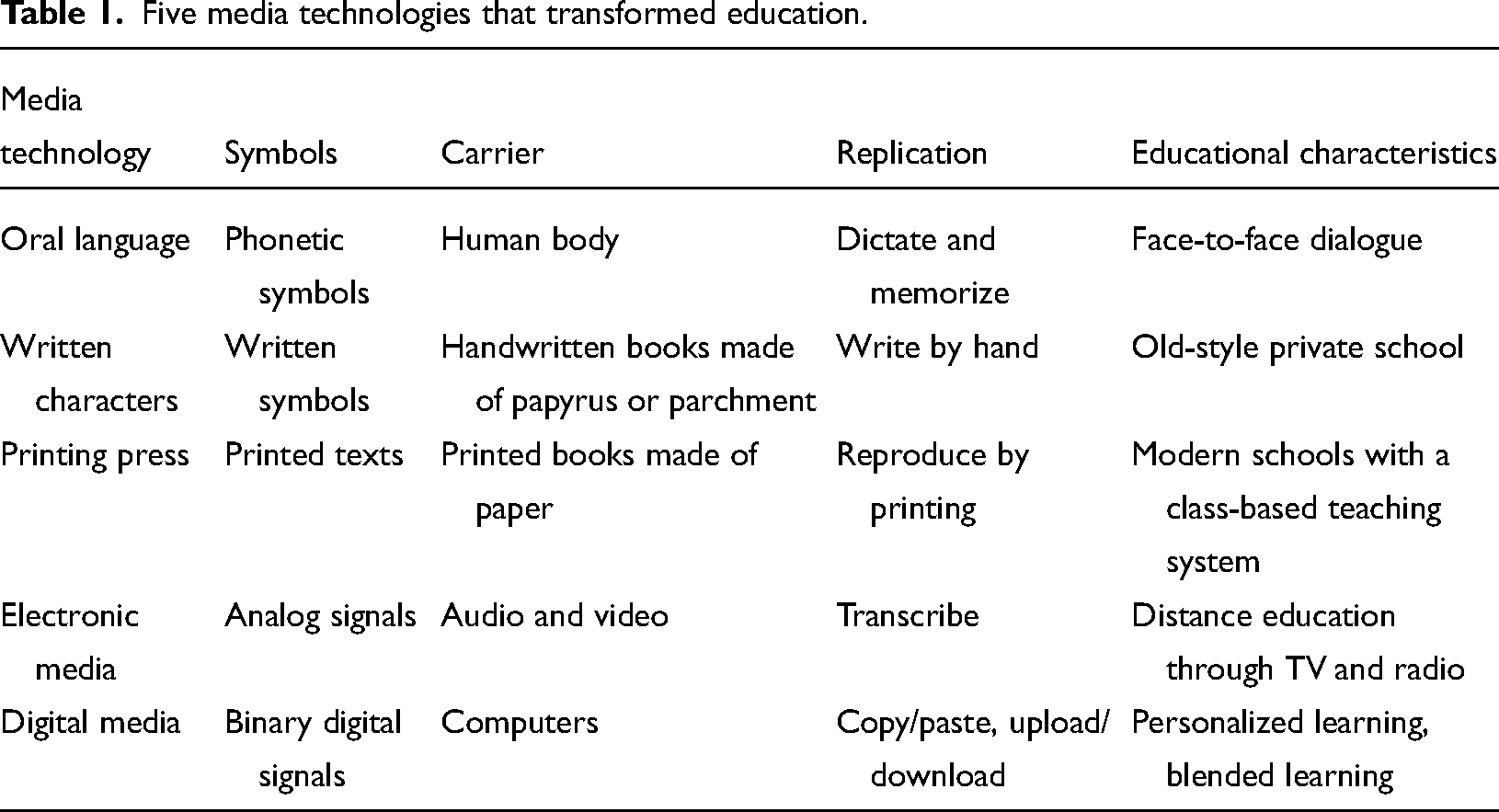
With broad and profound effects on education, these transformative technologies share several common characteristics. First, each technological breakthrough affected education by changing the ways in which symbols are represented and knowledge is carried. More specifically, as shown in Table 1, how knowledge is encoded has evolved from phonetic symbols to written symbols, printed texts, analog signals, and, most recently, binary digital signals; moreover, the knowledge carriers have shifted from the human body to handwritten books, printed books, audio and video, and, finally, computers.
Second, the emergence of new technology is always accompanied by doubt, vigilance, and rejection from the traditional community. For example, Confucius and Socrates—the great Chinese and Western educators who lived in the transitional period between oral and written language—both unequivocally opposed the intrusion of the written word in education. Confucius's well-known saying, “Narrating, not writing” (述而不作), reflects his emphasis on oral language as a teaching medium rather than written language (Ye, 2006). Socrates had little interest or belief in the value of writing and felt that writing had deleterious effects on contemporary Greek society (Finkelstein & McCleery, 2013). Early studies on the history of education generally ignored the Audio-visual Instruction Movement, a significant event in the history of educational technology, and questioned the value of audio-visual technology in education (Reese, 2007; Reese & Rury, 2008). Regardless of what conservatives say, technology continues to develop and has been widely applied in education.
Third, no single new medium will entirely replace the old ones. Rather than becoming a substitute for the existing media technology, oral and written language, printing, audio-visual media, computers, and the Internet interacted and influenced the development of one another, creating an increasingly complex ecology of educational technology. With the introduction of a new type of technology, older technology found a new application or form that deepened its participation in and effects on teaching and learning.
Does educative AI have the potential to change education?
Educative AI, represented by ChatGPT and other generative AI in education, refers to the use of AI in educational settings to enhance teaching and learning outcomes and has the potential to revolutionize education (Su & Yang, 2023). Does educative AI have the potential to become the next breakthrough technology that fundamentally changes education? We agree with Bill Gates that AI is a breakthrough technology on par with mobile phones and the Internet for the reasons outlined below (Gates, 2023).
First, during the application of the five technologies mentioned above in education, human beings have been the producers of knowledge. Although technological innovation changes how knowledge is represented and carried, humans’ role as knowledge producers has remained consistent. Educative AI, such as ChatGPT, does not represent a shift in how knowledge is encoded symbolically or in how it is carried, as AI is still based on natural language symbols underpinned by binary digital symbols. However, it proves its ability to become a knowledge producer. For example, ChatGPT can complete a series of tasks such as summarizing the central idea of a long article, developing a travel plan, and creating fictional works, all of which are processes of producing knowledge. In addition, the quality of the knowledge produced by ChatGPT has been greatly improved, which has realized the reconstruction of explicit knowledge and the explicitization of tacit knowledge. The language ability of AI has also improved, faithfully representing knowledge while being expressive and even, to a certain extent, elegant. Therefore, AI assists in completing various tasks based on language processing.
Second, the wide application of technology is driven by both affordability and social demand. Because educative AI relies on big data and models, it requires substantial computing power, which is expensive. Thus, it must serve society, share its costs with the public, and allow individual users to pay for quick and easy access to AI-produced knowledge. For example, the ChatGPT Plus service currently costs $20 monthly, which is affordable for many white-collar workers in schools, companies, and research institutions. Moreover, future AI research and development work should also consider reducing costs to make AI-powered chatbots more affordable and accessible to a broader range of people. Consumer demand is likely to push ChatGPT into establishing a sustainable business model and form a supply chain that integrates upstream business (e.g., data supply, data splitting, and labeling), midstream business (e.g., content design, content tools, and data compilation), and downstream business (e.g., content distribution and content organization). Affordability and social demand are expected to lead to the widespread use of ChatGPT across society. As a component of the social system, the education system will need to address and adapt to the challenges permeating the technology.
Third, educative AI will not replace the application of oral and written language, printing, or audio-visual and digital media in education. On the contrary, it will integrate and interact with existing technologies to form a new, complex technology ecosystem, which means that the class teaching system, in which lectures and textbooks are the primary teaching methods, will continue to exist. However, teachers’ professional abilities must be improved, particularly insofar as small-scale and individualized teaching will likely become an essential supplement to the class-teaching system. The ability of teachers to adapt to these emerging tools will become increasingly important. Moreover, the complex technology ecosystem that educative AI creates requires teachers to enhance their digital literacy and capabilities to include mastery of educative AI and form human–computer collaborative teaching relationships.
Suggestions for adjusting the education system
Educative AI, such as ChatGPT, is profoundly impacting all aspects of life, including schools. To avoid falling behind, the education system should adjust its educational goals and improve curricula and teaching models to accelerate the digital transformation of school education in the era of AI. In this respect, we have three suggestions for adjusting the education system at the institutional level.
Promoting small-scale, individualized, and conversational teaching in schools
As previously mentioned, throughout the history of the application of technology in education, no new media technology entirely replaced the old. Oral and written language, printing, electronic media, digital media, and educative AI interacted, creating an increasingly complex ecology of educational technology. The advantage of ChatGPT lies in its ability to provide high-quality knowledge production services. However, it is a product of bionics and has no emotions or personal views, values, or motivations. The lack of emotion is manifested in expressing empathy but no sympathy and being flirtatious but not emotional. The lack of personal views and values is evident in the fact that humans endow the value systems of ChatGPT, and it has no life purpose in and of itself. Equally, its lack of self-motivation is manifested in the fact that it is a tool used by humans and has no will or goals. As such, ChatGPT can assist in achieving educational goals at the knowledge level but cannot represent the core functions of human education, such as developing core capabilities, wisdom, and emotional intelligence. The latter can be better achieved through face-to-face oral communication. With this in mind, the educational responsibility of teachers only increases in significance. Achieving self-actualizing goals—life skills, wisdom, and emotional intelligence—requires a holistic set of processes and highly intense and immersive teacher–student interactions. Therefore, to ensure that such interactions are stimulated, the school system should consider promoting small-scale, individualized conversational teaching (e.g., face-to-face instruction and office hours) as a critical supplement to class teaching.
Developing teachers’ and students’ digital literacy in a multi-curricula system
With the five aforementioned media technologies transforming education, the connotation of human literacy has changed. In the era of oral transmission, human literacy meant “oracy” (being able to listen and speak). Troubadours were specifically responsible for recording and copying knowledge, and people acquired knowledge by listening rather than reading. With the birth of written characters and the invention of the printing press, reading and writing gradually became essential skills for everyone. The connotation of human literacy was updated to “being able to read and write.” In the digital age, the development of digital technology, especially AI technology, has further updated the connotation of human literacy to include digital literacy. Digital literacy quickly became an essential component of primary education, higher education, and professional development training for teachers. Therefore, a system of multiple digital literacy curricula should be established to meet these requirements to support societal development and educational practice. Developing students’ digital literacy through multiple means in primary and higher education is necessary. On the one hand, schools can integrate information technology in academic and professional courses and extend the cultivation of digital literacy in the context of students’ academic and professional learning. On the other hand, schools can implement information technology courses in primary education and establish general information technology courses in higher education to develop an integrated digital literacy skillset. Moreover, digital literacy should become necessary in pre-service teacher education and in-service teacher training programs.
Conducting research on grading and classification standards
With each media technology invented and applied to education, corresponding educational policies are needed to regulate and constrain it. With the rapid entry of AI into the education system, it is becoming increasingly necessary to establish the ethical principles of AI, compile a list of approved AI educational applications, and develop a risk management system. These laws and regulations should be formulated based on grading and classification standards for the educational application of AI technology. A user-friendly structured framework should be used to allow for the synthesis and summary of the characteristics of complex AI technologies and should clearly describe the various AI technologies available. This structured framework should be relevant to policy and stakeholder rights and benefits, including coverage of areas such as the autonomy of AI technology, impact dimensions, and usage scenarios rather than technical characteristics, such as openness of algorithms and data and machine learning or reasoning. Technical characteristics are more applicable to scholars and experts in the field of AI, while policy and stakeholder rights are more applicable to a broader range of policymakers and other non-technical users. The goal should be to help stakeholders and decision-makers within the education system better understand the technology and evaluate the value and risks of its application in education.
Footnotes
Contributorship
The first author, Mengqian Wang, wrote the article's first draft. The second author, Wenge Guo, revised and proofread it.
Declaration of conflicting interests
The authors declared no potential conflicts of interest with respect to the research, authorship, and/or publication of this article.
Funding
The authors disclosed receipt of the following financial support for the research, authorship, and/or publication of this article: This paper was supported by the Virtual Teaching and Research Section of Digital Textbook and Digital Pedagogy in Key Fields and the Beijing Postdoctoral Research Foundation (grant number 2022-ZZ-134).
